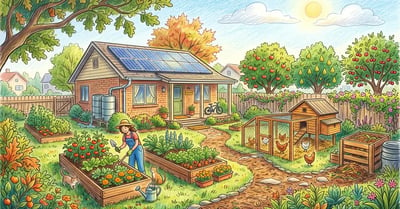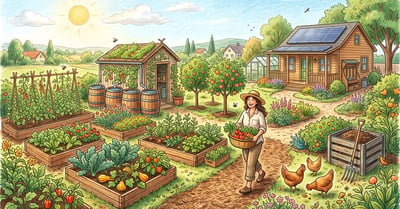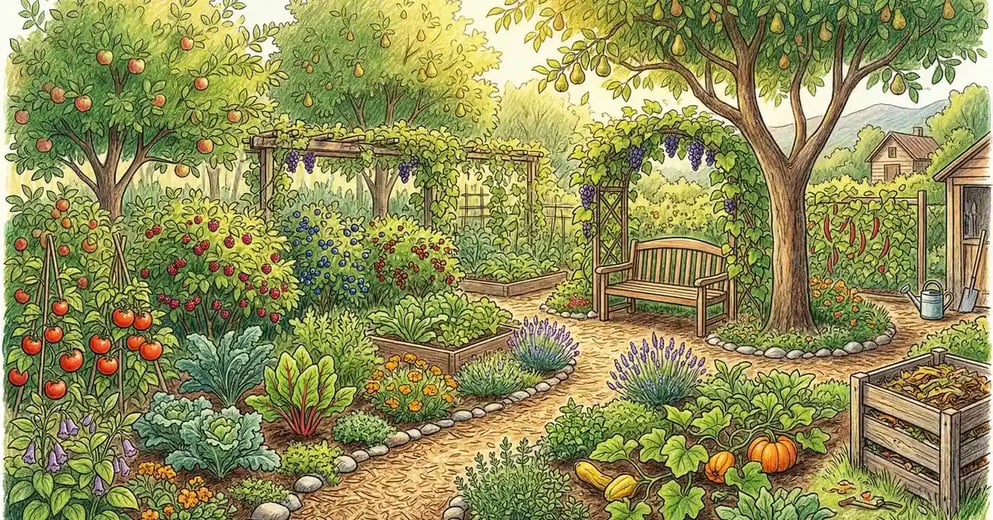

What Is Permaculture starting a permaculture community project permaculture vs sustainable agriculture Holzer mountain permaculture how to start permaculture free permaculture glossary transform a lawn into a permaculture garden permaculture for small spaces chickens in a permaculture system 15 essential permaculture books whether a Permaculture Design Certificate is worth it — and Why Are So Many Gardeners Making the Switch how to design your first permaculture system?
You've been gardening for years. You know how to grow tomatoes, build raised beds, and keep your compost in-ground composting for backyard gardens bin humming. But lately, you've noticed something: your garden works hard, yet it doesn't seem to work together. Every season means start our Start Here permaculture pathing over — new seeds, new amendments, new battles with pest garden pest control frameworks. What if your garden could function more like a forest PNW food forest in Oregon and Washington, where every plant supports the next and the soil gets better on its own? how to start permaculture gardening using ducks for slug control water-wise desert design permaculture and self-sufficiency David Holmgren's permaculture permaculture and mental health
That's the core promise of permaculture. Coined by Australian Australian roots of permaculture ecologists Bill Mollison and David Holmgren in 1978, the term blends "permanent" and "agriculture urban permaculture in Cuba" — though Mollison later expanded it syntropic agriculture vs permaculture to mean "permanent culture," recognizing that sustainable food edible perennial vines systems require sustainable human systems too. Today, permaculture operates in over 180 countries, and agroforestry systems aligned with its principles cover cover crops for vegetable beds an estimated 3.9 billion acres (1.6 billion hectares) globally — roughly 37% of all agricultural land. greywater to close the water loop
But permaculture isn't just for farms. It's a design permaculture edge design sector analysis science that works in suburban backyards, balcony containers, and community plots. And the science backs it up: a 2024 global meta-analysis found that agroforestry systems increase soil organic carbon by 26–40% compared to conventional agriculture, depending on soil syntropic biomass management technique does gypsum actually fix clay soil depth.
What you'll learn in this guide:
- The three ethics three permaculture ethics and 12 design principles that define permaculture — with practical garden examples for each
- How permaculture's zone Zone 1 permaculture design system maps onto a typical suburban backyard
- The science behind permaculture's soil, water rain garden design as permaculture water management duck pond integration in permaculture swales and berms, and biodiversity benefits
- How permaculture differs from organic permaculture vs organic gardening gardening (and where they overlap)
- Your first weekend permaculture project — with time and cost estimates
Key Takeaway
Permaculture is a design science, not a growing method. It gives you a framework for arranging your garden so that plants, soil, water, and wildlife support each other — reducing your work while increasing your garden's productivity and resilience over time. Aquaponics in permaculture is one striking example of this closed-loop design.
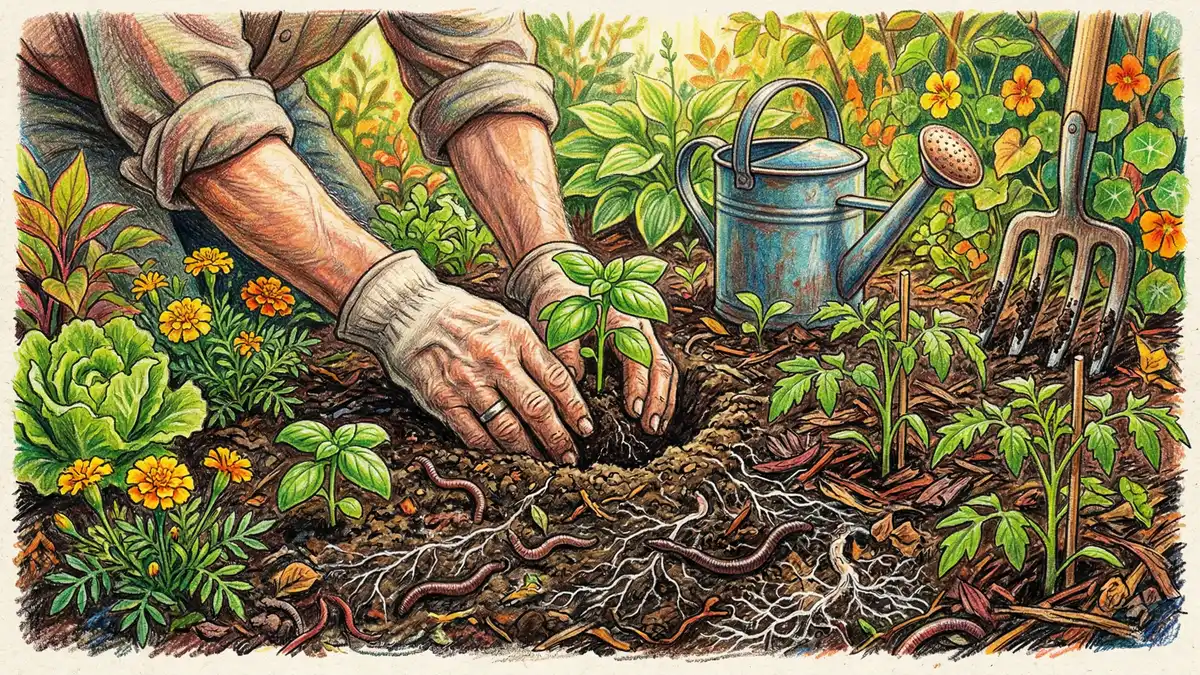
What Are the Three Ethics of Permaculture?
Before the principles, before the techniques, permaculture starts with three ethics that guide every design decision. Bill Mollison established these as the philosophical foundation in his landmark 1988 work, Permaculture: A Designers' Manual.
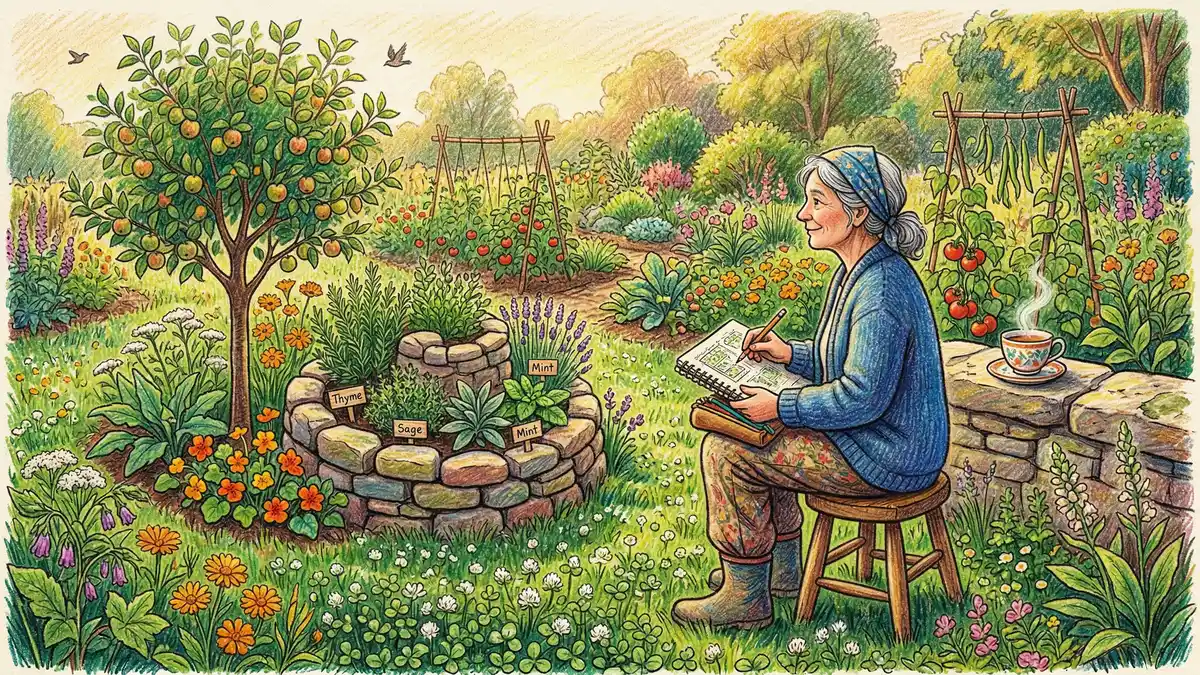
Earth Care means designing to improve — not just protect — your land. In a home garden, this looks like building soil organic matter through composting and mulching, capturing rainwater, and creating habitat for beneficial insects and pollinators Masanobu Fukuoka's natural farming. The USDA's Natural Resources Conservation Service identifies many of these same practices as core soil health principles.
People Care means meeting human needs equitably. Your garden should feed you and your family, but also connect you with neighbors, share surplus, and provide physical and mental wellbeing. Community gardens, seed swaps, and teaching teaching kids in the garden children to grow food are all People Care in action.
Fair Share — sometimes called "Return of Surplus" — means limiting consumption and redistributing what you don't need. In practice: share extra tomatoes with neighbors, donate surplus produce, compost everything possible, and design systems that produce enough without waste.
Why This Works: Ethics as a Design Filter
These three ethics aren't abstract philosophy — they're a practical decision-making tool. When you're choosing between a chemical pesticide (fast, effective, harms soil life) and companion calendula in a permaculture vegetable garden planting what to plant with tomatoes companion planting chart (slower, builds ecosystem resilience), the ethics help you choose the approach that serves Earth Care. When you're deciding whether to plant a monoculture lawn or a diverse food garden, People Care points toward nourishing your household. At the community scale, that ethic powers the Transition Towns movement. As Holmgren writes in Essence of Permaculture, the ethics provide "the compass headings" for all design.
What Are the 12 Principles of Permaculture Design?
In 2002, David Holmgren published Permaculture: Principles & Pathways Beyond Sustainability, distilling decades of practice into 12 design principles. Think of them as thinking tools — each one helps you make better decisions about your garden layout, plant choices, and maintenance routines.
Here's each principle with a practical example you can apply this season:
| Principle | Core Idea | Your Garden Example |
| 1. Observe observe and interact in practice & Interact | Watch before you act | Spend a full season mapping sun, shade, wind, and water flow before planting permanent trees |
| 2. Catch how to catch and store energy on your land & Store Energy | Harvest permaculture food preservation resources when abundant | Install rain barrels; grow perennials that store energy in roots over winter |
| 3. Obtain a Yield obtaining a yield from year one | Every element each element does multiple jobs must produce | Replace ornamental hedges with blueberry bushes — beauty and food from the same space |
| 4. Apply Self-Regulation | Use feedback to adjust | If aphids appear every spring, add companion plants that attract ladybugs rather than reaching for spray |
| 5. Use Renewables | Prioritize renewable inputs | Compost and cover crops replace purchased fertilizer; rainwater replaces municipal supply |
| 6. Produce No Waste | Every output is an input elsewhere | Kitchen scraps → compost → garden beds → food → repeat |
| 7. Design from Patterns to Details | Big picture first, specifics later | Plan your zones and water flow before choosing individual plant varieties |
| 8. Integrate, Don't Segregate | Elements support each other | Plant a "three sisters Aztec floating gardens of Xochimilco" guild fruit tree guild (corn, beans, squash) where each plant helps the others |
| 9. Use Small & Slow Solutions | Start modest, build gradually | Convert one garden bed to permaculture this year, not the whole yard at once |
| 10. Use & Value Diversity | Variety creates resilience | Grow 10 tomato varieties instead of 100 plants of one — if disease strikes one, nine others survive |
| 11. Use Edges & Value the Marginal | Boundaries are the most productive zones | Use the warm microclimate against a south-facing wall for tender herb permaculture herb spirals or early-season starts |
| 12. Creatively Respond to Change | Adapt, don't resist | As your climate zone shifts, experiment with heat-tolerant varieties instead of fighting the trend |
Source: David Holmgren — Permaculture Principles
Key Takeaway
You don't need to apply all 12 principles at once. Start with Principle 1 (Observe & Interact) — spend a season watching your garden's patterns — and Principle 9 (Small & Slow Solutions) — convert one bed at a time. The principles compound: each small change makes the next one easier.
How Does the Permaculture Zone System Work in a Home Garden?
One of permaculture's most practical tools is the zone system — a way of organizing your garden based on how often you visit and interact with each area. Mollison designed it so that the things you need daily are closest to your door, and the things that need less attention are farther away.
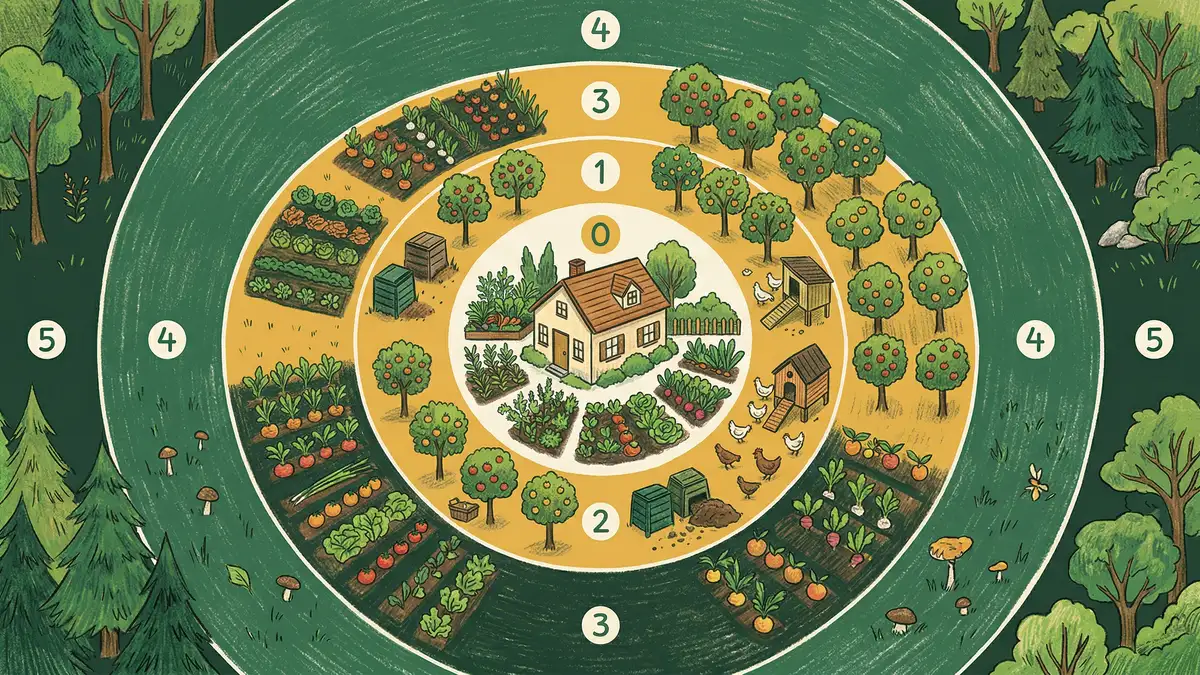
Here's how the five zones map onto a typical suburban property:
| Zone | Distance | What Goes Here | Suburban Example |
| Zone 0 | Your home | Indoor growing, energy efficiency | Windowsill herbs, sprouting station, kitchen compost crock |
| Zone 1 | 0–10 ft from door | Daily-harvest crops, herbs | Kitchen herb garden, salad greens, strawberry containers |
| Zone 2 | 10–50 ft | Crops needing regular care | Raised vegetable beds, berry bushes, compost bins, dwarf fruit trees |
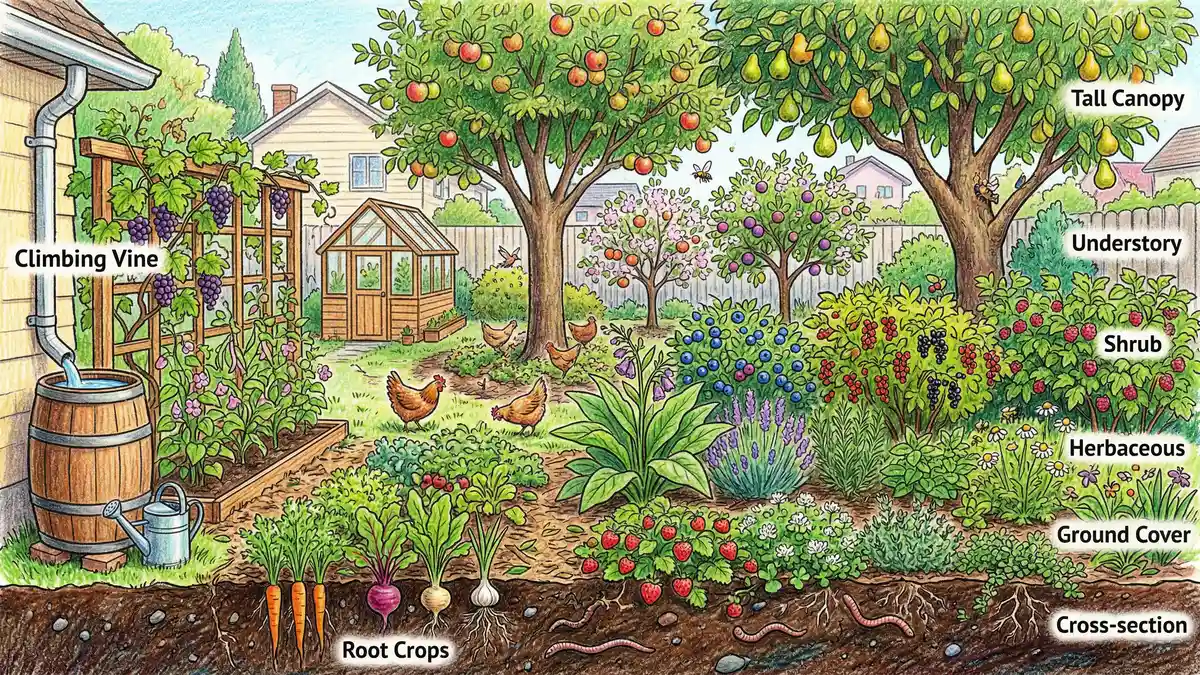
| Zone 3 | 50–150 ft | Low-maintenance food production seven-layer food forest | Larger fruit and nut trees, food forest establishment, perennial beds |
| Zone 4 | Garden edges | Semi-wild, minimal intervention | Wildflower meadow strips, native hedgerow, firewood coppice |
| Zone 5 | Beyond your property | Wild nature, observation | Unmanaged corners for wildlife habitat, observation areas |
Source: Utah State University Extension — Permaculture
Why This Works: Energy Efficiency Through Design
The zone system applies Holmgren's Principle 2 (Catch & Store Energy) to your energy — your time and effort. By placing frequently harvested herbs within 10 feet of your kitchen door, you eliminate wasted trips and actually use what you grow. The same catch-and-store-energy logic powers a rocket stove and its thermal mass. The Oregon State Extension permaculture guide calls this "designing for efficiency" — and notes it's one of the simplest ways beginner beginner permaculture mistakes to skips can start thinking like a permaculture designer.
Get Our Free Permaculture Zone Planning Worksheet
Map your garden using the 5-zone system with our printable planning guide — plus weekly permaculture tips for every skill level.
Send Me the WorksheetWhat Does the Science Say About Permaculture?
Permaculture sometimes gets dismissed as idealistic — but the peer-reviewed research tells a different story. While large-scale longitudinal studies are still limited (permaculture research receives less than 1% of global agricultural research funding), the evidence we have is compelling.
Soil health: A 2024 global meta-analysis published in Catena found that converting conventional agricultural land to agroforestry — a core permaculture practice — increased soil organic carbon stocks by 26% in the top 6 inches (15 cm) and 40% in the top 12 inches (30 cm). The USDA NRCS confirms that practices central to permaculture (no-till, cover cropping, diverse rotations) increase soil organic matter and improve microbial activity when maintained for five or more years.
Biodiversity: A peer-reviewed study in Sustainability found that agroforestry systems support significantly greater species richness than monocultures — with arthropod, bird, and plant diversity all increasing. A separate analysis in Frontiers in Ecology and Evolution reported 60% greater mean species richness in agroforestry compared to conventional cropland.
Water management: Mulched, no-dig systems (a permaculture staple) achieve water infiltration rates of 4–12 inches per hour, compared to just 1–2 inches/hour in compacted or tilled soil. The USDA's Sustainable Agriculture Research and Education program documents how cover crops — used extensively in permaculture — enhance water infiltration and reduce runoff by up to 50%.
Carbon sequestration: Regenerative regenerative soil practices for home gardeners regenerative gardening vs permaculture practices aligned with permaculture sequester an average of 1.09 tons of carbon per acre per year (1.22 t/ha) on arable land, according to research published in Frontiers in Sustainable Food Systems.
| Metric | Conventional Agriculture | Permaculture/Agroforestry | Improvement |
| Soil organic carbon (0–12 in / 0–30 cm) | Baseline | +40% after conversion | Significant |
| Species richness | Baseline | +60% mean increase | Significant |
| Water infiltration | 1–2 in/hour (2–5 cm) | 4–12 in/hour (10–30 cm) | 3–6× faster |
| Carbon sequestration | Near zero or negative | 1.22 t C/ha/year | Net positive |
| External input costs (year 5+) | Full input costs | 60–75% reduction | Major savings |
Sources: Catena (2024), Frontiers in Ecology (2021), Frontiers in Sustainable Food Systems (2023)
Common Mistake to Avoid
Don't expect instant results. Permaculture systems need 3–5 years to fully establish. In years 1–3, yields from a food forest food forest timeline best food forest trees or perennial polyculture will be lower than an intensive annual garden. But by year 5, the system becomes largely self-maintaining — soil improves on its own, pest pressure drops, and your workload decreases significantly. The investment is front-loaded; the returns compound.
How Is Permaculture Different from Organic Gardening?
This is one of the most common questions we hear, and the distinction matters. Organic gardening is a production standard — it tells you what inputs to avoid. Permaculture is a design science — it tells you how to arrange your entire garden so it functions as an integrated system.
You can be an organic gardener without practicing permaculture (picture a certified organic farm growing a single crop in rows, using approved organic inputs). And most permaculture practitioners garden organically by default — because building healthy soil ecosystems means avoiding the synthetic chemicals that harm them.
The key difference is scope. Organic gardening focuses on what you put in (and keep out of) the soil. Permaculture asks bigger questions: How does water move across your property? Where does the sun hit in January vs. July? Which plants can support each other? How can your compost system connect to your planting plan, which connects to your water management, which connects to the wildlife habitat at the edges of your garden?
| Aspect | Organic Gardening | Permaculture |
| Primary focus | Input restrictions (no synthetics) | Whole-system design for regeneration |
| Certification | USDA Organic, EU Organic, etc. | No formal certification — practitioner-defined |
| Planning horizon | Often annual crop cycles | 5–20+ year design perspective |
| Core question | "What should I avoid using?" | "How can I design everything to work together?" |
| Typical approach | Organic inputs to conventional garden structure | Redesign: polycultures, perennials, water systems, biodiversity |
Source: Holmgren Design — What is Permaculture
How Do You Start a Permaculture Garden This Weekend?
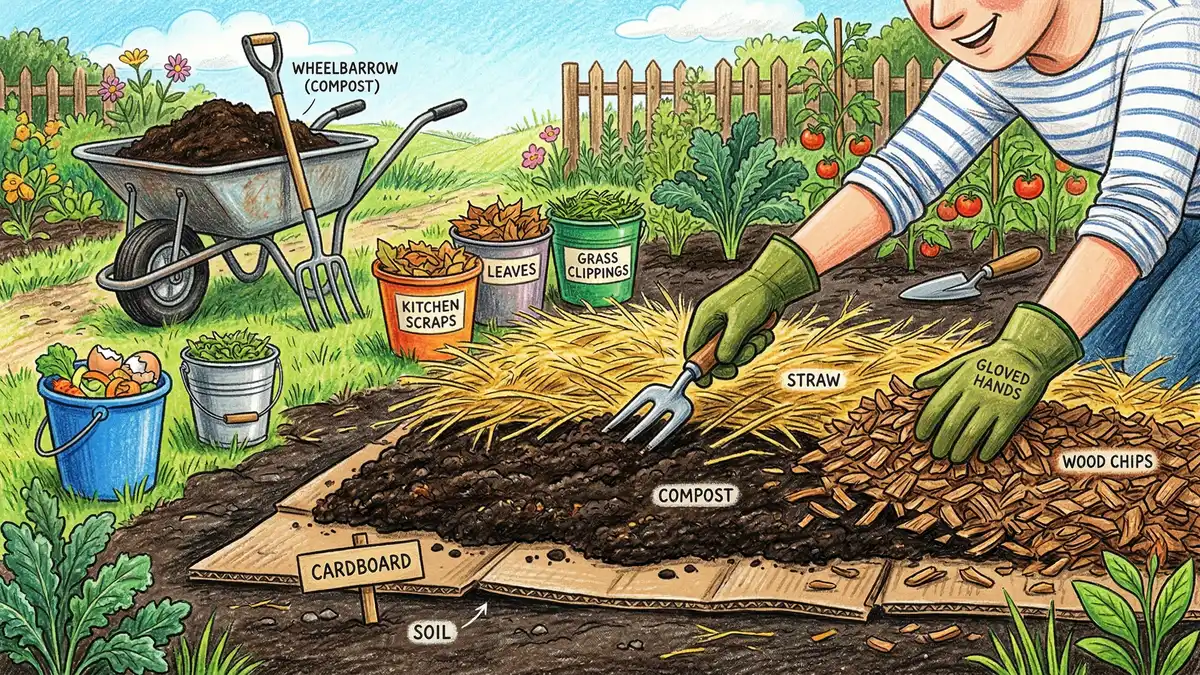
The best first project in permaculture is sheet mulching — also called "lasagna gardening." It's Principle 6 (Produce No Waste) and Principle 9 (Small & Slow Solutions) in action: you build a new garden bed directly on top of grass or weeds, using materials you likely already have. If you're new to the concept, our permaculture for beginners guide walks you through the full framework.
Choose Your Spot (Zone 1 or 2)
Pick a 4×8 ft area near your kitchen door that gets at least 6 hours of sun. Don't dig anything up — you're building on top of what's there. Time: 10 minutes.
Lay Cardboard Over the Grass
Flatten cardboard boxes (remove tape and staples) and overlap them by 6 inches to block all light. Wet the cardboard thoroughly. This smothers weeds without chemicals while feeding soil organisms as it decomposes. Time: 20 minutes. Cost: free (recycled boxes).
Layer Compost and Mulch
Add 3–4 inches of compost, then 3–4 inches of straw, wood chips, or shredded leaves on top. Water each layer as you build. Time: 1 hour. Cost: $30–80 for compost and mulch.
Plant Through the Mulch
Push aside the mulch, cut through the cardboard, and plant seedlings directly into the soil below. Start with easy wins: lettuce, herbs, bush beans, or companion plant combinations like basil and tomatoes. Time: 30 minutes. Cost: $15–30 for seedlings.
Observe and Adjust (Principle 1)
Water weekly for the first month, then step back and watch. Notice where water pools, which plants thrive, and what insects arrive. This observation becomes the data for your next design decision. Total project: 2 hours and $45–110.
Key Takeaway
Your first permaculture project should be small, cheap, and educational. A single 4×8 ft sheet-mulched bed costs under $110, takes one weekend afternoon, and teaches you three permaculture principles in practice: Produce No Waste (recycled cardboard), Small & Slow Solutions (one bed, not the whole yard), and Observe & Interact (watching what happens next).
Frequently Asked Questions
What is permaculture in simple terms?
Permaculture is a design system for creating gardens, farms, and landscapes that work like natural ecosystems. Instead of fighting nature with chemicals and constant intervention, you arrange plants, water, and soil to support each other — reducing your work while increasing productivity over time. The word combines "permanent" and "agriculture," and it's built on three ethics: Earth Care, People Care, and Fair Share. You can start practicing permaculture in any space, from a balcony container garden to a multi-acre homestead.
What are the 12 principles of permaculture?
David Holmgren's 12 principles are: Observe & Interact, Catch & Store Energy, Obtain a Yield, Apply Self-Regulation, Use Renewables, Produce No Waste, Design from Patterns to Details, Integrate Rather Than Segregate, Use Small & Slow Solutions, Use & Value Diversity, Use Edges & Value the Marginal, and Creatively Respond to Change. Each principle is a thinking tool — not a rule — that helps you make better design decisions. Start with just one or two and build from there.
How is permaculture different from organic gardening?
Organic gardening is a production standard that focuses on what inputs to avoid (no synthetic pesticides or fertilizers). Permaculture is a design science that focuses on how to arrange your entire garden — plants, water, soil, and wildlife — so everything works together as a self-sustaining system. Most permaculture practitioners garden organically by default, but permaculture goes far beyond input choices to address whole-system design over 5–20+ year timeframes.
How do you start a permaculture garden for beginners?
The easiest first project is sheet mulching — building a new garden bed directly on top of lawn or weeds using cardboard, compost, and mulch. It costs under $110 for a 4×8 ft bed and takes about 2 hours. Start in Zone 1 (near your kitchen door) with herbs and salad greens. The key beginner principle is Observe & Interact: spend time watching sun, water, and wind patterns in your yard before making permanent changes like planting trees or installing water features.
Does permaculture really work?
Yes — and the science is increasingly clear. Peer-reviewed research shows that permaculture-aligned practices increase soil organic carbon by 26–40%, boost species richness by 60% compared to conventional farming syntropic vs regenerative ecological farming, and sequester over 1 ton of carbon per acre annually. The caveat: results take time. Expect 3–5 years for a permaculture system to fully establish, after which maintenance drops and yields stabilize while soil continues improving year over year.
How much does it cost to start permaculture?
A beginner sheet mulch bed costs $45–110. An herb spiral runs $70–150. A full food forest on 1,000 sq ft costs $500–1,900 over the first two years. The economics favor permaculture long-term: after establishment (years 3–5), input costs drop 60–75% compared to conventional gardening because the system produces its own fertility through composting, nitrogen fixation, and natural pest control. Most home gardeners see a full return on investment within 5–7 years through reduced input costs and produce savings.
What is the permaculture zone system?
The zone system organizes your garden based on how often you visit each area. Zone 0 is your home. Zone 1 (closest to the door) holds daily-use herbs and salad greens. Zone 2 has vegetable beds and berry bushes. Zone 3 holds fruit trees and perennials. Zone 4 is semi-wild, and Zone 5 is untouched nature for observation. The idea is simple: put frequently used plants closest to where you live, so you actually harvest and maintain them. Even a small suburban yard can use all five zones.
Ready to Grow Smarter?
Get our free 20-page beginner's guide to backyard food forests. Two printable worksheets, a year-by-month food-forest calendar, and a curated reading path and sheet mulching checklist.
Download the Free GuideResources
- David Holmgren's 12 Permaculture Design Principles — Official Site
- Essence of Permaculture (Free PDF) — Holmgren Design
- Utah State University Extension — Permaculture Research
- Oregon State Extension — Permaculture Basics for Home Gardeners (PDF)
- USDA NRCS — Soil Health Principles
- SARE — 10 Ways Cover Crops Enhance Soil Health
- Agroforestry Increases Soil Carbon Sequestration — Catena (2024)
- Agroforestry and Biodiversity — Sustainability Journal (2019)
Aztec floating gardens growing medicinal plants in a permaculture system wildlife-friendly garden design
permaculture pharmacy herb spiral
solar dehydrator