
Most home gardeners discover a chewed leaf, panic, and reach for a spray bottle. That instinct ends well for nobody: the broad-spectrum spray kills the ladybug too, the next pest outbreak is worse because the predators are gone, and you have spent money on a problem you might have solved by walking past with a pair of gloves. There is a better framework, and it is not new. The EPA, USDA, and every major land-grant university extension service has used it since the 1960s. It is called Integrated Pest Management (IPM), and it is the structured way to handle every pest problem in a home garden without resorting to spraying first. vole control what the mosquito plant research actually shows cucumber beetle action thresholds how to spot cutworm damage flea beetle action thresholds by crop
This guide walks you through the four-step IPM process, the five-tier hierarchy of controls (cultural to chemical, in that order), specific responses for the eight most common backyard pests, and the action thresholds that tell you when to actually do something. Every recommendation cites a US extension service, the EPA, or peer-reviewed research.
Key Takeaway
IPM is not a list of products. It is a decision framework that orders your responses from least disruptive (healthy soil, crop rotation) to most disruptive (targeted least-toxic spray) and only escalates when the cheaper option fails. The four steps are identify, monitor, set a threshold, then act. The pyramid moves through cultural, mechanical, biological, and least-toxic chemical controls before any synthetic option is considered. Most home gardens never need to climb past tier three.
What Is IPM and Where Did It Come From
The EPA defines IPM as a sustainable, science-based decision-making process for managing pest problems by combining biological, cultural, physical, and chemical tools to minimise economic, health, and environmental risks. The framework emerged in US agricultural research stations through the 1950s and 60s, accelerated by Rachel Carson's Silent Spring in 1962 which made plain the cost of calendar-based pesticide spraying. By the 1970s, USDA-funded research had codified the model documented in the Federal IPM Coordinating Committee history.
For a home gardener, the practical version is simpler than the regulatory definition. IPM means: do not spray first. Look first. Pick the smallest tool that solves the problem. Track what happens. Repeat. The permaculture principle of "observe and interact" says exactly the same thing in different language.

The Four Steps of IPM
Penn State Extension and Cornell IPM both teach the same four-step decision sequence. Some publications list five; the substance is identical.
Identify the pest correctly
Half of all garden pesticide applications are wasted because the gardener misidentified the pest. A green caterpillar on broccoli could be a cabbage worm, an armyworm, or a benign hornworm look-alike. NC State Extension's IPM hub and the UC IPM vegetable guide are the two best free identification references for home gardens.
Monitor populations
Walk the garden twice a week with a magnifying lens. Check undersides of leaves where aphids and mites live. Use yellow sticky traps for flying pests. Penn State's scouting guide recommends 5 minutes per 100 ft of row.
Set an action threshold
Not every pest sighting requires action. The University of Nebraska economic threshold guide defines this as the pest density at which control cost equals the value of the damage prevented. For a home garden, a useful working threshold is "5 percent of plants showing damage" for most leaf-eaters, or 50 to 100 aphids per plant on broccoli.
Act in escalation order
Cultural and mechanical controls first. Biological second. Chemical only when the first three have failed and the threshold is exceeded. Document what worked.
The IPM Pyramid: Five Tiers in Order
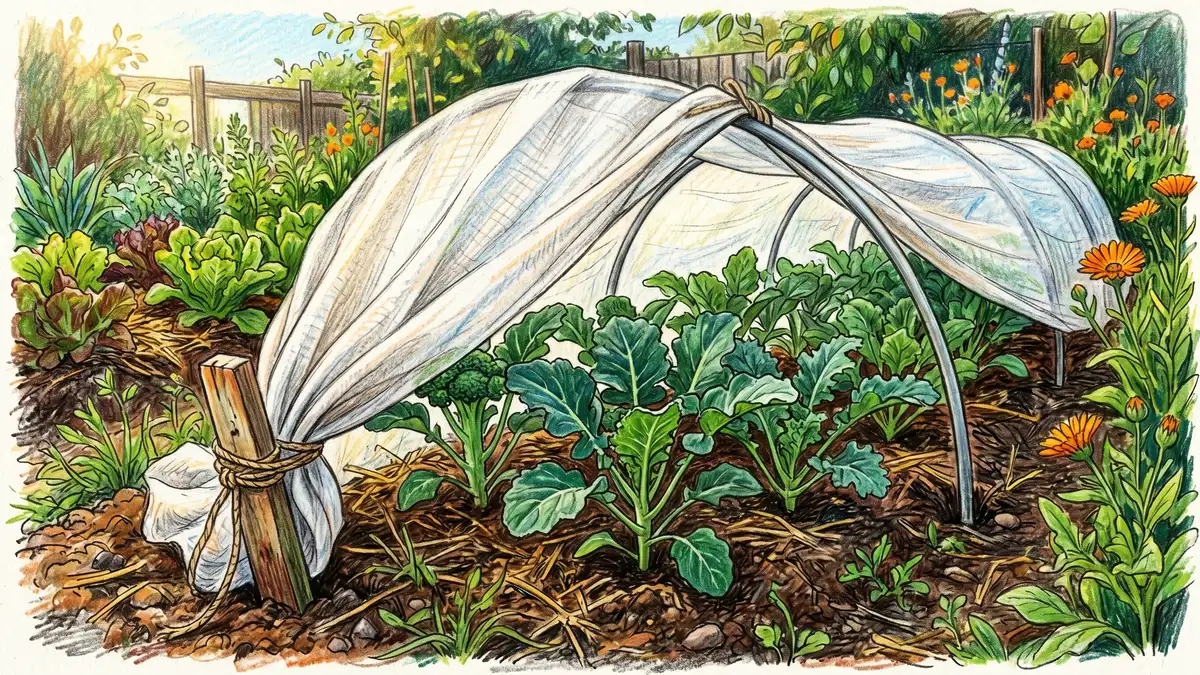
The pyramid hierarchy comes from the standard IPM pyramid handout taught across US extension services. The widest base is the cheapest, longest-lasting, and least disruptive. Each level up is more targeted, more expensive, and more disruptive to the broader ecosystem.
| Tier | Tactic Type | Examples | When to Use |
| 1 (base) | Cultural controls | Crop rotation, sanitation, healthy soil, resistant cultivars, optimal timing | Always: prevention is built into the bed |
| 2 | Mechanical / physical | Row covers, hand picking, traps, barriers, kaolin clay | When pest is detected at low population |
| 3 | Biological controls | Ladybugs, lacewings, parasitic wasps, predatory mites, Bt | When mechanical alone is not enough |
| 4 | Least-toxic chemical | Insecticidal soap, neem oil, spinosad (OMRI listed) | When biological fails and threshold exceeded |
| 5 (top) | Synthetic pesticide | Targeted, narrow-spectrum products only | Last resort; rarely needed in home gardens |
Sources:
Why This Works: Stacking Functions and Observation Before Action
The pyramid mirrors the permaculture design ethic of "small and slow solutions". Every layer rewards diversity and observation over force. Healthy soil at the base produces vigorous plants that resist pests; row covers protect during establishment; beneficial insects thrive in diverse plantings; and least-toxic sprays remain available as targeted last-resort tools rather than first-instinct reactions. Read more about how observation drives smart garden management in our permaculture zones guide.
Cultural Controls: The Cheapest Tier
Cultural controls are the prevention layer baked into the garden's design. They cost almost nothing and make every later tier work better.
Crop rotation. A 3-year minimum rotation away from the same plant family disrupts soil-dwelling pest life cycles. Onion maggots, cabbage maggots, and Colorado potato beetles all overwinter in soil expecting last year's host. Plantwise reviews summarised how crop rotation reduces pest populations. For tight beds, rotate brassicas, alliums, legumes, and nightshades through 4 zones.
Sanitation. Remove infected leaves, fallen fruit, and dead plant debris during the season and again at season's end. Arbico's sanitation guide covers the protocol; the goal is to deny pests overwintering habitat.
Resistant cultivars. Choose varieties bred for resistance to your local pest pressure. Cornell publishes lists of disease-resistant vegetable varieties by crop and disease.
Healthy soil. The single most important cultural control. Plants stressed by poor soil are aphid magnets; plants in living, microbially active soil resist most insect attack chemically through their own induced defenses. See our composting for beginners guide for the foundation, then layer with cover crops and minimal disturbance.
Optimal timing. Plant when conditions favor the crop, not the pest. Penn State's harvest calendar and University of Maryland's vegetable planting calendar give region-specific dates that dodge peak pest emergence.
Mechanical Controls: Cheap, Specific, Reliable
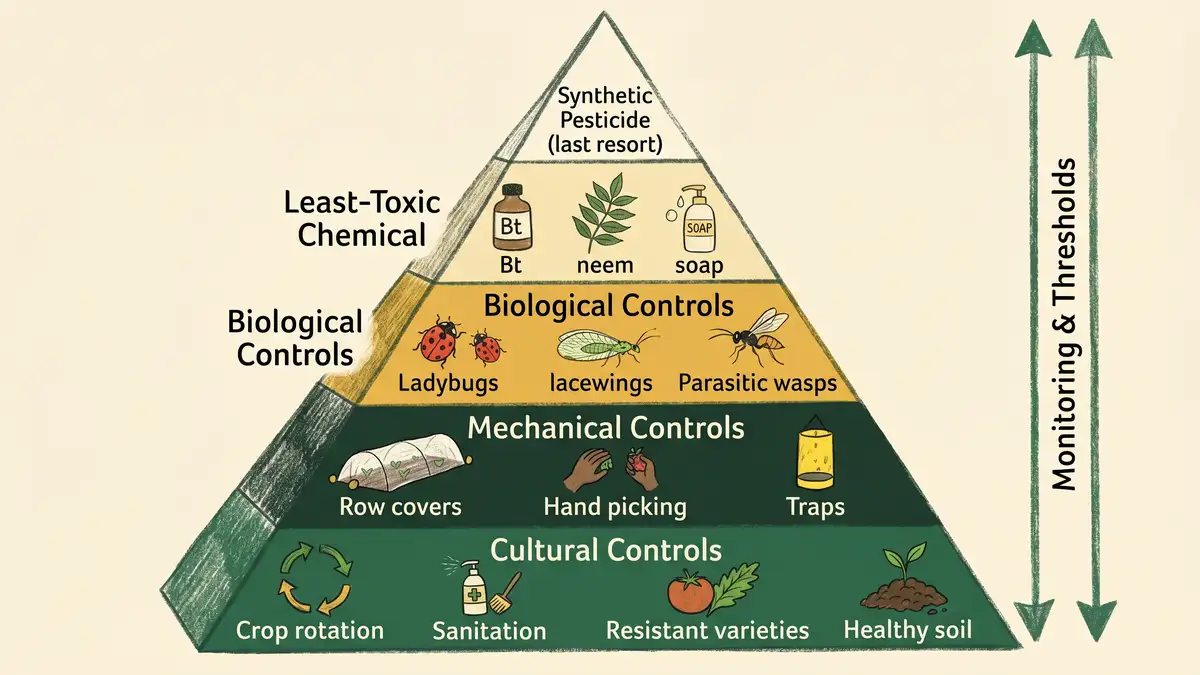
Mechanical controls are the second tier and the highest-leverage purchase most gardeners can make.
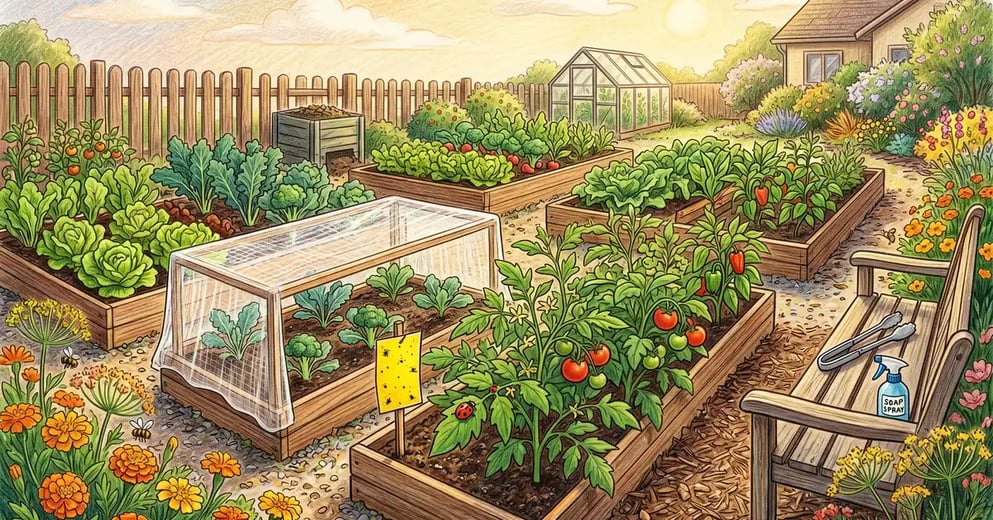
Row covers. A medium-weight row cover (0.5 to 1.0 oz/yd²) physically excludes flying insects from young plants. Cabbage moth, carrot fly, flea beetles, leaf miners, cucumber beetles all stop at the fabric. Cost is $20 to $40 per 50 ft. Deploy at planting and remove when crops need pollination.
Hand picking. Tomato hornworms, Japanese beetles, squash bugs, and slugs are large enough to remove by hand. Drop into soapy water. University of Missouri's Japanese beetle guide documents that morning hand-picking is the single most effective home control.
Yellow sticky traps and pheromone traps. Yellow attracts whiteflies, fungus gnats, thrips, and aphids. UC IPM uses sticky traps for monitoring as well as control. Pheromone traps target specific moths (codling moth, tomato hornworm).
Barriers. Copper tape repels slugs. Diatomaceous earth as a soil ring desiccates soft-bodied insects. Cardboard collars at planting block cutworms.
Trap crops. Plant a sacrificial crop more attractive than your main one. Nasturtium for aphids and cabbage worms (see Epic Gardening's nasturtium trap-crop guide), mustard greens for harlequin bugs.
Biological Controls: The Garden's Workforce
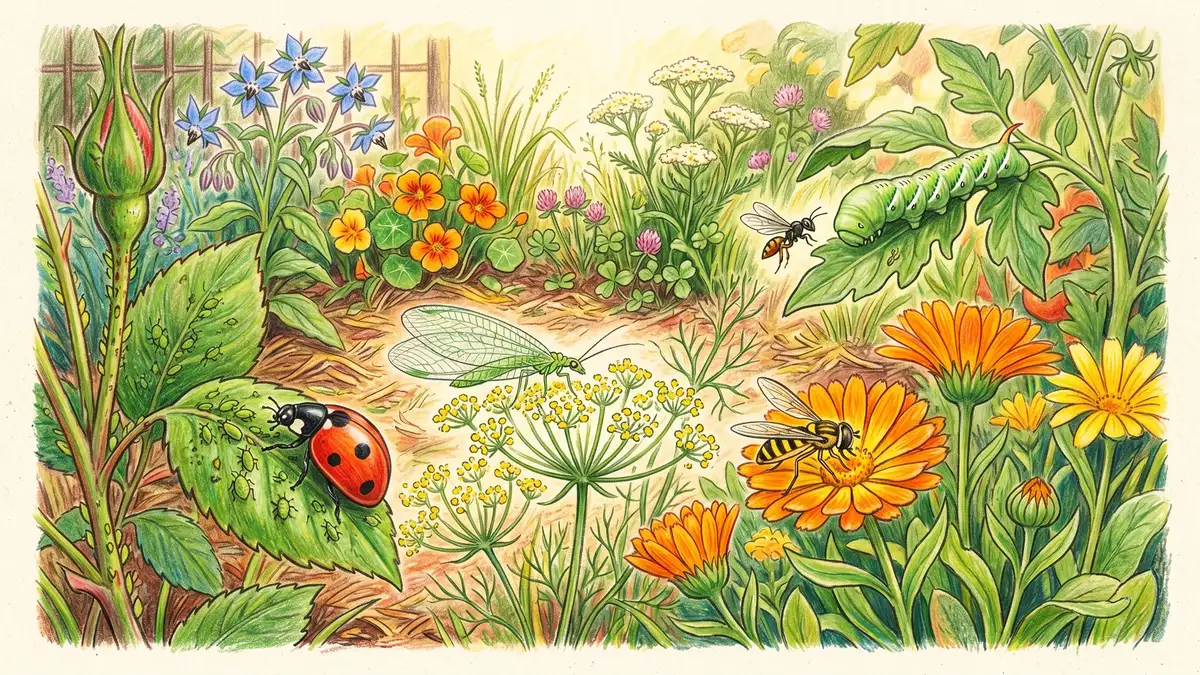
Tier three is letting the garden's own natural enemies do the work. The Xerces Society's native predator guide is the foundational reference.
Ladybugs (Hippodamia convergens) and lacewings (Chrysoperla rufilabris). Both consume aphids, scale, mites, and small caterpillars at every life stage. Attract by planting dill, fennel, yarrow, calendula, and alyssum. Commercial release is available from Arbico Organics and similar suppliers, but encouraging native populations is far more effective long-term.
Parasitic wasps. Tiny non-stinging wasps lay eggs in caterpillar pests; the most famous is Cotesia congregata, which decimates tomato hornworms. Ohio State BYGL documents the parasitic wasp lifecycle on hornworms; if you find a hornworm covered in white rice-shaped cocoons, leave it alone, those wasps are about to emerge and kill the next generation.
Predatory mites. Phytoseiulus persimilis controls spider mites in greenhouses and protected gardens. Best deployed at first sight of mites, not after damage is widespread.
Bacillus thuringiensis (Bt). A soil bacterium whose toxins are lethal to specific caterpillar species but harmless to mammals, birds, and beneficial insects. Bt kurstaki for cabbage worms and most caterpillars; Bt israelensis for fungus gnats and mosquito larvae. Spray on leaves where caterpillars feed; reapply weekly.
For complementary techniques, see our companion planting for pest control guide and the dedicated permaculture pest management deep-dive.
The Eight Most Common Home Garden Pests and IPM Responses
| Pest | Damage | IPM Response |
| Aphids | Cluster on undersides; sticky honeydew; transmit viruses | Strong water spray, ladybugs, insecticidal soap, onion companion planting |
| Cabbage worm (Pieris rapae) | Large holes in brassica leaves | Row covers, hand-pick, dill for parasitic wasps, Bt kurstaki |
| Tomato hornworm | Defoliated tomato plants overnight | Hand-pick (drop in soapy water), encourage parasitic wasps, Bt |
| Squash bugs | Wilting squash; egg clusters on leaf undersides | Hand-pick eggs, row covers, crop rotation, kaolin clay |
| Slugs and snails | Holes in lettuce, hostas; slime trails | Beer traps, copper barriers, iron phosphate baits, hand-pick at dusk |
| Japanese beetles | Skeletonised rose, bean, grape leaves | Morning hand-picking, milky spore for grubs, neem on adults |
| Flea beetles | Pinhole damage on eggplant, brassica seedlings | Row covers at planting, kaolin clay, sticky traps |
| Spider mites | Stippling on leaves; webbing in dry conditions | Strong water spray, predatory mites, neem, increase humidity |
Sources:
Least-Toxic Chemical Controls (When You Have to Spray)
If cultural, mechanical, and biological controls have not worked and your action threshold is exceeded, the chemical tier exists. The rule: pick the most targeted, least persistent, OMRI-listed product first. Spray late evening (when pollinators are inactive) and only on affected plants.
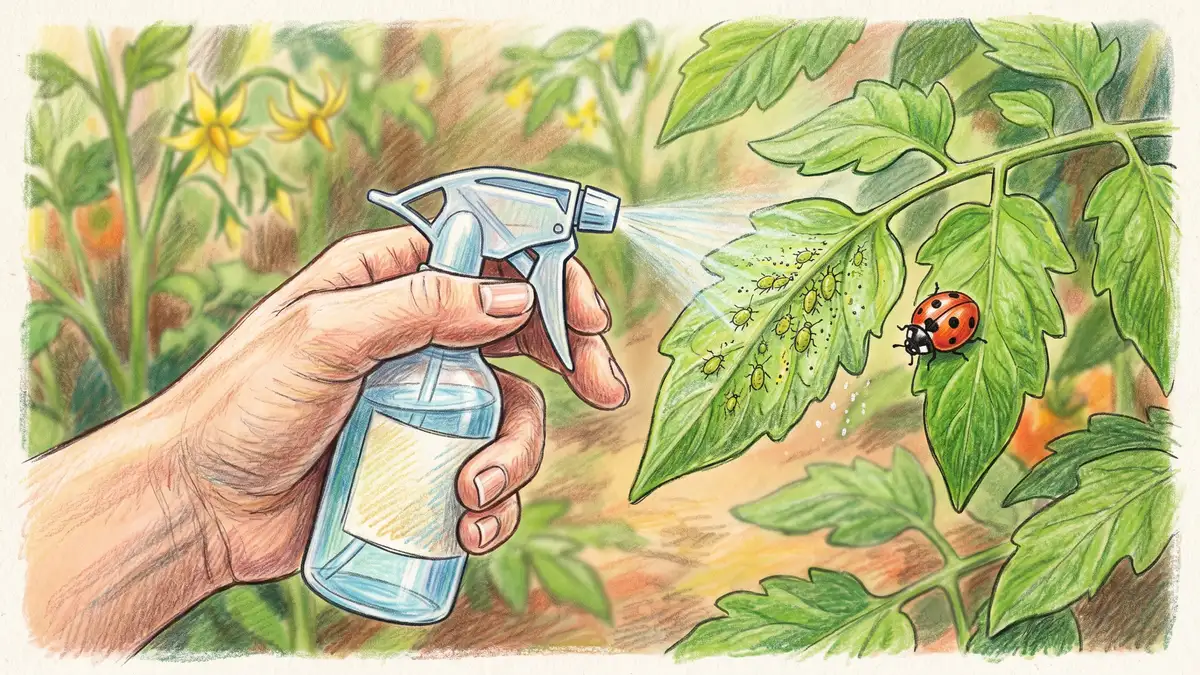
Insecticidal soap. Potassium salts of fatty acids that disrupt soft-bodied insect membranes. Safe for most beneficial insects once dry. Kills aphids, mites, thrips, whiteflies on direct contact only.
Neem oil. Extracted from the neem tree; disrupts insect hormone systems. Effective on a wide range of soft-bodied insects. Apply weekly during outbreaks, do not spray flowering plants midday (toxic to bees while wet).
Spinosad. A natural compound from soil bacterium Saccharopolyspora spinosa. Highly effective on caterpillars, leafminers, thrips. Arbico's spinosad guide covers application. Toxic to bees while wet, dries to safe within 3 hours.
Bt (Bacillus thuringiensis). Strain selection matters: Btk for caterpillars, Bti for fungus gnats and mosquitoes. A clear Bti vs Btk comparison helps you choose.
Kaolin clay (Surround WP). A fine mineral clay that coats leaves and physically deters insects from feeding. OMRI listed. Effective on flea beetles, cucumber beetles, Japanese beetles when applied early.
Synthetic chemical pesticides exist but rarely have a place in a home vegetable garden. The EPA's pesticide labeling guide covers the legal requirements when used. Consider whether the result is worth it before reaching that high on the pyramid.
Five IPM Mistakes to Avoid
Common Mistake to Avoid
Spraying broad-spectrum pesticides early. The biggest IPM failure is reaching for synthetic insecticide at first sight of any pest. The spray kills 90 percent of the natural predators along with the pest, and the surviving pest population rebounds two weeks later in a garden with no defenders. The UMN North Central IPM documents this "pesticide treadmill" effect repeatedly.
The other four:
Misidentifying pests. A green caterpillar might be a benign sphinx moth larva, not a pest. Always identify before acting. Use UC IPM's pest gallery or your state extension's pest portal.
Skipping the threshold step. Two aphids on a tomato is not an emergency. The plant tolerates them. Acting at the wrong threshold wastes effort and disrupts beneficials.
Killing pollinators with timing errors. Even least-toxic sprays harm bees while wet. Spray at dusk after pollinators are inactive.
Treating IPM as one-time. IPM is a continuous monitoring and decision loop, not a single intervention. Walk the garden twice a week throughout the season.
For broader pest-suppression design, the same principles drive design at multiple scales: see how an apple tree guild builds in pest control by design, and the foundational permaculture practical guide covers the wider mindset.
Frequently Asked Questions
What is IPM in simple terms?
IPM stands for Integrated Pest Management. It is a structured way to handle pest problems that starts with prevention (healthy soil, crop rotation, resistant varieties) and only escalates to mechanical methods (row covers, hand-picking), then to biological controls (ladybugs, parasitic wasps), then to least-toxic chemical controls (soap, neem) when each previous step is not enough. The point is to use the smallest tool that solves the problem rather than spraying first.
How do I stop insects eating my plants naturally?
Combine multiple cheap controls. Use floating row covers on young brassicas to exclude cabbage moths and flea beetles. Plant dill, fennel, calendula, and yarrow to attract ladybugs and parasitic wasps. Hand-pick larger pests like tomato hornworms and Japanese beetles in early morning. Spray strong water on aphid clusters to dislodge them. Add Bt for persistent caterpillar problems. Most home gardens never need to go beyond this.
How often should I monitor my garden for pests?
Twice a week during the growing season. A 5 to 10 minute walk with a magnifying lens looking under leaves and at growing points catches most problems while populations are still small enough to handle without sprays. Pair this with yellow sticky traps for flying pests. Penn State Extension recommends 5 minutes per 100 ft of row.
What is an action threshold?
An action threshold is the pest density at which you decide to take action because the cost of damage exceeds the cost of control. For most home garden vegetables, a working rule of thumb is 5 percent of plants showing damage for leaf-eating pests, or 50 to 100 aphids per plant on broccoli. University of Nebraska CropWatch has a more rigorous economic threshold framework if you want the deeper math.
Are organic pesticides safe?
Safer than synthetic, not zero risk. Insecticidal soap and neem are toxic to beneficial insects on direct contact and to bees while wet. Spinosad is highly effective but kills bees while wet. Bt is selectively toxic to caterpillars only. The IPM rule applies even to organic sprays: identify the pest, confirm the threshold is exceeded, choose the most targeted product, spray at dusk, and reapply only as needed.
Does IPM work in a small home garden?
Yes, and it works better in small gardens than in large farms because you can monitor every plant in 10 minutes. The four-step process scales down perfectly. Most home gardeners find that the cultural and mechanical tiers (rotation, sanitation, row covers, hand-picking) handle 80 percent of pest problems with no further escalation needed.
How does IPM reduce pesticide use?
By substituting prevention and least-disruptive controls for prophylactic spraying. Extension trials and the financial impact analysis from Clemson document 30 to 50 percent reductions in pesticide cost compared to calendar-based spraying programs, with equal or better pest suppression. The key is that calendar spraying treats every garden the same; IPM treats each garden as the specific situation it is.
Get the Weekly Dig
One practical permaculture guide a week, written for gardeners who do this on weekends: pest control that works without a spray bottle. Free, no spam, unsubscribe any time.
Join the Weekly DigResources
- US EPA: Definition of Verifiable School IPM
- USDA: History of the Federal IPM Coordinating Committee (PDF)
- Cornell CALS: Vegetable IPM
- NC State Extension: Integrated Pest Management
- Penn State Extension: IPM Scouting for Vegetables
- Penn State Extension: Steps to Controlling Insect Pests
- UC IPM: Vegetables and Melons Pest Guide
- University of Minnesota Extension: Insect Management for Vegetable Crops
- Iowa State Extension: Insect Pest Management
- University of Nebraska CropWatch: Economic Injury Level and Economic Threshold
- Xerces Society: Planting for Helpful Predators
- Pesticide.org: Five Steps of IPM
- ATTRA: Organic Vegetable Production Guide
- University of Missouri IPM: Organic Japanese Beetle Management
- UC IPM: Squash Bug Management
- US EPA: Pesticide Labeling Questions and Answers