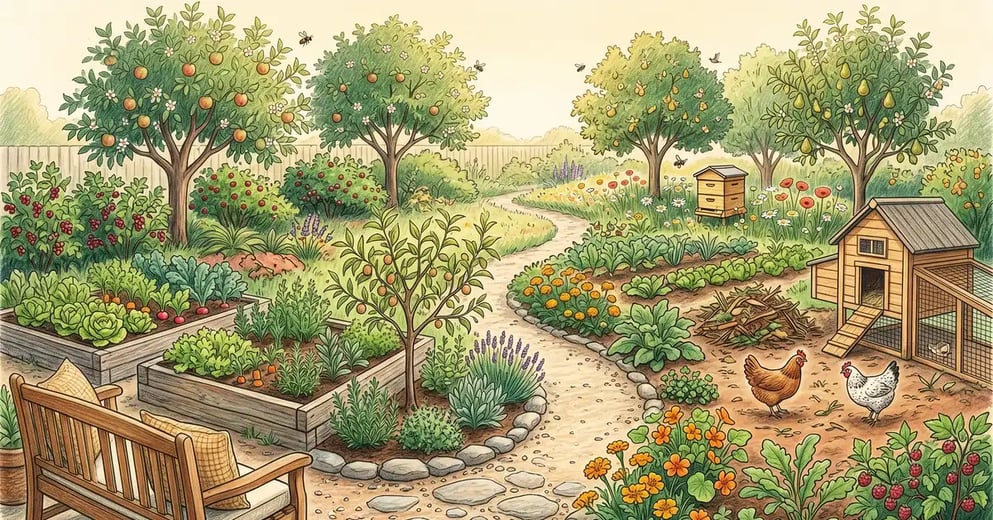

Gardens that work like forests. Grow more, tend less. The smart-friend guide to permaculture for normal backyards.
If you have ever stood in your garden in August and wondered why this is so much work, you are in the right place.
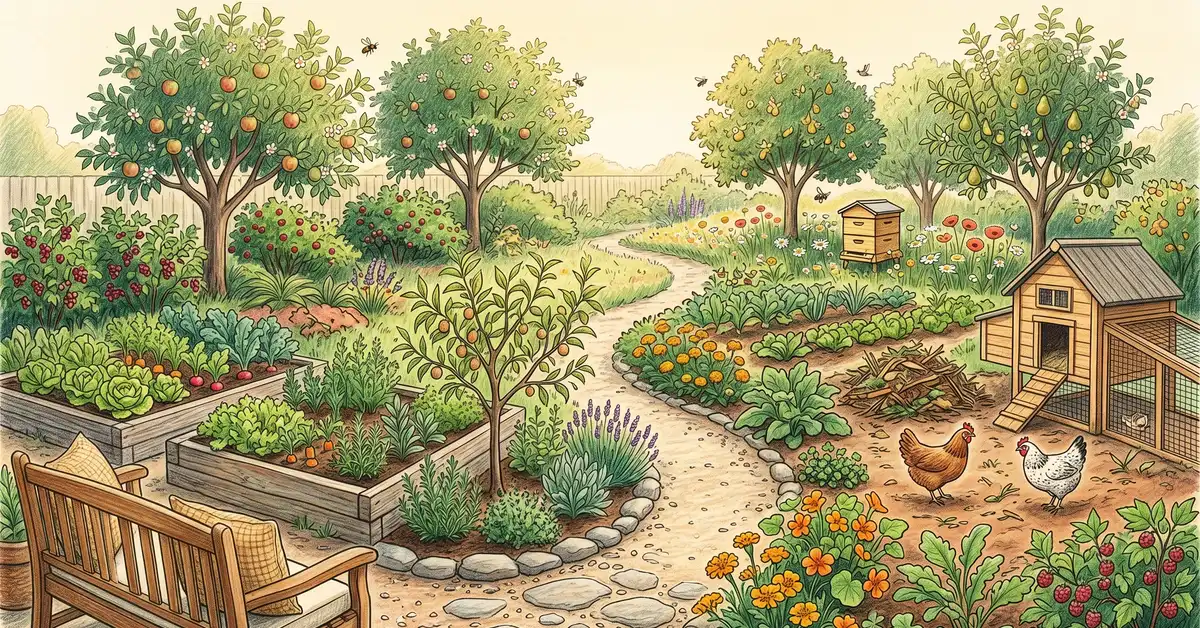
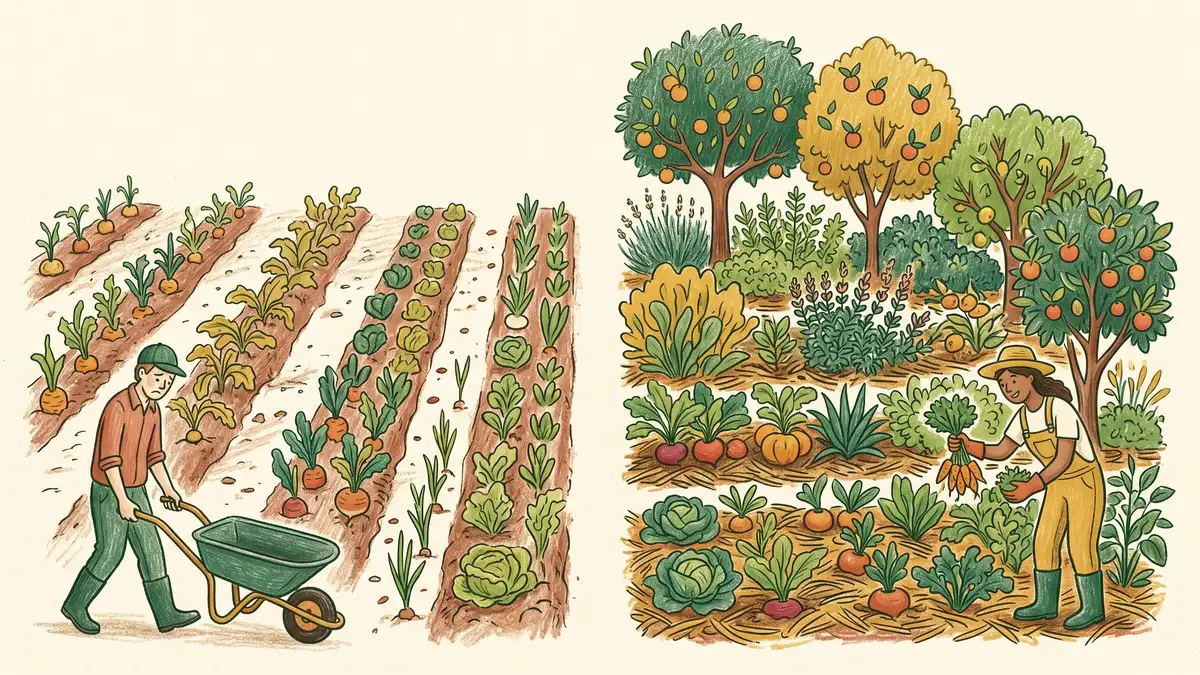
I am Peter. I have grown food my entire adult life, and for twenty years I did it the way every gardening book on the shelf told me to. Straight rows. Deep beds. Bags of mulch dragged across the driveway in July. Tomatoes I watered every other day that died anyway. Every August I made the same promise to myself: next year I will be more organised. They never were.
By the time I was 38 I was tired, the garden was tired, and I could not figure out why. I was doing everything right, by every book I owned. They all said the same thing: more effort, more yield, work harder, weed deeper. But every weekend felt like punishment, and by October the garden looked worse than it had in May.
Then I read a passage in Edible Forest Gardens describing a 30-year-old food forest in Massachusetts. In February. Snow on the ground. Nobody had weeded it, watered it, or fertilised it in a decade. It was still producing more food than the tilled bed beside it. I read that passage three times, walked outside, looked at my own straight rows and dead tomatoes, and the truth landed all at once: I was not gardening with nature. I was fighting it. Every Saturday for twenty years.
I read seventeen books in the next four months. Bill Mollison. Ernst Götsch. Mark Shepard. Toby Hemenway. And every one of them said the same thing the conventional books had been hiding: the most productive gardens in the world are the ones the gardener barely touches. They do not need ten acres. They work in a quarter-acre backyard. They work on a balcony. You just have to stop fighting and start designing.
That is why GrowPerma exists. It is the site I wish I had found at 38.
What This Site Is, and What It Isn't
GrowPerma sits in a lane nobody else really covers. The mainstream gardening sites are warm and approachable but skim the surface on regeneration. The permaculture sites are deep but academic enough to scare off anyone who has not taken a Permaculture Design Course.
This site is the bridge. Practical permaculture for normal backyards. Companion planting and composting are the gateway because they are what you already came here looking for. Food forests, soil food webs, syntropic systems, the seven layers, the Mollison principles. Those are what we keep returning to once the gateway opens.
Everything you read here is grounded in actual books by actual practitioners, cited in plain language, with honest notes on what works in a 200 square foot backyard versus what only works at scale.
Key Takeaway
You don't need 10 acres. You don't need a Permaculture Design Course. You need ten articles, two weekends, and the willingness to stop fighting your garden and start designing with it. That is the entire promise of this site.
Where to Begin: 10 Articles, In This Order
Ten articles, in order. If you read them in this sequence over a couple of weekends, you will know more about permaculture than 95% of gardeners who have never opened a Mollison book.
Foundations · What Is Permaculture? A Practical Guide for Gardeners
Start here. The plain-English definition, what permaculture is not, and why it is the missing layer under everything else on this site. Read article 1.
Foundations · 12 Permaculture Principles Explained
Holmgren's twelve principles, each tied to a concrete garden example. The mental model the rest of the site is built on. Read article 2.
Companion Planting · The Complete Companion Planting Chart
The most useful thing you can do this weekend. Pairings that actually work, based on the research, with the science behind them. Read article 3.
Soil & Composting · Soil Health: Building Living Soil
Soil is the substrate everything else stands on. Why the food web matters more than the NPK number on a fertiliser bag. Read article 4.
Soil & Composting · Composting for Beginners
The single highest-leverage habit in any garden. How to start a pile this weekend that actually works. Read article 5.
Soil & Composting · Nitrogen-Fixing Plants That Feed Your Soil for Free
The plants that build fertility without a bag of fertiliser. How legumes and their bacterial partners pull nitrogen out of the air for you. Read article 6.
Food Forest · The 7 Layers of a Food Forest
The layered system. Once you see it, you cannot unsee it. Every productive garden on Earth uses this structure, whether the gardener calls it permaculture or not. Read article 7.
Food Forest · Food Forest Guide: Design, Plant, and Grow
The plant inventory and design playbook. How to lay out the canopy, sub-canopy, shrubs, herbs, and groundcover for a self-feeding edible ecosystem. Read article 8.
Food Forest · Food Forest Maintenance, Season by Season
What to do each season once the system is in the ground. Pruning, chop-and-drop, watering, and the mistakes that kill year-three forest gardens. Read article 9.
Foundations · From Lawn to Food Forest: Design
The bridge from reading to doing. How to walk your own backyard, sketch zones, and design your first system in a single afternoon. Read article 10.
Get the Weekly Dig
One practical guide a week on permaculture design for real backyards. Free, unsubscribe any time.
Join the Weekly DigThe Mental Model: Holmgren's 12 Principles
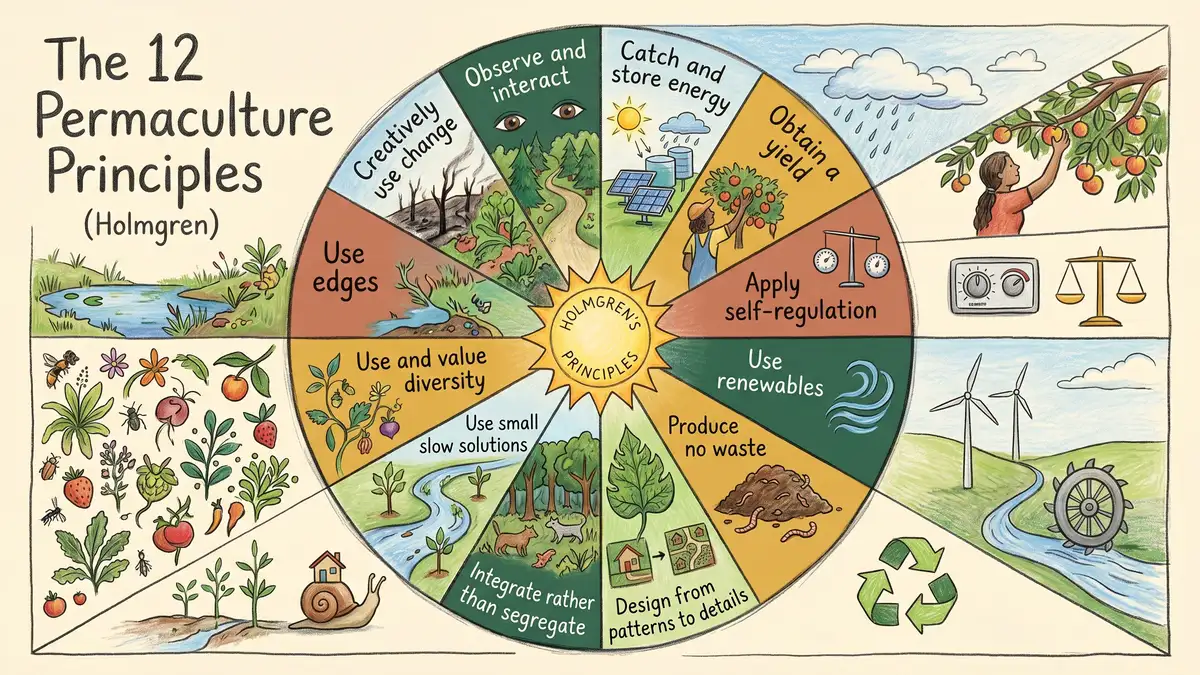
Permaculture was coined by Bill Mollison and David Holmgren at the University of Tasmania in 1978. Holmgren later published the twelve design principles that have guided every Permaculture Design Course taught since. Articles 1 and 2 in the path above go deep on these. This is the short version.
| # | Principle | What It Means in Your Backyard |
| 1 | Observe and interact | Spend a season watching your yard before changing it. Sun, wind, water flow. |
| 2 | Catch and store energy | Rain barrels, mulch, compost. Capture sun and water when they are abundant. |
| 3 | Obtain a yield | Every project should pay you back. Food, beauty, shade, habitat, or learning. |
| 4 | Apply self-regulation and accept feedback | When something fails, learn and adjust. Do not force it. |
| 5 | Use and value renewable resources | Let chickens till. Let beans fix nitrogen. Let leaves mulch themselves. |
| 6 | Produce no waste | Compost everything. A "waste" is a yield in the wrong place. |
| 7 | Design from patterns to details | Sketch zones first (kitchen garden close, orchard further out), then pick plants. |
| 8 | Integrate rather than segregate | Stack plants in guilds. A pond is irrigation, fish, frogs, and microclimate. |
| 9 | Use small and slow solutions | Start with one raised bed. Master it. Then expand. |
| 10 | Use and value diversity | Many species equals resilience. Monocultures fail together. |
| 11 | Use edges and value the marginal | The boundary between pond and lawn is the most productive zone. Plant there. |
| 12 | Creatively use and respond to change | Climate shifts, kids grow up, jobs change. Design gardens that adapt. |
Source:.
Why This Works: Observe and Interact
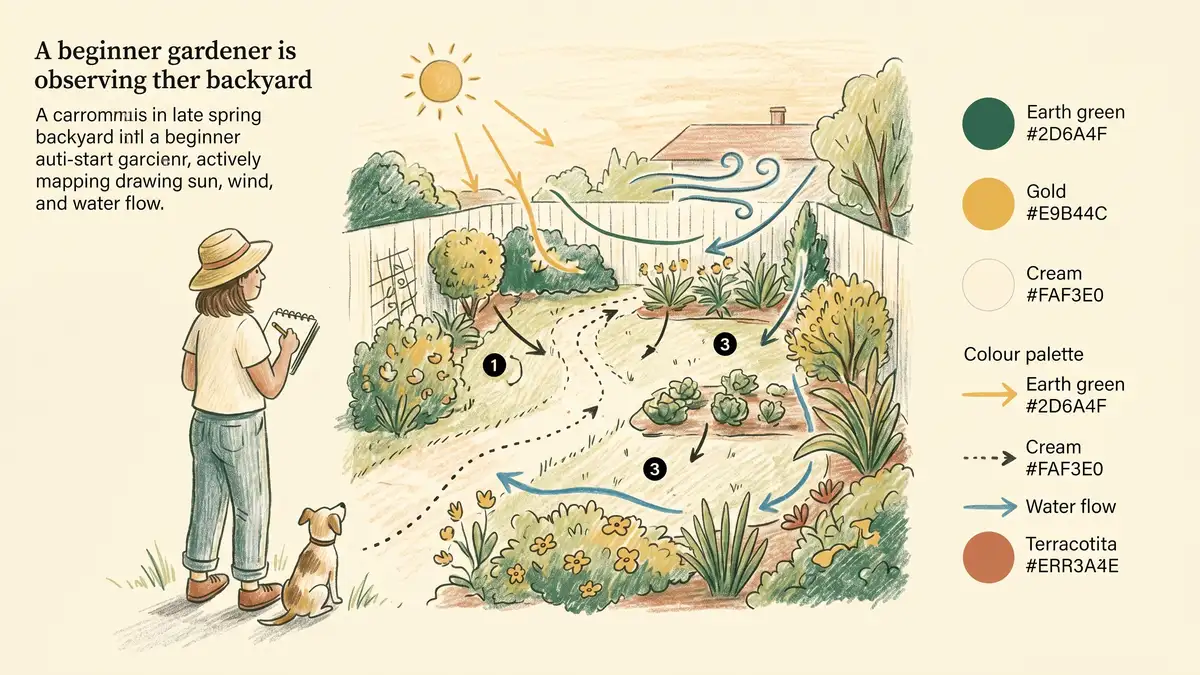
The first Holmgren principle is the one beginners skip and then regret. A season of watching where the sun lands, where snow lingers, where water pools, and which corner the wind tunnels through, is worth more than a year of trial and error. Sit with a sketchbook on a Saturday. Map your yard. That is the difference between gardeners who quit by year three and ones who are still planting at year thirty.
The Five Mistakes That Make Beginners Quit
Five mistakes account for most beginner burnout. Avoid these and your odds of still loving this in three years are very high.
| Mistake | What to Do Instead |
| Planting before observing | Sit with the site for a season. Sketch sun paths, wind, water flow, frost pockets, and where you actually walk. |
| Going too big, too fast | Convert one bed, not the whole lawn. Holmgren principle 9. Master one zone before expanding. |
| Wrong compost ratios | No meat, dairy, or pet waste. Aim for roughly 3 parts brown to 1 part green. Keep it as moist as a wrung-out sponge. (.) |
| Ignoring soil before planting | Test pH, build organic matter, mulch deeply. The food web matters more than fertiliser. (Penn State Extension.) |
| Treating companion planting as folklore | Use evidence-based pairings (alyssum with lettuce for aphid control, garlic at the base of fruit trees), not Pinterest charts. |
Sources:.
Common Misconception to Avoid
Permaculture is not zero work. The first three years of any food forest or perennial system are more work than a conventional garden, not less. The payoff is years 4 through 30, when the system runs itself. If a website promises "lazy gardening from day one", they are selling you mulch piles. Plant for the long game.
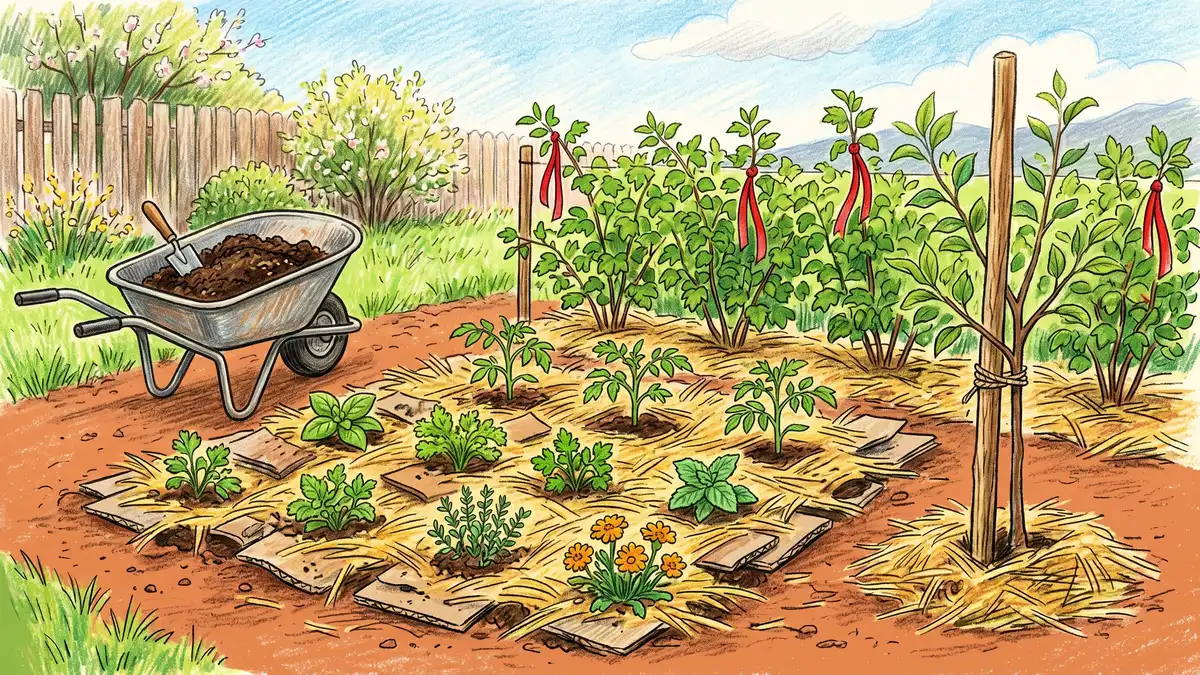
The GrowPerma Beginner's Guide
A 20-page beginner's permaculture guide that compresses everything above into one weekend's reading. It includes the three permaculture ethics and twelve principles in plain English, the zone-planning worksheet and sheet-mulching checklist to print and take outside, four DIY soil tests you can do this weekend, a USDA zone reference, a companion-planting cheat sheet, a month-by-month food-forest calendar, and a field guide to the five pests you will meet first.
Free to read. No email required. If you want a new practical permaculture idea each week, subscribe to the GrowPerma newsletter.
The 7-Layer Backyard
A 20-page beginner's guide to gardens that work like forests. Two printable worksheets, the three ethics and twelve principles, a USDA zone reference, a companion-planting cheat sheet, a year-by-month food-forest calendar, and a field guide to the five pests you will meet first. Free PDF.
Read the Free GuideThe Books Worth Reading
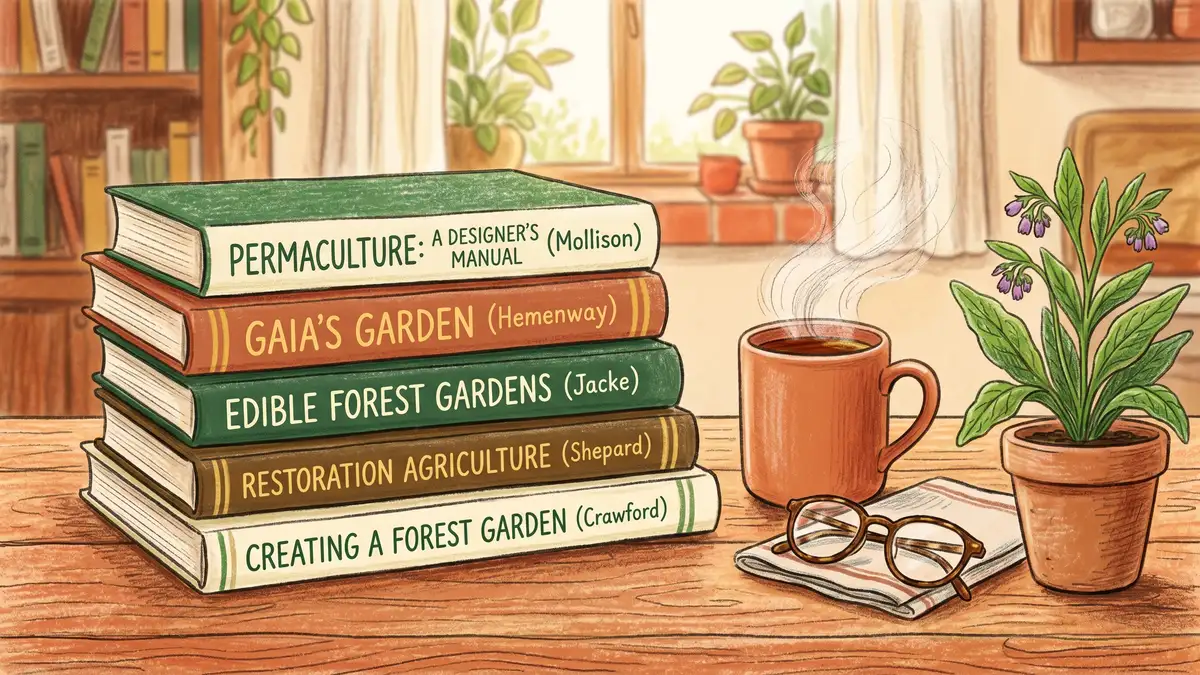
If you read just two books beyond the ten articles above, make them Toby Hemenway's Gaia's Garden (the best-selling home-scale permaculture book in the world, free PDF available via Mutual Aid Disaster Relief) and Dave Jacke and Eric Toensmeier's Edible Forest Gardens Vol. 1 (free PDF via United Diversity library). Hemenway is the warm-onboarding voice. Jacke is the systems-thinking reference.
| Practitioner | What They Built | Why They Matter |
| Bill Mollison | Permaculture Designer's Manual (1988) | The textbook every PDC has been taught from. |
| David Holmgren | The 12 principles (2002) | The shared operating system. Read this first. |
| Martin Crawford | Dartington 2-acre forest garden since 1994, 500+ species | The deepest living example of a temperate forest garden. |
| Ben Falk | Whole Systems Research Farm, Vermont, 20+ years | Cold-climate permaculture. The Resilient Farm and Homestead. |
| Mark Shepard | New Forest Farm, 106 acres, Wisconsin | Commercial-scale Restoration Agriculture proof of concept. |
| Ernst Götsch | 1,200+ acres of Brazilian rainforest restored on his Bahia farm | Syntropic agriculture. The cutting edge of perennial design. |
Sources:.
About the Writer
Peter Vogel. Writer at GrowPerma. Permaculture practitioner. I write this site the way I wish someone had written it for me at 38, citing the books that taught me. If you have a question about anything on this site, the contact link in the footer reaches me directly.
If you have ever stood in your garden in August and wondered why this is so much work, you are not a bad gardener. You were given the wrong model. There is a better one. It looks like a forest.
Frequently Asked Questions
What is permaculture in simple terms?
Permaculture is a design system for productive landscapes that work the way natural ecosystems do. You stack plants in layers like a forest, build soil instead of buying fertiliser, capture rain where it falls, and place high-frequency tasks close to where you live. Bill Mollison and David Holmgren coined the word at the University of Tasmania in 1978.
How do I start a permaculture garden as a beginner?
Read the ten articles in the sequence above, in order. Spend one season observing your site before planting. Start with one small bed or one corner of the yard rather than converting the whole lawn. Build a compost pile, mulch heavily, and plant a guild of three to five complementary species rather than rows of single crops.
How long does a permaculture garden take to mature?
An annual vegetable bed produces in 4 to 12 weeks. A small fruit shrub bears in 2 to 3 years. A full food forest reaches its self-maintaining mature phase around year 8. The first three years are the highest workload; after year 8 a properly designed system needs less time per week than the equivalent annual vegetable garden.
What are the 12 permaculture principles?
Observe and interact, catch and store energy, obtain a yield, apply self-regulation and accept feedback, use and value renewable resources, produce no waste, design from patterns to details, integrate rather than segregate, use small and slow solutions, use and value diversity, use edges and value the marginal, and creatively use and respond to change. David Holmgren published these in 2002.
Do I need a Permaculture Design Course to start?
No. A PDC is a 72-hour certification course that is excellent for serious practitioners and necessary for those wanting to teach or design professionally. For a home gardener building a backyard food forest, the ten articles in this hub plus Toby Hemenway's Gaia's Garden cover everything you need.
How much space does permaculture need?
It works at every scale. A windowsill of herbs plus a worm bin under the sink is permaculture if it stacks functions and closes a nutrient loop. A balcony works. A typical small US backyard (1,500 to 5,000 square feet) is plenty for a productive food forest. Acreage is not a requirement.
What is the best permaculture book for beginners?
Toby Hemenway's Gaia's Garden: A Guide to Home-Scale Permaculture is the best-selling permaculture book in the world and the most beginner-friendly. A free archival PDF is hosted by Mutual Aid Disaster Relief; the publisher edition is from Chelsea Green.
Resources
- David Holmgren, The 12 Permaculture Design Principles (canonical)
- Holmgren, Essence of Permaculture (free PDF)
- Toby Hemenway, Gaia's Garden (free PDF)
- Dave Jacke and Eric Toensmeier, Edible Forest Gardens Vol. 1 (free PDF)
- Ben Falk, The Resilient Farm and Homestead (Chelsea Green)
- Mark Shepard, Restoration Agriculture (Acres USA)
- Martin Crawford, Agroforestry Research Trust
- Ernst Götsch, Agenda Götsch (syntropic farming)
- Permaculture Research Institute (Geoff Lawton)
- NC State Extension, Home Composting
- Cornell Composting
- Penn State Extension, Home Gardening