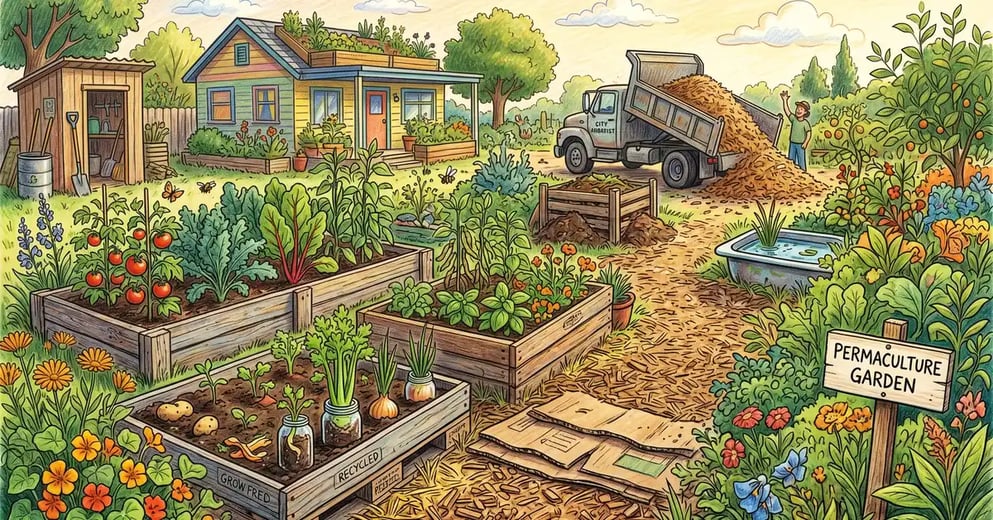

You watched a YouTube tour of someone's mature permaculture homestead and saw earthworks, swales, ponds, fruit trees, chicken coops, and a Permaculture Design Certificate on the wall. The natural conclusion is that permaculture costs thousands of dollars before you get a single tomato. It does not have to. A productive backyard permaculture system can be started for $0 to $50 using only free wood chips, cardboard, kitchen scraps, swapped seeds, and library books.
This guide covers the realistic cost ranges across three budget tiers, the 10 free or near-free resources every US gardener can tap right now, the year-by-year phased approach that spends nothing in year 1, and the cost mistakes that make permaculture feel expensive. Numbers come from documented practitioner setup data and US extension service publications.
Key Takeaway
Permaculture is not inherently expensive. A 1/4 acre (1,000 sq m) backyard conversion can begin with $0 to $50 in year 1 by combining free wood chips from ChipDrop, free cardboard from local stores, kitchen-scrap compost, divisions from neighbors, and seeds from community seed libraries. Year 2 adds $50 to $300 for bare-root fruit trees and basic tools. The expensive perception comes from buying mature fruit trees ($150+ each), paying for in-person Permaculture Design Certificate courses ($1,000 to $2,500), or hiring consultants when free education from Geoff Lawton, Oregon State Extension, and Bill Mollison's writings is available online.
The 3 permaculture budget tiers
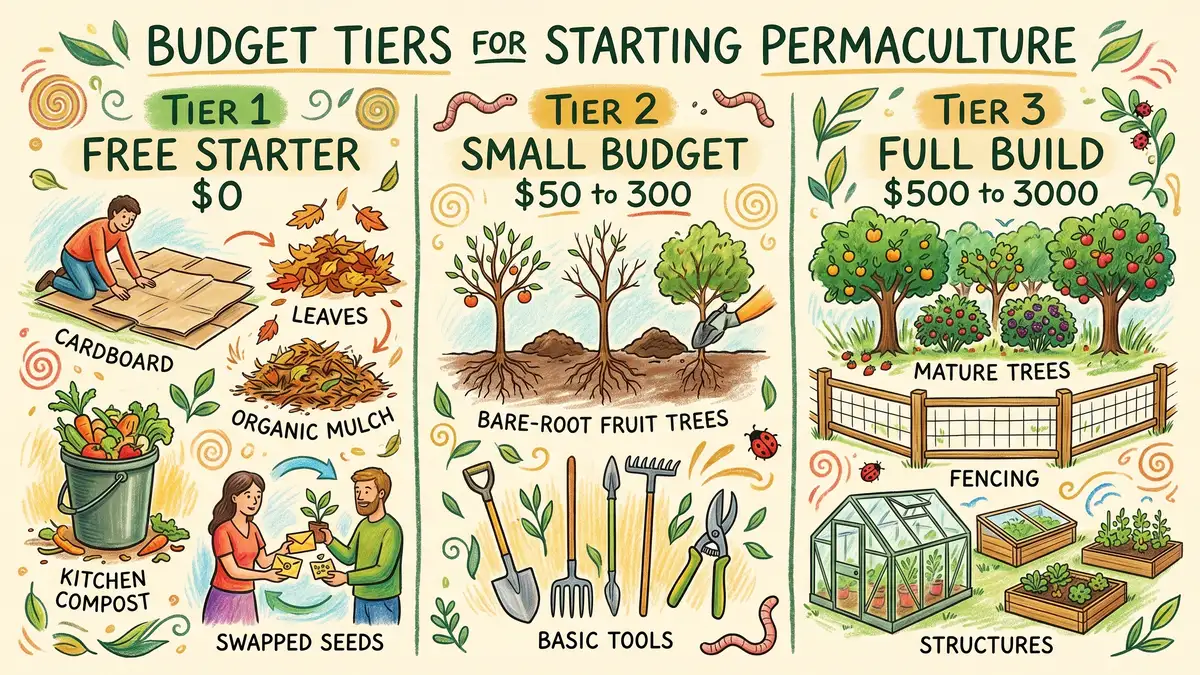
| Tier | Cost | What it includes |
| Tier 1: Free starter | $0 to $50 | Cardboard sheet mulch, free wood chips, kitchen compost, swapped seeds, perennial divisions from neighbors, library books |
| Tier 2: Small budget | $50 to $300 | Above plus bare-root fruit trees ($20 to $40 each), basic hand tools, organic soil amendments, seed potatoes |
| Tier 3: Full build | $500 to $3,000+ | Above plus mature fruit trees, fencing, raised bed lumber, pond construction, irrigation, PDC course |
Source: Cost ranges compiled from documented practitioner setups including Tenth Acre Farm and Permaculture Apprentice budget guides.
The honest answer to "is permaculture expensive" is "only if you skip Tier 1." Most permaculture failures and most online complaints about cost come from people who jumped to Tier 3 in year 1 instead of starting in Tier 1 and graduating to Tier 2 as the system matured. A traditional landscaping conversion for the same 1/4 acre site costs $500 to $5,000 per 1,000 sq ft of new beds and structures.
The 10 free or near-free starting points
1. ChipDrop for free wood chips
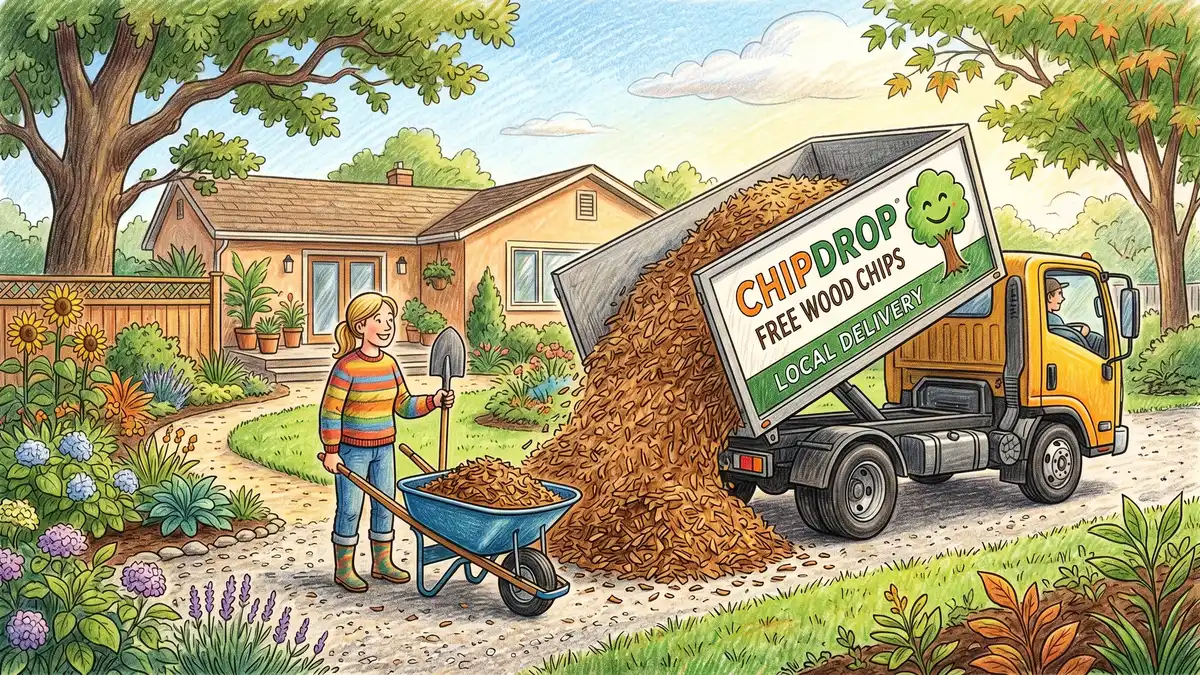
ChipDrop connects backyard gardeners with arborists who need to dispose of fresh wood chips. The service is free in most metropolitan US areas; a small optional tip ($20 to $80) bumps you to the front of the queue. A typical drop is 6 to 20 cubic yards (4.6 to 15.3 cubic meters), which would cost $200 to $700 if bought from a landscape supplier. The catch: you do not choose the day, the species, or the size of the pile. Ecology Center's directory entry on Chip Drop documents the service as one of the most-used free permaculture inputs in the US.
2. Free cardboard for sheet mulching
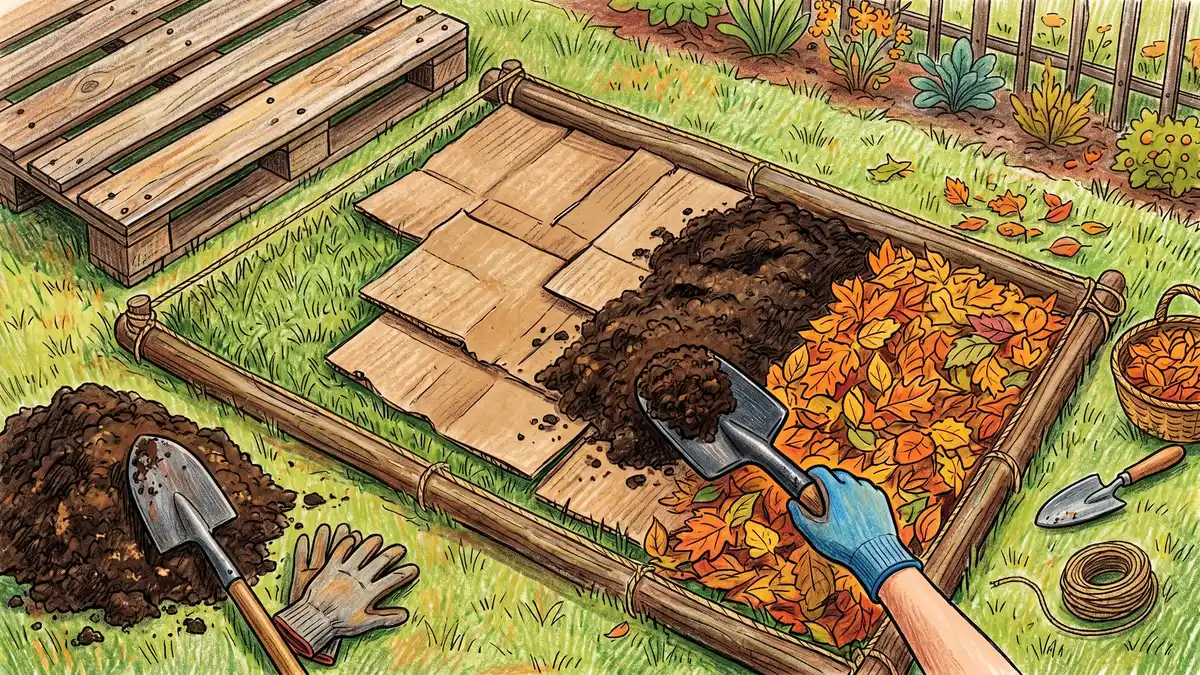
Big-box stores, appliance stores, and bicycle shops give away large flattened cardboard boxes every week. Oregon State Extension's sheet mulching guide documents the method: lay cardboard directly over grass, cover with 4 to 6 inches (10 to 15 cm) of compost or wood chips, and within 60 days the grass is dead and the soil underneath is alive. UC ANR's sheet mulching dos and don'ts warns to remove tape and glossy printing before use; plain brown corrugated is ideal.
3. Free seeds from community seed libraries
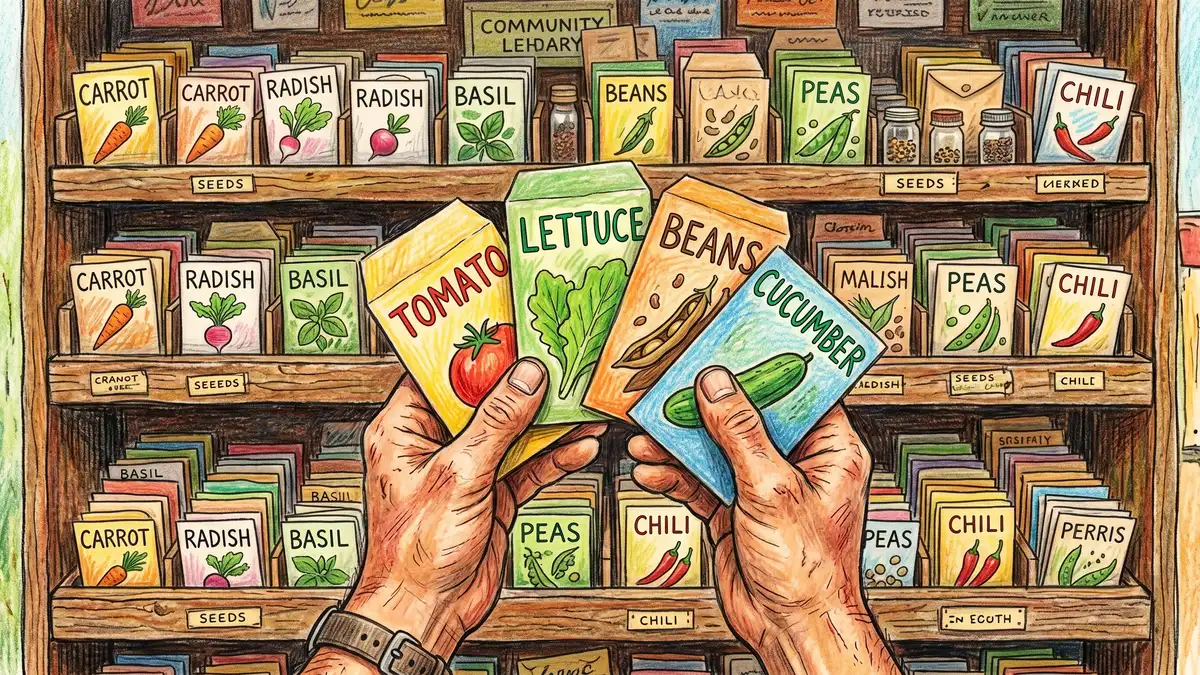
Hundreds of US public libraries operate free seed libraries: you take a packet of seeds in spring, save and return seeds in fall. Examples include Hudson Valley Seed Library, Seed Savers Exchange community chapters, and regional library networks. Many county extension offices also distribute free seeds during outreach events. Cost: $0. Quality: often regionally adapted heirloom varieties that outperform big-box hybrids in the local climate.
4. Kitchen scrap compost
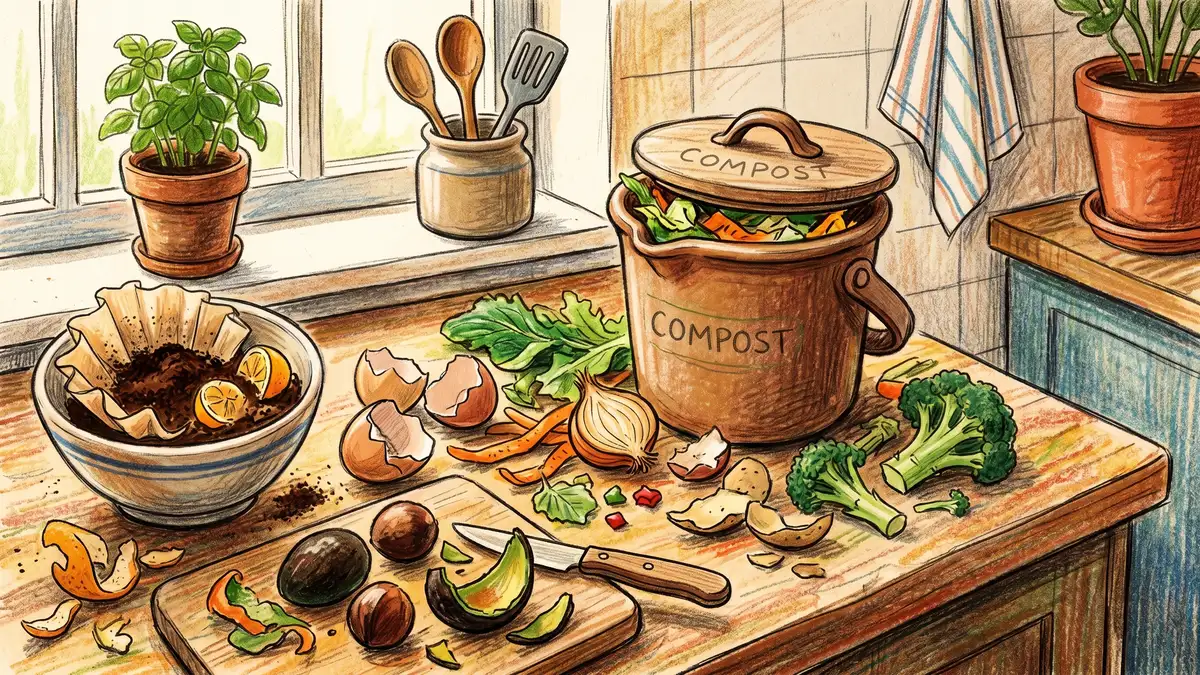
The average US household throws away about 240 lbs (109 kg) of food waste per person per year. Diverted to a $0 backyard compost pile (or a small bin from a free pallet), that becomes 60 to 80 lbs (27 to 36 kg) of finished compost annually. Free, on-demand fertility for the garden. For full details, see our composting for beginners guide.
5. Plant divisions and cuttings from neighbors
Every established gardener in your neighborhood has comfrey, mint, chives, oregano, raspberries, strawberries, daylilies, and other perennials they need to divide every 2 to 4 years. Knock on doors in spring and fall and offer to help with division work in exchange for the trimmings. A single afternoon yields what would cost $50 to $200 at a nursery.
6. Municipal free leaf mulch and compost programs
Many US cities run free leaf mulch and finished compost programs in spring and fall. Examples include New York City Compost Project, Seattle Public Utilities, Madison WI compost site, Austin TX dillo dirt program. Bring your own buckets or trailer. Free, often pre-aged 6 to 12 months.
7. Free library books and digital resources
Every major permaculture book is available through your public library or interlibrary loan. Free Permaculture's learn-for-free guide documents the best titles: Toby Hemenway's Gaia's Garden, Bill Mollison's Introduction to Permaculture, David Holmgren's Essence of Permaculture (free PDF from Holmgren's site). Oregon State University offers a free Intro to Permaculture book PDF.
8. Free permaculture courses
Geoff Lawton offers free 60-minute permaculture intro videos and courses. The Permaculture Research Institute publishes thousands of free articles. Redemption Permaculture's 5 ways to learn for free lists books, YouTube channels (Geoff Lawton, Edible Acres, Justin Rhodes), podcasts (Permaculture Podcast), websites, and free courses from PRI and Paul Wheaton at Permies. The paid Permaculture Design Certificate is $1,000 to $2,500 in person or $50 to $400 online; the free options cover the same 72-hour curriculum without certification.
9. Scavenged containers and structures
Free 5-gallon (19 L) buckets from restaurant kitchens (frosting, pickle buckets), free pallets from warehouse-district businesses for raised bed lumber, free clean glass jars for water bath canning your harvest, free 55-gallon (208 L) food-grade drums from car wash supply distributors for rain barrels.
10. Saved seed and self-propagation
Year 1 plants produce year 2 seed if you let some bolt. Tomato, bean, pea, squash, lettuce, dill, calendula, and most flowers self-seed reliably. After 2 years of saving, you stop buying seeds for most crops entirely.
The 5-step phased budget approach
Year 1: observe and sheet mulch ($0 to $50)
Observe your yard for a full season. Sheet mulch where future beds will go using free cardboard, free wood chips from ChipDrop, and free leaves. Plant only swapped seeds, kitchen scrap regrowth (potato eyes, garlic cloves, scallion roots), and perennial divisions from neighbors.
Year 2: first small purchases ($50 to $200)
Buy 2 to 4 bare-root fruit trees (Stark Bros, Burnt Ridge Nursery, Raintree at $20 to $40 each). Add a basic hand tool kit (Hori-Hori knife, pruners, soil knife) under $80. Build the first proper compost bin from free pallets.
Year 3: shrub layer and basic structures ($100 to $300)
Add raspberry canes, currant bushes, gooseberries (often $5 to $15 per bare-root). Build the first trellis or arbor from salvaged lumber. Start a small chicken flock if zoning allows ($50 to $200 in coop materials plus 3 to 6 chicks at $5 each).
Year 4: water and fertility infrastructure ($100 to $500)
Install a rain barrel or two ($30 to $80 each, or free from car wash supply). Build swales by hand if site warrants. Add comfrey patches from divisions and bocking 14 root cuttings ($15 to $30 for starter pack).
Year 5+: net savings begin
Fruit trees from year 2 begin meaningful production. Berry harvest is robust. Compost system is self-sustaining. Grocery savings from fresh produce begin exceeding annual input cost (now under $100 per year for replacement seeds and amendments).
The 5 most common cost mistakes
Avoid These Expensive Beginner Errors
Buying mature fruit trees instead of bare-root. A 5-year-old potted apple is $150 to $250; a bare-root maiden of the same variety is $20 to $40 and catches up within 2 years. Paying for an in-person PDC in year 1. The $2,000 PDC is worth it when you know permaculture is for you. Start with free Mollison and Holmgren PDFs, Geoff Lawton videos, and your library. Hiring a permaculture consultant before observing. A $500 to $2,000 consultation cannot replace your own year of site observation. Buying landscape fabric. Sheet mulch with free cardboard and free wood chips works better and costs nothing. Filling raised beds with bagged "garden soil". Bagged soil at $5 to $10 per cubic foot adds up fast; fill bottom 12 in (30 cm) of beds with free wood chips and free leaves, top 4 in (10 cm) with compost and free leaves instead.
Free vs paid permaculture education
| Format | Cost | What you get |
| In-person PDC (72 hours) | $1,000 to $2,500 | Certification, hands-on, network |
| Online PDC | $50 to $400 | Certification, video curriculum, forum access |
| Geoff Lawton free intro | $0 | 60-minute video, no certification |
| Library books + YouTube | $0 | Same content as PDC curriculum, no certification |
| Free intro PDF from OSU PACE | $0 | Beginner-friendly written intro |
| Permaculture Research Institute articles | $0 | 1,000+ practitioner articles |
Source: Compiled from, and current PDC course pricing.
The certification matters if you plan to teach or consult professionally. For backyard practice, the free curriculum is sufficient. For broader context on getting started, see our permaculture for beginners guide.
The realistic 5-year cost-benefit timeline
| Year | Cost spent | Value produced | Net |
| Year 1 | $0 to $50 | Annual veg + herbs: $50 to $200 | Even or small positive |
| Year 2 | $50 to $200 | Annual veg + first berries: $150 to $400 | Small positive |
| Year 3 | $100 to $300 | First small fruit harvest + berries: $300 to $700 | $0 to $400 net positive |
| Year 5 | $50 to $150 maintenance | Significant fruit and berry harvest: $800 to $1,500 | $650 to $1,350 annual net positive |
| Year 10+ | $50 to $150 maintenance | Mature system: $2,000 to $5,000 produce equivalent | $1,850 to $4,850 annual net positive |
Source: Annual produce values estimated using average US retail prices for organic produce 2025 and documented yield data from established backyard permaculture practitioners.
Why This Works (the permaculture lens)
Conventional landscaping is a one-way money flow: you spend $5,000 on plants and structures, the plants and structures depreciate, and you spend more next year. Permaculture flips the equation by treating waste streams (cardboard, leaves, wood chips, kitchen scraps, neighbor surplus) as the primary inputs. The system gets richer over time while your input cost falls. This is what Bill Mollison meant when he wrote that "the only ethical decision is to take responsibility for our own existence and that of our children." Cheap is a feature, not a constraint.
Frequently Asked Questions
Is permaculture expensive to start?
No. A 1/4 acre (1,000 sq m) backyard permaculture conversion can begin for $0 to $50 using free wood chips from ChipDrop, free cardboard for sheet mulch, kitchen-scrap compost, plant divisions from neighbors, and seeds from community seed libraries. Year 2 typically adds $50 to $200 for bare-root fruit trees. The high costs that scare beginners come from buying mature trees, paying for in-person Permaculture Design Certificate courses, or hiring consultants when free education is widely available.
How much does it cost to start a permaculture garden?
Tier 1 (free starter) runs $0 to $50 in year 1. Tier 2 (small budget) runs $50 to $300 in year 2. Tier 3 (full build) runs $500 to $3,000+ for those wanting mature trees, pond construction, fencing, and structural elements installed in the first year. Most practitioners progress from Tier 1 to Tier 2 organically over 2 to 3 years.
What is the cheapest way to start permaculture?
Sheet mulch with free cardboard (from grocery and appliance stores) and free wood chips (from ChipDrop) over the area where future beds will go. Plant only swapped seeds from a community seed library and divisions from neighbors. Compost your kitchen scraps. Read library books for design. Total cost: $0 in cash, 20 to 40 hours of labor in the first season.
Where can I get free wood chips?
ChipDrop (getchipdrop.com) is the main US-wide service connecting homeowners to local arborists for free wood chip deliveries of 6 to 20 cubic yards. Optional small tip ($20 to $80) speeds up delivery. Local tree-service companies also often drop chips for free when working in your neighborhood. Municipal yard waste programs in many US cities offer free finished compost and leaf mulch as well.
Do you need a Permaculture Design Certificate?
Not for backyard practice. The PDC ($1,000 to $2,500 in person, $50 to $400 online) is valuable if you plan to teach or consult professionally. For your own garden, free resources from Geoff Lawton, the Permaculture Research Institute, Oregon State PACE's free intro PDF, library books by Toby Hemenway, Bill Mollison, and David Holmgren cover the same curriculum without certification.
How long does permaculture take to pay back?
Most backyard permaculture systems reach break-even by year 3, when annual produce value exceeds annual input costs. Year 5 typically produces $650 to $1,350 in annual net produce value over costs. Mature systems at year 10+ produce $2,000 to $5,000 in equivalent fresh produce annually for $50 to $150 in maintenance costs.
Can I do permaculture in a small urban yard?
Yes, and a small urban yard is often the cheapest to convert. A 1/10 acre (400 sq m) lot needs less mulch, fewer plants, and less time to manage. Tier 1 free starter approach scales perfectly. A single dwarf fruit tree, a 100 sq ft (9 sq m) bed of polyculture vegetables, and a 25 sq ft (2.3 sq m) strawberry patch can produce $300 to $600 in fresh produce annually.
What free books should I read first?
David Holmgren's Essence of Permaculture (free PDF from Holmgren's site), Oregon State PACE's free Intro to Permaculture PDF, library copies of Toby Hemenway's Gaia's Garden and Bill Mollison's Introduction to Permaculture. These four cover everything a backyard practitioner needs.
Get the Weekly Dig
One practical permaculture guide a week, written for gardeners who do this on weekends: permaculture design for real backyards. Free, no spam, unsubscribe any time.
Join the Weekly DigResources
- ChipDrop: Free Wood Chip Mulch Delivery (GetChipDrop)
- How to Learn Permaculture for Free (Free Permaculture)
- 5 Ways to Learn Permaculture for Free (Redemption Permaculture)
- Free Intro to Permaculture Book PDF (Oregon State University PACE)
- Sheet Mulching and Lasagna Composting with Cardboard (Oregon State Extension)
- Sheet Mulching with Cardboard Dos and Don'ts (UC ANR)
- Chip Drop Directory Entry (Ecology Center)
- Easy Sheet Mulch Gardening (Heirloom Soul)
- Top 5 Online Permaculture Resources (Permaculture Apprentice)
- Where to Get Wood Chips for Mulch (Greg Alder Yard Posts)