
You read 1 permaculture article and bumped into 17 unfamiliar words. Swale, guild, hugelkultur, zone 3, dynamic accumulator, mycorrhizae, chop and drop. The vocabulary is dense because permaculture borrowed from agriculture, ecology, soil science, indigenous knowledge, and design theory all at once, then invented some words of its own.
This glossary defines the 50 most useful terms in plain language with US home garden examples and a verifiable source for each. Bookmark it and come back whenever you hit a word that does not yet make sense.
Key Takeaway
Permaculture vocabulary is built from 4 stacks: 3 ethics, 12 design principles, 6 zones, and 7 food forest layers. Learn those 28 building blocks and you can decode the rest. The vocabulary exists to compress complex ecology into useful shorthand for design conversations. Read once, skim later as a reference.
The 3 ethics (start here)
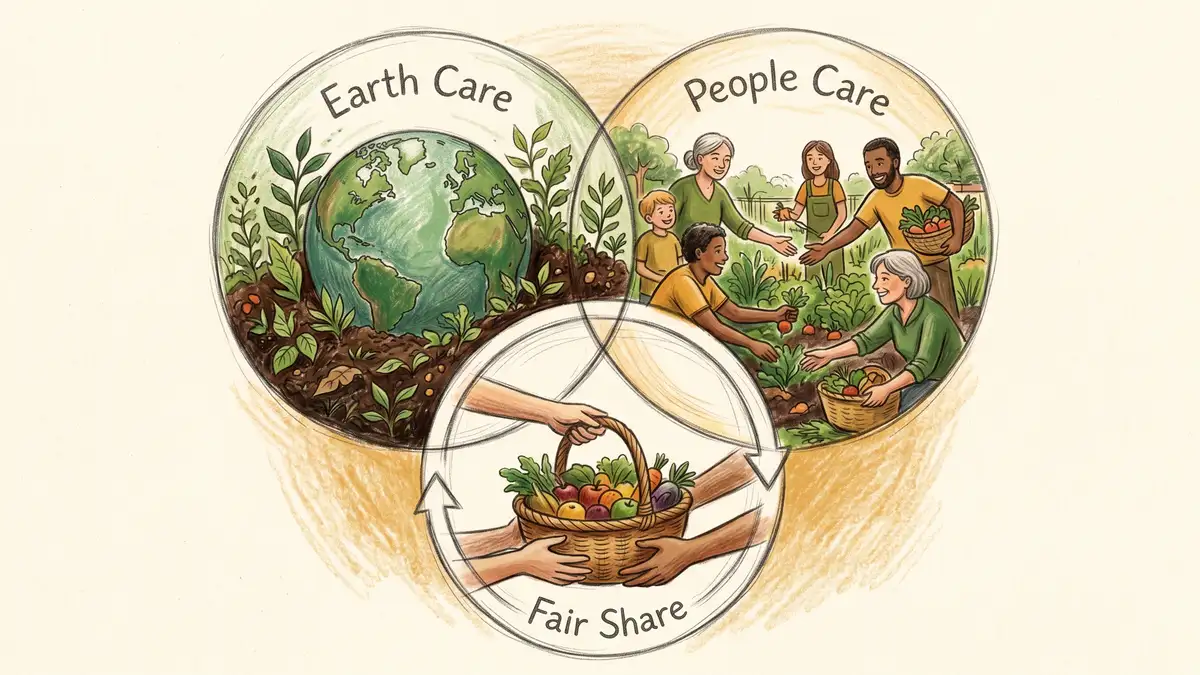
Every permaculture decision is meant to pass through 3 ethical filters. The ethics come from Bill Mollison and David Holmgren in the 1970s and remain unchanged across modern teaching, including Permaculture Principles (Holmgren's official site) and Oregon State University's open permaculture course.
Earth Care: Maintain or improve the health of the soil, water, plants, and animals on your land. If a design degrades any of these, redesign.
People Care: Meet human needs (food, shelter, medicine, community, education) without exploiting people. In a backyard, this means designing for the person who lives there, not for some imagined ideal homestead.
Fair Share (Return of Surplus): When the system produces more than you need, return the surplus to the system itself or share it with others. Compost, seeds, fruit, time, and knowledge all count.
The 12 design principles (Holmgren's framework)
David Holmgren codified 12 principles in Permaculture: Principles and Pathways Beyond Sustainability (2002), now treated as the canonical framework. Permaculture Principles documents all 12.
| # | Principle | What it means in a home garden |
| 1 | Observe and Interact | Watch your site through a full year before major changes |
| 2 | Catch and Store Energy | Rainwater barrels, soil organic matter, perennials, batteries |
| 3 | Obtain a Yield | Every element should produce something useful (food, mulch, shade) |
| 4 | Apply Self-Regulation and Accept Feedback | Adjust when something is not working; do not double down on bad designs |
| 5 | Use and Value Renewable Resources | Sun, wind, rain, animal manures, perennial systems |
| 6 | Produce No Waste | Compost kitchen scraps, mulch leaves, repair instead of replace |
| 7 | Design from Patterns to Details | Sketch the broad strokes (zones, sun, water) before picking individual plants |
| 8 | Integrate Rather Than Segregate | Mix plants and animals into guilds rather than separate plots |
| 9 | Use Small and Slow Solutions | Start with 1 bed, expand annually as you learn |
| 10 | Use and Value Diversity | Plant 30 species rather than 3; risk is spread |
| 11 | Use Edges and Value the Marginal | The bed-path boundary is the most productive zone |
| 12 | Creatively Use and Respond to Change | When climate shifts, change plants; do not fight reality |
Source: Permaculture Principles: The 12 Design Principles
Mollison's older principles (still in use)
Bill Mollison's earlier framework from Permaculture: A Designers' Manual (1988) added 3 principles still widely cited:
Relative Location: Place elements where they support each other. The chicken coop next to the compost pile next to the orchard, not at 3 separate ends of the property. Permaculture Magazine covers the principle in detail.
Each Element Performs Many Functions: A chicken provides eggs, meat, manure, pest control, and soil aeration. A pond provides water, fish, irrigation overflow, and microclimate moderation.
Each Important Function Is Supported by Many Elements: If your garden depends on 1 water source, 1 pollinator, or 1 crop, it is fragile. Build in redundancy.
Zones 0 to 5 (the spatial framework)
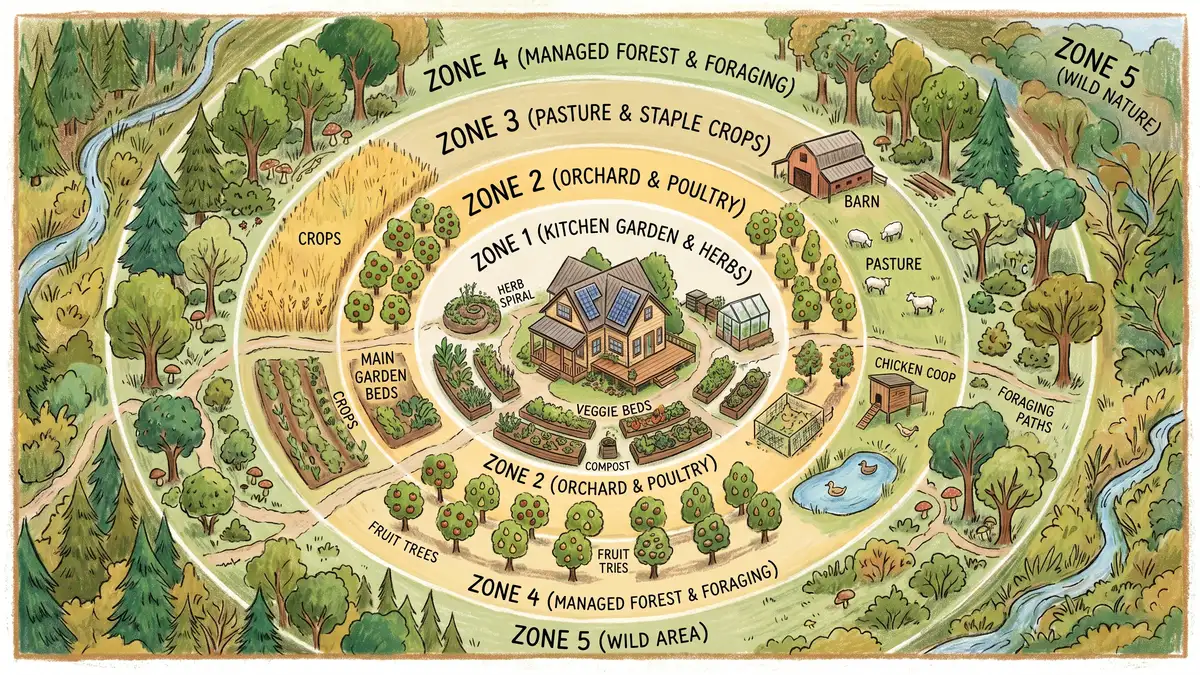
Zones organise a property by frequency of visit. Things you visit daily go in Zone 1; things you visit yearly go in Zone 4. The framework comes from Oregon State University's permaculture chapter.
| Zone | Location | What goes there |
| 0 | The house | Sprouts on the windowsill, indoor herbs, kitchen composting |
| 1 | Just outside the back door (10 to 20 ft) | Salad greens, herbs you cut daily, salad mandala |
| 2 | 20 to 100 ft from house | Vegetable beds, small fruit trees, chicken coop |
| 3 | 100+ ft, broader plantings | Orchard, larger vegetable plantings, grain crops |
| 4 | Managed forest and foraging | Coppice firewood, mushroom logs, nut trees, wild medicinals |
| 5 | Wild, undisturbed | Pollinator habitat, observation, learning from nature |
Source: Oregon State University: Permaculture Zones
For a 1/4 acre US suburban lot, you typically use Zones 0 through 3. Most home gardeners never need 4 and 5; those scale to acreage.
Earthworks and water
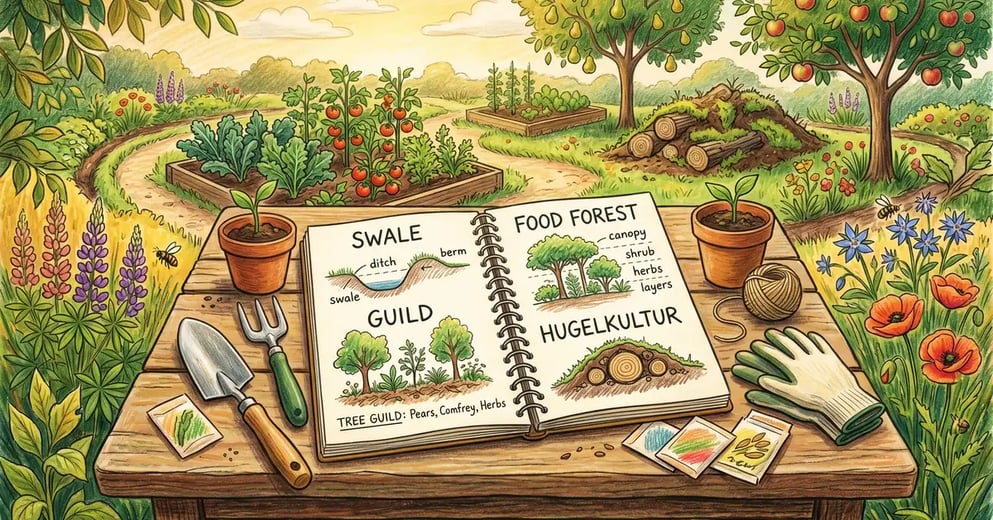
Swale: A shallow trench dug on contour (level along its length) that catches and infiltrates rainwater. Typical residential dimensions: 1 to 3 feet wide, 6 to 18 inches deep. The downhill soil is piled into a berm and planted. See our swales and berms guide.
Berm: The mounded soil downhill of a swale, planted with fruit trees or shrubs that benefit from the water captured above.
Keyline Design: A water management system developed by Australian engineer P.A. Yeomans in the 1950s that uses contour subsoiling to spread water across paddocks. Documented at Yeomans Plow Co.
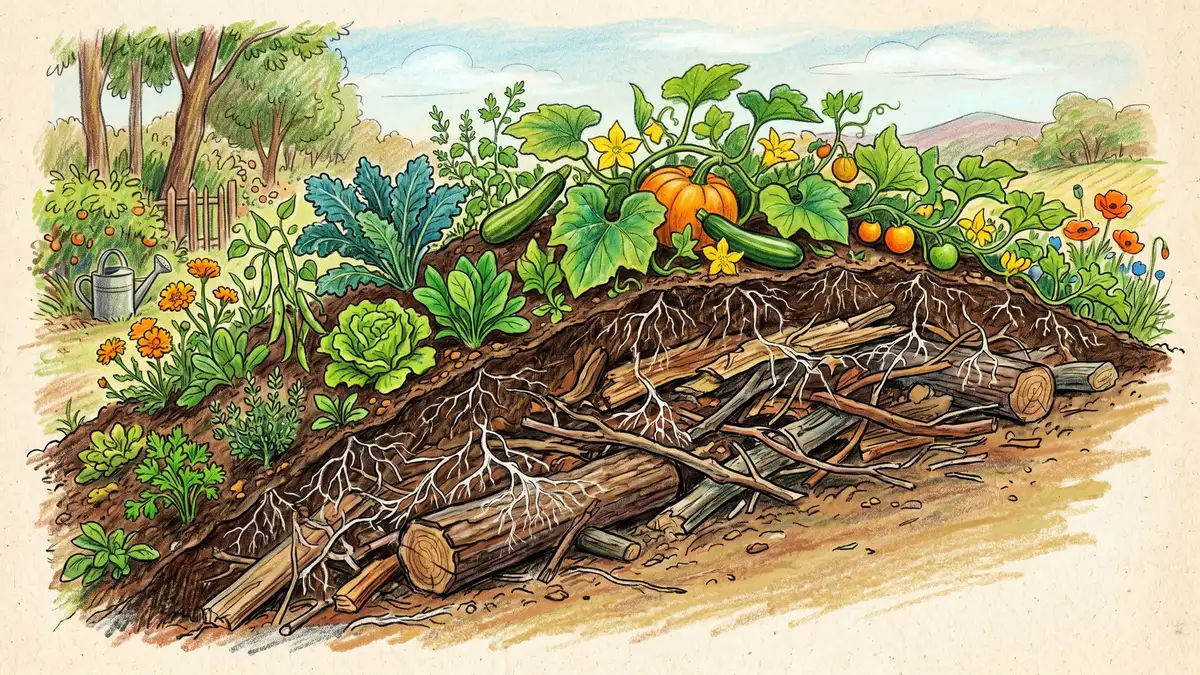
Hugelkultur: A raised bed built over a base of logs and branches. The buried wood holds water and slowly releases nutrients as it decomposes. Pronounced HOO-gul-kul-tur. Associated with Austrian permaculturist Sepp Holzer. Forks in the Dirt has a good build guide.
Rain Garden: A shallow planted basin sized to absorb runoff from a roof or driveway. Often paired with downspouts.
Cistern: A larger water storage tank (500 to 5,000+ gallons). Above-ground or buried.
Greywater: Household water from showers, bathroom sinks, and washing machines (not toilets). Can legally irrigate landscapes in most US states.
Blackwater: Toilet water and kitchen sink water (contains pathogens). Treated separately, not reusable on edible plants.
Contour Planting: Planting along lines of equal elevation rather than up and down a slope. Reduces erosion.
Site design terms
Sector Analysis: Mapping the directional influences on a site (prevailing wind, sun angles, fire risk, noise, views). Used to position elements that block or capture these flows.
Microclimate: A small area where temperature, humidity, wind, or sun exposure differs from the surrounding landscape. South-facing walls create warm microclimates; tree-shaded northern aspects create cool ones.
Edge Effect: The zone where 2 ecosystems meet (forest and meadow, pond and shore) is more productive and biodiverse than either alone. Permaculture designs deliberately maximise edge. Permaculture Food Forest explains.
Ecotone: The technical ecology term for the transition zone between ecosystems. Synonym for edge in permaculture usage.
Stacking Functions: Designing each element to perform multiple jobs. A chicken stacks 5 functions (eggs, meat, manure, pest control, soil aeration). A pond stacks 4 (water, fish, irrigation, microclimate). Permies forum has detailed examples.
Polyculture: Growing multiple species together (lettuce, carrots, radish, basil all in the same bed). Opposite of monoculture.
Monoculture: Single-species planting at scale (a wheat field, a corn field, a lawn). Vulnerable to pests, disease, and weather.
Succession: The natural progression of plant communities over time. Bare soil to weeds to grasses to shrubs to trees to mature forest. Permaculture often accelerates or arrests succession deliberately.
Plant systems
Guild: A small group of plants arranged to support each other. The classic apple guild: apple tree + comfrey + chives + nasturtium + clover + yarrow. Each plant performs a function (nitrogen fixation, pest deterrent, pollinator attractor, dynamic accumulator, ground cover).
Companion Planting: Pairing plants that benefit each other. Tomato + basil. Carrots + onions. Corn + beans + squash (the Three Sisters). Mostly intuitive, partly evidence-based.
Three Sisters: Corn, beans, and squash planted together. An indigenous North American polyculture predating permaculture by centuries. Corn supports beans, beans fix nitrogen, squash shades the ground. Nettles and Roses Permaculture covers the history.
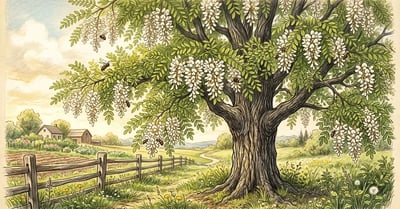
Nitrogen Fixer: A plant in the Fabaceae family (legumes) that hosts bacteria converting atmospheric nitrogen into a form roots can use. Beans, peas, clover, vetch, alfalfa, locust trees.
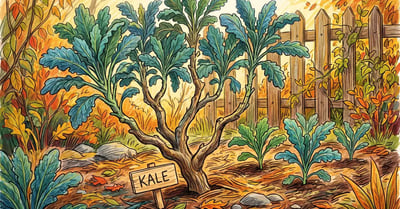
Dynamic Accumulator: A plant that draws specific minerals from deeper soil layers and concentrates them in its leaves. When chopped and dropped as mulch, the minerals become available to surrounding plants. Comfrey and yarrow are the most cited examples. A Food Forest in Your Garden covers the supporting research.
Pioneer Species: Fast-growing plants that colonise disturbed or poor soils first. They build soil and prepare conditions for slower successional plants. Locust, alder, willow, mullein, comfrey.
Climax Species: Long-lived plants that dominate a mature ecosystem. Oak, hickory, maple, beech.
Food Forest: A multi-layered perennial planting that mimics a natural forest but yields food at every layer.
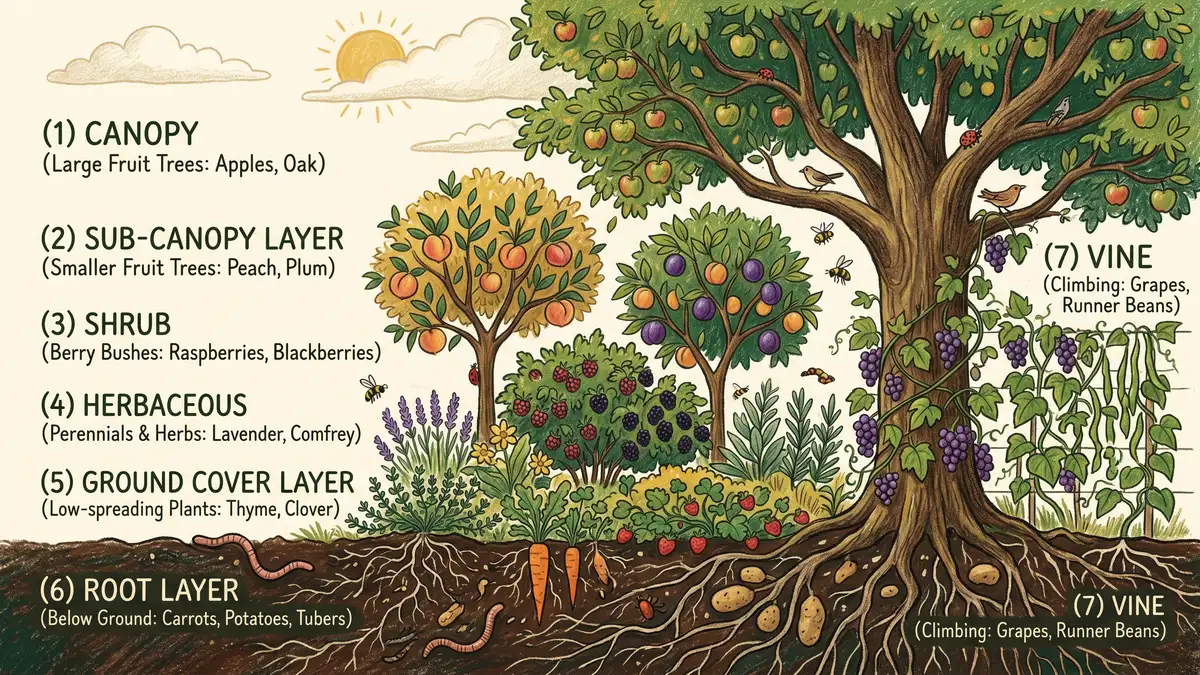
7 Layers of a Food Forest: The canonical structure (Robert Hart's framework, refined by later permaculture writers):
- Canopy: Large fruit and nut trees (apple, pear, walnut, chestnut)
- Sub-canopy: Smaller fruit trees (dwarf apple, peach, plum)
- Shrub: Berry bushes (blueberry, currant, gooseberry)
- Herbaceous: Perennial herbs and flowers (comfrey, oregano, lovage)
- Ground Cover: Low spreading plants (strawberry, clover, sweet woodruff)
- Root: Edible roots and tubers (carrot, potato, garlic, horseradish)
- Vine: Climbers (grape, kiwi, hops)
Some modern frameworks add an 8th layer for fungi (mushrooms in logs and soil) and a 9th for aquatic plants in ponds. See our full 7 layers of a food forest guide.
Chop and Drop: Pruning a plant and dropping the cuttings as mulch in place rather than hauling them off to compost. Common with comfrey, banana, pigeon pea, lemongrass.
Cover Crop: A crop grown to protect or improve soil rather than for harvest. Clover, rye, vetch, buckwheat.
Green Manure: A cover crop that is chopped or tilled into the soil to add nitrogen and organic matter.
Soil terms
Soil Food Web: The network of bacteria, fungi, protozoa, nematodes, arthropods, earthworms, and roots that recycle nutrients and build soil structure. Coined by Dr. Elaine Ingham. Free Permaculture has a good primer.
Mycorrhizae: Symbiotic fungi that attach to plant roots and extend their reach into the soil, exchanging water and nutrients for plant sugars. Roughly 90 percent of plant species form mycorrhizal partnerships.
No-Dig (No-Till): A method of building soil that avoids turning over the topsoil. Preserves soil structure, fungal networks, and reduces weed germination.
Sheet Mulching (Lasagna Gardening): Building a no-dig bed by layering cardboard, compost, manure, leaves, and straw directly on top of grass or weeds. Smothers the underlying vegetation and creates a planting layer over the course of a few months.
Compost: Decomposed organic matter used to improve soil.
Vermicompost: Worm-produced compost (worm castings). Higher in nutrients and beneficial microbes than regular compost.
Biochar: Charcoal produced by burning organic matter in low oxygen, then crushed and added to soil. Provides long-term habitat for microbes and increases water retention.
Carbon to Nitrogen Ratio (C:N): The ratio of carbon-rich material (browns: straw, wood chips, dried leaves) to nitrogen-rich material (greens: kitchen scraps, fresh grass, manure) in a compost pile. Ideal range is about 25:1 to 30:1. SDSU Extension documents the science.
Animals and integration
Chicken Tractor: A movable chicken pen (no floor) that is rotated across garden beds. The chickens clear weeds, eat pests, and fertilize each section before moving on.
Holistic Management: A grazing framework developed by Allan Savory that uses high-density rotational grazing to mimic herd movement and regenerate grasslands.
Silvopasture: Integrating trees, pasture, and livestock on the same land. Keela Yoga Farm documents silvopasture with chickens and sheep.
Specific patterns
Mandala Garden: A circular garden with pie-slice or concentric beds. Detailed in our mandala garden guide.
Banana Circle: A circular pit with a soil berm planted with 4 to 7 banana plants. The pit composts kitchen scraps and absorbs greywater. See our banana circle guide.
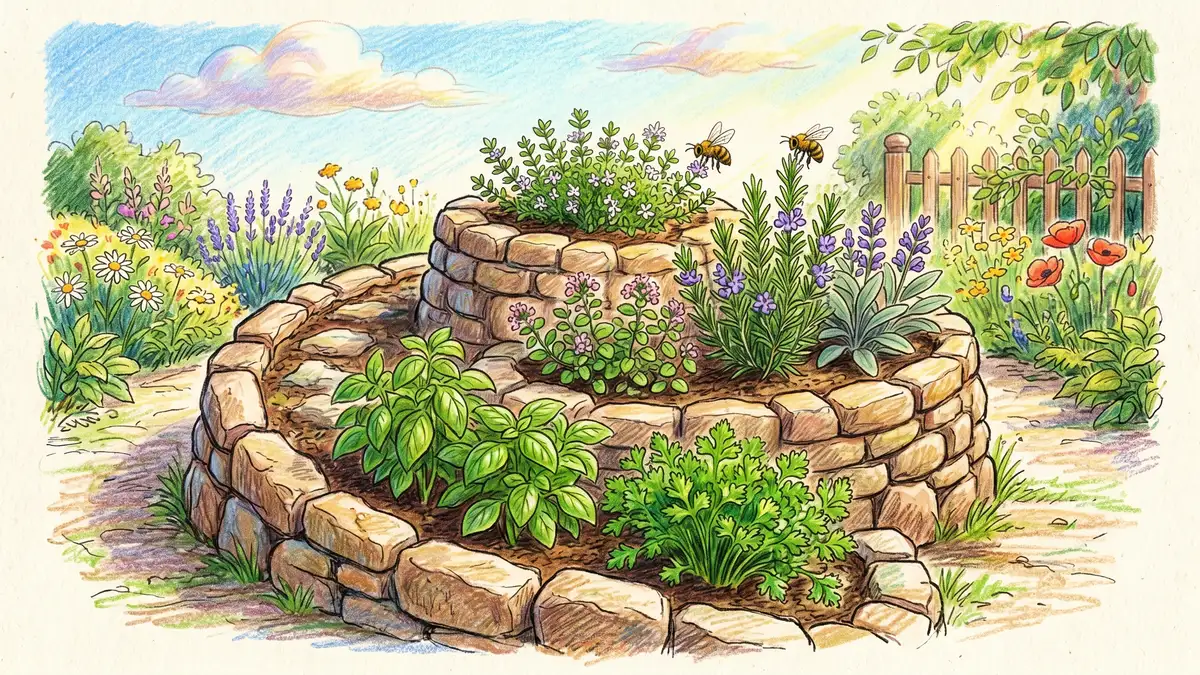
Herb Spiral: A spiral mound 3 to 6 feet across, 2 to 3 feet tall, edged with stone. Different microclimates support different herbs from top (dry, sunny) to bottom (moist, shaded).
Keyhole Bed: A circular raised bed with a notched access path so a single gardener can reach the entire bed without stepping on the soil. Often paired with a central compost basket.
Forest Garden: Synonym for food forest, more common in UK usage (Martin Crawford's Forest Garden Network).
Key thinkers and origins
Bill Mollison (1928 to 2016): Australian biologist, co-founder of permaculture in the 1970s. Author of Permaculture: A Designers' Manual, the foundational text.
David Holmgren: Australian designer, Mollison's collaborator. Codified the 12 design principles still in use today.
Geoff Lawton: Australian permaculturist, runs Zaytuna Farm and the Permaculture Research Institute, prolific teacher via Discover Permaculture YouTube.
P.A. Yeomans (1905 to 1984): Australian engineer and inventor of keyline design and the Yeomans plow.
Masanobu Fukuoka (1913 to 2008): Japanese natural farmer, author of The One-Straw Revolution. Influenced permaculture's no-dig and minimal-intervention philosophy.
Sepp Holzer: Austrian farmer, popularised hugelkultur and large-scale alpine permaculture on his Krameterhof farm.
Toby Hemenway (1952 to 2016): American permaculturist, author of Gaia's Garden, the most widely read US permaculture book.
Why This Works: Vocabulary as Compression
Each term in this glossary is a 1-word shortcut for a complex idea that would take 2 paragraphs to explain otherwise. Once you know "swale", you stop having to read "shallow ditch dug on contour to slow rainwater and direct it into the soil." Permaculture's vocabulary is dense because the system itself is dense; the words exist to let practitioners design quickly. You do not need to learn all 50 today. You will pick them up as you build.
Common beginner confusions
Mistakes That Slow Down New Permaculture Gardeners
Most vocabulary confusion comes from 3 sources: terms that overlap in meaning, terms that sound technical but describe simple things, and terms borrowed from ecology where the everyday meaning differs.
- Guild vs companion planting. Companion planting is the broad practice of pairing plants. A guild is a specific multi-plant arrangement (usually 5 to 9 species) around a focal plant. All guilds are companion planting, not all companion planting is a guild.
- Polyculture vs guild. Polyculture just means more than one species in a bed. A guild is a polyculture with intentional supportive relationships.
- Mulching vs sheet mulching. Mulching is putting any organic layer on top of soil. Sheet mulching is the specific technique of layering cardboard plus compost plus mulch to build a new bed over grass.
- Compost vs mulch. Compost is finished decomposed organic matter you mix into soil. Mulch is fresh organic matter you spread on top.
- Hugelkultur vs no-dig. Hugelkultur is a no-dig bed built specifically over buried wood. All hugelkultur is no-dig, but most no-dig beds are not hugelkultur.
FAQ
What is permaculture in simple terms?
Permaculture is a design system for working with nature instead of against it. It combines ecology, indigenous knowledge, and design theory to create gardens, farms, and human settlements that produce food, store water, build soil, and support wildlife. The core ethic is "leave the place better than you found it." Bill Mollison and David Holmgren coined the term in 1970s Australia by combining "permanent" and "agriculture/culture."
What are the 12 principles of permaculture?
Holmgren's 12 design principles, in order: 1) Observe and Interact, 2) Catch and Store Energy, 3) Obtain a Yield, 4) Apply Self-Regulation and Accept Feedback, 5) Use and Value Renewable Resources, 6) Produce No Waste, 7) Design from Patterns to Details, 8) Integrate Rather Than Segregate, 9) Use Small and Slow Solutions, 10) Use and Value Diversity, 11) Use Edges and Value the Marginal, 12) Creatively Use and Respond to Change. They are documented in his 2002 book Principles and Pathways Beyond Sustainability.
What is a swale?
A swale is a shallow ditch dug along a contour line (level along its length) that catches rainwater running across a slope, slows it, and lets it soak into the soil. The excavated soil is piled into a downhill berm and planted with fruit trees or shrubs that use the captured water. Typical home garden swales are 1 to 3 feet wide and 6 to 18 inches deep.
What is hugelkultur?
Hugelkultur is a raised garden bed built on top of logs and branches. As the buried wood decomposes over 10 to 20 years, it absorbs and releases water, releases nutrients, and feeds soil fungi. Beds are typically built 3 to 6 feet tall initially and settle to about 3 feet over a year. Pronounced HOO-gul-kul-tur (German for "mound culture"). Associated with Austrian permaculturist Sepp Holzer.
What is permaculture design?
Permaculture design is the systematic process of laying out a property using permaculture ethics, principles, zones, sectors, and patterns. The goal is to create a productive, resilient, low-input system that meets human needs while regenerating the land. Practitioners are trained through a 72-hour Permaculture Design Certificate (PDC) course following Bill Mollison's original curriculum.
What is a permaculture guild?
A guild is a small group of plants (usually 5 to 9 species) arranged around a focal plant (often a fruit tree) so that each member supports the others. A typical apple tree guild includes the apple plus comfrey (dynamic accumulator), chives (pest deterrent), clover (nitrogen fixer), nasturtium (insect distractor), and yarrow (pollinator attractor). The guild reduces the need for external inputs.
What is the difference between permaculture and organic gardening?
Organic gardening is a methodology focused on avoiding synthetic chemicals. Permaculture is a broader design framework that includes organic methods but adds ethics, principles, zone planning, integration of water and energy systems, and a focus on perennial polycultures. All permaculture gardens are organic by default; not all organic gardens are permaculture.
Get the Weekly Dig
One practical permaculture guide a week, written for gardeners who do this on weekends: permaculture design for real backyards. Free, no spam, unsubscribe any time.
Join the Weekly DigResources
- Permaculture Principles: The 3 Ethics (Holmgren's site)
- Permaculture Principles: The 12 Design Principles
- Oregon State University: Introduction to Permaculture
- Oregon State University: Permaculture Zones
- Free Permaculture: Soil Food Web Primer
- Free Permaculture: Earthworks and Keyline Design
- SDSU Extension: Carbon to Nitrogen Ratio
- Yeomans Plow Co: Keyline Systems Explained
- Permies: Beyond the Traditional 7 Layers
- Nettles and Roses Permaculture: Three Sisters History
- A Food Forest in Your Garden: Dynamic Accumulators
- Permaculture Magazine: Relative Location Principle