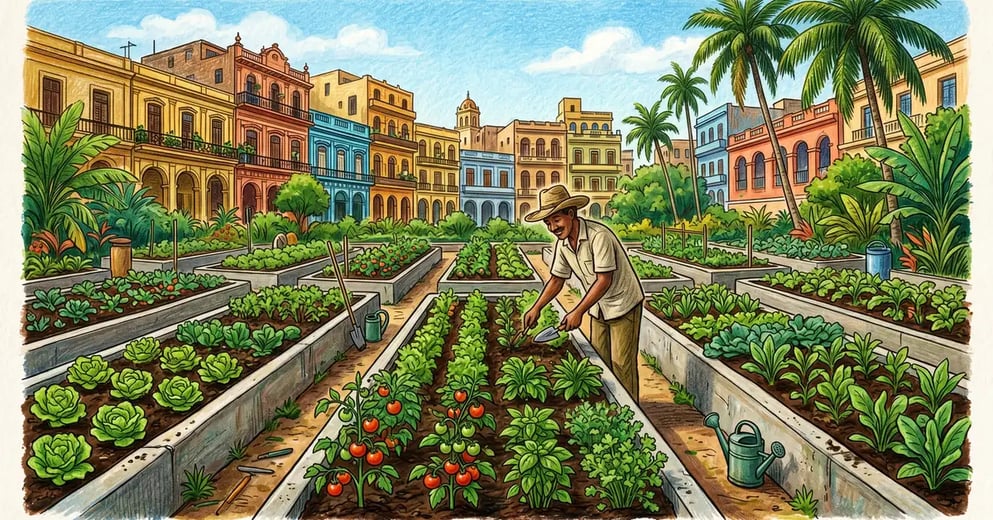

In 1989 the Soviet Union collapsed. For Cuba it meant an overnight 80 percent loss of imports: food, fuel, fertilizer, machinery, all gone. Calorie intake fell from 2,900 per day to 1,800 in about 4 years. The country lost roughly 5 to 9 percent of its population's body weight on average. And then Cubans did something remarkable. They tore up parking lots and bombed-out city blocks, built raised beds out of concrete debris, filled them with compost from neighborhood waste, and grew their cities back to fed.
This is what permaculture looks like when there is no other choice. Cuba's organoponico system is now the largest urban agriculture network in the world, producing roughly 1.5 million tons of vegetables a year. The lessons translate directly to US urban micro-growers with small lots, tight budgets, and no patience for theory.
Key Takeaway
Cuba's organoponico system is the world's largest urban agriculture network: 383,000 farms producing 1.5 million tons of vegetables annually, mostly in Havana. The model was born from necessity when Soviet trade collapsed in 1989. Core technique: walled raised beds 4 ft wide and 30 to 50 ft long, filled 50/50 with soil and compost, with biological pest control via 280 community insectaries. The same dimensions and soil mix work in US urban backyards for $50 to $150 per bed.
The Special Period: how Cuba invented urban permaculture by accident
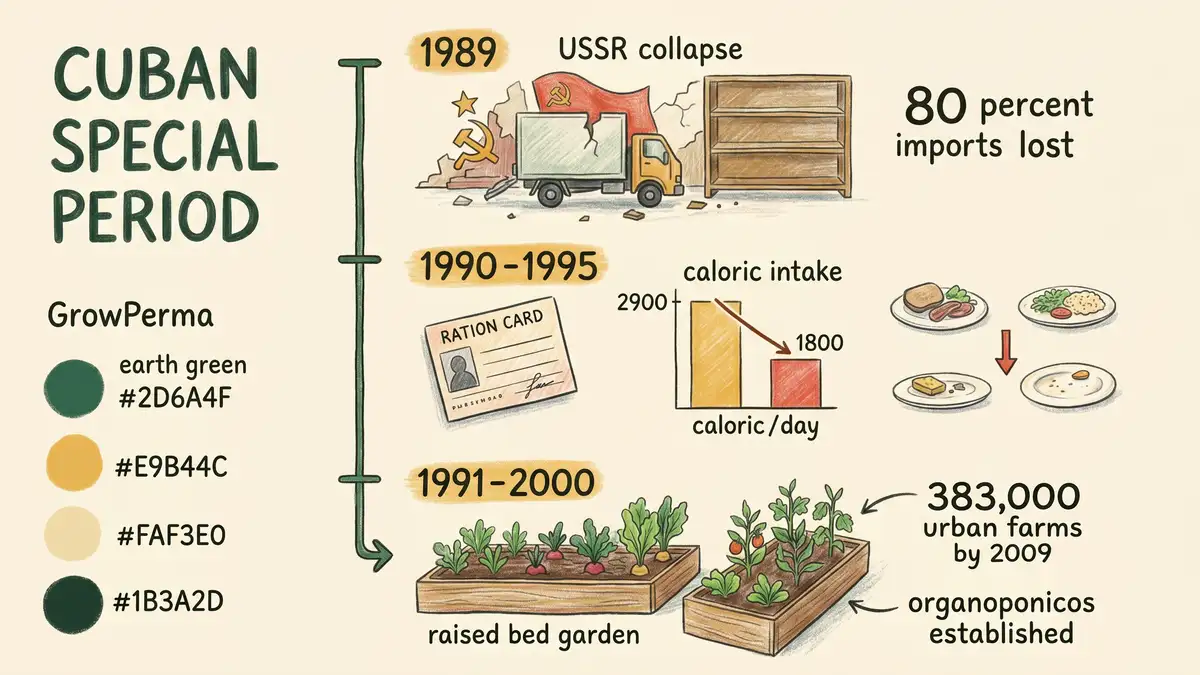
Pre-1989 Cuba ran on Soviet trade: 63 percent of food imports, almost all the fuel, 80 percent of machinery, 70 percent of fertilizer and pesticides. When the USSR dissolved in 1991, every one of those streams stopped. Cubans called the resulting crisis the Periodo Especial en Tiempos de Paz: the Special Period in Peacetime. Caloric intake dropped roughly 36 percent in 4 years. The average Cuban adult lost between 11 and 20 pounds during the worst years.
Within 18 months, Havana began converting vacant city lots, parking lots, traffic medians, and even rooftops into food production. The government published guidance, the National Group for Urban Agriculture (GNAU) was established in 1994, and by 2002 the network had grown into the formalized 5-tier organoponico system. By the early 2000s urban farming employed over 320,000 Cubans (Monthly Review).
Why This Works: Constraint as Designer
Cuba did not become organic because of ideology. Cuba became organic because no synthetic inputs were available. The same principle applies to US urban micro-growers: real constraints force real design. A tiny lot, a tight budget, and no time create the same pressure that produced the organoponico. Solutions emerge that would never appear in well-resourced environments.
What an organoponico actually is
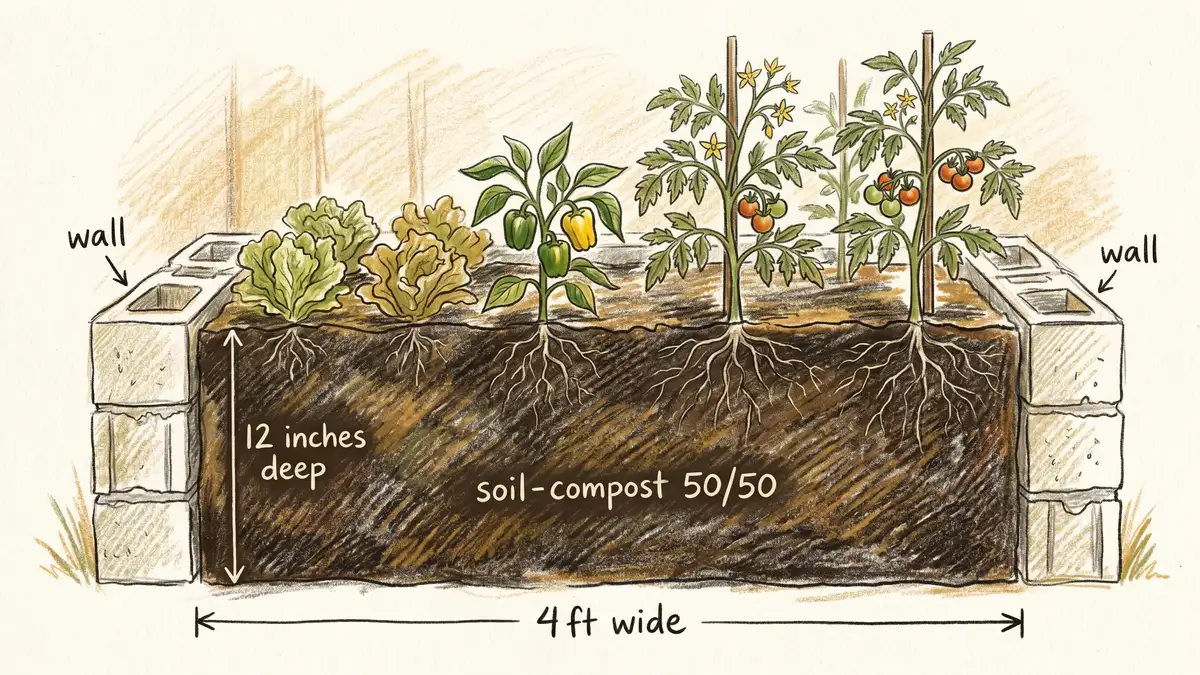
An organoponico is a walled raised bed urban garden, mandated organic by Cuban law, designed for high-density vegetable production on degraded or unfit-for-construction land. Yale's SAGE Magazine documents the standard specs:
| Element | Cuban standard | Why |
| Bed width | 4 ft (1.2 m) | Reachable from both sides without stepping in |
| Bed length | 30-50 ft (10-15 m) | Path-to-bed efficiency for a single garden cell |
| Bed depth | 12 in (30 cm) | Enough for shallow-rooted vegetables; matches available materials |
| Wall material | Concrete blocks, broken slabs, fired brick, repurposed rubble | Free or near-free in post-Soviet Cuba |
| Soil mix | 50% soil + 50% compost | Massively more compost than US conventional advice |
| Path width | 18 in (45 cm) | Wheelbarrow access |
| Density target | 4 lbs of vegetables per sqft per year | Roughly 10x conventional yield |
Sources:
The 50/50 soil-to-compost mix is the most important design choice. Most US raised-bed advice calls for 25 to 30 percent compost; the Cuban standard is double that. The reason: tropical heat burns through organic matter fast, and high compost ratios buffer water and feed crops continuously. The same logic improves yields in any climate where you need to feed plants without synthetic fertilizer.
The 5 tiers of Cuban urban agriculture
The system isn't just organoponicos. Cuba codified urban agriculture into 5 distinct types, each tuned to a specific scale and context:
Patios and parcelas (residential courtyards and small plots)
Roughly 30,000 in Havana alone. The Cuban kitchen garden. Backyards, balconies, rooftops, courtyards. Often under 200 sqft. Grown for the family, with surplus shared or sold informally.
Huertos populares (popular community gardens)
Neighborhood-managed plots on vacant lots. Members get plots, share tools and water. Function like US community gardens but at much higher density and with shared compost infrastructure.
Organoponicos (production organoponicos)
The signature system. Half-acre to 5-acre walled-bed farms on otherwise unusable urban land: rubble lots, abandoned construction sites, drainage easements. Run by cooperatives. Required by law to sell at affordable prices to the surrounding neighborhood.
Suburban farms (granjas suburbanas)
Larger 10 to 50 acre farms on the urban edge. Mixed vegetables, fruit trees, small livestock, fish ponds. Supply urban markets and provide training sites for new growers.
Cultivo semi-protegido (semi-protected cultivation)
Shade-houses, screen-houses, and simple high tunnels. Critical for tropical urban growing where direct sun is too intense for lettuce and tender crops. Roughly 30 percent shade cloth typical, with bird and pest netting integrated.
The 3 Cuban innovations US urban micro-growers can copy
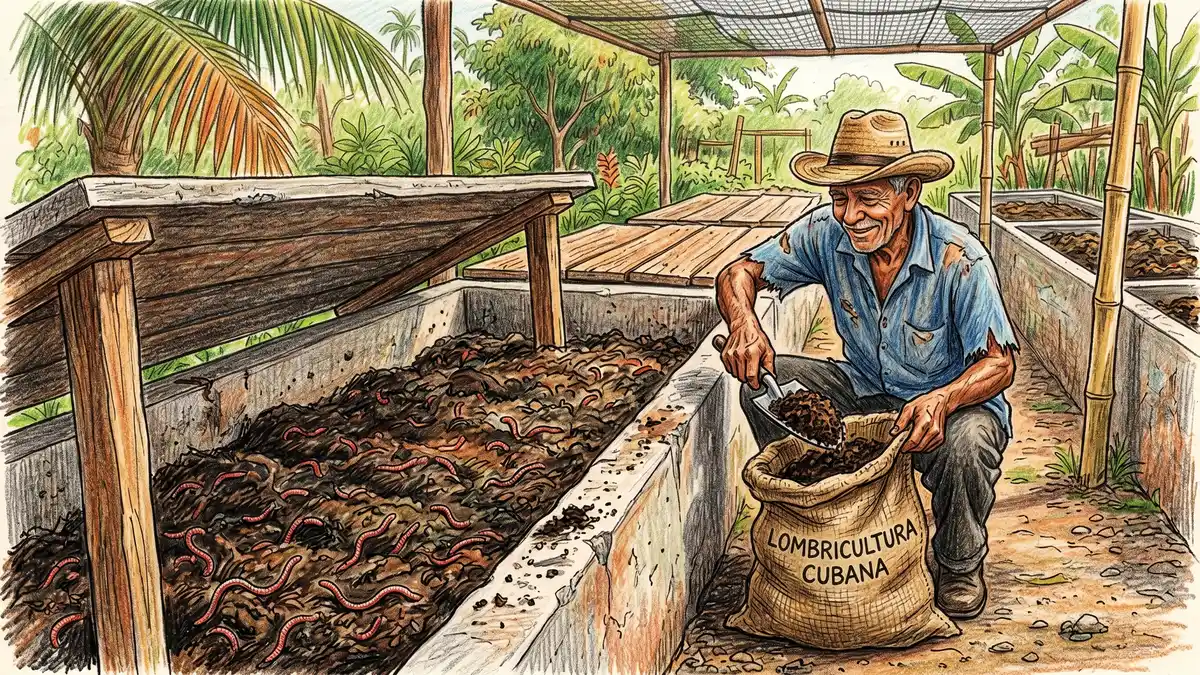
1. Lombricultura (industrial-scale worm composting)
Cuba composts roughly 100,000 tons of organic waste per year, much of it through lombricultura, large-scale worm composting in long concrete bins. BioCycle Magazine documents how Cuban municipal worm operations supply many organoponicos with their compost mix. Red wigglers process kitchen waste, manure, and yard waste in 3 to 6 months, producing vermicompost (worm castings) used directly in raised beds.
US version: even a 4 by 4 foot DIY worm bin in a garage or basement supplies enough castings for a 200 sqft garden. See our guide to harvesting worm castings and the worm composting guide.
2. CREE (community biocontrol centers)

Cuba runs roughly 280 Centros de Reproducción de Entomofagos y Entomopatogenos (CREEs): community-scale labs that breed beneficial insects, fungi, and bacteria for biological pest control. Trichogramma wasps (parasitize moth and butterfly eggs), Beauveria bassiana fungus (kills aphids and whiteflies), Bacillus thuringiensis (caterpillar control), ladybugs, lacewings.
Organoponicos rely on CREEs because synthetic pesticides are illegal in urban production. Green Economy Coalition documents CREEs as one of the most distinctive features of Cuban urban agriculture: free or near-free biocontrol available to any neighborhood grower who walks in with a problem.
US version: order live beneficial insects from Arbico Organics, Gardens Alive, or BioGardener. A $30 to $50 packet of trichogramma wasps or lacewing eggs covers 1,000 sqft of garden. Cheaper than annual pesticide programs and far better for soil microbes. For more, see our designing for pollinators guide.
3. Walled raised beds with 50/50 soil-compost
The single biggest US-translatable innovation. University of Georgia CAES recommends 3 to 4 foot wide beds with at least 25 percent compost; the Cuban standard is 4 ft wide with 50 percent compost. The doubled compost ratio holds 2 to 3 times more water, releases nutrients continuously, and supports the dense microbial life that fights soil disease.
Build cost in 2026 US: $50 to $150 for a 4 by 10 ft bed using cedar boards or recycled concrete blocks. Soil mix: 1 cubic yard topsoil + 1 cubic yard finished compost, mixed thoroughly. Plant immediately. First harvest in 30 to 45 days for fast greens.
What Cuban urban agriculture actually produces
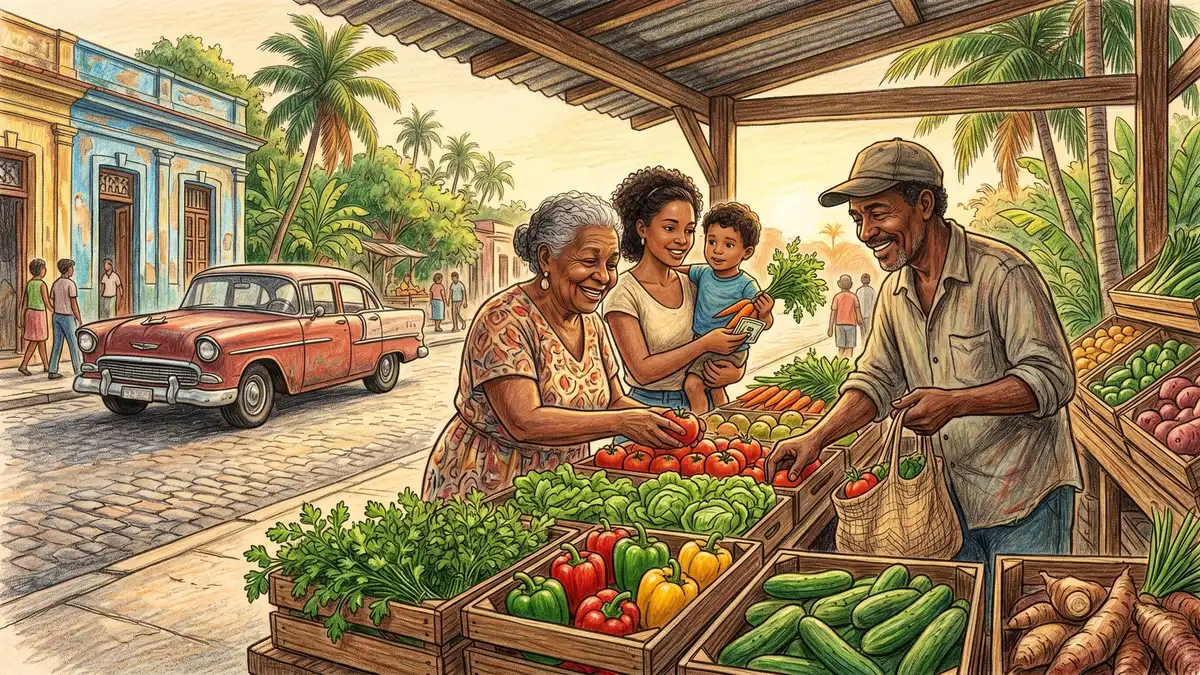
Vivero Alamar on the edge of Havana is the famous flagship: 25 acres, around 150 workers, ~300 tons of vegetables per year from what was once a contaminated dumping ground. Run as a cooperative by Miguel Salcines and his team since the mid-1990s. They produce lettuce, tomatoes, peppers, onions, garlic, chard, kale, beans, herbs, and medicinal plants. Sales happen at the garden gate; prices are set below state-market rates.
Across all of Cuba, urban agriculture now provides between 60 and 90 percent of the fresh vegetables consumed in Cuban cities (Incredible Edible). Havana alone has roughly 35,000 hectares (86,500 acres) of urban farms inside the metro area.
One epidemiological consequence: between 1980 and 2010, Cuban diabetes mortality fell by 51 percent and coronary heart disease mortality fell by 35 percent, partly attributed to the diet shift toward fresh vegetables and the increased physical activity of the Special Period (Franco et al., American Journal of Epidemiology, 2007).
Adapting Cuba's lessons to a US urban backyard
You are not Cuba. You probably have synthetic pesticides legally available. You probably have access to bagged compost, garden centers, and Amazon. The lessons that translate best are the design choices, not the ideology:
- Build raised beds 4 ft wide × any length × 12 in deep. Cuban dimensions are optimised; do not deviate without a reason.
- Use a 50/50 soil-to-compost mix. Double the compost most US guides suggest. Buy half compost, half topsoil from your local landscape supply.
- Run worm composting on the side. Even a small 10-gallon tub of red wigglers gives you finished castings to refresh beds yearly.
- Order biocontrol instead of spraying. Trichogramma wasps, lacewings, and ladybugs replace pesticide cycles for $30 to $50 per season.
- Plant in dense polyculture, not row monoculture. Organoponicos plant 6 to 12 species per bed in mixed patterns to confuse pests and stretch nutrients.
- Build community. Cuba's network worked because every neighborhood had a garden. Find or start a community plot near you.
For broader cultural context on global permaculture see our permaculture around the world overview and the permaculture in cold climates companion. For the underlying permaculture vocabulary see our permaculture glossary.
Why This Works: Closing the Loop
The Cuban organoponico closes the loop between household, neighborhood, and farm at walking distance. Kitchen scraps go to community worm bins. Worm castings go to nearby raised beds. Beds produce food sold to the same neighborhood. Money stays local. Soil improves year after year. This is what Bill Mollison meant when he wrote about closing nutrient and energy loops. It worked because Cuba had no choice, and it keeps working because the design is better than the alternative.
What to avoid: 4 mistakes US gardeners make when copying Cuba
Lessons That Do Not Translate
Not everything that works in Havana works in Minneapolis or Phoenix. The Cuban context includes specific climate, soil, and policy realities. Take the design choices; ignore the romanticisation.
- Skipping the shade-house in hot US climates. Cuba uses semi-protected cultivation in summer because direct tropical sun fries lettuce. Phoenix, Tucson, and Houston gardeners need the same approach: 30 percent shade cloth from June to September.
- Trying to grow tropical-only crops in zone 5. Organoponico species lists assume year-round growing. Most US zones below zone 7 cannot replicate the rotation. Adapt the bed design; adapt the species to your zone.
- Romanticising scarcity. Cuban urban agriculture is hard work driven by economic necessity. If you have other options, use them as needed. The system is admirable; the conditions that produced it are not.
- Skipping the soil test. US urban soils often contain lead from old gasoline and paint. Get a soil test through your county extension before planting any in-ground bed. Use walled raised beds with imported soil if results are high.
FAQ
What is Cuban urban agriculture?
Cuban urban agriculture is a national network of community gardens, raised-bed farms (organoponicos), and small plots that supply between 60 and 90 percent of the fresh vegetables consumed in Cuban cities. It includes roughly 383,000 farms across 5 distinct categories: residential patios, popular gardens, organoponicos, suburban farms, and semi-protected cultivation. The system was built between 1991 and 2010 in response to the collapse of Soviet food and fuel imports.
What is an organoponico?
An organoponico is a walled raised-bed urban garden filled with a 50/50 soil and compost mix, required by Cuban law to be 100 percent organic. Standard dimensions: 4 ft wide × 30 to 50 ft long × 12 in deep. Walls are typically concrete blocks, broken slabs, or fired brick. Yields target 4 lbs of vegetables per square foot per year, roughly 10x conventional gardens. The model was developed in Havana in the early 1990s during the Special Period.
Why did Cuba start urban agriculture?
The Soviet Union dissolved in 1991, ending Cuban access to roughly 80 percent of imports including most food, fuel, fertilizer, and pesticides. Per-capita caloric intake dropped from about 2,900 to 1,800 per day. Havana began converting vacant lots and rooftops into vegetable production in late 1991 and the program was formalized when GNAU (National Group for Urban Agriculture) was established in 1994.
How much food does Cuba's urban agriculture produce?
Roughly 1.5 million tons of vegetables per year nationally. Urban farms supply between 60 and 90 percent of the fresh vegetables consumed in Cuban cities. Havana's urban agriculture sector alone employs over 90,000 people and covers about 35,000 hectares (86,500 acres) of city land.
How do organoponicos control pests without chemicals?
Through 280 community-run CREE centers (Centros de Reproducción de Entomofagos y Entomopatogenos) that breed beneficial insects, fungi, and bacteria. Standard biocontrol agents: Trichogramma wasps (egg parasites), Beauveria bassiana fungus, Bacillus thuringiensis, ladybugs, and lacewings. Combined with mandatory crop rotation and polyculture planting, this replaces synthetic pesticide use entirely.
Can US gardeners build their own organoponico?
Yes. Build a 4 ft wide × 10 ft long × 12 in deep raised bed using cedar boards or recycled concrete blocks. Fill with 50/50 mix of topsoil and finished compost. Plant in dense polyculture (lettuce, herbs, peppers, tomatoes mixed together). Add live ladybugs and trichogramma wasps for biocontrol. Total cost in 2026 US: $50 to $150 per bed. First harvest in 30 to 45 days for fast greens; full production by month 3.
What is lombricultura?
The Spanish term for industrial-scale worm composting using red wigglers (Eisenia fetida) in long concrete bins to process organic waste at municipal scale. Cuba uses lombricultura to convert household and farm waste into vermicompost (worm castings) for organoponicos. Output: roughly 100,000 tons per year nationally. A home-scale version works fine for a US backyard with a small worm bin and red wigglers.
Get the Weekly Dig
One practical permaculture guide a week, written for gardeners who do this on weekends: permaculture design for real backyards. Free, no spam, unsubscribe any time.
Join the Weekly DigResources
- Monthly Review: The Urban Agriculture of Havana
- Monthly Review: Cuban Urban Agriculture as Food Sovereignty Strategy
- SAGE Magazine: Urban Farm-Fed Cities Lessons from Cuba's Organoponicos
- Yale Tropical Resources Institute: Crisis of Urban Agriculture Case Studies in Cuba
- BioCycle Magazine: Vermiculture in Cuba
- Green Economy Coalition: The Guerrilla Gardeners of Havana
- Incredible Edible: Havana as Inspiration for Urban Food Policy
- PubMed: Franco et al. (2007) Cuban Health Outcomes During Crisis
- University of Vienna: Increasing Food Sovereignty with Urban Agriculture in Cuba (PDF)
- University of Georgia CAES: Raised Garden Bed Dimensions
- Craftsmanship Magazine: Cuba's Harvest of Surprises
- UNCCD: ANAP (National Association of Small Farmers of Cuba)