
Three inches of rain hit your roof in an October storm. A 1,000 sq ft (93 sq m) roof in that storm sheds 1,870 gallons (7,080 L) of clean water. Most of it runs into the street and disappears. A few hundred miles away, the same storm fills a homesteader's tanks and waters her garden through the next month.
That difference, multiplied across rain, sun, wind, biomass, and soil carbon, is the second of David Holmgren's 12 permaculture principles: Catch and Store Energy. Holmgren formalized the principle in his 2002 book Permaculture: Principles & Pathways Beyond Sustainability, and it has become the framework most backyard permaculture systems are built around.
This guide explains what catch and store energy actually means, the four main energy flows you can capture in a US backyard (solar, water, biomass, thermal), the realistic costs and payback timelines, the federal tax credits that subsidize it in 2026, and the integration mistakes that waste the most money.
The short answer
Catch and store energy is the second of Holmgren's 12 permaculture principles, formalized in 2002. The idea is simple: when free energy flows past your property (sun, rain, wind, biomass), capture it and store it for when you need it later. In a US backyard the four big targets are roof rainwater, passive solar gain, soil organic matter (carbon storage), and biomass (chop and drop, biochar). Smart capture systems pay back in 4 to 10 years and qualify for federal tax credits.
What "Catch and Store Energy" actually means
David Holmgren coined the modern phrasing in Permaculture: Principles & Pathways Beyond Sustainability (2002), building on Bill Mollison's earlier work and the broader systems-thinking tradition. His insight was that natural and economic systems concentrate available energy during periods of abundance ("make hay while the sun shines") and draw on those stores during scarcity. Modern industrial society does the opposite: it depends on a constant flow of fossil energy and stores almost nothing locally.
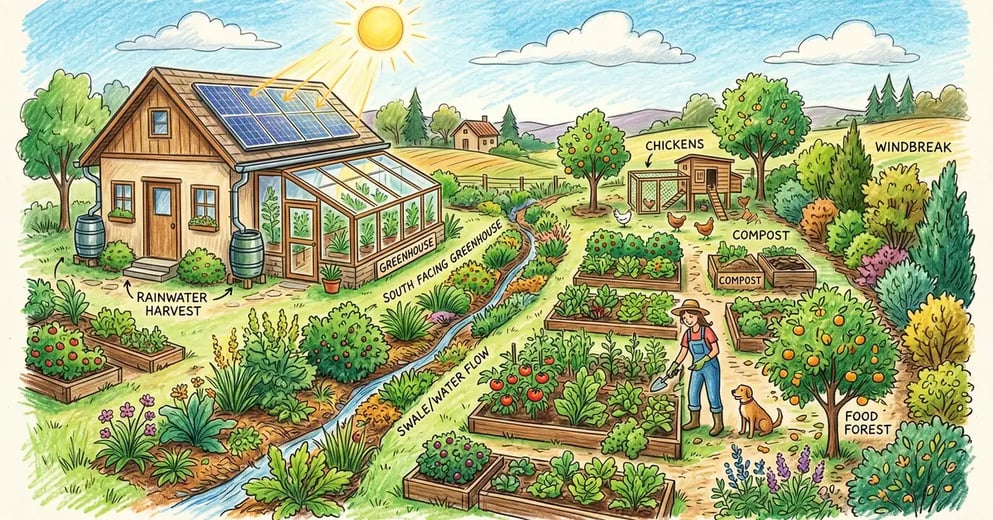
Permaculture homesteads invert that pattern. You design your land so that every flow of free energy passing through gets caught, stored, and used over the longest possible window. Holmgren's official permaculture principles site lists six energy types worth catching in a backyard: solar, water, wind, biomass, soil fertility, and human energy (skills, time, networks).
For a US gardener and homesteader, the four practical flows that matter most are solar, water, biomass, and thermal mass.
1. Catching water (roof rainwater and swales)
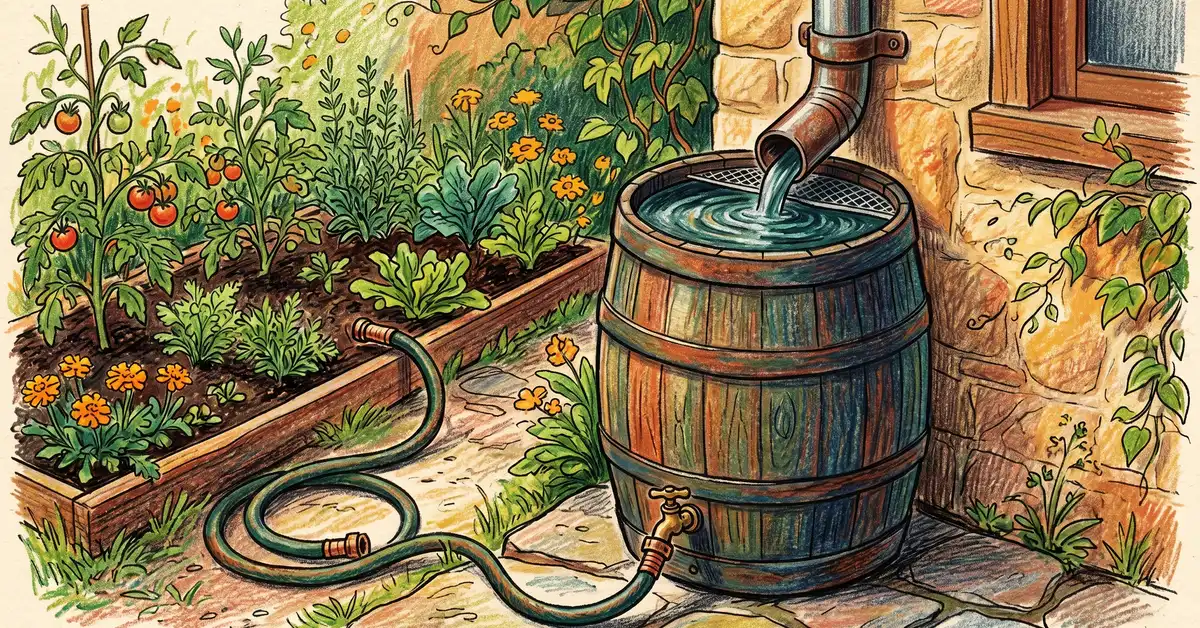
The fastest, cheapest, highest-ROI capture system most US homeowners can install is rainwater harvesting from the roof.
The math. Each square foot of roof captures 0.623 gallons (2.36 L) per inch of rain. A 1,000 sq ft (93 sq m) roof in 30 inches (76 cm) of annual rainfall sheds 18,690 gallons (70,750 L) per year. Even a 500 sq ft (46 sq m) roof in 15 inches of rain (38 cm) sheds 4,673 gallons (17,690 L). The Raincatcher's calculation guide walks through the formula.
System cost. A complete 1,000 gallon (3,785 L) rainwater harvesting kit with gutters, first-flush diverter, tank, and overflow runs $700 to $1,200 installed in 2026, per NTO Tank's rainwater cost breakdown. A single 55 gallon (208 L) rain barrel runs $80 to $150.
Payback. At average US municipal water rates ($4 to $8 per 1,000 gallons in 2026), a 1,000 gallon tank refilled 6 to 10 times per season offsets $40 to $80 per year in water cost, plus reduces stormwater runoff fees in cities that charge them. Realistic payback is 4 to 6 years for a $1,000 system, faster in cities with stormwater credits.
Beyond barrels: swales. A swale is a ditch dug on contour with the excavated soil forming a downhill berm. Rain falling on or running across the land collects in the swale, soaks into the soil, and feeds plants growing on the berm. Poor Prole's Almanac's swale math documents the standard rule: 1 cubic foot of swale storage per 100 sq ft of catchment area, sized for your local design storm. For a 1/4 acre yard (10,890 sq ft / 1,012 sq m), that means about 110 cubic feet (3.1 cu m) of swale capacity, which equates to a swale roughly 110 ft long, 1 ft wide, 1 ft deep (33.5 m x 0.3 m x 0.3 m).
USDA NRCS support. The federal NRCS Water Harvesting Catchment Conservation Practice Standard 636 defines the technical specs for water harvesting systems and qualifies many designs for federal cost-share programs through the EQIP program.
2. Catching solar (passive and active)
Solar energy is the most concentrated free flow most properties receive. There are two ways to catch it.
Passive solar. Orienting your house or greenhouse so south-facing glass collects winter sun while overhangs block summer sun. The Whole Building Design Guide on passive solar heating documents that well-designed passive solar can offset 30 to 50% of winter heating costs in temperate US climates. A backyard passive solar greenhouse 8 ft by 12 ft (2.4 m x 3.7 m) with double-pane glass costs $1,500 to $3,000 to build and extends your growing season by 2 to 4 months.
Thermal mass storage. Inside a passive solar space, you need something dense to absorb daytime heat and release it at night. Water is the cheapest and most effective: 8.3 BTU per gallon per degree Fahrenheit (34.7 kJ per L per degree C). A bank of ten 55 gallon (208 L) black-painted barrels filled with water stores 45,650 BTU per 10°F (5.6°C) swing. BuildItSolar's water barrel thermal mass guide documents the standard 4 gallon (15 L) per square foot of south-facing glass rule.
Active solar (photovoltaic). A 6 kW residential PV system in 2026 costs $14,000 to $20,000 installed. The IRS Residential Clean Energy Credit (25D) covers 30% of that cost through 2032, dropping to 26% in 2033 and 22% in 2034. After credit, net cost is $9,800 to $14,000 for a system that offsets $1,400 to $2,200 per year in electricity. Realistic payback is 7 to 10 years.
Solar hot water. A solar hot water system runs $4,000 to $7,000 installed, qualifies for the same 30% federal credit, and offsets 50 to 80% of household water heating cost. Payback in 5 to 8 years.
Why this works (the permaculture insight)
The catch and store principle is what separates a permaculture homestead from an organic garden. An organic garden grows food. A catch and store property grows food while simultaneously building soil carbon, banking rainwater, generating electricity, and reducing thermal load. Each system you install becomes a future source of resilience: when the grid wobbles or water rates spike or a drought hits, you have stored energy to draw on. Holmgren's original framing was about closing the loop on a fossil-fuel-dependent food system. The practical outcome for a US homeowner is a property that costs progressively less to run every year you live there.
3. Storing energy in soil (biomass and biochar)
The largest and most overlooked energy store on most properties is the soil itself. Every 1 percentage point increase in soil organic matter stores roughly 30 to 40 tonnes of carbon per hectare (12 to 16 tons per acre), per Washington State University's soil carbon assessment. That carbon is solar energy that was photosynthesized into plant matter, decomposed, and locked into stable humus.
Chop and drop. The simplest soil energy storage method. Cut perennials, herbs, and cover crops back to the ground; leave the cuttings on the soil surface as mulch. Permies' chop and drop discussion documents the standard practitioner approach. A 1/4 acre yard with chop and drop discipline adds 0.2 to 0.4% soil organic matter per year.
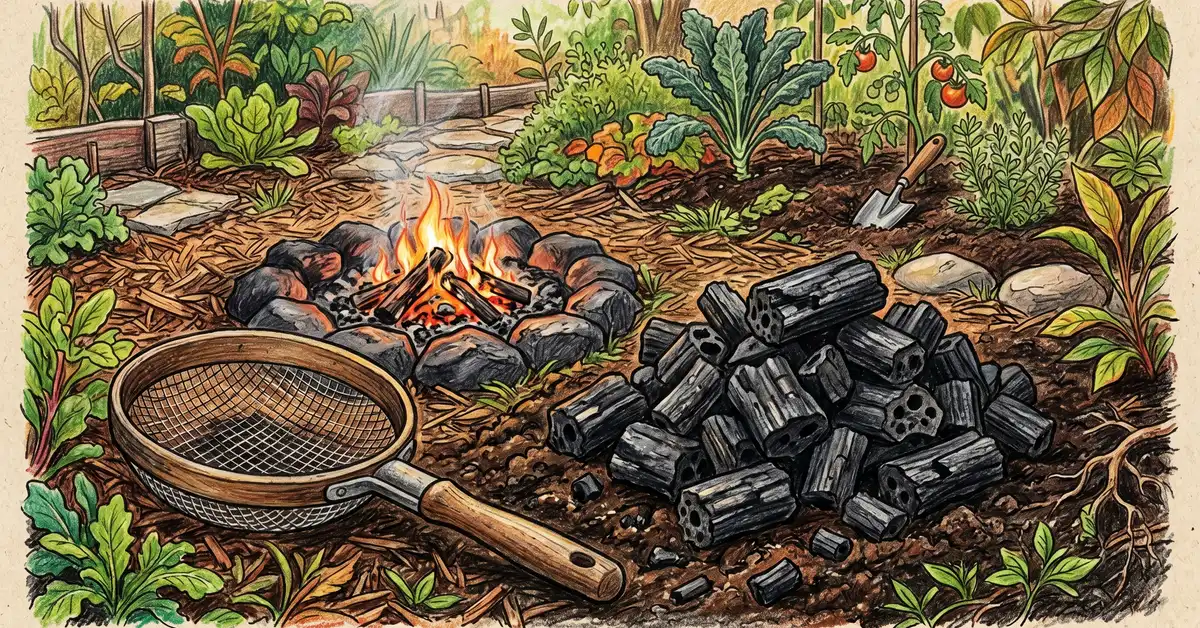
Biochar. Charcoal produced by burning biomass in low-oxygen conditions, then crushed and incorporated into soil. The carbon in biochar resists decomposition for centuries to millennia. The International Biochar Initiative's stability assessment (PDF) documents half-lives ranging from 100 to over 1,000 years for various biochar types, making it one of the only practical residential carbon-storage methods.
Cover crops. Winter rye, crimson clover, vetch, daikon, and oats planted between cash crops. They photosynthesize through fall and winter, then are terminated in spring and incorporated as green manure. A backyard 100 sq ft (9.3 sq m) bed under cover crops adds 5 to 15 lb (2.3 to 6.8 kg) of biomass per cycle.
Compost. The middle stage between biomass and stable humus. A 1 inch (2.5 cm) annual compost topdress moves soil organic matter up roughly 0.3 to 0.5 percentage points per year and stores the equivalent of roughly 200 lb (91 kg) of carbon per 1,000 sq ft (93 sq m) per year.
4. Catching wind and biological energy (the smaller flows)
Windbreaks. A row of trees or tall shrubs on the windward side of your property slows wind by 50 to 75% for a distance of 10 to 20 times the windbreak height. That reduces winter heating load by 10 to 30% and protects vegetable beds from desiccation. The standard windbreak design is three rows: shrubs on the inside, medium trees in the middle, tall trees on the outside. Plant on the north side in cold US climates, west side in dry western climates.
Living biomass. Comfrey, willow, alder, hazel, and other coppice species store energy in their root systems and regrow biomass continuously. Coppiced willow can yield 4 to 6 tons of fuel-grade biomass per acre per year (9 to 13 tonnes per hectare) on a 3 to 5 year rotation.
Animal energy. Chickens, ducks, and rabbits convert kitchen scraps, garden waste, and weed seeds into eggs, meat, and high-nitrogen manure. A flock of 6 hens cycles roughly 200 lb (91 kg) of food waste per year into 1,200 to 1,500 eggs and 60 to 90 lb (27 to 41 kg) of compostable manure.
How to install catch and store systems, in priority order
Start with rainwater (cheapest, fastest payback)
Put 2 to 4 rain barrels under your downspouts in week one. Cost: $200 to $500. Time: a Saturday afternoon. Result: 200 to 400 gallons (757 to 1,514 L) of free garden water per heavy storm. Once you have proof of concept, upgrade to a 1,000 gallon (3,785 L) tank in year 2.
Dig a swale on contour through the highest-priority bed
Use a string level or laser to find contour. Dig 1 ft (30 cm) deep, 1 to 2 ft (30 to 60 cm) wide, as long as the bed. Pile the excavated soil on the downhill side as a berm. Plant fruit trees and nitrogen-fixing shrubs on the berm. Total cost: a day of labor, no materials.
Build soil organic matter with annual compost and cover crops
Apply 1 inch (2.5 cm) of compost across all beds in fall. Plant winter cover crops in any bed that will be empty for more than 6 weeks. By year 3 to 5, soil organic matter will have climbed 1 to 2 percentage points and watering need will drop noticeably.
Plant a windbreak hedge on the cold-wind side
Identify your prevailing winter wind direction. Plant a 3-row windbreak on that side: blueberry or hazel on the inside, alder or autumn olive in the middle, mulberry or willow on the outside. Use bare-root stock in spring or fall for $5 to $15 per plant.
Build a passive solar greenhouse or cold frame
A 4 ft by 8 ft (1.2 m x 2.4 m) cold frame costs $200 to $400 and extends spring and fall growing windows by 4 to 6 weeks each. A full 8 ft by 12 ft (2.4 m x 3.7 m) passive solar greenhouse with black water barrels inside costs $1,500 to $3,000 and adds 2 to 4 months to your season.
Add solar PV last (highest upfront cost, longest payback)
Only after your conservation work (insulation, weather sealing, LED lighting, heat pump water heater) has cut electricity load by 30 to 50% should you size and install a PV system. Sized to actual use, a typical 6 kW system in 2026 costs $14,000 to $20,000, qualifies for a 30% federal tax credit through 2032, and pays back in 7 to 10 years.
2026 US federal incentives that matter
| System | Federal incentive | Cap or rate | Expires |
| Solar PV | Residential Clean Energy Credit (IRS 25D) | 30% of total cost | 2032 (drops to 26% in 2033, 22% in 2034) |
| Solar hot water | Residential Clean Energy Credit (IRS 25D) | 30% of total cost | 2032 (same step-down) |
| Geothermal heat pump | Residential Clean Energy Credit (IRS 25D) | 30% of total cost | 2032 (same step-down) |
| Air-source heat pump | Energy Efficient Home Improvement Credit (IRS 25C) | 30% up to $2,000 per year | 2032 |
| Battery storage | Residential Clean Energy Credit (IRS 25D) | 30% of total cost (3 kWh minimum) | 2032 |
| Rainwater harvesting | USDA NRCS EQIP cost-share | 50 to 75% of installation cost | Annual application window |
| State and utility rebates | Varies by state (CA, NY, TX, CO highest) | $500 to $5,000+ depending on system | Varies |
Sources:.
Five common catch and store mistakes
1. Oversizing solar PV before fixing the load
Most US homes can cut electricity demand by 30 to 50% with insulation, LED lighting, heat pump water heater, and air sealing. Doing those things first means a smaller, cheaper solar system delivers the same coverage. Sizing PV to your pre-conservation load wastes money.
2. Building rainwater systems without overflow planning
A 1,000 gallon tank fills in one moderate storm. Without a planned overflow path, the next rain backs up your gutters or floods your foundation. Always pipe overflow to a swale, a French drain, or the lawn. The Harvesting Rainwater organizations directory lists certified designers if you want a professional plan.
3. Adding swales without checking infiltration
Swales work in soils that drain. In heavy clay or below the water table, a swale becomes a stagnant pond. Test your soil first: dig a 12 inch (30 cm) hole, fill with water, time how long it takes to drain. If under 24 hours, swales work. If over 48 hours, choose berms and beds instead.
4. Chop and drop without nitrogen balance
Woody mulch (high carbon, low nitrogen) without a nitrogen source temporarily locks up soil nitrogen and stunts crops. Balance high-carbon mulch with a nitrogen source: a thin compost layer underneath, a clover cover crop, or a side-dress of blood meal during heavy mulching.
5. Building thermal mass without enough south-facing glass
Thermal mass without sun is just cold water. The standard ratio is 4 gallons (15 L) of water per square foot (0.09 sq m) of south-facing glass. More mass than that and the space never warms up; less and the temperature swings damage plants.
Check rainwater harvesting laws before installing
Most US states allow rainwater harvesting freely. A few western states (Colorado historically, parts of Utah and Washington) have had restrictions tied to water rights doctrine. Colorado liberalized in 2016 to allow up to 110 gallons (416 L) per single-family home. Check your state's current law before installing a large catchment system. Stormwater fee rebates also vary by city; many municipalities will rebate $50 to $250 per installed barrel.
Get the Weekly Dig
One practical permaculture guide a week, written for gardeners who do this on weekends: building living soil without buying it in bags. Free, no spam, unsubscribe any time.
Join the Weekly DigFrequently asked questions
What is the catch and store energy principle?
It is the second of David Holmgren's 12 permaculture principles, formalized in his 2002 book Permaculture: Principles & Pathways Beyond Sustainability. The principle states that systems should capture renewable energy flows during periods of abundance and store them for use during scarcity. In a US backyard, the main flows are roof rainwater, passive solar, biomass, and soil organic carbon.
How much rainwater can I catch from my roof?
Each square foot of roof yields 0.623 gallons (2.36 L) per inch of rain. A 1,000 sq ft (93 sq m) roof in 30 inches (76 cm) of annual rainfall sheds 18,690 gallons (70,750 L) per year. A single moderate storm of 1 inch (2.5 cm) gives you 623 gallons (2,360 L) from a 1,000 sq ft roof.
What does a rainwater system cost?
A single 55 gallon (208 L) rain barrel runs $80 to $150. A complete 1,000 gallon (3,785 L) system with gutters, first-flush diverter, tank, and overflow runs $700 to $1,200 in 2026. Larger 2,500 to 5,000 gallon (9,460 to 18,930 L) cistern systems run $2,500 to $6,000 installed.
How much does solar PV cost in 2026?
A 6 kW residential system costs $14,000 to $20,000 installed before incentives. The federal Residential Clean Energy Credit (IRS 25D) covers 30% through 2032, dropping to 26% in 2033 and 22% in 2034. Net cost after credit: $9,800 to $14,000. Realistic payback is 7 to 10 years.
What is a swale in permaculture?
A swale is a ditch dug on contour with the excavated soil forming a downhill berm. Rain collects in the ditch and soaks into the soil, watering plants growing on the berm. Standard sizing is 1 cubic foot (0.028 cu m) of swale capacity per 100 sq ft (9.3 sq m) of catchment area for typical US design storms.
How do I store solar heat without electronics?
Thermal mass. Water holds 8.3 BTU per gallon per degree Fahrenheit (34.7 kJ per L per degree C), more than any common building material. Black-painted barrels filled with water inside a south-facing greenhouse or sunroom absorb daytime heat and release it at night. The standard ratio is 4 gallons (15 L) per square foot (0.09 sq m) of south-facing glass.
Can I use catch and store on a small urban lot?
Yes. A 1/10 acre (404 sq m) urban yard with a 500 sq ft (46 sq m) roof catches 9,345 gallons (35,375 L) in 30 inches (76 cm) of rain. Add 2 rain barrels, 1 small swale, comfrey for chop and drop, and one south-facing cold frame, and you have a working catch and store system for under $500 in materials.
What is biochar and how does it store energy?
Biochar is charcoal made by burning biomass in low-oxygen conditions (pyrolysis), then crushed and worked into soil. The carbon resists decomposition for 100 to over 1,000 years per the International Biochar Initiative, making it one of the most stable residential carbon-storage methods. Biochar also improves soil cation exchange capacity and water holding when "charged" with compost or manure before application.
Resources
- David Holmgren: Permaculture - Principles and Pathways Beyond Sustainability (PDF)
- Holmgren's official permaculture principles site
- Whole Building Design Guide: Passive Solar Heating
- IRS Residential Clean Energy Credit (25D)
- US DOE Homeowner's Guide to Solar
- USDA NRCS Conservation Practice Standard 636: Water Harvesting Catchment
- Raincatcher: Rainwater calculation guide
- International Biochar Initiative: Biochar stability assessment (PDF)
- Harvesting Rainwater: Designers and instructors directory