
What Is a Herb Spiral and Why Build One?
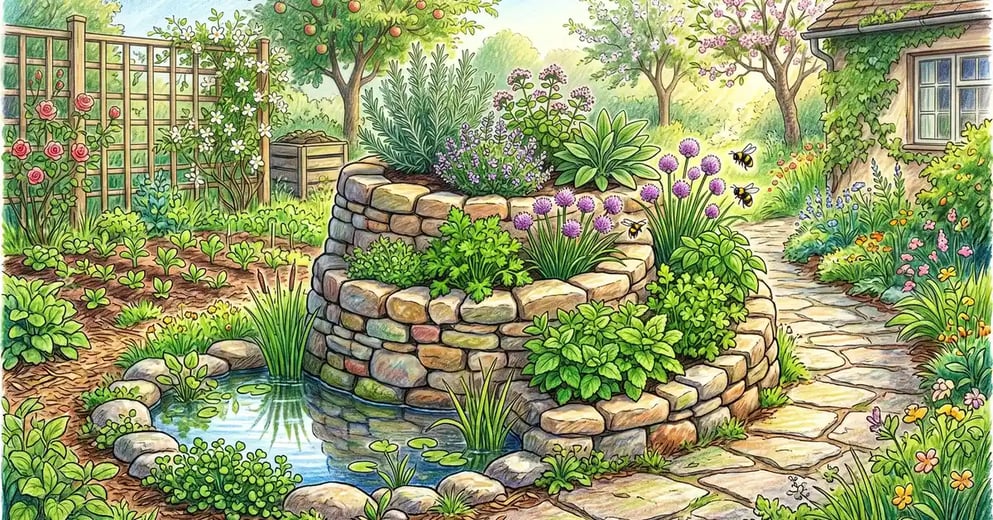
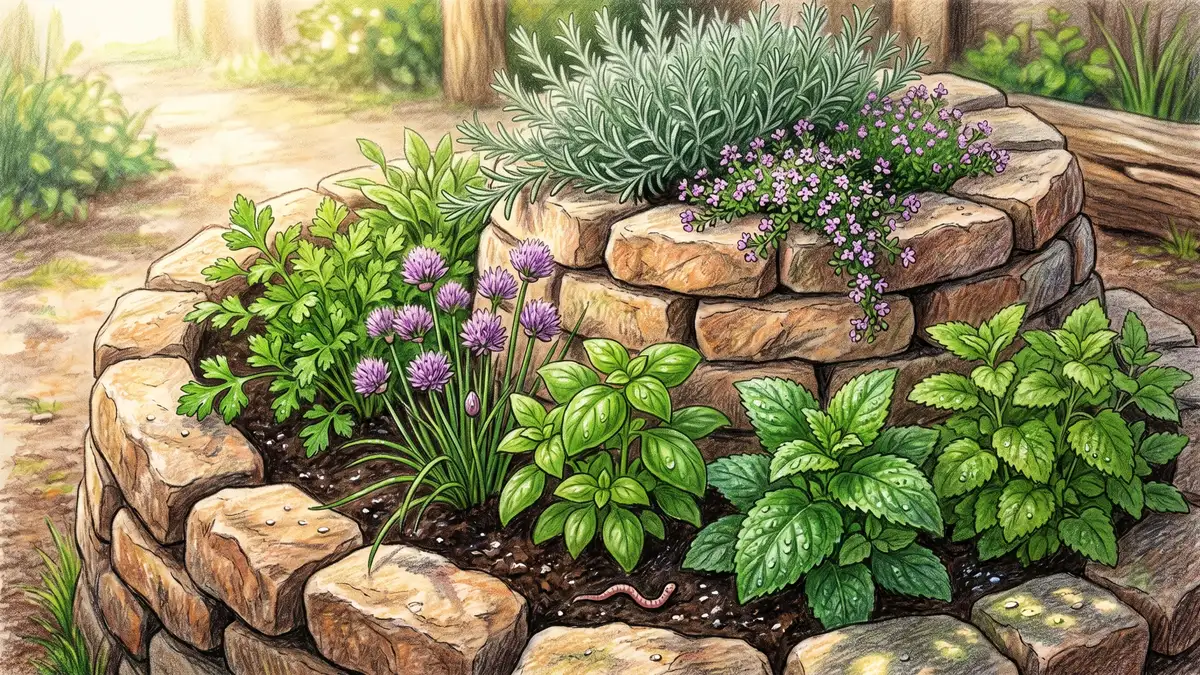
Most kitchen gardens spread herbs across a flat bed. A herb spiral does something different — it compresses the same diversity into a footprint about 6 feet (1.8 m) across by stacking four to five distinct microclimates vertically, from a dry, sun-baked apex down to a shaded, moisture-loving base. That is why one compact structure can host rosemary, thyme, mint, parsley, cilantro, and watercress at the same time, even though each plant comes from a different ecological niche.
Bill Mollison documented the original design in Permaculture: A Designers' Manual (1988) as a deliberate piece of microclimate engineering: a 6-foot (1.8 m) wide, 3-foot (0.9 m) tall mound built to give a gardener "dry places, wet places, sunny places, and shady places" within a single structure. Forty years later, university extension services from Maryland to UF IFAS in Florida publish step-by-step herb spiral plans because the design genuinely works — when you build it correctly.
Key Takeaway
A herb spiral is not a decorative shape — it's a deliberate microclimate gradient. Solar exposure, gravitational water movement, and the thermal mass of stone do most of the work, which is why a well-built spiral grows Mediterranean herbs and moisture-loving herbs in roughly 28 sq ft (2.6 m²) of ground.
The Microclimate Science Behind a Herb Spiral
Three physical variables interact inside a herb spiral: solar aspect, gravity-driven moisture, and thermal mass. Together they explain why each turn of the spiral grows a different plant community.
Solar aspect. In the Northern Hemisphere, the convention is to position the spiral's lowest, north-facing point on the shaded side and to wind the path clockwise as you climb. As you progress inward and upward, the planting face rotates through east (morning sun), south (peak insolation), and west (afternoon sun). According to UC Marin Master Gardeners, southern-facing aspects can extend the growing season by 2–3 weeks at each end of the year compared to north-facing ones — meaningful when you're squeezing in extra basil harvests.
Soil moisture stratification. Water applied at the apex percolates downward through progressively finer soil. The top 6–8 inches (15–20 cm) of an apex amended with sandy loam may drop to 8–12% volumetric water content within 48 hours of irrigation, while the bottom 6 inches (15 cm) holds 18–22% — a 2× difference inside one structure. Cornell's SoilNOW raised-bed materials describe the same capillary physics at work in any layered raised bed.
Thermal mass. Stone and brick absorb solar radiation by day and re-radiate it overnight, which is why practitioners report reliably overwintering one USDA hardiness zone warmer than the surrounding landscape. A zone 5 gardener can keep zone-6 plants like marginally hardy oregano (Origanum vulgare) and French tarragon (Artemisia dracunculus) alive inside the spiral when they would die in a flat bed feet away.
Why This Works: The Edge Effect
In permaculture, the most productive place in any system is the boundary between two conditions — what David Holmgren formalises as Principle 11: Use edges and value the marginal. A flat bed has one set of conditions; a herb spiral manufactures four or five interfaces in the same footprint. Every turn is a new edge, and each edge gives a different group of plants exactly the conditions they need.
How to Build a Herb Spiral: Step-by-Step
The structure is forgiving once you respect the basic specs. University of Maryland Extension recommends a weekend project of roughly 6–10 hours from site prep to first planting. This is the build sequence we use:
Pick the right site (6+ hours of sun)
Herb spirals fail in deep shade. You need a minimum of 6 hours of direct sun, ideally on a flat or slightly south-sloping spot well away from frost pockets and large tree roots. Avoid sites with high water tables — they overwhelm the drainage gradient.
Lay a drainage base
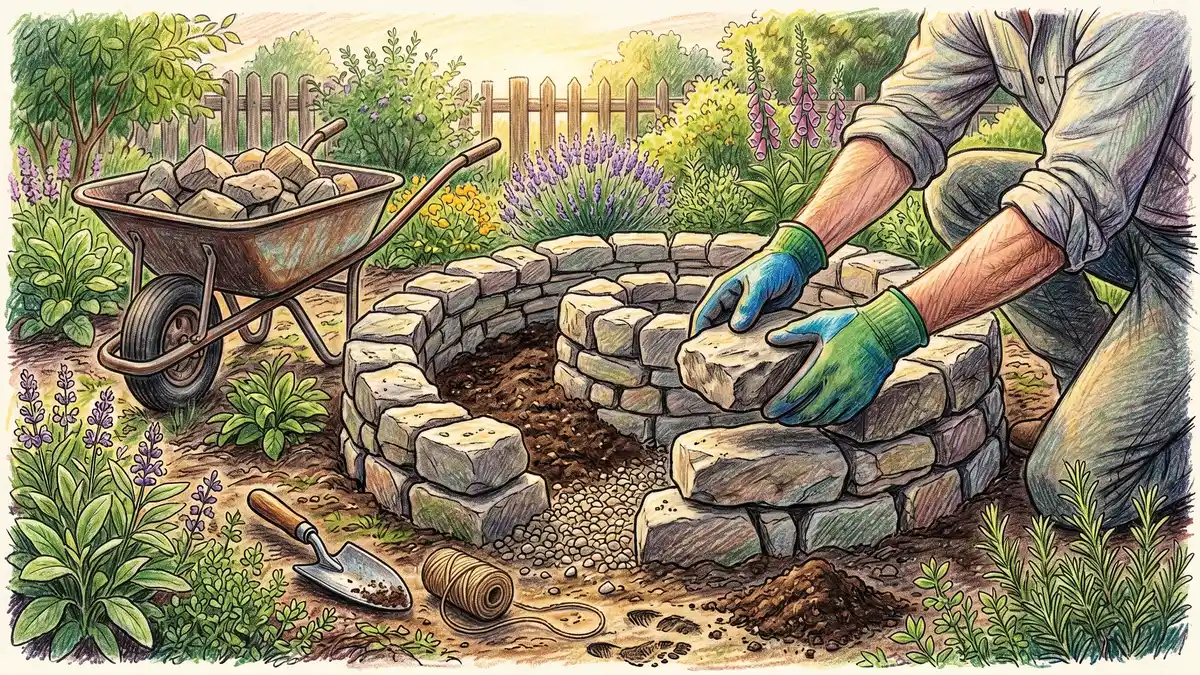
Mark a 6-foot (1.8 m) circle. Cover with cardboard to smother grass, then add a 6–8 inch (15–20 cm) layer of coarse gravel — pieces about 1–2 inches (2–5 cm). This is non-negotiable: skip it and the spiral compacts into a muddy bowl within two seasons.
Build the spiral wall (two full turns)
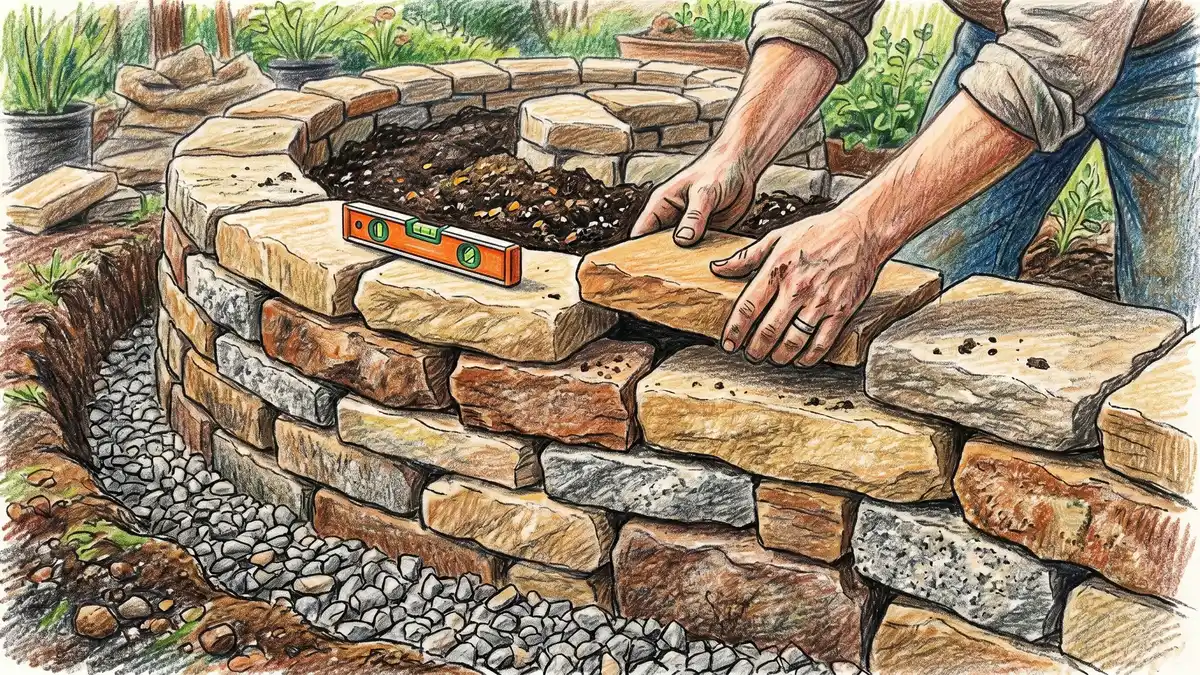
Dry-stack stone, salvaged brick, or "urbanite" (broken concrete) in two complete 360° turns rising to a 3–4 foot (0.9–1.2 m) apex. Outer wall: 6–8 inches (15–20 cm). Each turn rises another 2–3 inches (5–7 cm). Plan on 120–160 reclaimed bricks for a typical build.
Layer the soil — coarse on top, rich at the base
Top 8–10 inches (20–25 cm): garden soil with extra sand or grit for drainage. Middle: 50/50 garden soil and finished compost. Bottom 6–8 inches (15–20 cm): heavier loam plus extra compost for moisture retention. Mulch the surface with 1–2 inches (2.5–5 cm) of straw or leaf mould.
Orient the entry, then plant
In the Northern Hemisphere, set the lowest entry on the north side. Plant from the top down, working species to their preferred level (see the planting table below). Water deeply once, then leave it alone for a week to let the soil settle before topping off.
What Herbs Belong on Each Level
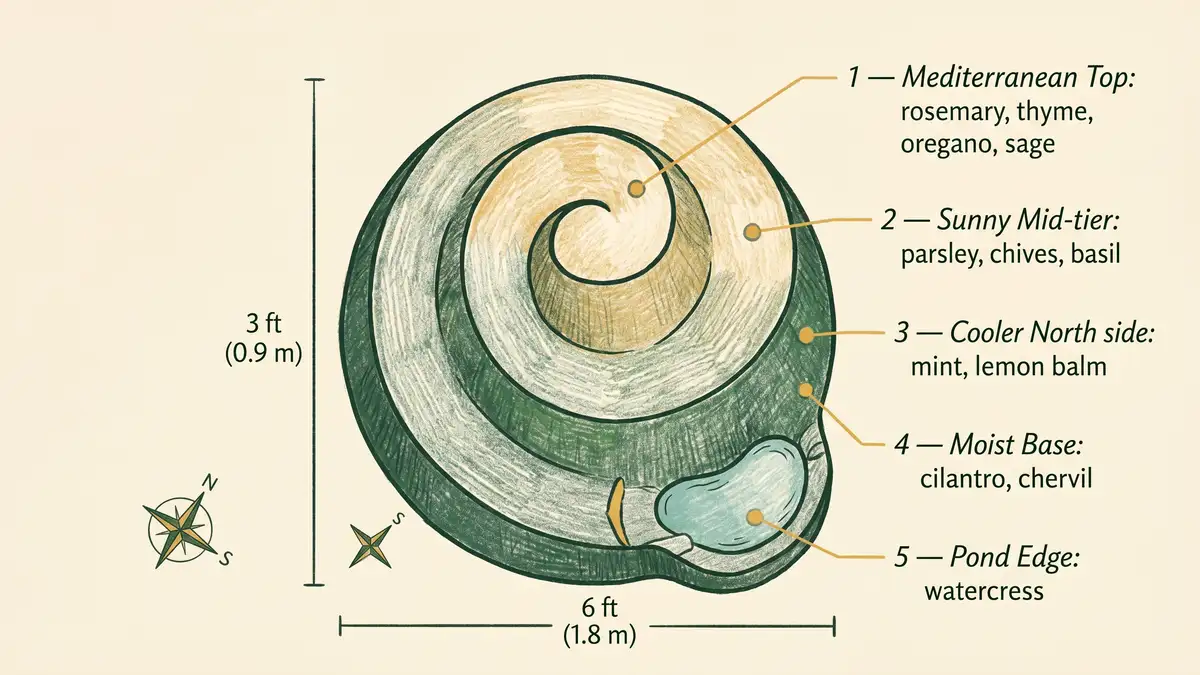
This is where the design earns its keep. Each spiral zone is suited to a distinct group of herbs based on water need, root depth, and light tolerance. Place plants where the conditions already match their native habitat and you'll spend dramatically less time fighting the system.
The reference layout below pulls from, and decades of practitioner reports archived through the UF IFAS spiral herb garden tutorial.
| Zone | Conditions | Recommended herbs | Why they belong here |
| Zone 1 — Apex (top) | Full sun, fastest drainage, warmest, driest | Rosemary (Salvia rosmarinus), thyme (Thymus vulgaris), oregano (Origanum vulgare), sage (Salvia officinalis), lavender (Lavandula spp.) | Mediterranean origin — waxy or needle-like leaves, deep roots, drought-adapted, more flavour under stress |
| Zone 2 — Sunny mid-slope | 4–6 hr sun, moderate moisture | Basil (Ocimum basilicum), parsley (Petroselinum crispum), chives (Allium schoenoprasum), French tarragon | Need consistent moisture but suffer in waterlogged soil — mid-slope is the moisture sweet spot |
| Zone 3 — Shaded lower slope | 2–4 hr morning sun, retained moisture | Cilantro/coriander (Coriandrum sativum), chervil, parsley (cool-season placement), chamomile (Matricaria chamomilla) | Cool-season annuals that bolt under heat; afternoon shade extends harvest by weeks |
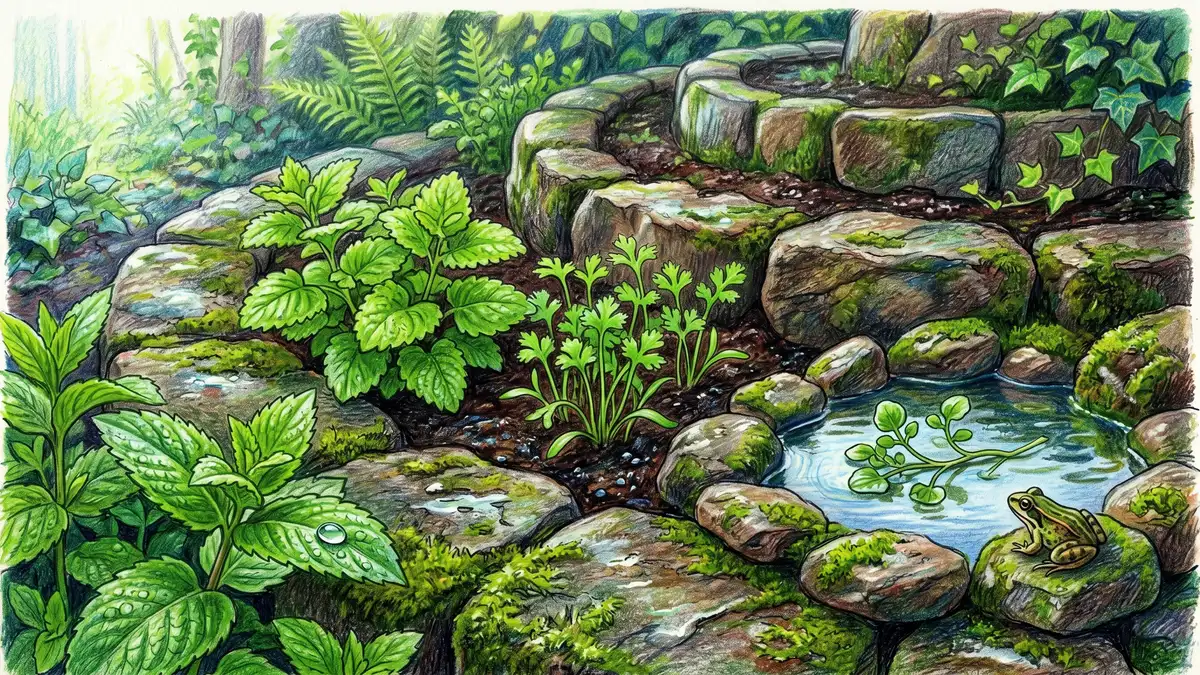
| Zone 4 — Moist base / pond edge | Shaded, permanently damp | Watercress (Nasturtium officinale), water mint, lemon balm in a buried pot (Melissa officinalis) | Riparian or wetland origin — they thrive where most herbs would rot |
Sources:.
Common Mistakes That Wreck a Herb Spiral
Most failed herb spirals fail for the same handful of reasons. The good news: every one of them is preventable at the design stage. The most common errors include wrong orientation (which inverts the entire microclimate gradient), undersized structures (less than 0.6 m / 2 ft tall give you no real differentiation), no drainage layer (the spiral becomes a muddy bowl in two seasons), and putting mint directly into the soil. The Permies forum's "When NOT to use a herb spiral" thread is a useful reality check before you start digging.
Common Mistake to Avoid: Planting Mint Directly
Mint (Mentha spp.) is the single most common herb-spiral killer. One peppermint plant will systematically eliminate every other species within 12–18 months as its rhizomes spread horizontally. Broken Ground Permaculture puts it bluntly: don't put mint in a herb spiral. Grow it in a pot beside the spiral, or sink a 12-inch (30 cm) deep pot into the lower zone with the rim above soil to contain the runners.
Adapting a Herb Spiral to Your Climate
The standard design works in temperate climates, but practitioners in cold and hot extremes need to adjust dimensions, materials, and species lists.
Cold climates (USDA zones 3–5). Lean into the thermal mass advantage. Build with substantial stone or brick, mulch the entire spiral with 4–6 inches (10–15 cm) of straw after the first hard frost, and choose cold-hardy perennials like thyme, sage, and oregano. Tender perennials such as rosemary should be potted up and brought indoors over winter. Cornell Small Farms covers the broader climate-considerations framework these adjustments fit into.
Hot, dry climates (USDA zones 8–10). Build a slightly taller spiral (closer to 4 ft / 1.2 m) to increase the shaded base area. Lean toward heat-tolerant Mediterranean herbs and treat basil and cilantro as cool-season crops, sown in early spring and again in autumn. Oregon State Extension's central Oregon climate guide gives a useful framework for thinking about thermal extremes. Use light-coloured mulches to reflect solar heat and irrigate from the apex in early morning so gravity does the distribution work.
Whichever climate you're in, the herb spiral is best understood as one element in a wider permaculture foundations toolkit. It pairs naturally with the zone 1 placement idea (close to the kitchen door for daily harvest) and demonstrates several of the 12 permaculture principles at once — particularly stacking functions and edge effect. If you're newer to the framework, start with our permaculture for beginners guide and the broader what is permaculture introduction. The same plants you grow on the spiral show up in our companion planting chart, and the layered soil profile inside the structure is a small-scale expression of the principles in our soil health guide.
Frequently Asked Questions
How big should a herb spiral be?
The practical sweet spot is 5–6 feet (1.5–1.8 m) in outside diameter and 3–4 feet (0.9–1.2 m) tall at the apex. Smaller than that and you don't get enough microclimate differentiation — the apex isn't dry enough and the base isn't shady enough to be meaningfully different. Larger and you can't reach the centre to harvest without stepping on plants. Within those bounds, scale to the space you have. A 5-foot (1.5 m) spiral fits in a tight backyard; a 6-foot (1.8 m) spiral feeds a household of four with daily culinary herbs.
Stone or brick — which is better for the wall?
Both work and both deliver the thermal mass benefit. Dry-stacked stone is more aesthetically forgiving and tolerates uneven ground better, but takes more skill to stack stably. Reclaimed brick is faster to build with because the geometry is uniform; about 120–160 bricks build a standard spiral. Concrete blocks or "urbanite" (broken concrete from demolition sites) are the cheapest option and have equivalent thermal mass — just less visual appeal. Avoid wood: it rots within 3–7 years and gives you no thermal benefit.
Do I really need a pond at the base?
No — it's optional and site-dependent. A pond adds humidity to the lower zone, supports watercress, and provides habitat for amphibians that eat slugs. But in regions with high rainfall it can become stagnant, and in hot climates it evaporates faster than you can refill. A simpler alternative is a "bog patch": a shallow depression lined with landscape fabric that retains moisture without standing water. Either way, position it on the shaded side and only commit if you're confident your site supports it.
Can a herb spiral work in a small backyard or on a balcony?
In a small backyard, yes — a 5-foot (1.5 m) spiral fits in roughly 25 sq ft (2.3 m²) and replaces a much larger flat herb bed. On a balcony under 20 sq ft (2 m²) it's not worth the effort; a single tiered planter or stacked containers achieves more in the space. The herb spiral really earns its keep when you have the ground area for the full structure but want to compress as much herb diversity as possible into it.
How long does a herb spiral last before it needs rebuilding?
A well-built stone or brick spiral with proper drainage typically performs well for 5–7 years before the soil has settled significantly and organic matter has been depleted by plant uptake. Annual maintenance is light: top-dress with 1 inch (2.5 cm) of compost each spring, replace failed plants, and keep mint and lemon balm contained. After about 5 years many practitioners do a full deconstruction-and-rebuild — composting the existing soil, adjusting the wall, and replanting with what they've learned about their site.
Get the Weekly Dig
One practical permaculture guide a week, written for gardeners who do this on weekends: permaculture design for real backyards. Free, no spam, unsubscribe any time.
Join the newsletterResources
- University of Maryland Extension — Herb Spirals: Ten Simple Steps (PDF)
- UF IFAS Gardening Solutions — Spiral Herb Garden Tutorial
- Maryland Grows — Build an Herb Spiral
- Cornell SoilNOW — Raised Beds and Soil Layering
- UC ANR Marin Master Gardeners — How to Assess Your Microclimates
- UC ANR Sonoma Master Gardeners — Low Water Kitchen Herbs
- Royal Horticultural Society — Herbs: Growing and Harvesting
- Permaculture Principles — Principle 11: Use Edges and Value the Marginal
- Broken Ground Permaculture — Don't Put Mint in a Herb Spiral
- Mollison, B. — Permaculture: A Designers' Manual (1988, Tagari Publications)