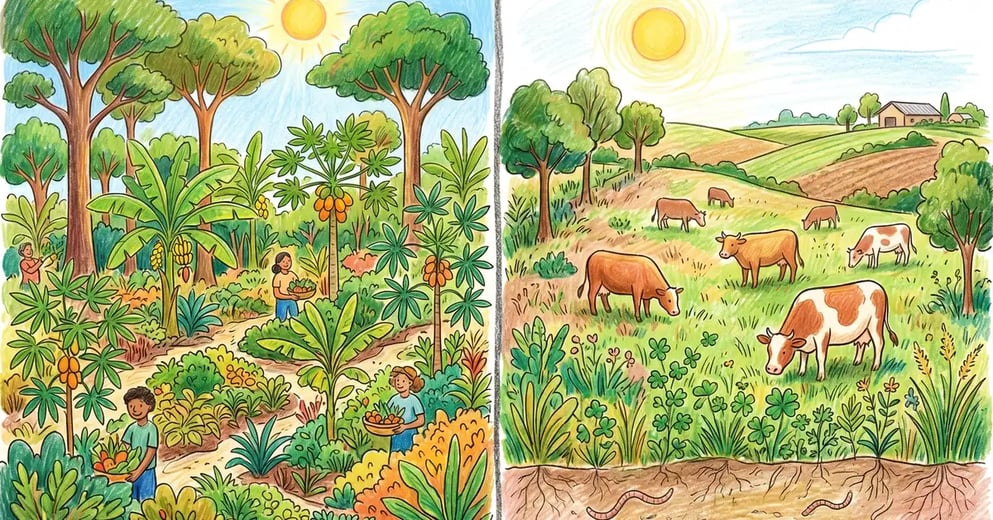

Syntropic agriculture and regenerative agriculture are the two ecological farming systems most likely to be cited in the climate conversation right now. They overlap a lot. They differ in important ways. Syntropic is a tropical-origin multi-strata food forest method developed by Ernst Gotsch in Brazil. Regenerative is a mostly-temperate movement focused on soil organic carbon, pasture-cattle integration, and cover crops, scaled across millions of acres of US farmland by USDA NRCS. Both descend from permaculture. Both rebuild soil. Neither will solve climate change alone. Here is how they really differ and how to choose between them.
Sources: EMBRAPA Brazilian agricultural research; USDA NRCS Climate Smart Commodities Initiative; Stanley et al. 2018 (Agricultural Systems); Project Drawdown.
If you are a climate-conscious reader trying to figure out where to plug in (degree path, food choices, voting, career, weekend volunteer days), it helps to know that "ecological farming" is not a single thing. The two most cited systems are syntropic agriculture and regenerative agriculture, and they answer different questions. Syntropic answers "how do we turn degraded tropical land back into food forest?" Regenerative answers "how do we get US row-crop and pasture systems to draw down carbon, hold water, and feed people?" Both are real. Both have peer-reviewed support. They are not interchangeable.
What is syntropic agriculture?
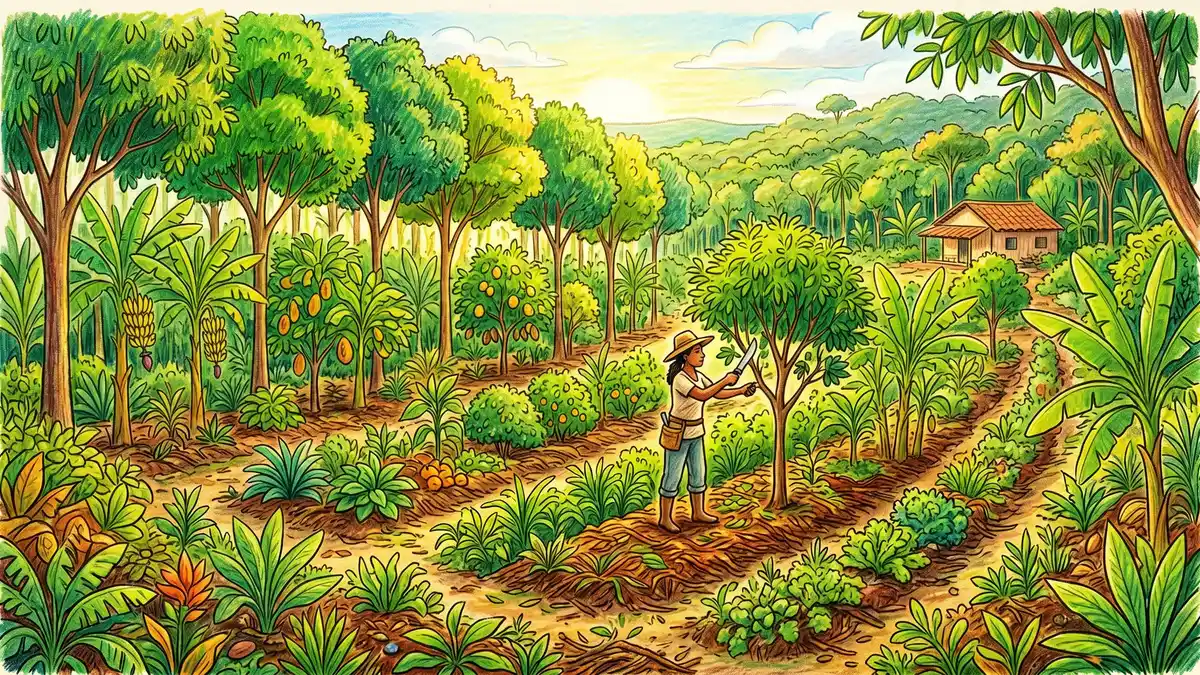
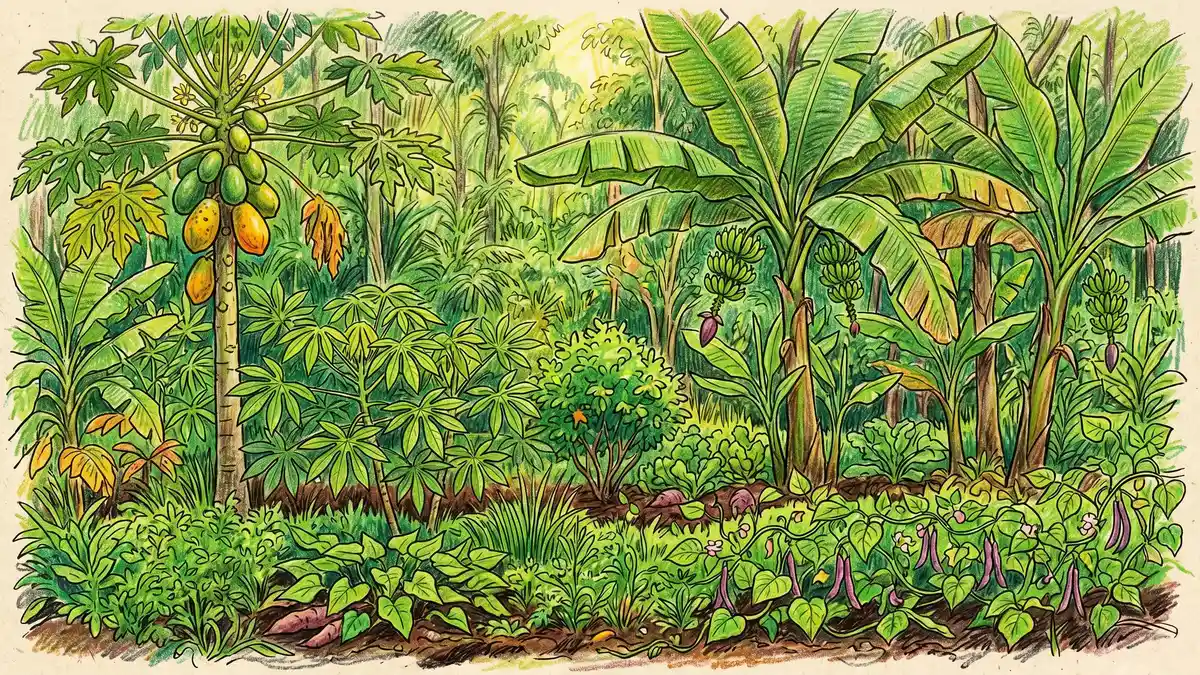
Syntropic agriculture (also called syntropic farming) was developed by Ernst Gotsch, a Swiss-Brazilian farmer, on the Olhos d'Agua farm in Bahia, Brazil, starting in the 1980s. Gotsch bought 1,200 acres of severely degraded cattle pasture, then over 30 years restored more than 600 acres of it into a productive Atlantic rainforest food forest. His farm grows cocoa, bananas, papaya, cassava, and many timber and fruit species in dense vertically-layered rows, with no compost, no synthetic fertilizer, no pesticide, and no irrigation beyond the system's own water cycling.
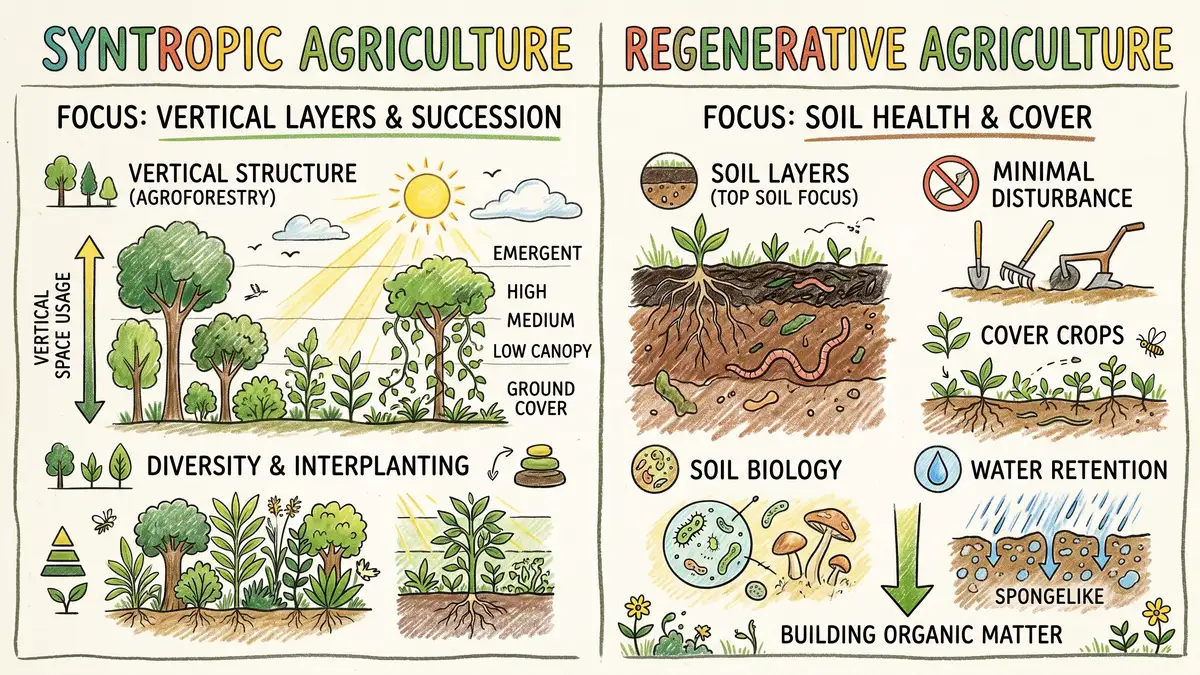
The core principle is succession-driven multistrata agroforestry. Gotsch designs his planting rows to mimic the natural ecological succession of the Atlantic rainforest. Each row contains a stack of 4 plant layers (emergent, canopy, low, and ground) and species at multiple successional stages (placenta, secondary, transition, climax). You plant everything at once at very high density, then prune heavily over 10 to 25 years to manage light, water, and nutrient cycling. The pruned biomass becomes mulch and feeds the soil microbiome.
The four practical pillars of syntropic agriculture:
- Dense polyculture: 10x to 20x the plant density of conventional monoculture. Banana, papaya, cassava, beans, leafy greens, and hardwood trees in the same row.
- Aggressive pruning: Pruning every 1 to 3 months on young systems, less often on mature ones. The pruning stimulates plant growth and produces ground mulch.
- Succession management: Plant short-lived placenta species (banana, cassava) alongside long-lived climax species (timber trees). The shorter-lived species feed the soil and shade the slower species.
- No external inputs: No imported compost, no fertilizer, no pesticide, no irrigation. The system's own pruning and falling leaves feed the soil.
What is regenerative agriculture?
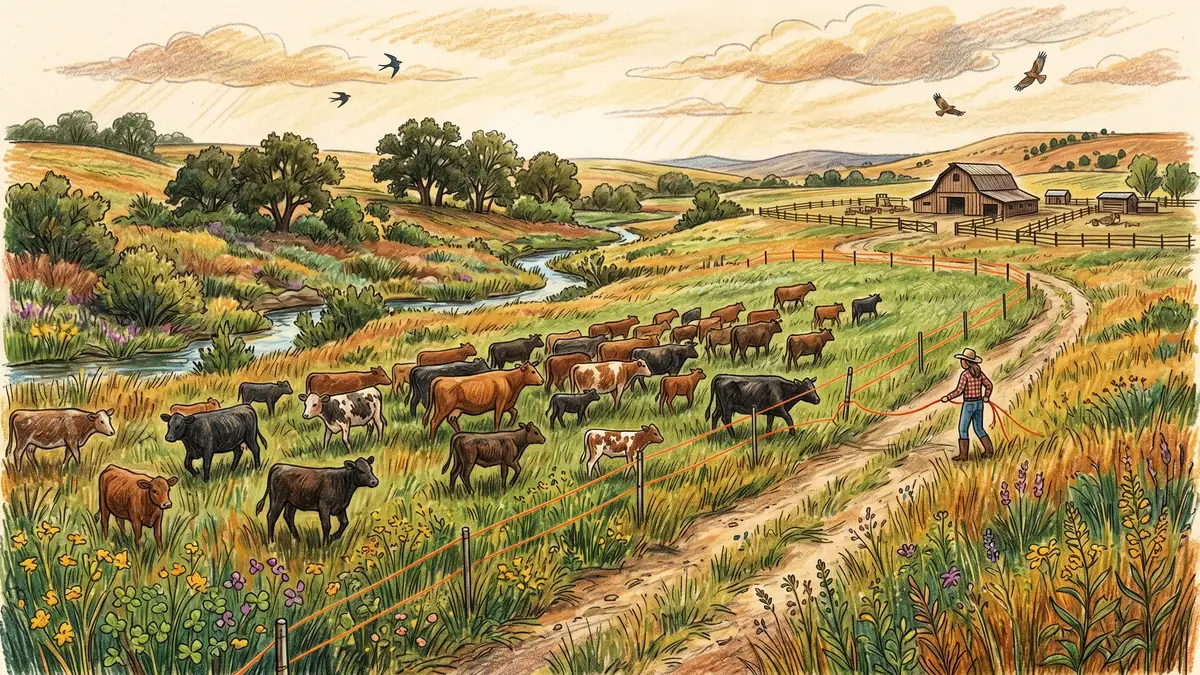
Regenerative agriculture is a movement and a set of practices, not a single design. It traces back to Robert Rodale (Rodale Institute, Pennsylvania) coining the term in the 1980s, and even earlier to Allan Savory's holistic management work in Zimbabwe and the US ranching community. Gabe Brown's work on Brown's Ranch (North Dakota) brought regenerative thinking into mainstream US row-crop and cattle farming in the 2000s. The 2022 USDA NRCS Climate Smart Commodities Initiative funded regenerative practices with $3.1 billion of federal money across US farms.
USDA NRCS and the Kiss the Ground organization codify 5 regenerative principles:
- Minimize soil disturbance: No-till or low-till. Avoid plowing.
- Keep soil covered: Living plants or residue on the surface at all times.
- Maintain living roots year-round: Cover crops between cash crops.
- Maximize plant diversity: Cover crop blends with 6 to 20 species. Cash crop rotation.
- Integrate animals: Rotational grazing of cattle, sheep, chickens. Adaptive multi-paddock grazing.
The regenerative landscape is mostly horizontal. The carbon goes into the soil. The biodiversity gain is mostly in soil microbial life and cover crop species rather than in canopy and understory. Animals are central. Mechanization is compatible (no-till drills, mob grazing electric fences, drone seeding). Time horizon to measurable soil regeneration is 3 to 7 years.
Why this works (the permaculture insight)
Both syntropic and regenerative descend from permaculture (Bill Mollison and David Holmgren, 1978). Permaculture's principle 6 is "produce no waste," and its principle 11 is "use edges and value the marginal." Syntropic takes the principles into a vertical, tropical, intensively designed direction. Regenerative takes them into a horizontal, temperate, large-scale direction. Both are valid expressions of the same underlying ecological logic: build healthy soil, increase biodiversity, close nutrient loops, eliminate synthetic inputs.
The side-by-side comparison
| Dimension | Syntropic agriculture | Regenerative agriculture |
| Founder and origin | Ernst Gotsch, Bahia, Brazil, 1980s | Robert Rodale, Allan Savory, Gabe Brown, US and Zimbabwe, 1980s onward |
| Climate of origin | Tropical Atlantic rainforest | Temperate US Great Plains and ranching country |
| Architecture | Vertical multi-strata food forest | Horizontal row crop and pasture |
| Core practice | Dense polyculture with aggressive pruning | No-till, cover crops, rotational grazing |
| Time horizon | 10 to 25 years to mature canopy | 3 to 7 years to measurable soil regen |
| Labor intensity | High (pruning every 1 to 3 months) | Lower (cover crop and rotation) |
| Yield mix | 5 to 30 simultaneous crops per plot | 1 to 3 crops per field per year |
| Animal role | Minimal (chickens, maybe pigs) | Central (cattle, sheep, chickens) |
| Mechanization | Resistant (tractors damage rows) | Compatible (no-till drills, electric fence) |
| External inputs | None (closed system) | Some (cover crop seed, occasional amendments) |
| US carbon scale | Specialty (Hawaii, California) | Mainstream ($3.1B USDA NRCS, millions of acres) |
Source: EMBRAPA syntropic research summaries; USDA NRCS Climate Smart Commodities documentation; Project Drawdown solution profiles.
What they overlap on (more than you might think)
The fight on social media often pits syntropic and regenerative against each other. The science says they overlap in 5 major ways:
- Both rebuild soil organic carbon. Syntropic on tropical degraded land has measured SOC gains of 60 percent or more over 6 to 8 years (Brazilian EMBRAPA studies). Regenerative grazing studies (Stanley et al. 2018; Teague et al. 2016; Rowntree et al. 2020) show 0.4 to 1.2 tons of SOC per acre per year in well-managed adaptive multi-paddock grazing.
- Both eliminate synthetic fertilizer and pesticide. Syntropic completely. Regenerative reduces by 50 to 90 percent and aims for zero.
- Both increase biodiversity. Syntropic in plant species and forest structure. Regenerative in soil microbial life and cover crop plant diversity.
- Both improve water cycling. Syntropic through canopy interception and transpiration. Regenerative through soil structure and infiltration.
- Both descend from permaculture. They share the core permaculture principles of working with nature, closing loops, and observing systems.
What they differ on (and why it matters)
The differences matter because they determine which system fits your context.
Climate. Syntropic was designed for tropical Bahia. The Atlantic rainforest succession model that Gotsch mimics does not exist in Iowa or Montana. Syntropic principles transfer in concept but the specific species, pruning schedules, and growth rates do not. Regenerative was designed for the US Great Plains and ranching country, where the original ecosystem was a perennial grass mixed with native grazers. That system maps cleanly onto current US row-crop and pasture geography.
Architecture. Syntropic stacks 4 plant layers vertically. Regenerative spreads horizontally. This is the deepest design split. Syntropic uses light at multiple canopy heights and assumes the gardener will prune to manage that. Regenerative uses light across a wide surface area and integrates grazing animals as the "pruners."
Labor and scale. A syntropic acre demands 200 to 500 hours of labor per year for the first 10 years. A regenerative acre demands 20 to 80 hours per year on a well-set-up rotation. That single difference explains why regenerative has scaled to millions of US acres while syntropic remains a specialty in Brazil, Hawaii, and tropical California.
Mechanization. Regenerative agriculture works with existing US farm equipment (no-till drills, mob grazing electric fences, even drones for cover crop seeding). Syntropic actively resists tractors because tractor paths damage the dense planted rows.
Yield mix. Syntropic produces 5 to 30 crops per plot at once, but each individual crop has a smaller yield. Regenerative produces 1 to 3 crops per field at conventional yields or close to it.
What the carbon math actually says
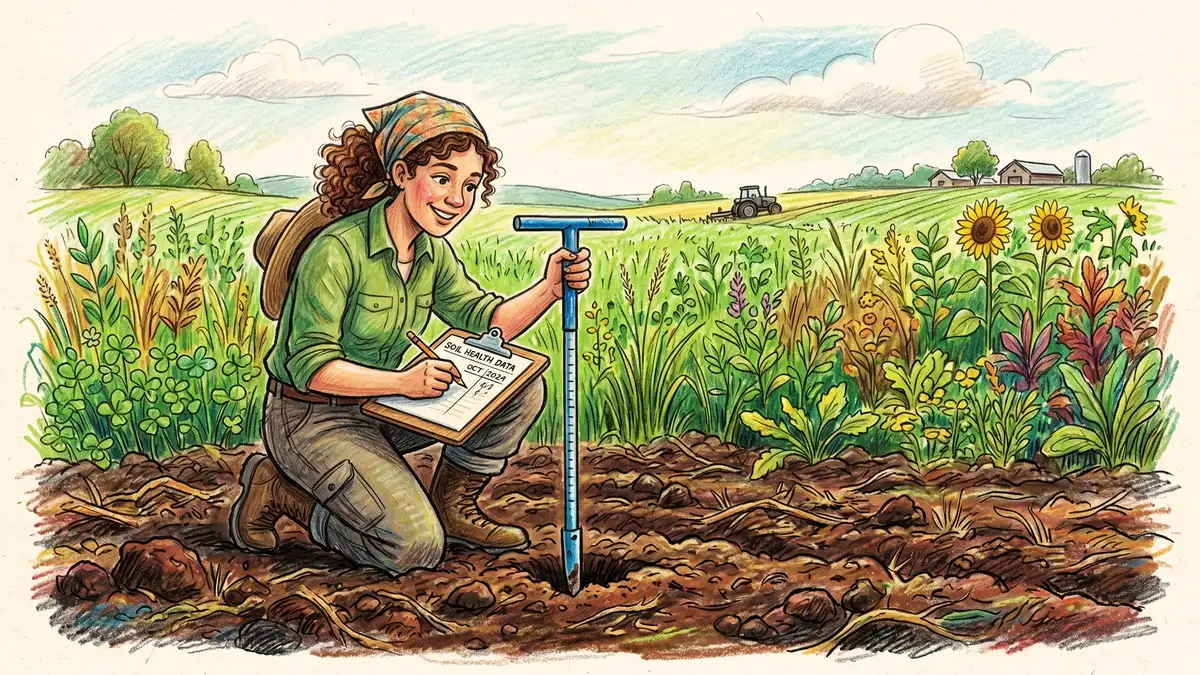
Climate-conscious readers often want to know which system sequesters more carbon. The honest answer is that the question is poorly framed. Both systems sequester carbon. The amount depends on starting soil condition, climate, management quality, and timeframe.
Regenerative carbon estimates: Peer-reviewed grazing studies (Stanley et al. 2018 in Agricultural Systems; Teague et al. 2016; Rowntree et al. 2020) show soil organic carbon gains of 0.4 to 1.2 tons per acre per year in adaptive multi-paddock grazing on previously conventional rangeland. Project Drawdown ranks regenerative annual cropping at #11 in its climate solution list and silvopasture at #9.
Syntropic carbon estimates: Brazilian EMBRAPA research on Olhos d'Agua and similar syntropic farms shows SOC gains of 60 to 200 percent over 6 to 10 years compared to baseline degraded pasture. Above-ground biomass also accumulates rapidly as the food forest matures.
The difference: regenerative numbers are validated across thousands of US acres in peer-reviewed studies. Syntropic numbers are validated on a smaller sample of farms, mostly tropical. Both are real climate solutions. Neither is the silver bullet that some advocacy materials claim. The climate problem is large enough that we need both.
Which one is right for me?
Here is a decision tree for a Gen Z climate-curious reader trying to figure out where to engage.
I want to grow food in my backyard or balcony
Lean syntropic. Or rather, lean on syntropic principles inside a permaculture frame. The vertical stacking of crops and the no-input philosophy translate well to a 100 sq ft or 1,000 sq ft backyard food forest. Look up Mark Shepard's Restoration Agriculture for a temperate North American adaptation.
I want to work in farming as a career
Lean regenerative. Most US farm jobs and policy work, USDA NRCS positions, and grant-funded conservation work runs through the regenerative framework. Singing Frogs Farm (CA), White Oak Pastures (GA), Brown's Ranch (ND), and Polyface Farm (VA) all run apprentice programs.
I want to support climate-friendly food with my purchases
Both pay off, but regenerative has more US verification frameworks (Regenerative Organic Certified, A Greener World, Land to Market). Buy from regenerative farms where possible. Buy syntropic-grown cocoa, coffee, and tropical fruit where available (some specialty chocolate brands now source from syntropic Brazilian cooperatives).
I want to work in climate policy or food sovereignty
Learn both. The conversation in Washington, DC and at state extension levels uses regenerative vocabulary. The conversation in the Global South often uses syntropic and agroecology vocabulary. Speaking both lets you bridge.
I want to do a hybrid on a homestead
This is what most US small-acreage permaculture sites end up doing. A central syntropic-inspired food forest near the house, surrounded by regenerative-managed cover-cropped vegetable beds, surrounded by adaptive multi-paddock grazing on pasture. Each system in its zone.
US farms running each system
Regenerative US:
- Brown's Ranch (North Dakota): Gabe Brown's 5,000 acres of integrated corn, wheat, cattle, and cover crops. The flagship case study in the US regenerative movement.
- White Oak Pastures (Bluffton, Georgia): Will Harris's 3,000-acre multi-species grazing operation. Verified carbon-negative beef production through a life cycle analysis published in Agricultural Systems.
- Singing Frogs Farm (Sebastopol, California): Paul and Elizabeth Kaiser's 8-acre intensive no-till vegetable operation. Grosses $100k+ per acre with minimal external inputs.
- Polyface Farm (Swoope, Virginia): Joel Salatin's family farm. The original mob-grazing demonstration farm. Featured in Omnivore's Dilemma.
Syntropic and syntropic-inspired US:
- Project Bona Fide (Hawaii): A syntropic agroforestry research and education center on Big Island.
- Aloha Aina Farm (Hawaii): Tropical syntropic cocoa and fruit production.
- Las Cañadas (Veracruz, Mexico): Just south of the US border, the most influential syntropic education center in North America. Hosts US apprentices.
The hybrid future
The most realistic path forward for US ecological agriculture is hybrid. Use syntropic principles in intensive food-forest zones (Zone 1 and 2 of a permaculture site). Use regenerative principles in broad-acre zones (Zone 3 and 4). Mix them at the edges.
Stefan Sobkowiak's Miracle Farms in Quebec is a temperate hybrid example: dense polyculture orchard rows (syntropic-inspired) inside a no-till management frame (regenerative-inspired). Singing Frogs Farm in California runs a similar synthesis on annual vegetables. Mark Shepard's New Forest Farm in Wisconsin runs a savanna-style restoration agriculture system that integrates both vocabularies.
The deeper truth: the labels matter less than the practices. Build soil. Grow diverse crops. Cover the ground. Eliminate synthetic inputs. Close the nutrient loop. Integrate animals where possible. Whether you call that syntropic, regenerative, agroecology, permaculture, or just "good farming" matters less than doing it.
Get the Weekly Dig
One practical permaculture guide a week, written for gardeners who do this on weekends: food forest and guild designs that produce. Free, no spam, unsubscribe any time.
Join the Weekly DigFAQ
What is the difference between syntropic and regenerative agriculture?
Syntropic agriculture is a vertical multi-strata tropical food forest method developed by Ernst Gotsch in Brazil, emphasizing dense polyculture and aggressive pruning to mimic natural rainforest succession. Regenerative agriculture is a broader US-driven movement of soil-focused practices (no-till, cover crops, rotational grazing) that scales across millions of acres of temperate row-crop and pasture systems. Both rebuild soil organic carbon and eliminate synthetic inputs, but the architecture, climate fit, and labor intensity differ significantly.
Is syntropic agriculture the same as permaculture?
No. Both descend from the same root (Bill Mollison and David Holmgren's 1978 Permaculture One), but syntropic emphasizes succession-driven multistrata agroforestry and aggressive pruning, while permaculture is a broader design framework that includes water harvesting, building, social systems, and many other elements. Syntropic is a specific farming method. Permaculture is a design philosophy.
Who created syntropic agriculture?
Ernst Gotsch, a Swiss-Brazilian farmer who developed the method on his Olhos d'Agua farm in Bahia, Brazil starting in the 1980s. He restored more than 600 hectares of degraded cattle pasture into productive Atlantic rainforest food forest, growing cocoa, bananas, papaya, and dozens of other species without synthetic inputs.
How much carbon does regenerative agriculture sequester?
Peer-reviewed grazing studies (Stanley et al. 2018, Teague et al. 2016, Rowntree et al. 2020) measure soil organic carbon gains of 0.4 to 1.2 tons per acre per year in adaptive multi-paddock grazing. Project Drawdown ranks regenerative annual cropping at #11 in its climate solution list. Globally, regenerative agriculture is estimated to address 5 to 15 percent of needed annual CO2 reduction.
Can syntropic agriculture work in the US?
Syntropic principles transfer to the US (especially Hawaii, southern California, the Gulf Coast, and Florida), but the specific Atlantic rainforest succession model that Gotsch designed does not. Mark Shepard's restoration agriculture in Wisconsin and Stefan Sobkowiak's Miracle Farms in Quebec are temperate adaptations of similar principles. For most of the continental US, regenerative agriculture maps more directly onto the original ecosystems.
Is regenerative agriculture certified?
Several certification frameworks exist: Regenerative Organic Certified (managed by the Regenerative Organic Alliance), Land to Market (Savory Institute), A Greener World's Certified Regenerative, and USDA's Climate Smart Commodities Initiative practices. Syntropic agriculture does not have a US certification framework yet.
Which farming system is best for climate change?
Neither alone. Peer-reviewed estimates put the global potential of regenerative agriculture at 5 to 15 percent of needed CO2 reduction, with syntropic adding meaningful but smaller global contributions. Both are real climate solutions but should be combined with energy transition, transportation decarbonization, and reduced consumption. Anyone claiming a single farming system can solve climate change is overselling.
How do I start a regenerative farm?
Start with USDA NRCS technical assistance (free, available in every US county). Apply for an EQIP (Environmental Quality Incentives Program) grant or a CSP (Conservation Stewardship Program) contract. Start small: cover crop one field, rotational graze one pasture. Connect with your state's regenerative network (e.g., Quivira Coalition in the Southwest, Northeast Organic Farming Association in New England). Apprentice at an established farm for one season.
Resources
- Agenda Gotsch: Ernst Gotsch's syntropic farming primary source
- USDA NRCS: Soil Health Principles for Regenerative Agriculture
- USDA Climate Hubs: Regenerative Agriculture Resources
- Rodale Institute: Regenerative Organic Agriculture
- Project Drawdown: Regenerative Annual Cropping climate solution profile
- Stanley et al. 2018 (Agricultural Systems): Impacts of soil carbon sequestration on life cycle greenhouse gas emissions in Midwestern USA beef finishing systems
- Kiss the Ground: Regenerative Agriculture 101