
In 1962 a 19-year-old Austrian named Sepp Holzer took over a 111-acre marginal mountain farm at 3,600 to 4,900 feet elevation. The land was officially classified as too cold and steep for conventional agriculture. Sixty years later he was growing lemons, cherries, kiwi, and grain wheat at altitudes the textbooks said were impossible, on a profitable working farm without subsidies. The methods he developed, known as Holzer mountain permaculture, translate directly to cold-climate American homesteads in the Appalachians, Rockies, and Pacific Northwest. a step-by-step hugelkultur build guide
Who is Sepp Holzer?
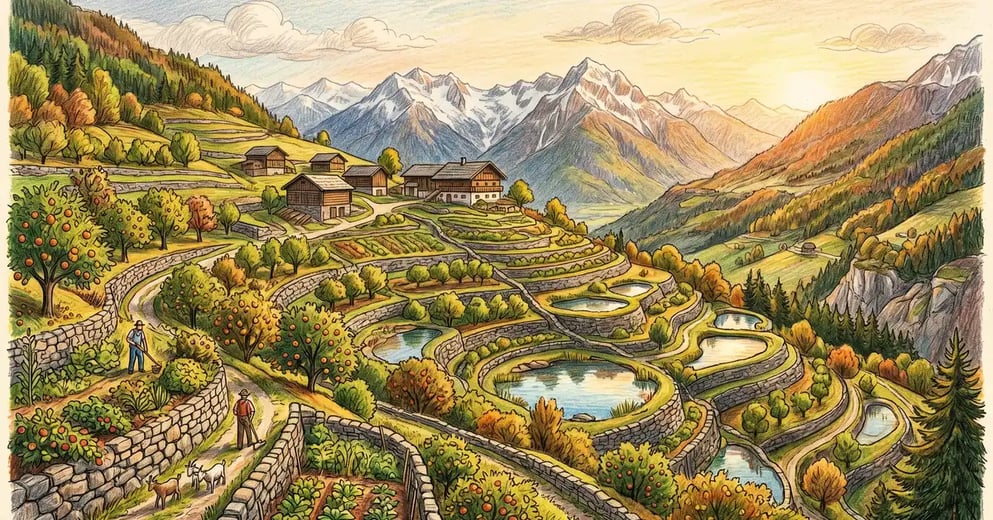
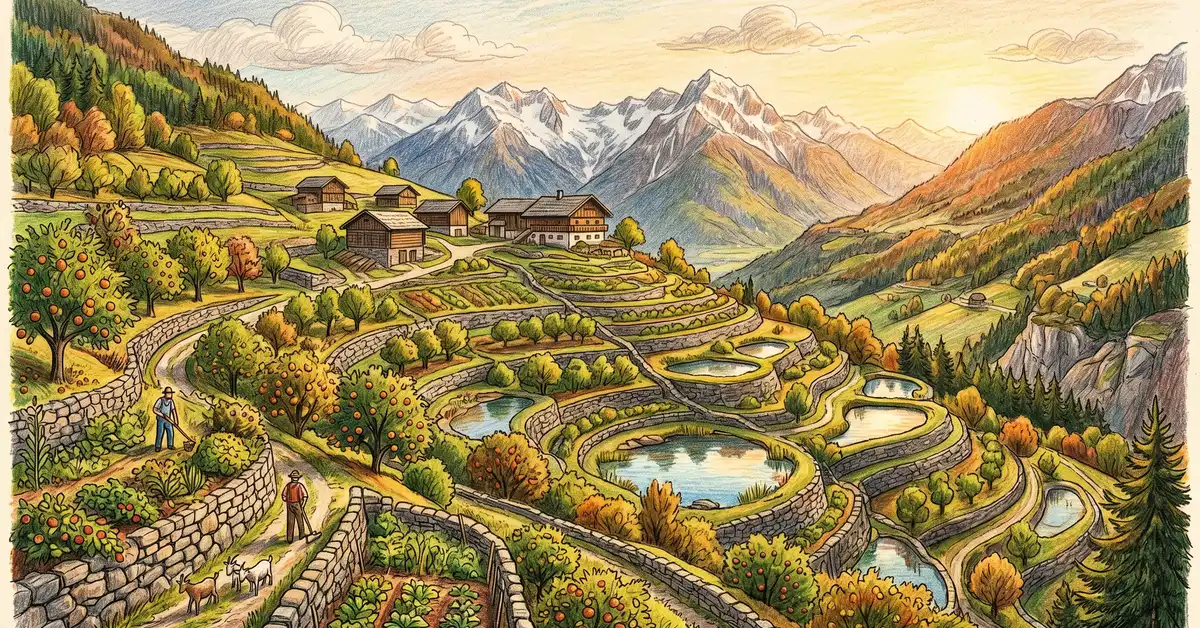
Josef "Sepp" Holzer was born July 24, 1942, in Ramingstein, in the Salzburg region of Austria. At age 19 in 1962 he took over the family farm, the Krameterhof, on the southern slope of the Schwarzenberg mountain in the Lungau region. The property runs 45 hectares (111 acres) at elevations from 1,100 to 1,500 meters (3,600 to 4,900 ft) above sea level. By Austrian agricultural standards the site was marginal: average annual temperature near 5 C (41 F), 166 frost days per year, steep slopes, and thin soils on weathered bedrock.
Holzer developed his methods by observation rather than formal training. He did not discover the word "permaculture" until 1995, by which point he had already been practicing what Bill Mollison and David Holmgren had codified as the discipline. His approach is more earthworks-heavy and less doctrinal than mainstream Mollison-Holmgren permaculture, focused on the physical reshaping of land (terraces, ponds, hugelkultur) rather than on design principles. His 1995 German-language book The Rebel Farmer (Der Agrar-Rebell) and his 2010 English-language Sepp Holzer's Permaculture brought the methods to the international permaculture community.
Today the Krameterhof is a teaching center run by Sepp's son Josef, host to workshops and consultancy projects across Europe, Russia, Spain, Portugal, Ecuador, and the United States.
The five core practices of Holzer mountain permaculture
Why this works (the permaculture principle)
Holzer's insight was that "marginal" land is not marginal if you reshape it. A steep, cold, north-facing slope produces nothing. A terraced south-facing wall of stone absorbing sunlight, with a pond at its base reflecting heat upward and a hugelkultur bed planted between, produces cherries at 4,500 ft. The land was never the problem. The shape was. The same logic underpins our broader permaculture garden design framework.
Hugelkultur: buried wood core beds
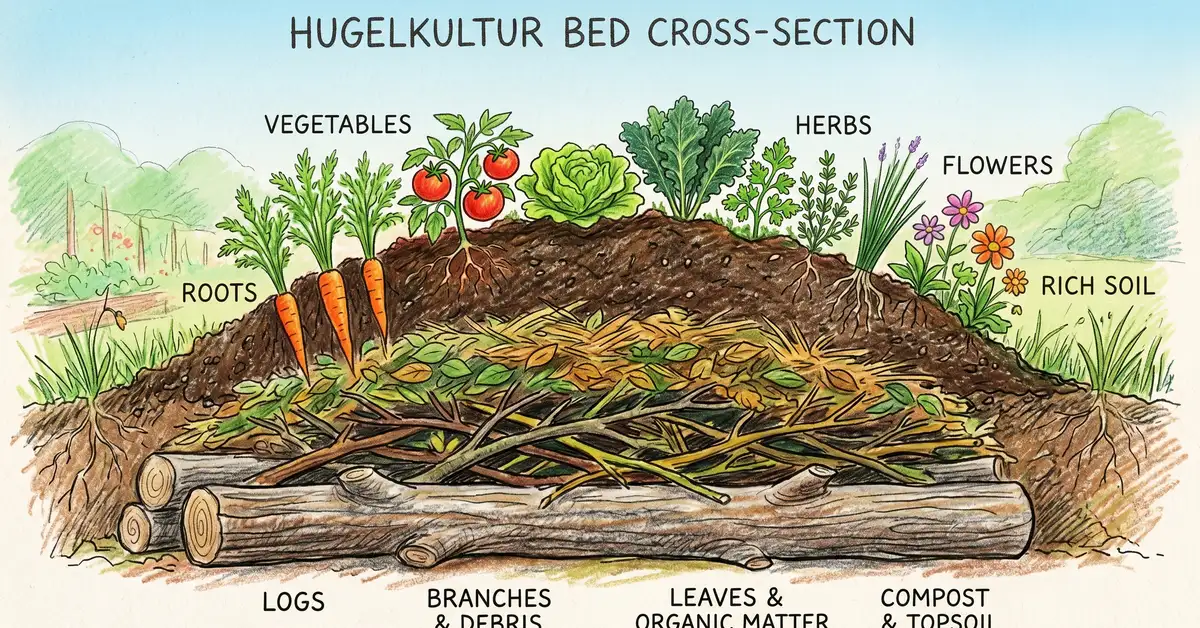
A Holzer hugelkultur bed is built by digging a shallow trench, filling it with logs and woody debris, covering with branches, leaves, manure, and topsoil, and planting on the resulting mound. Typical heights run 3 to 6 ft. The wood acts as a sponge that holds water through dry periods and a slow-release fertilizer for 7 to 20 years as it decomposes. Research documents 10x reductions in irrigation needs vs flat beds during drought.
Ponds: water storage and microclimate engines
The Krameterhof has roughly 70 small to medium ponds scattered across the slope. Each pond serves four functions: water storage for dry summer months, reflective heat for adjacent south-facing plantings, raised local humidity that buffers frost, and habitat for fish (carp, trout, char) that contribute to the food economy. Pond plus south-facing stone wall can raise effective local temperatures 5 to 8 C, equivalent to shifting 2 hardiness zones south.
Terraces and stone walls: solar heat capture
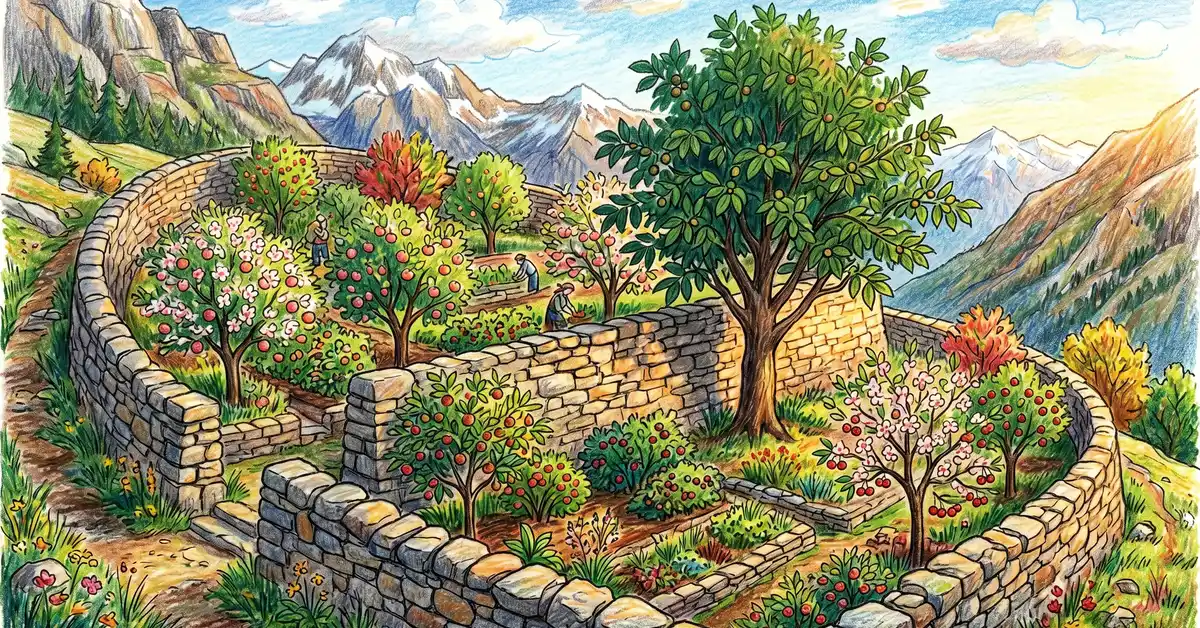
Holzer cut contour terraces into the steep slopes and built stone retaining walls. The stones absorb solar heat by day and radiate it through the night, smoothing out temperature swings and extending the growing season for trees planted on the warm side. The terraces also slow water, prevent erosion, and create planting pockets that accumulate organic matter.
Integrated livestock
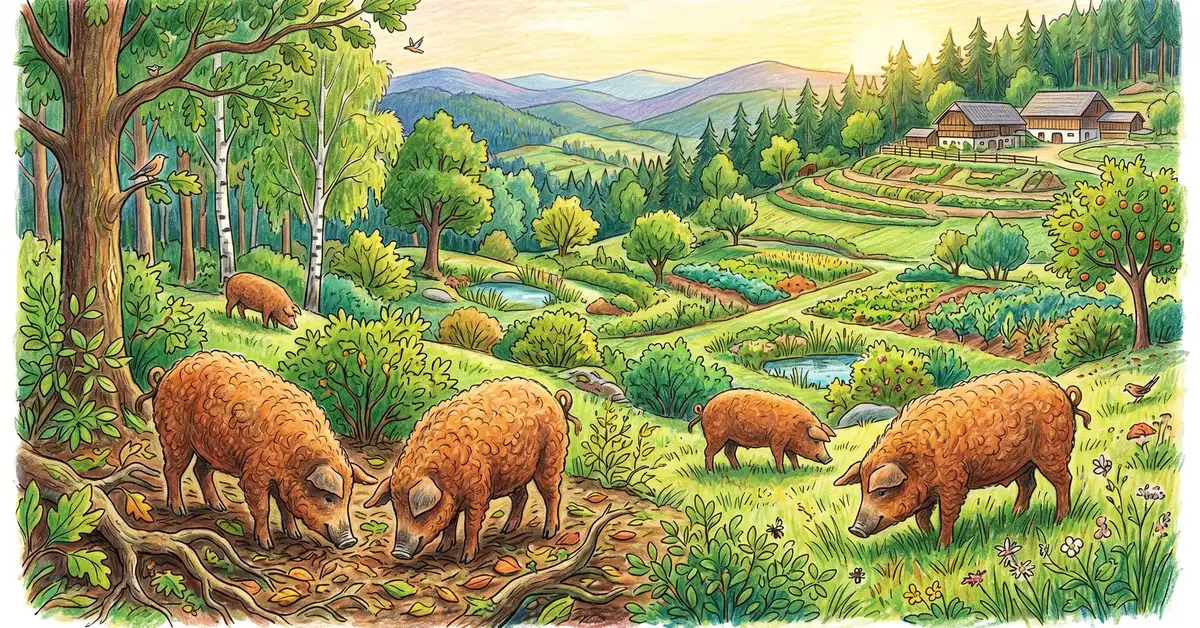
Mangalitsa pigs (a hardy hairy Hungarian heritage breed) root and turn ground that the farmer would otherwise have to till. Cattle graze rotational paddocks. Fish populate the ponds. Chickens forage the herbaceous layer. Each animal does work the farmer would otherwise pay for. Holzer's pigs in particular are famous: he scatters acorns and grain into beds he wants tilled, the pigs root the area thoroughly while eating, and the farmer plants the prepared seedbed.
Cold-tolerant seed saving
When commercial grain varieties failed at his altitude, Holzer bred his own cold-tolerant cereals by crossing landraces and selecting seed from the plants that survived hardest winters. The same patient saving applies to fruit trees, vegetables, and herbs. The seed bank he developed is now distributed through his consultancy network.
Crops that should be impossible at 4,500 feet
The Krameterhof produces species that the elevation and latitude should not allow:
Lemons and citrus (in protected microclimates). Behind warm south-facing stone walls with reflective pond heat.
Kiwi (Actinidia deliciosa and the hardier Actinidia arguta). On terraced south-facing slopes.
Cherries, plums, apples, and apricots. Productive in mass.
Walnuts (including Carpathian walnut). Cold-hardy varieties handle the climate well.
Chestnuts. Marginal at the elevation but produce in warmer pockets.
Wild and bred-cold cereals. Holzer's own wheat, rye, and emmer lines.
Mushrooms. Inoculated logs in shaded zones.
Fish. Carp, trout, and Arctic char in the ponds.
Berries. Sea buckthorn, currants, gooseberries, haskap, raspberries, blackberries, and wild strawberries.
Where Holzer differs from mainstream permaculture
Mollison-Holmgren mainstream permaculture is taught as a design discipline with 12 principles, ethical frameworks, and certification courses. Holzer's permaculture is taught as a set of physical interventions performed on land. The mainstream community talks about zones and sectors; Holzer talks about logs, stones, and ponds. Both succeed; they emphasize different parts of the same field.
Translating Holzer methods to US cold-climate homesteads
| US region | Climate match | Holzer methods that translate best |
| Appalachian highlands (VA, WV, NC mountains, VT, NH) | Strong match, steep slopes plus cold winters | Terraces, ponds, hugelkultur, stone walls, cold-hardy fruit trees |
| Rocky Mountain foothills (CO, MT, ID, WY) | Strong match, high elevation cold dry | Hugelkultur for water retention, south-facing terraces, pond microclimates |
| Pacific Northwest mountains (WA, OR Cascades) | Good match, wet steep cold | Ponds, terraces, mushrooms in shade zones, cold-hardy fruit |
| Upper Midwest (MN, WI, MI Upper Peninsula) | Cold but flat; partial match | Hugelkultur, ponds, livestock integration, seed saving |
| Maine and upstate NY | Strong cold match | Hugelkultur, ponds, cold-hardy fruit, livestock |
| High Plains and Front Range (eastern CO, WY) | Cold dry mid-elevation | Hugelkultur for water, pond storage, windbreaks, livestock |
Source:, US cold-climate permaculture practitioner reports.
Pond microclimate effect explained
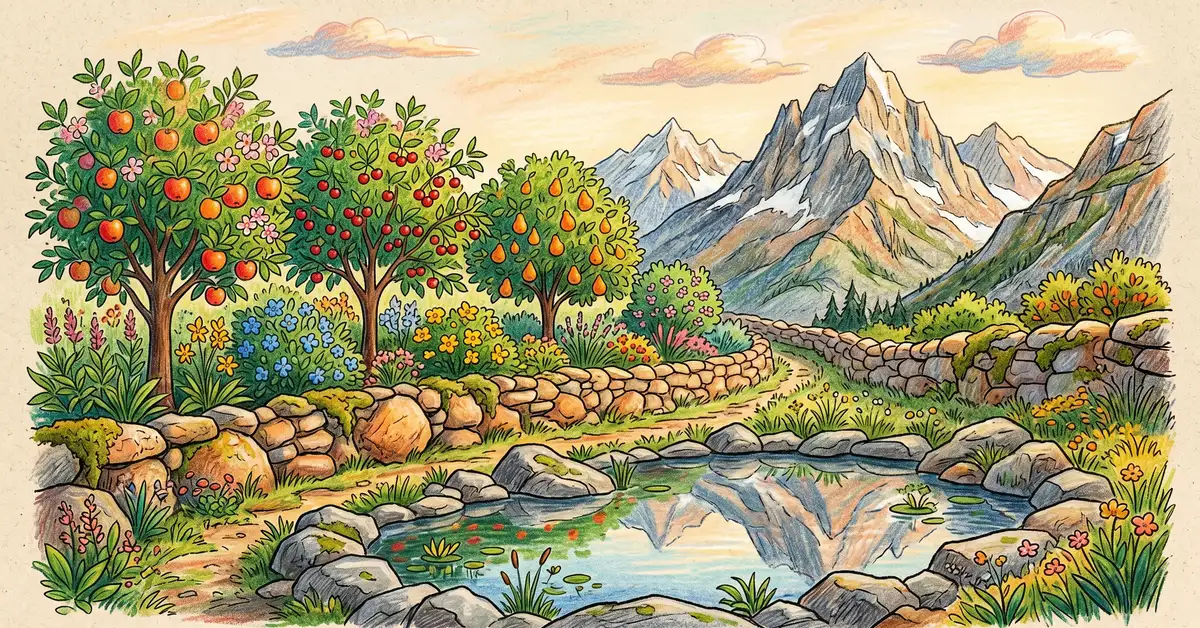
The single most underrated element in Holzer's method is the small pond. A 200 sq ft pond holds roughly 6,000 gallons of water, which functions as a thermal battery. By day the water absorbs solar energy and stays cooler than surrounding air, buffering against summer heat spikes. By night the water releases stored heat slowly, lifting overnight low temperatures around the pond by 3 to 8 F. Add a south-facing stone wall on the pond's north side, and the wall doubles the effect: the wall absorbs daytime sun, reflects radiation onto plantings on its south side, and re-emits heat through the night. The combined effect of pond plus stone can extend the growing season by 3 to 5 weeks at temperate cold-climate sites and unlock species that should not produce at the latitude.
A starter Holzer project for a US homesteader
You do not need 111 acres to start. A single 1/4 acre cold-climate homestead can apply Holzer methods at scale:
Year 1: Build one hugelkultur bed (4 ft tall, 12 ft long) using fallen wood from the property or the local arborist. Excavate a small frog pond (10 by 15 ft, 4 ft deep) on a contour. Stack flat field stones into a low retaining wall on a south-facing aspect.
Year 2: Plant the hugelkultur with annuals (squash, beans, potatoes) and perennial herbs (oregano, lemon balm, comfrey). Stock the pond with native fish (check your state regulations). Plant cold-hardy fruit (haskap, sea buckthorn, currants, Carmine Jewel cherries) on the warm side of the stone wall.
Year 3: Add livestock at appropriate scale (chickens, ducks, or small pig herd). Expand hugelkultur. Add second pond. Save seed from the best-performing plants.
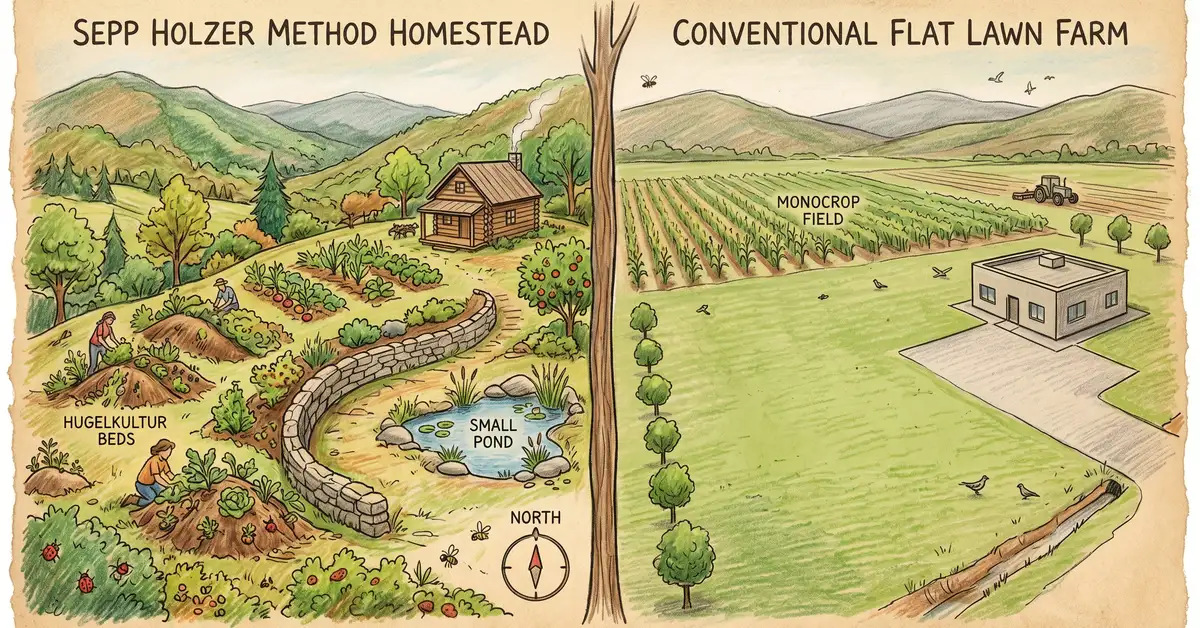
Year 5: System reaches partial maturity. Fruit trees producing. Pond fish harvestable. Soil dramatically improved. Compare to flat conventional plot from before.
Get the Weekly Dig
One practical permaculture guide a week, written for gardeners who do this on weekends: permaculture design for real backyards. Free, no spam, unsubscribe any time.
Join the newsletterFrequently asked questions
Who is Sepp Holzer?
Sepp Holzer is an Austrian farmer and self-taught permaculture pioneer born in 1942. He took over the Krameterhof mountain farm at age 19 in 1962 and spent six decades developing what he calls Holzer permaculture, an earthworks-heavy method for productive cold-climate farming that he developed independently of Bill Mollison and David Holmgren. His 2010 English-language book Sepp Holzer's Permaculture brought the method to the international community.
What is the Krameterhof?
The Krameterhof is Sepp Holzer's family farm in the Lungau region of Salzburg, Austria, covering 45 hectares (111 acres) at elevations from 1,100 to 1,500 meters (3,600 to 4,900 ft) on the southern slope of the Schwarzenberg mountain. Originally classed as marginal alpine land, Holzer transformed it into a productive working farm featuring roughly 70 ponds, terraced fields, hugelkultur beds, mixed orchards, and integrated livestock.
What is hugelkultur?
Hugelkultur is a German term meaning "mound culture," a raised bed technique where buried logs and woody debris form the core of a tall planting mound. The decomposing wood holds water like a sponge and slowly releases nutrients for 7 to 20 years. Holzer popularized hugelkultur as a tool for cold-climate water retention and microclimate creation. Beds typically run 3 to 6 ft tall and are planted with mixed polycultures.
What to plant in hugelkultur the first year?
First-year hugelkultur beds work best with annuals that handle slightly nitrogen-poor conditions because the fresh wood ties up nitrogen during initial decomposition. Good first-year choices include squash, pumpkin, potatoes, beans, peas, sunflowers, and herbs (oregano, thyme, sage). Add a side dressing of compost or aged manure. From year 2 onward, hugelkultur supports the full range of vegetables and perennial plants.
Can you use cedar for hugelkultur?
Cedar can be used in hugelkultur but breaks down very slowly due to its natural decay resistance and allelopathic compounds in some species. Place cedar at the deep core where slow decomposition is acceptable, not in the upper layers. Avoid black walnut (juglone allelopathy), eucalyptus, and treated lumber entirely. Best hugelkultur woods are alder, willow, poplar, maple, aspen, birch, and most hardwoods past the initial wet stage.
What are the drawbacks of hugelkultur?
Hugelkultur drawbacks include first-year nitrogen tie-up by decomposing wood (mitigated by manure or compost), large upfront labor for the build, settling of the mound by 6 to 12 inches over the first 2 years, potential rodent habitat in voids, and unsuitability for some woody material (walnut, cedar in upper layers, treated lumber). Once established, the benefits substantially outweigh these drawbacks for most cold-climate sites.
How is Sepp Holzer different from Bill Mollison and David Holmgren?
Mollison and Holmgren codified permaculture as a design discipline with 12 principles, ethical frameworks, and certification courses, taught primarily as a planning method. Holzer developed his methods through 50+ years of hands-on experimentation on mountain land and emphasizes physical earthworks (terraces, ponds, hugelkultur, stone walls) over design theory. The two streams complement each other.
Has Sepp Holzer worked on US projects?
Yes. Holzer and his consultancy team have advised on cold-climate American projects including farms in the Pacific Northwest, the Rocky Mountain region, and the Appalachians, plus international work across Russia, Spain, Portugal, and Ecuador. His son Josef now runs the consultancy from Krameterhof.