
You've read about permaculture for years — zones, guilds, Mollison's book sitting on your shelf. Then a YouTube video on Ernst Götsch shows up, and suddenly everyone is talking about syntropic agriculture like permaculture's smarter cousin. Are they the same thing? Different? Does one actually work better in a US backyard, or is this a Brazilian tropical method that won't survive your Zone 6 winters? syntropic agriculture in year 3 is syntropic agriculture actually proven analog forestry compared with syntropic agriculture
Short answer: they're different frameworks with real overlap. Permaculture is a design philosophy — how to arrange a whole property. Syntropic agriculture is a production methodology — how to pack a planting strip with species that pay for themselves in biomass. This guide explains the measurable differences, where each one fits a US home garden, and whether a Weekend Gardener should pick one, the other, or combine them.
The 30-second version
Permaculture is a whole-property design framework with 12 principles, zones, and sectors — it answers "where does everything go?" Syntropic agriculture is a single-strip planting method invented by Ernst Götsch in Brazil — it answers "how do I pack one row with succession-stacked species and manage it through aggressive pruning?" You can run a permaculture property that uses syntropic strips inside it. For most US Weekend Gardeners, permaculture is the easier starting point; syntropic works best once you already have a design and want to intensify one area.
What each system actually is
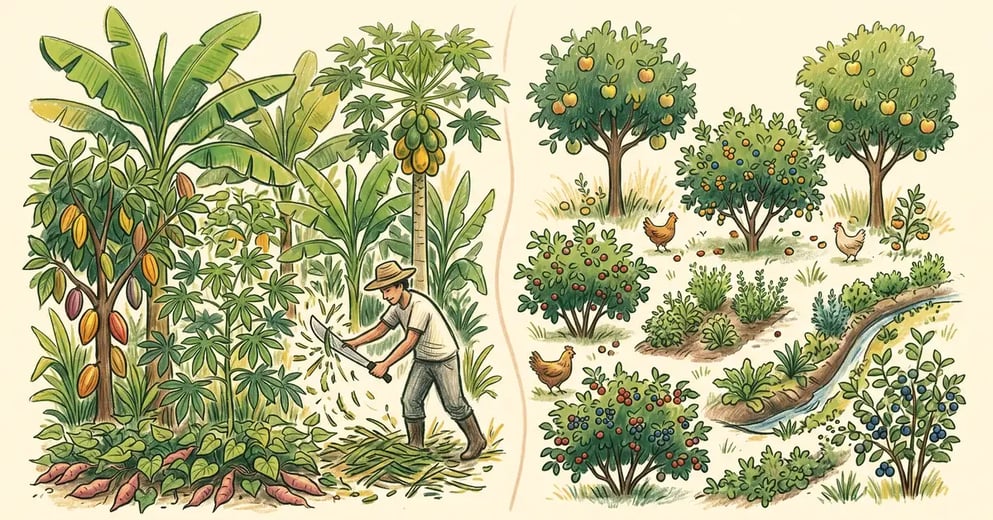
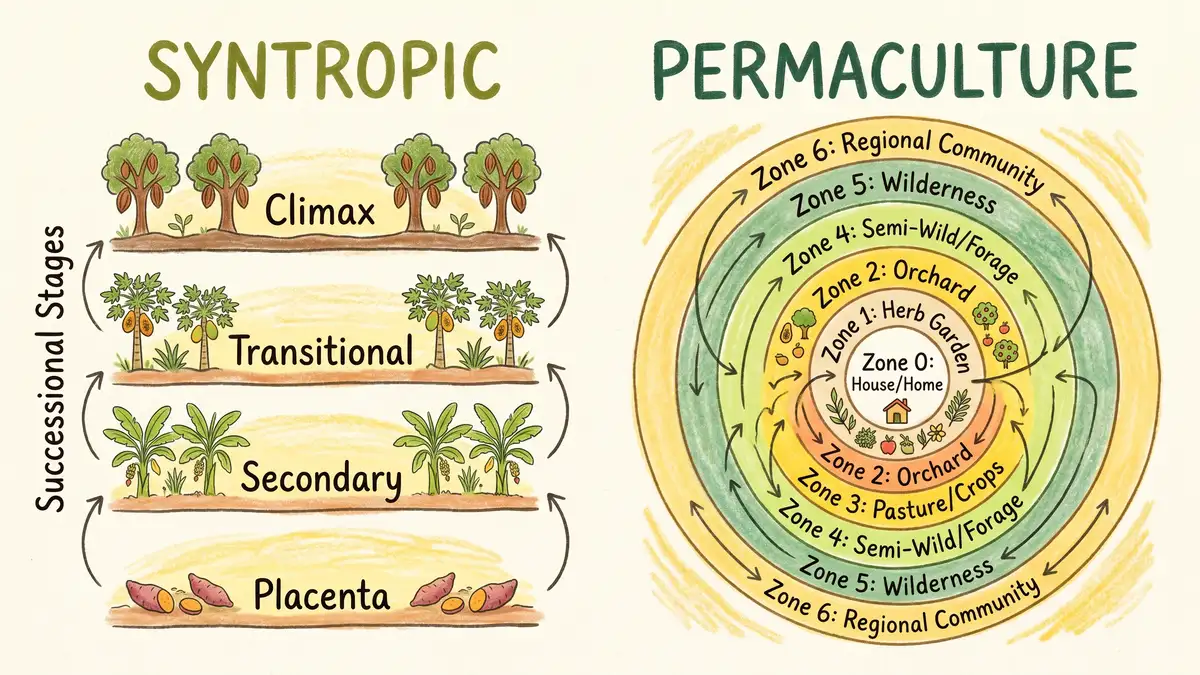
Both systems model themselves on natural forests. Both prioritise soil life, biomass cycling, and closed loops. The origins and emphasis, however, are genuinely different.
Permaculture was coined by Bill Mollison and David Holmgren in Tasmania and formalised in their 1978 book Permaculture One. It is a design system built on three ethics (earth care, people care, fair share) and twelve principles. The core tools are site analysis, zones 0–5 (from your kitchen outward), sector mapping for sun/wind/water, and guilds — plant communities around a central species. Permaculture is broad by design: it covers water, shelter, energy, community, and finance, not just gardening. The USDA agroforestry program borrows heavily from permaculture vocabulary.
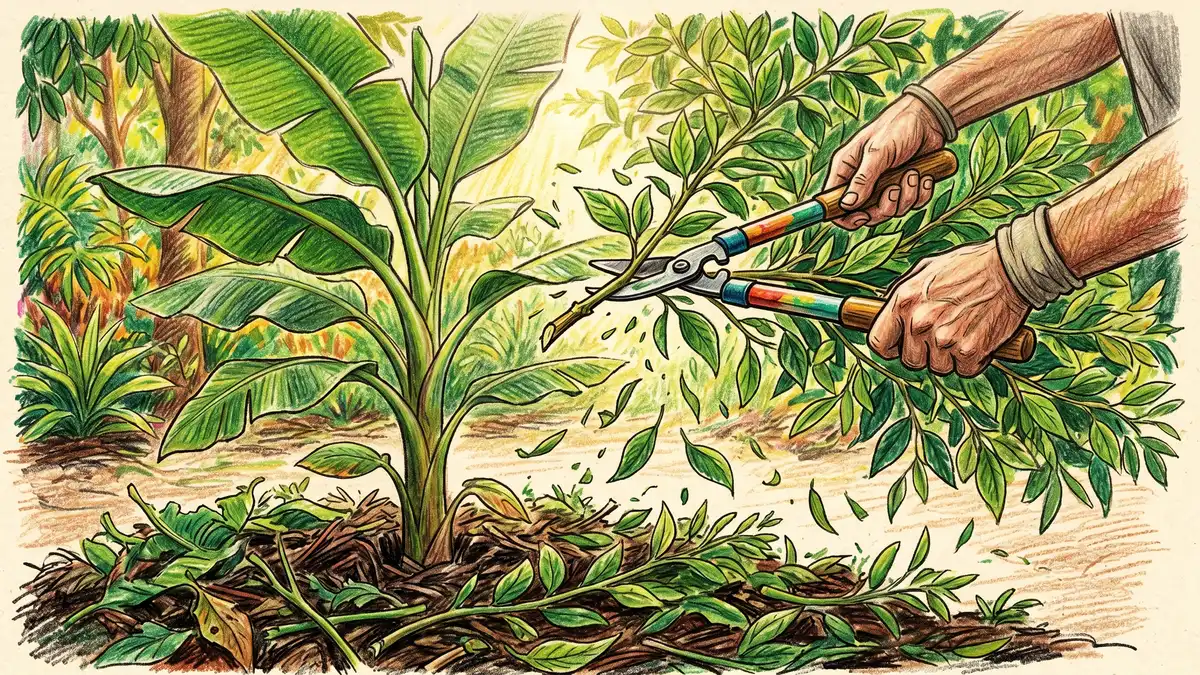
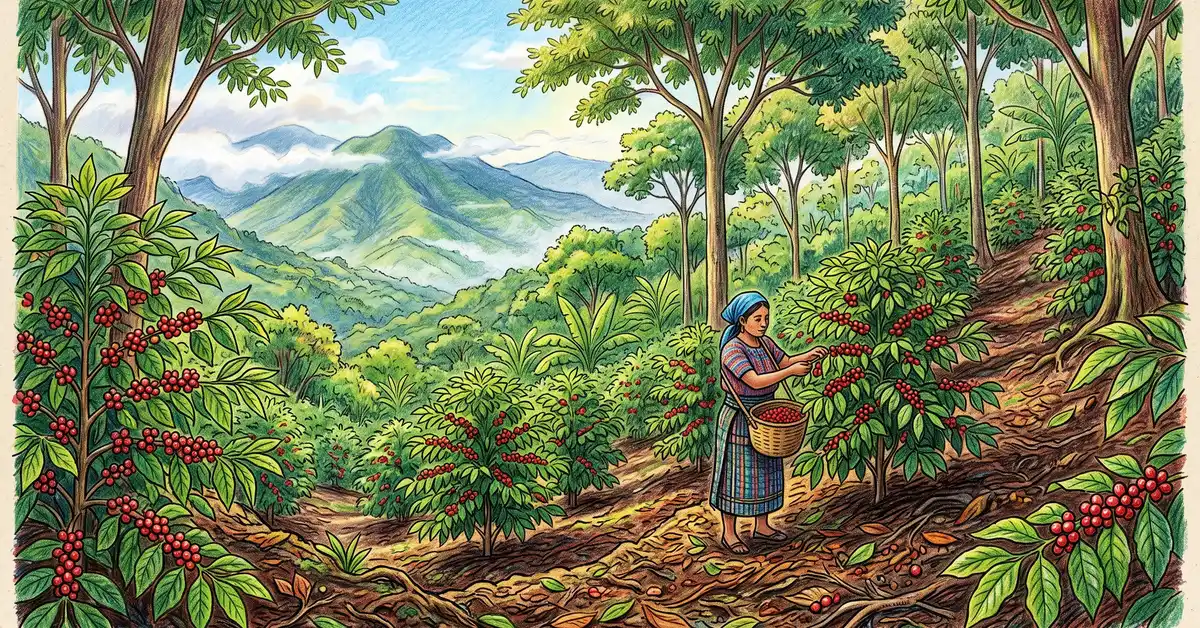
Syntropic agriculture was developed by Swiss-Brazilian farmer Ernst Götsch on the degraded cacao lands of Fazenda Olhos d'Água, Bahia, starting in 1984. Götsch observed that a forest's "climax" community is built in predictable succession waves, and he codified those waves into four succession classes — placenta, secondary, transitional, and climax — along with four stratification levels — emergent, high, medium, and low. Every plant in a syntropic strip has a succession class and a stratum coordinate. Management is defined by aggressive periodic pruning — chopping biomass as mulch every 4–6 weeks in the growing season to accelerate what Götsch calls "life processes." The method spread globally through the Life in Syntropy film released at COP21 in 2015.
If you're new to the Brazilian system, our complete introduction to syntropic agriculture walks through Götsch's vocabulary in more detail.
The core difference in one sentence
Permaculture asks "where should this live?" Syntropic agriculture asks "who pays the biomass rent next to this crop?" Permaculture is a layout framework. Syntropic is a production recipe. Everything below is a consequence of that split.
Why This Works: Both obey the same ecological law
The deeper pattern underneath both systems is the same — succession. A bare patch of ground wants to become a forest, and it will run through predictable communities (annual weeds → biennials → shrubs → pioneer trees → climax) to get there. Permaculture surfaces this as "accelerate natural succession" (principle 9 in Holmgren's formulation). Syntropic builds it into the planting chart. Neither invented succession; both let you ride it instead of fighting it.
Where they really diverge — a side-by-side
Treat this table as a decision aid, not a scoreboard.
| Dimension | Permaculture | Syntropic agriculture |
| Scope | Whole-property design — water, shelter, energy, plants, animals, community | Planting-strip production system — food crops + biomass species |
| Primary output | A self-regulating homestead | Marketable yield from dense agroforestry |
| Planting density | Lower — guilds of 5–12 species per tree | Very high — up to 10× denser; dozens of species per linear meter |
| Pruning cadence | Selective, seasonal; chop-and-drop when needed | Heavy, rhythmic; every 4–6 weeks in growing season |
| Design unit | Zone + sector + guild | Line (planting strip) + stratum + succession class |
| Climate origin | Temperate Tasmania, adapted globally since 1978 | Tropical Bahia; temperate adaptation still experimental |
| Training path | Permaculture Design Certificate (72 hours, globally accredited) | No unified certification; Agenda Gotsch courses, Life in Syntropy cohorts |
| Research base | Broad — 1,000+ journal articles on agroforestry principles it shares | Narrow — handful of peer-reviewed studies; mostly grey literature |
Sources:.
Which one fits your garden?
A Weekend Gardener running a 2,000 sq ft backyard in USDA zones 4–7 (covering most of the lower 48) has a different answer than a homesteader with ten acres in north Florida.
Start with permaculture if you're new
Zone mapping gets more value from a small garden than succession stacking does. If your kitchen garden, compost, chickens, and fruit trees aren't arranged yet, spend 3–4 hours with Holmgren's 12 principles and the free USDA Agroforestry Strategic Framework before adding any new beds.
Add syntropic strips once the layout is settled
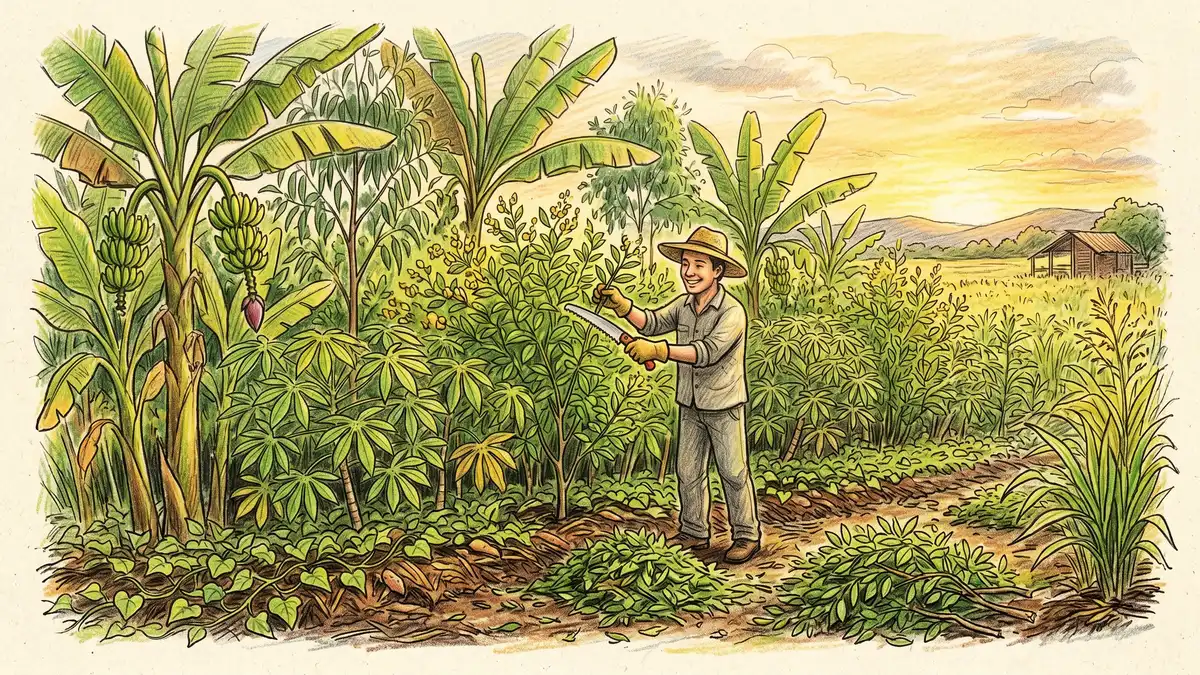
A 4 ft × 30 ft strip on the south edge of your property is a realistic first syntropic project. Pack it with a pioneer line (pigeon pea, moringa+), a production line (fruit trees), and a ground line (sweet potato, squash). Expect 60–90 minutes of pruning every 4–6 weeks from May through September.
Swap species for your climate
Götsch's original plant list assumes 60+ inches (1,500 mm) of rain and no freezes. In temperate US gardens, replace banana with elderberry, cassava with Jerusalem artichoke, cacao with pawpaw, and pigeon pea with Siberian pea shrub or Robinia pseudoacacia. The University of Hohenheim's temperate syntropic trial documents one successful substitution set.
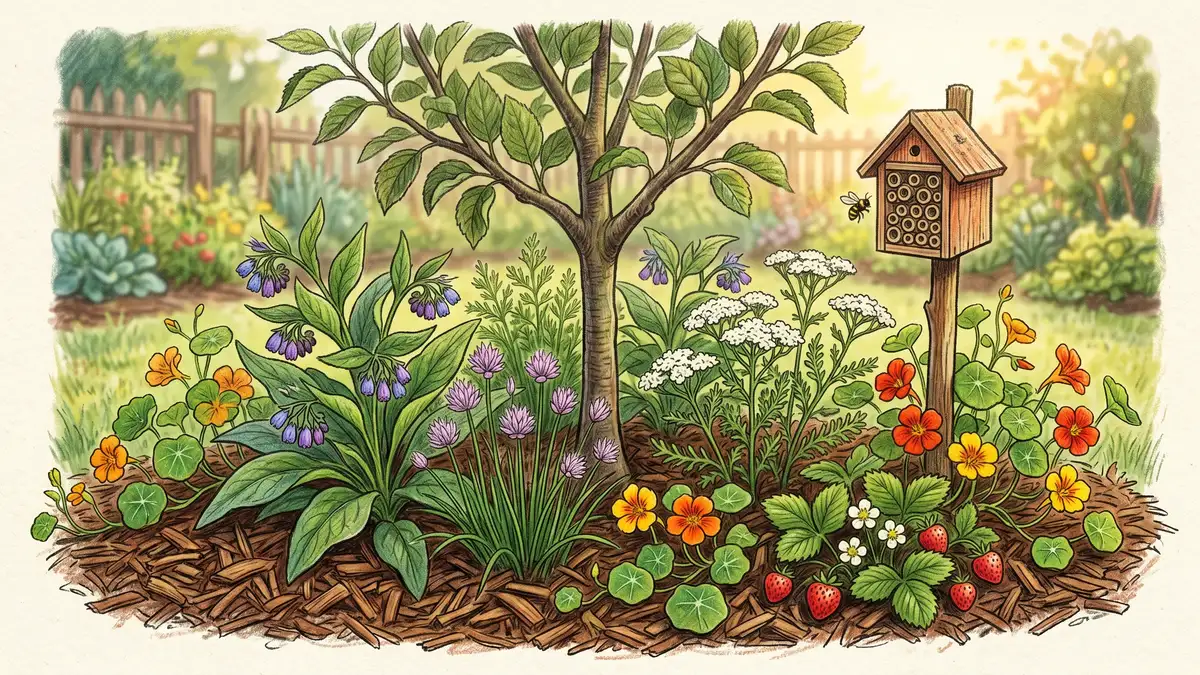
Homesteaders managing 5–40 acres often run both: permaculture for the overall farm design (animal paddocks, swales, windbreaks, pond placement) and syntropic strips in the highest-access zones where intensive pruning pays for itself. Urban Micro-Growers with a single raised bed can extract most of the value by borrowing syntropic stacking without committing to the pruning cadence — dense polyculture is still dense polyculture.
Syntropic in cold climates — what to expect
Syntropic was designed in a climate with no freezing season, where pigeon pea puts on 10 ft (3 m) of biomass in six months. In USDA zones 3–6, your pioneer/placenta species will be limited to annuals (sunflowers, sorghum, amaranth) and a short list of hardy perennials. Expect roughly half the biomass production of a Brazilian strip, and plan on mulching from an external source for the first 2–3 years. This is an evolving area; the SIT semi-arid New Mexico study (2024) found small-scale syntropic is feasible in the Southwest but requires species substitution and supplemental irrigation.
Cost, time, and labor compared
A realistic comparison for a first-year home project, using US retail prices and a 1,500 sq ft (140 m²) area.
| Item | Permaculture food forest | Syntropic strip |
| Plants + seeds (year 1) | $180–$350 | $220–$420 |
| Mulch (imported) | $80–$160 | $40–$90 after year 1 |
| Tools (loppers, pruning saw, wheelbarrow) | $120 | $160 (add folding saw) |
| Setup labor | 20–30 hours | 30–45 hours (denser planting) |
| Weekly maintenance, growing season | 30–60 min | 60–120 min (pruning rhythm) |
| Expected first yield | Year 2 (berries, herbs) | Year 1 (short-cycle crops) |
Source: compiled from Lancaster Farmland Trust syntropic guide (2025) and US retail pricing (Johnny's Seeds, Fedco, April 2026).
The syntropic strip returns food faster — short-cycle ground line crops (radish, arugula, bush beans) are intentional placenta species in year one. The food forest catches up in year 3–4 and has lower ongoing labor. If you're choosing based purely on hours per pound of food, permaculture wins for passive homesteaders; syntropic wins for gardeners who enjoy the weekly rhythm.
Not sure which fits your site?
Our companion guide compares climate, scale, and skill-level matches so you can choose with clear eyes instead of hype.
Read the beginner's syntropic guide →Can you combine them? (Yes — and most practitioners do)
The framing "syntropic vs permaculture" is mostly a marketing artefact. On real properties, they stack cleanly:
- Permaculture gives you the map. Use zones, sectors, and guilds to decide where your syntropic strip lives, what it catches from, and what it shelters.
- Syntropic gives you the planting chart. Inside that strip, use succession classes and strata to decide what goes next to what.
- Both share tools. Chop-and-drop, dynamic accumulators (comfrey, nettle), nitrogen-fixers, and mulch-heavy soil care appear in both systems. Our chop-and-drop mulching guide works equally well in a permaculture guild or a syntropic row.
Götsch himself does not position syntropic as a replacement for permaculture; his students at Agenda Gotsch routinely run properties designed with permaculture zones. The Australian practitioner community at Syntropia describes the relationship as "permaculture is how to live; syntropic is how to obtain a yield."
What the research actually says
Be honest about the evidence gap. Permaculture principles inherit the broader agroforestry and ecological-intensification literature — the, and decades of Embrapa tropical research. Syntropic agriculture has a much narrower peer-reviewed footprint; most documentation is practitioner video and grey literature from Life in Syntropy, the Yale Forum on Religion and Ecology overview, and the Hohenheim temperate-zone trial cited above.
Reported outcomes from Götsch's Fazenda Olhos d'Água — restored springs, measurably higher soil organic matter, cacao yields that match or exceed conventional — are documented by Götsch's team but have not been replicated across independent sites at scale. Treat enthusiastic syntropic yield claims as promising, not settled. Treat permaculture's broader agroforestry base as well-supported; treat its whole-property claims (energy, community, finance) as largely philosophical.
Frequently asked questions
Is syntropic farming just advanced permaculture?
No. Syntropic is a narrower, more prescriptive planting methodology developed independently by Ernst Götsch in Brazil. Permaculture is a broader whole-property design framework developed in Tasmania. They share an ecological grounding but are not nested versions of the same thing.
Who invented syntropic agriculture?
Ernst Götsch, a Swiss farmer and researcher, developed the method on degraded land in Bahia, Brazil beginning around 1984. He formalised the succession-class vocabulary in the 1990s and 2000s, and the method reached global audiences through the 2015 short film Life in Syntropy.
Which is better for a small US backyard?
Permaculture, for most Weekend Gardeners. Zone-based design gives you more value on a 2,000–10,000 sq ft lot than dense succession stacking does. Add a single syntropic strip later, after the overall layout is settled and you have time for the weekly pruning rhythm.
Does syntropic work in cold climates?
Partially. The core principles (succession, dense planting, heavy biomass) transfer; the species list does not. Expect lower biomass production, fewer woody pioneers, and a shorter management window. Temperate adaptations exist but are still early-stage — see the Hohenheim quarry study and the SIT New Mexico thesis linked above.
Can you get certified in syntropic agriculture?
There is no global accreditation equivalent to the Permaculture Design Certificate. Agenda Gotsch runs intensive courses in Brazil and occasionally in the US and Europe; Scott Hall's Syntropia offers online modules; most practitioners learn by copying documented strips from YouTube and farm visits.
Is syntropic farming profitable?
On tropical commercial farms in Brazil and Australia, yes — Götsch's Fazenda Olhos d'Água is financially viable. On temperate small farms, the evidence is thin and mixed. For home gardeners, "profitable" is the wrong frame; both systems are about lower inputs and resilient yields, not cash-crop returns.
Get the Weekly Dig
One practical permaculture guide a week, written for gardeners who do this on weekends: food forest and guild designs that produce. Free, no spam, unsubscribe any time.
Join the Weekly DigResources
- Ernst Götsch profile — Global Earth Repair Foundation
- Life in Syntropy film — ECHO Community (Agenda Gotsch, 2015)
- A Beginner's Guide to Syntropic Farming — Lancaster Farmland Trust (2025)
- Syntropic Farming vs Permaculture — Syntropia (2024)
- USDA Agroforestry program overview
- USDA Agroforestry Strategic Framework 2019–2024 (PDF)
- Adapting Syntropic Permaculture in Temperate Zones — Hohenheim (2020, PDF)
- Syntropic Agriculture in Semi-Arid New Mexico — SIT thesis (2024, PDF)
- Ernst Götsch: creator of the real green revolution — Believe Earth (2018)
- Syntropic Farming & Agroforestry — Yale Forum on Religion and Ecology (2024)
- Sustainable intensification review — Royal Society B (2008)
- Agroforestry ecosystem services — Jose, Agroforestry Systems (2010)
- Agenda Gotsch — official Götsch learning platform
- Syntropic Farming Worldwide — Ideass/Life in Syntropy (2024, PDF)