
If you garden on heavy clay, you have probably seen the advice: dump a bag of gypsum on the soil and your problems go away. The honest answer is that for most US backyard gardeners, gypsum is one of the most overpromised soil amendments on the shelf. It works in a narrow set of conditions (sodic clay, mostly in the irrigated US Southwest) and does almost nothing for the dense Midwestern or Northeastern clay that most weekend gardeners are fighting. adding calcium without changing pH what to grow in heavy ground why adding sand to clay backfires
This guide walks through the actual soil science, the specific conditions where gypsum does help, what the major university extensions say (including Washington State, Penn State, and Iowa State), and the five year compost-based plan that actually works.
Sources:.
What gypsum actually does
Gypsum is calcium sulfate dihydrate. When you dissolve it in soil water, the calcium cations (Ca++) exchange places with sodium cations (Na+) held on the clay particles. The displaced sodium washes away with drainage water, and the freed clay particles flocculate together into stable aggregates. The dense, sticky, structureless clay becomes a properly aggregated soil with pore spaces.
That entire chemistry depends on one premise: the clay was sticky and structureless BECAUSE of excess sodium. Soil scientists call this sodic clay. The threshold is an exchangeable sodium percentage (ESP) above about 15, or a sodium adsorption ratio (SAR) above 13.
If your clay has normal sodium levels (the case for almost all rain-fed US gardens), the calcium from gypsum is replacing a calcium ion that was already there. The chemistry does nothing. The compaction stays. The bag was wasted.
Why this matters as permaculture
Permaculture asks: what is the real problem? For most non-sodic clay the real problem is not sodium chemistry. It is depleted organic matter, soil compaction, and a missing soil food web. Permaculture solutions match the real problem: cover crops, compost, no-till, mulch, perennial deep-rooted plants. Gypsum is a chemical answer to a biological problem.
Sodic clay vs non-sodic clay
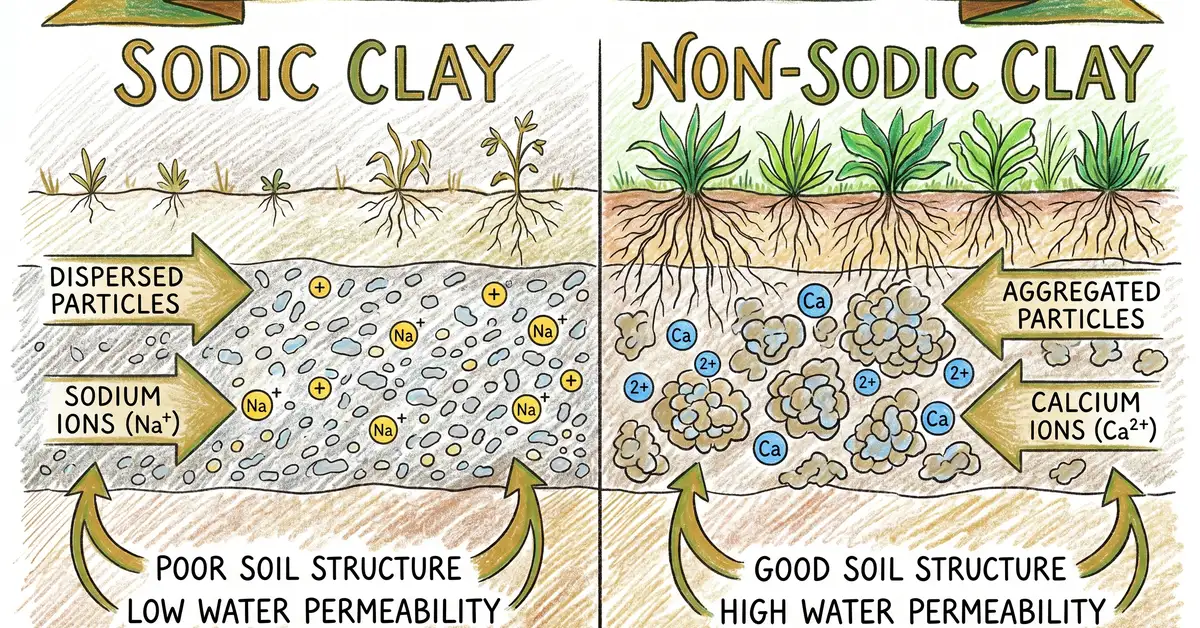
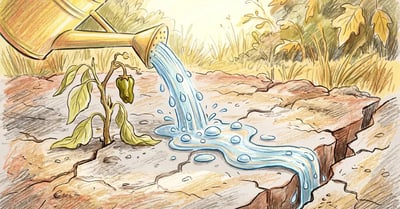
Sodic clay. Common in arid US regions: parts of Arizona, New Mexico, west Texas, Nevada, Utah, the Central Valley and Imperial Valley of California, and irrigated lands in Colorado and Wyoming. Telltale signs: water sits on the surface and never penetrates, white salt crusts in dry weather, plants wilting despite irrigation, sodium-sensitive crops (beans, fruit trees) showing leaf burn. Gypsum works here.
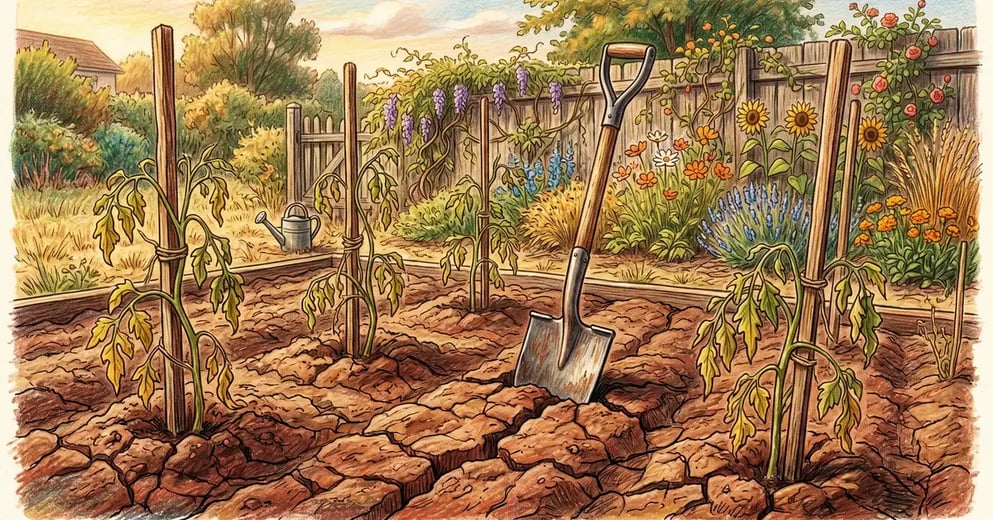
Non-sodic clay. Most clay east of the 100th meridian, plus the Pacific Northwest, plus glacial till soils, plus Mid-Atlantic and Northeast clay. The clay is dense because of mineralogy (smectite, vermiculite, kaolinite) and low organic matter, not sodium. Linda Chalker-Scott at Washington State University has documented the gypsum myth specifically for non-sodic clay in her Horticultural Myths research series. Penn State Extension, Iowa State Extension, and Ohio State Extension all reach the same conclusion: gypsum is ineffective on non-sodic clay.
| Sign | Sodic Clay | Non-Sodic Clay |
| White salt crust on surface | Common | Rare |
| Water won't penetrate even after rain | Yes | Sometimes, but penetrates eventually |
| US region | Arid Southwest, irrigated valleys | Most of central, eastern, and PNW US |
| ESP (exchangeable sodium percentage) | Above 15 | Below 5 |
| Will gypsum help? | Yes, meaningfully | No, or minimally |
| Real solution | Gypsum plus drainage and leaching | Compost, cover crops, no-till |
Source: Linda Chalker-Scott WSU: Horticultural Myths on Gypsum and Penn State Extension.
How to tell which kind of clay you have
Check your USDA NRCS soil survey
Go to Web Soil Survey, type your address, and read the soil classification. If it lists "sodic" or "saline-sodic", you have the kind of clay gypsum helps. If it lists Mollisol, Alfisol, Ultisol, or Inceptisol without sodic flags, you do not.
Send a soil sample to your land-grant lab
$15 to $30 at most state extension labs. Ask for the electrical conductivity (EC) test and the sodium adsorption ratio (SAR). EC above 4 dS/m plus SAR above 13 indicates sodic conditions. Most US gardeners get back numbers far below these thresholds.
Do the puddle test at home
Pour 1 gal (3.8 L) of clean water on a 1 sq ft (0.09 sq m) bare clay patch after 24 hours of dry weather. Time how long it takes to soak in. Under 10 minutes is fine clay. 10 to 60 minutes is dense clay. Over 60 minutes plus visible white crust suggests sodic conditions.
Look at the salt crust
If you see a white powdery crust on bare soil after dry weather, especially around irrigation lines or paths, your clay is at least somewhat sodic. If no crust ever appears, gypsum is almost certainly the wrong product.
What actually fixes non-sodic clay
Cornell Soil Health Laboratory data shows that adding 2 to 4 in (5 to 10 cm) of finished compost annually for 3 to 5 years restructures dense clay into friable loam. The mechanism is the biological aggregation pathway: organic matter feeds fungi and bacteria that produce glomalin and polysaccharide glues, which bind clay particles into stable aggregates with pore spaces. This is what gypsum manufacturers promise but cannot deliver on non-sodic clay.
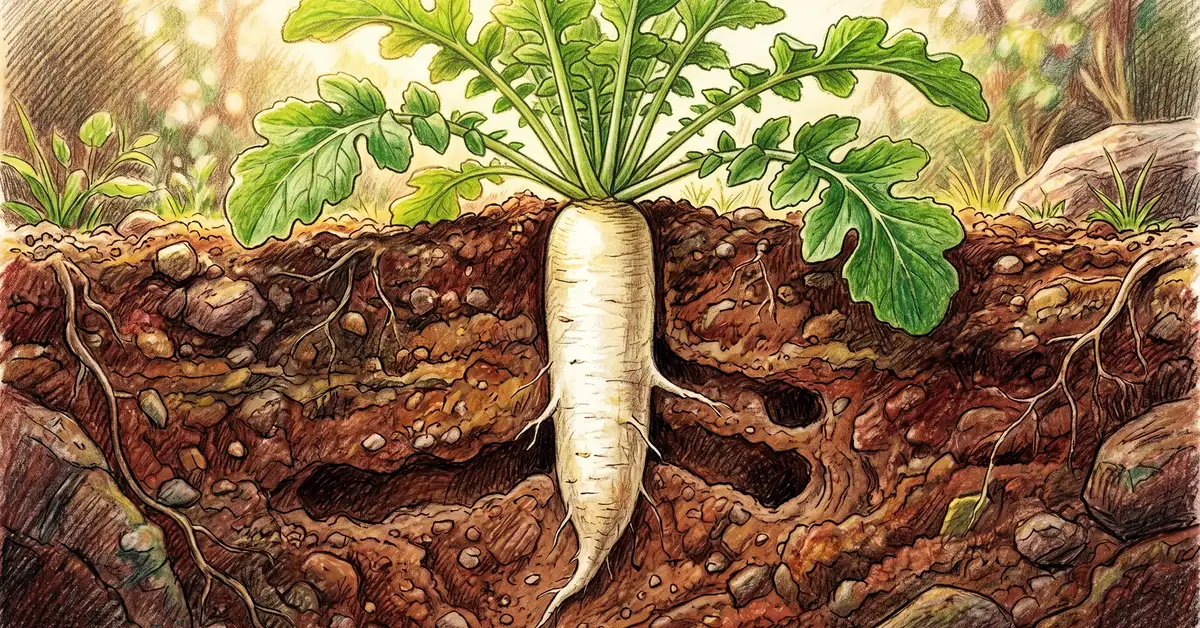
Cover crops with deep tap roots. Daikon radish (Raphanus sativus var. longipinnatus, also called tillage radish) drills 12 to 24 in (30 to 60 cm) into compacted clay over a single fall and winter season. When it winter-kills in northern zones, the decaying root leaves a vertical channel for water and roots to follow. USDA SARE research documents 25 to 40 percent reductions in soil bulk density after one daikon cycle.
No till after the first year. Tilling clay is the single fastest way to destroy whatever structure exists. The repeated breaking of natural aggregates creates the compaction layer you are trying to fix. After year 1 of initial bed prep, switch to sheet mulching and let earthworms do the mixing.
Sheet mulch with cardboard and compost. Lay cardboard directly on weedy or compacted clay, top with 4 in (10 cm) of compost, then 2 in (5 cm) of wood chip mulch. Plant directly into the compost layer the same season. Within 12 months the cardboard rots, earthworms pull organic matter into the clay, and the soil food web takes off.
Avoid compaction. Never walk on wet clay. Build narrow beds 3 to 4 ft (90 to 120 cm) wide with permanent paths between them. Use stepping stones if you need to access beds during wet weather. Compaction at the soil surface is the parent of most clay garden problems.
When gypsum is worth it
Confirmed sodic clay. If your USDA soil survey, soil test, or visible salt crust confirms sodic conditions, gypsum is the right product. Apply 30 to 40 lb per 1,000 sq ft (15 to 20 kg per 100 sq m) for moderate sodic conditions. For serious cases, agricultural rates of 1 to 2 tons per acre (2,200 to 4,500 kg per ha) are used, but consult your county extension agent before applying that much in a backyard.
High-sodium irrigation water. Some western US cities, including parts of Phoenix, Albuquerque, and San Diego, have municipal water with high sodium content. Irrigated landscape and garden soils gradually become sodic. Annual gypsum application offsets the salt buildup.
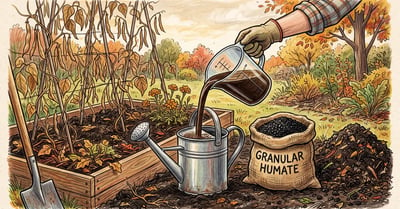
Calcium-deficient soils. If your soil test shows low calcium AND a pH already near 7 (where lime would push it too alkaline), gypsum delivers calcium without changing pH. Useful for preventing tomato blossom end rot and similar calcium-deficiency problems on alkaline soils.
The 5-year clay improvement plan that works
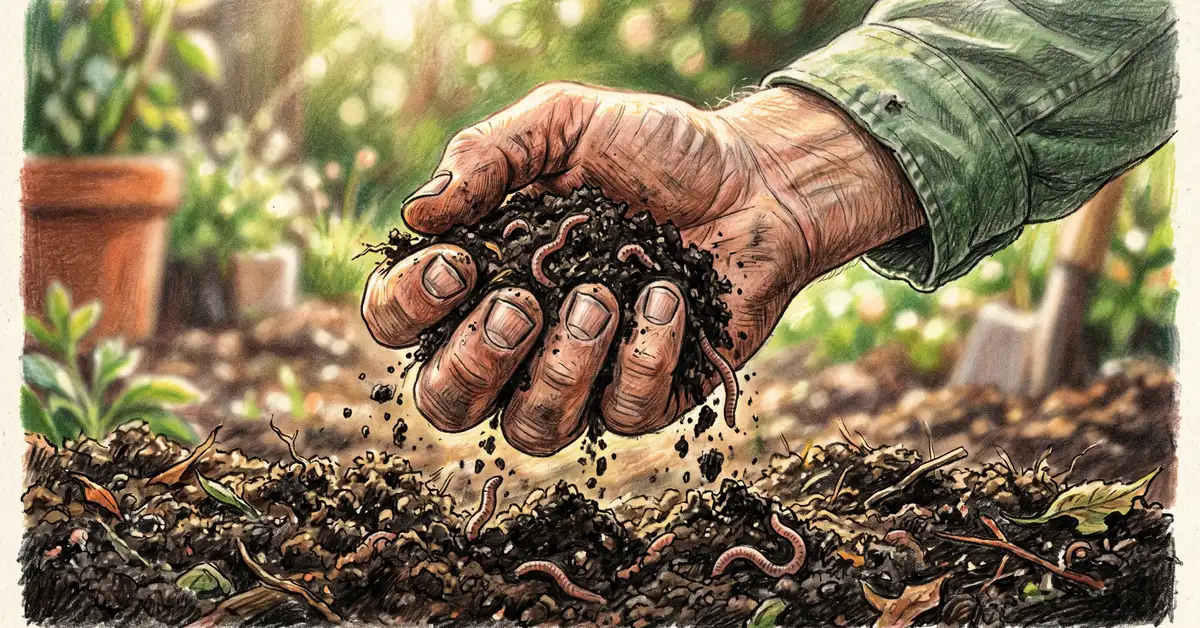
Year 1: Sheet mulch and daikon. Lay cardboard over the existing clay. Top with 3 to 4 in (8 to 10 cm) of compost. In fall, broadcast daikon radish seed (10 to 15 lb per acre / 11 to 17 kg per ha). Let it winter-kill.
Year 2: Plant heavy feeders and add another compost layer. Plant tomatoes, squash, brassicas in the compost layer. Topdress with 2 in (5 cm) of fresh compost in spring. Repeat the daikon cover crop in fall.
Year 3: Diversify and observe. Add a perennial root layer: comfrey, asparagus, rhubarb. These deep-rooted perennials continue the mining and aggregation work. Topdress 2 in (5 cm) compost again.
Year 4: The soil food web is established. By year 4 the worm population is dense (often 100+ per cubic foot / 3,500 per cubic meter in fully restored beds). The original clay layer is now mostly aggregated soil with organic matter percentages climbing from under 2 percent to 4 to 6 percent.
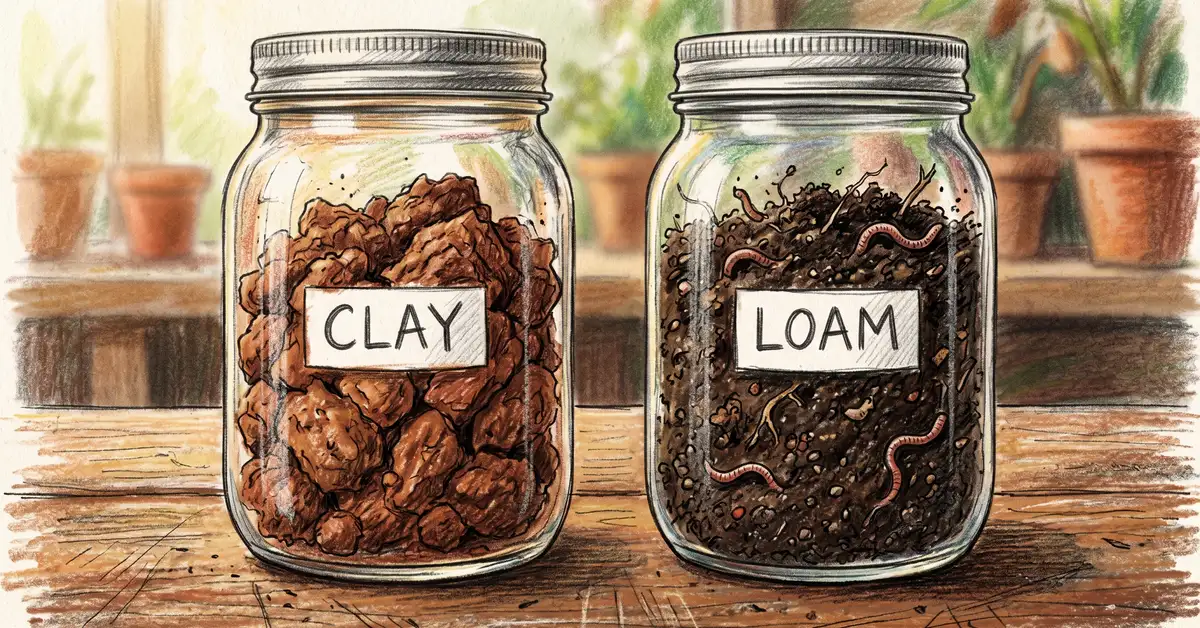
Year 5: Friable loam. The soil at this point looks and feels nothing like the starting clay. You can push a hand into the bed up to the wrist with ease. Water absorbs in seconds. Plants thrive with minimal irrigation.
Get the Weekly Dig
One practical permaculture guide a week, written for gardeners who do this on weekends: building living soil without buying it in bags. Free, no spam, unsubscribe any time.
Join the Weekly DigFrequently asked questions
Does gypsum break up clay soil? Only on sodic clay where excess sodium has dispersed the clay particles. For typical non-sodic clay (most of the central, eastern, and Pacific Northwest US), gypsum delivers little to no improvement. Compost, cover crops, and no-till work better for non-sodic clay.
How does gypsum help clay soil? Calcium from gypsum displaces sodium on clay particles, which then flocculate (clump together) into stable aggregates with pore spaces. This works only when sodium was the cause of poor structure. On non-sodic clay, the calcium has no sodium to displace and the soil structure does not change.
How much gypsum to add to clay soil? For confirmed sodic clay, 30 to 40 lb per 1,000 sq ft (15 to 20 kg per 100 sq m) once a year. For serious sodic problems, 1 to 2 tons per acre (2,200 to 4,500 kg per ha) under extension agent guidance. For non-sodic clay, the answer is zero. No bag rate will fix a problem that is not sodium-driven.
How to apply gypsum to clay soil? Broadcast the powder or pelleted gypsum evenly over the soil surface, then water in lightly so the calcium ions begin dissolving and reaching the clay. Repeat annually if conditions justify it. Surface application alone is fine; tilling in is not necessary and damages soil structure.
What is the difference between gypsum and lime? Both add calcium, but lime (calcium carbonate) also raises soil pH while gypsum (calcium sulfate) is pH-neutral. Use lime for acidic soils that need calcium and a pH boost. Use gypsum for already-neutral or alkaline soils that need calcium without pH change, or for confirmed sodic conditions.
How to break down clay soil fast? The honest answer: there is no fast way. The 5 year plan with annual compost, cover crops, and no-till is the proven path. Faster approaches (rototilling, gypsum, sand) either fail or create worse problems. For one season, build raised beds with imported soil over the clay and start the slow restoration underneath.
Will sand break up clay soil? No. Mixing sand into clay produces an adobe-like brick. The fine clay particles fill the spaces between the larger sand grains, creating a denser and harder soil. Avoid this advice no matter where you read it.
Is gypsum good for clay soil with low pH? No, gypsum does not change pH. For low-pH (acidic) clay, you need lime (calcium carbonate) to raise pH and add calcium. Save gypsum for soils that need calcium without pH change.
Resources
- Linda Chalker-Scott WSU: The Myth of Soil Amendments (Gypsum)
- Penn State Extension: The Myth of Soil Amendments
- Iowa State Extension: Gypsum as a Soil Amendment
- USDA NRCS Web Soil Survey
- Cornell Soil Health Laboratory
- USDA SARE: Managing Cover Crops Profitably (Daikon Radish)
- University of Minnesota Extension: Soil Amendments
Need the gear for this?
Which broadfork holds up in clay, which one suits a small bed, and what to skip.
See the broadfork picks