Permaculture and sustainable agriculture get used interchangeably in podcasts, news articles, and Instagram reels. They are not the same. The short answer: sustainable agriculture is a set of farming practices defined by the USDA in 1990. Permaculture is a whole-system design framework with three ethics, developed by Bill Mollison and David Holmgren in 1978. They overlap on cover cropping, reduced tillage, and integrated pest management. They diverge on scope, scale, and what counts as a goal.
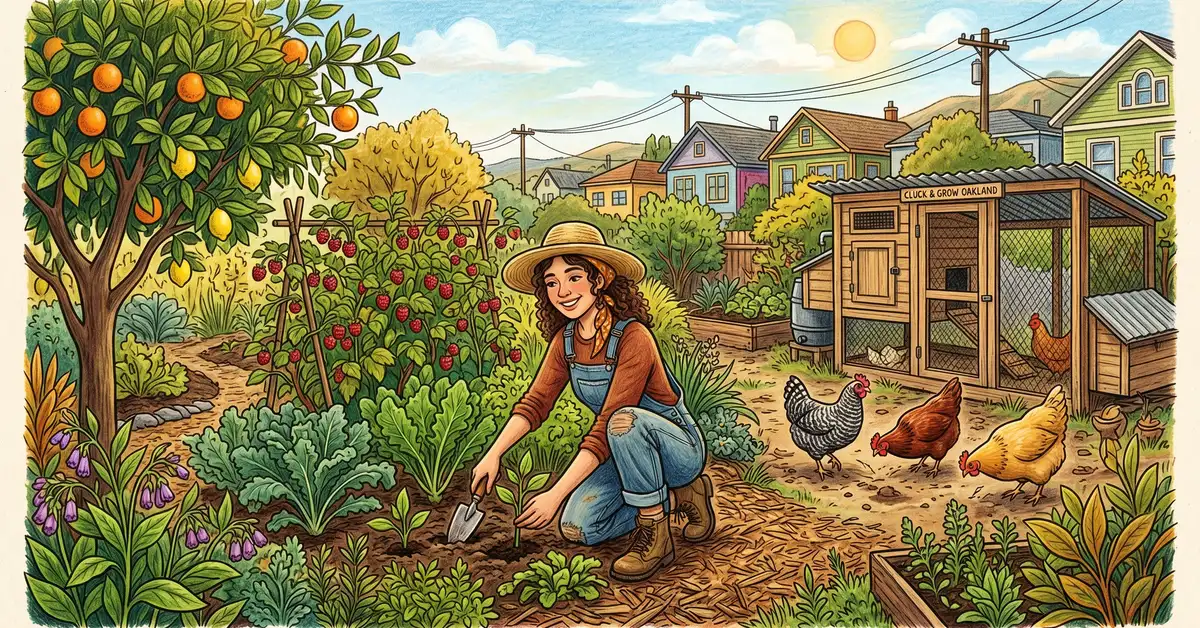
This matters if you are choosing books, a design course, a job, or an internship, and especially if you are choosing how to use the quarter-acre, two acres, or twenty acres that you actually have access to. The label changes what you read, who you talk to, and what your end state looks like.
What you will get from this article: the honest definition of each term with its founding documents and dates, a comparison table you can screenshot, the overlap you should keep, the differences that matter, and an editorial verdict on when each one fits. Sources are linked inline so you can verify each claim against the original publication.
Sources: Permaculture: A Designers' Manual (Mollison, 1988); USDA NIFA Sustainable Agriculture program; USDA National Agricultural Statistics Service 2022 Census.
What is sustainable agriculture? The 1990 USDA definition
Sustainable agriculture has a precise legal definition in the United States. It was codified in the 1990 Farm Bill, written into US Code at 7 U.S.C. 3103, and operationalized through USDA programs and grants. The full definition, from the USDA National Institute of Food and Agriculture, reads:
An integrated system of plant and animal production practices having a site-specific application that will, over the long term: satisfy human food and fiber needs; enhance environmental quality and the natural resource base; make the most efficient use of nonrenewable resources and on-farm resources and integrate, where appropriate, natural biological cycles and controls; sustain the economic viability of farm operations; and enhance the quality of life for farmers and society as a whole.
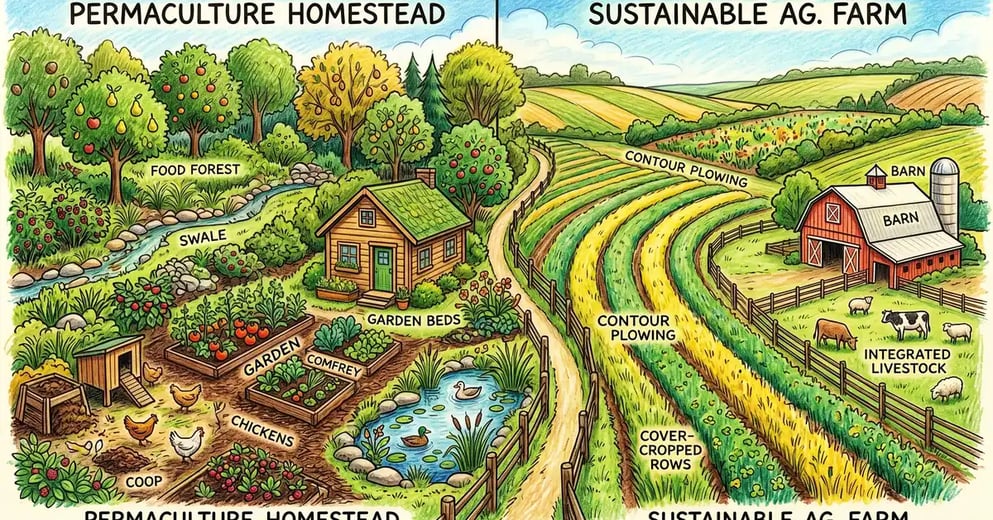
Five goals, scoped to farming. Notice what is in the definition: food production, environmental quality, resource efficiency, farm economics, and farmer quality of life. Notice what is not: housing design, energy systems, settlement layout, social structure. Sustainable agriculture is a set of practices applied to a farm, not a framework for designing a whole way of life.
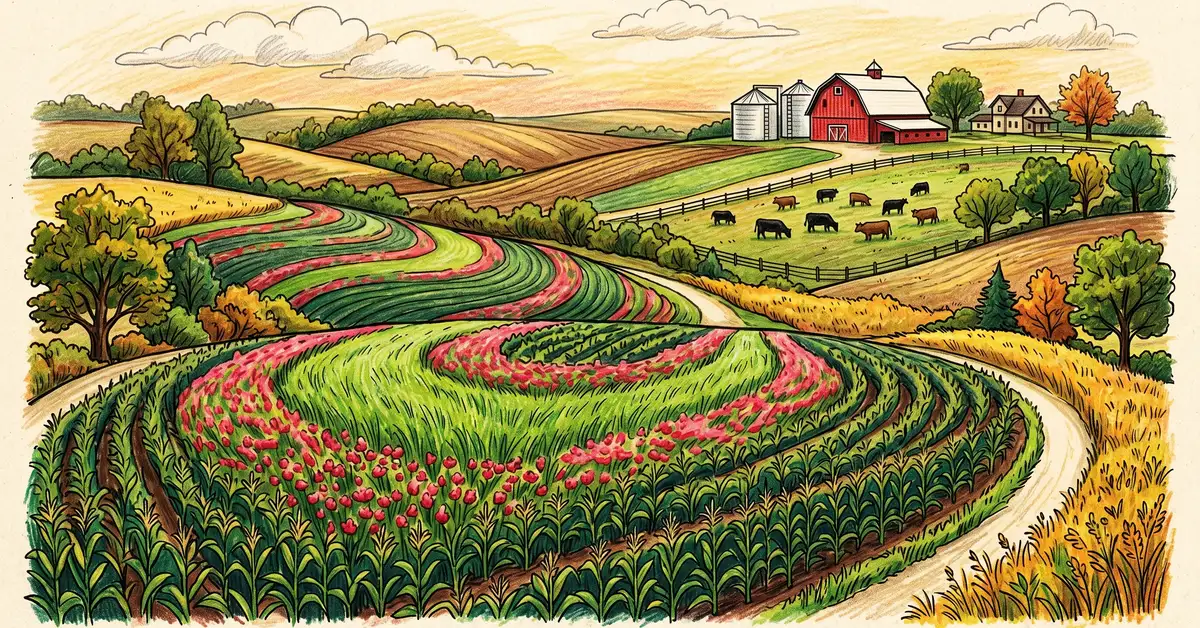
In practice, sustainable agriculture in the US looks like cover cropping between cash crops, integrated pest management instead of calendar spraying, reduced tillage or no-till for soil structure, crop rotation to break pest cycles, and nutrient management plans that match fertilizer applications to crop need. The USDA Sustainable Agriculture Research and Education (SARE) program has been funding this work since 1988 and publishes free practitioner guides covering each practice.
The strength of sustainable agriculture is that it scales. A 5,000 acre Iowa corn-soy farm can adopt cover crops and no-till and qualify. A 50 acre organic vegetable farm can too. The framework is intentionally practice-focused so it can be applied across the 895 million acres of US farmland tracked in the 2022 USDA Census of Agriculture.
What is permaculture? The 1978 Mollison and Holmgren framework
Permaculture has a different origin and a different scope. The word is a contraction. David Holmgren coined it in his 1974 graduate thesis at the College of Advanced Education in Hobart, Tasmania, as "permanent agriculture." Mollison and Holmgren expanded it to "permanent culture" through the 1980s as the framework grew beyond farming into housing, water, energy, and social structure.
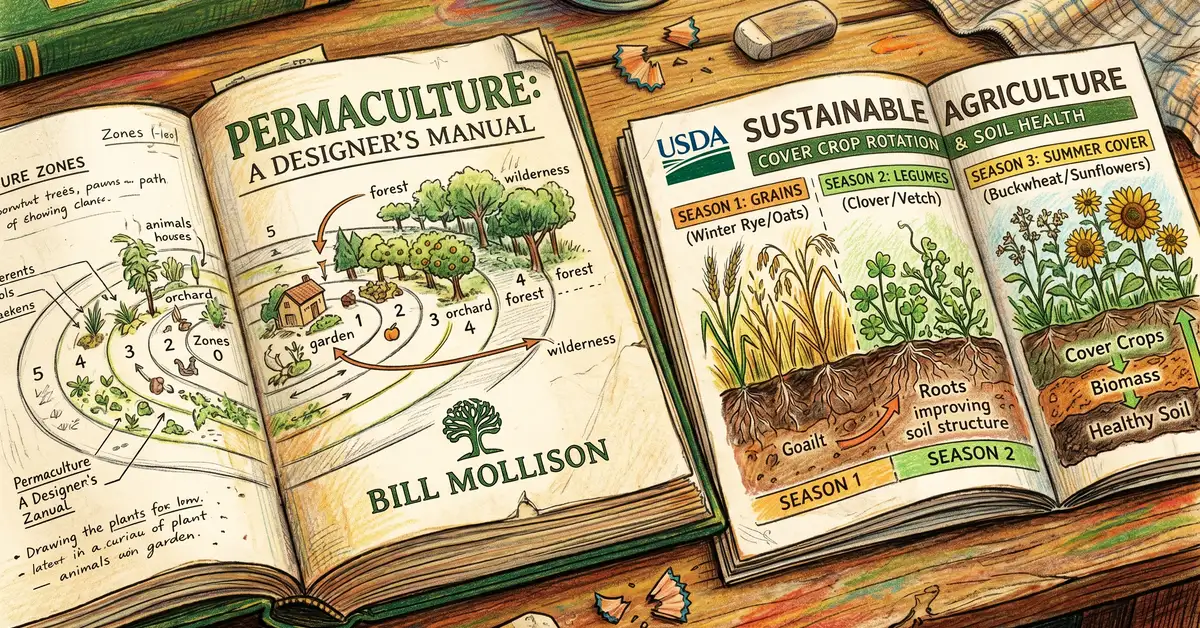
The founding texts are Permaculture One (1978), Permaculture Two (1979), and the 600 page Permaculture: A Designers' Manual (Mollison, 1988). Holmgren's Essence of Permaculture (free PDF, 2002) codified the modern 12 principles. Gaia's Garden by Toby Hemenway (Chelsea Green, 2009) became the canonical US homestead text.
Permaculture has three ethics that come first, before any practice: earth care, people care, fair share (also called future care or return of surplus). Sustainable agriculture has no ethics clause. The USDA definition references "quality of life" but does not require practitioners to commit to a value framework. Permaculture requires the ethics commitment as a precondition for using the design system. This is the central philosophical difference.
Underneath the ethics sit the 12 design principles, which Holmgren published in Permaculture: Principles and Pathways Beyond Sustainability (Holmgren Design Services, 2002). They include observe and interact, catch and store energy, obtain a yield, produce no waste, use small and slow solutions, use edges and value the marginal, and creatively use and respond to change. These principles apply to gardening, but also to building design, business design, and community organizing. That breadth is the second central difference.
The comparison table
| Dimension | Permaculture | Sustainable Agriculture |
| Origin | Mollison & Holmgren, Tasmania, 1978 | USDA 1990 Farm Bill, 7 U.S.C. 3103 |
| Founding text | Permaculture One (1978), Designers' Manual (1988) | Farm Bill 1990; SARE practitioner guides (1988 onward) |
| Scope | Whole-settlement design (food, water, energy, housing, community) | Farming practices on agricultural land |
| Ethics | Three: earth care, people care, fair share (required) | None codified; quality-of-life goal stated |
| Typical scale | 0.1 to 10 acres (rare exceptions to 100+) | 10 to 10,000+ acres |
| Certification | No federal cert; PDC course is the credential | Federal programs (NOP organic, EQIP, CSP) |
| Government support | None directly; USDA SARE funds some related research | Direct: USDA NRCS, SARE, EQIP, CSP, organic certification |
| Carbon focus | Strong (perennials, food forests, no-till) | Variable (depends on practices adopted) |
| Output measure | System resilience and ethics compliance | Yield, soil health, profitability, environmental indicators |
| Typical practitioner | Homesteader, designer, small-farm operator | Commercial farmer of any size |
Sources: USDA NIFA Sustainable Agriculture definition; Holmgren Essence of Permaculture (2002); Permaculture Research Institute; USDA NASS 2022 Census of Agriculture.
Where they overlap (and why the confusion exists)
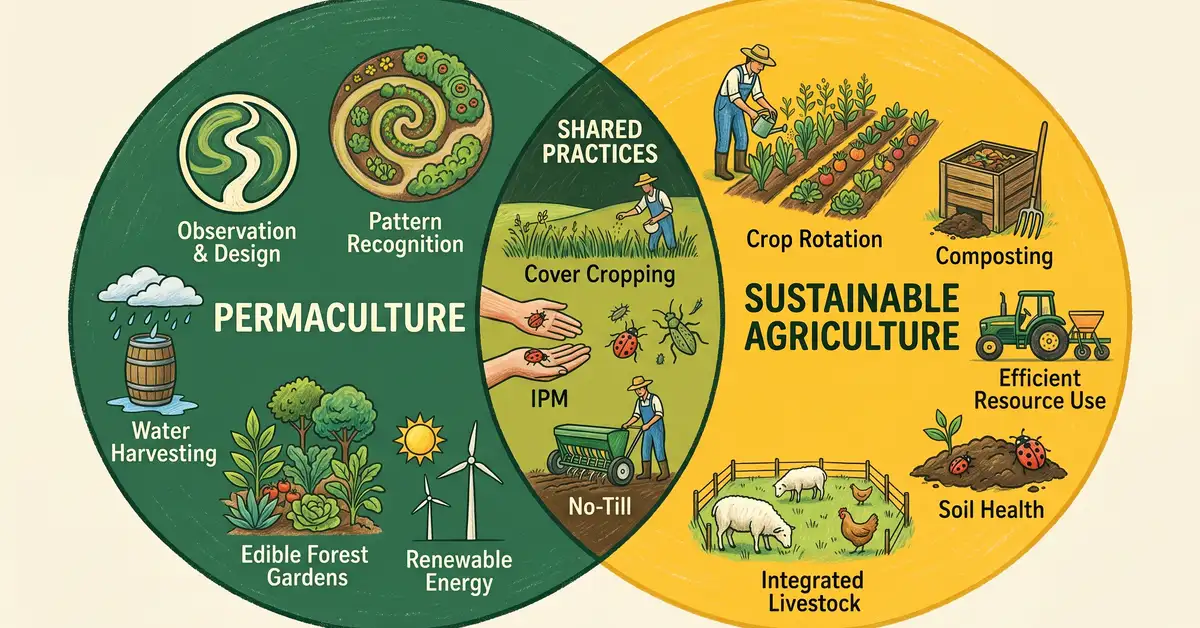
The confusion between permaculture and sustainable agriculture is not random. Both frameworks reach for many of the same practices on the ground. If you walked onto a well-run sustainable farm in Iowa and a well-designed permaculture homestead in Vermont, you would see overlapping techniques.
Why this overlap exists
Both frameworks emerged from the same critique: industrial monoculture agriculture is depleting soil, contaminating water, and externalizing costs. Permaculture (1978) and sustainable agriculture (1990) both arose to address this. They converged on similar practices because the soil biology and water cycles they work with are the same. Cover cropping rebuilds soil organic matter whether you call it sustainable or permacultural.
Shared practices include: cover cropping, crop rotation, reduced or no tillage, integrated pest management, composting and nutrient cycling, native and beneficial plantings for pollinators, water-efficient irrigation, and integrated livestock. Building Soils for Better Crops (SARE, 4th edition, 2021) is a free 432 page reference that any permaculture practitioner can use without modification.
The overlap is large enough that some people, including Mark Shepard at New Forest Farm in Wisconsin, deliberately work in both camps. Shepard's 106 acre commercial farm is designed using permaculture principles (perennial polyculture, keyline water management, zone planning) but qualifies as sustainable agriculture under USDA definitions and has received SARE funding.
Where they diverge (the actual differences)
Below the shared practices, the frameworks diverge on three dimensions that matter when you choose how to spend your time, money, and land.
Scope
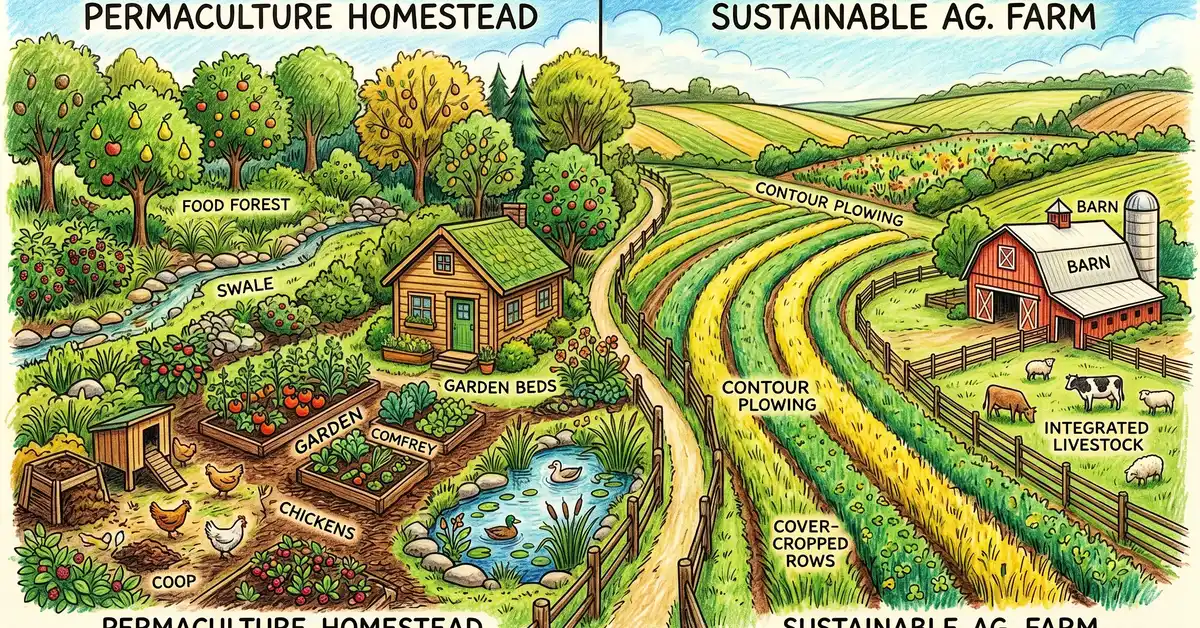
Sustainable agriculture stops at the farm gate. The USDA definition covers plant and animal production. Housing, energy, transport, water harvesting for non-farm use, and community structure are out of scope. Permaculture explicitly includes all of these. A permaculture design includes the house, the water system, the energy system, the social structure of the residents, and the relationship to the surrounding bioregion. Many permaculture courses spend more time on house design and water harvesting than on vegetable beds.
Scale
Sustainable agriculture scales to thousands of acres. The 5 million acre Wessels Living History Farm in Nebraska or a 10,000 acre Kansas wheat-soy rotation can both adopt sustainable practices and qualify. Permaculture rarely scales past 10 acres because the design intensity (zone analysis, microclimate observation, polyculture management) does not amortize over large monocultures. Shepard's 106 acres and Sepp Holzer's 110 acre Krameterhof in Austria are notable exceptions, not the rule.
Ethics
Sustainable agriculture has goals (productivity, environmental quality, profitability) but no ethics clause. A practitioner can adopt cover crops solely to reduce input costs and still qualify. Permaculture requires commitment to the three ethics. The Permaculture Design Course (PDC) curriculum, standardized by Mollison in the 1980s, makes ethics the opening module. You cannot do permaculture without earth care, people care, fair share. This makes permaculture closer to a values-based design framework than a technical specification.
Regenerative agriculture, agroecology, and the other adjacent terms
Three other terms get pulled into this conversation. Each is distinct.
Regenerative agriculture is the newest of the three (popularized by Rodale Institute in the early 2010s after decades of earlier use). It focuses specifically on rebuilding soil health, sequestering carbon, and restoring ecosystem function on working farms. Practices include cover cropping, diverse rotations, integrated livestock, and minimal tillage. It overlaps heavily with sustainable agriculture and the soil-building side of permaculture, but does not include permaculture's whole-settlement scope or its three ethics.
Agroecology is the scientific discipline that studies agricultural ecosystems. It is older than permaculture as a term (dating to the 1930s) and broader as a science. The FAO promotes agroecology globally as a framework for food system transformation. It includes the social and political dimensions that sustainable agriculture leaves out, which makes it closer to permaculture in scope, but it is a research framework rather than a practitioner design system.
Organic agriculture is the most narrow. It is a certification standard (USDA National Organic Program, 2002) defined primarily by what you cannot use (synthetic pesticides, synthetic fertilizers, GMOs, sewage sludge). An organic farm can be sustainable, regenerative, permacultural, or none of the above. The label tells you about inputs, not about systems thinking.
The honest verdict: which one fits your situation?
The choice is rarely either/or. The choice is which framework gives you the most leverage on the land and decisions you actually control.
For a Gen Z homesteader with a quarter-acre rental in Oakland or a half-acre lot in Asheville, permaculture is the better starting point. The scale fits. The ethics fit a generation that overwhelmingly identifies climate and equity as core concerns. The 12 principles give you a thinking framework for housing, food, water, and community alongside the vegetable beds. Start with Gaia's Garden (Hemenway) and Holmgren's Essence of Permaculture PDF, both available in our curated permaculture books reading list.
For someone working on a 200 acre family farm in Ohio, sustainable agriculture is the better label. The USDA programs (EQIP, CSP, SARE grants) actually fund the practices. The technical assistance from your local NRCS office is free. Cover crop seed costs $30 to $50 per acre and the Conservation Stewardship Program will pay for it. Permaculture principles can still inform decisions like where the buffer strips go or which margins to plant in pollinator habitat, but the operating framework is sustainable agriculture.
The climate question
One question that comes up constantly: which framework is better for the climate?
Per acre, well-designed permaculture sequesters more carbon. Perennials (fruit trees, nut trees, berry bushes) hold soil carbon longer than annuals. Food forests build soil organic matter year over year. No-till is the default rather than an upgrade. Studies from the Rodale Institute long-term Farming Systems Trial (running since 1981) document the soil carbon advantage of perennial-heavy and organic systems over conventional annuals.
At national food-supply scale, sustainable agriculture has more total climate impact because it can be applied to a much larger share of the 895 million acres of US farmland. Even a modest gain per acre, multiplied across that area, exceeds what permaculture can achieve on the homestead acreage where it typically operates. The USDA Climate-Smart Agriculture initiative is structured around this leverage.
The climate-honest answer: both are correct at different scales. Use permaculture on land you control directly. Support sustainable agriculture certifications and policy when buying food beyond what you grow. Vote for Farm Bill provisions that fund cover crop incentives and conservation easements. Doing only one without the other leaves leverage on the table.
Get the Weekly Dig
One practical permaculture guide a week, written for gardeners who do this on weekends: permaculture design for real backyards. Free, no spam, unsubscribe any time.
Join the Weekly DigCommon mistakes when sorting these terms out
Three patterns to avoid when you read or write about this topic.
Mistake 1: Treating permaculture as just gardening. A lot of US permaculture content reduces the framework to companion planting and food forests. That misses the housing, water, energy, and community design that Mollison and Holmgren spent equal time on. If you only read US YouTube content you will get the gardening half. Read the 1988 Designers' Manual or the Holmgren PDF to see the full scope.
Mistake 2: Treating sustainable agriculture as a low bar. Some permaculture writers describe sustainable agriculture as "industrial agriculture with cover crops." The USDA definition is broader than that. A serious sustainable agriculture operation includes integrated pest management, nutrient management, soil health planning, and biodiversity goals. It is not the same as permaculture but it is not industrial agriculture either.
Mistake 3: Assuming either framework is rigid. Both are open frameworks that get adapted. Permaculture has hundreds of regional adaptations, from Geoff Lawton's drylands designs to Sepp Holzer's alpine work. Sustainable agriculture varies between Iowa row crops, California vegetables, and Vermont dairy. Both are evolving as climate, soil science, and economics change.
What this means for the next decade
The two frameworks are converging in practice while staying distinct in framing. Three forces are driving the convergence: climate concerns are pushing both toward soil carbon and perennial systems; consumer markets are willing to pay premiums for both certifications and stories; and a generation of young farmers and homesteaders is comfortable using both labels without seeing them as opposed.
Federal funding for cover crops, conservation easements, and climate-smart agriculture practices through the USDA Farm Service Agency has expanded under successive Farm Bills. That funding flows through sustainable agriculture program structures but supports practices that permaculture practitioners use too. The line between the two is blurry in operation while remaining clear in definition.
For an individual making decisions in 2026, the practical guidance has not changed. Use permaculture as your design framework for land and life under your direct control. Use sustainable agriculture as the policy framework you support and the certification you look for at the grocery store. Read the books from both traditions. Take a Permaculture Design Course if you have a piece of land you want to design. Subscribe to SARE publications to see what current research says about which practices work in your bioregion.
Frequently Asked Questions
Is permaculture the same as sustainable agriculture?
No. Permaculture is a whole-system design framework rooted in three ethics, developed by Mollison and Holmgren in 1978. Sustainable agriculture is a USDA-defined set of farming practices codified in the 1990 Farm Bill. They overlap on practices like cover cropping and reduced tillage but differ in scope, scale, and ethics.
What is the main difference between permaculture and sustainable agriculture?
Scope and scale. Sustainable agriculture is scoped to farming and scales to thousands of acres. Permaculture is scoped to whole settlements (including housing, water, energy, community) and typically operates at homestead scale under 10 acres. Permaculture also requires commitment to three ethics; sustainable agriculture does not.
Who invented permaculture?
Bill Mollison and David Holmgren in Tasmania, Australia. Holmgren's 1974 graduate thesis introduced the term. The two co-authored Permaculture One in 1978 and Mollison's 600 page Permaculture: A Designers' Manual followed in 1988.
What is the USDA definition of sustainable agriculture?
From the 1990 Farm Bill, 7 U.S.C. 3103: an integrated system of plant and animal production practices having a site-specific application that will, over the long term, satisfy food and fiber needs, enhance environmental quality, make efficient use of nonrenewable resources, sustain farm economic viability, and enhance quality of life for farmers and society.
Is regenerative agriculture the same as permaculture?
No, though they overlap on soil-building practices. Regenerative agriculture focuses specifically on rebuilding soil health and sequestering carbon on working farms. It does not include permaculture's three ethics or the whole-settlement design scope (housing, energy, community structure).
Which is better for the climate: permaculture or sustainable agriculture?
Per acre, well-designed permaculture sequesters more carbon through perennials, food forests, and no-till. At national food supply scale, sustainable agriculture has more total climate impact because it can be applied across 895 million acres of US farmland. The honest answer: use permaculture for land you control directly; support sustainable agriculture for food you buy.
Can you have permaculture on a large farm?
Yes but it is rare. Most permaculture sites are under 10 acres. Mark Shepard's 106 acre New Forest Farm in Wisconsin and Sepp Holzer's 110 acre Krameterhof in Austria are notable exceptions. Sustainable agriculture, by contrast, routinely scales to thousands of acres.
Where do I start if I want to learn permaculture?
Read Holmgren's free Essence of Permaculture PDF, then Toby Hemenway's Gaia's Garden, then take a Permaculture Design Course (PDC) when you have a piece of land you want to design. Our curated permaculture books reading list ranks the canonical texts.
Resources
- USDA NIFA Sustainable Agriculture program (with full 1990 Farm Bill definition)
- USDA Sustainable Agriculture Research and Education (SARE) program
- David Holmgren, Essence of Permaculture (free PDF, 2002)
- USDA 2022 Census of Agriculture
- SARE, Building Soils for Better Crops (4th edition, free)
- Rodale Institute on regenerative agriculture
- Mark Shepard, New Forest Farm (large-scale permaculture)
- Sepp Holzer, Krameterhof (Austrian alpine permaculture)
- USDA Climate-Smart Agriculture initiative