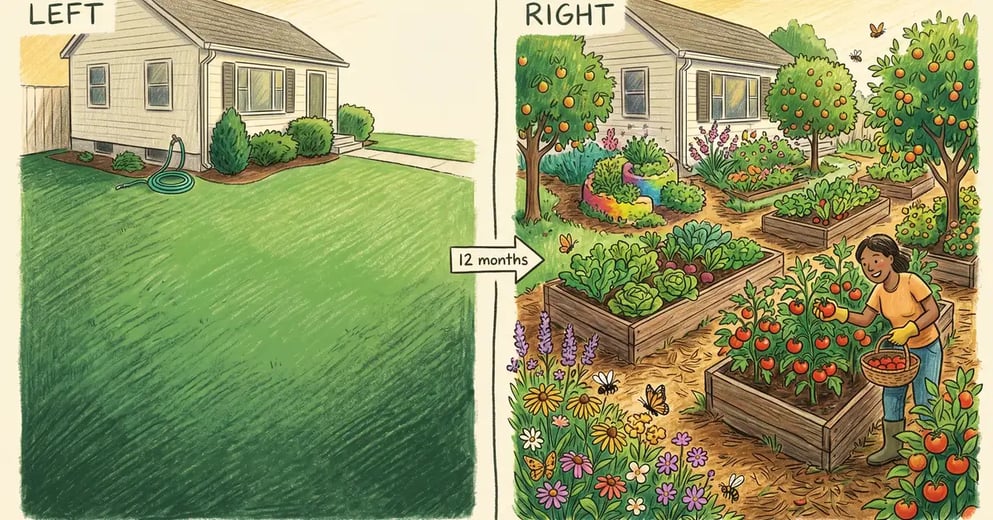

You are looking out the kitchen window at the same flat patch of green grass you have mowed every Saturday for the last seven years. It costs water. It costs gas. It costs a Saturday morning. It feeds nothing and nobody. You have read about food forests and Zone 1 kitchen gardens and you want in, but you do not know how to start without ripping everything out, alienating the neighbors, or watching $2,000 of plants die in July. solarizing or tarping the lawn first
This guide is the realistic 12-month plan. Month by month, starting with observation in winter and ending with a productive garden by next fall. We cover site assessment, the four ways to kill a lawn (and which is best), the classic sheet mulch recipe, first-year plant selection, hardscape, what to budget, how to handle HOA and zoning rules, and the common mistakes that derail well-meaning first-year converters. Numbers and methods sourced to USDA, EPA, university extension, and Toby Hemenway's Gaia's Garden.
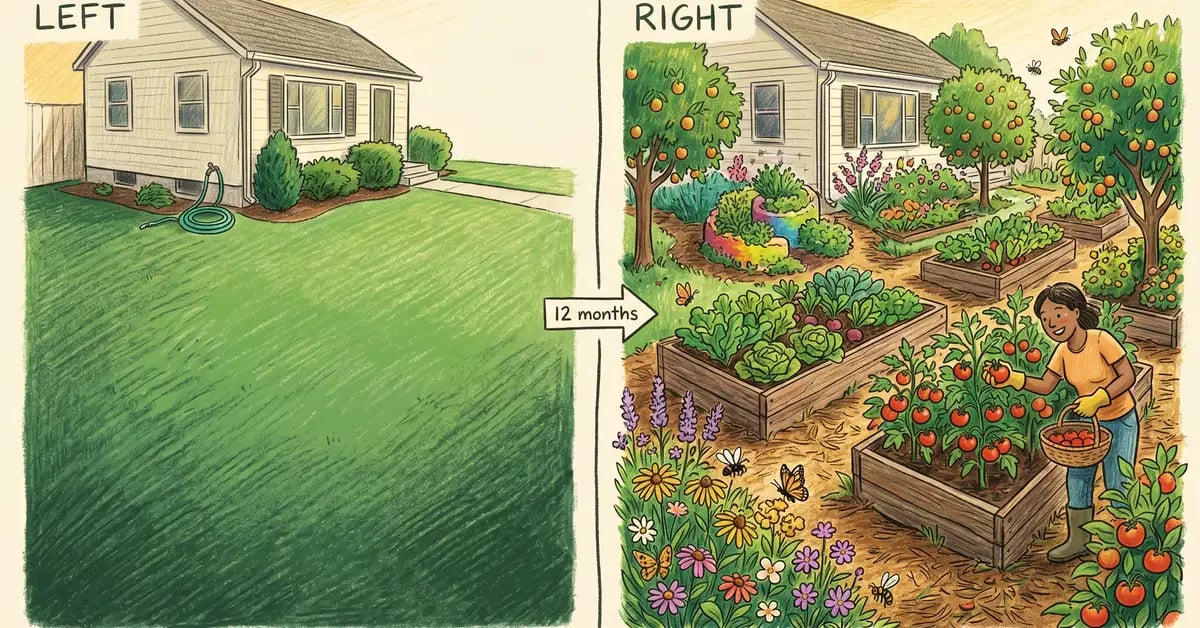
The Lawn Problem (Why Bother Converting?)
The numbers are striking. According to Sugi Project's summary of NASA satellite estimates, the US has roughly 40 million acres of irrigated lawn, more than three times the acreage of irrigated corn. The EPA WaterSense statistics document that landscape irrigation consumes about 9 billion gallons per day nationally, with as much as 30 to 60 percent wasted through evaporation, runoff, and wind drift.
Pesticide load is the second story. Beyond Pesticides' lawn fact sheet compiles EPA-cited estimates of 70 million pounds of synthetic pesticides applied to US lawns annually, much of it 2,4-D, glyphosate, and various neonicotinoids that harm pollinators and aquatic life.
The opportunity cost is the third. A 500 sqft permaculture garden converted from lawn can produce 100 to 300 lbs of food per year, support dozens of pollinator species, sequester 2 to 5 tons of carbon per acre per year of soil-building work, and turn the Saturday mow into a Saturday harvest.
The 12-Month Transformation Plan: Month by Month
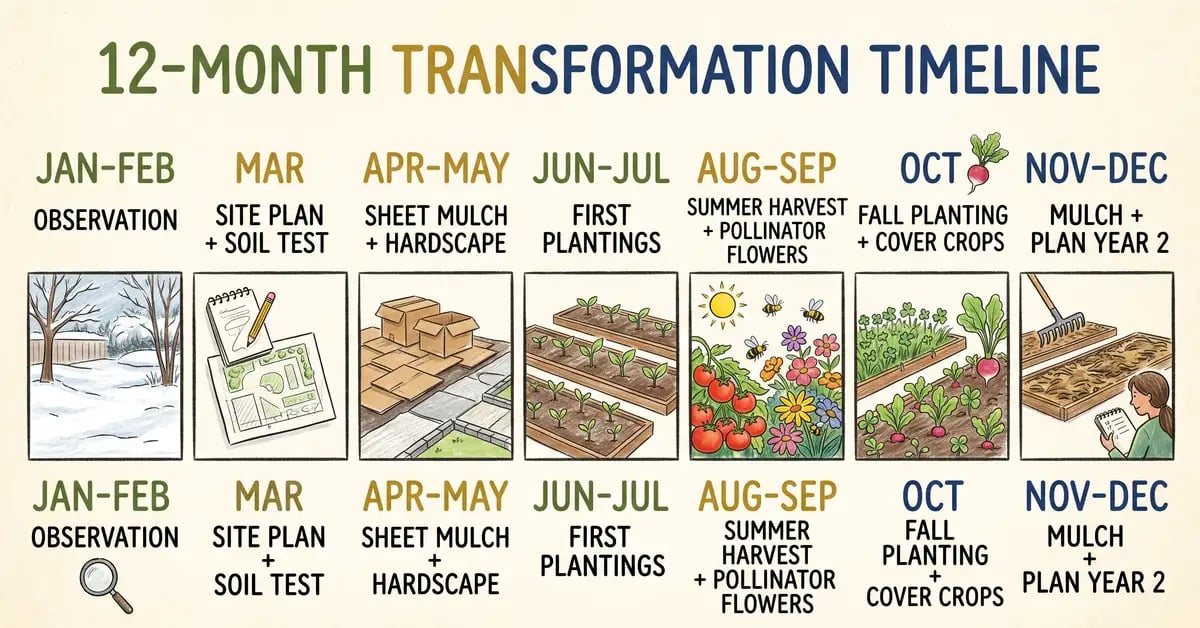
The order matters. Bill Mollison's Permaculture Designers Manual is explicit that observation precedes intervention. A full year of seasonal observation is ideal, but for the homeowner who wants results this year, three months of winter observation followed by spring action is the minimum.
January and February: Observation
Walk the yard daily. Note where the sun rises and sets, where snow lingers (frost pockets), where ice forms (drainage problems), where the dog runs (Zone 5 path), where you actually look from the kitchen window (visual priority). Take photos at noon every weekend. Sketch a rough map. Do not buy a single plant yet.
March: Site Plan and Soil Test
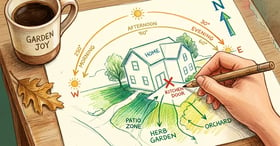
Use the observation notes to draw a property map at 1 inch equals 4 feet. Mark north, the kitchen door, prevailing wind, summer and winter sun arcs, water flow, and any HOA-restricted zones (typically the front 10 feet from the sidewalk). Send a soil sample to your local extension office. According to NC State Extension's permaculture design appendix, a baseline soil test for pH, organic matter, and macronutrients costs $15 to $40 and is the single most useful data point for the next 10 years of decisions.
Pick your conversion zone. For a first-year project, choose 500 to 1,000 sqft in the sunniest backyard spot within 30 ft of the kitchen door.
April and May: Kill the Lawn and Build Hardscape
This is the heavy work month. Four lawn-killing methods exist, with very different trade-offs.
| Method | Time | Cost / 500 sqft | Best for |
| Sheet mulching (cardboard + compost + mulch) | 3 to 6 months until plantable | $80 to $250 | Permaculture default |
| Solarization (clear plastic, 6 to 8 weeks) | 6 to 8 weeks in summer | $30 to $80 | Quick kill, hot summer climate |
| Sod cutting (rent a sod cutter) | 1 day labor | $80 to $200 rental | Quick prep, you want the sod for compost |
| Mechanical / sod removal service | 1 day | $500 to $1,500 | Speed, no DIY |
Source: YourGreenPal grass removal cost guide and High Country Gardens lawn removal methods (2024)
The Sheet Mulch Method (The Permaculture Default)
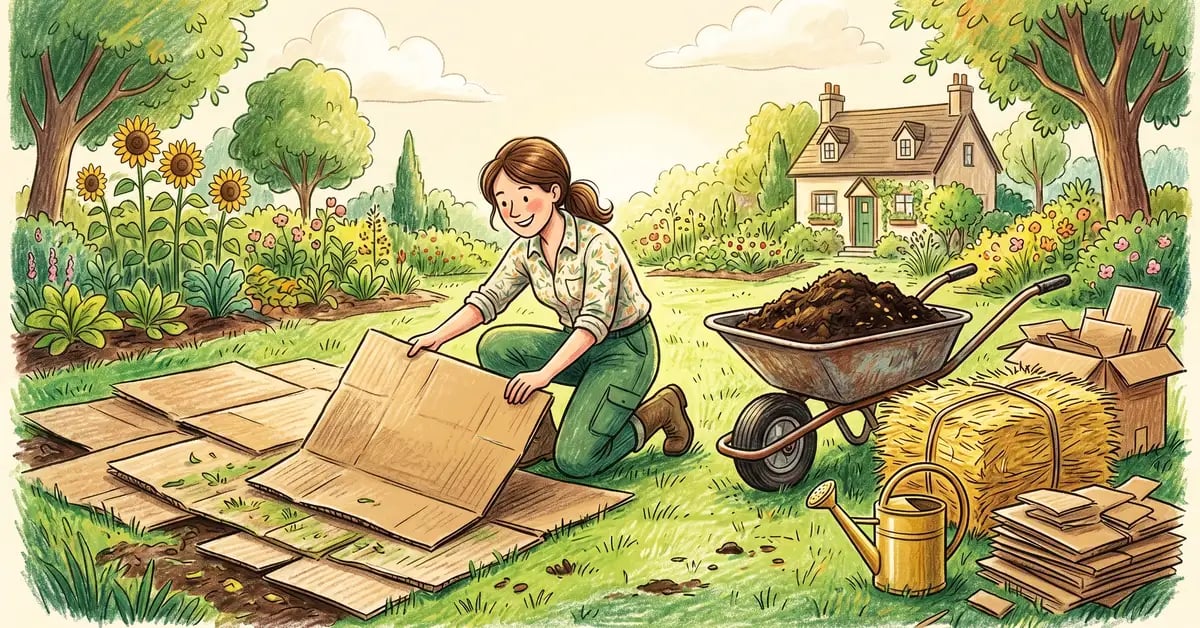
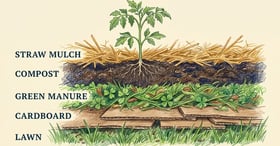
Toby Hemenway's classic recipe, documented at tobyhemenway.com, is the standard for permaculture lawn conversion. The layers, bottom to top:
- Mow the lawn short. Water it deeply.
- Soak cardboard. Lay overlapping cardboard sheets (2-inch overlap) across the entire footprint. Remove tape and labels. Soak with the hose.
- Green layer (1 to 2 inches). Grass clippings, fresh leaves, kitchen scraps, manure.
- Compost layer (2 to 4 inches). Finished compost from any source.
- Mulch layer (3 to 6 inches). Straw, wood chips, or shredded leaves.
- Water deeply. Soak everything down to the cardboard.
Total stack height: 6 to 12 inches. By 8 weeks the cardboard will have decomposed enough that you can plant directly through the top layers. For deeper-rooted plants (tomatoes, peppers), cut an X in the cardboard and add compost in the planting hole.
Cardboard sourcing: free from local appliance stores, bike shops, furniture stores. A 500 sqft project needs 100 to 200 sqft of cardboard (double layer). Plan an afternoon to collect.
June and July: First Plantings
After 6 to 8 weeks of sheet mulch decomposition, plant directly into the top layer. Year one priorities, drawing from University of Minnesota Extension's yard and garden resources and Xerces Society pollinator plant lists:
Quick wins (year 1 yield): Cherry tomatoes, bush beans, summer squash, basil, lettuce, salad greens, sunflowers.
Perennials to start now (year 3 to 5 yield): One small fruit tree (apple, pear, plum) appropriate to your USDA hardiness zone, two berry bushes (currant, gooseberry, raspberry), comfrey for biomass.
Pollinators (essential): Bee balm, echinacea, native asters, milkweed.
Soil builders: White clover as a living mulch, daikon radish in fall.
August and September: Summer Harvest and Observation
This is when you find out what works. Note which plants thrive, which struggle, what the neighbors say. Photograph everything. Keep harvest tallies. The notes drive year two decisions.
October: Fall Planting and Cover Crops
Plant garlic, fall greens, winter rye, daikon radish, and crimson clover as cover crops on any bare areas. The cover crops protect and feed the soil over winter and break up any residual compaction.
November and December: Mulch and Plan Year 2
Top-dress the entire converted area with 2 to 3 inches of fresh mulch. Review the year. Sketch year two expansions (next 500 to 1,000 sqft). Order seeds for spring.
Why This Works
The 12-month plan is the practical expression of Bill Mollison's permaculture principle "Use Small and Slow Solutions." Standard lawn-to-garden advice tells you to rip out the whole yard in a weekend, buy $2,000 of plants, and design the whole thing on paper before you start. The permaculture approach is the opposite: observe first, convert a small patch, learn what works on your specific site, then expand. Year one looks modest. Year three looks transformative. Year five produces real food, real biodiversity, and a soil base that will last decades. The slow path costs less, kills fewer plants, and gives you time to handle neighbors, HOA, and your own learning curve.
Realistic Budget for 1,000 sqft of Conversion
| Item | Cost range |
| Cardboard (free) and labor | $0 |
| Compost (3 cubic yards delivered) | $120 to $300 |
| Mulch (3 to 5 cubic yards) | $80 to $200 |
| Soil test | $15 to $40 |
| Plants (perennials + annuals + 1 fruit tree) | $150 to $400 |
| Path material (woodchip or gravel) | $50 to $200 |
| Drip irrigation kit | $60 to $150 |
| Hand tools (broadfork, snips, trowel) | $80 to $250 |
| Total establishment | $555 to $1,540 |
Source: Composite of Gardenary cost analysis and Mountain Time Farm establishment data (2024)
HOA, Zoning, and Neighbor Realities
Front yard conversions trigger more pushback than backyard. Roughly 53 to 58 million US homes are in HOA-governed neighborhoods, and many HOAs restrict vegetable gardens, mulch piles, or any non-turf groundcover in the front yard. According to the Institute for Justice Vegetable Garden Protection Act overview, several states (including Florida and Illinois) have passed "right to garden" laws that protect homeowners from HOA bans on backyard vegetable gardening, though front-yard rules vary widely.
Practical advice: read your CC&Rs before buying plants. Start in the backyard. Use ornamental-looking pollinator plants and edible perennials (currants, blueberries) that look like landscaping. Keep paths neat. Talk to neighbors before they complain.
Common First-Year Mistakes
- Skipping observation. Three months of winter notes prevents three years of replanting in the wrong spot.
- Trying to convert the entire yard in year one. Start with 500 to 1,000 sqft. You can always expand year 2 once you know what works.
- Spraying herbicide first. Glyphosate kills the soil biology you are trying to build. Sheet mulch achieves the same result without the residue.
- Buying tropical-zone plant lists. Permaculture videos from Australia and Brazil are inspiring but use species that die in US winters. Build your plant list from local extension recommendations.
- Ignoring the HOA. A friendly conversation before the project saves a hostile complaint after.
- No drip irrigation. July will kill your investment without it. The $60 kit is non-negotiable.
Get the Weekly Dig
One practical permaculture guide a week, written for gardeners who do this on weekends: permaculture design for real backyards. Free, no spam, unsubscribe any time.
Join the Weekly DigFrequently Asked Questions
How long does it take to convert a lawn to a permaculture garden?
The first productive patch is plantable in 6 to 8 weeks after sheet mulching, with first-year vegetable harvests by month 4 to 6. A mature, fully producing 1,000 sqft conversion takes 3 to 5 years. Year one is establishment, year two is fine-tuning, year three is when perennials start producing real food.
What is the easiest way to kill grass for a garden?
Sheet mulching: lay overlapping cardboard on the grass, cover with 2 to 4 inches of compost and 3 to 6 inches of mulch. By 6 to 8 weeks the grass has died and the bed is plantable. Cost is $80 to $250 for 500 sqft. No chemicals, no digging, and the dead grass becomes organic matter for the new garden.
Do I need to remove the grass before sheet mulching?
No. Mow it short, water it deeply, then lay cardboard right on top. The cardboard smothers the grass, which decomposes in place and feeds the soil. Removing sod is extra work that wastes the nitrogen in the grass roots.
What does it cost to convert 1,000 sqft of lawn to permaculture?
Realistic establishment cost is $555 to $1,540 including compost, mulch, soil test, plants, paths, drip irrigation, and basic tools. Sourcing free cardboard, growing from seed, and propagating from neighbors keeps costs at the low end.
Can I do this if my HOA bans front yard gardens?
Yes, just start in the backyard. Many HOAs restrict only front yard appearance. Several US states have passed "right to garden" laws that protect backyard vegetable gardening from HOA bans, but front yard rules vary. Read your CC&Rs first.
What is the best time of year to start?
Late winter for observation, early spring for planning, late spring through early summer for sheet mulching and hardscape, summer for first annual plantings, fall for perennials and cover crops. Starting in April or May in zones 5 to 8 gives the smoothest first-year cycle.
How much food can I produce in year one?
A well-managed 1,000 sqft conversion produces 100 to 300 lbs of food in year one (mostly annuals: tomatoes, beans, squash, greens, herbs). By year three perennials kick in and the total can rise to 400 to 800 lbs per year on the same footprint.
The Takeaway
A 12-month lawn-to-permaculture conversion is realistic for any motivated homeowner with 500 to 1,000 sqft to start, $555 to $1,540 in budget, and the patience to observe before acting. The plan: winter for observation and site mapping, spring for sheet mulching and hardscape, summer for first plantings and harvest, fall for perennials and cover crops. The default lawn-kill method is sheet mulching with cardboard, compost, and mulch. First-year plant list mixes quick annuals, two berry bushes, one fruit tree, pollinator flowers, and soil-building cover crops. Year one looks modest. Year three looks transformative. Year five produces real food on land that was a mowed monoculture twelve months earlier.
Resources
- Toby Hemenway: The Ultimate Bomb-Proof Sheet Mulch (Gaia's Garden author)
- EPA WaterSense: Statistics and Facts
- EPA: Lawn and Garden Pesticide Information
- Sugi Project: 40 Million Acres of Lawn (NASA satellite estimates)
- Beyond Pesticides: Lawn Facts and Figures
- USDA NRCS: Soil Health Practices
- NC State Extension: Permaculture Design Appendix
- University of Minnesota Extension: Yard and Garden
- Oregon State Extension: Permaculture Basics for Home Gardeners
- Xerces Society: Pollinator-Friendly Plant Lists
- UMass Extension: Landscaping to Conserve Water
- Institute for Justice: Vegetable Garden Protection Act
- YourGreenPal: Grass Removal Cost Guide