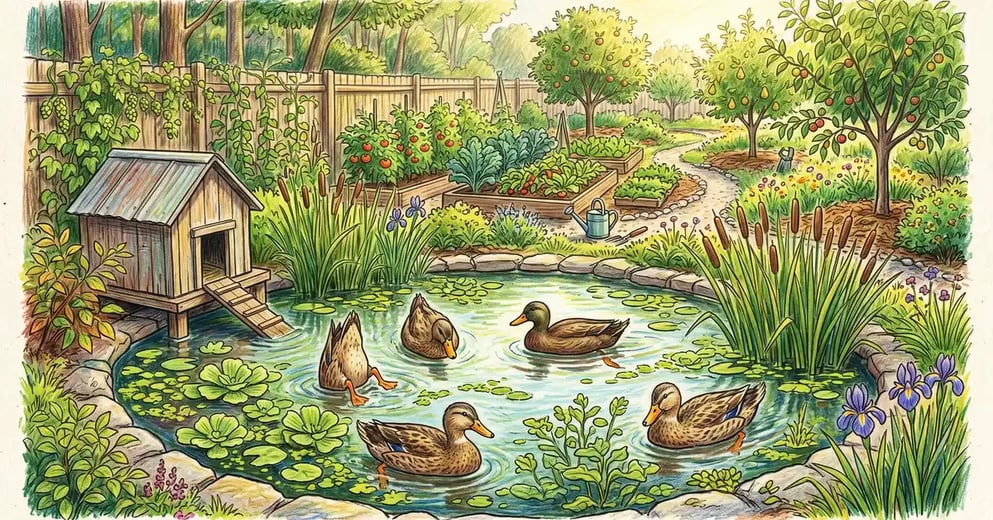

A backyard duck pond is one of the most productive water features you can build in a permaculture system. Done well, it produces 280+ eggs per duck per year, eliminates slug and snail pressure on the garden, fertilizes adjacent beds through pumped pond water, supports edible aquatic plants, and works as a rainwater cistern. Done poorly, it becomes a muddy, smelly maintenance trap. The difference is integration: the pond connects to the rest of the system rather than sitting in a corner.
Sources: ATTRA/NCAT Sustainable Agriculture Program duck guides; Storey's Guide to Raising Ducks; Murray McMurray Hatchery breed standards; Cornell Cooperative Extension small-flock guidance.
Bill Mollison wrote in Permaculture: A Designer's Manual that "ducks are the gardener's ally," and 40+ years of US backyard practice has not improved on the assessment. Ducks integrate into a backyard food system in ways that chickens cannot: they eat slugs and snails (chickens generally do not), they thrive in wet conditions chickens hate, they continue laying through midwinter for some breeds, and they need a water feature that doubles as a permaculture pond.
This guide covers the integration patterns that make a duck pond a producing system, the 6 best US breeds for backyard permaculture, pond construction options from $200 (IBC tote) to $5,000 (full liner pond), the daily and seasonal maintenance, and the legal and predator constraints US permaculture-curious gardeners need to know.
Why ducks belong in permaculture
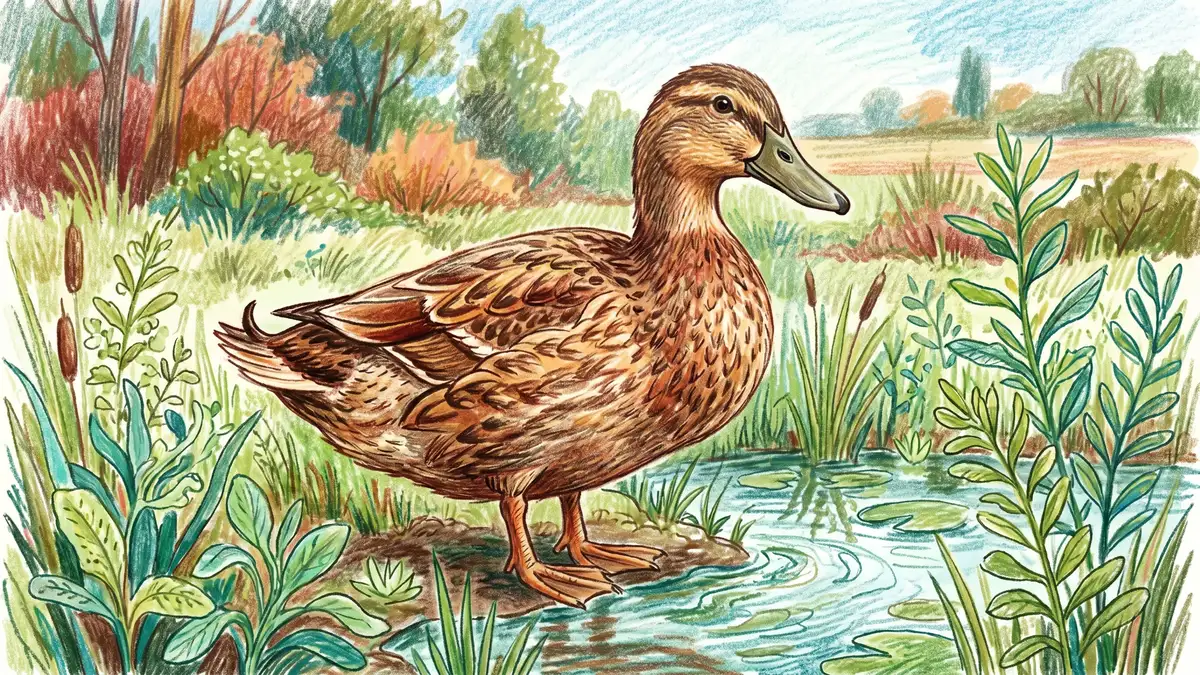
Three categories of yield separate ducks from chickens in a permaculture system.
Pest control. Ducks eat slugs, snails, mosquito larvae, fly larvae, Japanese beetle grubs, cabbage worms, and earwigs. They are messier in the vegetable bed than chickens (they puddle and mash), but the slug and snail control alone justifies them in any garden that has those pests. Salinas Valley organic vineyards in California use Indian Runner ducks to control snails. A flock of 4 to 6 ducks reduces slug populations in a 1/4 acre US backyard by 90 percent or more within one growing season.
Steady high-volume laying. Top duck breeds outperform top chicken breeds on three metrics: total annual eggs (280 to 340 for Khaki Campbell vs 280 to 300 for Rhode Island Red), egg weight (70 to 90 g vs 50 to 65 g), and winter laying (some duck breeds continue through the shortest days when chickens stop). Duck eggs are also higher in protein, fat, and vitamin B12 than chicken eggs.
Water cycling. A duck pond stores rainwater, supports aquatic plants, fertilizes the surrounding soil through overflow and pumped irrigation, and creates microclimate (cool air on hot days, frost protection on cold nights). Chickens cannot do any of this.
Why this works (the permaculture insight)
Permaculture principle 11 is "use edges and value the marginal." The duck pond is pure edge: water meets land, planted meets bare, swimming meets foraging. Every edge in a permaculture system is a high-productivity zone because two different ecosystems exchange resources across it. The duck pond stacks three or four edges into one small water feature: surface (where ducks dabble), shallow shore (where pond plants and ducks meet), deep zone (where ducks swim and rest), and pond-bed (where pumped water meets garden beds). Each edge produces something.
The 6 best US backyard duck breeds
| Breed | Eggs/year | Adult weight | Best for |
| Khaki Campbell | 280 to 340 | 4.0 to 4.5 lb | High-volume laying, friendly, cold-tolerant |
| Welsh Harlequin | 240 to 330 | 4.5 to 5.5 lb | Dual-purpose, beautiful plumage |
| Indian Runner | 250 to 300 | 3.5 to 4.5 lb | Best garden forager (upright stance) |
| Pekin | 200 to 220 | 8.0 to 10.0 lb | Dual-purpose meat, gentle temperament |
| Muscovy | 70 to 120 | 9.0 to 15.0 lb | Quiet (no quacking), meat breed, excellent foragers |
| Buff Orpington (duck) | 220 to 250 | 7.0 to 8.0 lb | Dual-purpose, cold-tolerant, calm |
Source: Murray McMurray Hatchery breed standards; Metzer Farms duck breed data; Storey's Guide to Raising Ducks.
The Khaki Campbell is the workhorse of US backyard duck flocks. Developed in England in 1898, it consistently lays more eggs per year than any chicken breed and tolerates cold down to -10 degrees F with a windbreak and dry housing. Welsh Harlequin produces almost as many eggs and weighs slightly more, making it a better dual-purpose choice. Indian Runners stand upright like penguins, walking 200+ yards from the pond to forage and back, making them the best slug-and-snail patrol for a vegetable garden.
Muscovy ducks (Cairina moschata) are technically a separate species and do not quack: they hiss. This makes them ideal for urban backyards under noise ordinances. They fly well (clip wings or build covered runs), are the best mosquito-control duck, and produce excellent table meat.
The pond sizing math
| Duck count | Minimum pond size | Depth | Water exchange frequency |
| 2 ducks | 4 ft diameter (or IBC tote 275 gal) | 18 to 24 in | Weekly |
| 4 to 6 ducks | 8 ft x 8 ft (~480 gal) | 24 to 30 in | Every 5 to 7 days |
| 8 to 12 ducks | 10 ft x 12 ft (~900 gal) | 30 to 36 in | Every 7 to 10 days |
| 15+ ducks | 15 ft x 20 ft (~2,000 gal) or natural pond | 36 to 48 in | Bi-weekly with biofilter |
Source: ATTRA/NCAT Sustainable Agriculture Program duck pond design guides; Cornell Cooperative Extension small-flock waterfowl management.
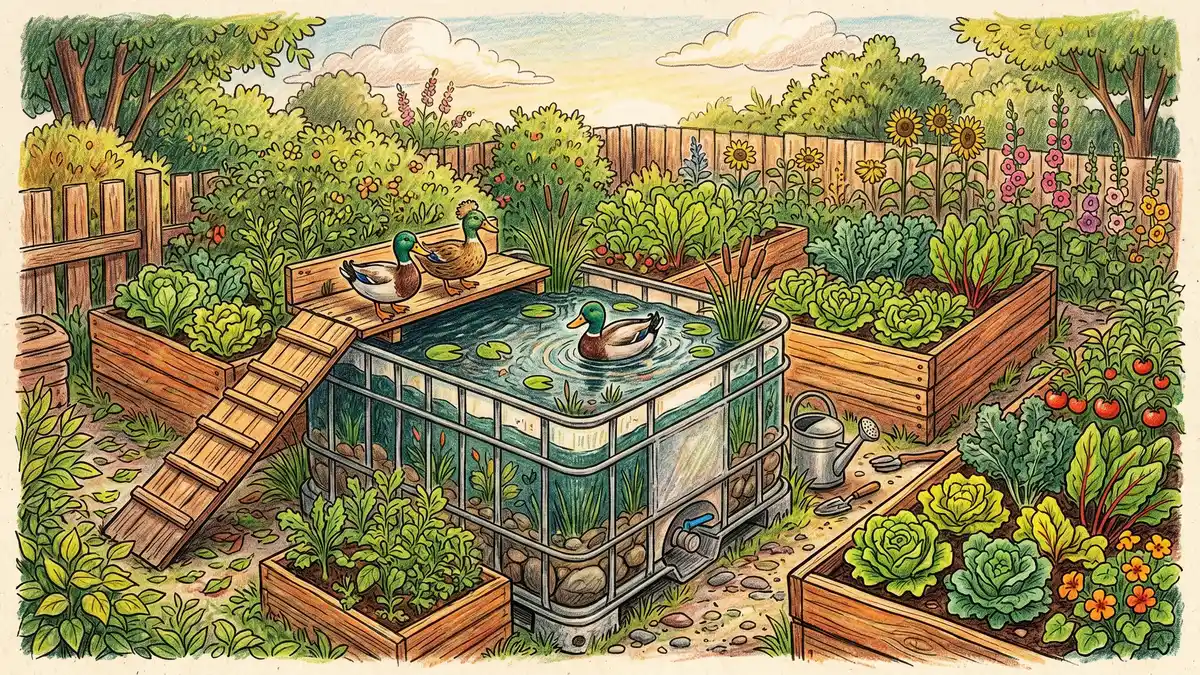
The IBC tote (275 gal industrial container, $50 to $150 used) is the cheapest viable duck pond. Cut the top off, add a ramp, install a drain valve at the bottom, and connect the drain to a garden irrigation line. Two ducks thrive in this setup. Many US backyard permaculture sites start here, add a second tote in year 2, and build a full liner pond in year 3 or 4.
An EPDM rubber liner pond (45 mil, 30-year life) is the most popular permanent option. Dig a basin with a 12 in shallow shelf around the edge for pond plants, line with old carpet or 4 in of sand, then drape EPDM. Edge with stones. The 8 ft x 8 ft size costs $300 to $600 in materials and 1 to 2 weekends of work.
The integration pattern: pond as garden hub
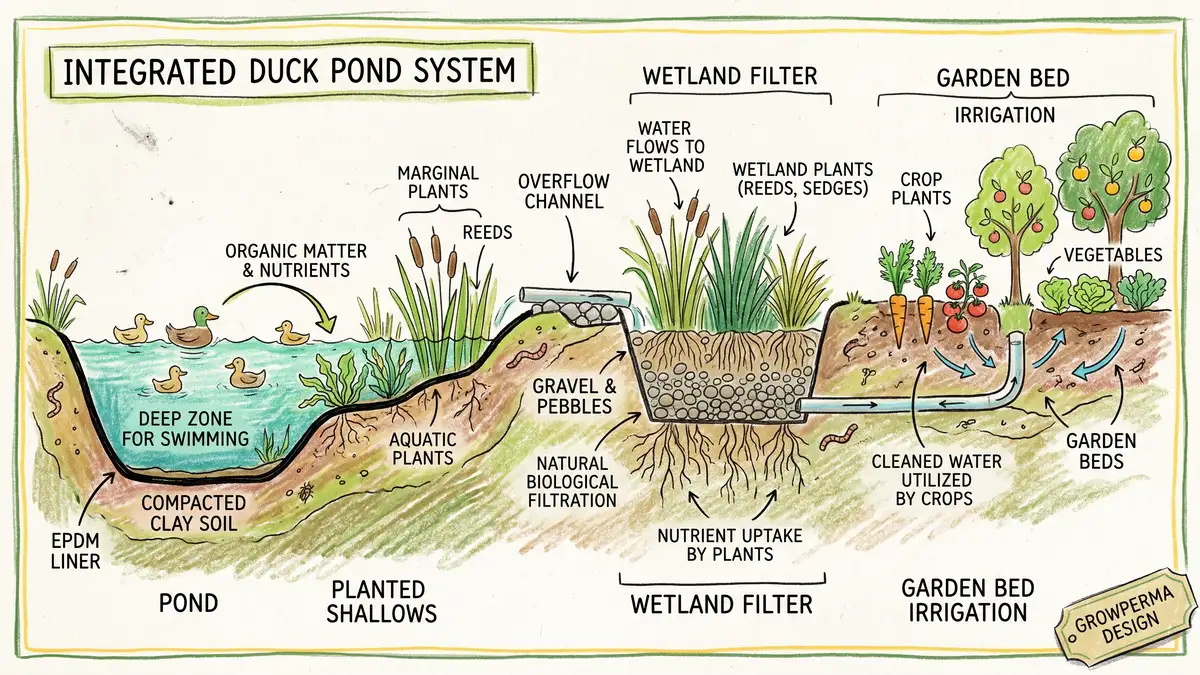
The simplest integration loop connects four elements:
- Pond. Holds water and ducks. Drains to garden beds every 1 to 2 weeks.
- Pond plants. Floating layer (azolla, duckweed, water lettuce) doubles as duck feed. Emergent layer (cattail, sedge, rush) filters water and provides cover. Shore layer (water mint, watercress, marsh marigold) absorbs nutrients and produces edibles for humans.
- Wetland filter (optional, recommended). A second shallow basin (1/3 the size of the duck pond) planted heavily with reeds and bulrushes. Pond water flows through the wetland and returns clean.
- Garden beds. Receive nutrient-rich pond water on a 1 to 2 week schedule. The fertility from duck droppings plus the water itself can replace most or all of the supplemental feeding for a typical 200 sq ft bed.
The advanced integration adds a fifth element: an overflow channel to a fruit tree guild or a banana circle (in warm climates), turning excess pond water into orchard irrigation.
The aquatic plant stack
| Plant | Layer | Function |
| Azolla, duckweed (Lemna) | Floating | High-protein duck feed (15 to 25% protein); nitrogen fixing |
| Water lettuce, water hyacinth | Floating | Shade water, absorb nutrients (water hyacinth invasive in southern US, do not release) |
| Cattail (Typha) | Emergent | Edible roots and shoots for humans; pollen as flour; ducks eat young shoots |
| Bulrush (Schoenoplectus) | Emergent | Wetland filtration; edible shoots |
| Watercress | Shore | Edible salad green; absorbs nitrogen |
| Water mint, marsh marigold | Shore | Aromatic ground cover; pollinator calendula pollinator support around the pond attraction |
Source: Bill Mollison, Permaculture: A Designer's Manual (Aquaculture chapter); USDA NRCS wetland plant guides.
Azolla and duckweed grow fast enough in summer that 100 sq ft of pond surface can produce 1 to 3 lb dry weight per week, enough to provide 30 to 50 percent of the protein for a 4-duck flock. The ducks eat the floating plants directly and also forage the wetland edges for snails and aquatic insects.
What ducks eat (and what to provide)
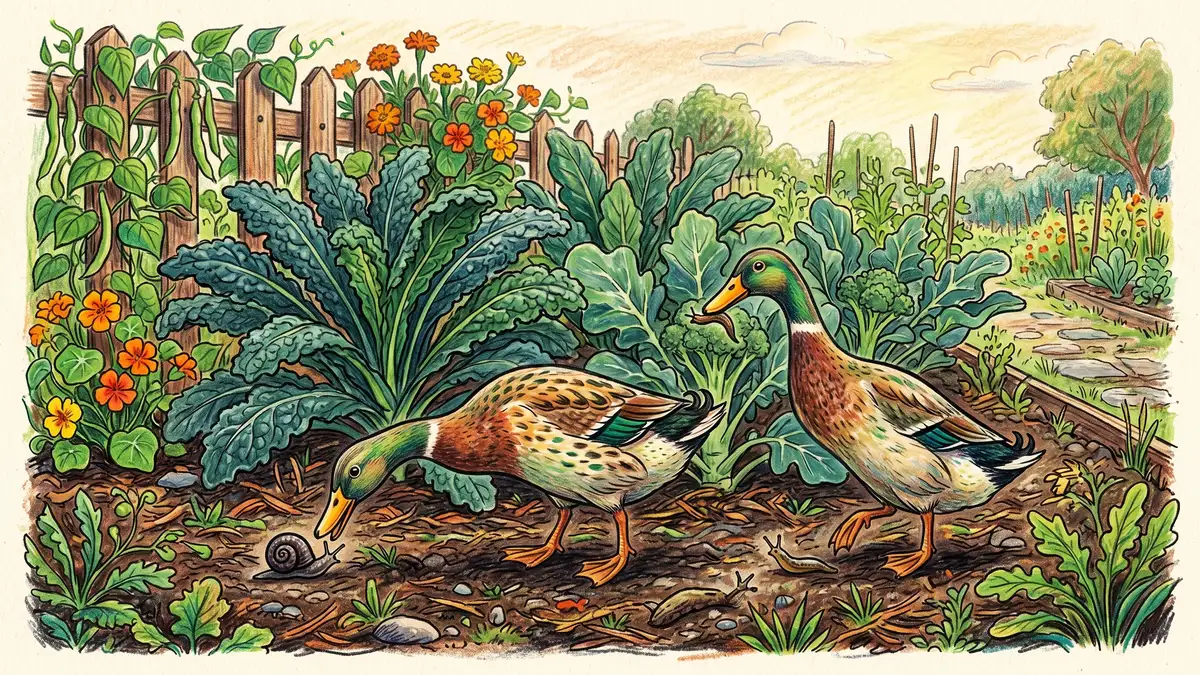
A laying duck eats 4 to 6 oz of food per day. The mix in a permaculture system:
- Commercial waterfowl pellet (16 to 18% protein): The protein anchor. Available from Tractor Supply, Purina Mills, Mazuri, and Kalmbach. Avoid chicken feed (the calcium and protein ratios are wrong for ducks).
- Pond and yard forage: 25 to 50% of total intake in a well-designed system. Includes pond plants, slugs, snails, garden insects, fallen fruit, garden trim.
- Kitchen scraps: Vegetable trim, leftover grains, eggshells (calcium for shell formation). Avoid onions, citrus, raw beans, avocado.
- Grain ration in winter: Whole grain or scratch mix as a calorie supplement when foraging drops off.
- Grit and oyster shell: Free choice in a separate dish for digestion and shell formation.
Daily fresh drinking water is non-negotiable. Ducks need to be able to submerge their head to clear nostrils and eyes. A 5 gal bucket with a wide top works at minimum.
The egg side of the equation
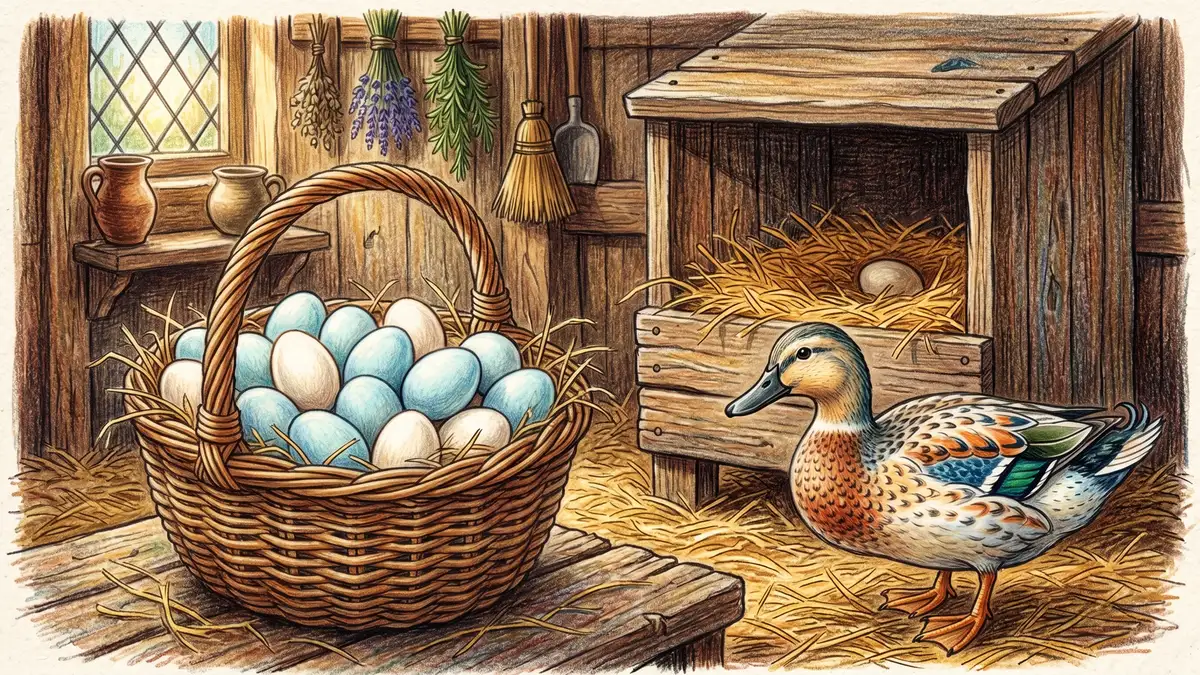
Most duck breeds lay early in the morning, often before sunrise. A typical schedule: collect eggs by 8 a.m. from the nesting boxes inside the coop, then open the run to the yard. Ducks rarely lay outside if they have nesting boxes that meet their preferences (10 in x 12 in floor, 14 in tall, straw bedding, low ambient light).
Duck eggs sell for $6 to $12 per dozen at US farmers markets (vs $4 to $8 for chicken eggs) because of their size and protein density. Bakers prize them for the higher fat content. A 4-duck flock producing 280 eggs per duck per year yields 1,120 eggs annually, or roughly 93 dozen. Even keeping half for the household, that produces $300 to $500 in sales potential plus 47 dozen for kitchen use.
Ducks lay continuously for the first 2 to 3 years, drop production by 15 to 30 percent in year 4, and plateau through year 6 to 8. Plan a flock rotation: add 2 new ducklings every 2 years, retire older ducks to meat or to a hen retirement role.
Predator protection and overnight housing
The single most common cause of duck flock failure is predator loss. Raccoons, owls, hawks, foxes, dogs (including the family dog), coyotes, mink, and weasels all attack backyard ducks. The defense pattern:
- Secure overnight coop. 4 sq ft per duck minimum, fully enclosed with hardware cloth (1/2 in opening, not chicken wire). Door latches must defeat raccoons.
- 8 ft perimeter fencing or covered run. Hawks and owls take ducks from open yards. Either fence at least 8 ft (most hawks will not dive into tight space) or cover the run with bird netting.
- Lock up at sunset, open at sunrise. The majority of predator attacks happen overnight. Automatic coop door openers (Run-Chicken, ChickenGuard, around $200) save the daily routine.
- Electric net fencing. Premier1 PoultryNet (164 ft, 35 in tall, around $200) keeps out most ground predators and contains ducks during the day.
Cold weather management
Most duck breeds tolerate cold dramatically better than chickens. The combination of waterproof feathers, oil glands that keep them dry, and a layer of down works through -10 degrees F if the ducks have a wind-block. Critical winter setup:
- Dry, draft-free coop floor. Pine shavings or straw, refreshed weekly.
- Heated waterer. A 2 gal heated waterer ($40 to $60) prevents frozen drinking water. Ducks need water to swallow food.
- Pond de-icer. A 250 W floating de-icer ($30 to $60) keeps a small zone of the pond open through US zone 5 to 7 winters. Without it, ducks lose pond access from December through March in much of the US.
- Winter laying tips. Khaki Campbell, Welsh Harlequin, and Buff Orpington continue laying through the shortest days. Most other breeds drop production by 50 percent or stop. Adding 14 hours of total daylight via a coop light maintains winter production.
Daily, weekly, and seasonal maintenance
Daily (10 to 15 min)
Open coop at sunrise. Collect eggs. Refresh drinking water. Check feed level. Walk the pond edge. Close coop at sunset.
Weekly (30 to 60 min)
Refresh coop bedding. Clean nesting boxes. Drain or partially exchange pond water (drains to garden beds). Skim debris from pond surface. Check fencing.
Monthly
Deep clean coop. Check ducks for body condition (feel breastbone for muscle). Inspect for mites and parasites. Trim pond plants to manage spread.
Seasonal (spring and fall)
Spring: clean pond bottom of accumulated sludge (use it as fertilizer). Add new pond plants. Check breeding setup if expanding flock. Fall: prepare winter housing. Add pond de-icer. Stock winter feed.
The legal and zoning context
Most US cities allow 4 to 12 ducks in backyards under chicken ordinances. A few details to verify with your local code:
- Coop setback: Often 10 to 25 ft from neighbor property lines.
- Total bird count: Many municipalities cap "fowl" at 6 to 12 per single-family lot.
- Drake (male) restrictions: Some cities prohibit roosters but allow drakes (drakes do not crow). Drakes are not required for egg production.
- Permit requirement: Cities like Seattle, Minneapolis, Austin, and Portland have specific small-flock permit processes.
- HOA restrictions: Homeowners associations frequently ban fowl regardless of city code. Check the HOA CCRs.
Tucson, Madison, Atlanta, and many other US cities have moved toward allowing 4 to 6 hen-and-duck combinations as of right. Even in restrictive jurisdictions, Muscovy (technically a separate species) is sometimes exempt from "fowl" ordinances. Verify before buying ducks.
Get the Weekly Dig
One practical permaculture guide a week, written for gardeners who do this on weekends: permaculture design for real backyards. Free, no spam, unsubscribe any time.
Join the Weekly DigFAQ
Do ducks really need a pond?
Ducks need at least some water deep enough to submerge their head and clean their nostrils. A 5 gal bucket meets the minimum survival standard. For thriving ducks that lay well and stay healthy, a true pond (4 ft diameter minimum, 18 to 24 in deep for 2 ducks) is strongly recommended. Ducks bathe daily, mate in water, and run their oil gland by dipping their heads. Without a pond they can survive but cannot truly thrive.
How often do ducks lay eggs?
Top US laying breeds (Khaki Campbell, Welsh Harlequin) lay 280 to 340 eggs per year, roughly one egg every 1.1 to 1.3 days. They lay early in the morning, typically before sunrise. Pekin lays 200 to 220 eggs/year. Muscovy lays only 70 to 120 eggs/year but produces excellent meat. Some duck breeds continue laying through midwinter when chickens stop.
What is the best duck breed for a backyard?
For pure egg production, Khaki Campbell (280 to 340 eggs/year) is unmatched. For dual-purpose (eggs and meat), Welsh Harlequin and Buff Orpington duck are top choices. For pest control in the vegetable garden, Indian Runner walks farther from the pond and forages more aggressively. For quiet backyards under noise ordinances, Muscovy hisses instead of quacking. Most US backyard flocks mix 2 to 3 of these breeds.
Do ducks need a male to lay eggs?
No. Ducks lay eggs whether or not a drake is present, just like chickens lay without a rooster. A drake is only needed to produce fertile eggs for hatching. Most US backyard duck flocks are all female to avoid drake aggression and to comply with city ordinances that ban roosters.
Can ducks freeze to death in winter?
Healthy adult ducks of cold-tolerant breeds (Khaki Campbell, Buff Orpington, Welsh Harlequin, Pekin) handle temperatures down to -10 degrees F with proper shelter. They have waterproof feathers and an insulating down layer. Critical setup: dry draft-free coop, heated drinking water, access to open water (use a pond de-icer), and food calories scaled up by 15 to 25 percent in cold months.
Do ducks need a pond in the winter?
Ideally yes. Ducks bathe to keep their feathers oiled and waterproof. Without pond access, the down layer can compact and lose insulation value. A 250 W floating pond de-icer ($30 to $60) keeps a small zone open through most US winters. If a full open pond is not possible, a heated 5 gal waterer that ducks can dip their heads into is the minimum acceptable substitute.
Are ducks better than chickens for pest control?
Yes for slugs, snails, mosquito larvae, and wet-ground pests. Ducks actively eat slugs and snails (most chickens ignore them). Ducks tolerate wet conditions where chickens get sick. Indian Runner ducks can reduce slug populations in a small garden by 90 percent or more. Chickens may have a slight edge on flying insects and ticks, but most backyard permaculture systems benefit more from ducks.
How many ducks do I need for eggs?
2 to 3 Khaki Campbell or Welsh Harlequin ducks produce 600 to 1,000 eggs per year, more than enough for a family of 4. Most US backyard flocks settle at 4 to 6 ducks to handle slug and snail control plus produce enough eggs for selling or sharing. Keep flock counts even-numbered (ducks are social and prefer pair bonding) and skew female (no drake needed for eggs).
Resources
- ATTRA/NCAT: Ducks Beginner's Guide to Small-Scale Production
- Metzer Farms: Duck Breed Reference Guide
- Murray McMurray Hatchery: US Duck Breeds Catalog
- eXtension: Raising Ducks Resource Library
- Storey's Guide to Raising Ducks (Dave Holderread)
- USDA APHIS: Defend the Flock biosecurity guidance
- David Holmgren: Use Edges and Value the Marginal (Principle 11)
working with heavy clay soils