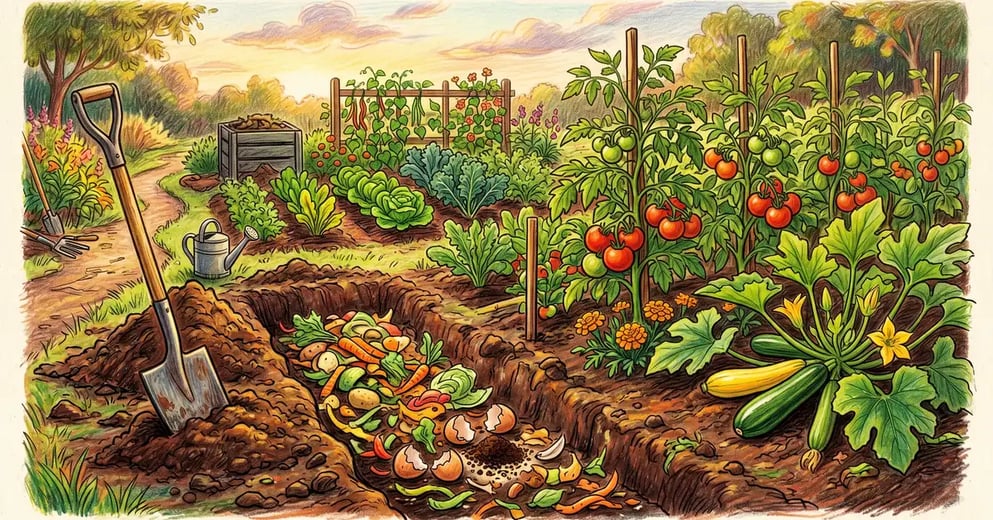

Trench composting skips the compost pile entirely. You dig a hole 12 to 18 inches deep, dump in your kitchen scraps, cover with soil, and walk away. In 2 to 6 months you have rich, finished compost exactly where your plant roots can reach it. No turning. No carbon-to-nitrogen ratio math. No fly problem. No critters digging through a backyard heap. the single-hole pit method
For a weekend gardener with a 5 gallon kitchen scrap bucket and a spade, this is the easiest composting method that exists. This guide covers the three trench methods, what to bury and what to skip, the soil science behind why it works, and the timing for US zones 3 through 11.
Sources: NC State Cooperative Extension: Types of Composting and USDA NRCS Soil Health.
What trench composting actually is
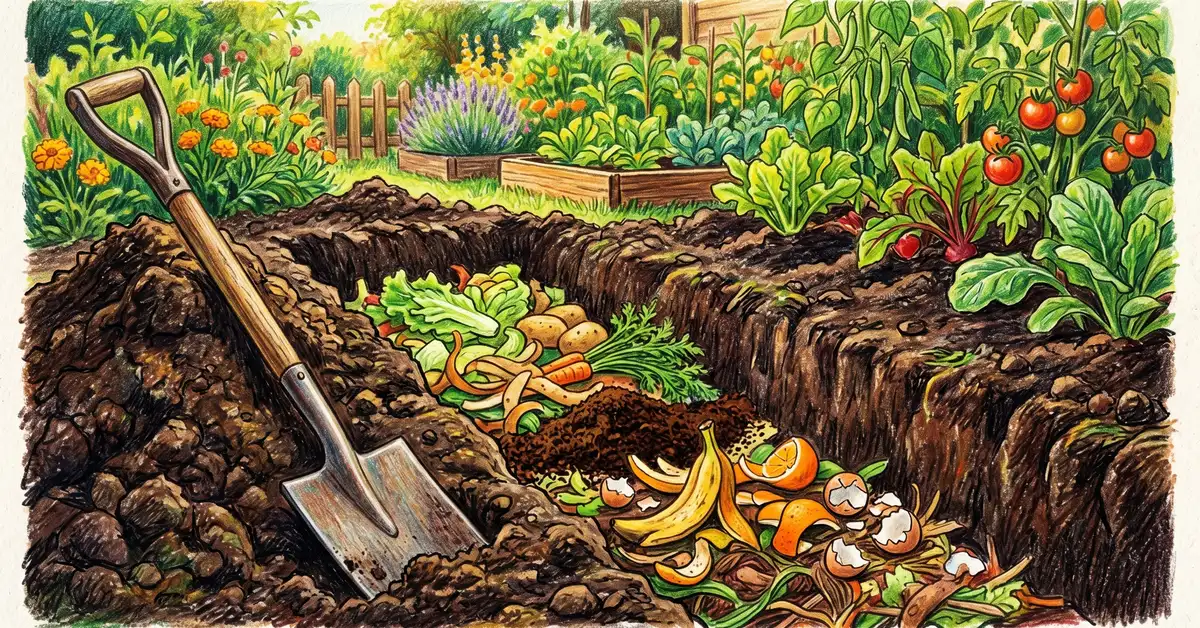
Trench composting (also called in-ground composting, pit composting, or dig and drop) is one of the oldest composting methods on the planet. Victorian English kitchen gardens routinely trenched the previous winter's kitchen waste under their bean and pea rows, and the technique appears in Roman agricultural texts under the name stercoration. Indigenous farming traditions across North America used buried fish and food waste to feed corn and squash for centuries before European settlement.
The mechanism is simple. You put the organic matter where the soil microbes already live and where the moisture is. Underground decomposition is steadier, cooler, more anaerobic at depth, and protected from the weather that slows surface compost piles in summer drought or winter freeze. The breakdown is slower than hot composting, but the finished material lands directly in the root zone of next year's plants.
Why this works as permaculture
Trench composting collapses three steps (collect, compost, distribute) into one. Permaculture calls this "stacking functions". You are not maintaining a compost pile, then turning a compost pile, then hauling compost to the garden bed. You are skipping straight to the end state. The plant roots and the soil food web finish the job in place, which is exactly what a forest floor does naturally.
The three trench composting methods
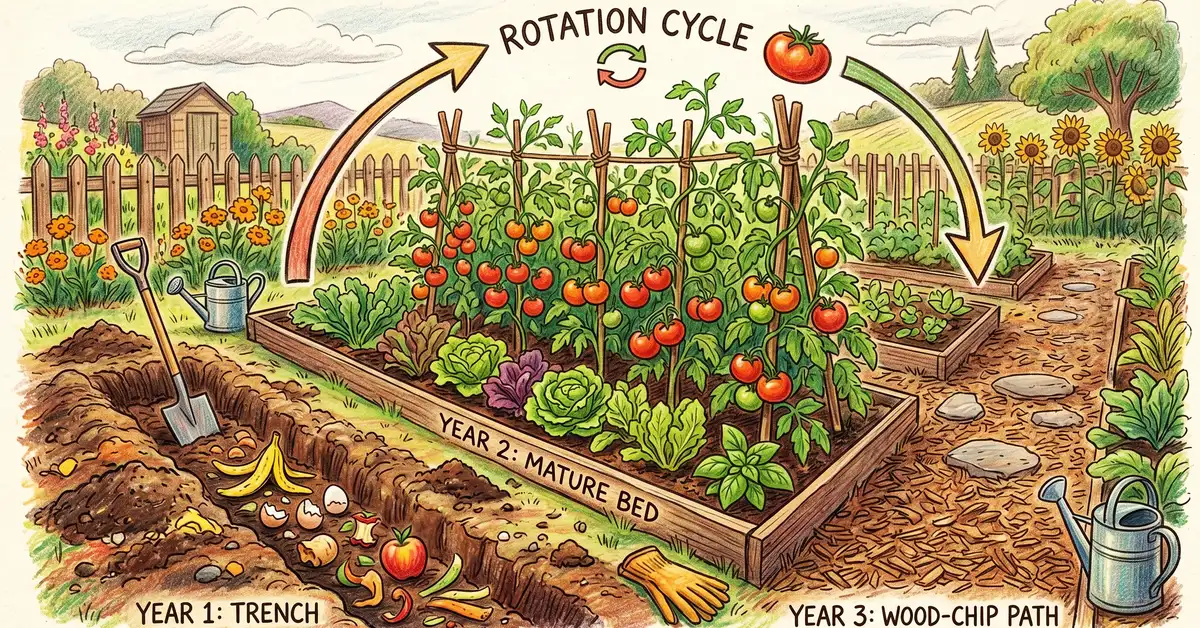
Method 1: English Three-Year Rotation. Lay out three parallel rows. Year 1: trench and fill row A with scraps over the season. Year 2: plant heavy feeders (tomatoes, squash, beans, peas) on row A while you trench row B. Year 3: walking path on row A, plant heavy feeders on row B, trench row C. The whole bed rotates every year. This is the system Eliot Coleman uses at Four Season Farm in Maine and what Lee Reich teaches in Weedless Gardening.
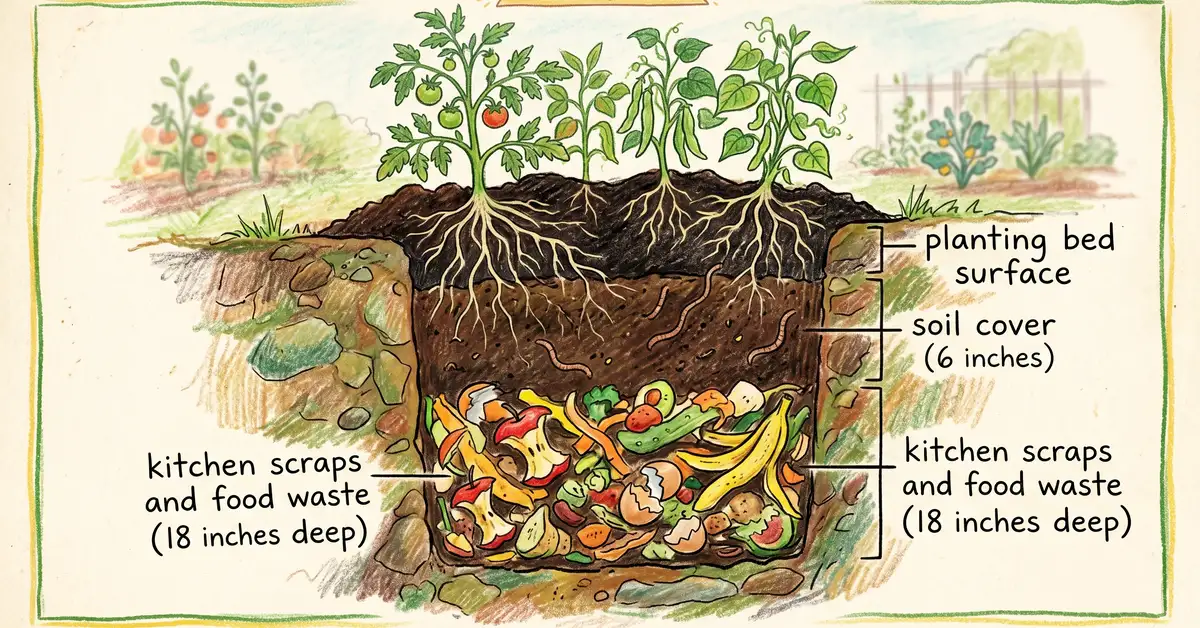
Method 2: Single Trench. One-time burial under a future bed. Dig a trench 12 to 18 in (30 to 45 cm) deep, fill with collected kitchen waste over 2 to 6 weeks, cover with 6 in (15 cm) of soil, mark with stakes, then plant on top after 2 to 6 months. Best for new beds and for gardeners testing the method.
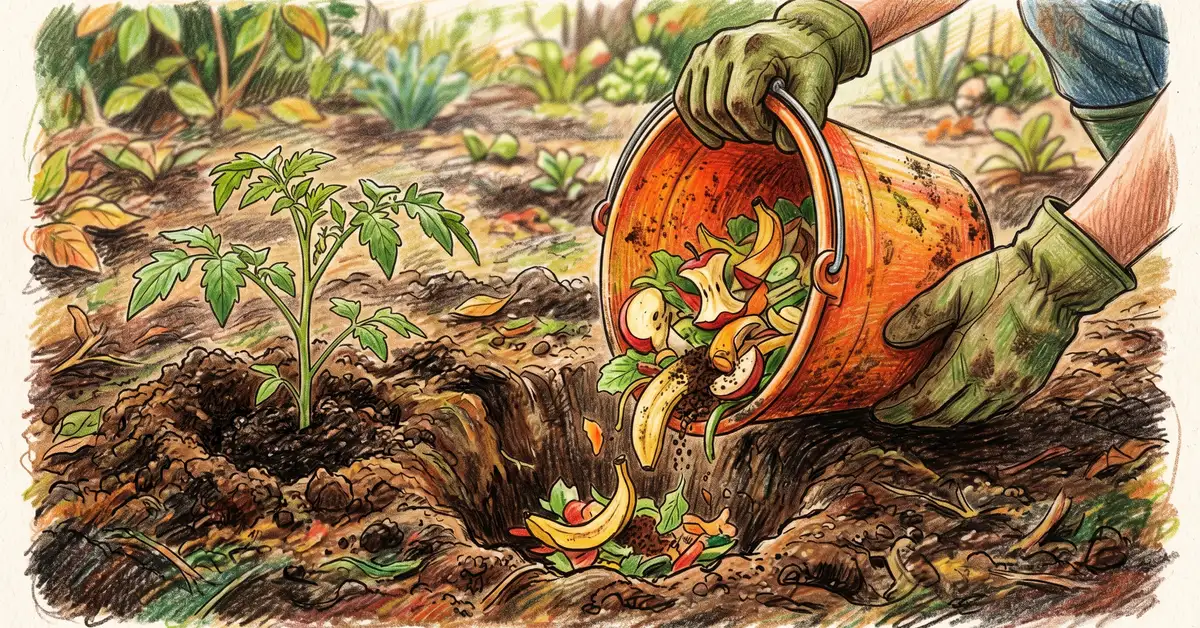
Method 3: Posthole or Pit Composting. Small targeted burial near individual plants. Dig a 12 in (30 cm) deep hole between two tomato plants, dump in a gallon of scraps, cover with soil. The plants get a localized feed. Repeat every few feet down the row. Great for already-planted beds where you cannot trench the whole row.
| Method | Best For | Effort | Time to Plant |
| Three-Year Rotation | Permanent veg garden | Steady weekly | 1 year after fill |
| Single Trench | New bed prep | 1 burst of digging | 2-6 months |
| Posthole / Pit | Established beds, individual plants | 5 min per hole | Plant already in |
Source: The Old Farmer's Almanac: Trench Composting.
What you can (and cannot) bury
Trench composting accepts a wider material list than hot composting. Underground decomposition is mostly anaerobic, deters most pests and flies, and contains odors below 6 inches of soil cover. This means you can safely bury several things you would never put on a backyard heap.
Yes, bury these: all vegetable scraps, fruit peels and cores, coffee grounds and filters, tea bags, eggshells, garden trimmings, dead plants without disease, weeds without rhizomes or set seed, paper towels, shredded cardboard, hair, and yes, in moderation, small amounts of meat scraps, bones, dairy, and cooking oils. Bury meat and dairy at the deeper end, 18 inches (45 cm), to deter raccoons and dogs.
Skip these: diseased plant material (especially blighted tomatoes), persistent rhizome weeds like bindweed and quack grass (they reroot from buried pieces), woody material thicker than a pencil (will not break down in one season), pet waste from dogs and cats (pathogen risk), and any synthetic material. Treated wood ash and industrial chemicals never belong in a food garden.
The 5-step trench compost
Pick the spot
Choose where next year's heavy feeders will go: tomatoes, squash, beans, peas, brassicas. Trench composting feeds these crops directly. Avoid root crop locations (carrots, parsnips fork in disturbed soil).
Dig the trench
12 to 18 in (30 to 45 cm) deep, 10 to 12 in (25 to 30 cm) wide, as long as your row. Pile the excavated soil along one side. A standard garden spade does the job in 30 to 45 min for a 10 ft (3 m) row.
Fill in layers
Add scraps to the bottom 6 in (15 cm) only, then 1 to 2 in (2.5 to 5 cm) of soil on top of each layer of scraps to control odor. Keep filling over days or weeks until you reach 6 in (15 cm) below the surrounding ground level.
Cap with soil
Add at least 6 in (15 cm) of soil over the topmost scrap layer. Mound it slightly, since the trench will settle 2 to 4 in (5 to 10 cm) over the following weeks. Mark the trench ends with stakes.
Wait and plant
2 months in summer, 4 to 6 months in cool weather or winter. Plant heavy feeders directly on top once the soil feels dense and there are no remaining identifiable scraps when you dig a test hole.
Timing across US zones
The decomposition rate underground is driven mostly by soil temperature and moisture. Cornell Cooperative Extension data shows full breakdown in 6 to 12 weeks at soil temps above 60 F (15 C), and 4 to 6 months at soil temps from 35 to 50 F (2 to 10 C). Frozen soil stops decomposition entirely.
Zones 3 to 5 (cold). Trench in fall only, planning to plant the following May or June. The frozen ground does not break down material in winter, so the bulk of decomposition happens in spring as the soil thaws. Cover the trench with 6 in (15 cm) of mulch to protect from freeze damage.
Zones 6 to 7 (moderate). Trench in fall for spring planting, or trench in spring for fall planting. The double window makes this the most flexible US climate for trench composting. Most major US gardening reference works are written for this zone.
Zones 8 to 11 (warm). Trench year round. Decomposition continues through mild winters. Watch for fly hatch in summer if scraps are exposed during fill, and bury each addition with at least 1 in (2.5 cm) of soil within 24 hours.
The soil science: why this beats surface compost
Buried organic matter raises soil organic matter (SOM) percentage faster than top-dressed compost because nothing is lost to surface oxidation. Cornell Soil Health Manual notes that every 1% rise in SOM in the top 12 in (30 cm) of soil holds an additional 25,000 gallons of water per acre, roughly 0.04 gal per sq ft.
For a 100 sq ft (9.3 sq m) backyard plot, that is the difference between needing to water every 3 days in July and watering once a week. The same SOM also feeds mycorrhizal fungi and bacteria that exchange nutrients with plant roots through a symbiotic network, the fungal "internet" Suzanne Simard, Merlin Sheldrake, and other recent soil ecologists have documented.
Buried compost releases nutrients slowly. A study from the Soil Science Society of America showed buried organic matter at 12 in (30 cm) released nitrogen at about 30 to 50% of the rate of surface compost, meaning longer-lasting fertility through the growing season without leaching loss.
Get the Weekly Dig
One practical permaculture guide a week, written for gardeners who do this on weekends: composting that actually finishes and soil that feeds itself. Free, no spam, unsubscribe any time.
Join the Weekly DigFrequently asked questions
How long does trench composting take? 2 to 6 months in most US climates. Faster in warm summer soil (6 to 12 weeks at 60 F+ soil temps), slower in cool spring or fall soil (4 to 6 months). Frozen winter ground pauses the process entirely until thaw.
Can you compost in a hole in the ground? Yes. Pit composting (a small posthole version of trench composting) is one of the simplest backyard methods. Dig a hole 12 in (30 cm) deep, dump in a gallon of food scraps, cover with at least 6 in (15 cm) of soil. The buried scraps break down in 2 to 6 months without odor or pest issues.
What can be trench composted that cannot be put in a backyard heap? Small amounts of meat, dairy, oils, and bones can be safely buried at 18 in (45 cm) depth because anaerobic decomposition and soil cover deter pests and contain odor. Surface compost piles cannot handle these materials.
What is the difference between trench composting and hot composting? Hot composting maintains an aerobic pile at 130 to 160 F (54 to 71 C) and produces finished compost in 6 to 12 weeks. It requires turning and a strict carbon-to-nitrogen ratio. Trench composting is anaerobic, slower (2 to 6 months), requires no turning, accepts a wider material list, and delivers compost directly to root zones.
Can you trench compost in winter? In zones 3 to 6, the ground freezes too hard to dig from December through February. Dig fall trenches in October and November and fill them gradually through winter (with snow or a tarp over the top). Decomposition resumes when soil temps cross 35 F (2 C) in spring.
Will trench composting attract rats and raccoons? Only if cover soil is too shallow. With 6 in (15 cm) of soil over plant scraps and 18 in (45 cm) over meat, bones, or dairy, smell is contained underground and animals lose interest within a few days. Surface mulch on top of the cover adds another layer of protection.
What can I plant after trench composting? Heavy feeders thrive on a finished trench: tomatoes, peppers, squash, melon, cucumber, beans, peas, brassicas (cabbage, kale, broccoli, Brussels sprouts), and corn. Avoid root crops like carrots and parsnips in the first season because the soft, settling soil produces forked roots.
Is trench composting better than a compost bin? Different jobs. Trench composting wins for low effort, no smell, accepting meat and bones, and direct root-zone feeding. A compost bin wins for producing portable finished compost for transplants, containers, and starting new beds. which compost bin fits your yard Most homesteaders use both.
Resources
- NC State Cooperative Extension: Composting Types
- The Old Farmer's Almanac: Trench Composting
- Gardening Know How: In-Ground Composting Guide
- Eliot Coleman: Four Season Farm Maine
- Lee Reich: Weedless Gardening
- USDA NRCS Soil Health Resources
- Cornell Soil Health Laboratory Manuals
Need the gear for this?
Bins and tumblers picked by yard size, with the honest trade-offs for each.
See the compost bin picksgypsum for heavy clay soil