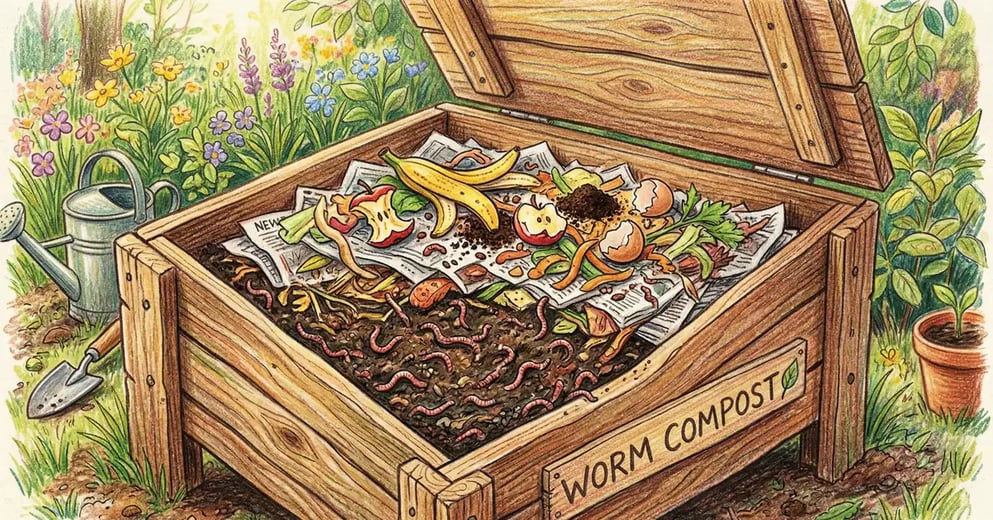

Most worm composting guides start by telling you how great worm composting is. This one starts with the honest version: a worm bin is a small livestock operation in your basement. worm bin setups compared side by side It needs a decision every week, it fails in specific and predictable ways, and for maybe a third of the people who start one, an ordinary compost pile would have been the better answer.
This page is the map for everything we have written about vermicomposting. It answers the questions that only make sense at the top level, which bin, which worms, whether to bother at all, and then hands you off to the guide that goes deep on each step. If you want the deep version of any section, the link is right there in it.
Quick answer
Worm composting uses Eisenia fetida, red wigglers, to turn kitchen scraps into castings at room temperature, indoors, year round. Stock 1 lb of worms per cubic foot of bedding, keep the bin between 55 and 77°F, feed under 2 inches of bedding, and expect your first harvest after 3 to 6 months. It beats a compost pile on nutrient density and on being usable in a flat with no garden. It loses on volume, on yard waste, and on being forgiving when you go on holiday.
Is a worm bin actually the right call for you?
This is the question every other guide skips, so we will do it first.
A worm bin is the better choice if your organic waste is mostly kitchen scraps rather than garden waste, if you have no outdoor space or a hard winter that shuts an outdoor pile down for months, if you want a concentrated soil amendment rather than bulk material, or if you have children and want a system they can actually watch working.
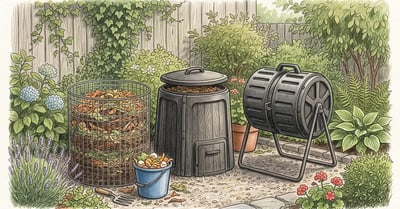
A compost pile or bin is the better choice if you generate significant yard waste, leaves, prunings, grass, since worms cannot process woody material at all. It is also better if you produce more than about 8 lb of food waste a week, if you travel often enough that a two week gap in attention is normal, or if you simply want volume for topdressing beds. Our comparison of bin, tumbler and open pile covers that side of the decision, and the composting basics guide is the starting point if you go that way.
Plenty of gardeners run both, a worm bin under the sink for kitchen scraps and a pile outside for everything the worms will not touch. That is usually the right answer for a household with a garden.
What worm castings actually give you that compost does not
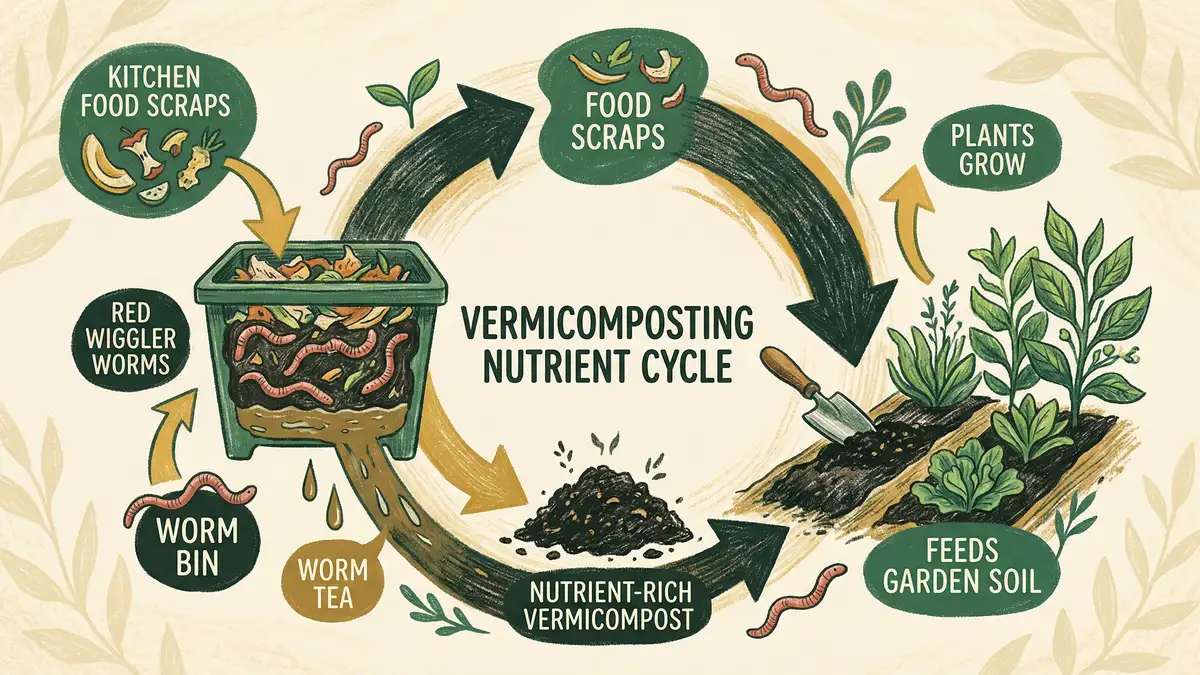
This is the one comparison that belongs on this page rather than in a spoke, because it is the reason to take on the extra work at all. The difference is not really the NPK numbers, it is the biology. Vermicompost passes through a worm gut, and what comes out is a microbially dense material rather than a nutrient store.
| Measure | Vermicompost | Traditional compost |
| Nitrogen (N) | 1.0 to 1.5% | 0.5 to 1.0% |
| Phosphorus (P) | 0.5 to 0.8% | 0.3 to 0.5% |
| Potassium (K) | 0.5 to 1.0% | 0.4 to 0.8% |
| Humic acid | 7.5 to 15.0% | 2 to 4% |
| Bacteria per gram | 6 to 12 billion | 2 to 4 billion |
Source: Cornell Waste Management Institute, vermicompost research summary.
The practical consequence is that you use castings differently. A handful worked into a planting hole or a half inch topdressing does what a bucket of compost would, which is fortunate, because a worm bin will never produce a bucket. What that looks like in the garden is covered in worm castings as a natural fertilizer, and if you want to extend a small harvest further, worm tea versus compost tea explains which brew is worth the trouble and which is not.
The five decisions, in the order you have to make them
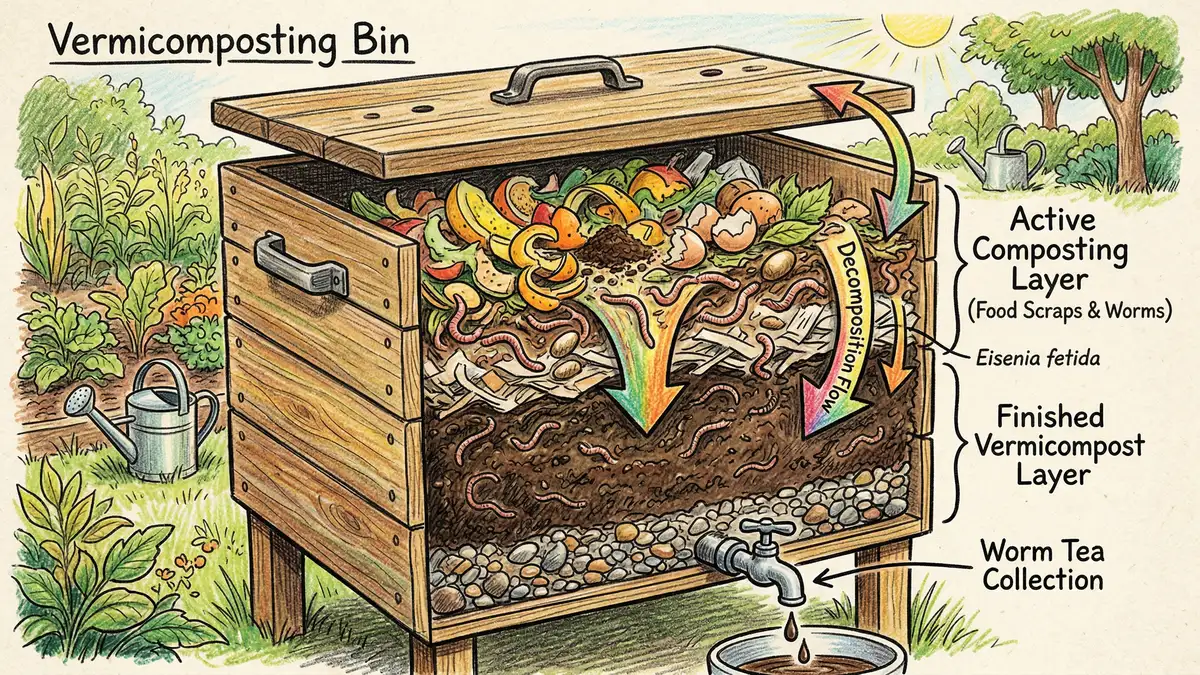
Everything else on this page is detail. These five are the decisions that determine whether the bin works, and each one has a guide behind it.
Which worms
Red wigglers, Eisenia fetida. They are surface dwellers that evolved in leaf litter and manure, which is exactly the environment inside a bin. Garden earthworms are deep burrowers, will try to escape within days and usually die within weeks. This is the single most common beginner mistake, and it is unrecoverable. Red wigglers versus earthworms covers the species question and where to buy without getting the wrong thing.
Which bin
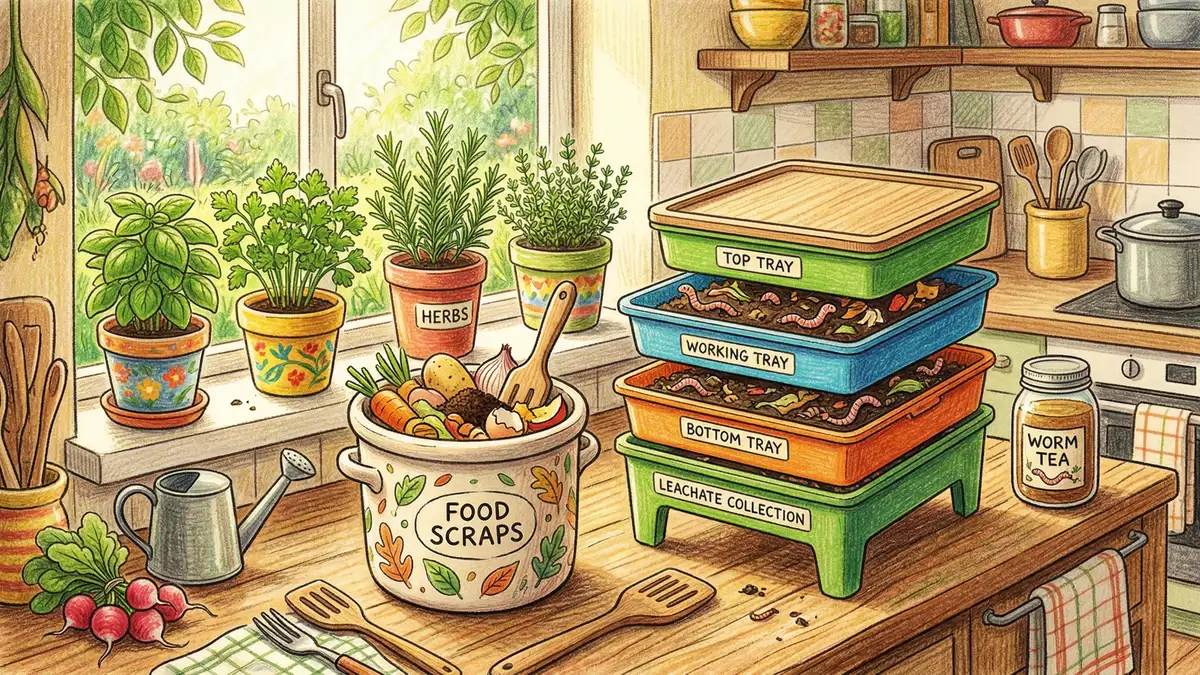
A drilled storage tote for under $25 works genuinely well and is the honest recommendation for a first bin. Tray systems cost four to five times more and buy you one thing: harvesting takes 20 minutes a month instead of an hour or two every few months. Whether that trade is worth it depends on how much you value your Saturday. Our comparison of five bin types has the DIY builds and the store bought systems side by side with real prices.
Where it lives
Between 55 and 77°F, out of direct sun. In most homes that means a basement, a garage, a utility room or a cupboard. If you are in a flat with none of those, the bin goes in the kitchen, and that changes how carefully you have to manage moisture and feeding. Indoor worm composting is written for exactly that situation. If your winters drop below freezing where the bin lives, read keeping worms alive in winter before November, not during it.
What goes in
Vegetable and fruit scraps, coffee grounds, crushed eggshells, plus a constant supply of carbon bedding, mostly shredded corrugated cardboard. No meat, no dairy, no oils, no pet waste. Citrus and onion in quantity will turn the bin acidic. The trap is not the forbidden list, it is quantity: almost every failed bin was overfed. The complete worm food list is the yes and no reference, including the items people argue about.
How you get the castings out
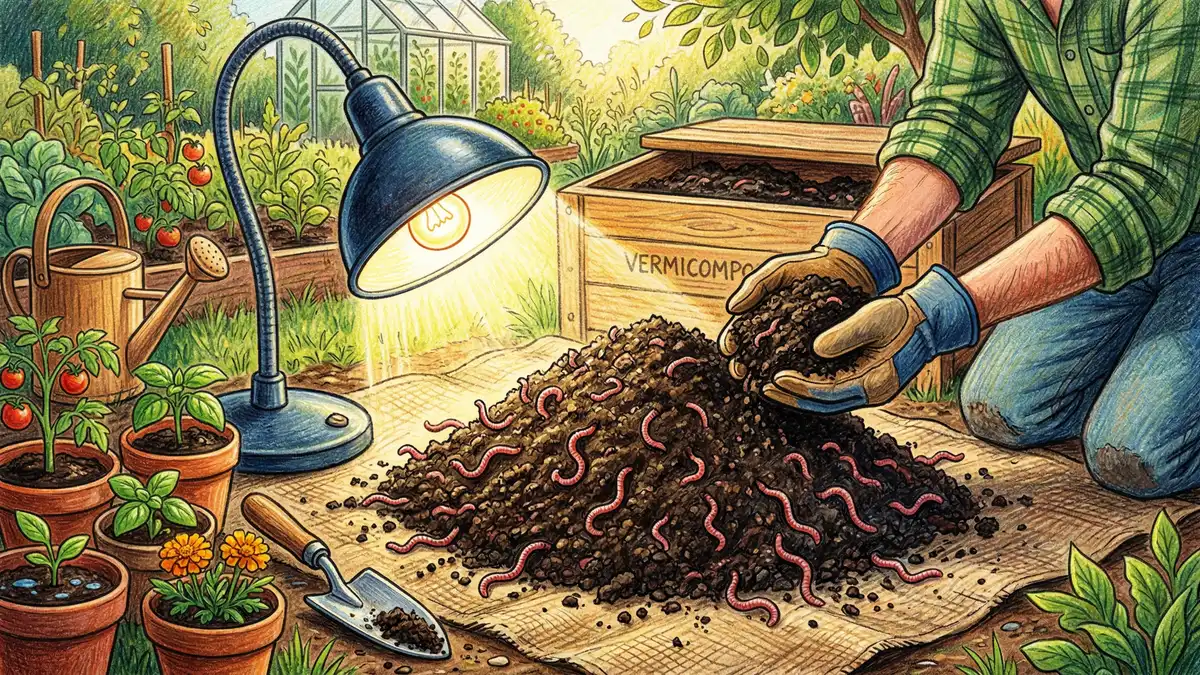
Four methods, and the one you pick is mostly determined by which bin you chose in decision two. Tray systems harvest themselves by migration. A single tote needs either the light separation method or a bit of patience with a dump and sort. Four harvesting methods compared walks through each with the time each one actually takes.
What goes wrong, and when
Almost every failure happens in the first month
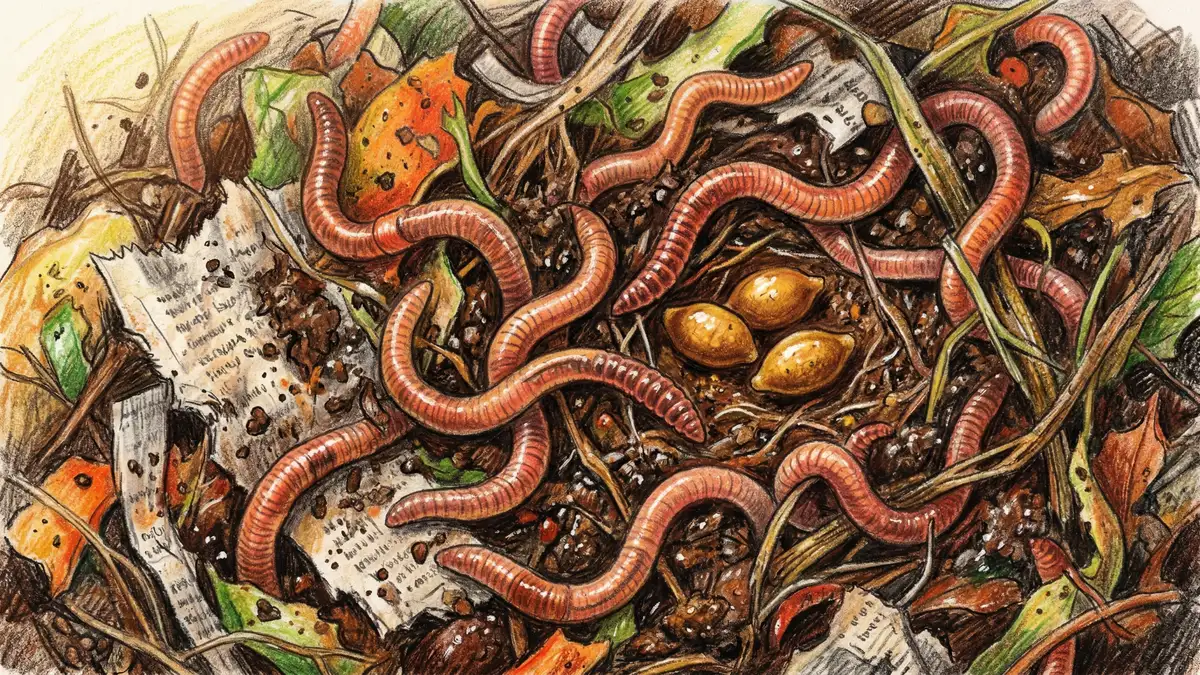
New bins fail from enthusiasm, not neglect. You add worms, they look inactive, so you feed more. The uneaten food rots, the bin goes acidic and wet, the worms head for the lid.
The fix for the first month is counterintuitive: feed less than feels right, bury everything under two inches of bedding, and leave the bin alone for two weeks after you add the worms. Population and appetite build together, and a bin that looks slow in week two is usually just a bin that has not established yet.
After that, the recurring problems are smell, fruit flies, escaping worms and pooled leachate, and all four trace back to moisture and feeding rate. Worm farm troubleshooting works through each symptom to its cause. If you find larvae rather than worms, maggots in compost explains which ones are harmless and which mean something is wrong.
Once the bin is running
A settled bin needs about ten minutes a week, and the interesting questions move outward from the bin itself.
If you want the worms working in the garden rather than in a box, a worm tower is an in ground version that feeds a bed directly, with real limits in cold climates. If you are wondering what the worms already in your soil are doing, worms in the garden beyond composting covers the species you did not put there. And a worm bin is one of the few garden systems a child can genuinely run, which is why worm composting with kids exists as its own guide.
For where vermicomposting sits in the bigger picture of building soil rather than just feeding plants, the soil health guide is the wider frame.
Why this works, the permaculture principle
Permaculture calls this producing no waste, but the mechanism is more specific than the slogan. A compost pile is a heat engine, it burns through material fast and loses nitrogen as ammonia while it does. A worm bin is a digestion system running at room temperature, and what leaves the worm carries the gut microbiology with it. You are not making fertilizer, you are making an inoculant. That is why a handful does the work of a bucket, and why the material stops being interesting once you sterilize it.
Frequently asked questions
What is vermicomposting and how is it different from regular composting?
Vermicomposting uses earthworms, specifically Eisenia fetida, to break down organic matter at room temperature. Traditional composting relies on thermophilic bacteria that heat the pile to 130 to 160°F. The worm route is slower per unit of volume, works indoors year round, handles no woody material, and produces a microbially richer end product. Most gardens benefit from both.
How many worms do I need to start?
One pound, roughly 1,000 red wigglers, per cubic foot of bedding. For a single storage tote, half a pound is enough. The population doubles roughly every three to four months under good conditions, so the starting quantity sets how fast you get going, not the ceiling.
Do worm bins smell?
A working bin smells like damp forest floor. Anything else is a symptom. Rotten food means overfeeding, a swampy or sulphur smell means it is too wet and short of air, ammonia means too much nitrogen against too little bedding. All three reverse within a week or two if you stop feeding and add dry shredded cardboard.
How long until I get usable castings?
Three to six months from setting the bin up. The first six to eight weeks produce almost nothing while the population establishes. A single tote yields 5 to 10 lb per harvest, a four tray system 20 to 30 lb a year at full capacity.
Can I keep a worm bin in a flat with no outdoor space?
Yes, and it is one of the few composting methods that genuinely works in a flat. A properly run bin produces no detectable smell and fits under a sink or in a cupboard. The constraints are temperature stability and discipline about feeding rate, both covered in our indoor worm composting guide.
Get the Weekly Dig
One practical permaculture guide a week, written for gardeners who do this on weekends: composting that actually finishes and soil that feeds itself. Free, no spam, unsubscribe any time.
Join the Weekly DigResources
- Cornell Composting, Worm Composting Basics
- Cornell Waste Management Institute, Vermicompost Research
- NC State Extension, Vermicomposting for Households
- NC State Extension, Earthworms and Worm Bins
- Oregon State Extension, Composting with Worms
- Oregon State Extension, Composting with Worms (EM 9034)
- Ohio State Master Gardener, Vermicomposting (PDF)
- US EPA, Food Material Specific Data
- Mary Appelhof, Worms Eat My Garbage