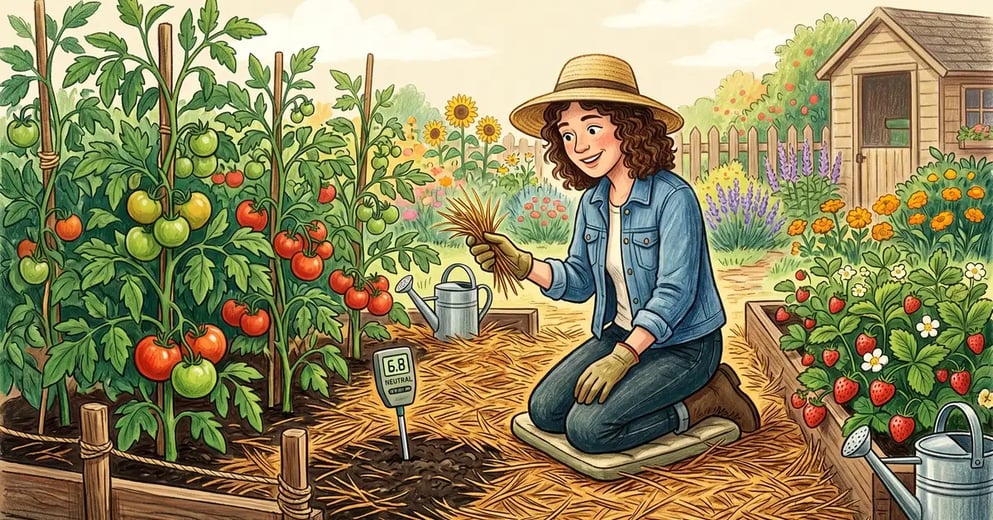

You raked a wheelbarrow of pine needles from under the white pine in your yard and started spreading them in the vegetable bed. Then a neighbor leaned over the fence: "Careful, those will turn your soil acidic. You will have to dig everything up next spring." You stopped, pulled some needles back, and Googled it. Now you have 14 contradictory blog posts and no clear answer. whether pine bark acidifies soil
This guide is the clear answer. The myth that pine needles dramatically acidify garden soil is wrong, and the actual peer-reviewed soil science has been telling us so for over 30 years. We cover what fresh and decomposed pine needles actually do to soil pH, why pine forests have acidic soil (it is not the needles), which plants benefit most from pine straw mulch, how to apply it correctly, what it costs in 2026, and the situations where it genuinely is not the right pick.
The Myth (and Where It Came From)
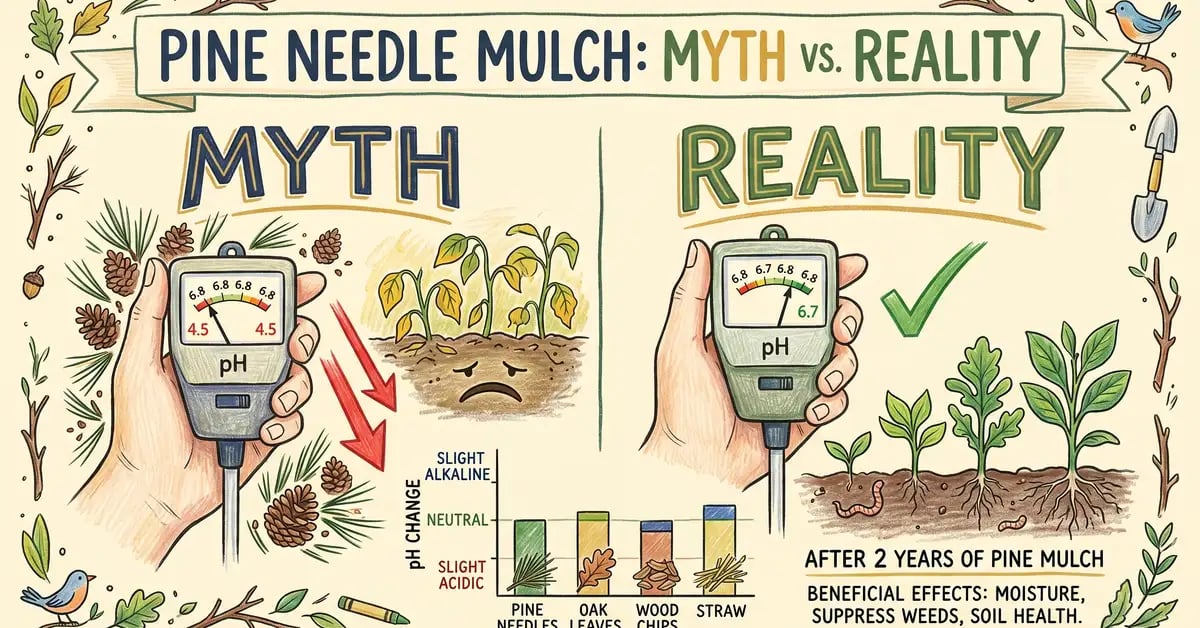
The folk wisdom: pine needles are very acidic, so spreading them on the garden will lower the soil pH, lock up nutrients, and kill anything that is not an azalea. The advice has been repeated in gardening books for decades.
The origin makes sense at first glance. If you take a fistful of fresh, green pine needles and test their pH, they typically register between 3.2 and 3.8. That is acidic, comparable to lemon juice or vinegar. The leap is reasonable: acidic needles plus garden soil equals acidic garden soil.
But that leap skips three things: the buffering capacity of garden soil, what actually happens during decomposition, and the difference between what is sitting on top of the soil and what is mixed in. When those three are accounted for, the math breaks down.
The Reality: What Peer-Reviewed Research Actually Shows
Dr. Linda Chalker-Scott, urban horticulturist at Washington State University, has spent over two decades testing common gardening myths against published research. Her Horticultural Myths series at WSU Puyallup documents that pine needle mulch causes negligible long-term change to soil pH because (1) the acidic compounds in fresh needles are quickly neutralized by soil microbes during decomposition, and (2) typical garden soils have strong buffering capacity that resists pH change.
The University of New Hampshire Extension reports controlled trials in which gardens mulched with pine needles for multiple years showed no significant difference in soil pH compared to gardens mulched with hardwood chips or shredded leaves. The Colorado State University Extension Pine Needle Myths fact sheet states bluntly that pine needles, including fresh ones, do not significantly acidify soil even after years of application.
The Alberta Urban Garden review of pine needle pH research summarized multiple studies: across all of them, pine needle mulch shifted soil pH by less than 0.3 units after 2 to 5 years of continuous application, and several showed no measurable change at all. The Master Gardeners of Northern Virginia myth-busters review reached the same conclusion citing university extension data.
Why Pine Forests Have Acidic Soil (Not What You Think)
If pine needles do not acidify soil, why is the ground under a mature pine forest so acidic? Three reasons, none of them the needles in isolation:
Parent rock geology. Many pine forests grow on soils derived from acidic parent rock (granite, sandstone). The soil was acidic before the pines arrived. Pines tolerate it; many other species do not.
Centuries of deep organic decomposition. A mature pine forest has 50 to 200 years of accumulated needle, cone, and bark litter. The total mass and time produce measurable acidification through humic acids, but this is operating on a timescale and volume that no home garden ever reaches.
Self-reinforcing ecology. Acid-tolerant species (mosses, blueberry relatives, mycorrhizal fungi) thrive under pines and continue to acidify the soil. The system reinforces itself. A garden with a 3-inch pine needle mulch over loamy garden soil does not replicate any of this.
According to the USDA NRCS Soil pH fact sheet, garden soil pH is far more influenced by parent material, irrigation water chemistry, fertilizer use, and rainfall than by surface mulch type.
Where Pine Needle Mulch Genuinely Shines
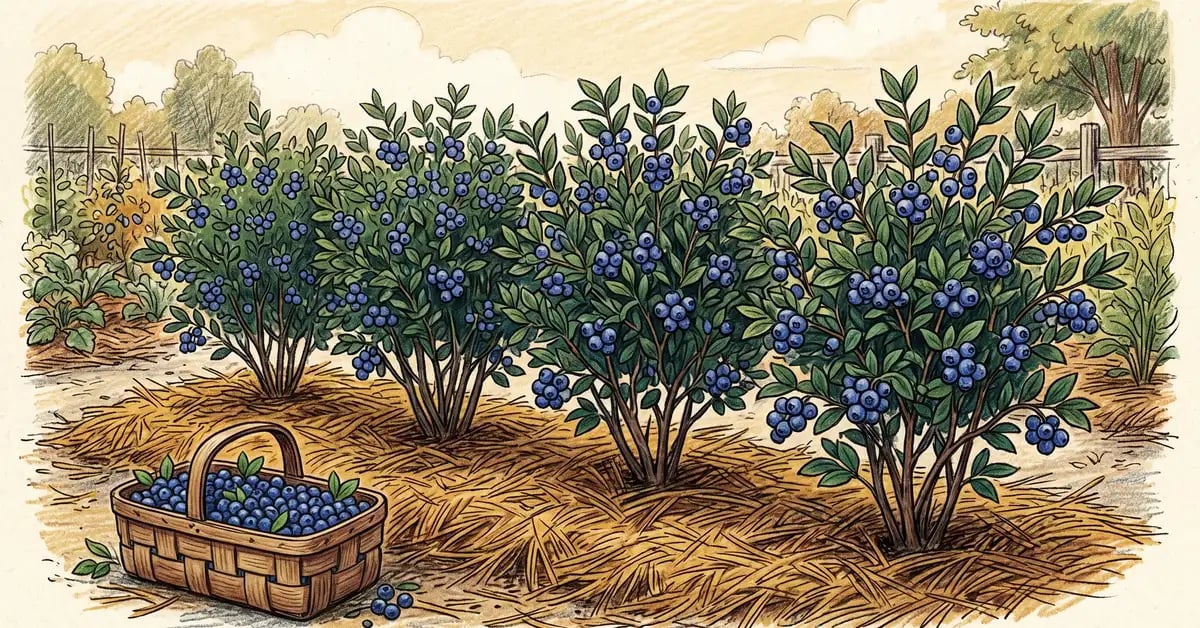
Blueberries, azaleas, rhododendrons, camellias. These genuinely acid-loving plants benefit from pine straw both for moisture retention and the very slight acidifying effect at the surface root zone. University of Minnesota Extension's growing blueberries guide recommends pine needle mulch as a standard practice for home blueberry beds.
Strawberries. Pine straw was used as winter mulch on commercial strawberry farms long before "pine straw" became a brand name. It does not pack down like hay, allows air circulation, and pulls back easily in spring.
Vegetables and perennials. Tomatoes, peppers, beans, squash, garlic, perennial flowers all do fine under pine straw. Penn State Extension's mulch options survey lists pine straw among the recommended mulches for general garden use.
Slopes and erosion-prone beds. Pine needles interlock and resist washing in heavy rain better than most mulches. University of Georgia Extension's mulching guide highlights pine straw for sloped landscape areas.
Pathways and bare-soil winter cover. Pine needles decompose slowly, lasting 12 to 18 months on the surface compared to 4 to 6 months for shredded leaves.
How Pine Straw Compares to Other Mulches
| Mulch type | Lifespan | pH effect | Best use |
| Pine needles (fresh) | 12 to 18 months | Negligible | Blueberries, perennials, slopes |
| Pine needles (aged) | 9 to 12 months | None measurable | Vegetables, paths |
| Hardwood chips | 2 to 4 years | Slightly raises (alkaline ash) | Tree wells, perennial borders |
| Shredded leaves | 3 to 6 months | Negligible | Annual veg beds |
| Straw (wheat, oat) | 6 to 9 months | Negligible | Vegetable beds, strawberries |
| Cocoa hulls | 1 to 2 years | Slight raise | Ornamental beds (toxic to dogs) |
Source: Penn State Extension mulch survey and Iowa State Extension mulch comparison
What It Costs and Where to Buy
Pine straw is one of the cheapest commercial mulches by volume. Typical 2026 US retail pricing:
| Source | Price per bale | Coverage |
| Lowe's / Home Depot bagged | $5 to $8 | 40 to 60 sqft per bale |
| Local landscape supply (bulk) | $4 to $6 | 40 to 60 sqft per bale |
| Pine straw producer direct | $3 to $5 | 40 to 60 sqft per bale |
| Backyard pine tree (free) | $0 | Whatever drops |
Source:, and Clemson News Pine Straw 101
For a 100 sqft vegetable bed, plan on 2 bales for a 3-inch initial mulch (about $10 to $16 retail).
Why This Works
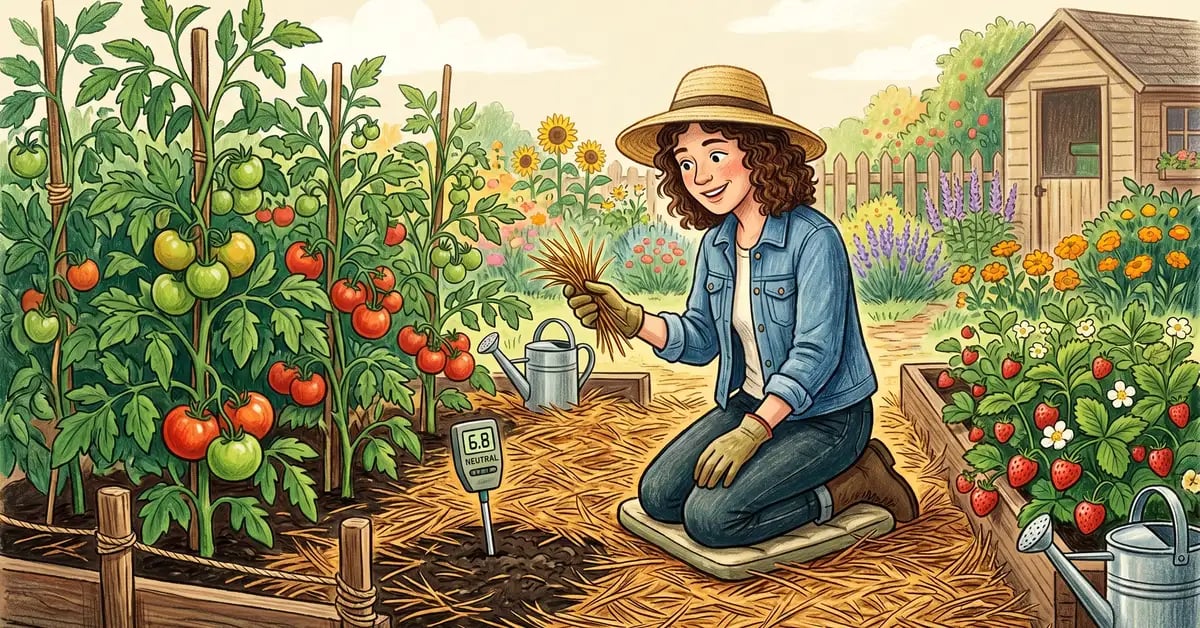
The pine needle acidity myth is a textbook example of where intuition fails soil science. Pine needles are acidic in isolation. Soil pH is acidic under pine forests. The intuitive leap is that one causes the other. The peer-reviewed data shows the relationship is far more complicated: parent rock, centuries of accumulation, irrigation chemistry, and self-reinforcing ecology all matter more than the topical mulch layer. This matters for permaculture because permaculture's "Observe and Interact" principle pushes us to test our assumptions against actual data rather than passing folk wisdom forward. A 3-inch layer of free pine needles around your tomatoes is not going to ruin your bed. It is going to suppress weeds, hold moisture, feed earthworms, and break down into stable organic matter, just like any other quality mulch.
How to Apply Pine Needle Mulch Correctly
Step 1: Weed and water the bed first
Pine needles do not kill mature weeds. Pull weeds, then water deeply so the soil under the mulch goes in moist.
Step 2: Apply 2 to 4 inches of pine needles
Less than 2 inches and weeds break through. More than 4 inches restricts air and water movement. The sweet spot is 3 inches loose.
Step 3: Keep needles 3 inches away from plant stems
Like all mulches, pine needles piled against tomato stems or tree trunks can promote rot and pest entry. Leave a small clear ring at the base.
Step 4: Refresh once a year
Top up with 1 to 2 inches of fresh pine straw each spring. Decomposed needles below feed the soil.
Step 5: Pull back in spring for warm-season crops
Pine straw insulates the soil and keeps it cool. For early-spring planting of warm-loving crops (tomatoes, peppers, melons), pull back the mulch a week before transplanting to let the soil warm.
When Pine Needle Mulch Is NOT a Good Pick
- Fire-prone areas within 5 feet of structures. Pine straw is highly combustible. UC ANR Fire Network and city of Raleigh fire department guidance recommend non-combustible mulch (gravel, stone) in the immediate defensible space zone. Use pine needles only beyond that 5-foot perimeter.
- Very alkaline desert soils trying to grow acid-loving plants. The slight acidifying nudge from pine straw is real but small. If you need to drop pH from 8.0 to 5.5 for blueberries, you need elemental sulfur, not just pine mulch.
- Compacted clay beds with poor drainage. Pine straw decomposes slowly, which means it does not add organic matter to the soil profile as fast as shredded leaves or compost. If your soil needs structural help, mix mulches.
- Near vegetable beds where allelopathic concerns exist (rare). Some research has shown minor allelopathic effects from very fresh pine needles on seedlings of certain crops. Letting needles age 2 to 4 weeks before applying solves this entirely.
Get the Weekly Dig
One practical permaculture guide a week, written for gardeners who do this on weekends: building living soil without buying it in bags. Free, no spam, unsubscribe any time.
Join the Weekly DigFrequently Asked Questions
Does pine needle mulch acidify garden soil?
Not significantly. Peer-reviewed research at Washington State University, the University of New Hampshire, Colorado State, and other US extensions shows that pine needle mulch shifts soil pH by less than 0.3 units after 2 to 5 years of continuous application, and many trials show no measurable change at all. The myth is wrong.
Why is the soil under pine trees so acidic if pine needles do not acidify soil?
Three factors: the parent rock under most pine forests is acidic to begin with, mature forests accumulate 50 to 200 years of organic matter that does eventually shift pH, and acid-tolerant species under pines reinforce the acidification through self-perpetuating ecology. A 3-inch pine straw mulch over typical garden soil does not replicate any of this.
Is pine straw a good mulch for a vegetable garden?
Yes. Pine straw is recommended by Penn State, Iowa State, and University of Georgia Extension for vegetable beds. It suppresses weeds, holds moisture, allows air circulation, and decomposes slowly. The only adjustment is to pull it back briefly in spring for warm-loving crops like tomatoes and peppers so the soil warms.
What plants do not like pine needle mulch?
Very few. Acid-loving plants (blueberries, azaleas, rhododendrons) love it. Almost everything else is fine with it. Avoid burying small seedlings under it for the first 2 to 3 weeks of growth, and let very fresh needles age 2 to 4 weeks before applying around seedlings to be safe.
Does pine straw attract termites?
Research and university extension data do not support a meaningful link. Termites prefer wet, decaying wood and cellulose-rich materials in direct contact with structures. Pine straw decomposes too slowly to be an attractive termite food, and any mulch within 6 inches of a foundation creates some risk. Keep pine mulch (or any mulch) at least 6 inches away from house siding regardless.
How much is a bale of pine straw?
Retail bagged pine needle mulch at Lowe's and Home Depot runs $5 to $8 per bale (covering 40 to 60 sqft). Bulk from a local landscape supplier runs $4 to $6 per bale. Direct from a pine straw producer runs $3 to $5. Free from your own pine trees runs $0.
How long does pine needle mulch last?
Fresh pine straw lasts 12 to 18 months on the surface before significant decomposition. Aged needles last 9 to 12 months. Top up annually in spring with 1 to 2 inches of fresh needles to maintain a 3-inch effective depth.
Can I use pine needles in my compost?
Yes, but they decompose slowly because of their waxy coating. Chop or shred first if possible, and balance with greens (grass clippings, kitchen scraps) at a 30:1 brown:green ratio. Expect 12 to 18 months for finished compost from a pile heavy in pine needles.
The Takeaway
Pine needle mulch does not significantly acidify garden soil. Peer-reviewed research and US university extension data show pH shifts of less than 0.3 units after years of continuous application, and many trials show no measurable change at all. Pine forests have acidic soil because of parent rock geology, centuries of accumulated humus, and self-reinforcing ecology, not because of fresh needles on the surface. Pine straw is a cheap, effective, slow-decomposing mulch ideal for blueberries, strawberries, perennials, vegetables, and slopes. Apply 3 inches deep, keep 3 inches clear around plant stems, and refresh once a year in spring. Do not use it in the 5-foot defensible space zone in fire-prone areas. Otherwise, ignore the neighbor and enjoy the free mulch.
Resources
- WSU Puyallup: Linda Chalker-Scott Horticultural Myths series
- University of New Hampshire Extension: Do Pine Trees and Pine Needles Make Soil More Acidic? (2019)
- Colorado State University Extension: Pine Needle Myths (2019)
- Master Gardeners of Northern Virginia: Pine Needle Mulch Myth Busters
- Penn State Extension: Mulch, a Survey of Available Options
- University of Georgia Extension: Mulching in the Landscape
- University of Minnesota Extension: Growing Blueberries in the Home Garden
- Iowa State Extension: Mulch Comparison
- Clemson News: Pine Straw 101
- USDA NRCS: Soil pH fact sheet
- UC ANR Fire Network: Mulch and Fire Safety
- City of Raleigh Fire Department: Pine Straw Use Rules