Yes, You Can Compost in an Apartment — Here Are the Four Methods That Actually Work
Composting in 400 sq ft (~37 m²) without a yard isn't a compromise — it's just a different system. The four methods that work in a real apartment are vermicomposting (worm bin), bokashi fermentation, electric countertop composters, and curbside or community drop-off. Each has a different footprint, smell profile, time-to-finished, and cost. Pick the one that matches your space, your tolerance for living with worms, and how often you want to deal with food scraps. urban food forest design
The EPA's home composting guidance and Cornell Composting's "Composting Indoors" reference agree on the basics — apartment-scale food-waste diversion is well-established and proven safe when done correctly. The question isn't "does it work" but "which method fits your kitchen?"
Key Takeaway
Most apartments end up using two methods together: a fast one for everyday scraps (curbside or bokashi) and a slow one that produces actual compost (worm bin). You don't have to pick a single method — you have to pick the right combination for your space, schedule, and what's available in your city.
Method 1: Worm Bin (Vermicomposting)
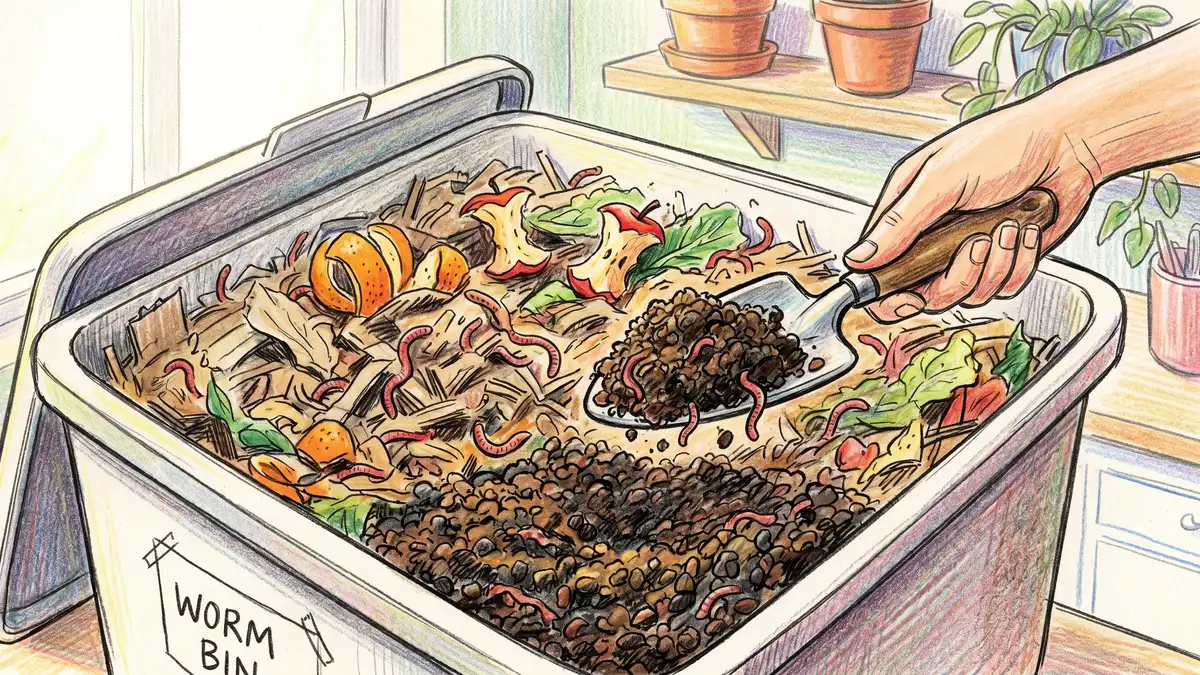
This is the apartment-composting classic — a stacking-tray bin (or DIY plastic tote) with a colony of red wigglers (Eisenia fetida) that processes 5–10 lb (2.3–4.5 kg) of food scraps per week. Per Oregon State Extension, red wigglers are the only reliable composting worm — earthworms from your yard will not work indoors.
The basic specs: 1 sq ft (0.09 m²) of bin surface area per pound of food waste per week. A 2 sq ft bin handles a typical single-person apartment; a 4 sq ft bin handles a couple or small family. small-space compost bin options Bin lives under a sink, in a closet, or on a balcony in mild climates. Worms thrive at 55–80°F (13–27°C), so most apartment temperatures work fine.
What goes in: fruit and vegetable scraps, coffee grounds, tea bags (without staples), crushed eggshells, shredded plain cardboard or newspaper as bedding. What stays out: meat, dairy, oily food, citrus in volume (acidic), garlic and onion in volume (kills worms), salty leftovers. Urban Worm Company's red wiggler guide has a thorough do/don't list.
Smell? A well-balanced bin smells like soil. If it stinks, you've overfed it or gone anaerobic — pull back on greens for two weeks, add more cardboard, and stop adding citrus. Cost: $30–80 for a DIY bin, $80–150 for a commercial stacking tray, plus $25–40 for a starter pound of worms.
Method 2: Bokashi Fermentation
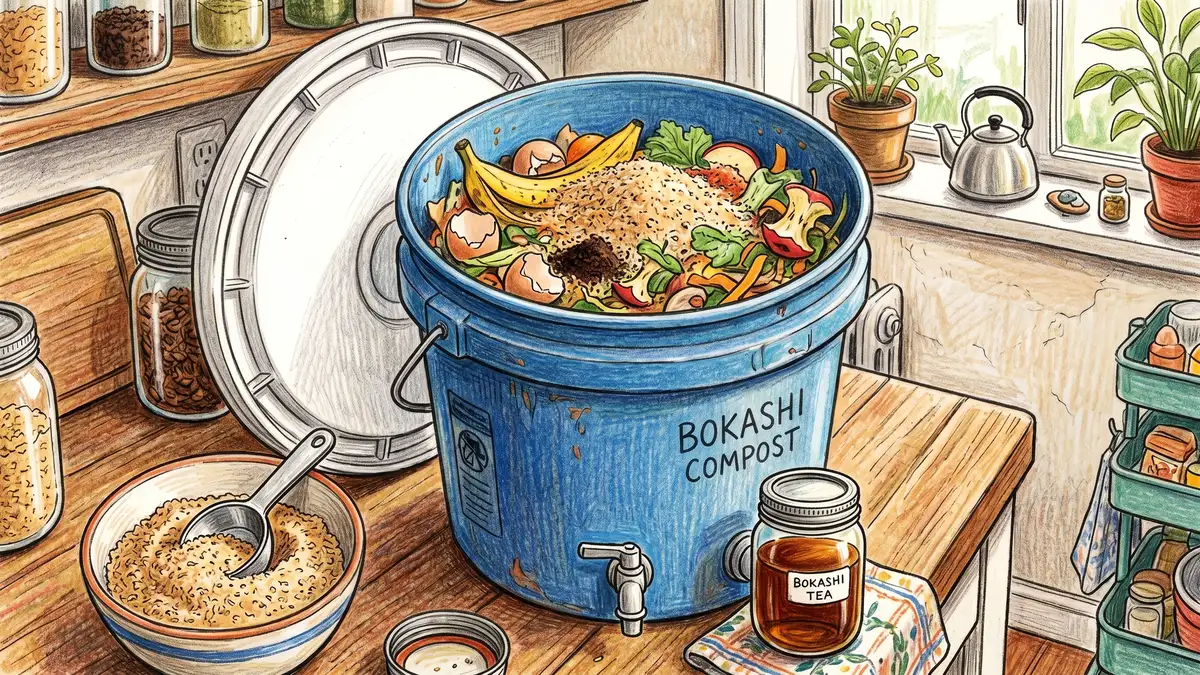
Bokashi is the wildcard apartment method — it's anaerobic fermentation rather than aerobic decomposition. You layer food scraps in a sealed 5-gallon (19 L) bucket, sprinkle a tablespoon of inoculated bran on top, press down, seal, and repeat until the bucket is full. Then you let it ferment for 2 weeks. The output is "pickled" food waste that smells faintly of vinegar — not finished compost, but a stable pre-processed form that breaks down quickly when buried in soil or a bokashi soil factory.
The big advantage: bokashi accepts everything. Meat, dairy, cooked food, oily leftovers, citrus, onion — all of it. None of the worm-bin restrictions apply. The trade-off: the output isn't finished compost; you still need a soil step at the end. For apartment dwellers without any soil access, this means giving the fermented scraps to a friend with a yard, contributing them to a community garden, or running a bokashi soil factory in a separate large container.
Drain the "bokashi tea" from the spigot every 2–3 days. Diluted 1:100 with water, it makes a quick liquid plant feed. Don't skip the draining — accumulated tea goes anaerobic and stinks.
Cost: $60–100 for a starter kit (bucket + initial bran), $20 for refill bran every 2–3 months. Footprint: roughly the size of a small kitchen trash can.
Method 3: Electric Countertop Composters
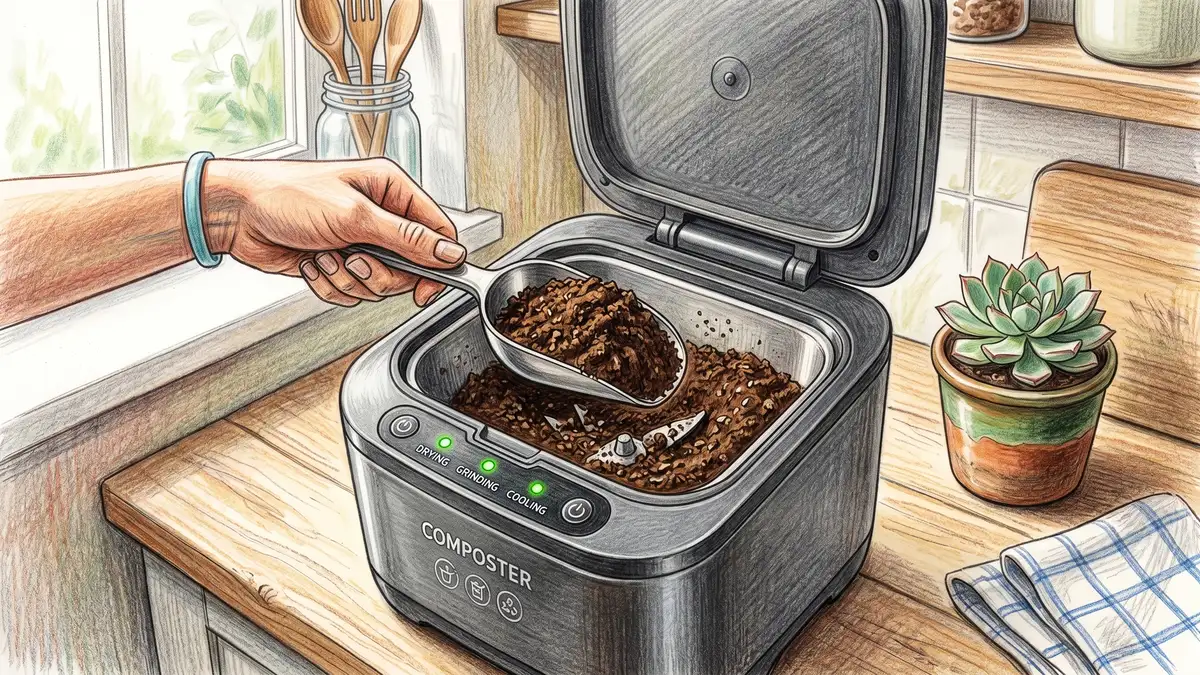
Lomi, Mill, Vitamix FoodCycler, and similar units have become popular in the last few years. They grind, heat, and dehydrate food waste into a coffee-ground-textured material in 4–8 hours. The output is convenient, low-volume, and odourless once cycled.
The honest assessment: what comes out of these machines is not finished compost. It's dehydrated, ground food waste — a soil amendment that needs additional curing (mixed with soil for 2–4 weeks) before it's biologically active. Cornell Composting classifies the biological transformation that defines compost as a microbial process; mechanical dehydration just shrinks the input. The marketing language often blurs this line.
That said, electric composters do have legitimate use cases: when you have no yard, no curbside service, no community garden access, no patience for worms, and want something effortless. Energy use runs 0.6–1.5 kWh per cycle. Cost: $300–700 up front, plus charcoal filter refills every 3 months.
If you have curbside service, skip the appliance — the energy cost and the questionable end-product don't justify the convenience over a kitchen-counter scraps caddy that goes to the curb.
Method 4: Curbside and Community Drop-Off
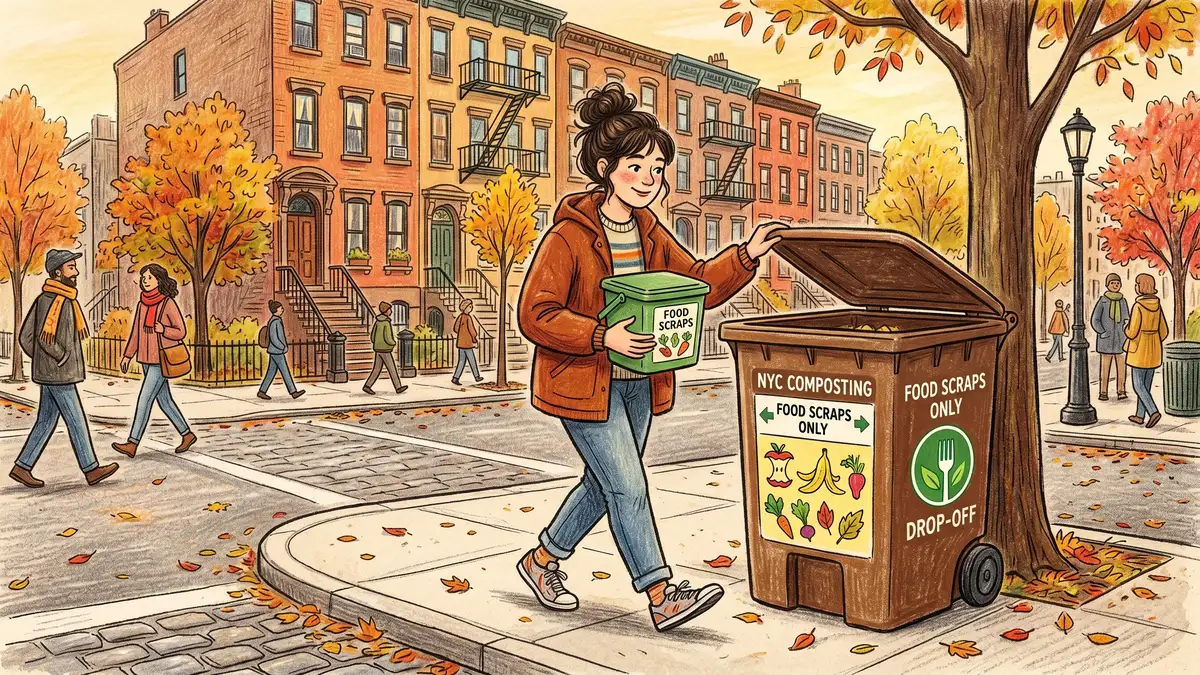
The newest and easiest option for many city dwellers — let the municipality handle the actual composting. NYC's DSNY curbside composting rolled out citywide in 2024 and is now mandatory for all residents; food scraps go in a brown bin and get picked up weekly on recycling day. NYC 311's curbside composting page covers the program details. San Francisco has had mandatory curbside composting since 2009; Seattle, Portland, Denver, and Minneapolis offer it as standard service.
Even cities without municipal pickup often have community drop-off points — local farmers' markets, community gardens, or apps like ShareWaste that connect compost producers with backyard composters or farms willing to accept scraps. Check your municipal recycling/sustainability website or search "compost drop off [your city]" to find the nearest option.
Setup at home is just a kitchen counter caddy with a charcoal-filter lid (about $25) that you empty into the curbside bin or carry to the drop-off twice a week. Zero biological skills required, zero worms, zero appliance, no smell at home if you empty it before scraps go bad.
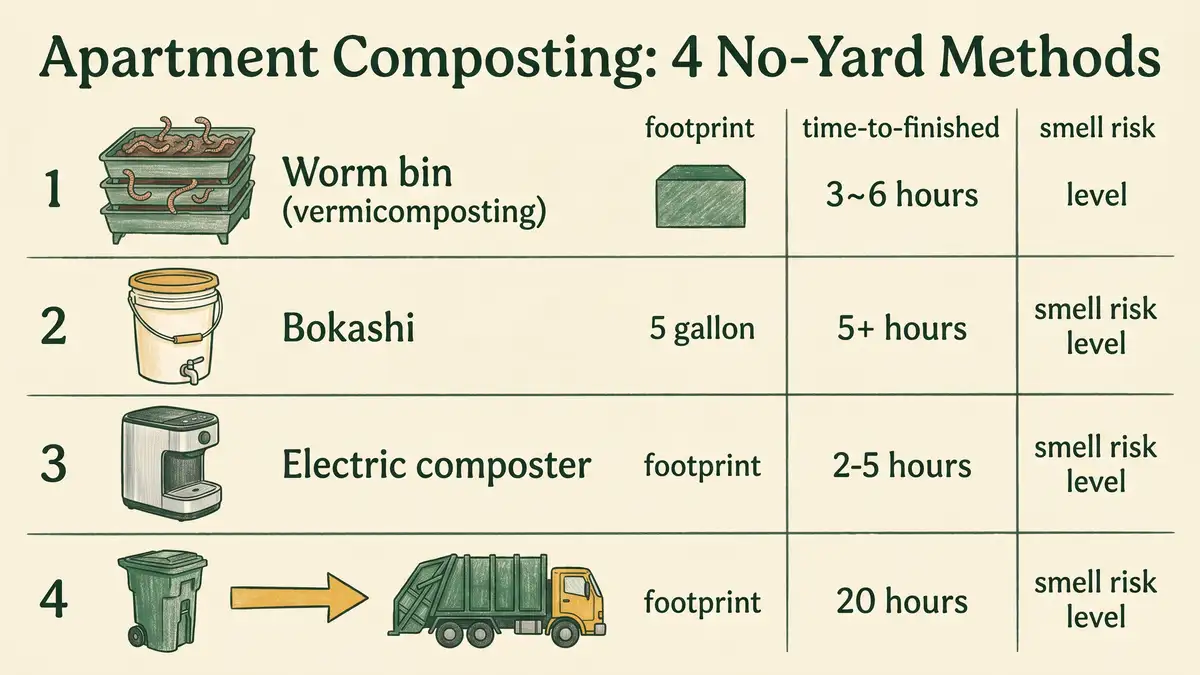
Quick Comparison: Which Method Fits Your Apartment?
| Method | Footprint | Time to finished | Accepts meat/dairy | Cost |
| Worm bin | 1–4 sq ft floor | 2–4 months | No | $80–150 + $25–40 worms |
| Bokashi | ~1 sq ft floor | 2 wk ferment + soil step | Yes | $60–100 + $20 bran refills |
| Electric composter | ~1 sq ft counter | 4–8 hours (not real compost) | Most accept it | $300–700 + filter refills |
| Curbside / drop-off | Small kitchen caddy only | Off-site | Varies by program | $25 caddy |
Sources:.
Why This Works: Closing the Loop in 400 sq ft
The reason apartment composting matters isn't just the finished product — it's the loop you close. Roughly 30–40% of household trash by weight is food waste, and in landfills it produces methane (a potent greenhouse gas). Diverting it through any of these four methods cuts your household landfill weight in half. The EPA's Preventing Wasted Food at Home guidance covers the broader food-waste reduction picture, with composting as the last step after reducing and donating.
How to Pick the Right Method for Your Apartment
Check curbside first
If you're in NYC, San Francisco, Seattle, Portland, Denver, Minneapolis, or any major US city, check your municipal sanitation website. If curbside is available, this is almost always the simplest option — minimal in-home footprint, zero biological management, no smell.
Search for community drop-off
If no curbside, search "compost drop off [your city]" or check ShareWaste / MakeSoil. Many farmers' markets and community gardens accept household food scraps. This adds a 10-minute weekly errand but no in-home equipment.
If you want plant food, run a worm bin
Worm bins are the only apartment method that produces actual finished compost (worm castings) you can use on houseplants and balcony pots. A 2 sq ft bin under a sink processes one person's vegetable scraps and produces a few pounds of castings every 2–4 months. Live worms aren't for everyone — that's a real personal preference, not a flaw.
If you eat a lot of meat or dairy, add bokashi
Worm bins reject these inputs. Curbside often accepts them but check your local rules. Bokashi accepts everything and is the only home method that handles cooked leftovers cleanly — pair it with curbside or a friend with a yard for the soil step.
Use an electric composter only as a last resort
If you genuinely have no curbside, no drop-off, no soil access, no patience for biology — and you mostly want food waste to disappear from your kitchen — an electric composter does that. Otherwise the energy use, the cost, and the not-quite-compost output don't justify it over the simpler options.
Common Mistake to Avoid: Buying a Worm Bin Without Doing the Math First
The single most common apartment-composting failure is buying a worm bin without checking how much food waste you actually produce. A typical single-person household generates 4–7 lb (1.8–3.2 kg) of compostable scraps per week — that's the upper limit of what 1 lb of worms in a 2 sq ft bin can process. Two adults and a couple of kids? You need a 4 sq ft bin or two smaller ones, or you'll overfeed and the bin will go anaerobic. Per Cornell Waste Management Institute's small-scale composting guidance (PDF), the matching of feedstock volume to bin capacity is the most reliable predictor of whether your apartment system will succeed or stink.
Need the gear for this?
Bins and tumblers picked by yard size, with the honest trade-offs for each.
See the compost bin picksApartment composting connects to almost every other piece of soil-building work, even if you have no yard. The output of any of these methods feeds the same broader picture covered in the soil and composting hub — including container gardens, balcony beds, and the houseplants you might be feeding the worm castings to. The full primer is in composting for beginners; a deep dive on the worm-bin specifics is in worm composting for beginners; and bokashi gets its own dedicated walkthrough in bokashi composting. Worm castings — the finished output of method 1 — are covered in detail in our worm castings guide. The hot-vs-cold framing extends naturally from this article — see hot vs cold composting for what happens when you do have yard space. And the macronutrient question — what NPK does any of this output deliver — is in NPK explained.
Frequently Asked Questions
How do I compost in a small apartment without smell?
The smell question depends on the method. A well-run worm bin smells like soil — neutral, earthy, not unpleasant. Bokashi smells faintly of pickles or vinegar but is sealed during fermentation, so the smell stays inside the bucket. Electric composters smell briefly of cooked food during the 4–8 hour cycle, then nothing. Curbside has zero smell at home if you empty your kitchen caddy every 2–3 days. The smell failure modes are: overfed worm bin (anaerobic), undrained bokashi tea (anaerobic), or a kitchen caddy left more than a week (any method). Stick to the basics and apartment composting is genuinely odourless.
Does bokashi composting smell?
The sealed bucket smells faintly sweet-acidic (like pickles or sourdough starter) when you open it to add scraps. The drained bokashi tea smells more strongly of fermentation but is contained in a small jar. Once the fermented scraps are buried in soil or added to a soil factory, the smell disappears within a week. Bokashi is the most "different" smell of the four methods, but it's not unpleasant — most people get used to it within the first bucket.
Can I compost in NYC apartment?
Yes, easily. NYC's curbside composting program is now mandatory for all residents in all five boroughs as of October 2024 — you separate food scraps and food-soiled paper into a brown bin (or any 55-gallon-or-less labelled bin) for weekly DSNY pickup on recycling day. If you want to also produce your own compost for houseplants or a fire-escape garden, layer a small worm bin or bokashi bucket on top.
How long does bokashi composting take?
The fermentation phase is 2 weeks once the bucket is full and sealed. Filling the bucket typically takes 2–4 weeks for a single household. So total in-bucket time is 4–6 weeks, after which the fermented scraps go into soil for another 2–4 weeks of breakdown. End-to-end from kitchen scrap to garden-usable matter is roughly 6–10 weeks — slower than electric, faster than a worm bin's 2–4 months.
Can I compost on a balcony?
Balconies expand your options significantly. A worm bin tolerates a covered, shaded balcony in zones 7–10 year-round; in colder zones it needs to come inside November–March. Bokashi is unaffected by balcony temperatures. A small tumbler composter (15–30 gallons) becomes possible on a balcony, which neither apartment-only setup supports. The constraint is HOA rules and weight — check your lease and your balcony's rated load before installing anything heavy.
Get the Weekly Dig
One practical permaculture guide a week, written for gardeners who do this on weekends: composting that actually finishes and soil that feeds itself. Free, no spam, unsubscribe any time.
Join the Weekly DigResources
- US EPA — Composting at Home
- US EPA — Preventing Wasted Food at Home
- Cornell Composting — Composting Indoors
- Cornell Waste Management Institute — Health and Safety Guidance for Small Scale Composting (PDF)
- Oregon State Extension — Composting With Worms
- Urban Worm Company — Red Wigglers Guide
- NYC DSNY — Curbside Composting Program
- NYC 311 — Curbside Composting Information
- Bonhotal (Cornell CWMI) — Home Composting (PDF)
- Cornell Waste Management Institute — Compost Equipment Factsheet (PDF)