
Why Is My Compost Not Working? Every Fix, Explained
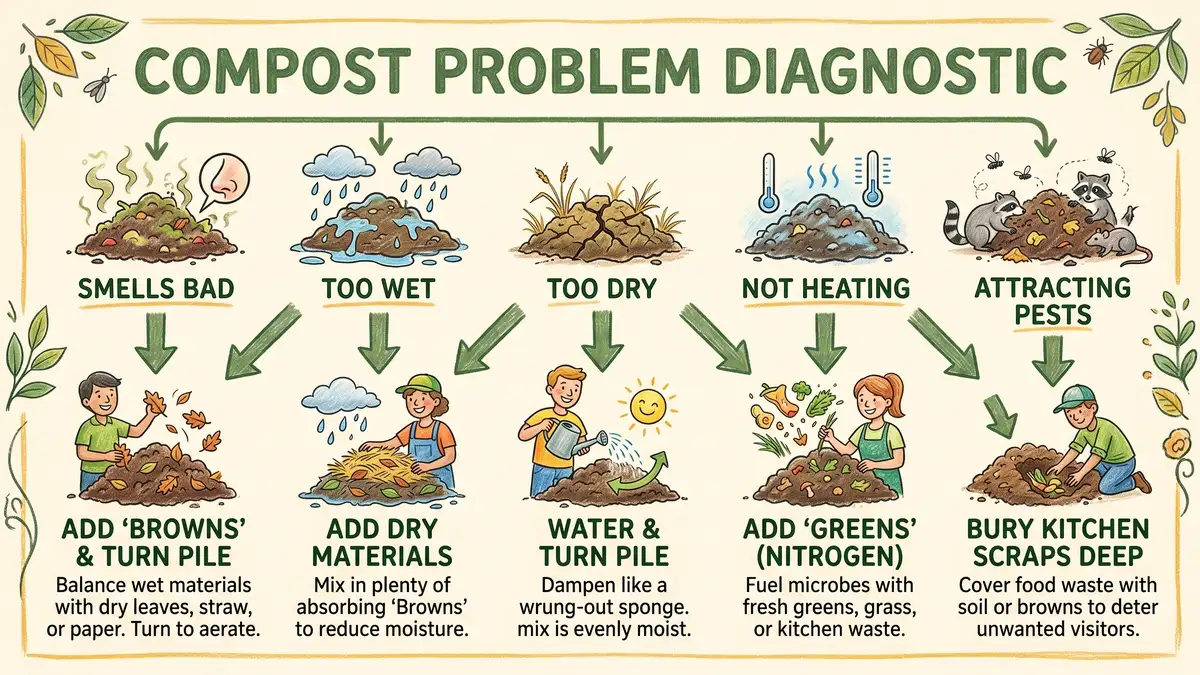
Your compost pile is telling you something. A pungent ammonia smell, a cold damp heap that hasn't shrunk in weeks, a cloud of fruit flies every time you lift the lid — each symptom points to one of four underlying imbalances: carbon-to-nitrogen ratio, moisture, oxygen, or pile size. Fix the balance and the pile fixes itself. compost that smells bad
Home composting fails for predictable, science-backed reasons. Once you know which lever to pull, almost every problem is solvable in a single afternoon. This guide walks through the seven problems real gardeners hit most — the smells, the slump, the pests, the mystery white fuzz — and gives you the specific fix for each, grounded in research from Cornell, EPA, and university extension services.
What you'll learn: how to diagnose the four common smells, fix a wet or dry pile in under an hour, restart a cold pile, keep fruit flies and rodents out for good, and recognise when your compost is actually done.
Key Takeaway
Nearly every compost problem traces back to one of four imbalances: too wet, too dry, wrong C:N ratio, or too small a pile. The symptom tells you which lever to adjust. A healthy pile smells like forest floor — if yours doesn't, something in this list will get it back on track.
Why Does My Compost Smell Bad?
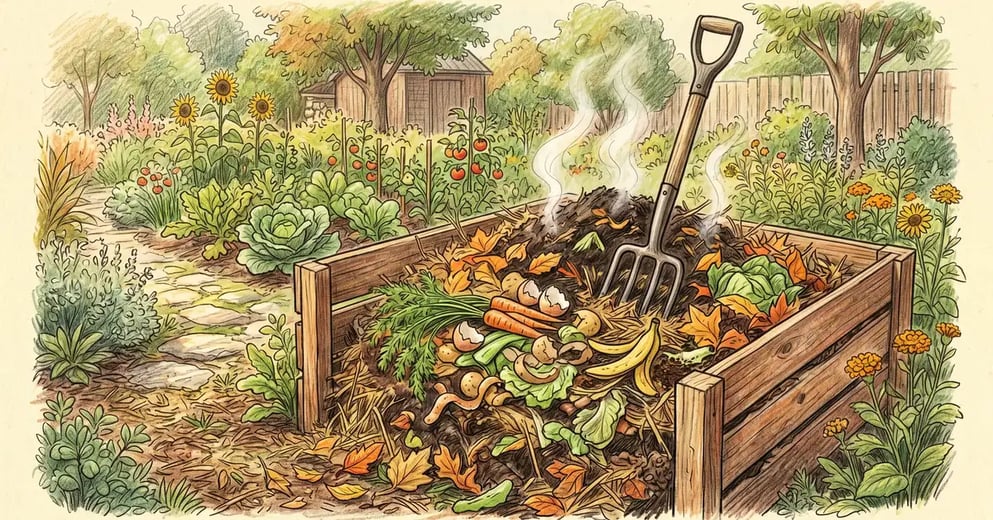
A healthy compost pile smells earthy — like a rich forest floor after rain. Any other smell is a diagnostic signal telling you exactly what's wrong.
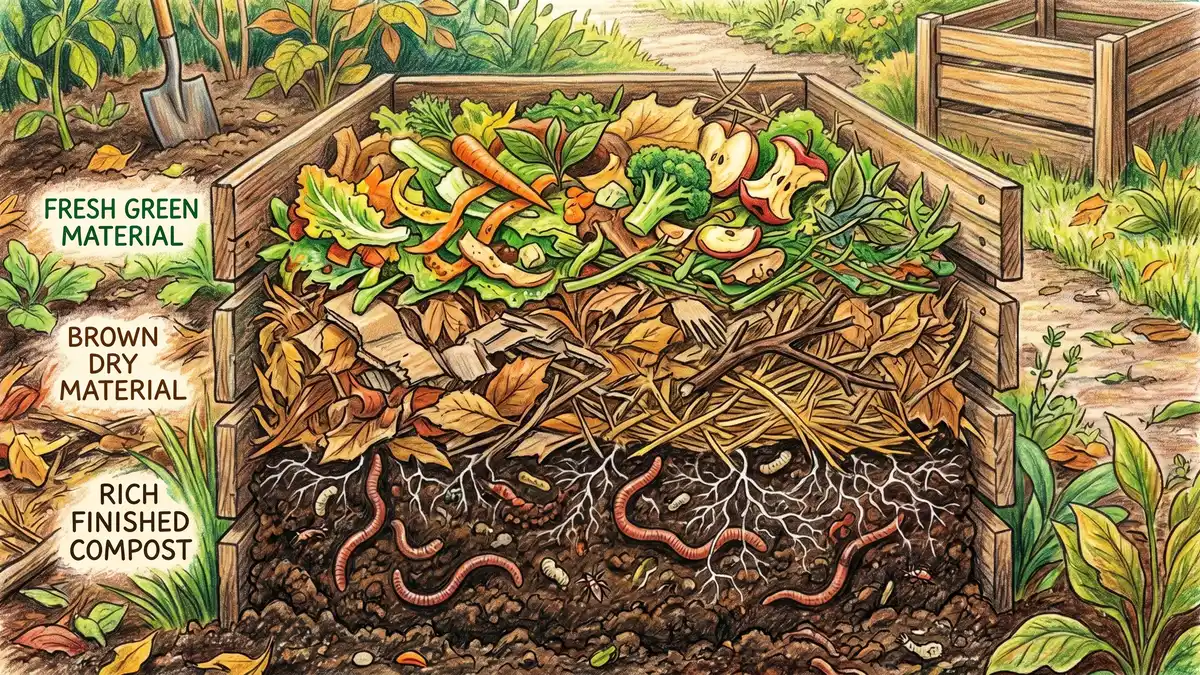
Ammonia smell (like urine or cat litter) means too much nitrogen and not enough carbon. Research from Cornell's Waste Management Institute shows that when the C:N ratio drops below about 15:1, nitrogen volatilises as ammonia gas instead of being held in the pile. The fix: layer in 3 parts brown material (dry leaves, shredded cardboard, straw) for every 1 part green (food scraps, grass clippings) and rebalance the browns and greens with a good turn.
Rotten egg or sulphur smell means your pile has gone anaerobic — oxygen-starved bacteria are producing hydrogen sulphide. This usually follows heavy rain or too many wet greens dumped in at once. Cornell Cooperative Extension recommends an immediate turn with a pitchfork and a generous handful of dry, porous browns between every layer to restore air pockets.
Sour, putrid, or "like poop" points to compacted, saturated material that's fermenting rather than composting. Same fix as above — turn, add browns, improve drainage. If the smell is specifically garbage-like, check whether meat, dairy, or cooked food scraps have snuck in. They don't belong in a home pile.
Common Mistake to Avoid
Don't try to fix a smelly pile by adding more greens or "compost activator" — you'll make it worse. The pile is screaming for carbon and air. Always diagnose the smell first, then add the right correction.
Is My Compost Too Wet or Too Dry?
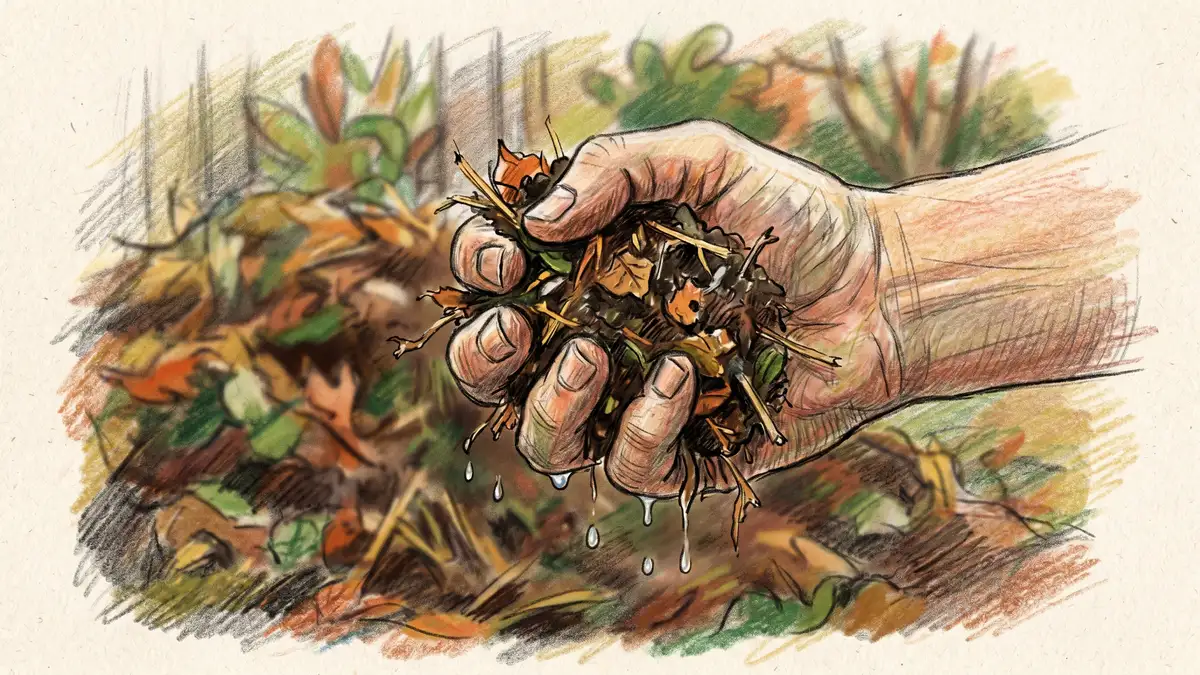
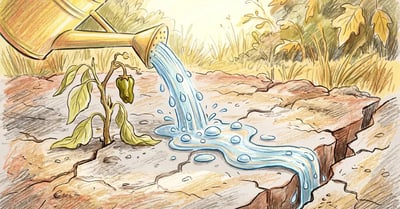
Moisture is the second most common failure point. Microorganisms need water to dissolve nutrients and move around, but too much water pushes the oxygen out and turns your pile into a slimy, anaerobic mess.
The benchmark every extension service uses is the "wrung-out sponge" test. Grab a handful from the middle of the pile and squeeze. A few drops of water should just barely appear — if water streams out, it's too wet; if nothing comes out at all, it's too dry. Let's Go Compost and UVM Extension both cite 50–60% moisture as the target range.
Too wet? Spread the pile out on a tarp for a few hours to air-dry, then rebuild it with generous layers of shredded cardboard, straw, or dry autumn leaves between every foot of wet material. Cover the pile with a plywood sheet (not plastic tarp — that traps moisture) during prolonged rain, per guidance from Gurney's.
Too dry? Water the pile as you turn it, aiming for uniform dampness throughout. Dry piles are almost always carbon-heavy — bury in fresh grass clippings, vegetable scraps, or a shovel of nitrogen-rich manure to rebalance. Decomposition speed depends entirely on hitting both the moisture and C:N targets.
Why Won't My Compost Pile Heat Up?
A cold pile isn't decomposing — or at least not fast. Hot composting happens in the thermophilic phase, when temperatures hit 131–149°F (55–65°C) and specialised heat-loving microbes dominate. According to UMass Extension, this range is what kills weed seeds and pathogens. If your pile is stuck at ambient temperature, diagnose in this order:
Check the size
Piles under 27 cubic feet (a 3×3×3 ft cube) lose heat through the surface faster than they can generate it. Build the pile up to at least this volume before expecting heat.
Check moisture
Do the wrung-out sponge test. Dry piles are the #1 cause of stalled decomposition in summer.
Check the C:N ratio
Too many browns (dry leaves, sawdust, cardboard) and not enough greens? Add fresh grass clippings, food scraps, or a cup of blood meal to inject nitrogen.
Turn it
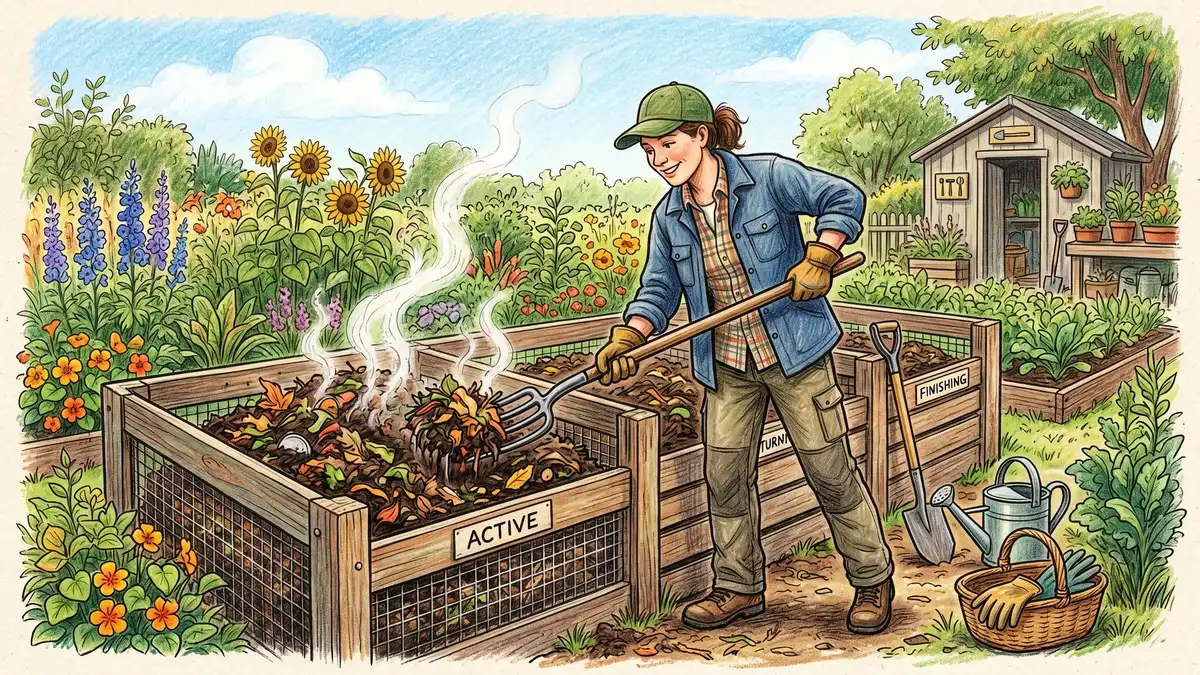
Oxygen feeds the heat-loving microbes. One good turn with a pitchfork after the fix above usually kicks the pile back into the thermophilic phase within 48 hours.
If none of those apply and the pile has already been hot for several weeks, it may simply be finished and entering the curing phase — that's normal, not a failure.
Why This Works: The Soil Food Web
Your pile isn't a chemistry set — it's an ecosystem. In permaculture, we think of compost as a compressed forest floor: a tiered microbial community where bacteria, fungi, actinomycetes, and protozoa each play a role. When you balance C:N ratio, moisture, and oxygen, you're not just "feeding the pile" — you're building the same soil food web that runs a healthy forest, then borrowing its finished product for your garden beds.
How Do I Stop Compost Attracting Pests?
Fruit flies are the #1 home-composter complaint. They arrive within days of adding food scraps and multiply fast — adult to new adult in about 8–10 days. Prevention is simple: every time you add food scraps, bury them under at least 3 inches (8 cm) of dry brown material. The EPA composting guide and extension-sourced home composters are unanimous on this.
Rodents require physical barriers. The gold standard — per St. Lawrence Cornell Cooperative Extension — is lining your bin base and vents with 1/4 to 1/2 inch (0.6–1.3 cm) hardware cloth. If you've ever seen a mouse slip through a 3/4-inch gap, you'll understand why the mesh has to be this fine.
The material you don't put in matters as much as the design of the bin:
| Never Compost | Why | Alternative |
| Meat, fish, bones | Attracts rodents; decomposes slowly | Municipal food-waste program or bokashi |
| Dairy, cheese, yoghurt | Strong smell; pathogen risk | Municipal program only |
| Fats, oils, grease | Very slow breakdown; pest magnet | Soak into paper towel & bin it |
| Pet waste (dog, cat) | Human-infectious parasites | Dedicated pet-waste system only |
| Glossy paper, pressure-treated wood | Chemicals contaminate finished compost | Recycle glossy paper; trash treated wood |
| Weeds gone to seed | Seeds survive cold piles | Hot compost (131°F+) or solar-bake first |
Sources:.
Is the White Fuzz in My Compost a Problem?
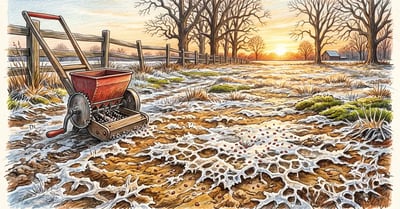
That cobweb-like white or grey filamentous mat is almost certainly actinomycetes — a bacterium that looks like fungus and is arguably the best news your pile can give you. Urban Worm Company and multiple extension sources agree: actinomycetes only thrive in well-aerated, active hot piles.
They're also what give finished compost its signature earthy smell. A landmark 1965 paper published in the NIH's PMC archive first isolated the compound responsible — geosmin — and traced it directly to actinomycetes. If your pile smells like a forest after rain, that's geosmin doing its work.
Visible white or grey fungal threads on woody material are also normal — they're breaking down lignin and cellulose, the two hardest materials to decompose. The only fungal growth to worry about is persistent black mould in a cool, wet pile, which means the pile has gone anaerobic. Same fix as before: turn, add browns, improve drainage.
Need the gear for this?
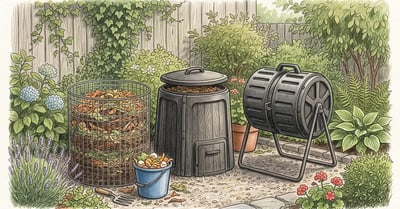
Bins and tumblers picked by yard size, with the honest trade-offs for each.
See the compost bin picksHow Do I Know When Compost Is Ready to Use?
Finished compost has four clear signatures, per UF/IFAS Extension and Cornell Cooperative Extension:
| Signal | Finished | Not Yet |
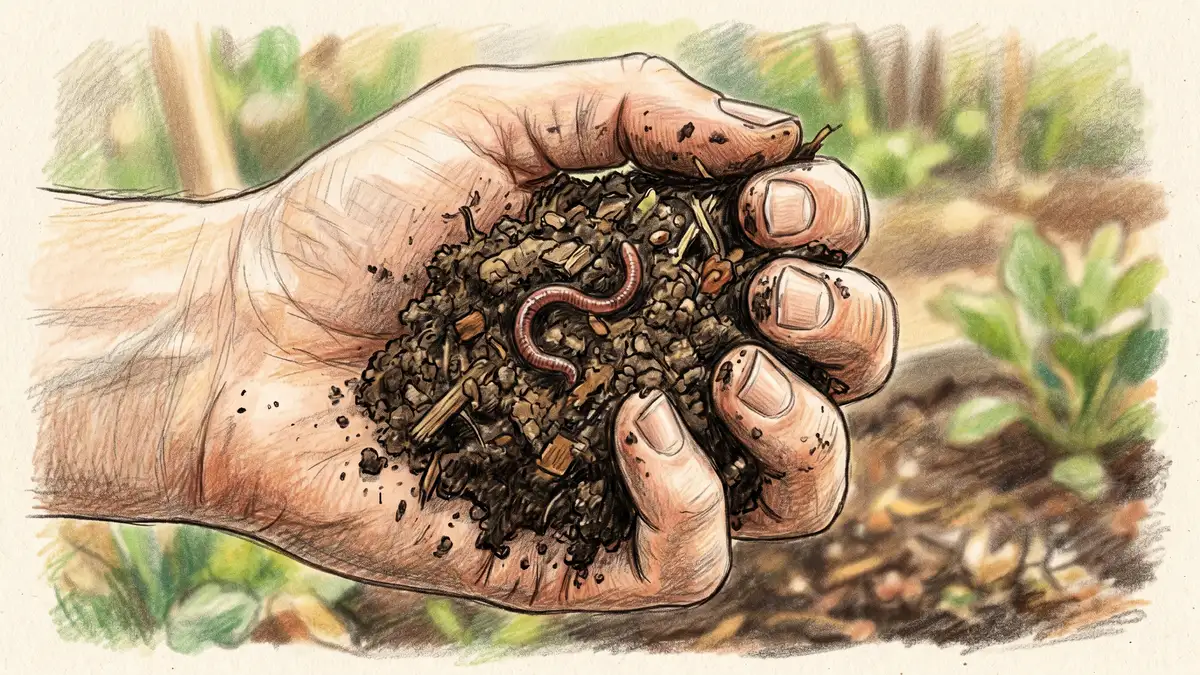
| Appearance | Dark brown, crumbly, soil-like | Recognisable scraps, stringy |
| Smell | Earthy — like forest floor | Sour, ammonia, or sharp |
| Volume | ~1/3 of original pile | Still near original size |
| Temperature | Ambient (cool to touch) | Still warm in the centre |
Sources:.
A simple confirmation: put two cups of compost in a jar, seal it, and open after 24 hours. If it smells like wet earth, use it. If it smells sour or sharp, give it another month to cure. Hot piles typically finish in 2–3 months; passive cold piles take 6–12 months or longer. For a deeper dive on timelines and how to tell when your compost is done, see our full timeline guide.
Frequently Asked Questions
How do I fix smelly compost?
Diagnose the smell first. Ammonia (urine-like) means too much nitrogen — add 3 parts browns (dry leaves, cardboard, straw) to 1 part greens and turn the pile. Rotten egg or sour smell means anaerobic conditions — turn immediately, add dry browns as bulking agent, and improve drainage. A healthy pile always smells earthy. Our complete composting guide walks through all common failure points in more detail.
Can I use smelly compost on my garden?
No — not until the smell goes away. Compost that smells like ammonia is actively losing nitrogen, and the residual salts can burn plant roots. Compost that smells sour is anaerobic and may contain phytotoxic compounds (organic acids) that inhibit seed germination. Give it another 2–4 weeks of curing with occasional turning. Once it smells earthy, it's safe to use on your garden soil.
What should compost smell like when it's done?
Earthy — like a forest floor after rain. That characteristic smell comes from geosmin, a compound produced by actinomycetes bacteria as your pile cures. Any sharp, sour, ammonia, or rotten-egg note means the pile isn't finished yet. Check the volume (has it shrunk to about a third of its original size?) and appearance (uniform, crumbly, dark brown?) to confirm readiness.
Why isn't my compost composting?
The four things to check, in order: (1) pile size — is it at least 3×3×3 ft? (2) moisture — does a squeezed handful produce a few drops of water? (3) balance — do you have roughly 3 parts browns to 1 part greens? (4) oxygen — has it been turned in the last week? A cold, inactive pile almost always fails on one of these four. Fix the weak link and most piles restart within 48 hours.
What makes compost break down faster?
Four things, in priority order: (1) chop materials smaller — surface area dictates speed; (2) keep moisture at wrung-out-sponge consistency; (3) turn weekly to re-introduce oxygen; (4) hit the 3:1 browns-to-greens ratio by volume. A well-managed hot pile finishes in 2–3 months; a passive cold pile takes 6–12+ months. How you build the bin matters too — good airflow from the start prevents most problems.
Get the Weekly Dig
One practical permaculture guide a week, written for gardeners who do this on weekends: composting that actually finishes and soil that feeds itself. Free, no spam, unsubscribe any time.
Join the Weekly DigResources
- Cornell Waste Management Institute — Compost Chemistry: the scientific foundation of C:N ratios and microbial ecology.
- US EPA — Compost Guide (PDF): the EPA's home composting primer, including minimum pile size and prohibited materials.
- Cornell Cooperative Extension — Troubleshooting Your Compost (PDF): practical fixes for every common smell and failure mode.
- UMass Amherst Extension — Compost Production, Analysis & Regulation: the thermophilic temperature ranges and pathogen control thresholds.
- University of Vermont Extension — Composting Food Waste (PDF): moisture management and the wrung-out sponge test.
- Washington State University Extension — Backyard Composting: bin design, pile management, and finishing indicators.
- US EPA — Quantifying Methane Emissions from Landfilled Food Waste: the environmental case for composting at home.
- UF/IFAS Extension — When Is Compost Ready?: sensory tests and readiness signals.