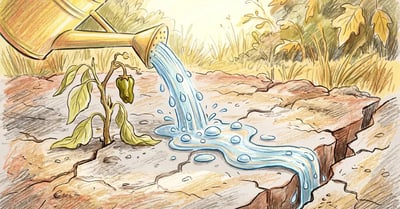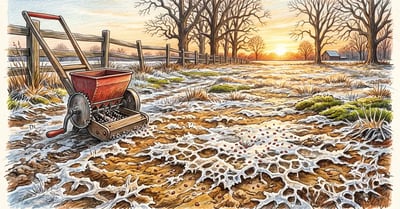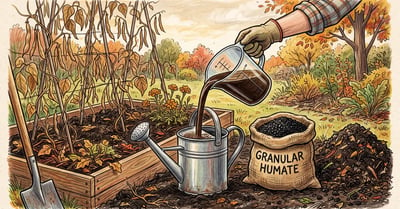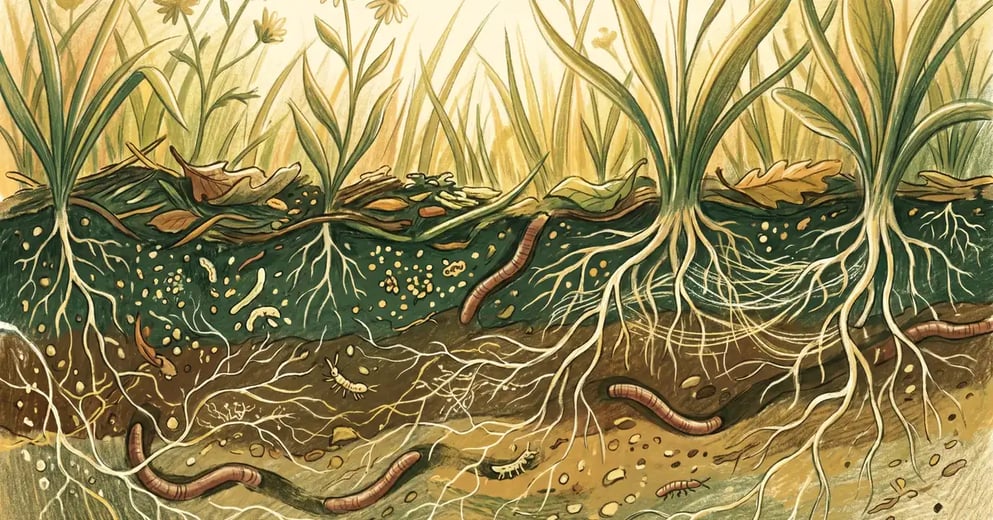

A teaspoon of healthy garden soil contains more living organisms than there are humans on Earth. Bacteria. Fungi. Protozoa. Nematodes. Microscopic mites and springtails. Earthworms threading through the dark. Together they form the soil food web — a hierarchical ecosystem that decomposes organic matter, cycles nutrients into plant-available form, builds soil structure, and suppresses disease, all without any input from you. The framework was systematized by Dr. Elaine Ingham starting in the 1990s and adopted by the USDA NRCS Soil Biology Primer, which remains the canonical reference. Once you understand who's down there and what they do, every garden decision — to till or not, to fertilize or not, to mulch or rake — becomes obvious. leaf litter as overwintering habitat the indicators that track soil biology the soil continuum model that replaced humus theory
This guide walks through the seven major organism groups, the three jobs they do, the bacterial-versus-fungal balance you should aim for in different beds, and the five practices that either feed or starve the system. Five minutes of reading saves you a decade of fertilizer bills.
Key Takeaway
The soil food web is the engine that turns dead matter into plant-available nutrients, builds the crumb structure your roots love, and out-competes the pathogens that cause root rot and damping-off. You don't build it directly — you stop killing it. Skip tilling, mulch with 3 to 4 inches (7.6 to 10 cm) of organic matter, halve synthetic nitrogen, plant a winter cover, and earthworm count rises within 18 months. From there the web does the rest.
Who Lives Down There: The 7 Major Organism Groups
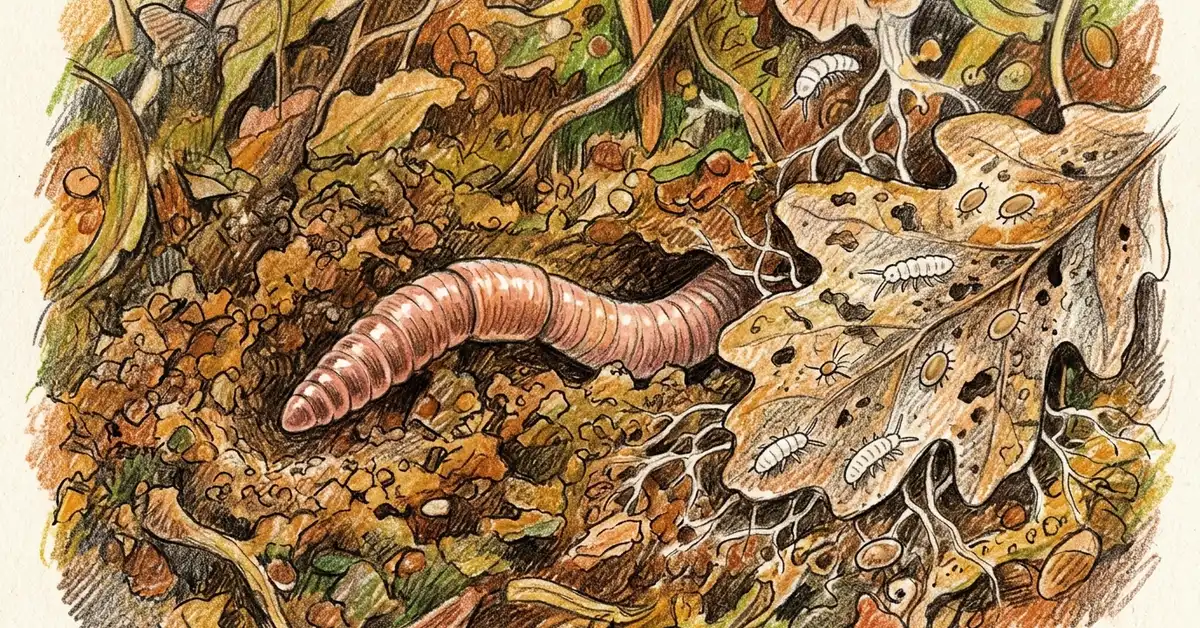
The soil food web is a layered system. At the bottom are decomposers eating organic matter; above them, grazers eating the decomposers; above those, predators eating the grazers. Each level releases plant-available nutrients as a byproduct. Here's who's in each layer.
| Group | Density | Job | How to spot it |
| Bacteria | 100M–1B per gram | Decompose simple organic compounds; fix nitrogen; outcompete pathogens | Earthy smell of healthy soil; rapid straw breakdown |
| Fungi (saprotrophic) | 200–300 m hyphae/g | Decompose lignin, cellulose, chitin; bind soil aggregates via glomalin | White threads in mulch; crumbly aggregated soil |
| Fungi (mycorrhizal) | Colonize 70–90% of plants | Symbiotic with roots; mine phosphorus and trace minerals; extend root reach 100×+ | Healthy unstressed plants; fine white network on roots |
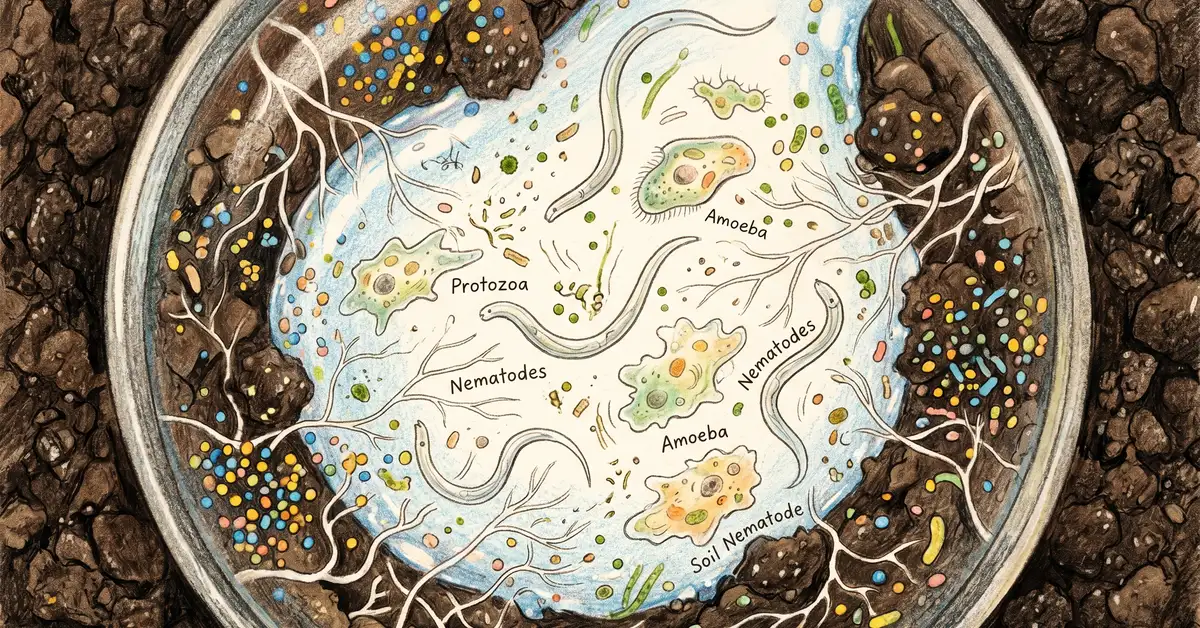
| Protozoa | 1,000–100,000/g | Graze bacteria and excrete plant-available ammonium (the "microbial loop") | Indirect: fast greening without fertilizer |
| Nematodes | 100–10,000/g | 95%+ are beneficial — graze bacteria/fungi, prey on pathogens, cycle nutrients | Healthy roots without galls; lab/microscope to count |
| Microarthropods (springtails, mites) | 1,000–100,000/g | Shred coarse organic matter into microbe-accessible bits; aggregate engineers | Tiny jumping/crawling creatures under mulch (10× hand lens) |
| Earthworms | 500–1,500 lb/acre healthy | Process 5–20 tons soil/acre/year; create burrows; redistribute organic matter | 10+ per shovel = healthy garden |
Source:.
The Soil Food Web Pyramid
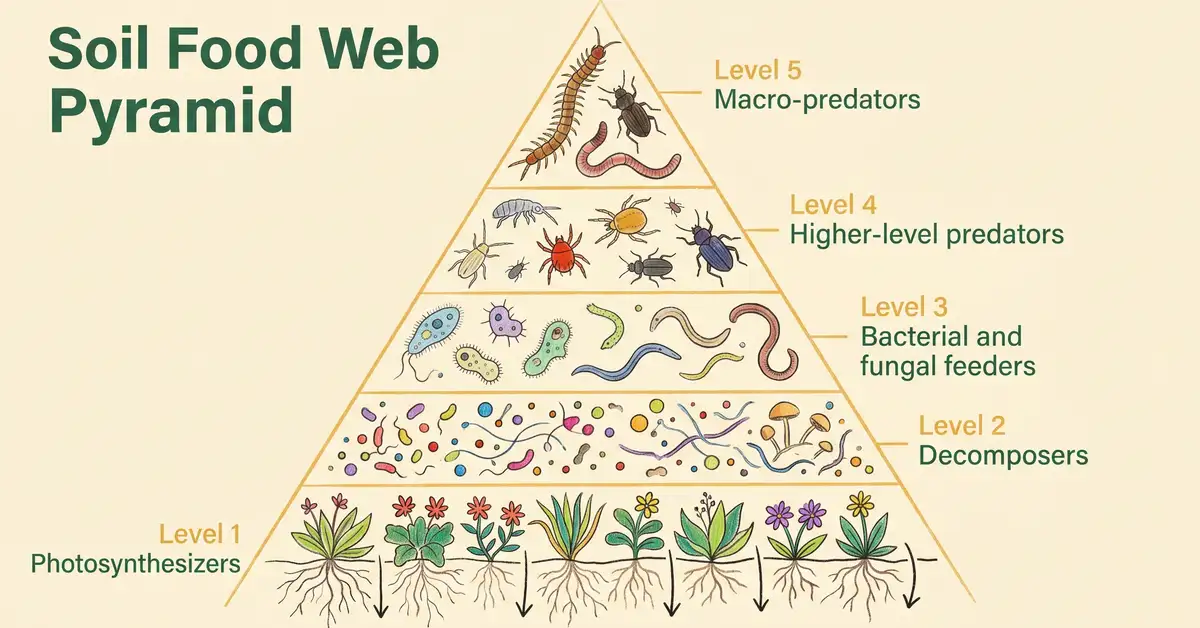
Dr. Elaine Ingham — the soil scientist who systematized the framework now embedded in NRCS extension materials — describes the food web as five trophic levels stacked above the energy of plants. Photosynthesizing plants release sugars and root exudates that feed primary decomposers. Decomposers feed grazers. Grazers feed predators. Each transfer releases nutrients back into plant-available form. The Land Stewardship Project's profile of Ingham's work documents the framework in detail.
The 3 Jobs the Soil Food Web Does for You
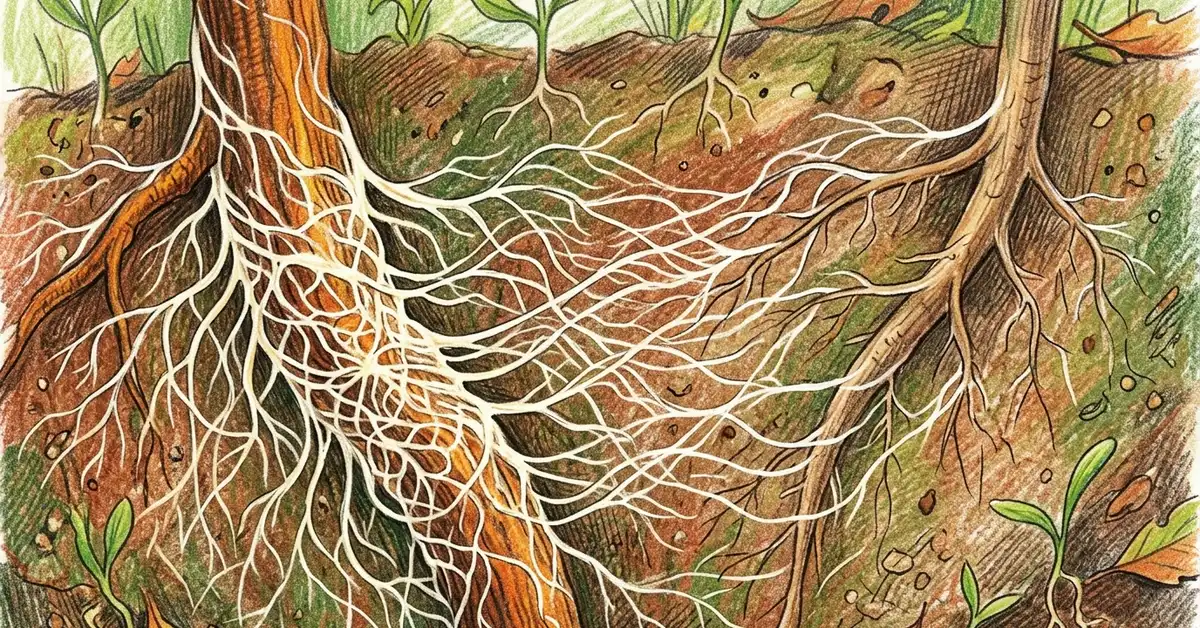
Three functions matter most for the gardener. Get them right and most other garden problems shrink.
Job 1: Cycle nutrients via the "microbial loop." Bacteria and fungi decompose organic matter and lock the nutrients into their own bodies. Protozoa and nematodes then eat the bacteria — and because protozoa have no cell walls to retain the excess nitrogen, they excrete it as plant-available ammonium right where the roots can grab it. This single mechanism supplies 20 to 50% of plant nitrogen in healthy perennial systems with no fertilizer at all (USDA NRCS Soil Biology Primer). Mycorrhizal fungi handle phosphorus separately — they extend hyphal networks into soil zones plant roots can't reach and trade phosphorus for plant sugars, increasing plant phosphorus uptake by 100 to 300% compared with non-mycorrhizal plants per van der Heijden's mycorrhizal ecology research.
Job 2: Build soil structure. Mycorrhizal fungi produce a sticky protein called glomalin that binds clay, silt, and sand into water-stable aggregates. Saprotrophic fungal hyphae physically thread through soil. Earthworm castings cement organic and mineral particles together. The result: crumbly, well-drained soil that holds water without compacting. Healthy fungal-dominant soil shows 70 to 90% water-stable aggregates and absorbs water at 6 to 12 inches per hour — versus less than 40% aggregates and under 2 inches per hour in compacted bacterial-dominant soil. This is why our soil health guide spends so much time on aggregation.
Job 3: Suppress disease. A diverse microbial community out-competes pathogens for nutrients, produces antibiotics that kill them outright, and physically predates them with predatory nematodes. NM Healthy Soil's review of the published literature documents that soils with high bacterial diversity (10,000+ taxa) show 30 to 60% lower incidence of root rot, damping-off, and fusarium wilt than depleted soils. The same beneficial insects we discuss in our beneficial insects guide work above ground; the soil food web is the underground equivalent.
Bacterial vs Fungal: The Spectrum That Decides Your Garden Type
Ingham's framework distinguishes soils by their fungi-to-bacteria biomass ratio. Different gardens want different ratios — and most home gardens are too bacterial-dominant by default.
| Soil type | F:B ratio | Best for | Nutrient release |
| Bacterial-dominant | 0.1:1 to 1:1 | Annual vegetable beds, root crops, bare-ground annual systems | Fast (weeks); leaching risk |
| Balanced | 1:1 to 5:1 | Perennial herbs, lawns, mixed beds, transitional systems | Moderate (weeks–months) |
| Fungal-dominant | 5:1 to 100:1 | Forests, fruit trees, food forests, perennial orchards | Slow, stable (months–years); excellent retention |
Source:.
Most backyard gardens drift bacterial because they get tilled, kept bare in winter, and dosed with synthetic nitrogen — all of which favor fast-growing bacteria over slow-growing fungi. If you grow vegetables, that's tolerable; bacterial-dominant soil cycles fast nutrients quickly, which is what annuals want. If you grow fruit trees or build a food forest, the same approach quietly starves your trees over the years. Match the system to the crop.
The 5 Practices That Feed the Soil Food Web
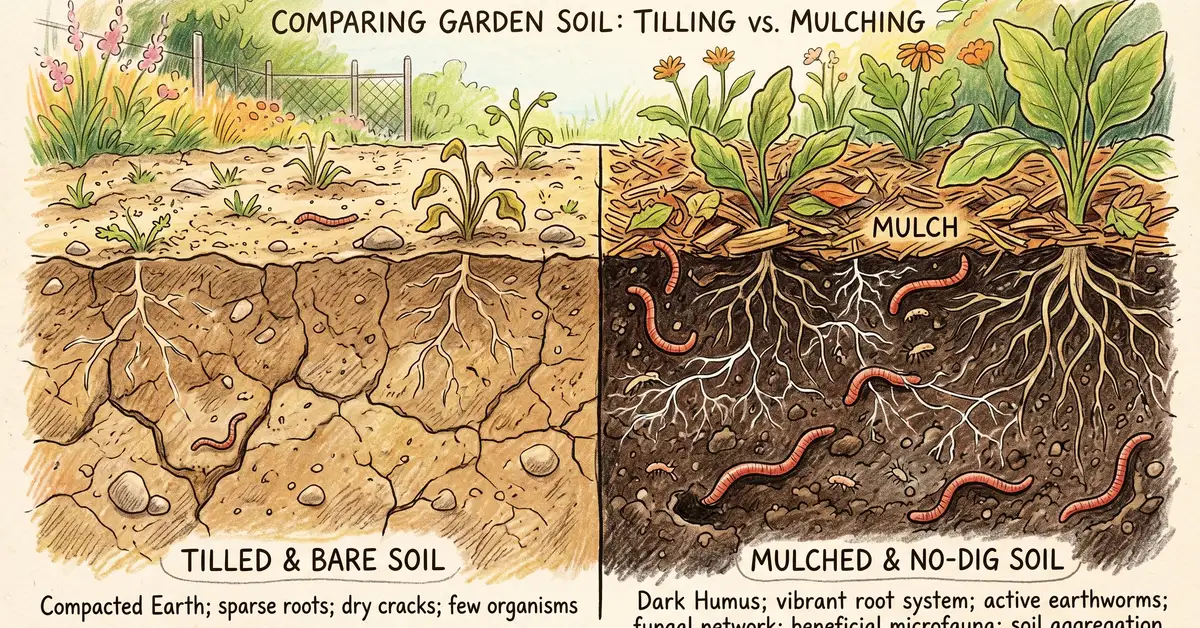
Mulch with 3–4 inches (7.6–10 cm) of organic matter
Wood chips for fungal-dominant systems (perennials, fruit trees) — the lignin in wood favors saprotrophic fungi. Straw or aged compost for bacterial-dominant systems (annual vegetables) — lower lignin, higher nitrogen, faster bacterial decomposition. Either way, mulch raises fungal biomass 50 to 100% within 6 months.
Use compost strategically (cool/aged for fungi, hot for bacteria)
Hot compost (131–149°F / 55–65°C thermophilic phase) kills pathogens but also kills most beneficial fungi. Use it on annual beds. Cool/aged compost (under 104°F / 40°C, or cured 6+ months) keeps fungi alive — use it on perennials. Apply 0.5 to 1 inch (1.3 to 2.5 cm) annually.
Stop tilling (or reduce to one shallow pass every 2 years)
A single rototiller pass destroys roughly 50% of fungal hyphae per Wardle's 2002 research, with recovery taking 18 to 24 months under continuous plant cover. Annual tilling drops fungal biomass 70 to 90% per season and prevents recovery entirely. Switch to no-dig methods and the fungi rebuild themselves.
Halve (or eliminate) synthetic nitrogen fertilizer
Soluble synthetic N suppresses mycorrhizal colonization 30 to 80% via osmotic stress and metabolic feedback (the plant stops feeding fungi when it has all the nitrogen it needs). Salts also kill 30 to 60% of protozoa, breaking the microbial loop. Switch to organic slow-release sources like compost, blood meal, or legume cover crops.
Keep something growing year-round
Bare soil over winter loses 30 to 50% of its microbial biomass to UV exposure, temperature swings, and erosion. A simple winter cover crop (crimson clover, vetch, or winter rye) keeps roots feeding the food web through the cold months and stabilizes the system for spring.
Source:.
The 5 Practices That Starve It
Avoid these — they cost you years of soil-building work
1) Annual rototilling — destroys 50% of fungal hyphae per pass; cumulative loss of 70–90% per year. 2) Synthetic high-N fertilizer at standard rates (150 lb N/acre or 67 kg/ha) — suppresses mycorrhizae 30–50%, doubles to 70–80% at heavy rates. 3) Broad-spectrum pesticides — neonicotinoids reduce protozoa by 60–80%; copper fungicides cut fungi 40–70%; recovery takes 6–16 weeks. 4) Bare soil over winter — 30–50% microbial biomass loss; needs 2–3 years of cover to fully restore. 5) Compaction — anaerobic conditions favor disease-causing bacteria (Pythium, Phytophthora); aerobic beneficial fungi cannot survive; recovery takes 12–24 months.
Source:.
How to Test Your Own Soil Food Web (Free, in 10 Minutes)
You don't need a microscope to know if your soil food web is functional. Three free tests, in order of usefulness:
1. Earthworm count. Dig a single shovel hole 12 inches (30 cm) deep, count the worms. Per USDA NRCS benchmarks: under 1 per shovel = degraded; 1 to 3 = adequate; 4 to 10 = healthy; 10+ = excellent. This is the single best free indicator you have. Repeat annually after any management change.
2. Smell test. Healthy aerobic soil smells earthy and sweet (acetyl compounds from active microbes). Sharp ammonia smell = anaerobic or excessive nitrogen release. Sour, musty, or sulfur smell = waterlogged, anaerobic conditions favoring pathogens.
3. Visual fungal check. Lift a piece of mulch or look at the soil surface a day after rain. White thread-like networks visible? That's saprotrophic fungal mycelium, and it means your fungal-decomposer layer is alive. Total absence usually means too much tillage, too much nitrogen, or too little organic matter.
If you want a quantified read, the Cornell Soil Health Test measures wet aggregate stability, active carbon, and respiration for $20 to $40 per sample — those three metrics correlate tightly with food web function. Microscopy and lab-based microbial counts run $100 to $300 per sample and are mostly useful when troubleshooting persistent problems.
Why This Works: The Permaculture Bridge
The soil food web is the engine that runs every healthy natural ecosystem on Earth. Forests don't get fertilized. Native prairies don't get tilled. Old-growth woodlands don't get sprayed. They sustain their fertility through decomposition cycles powered by billions of microbes that nobody manages — and they produce more biomass per acre than any human-managed annual cropping system. Permaculture's central insight is that we don't need to invent better fertility; we need to stop interrupting the one already in the dirt. Every gardening tool that makes the work easier in the short term — the rototiller, the bag of urea, the broad-spectrum pesticide — is interrupting the system. Every habit that makes work disappear over years — the mulch, the cover crop, the no-dig bed — is letting it run. The soil under a five-year-old permaculture bed is doing the same job the forest floor does. You just stopped getting in its way.
Get the Weekly Dig
One practical permaculture guide a week, written for gardeners who do this on weekends: building living soil without buying it in bags. Free, no spam, unsubscribe any time.
Join the newsletterFrequently Asked Questions
What is the soil food web?
The soil food web is the network of organisms — bacteria, fungi, protozoa, nematodes, microarthropods, earthworms, and larger predators — that decompose organic matter, cycle nutrients into plant-available forms, build soil structure, and suppress pathogens. The framework was systematized by Dr. Elaine Ingham in the 1990s and is the basis of the USDA NRCS Soil Biology Primer used in conservation extension across the United States.
Who coined the term "soil food web"?
Dr. Elaine Ingham (Oregon State University, then founder of Soil Food Web Inc.) is widely credited with popularizing the term and developing the diagnostic framework that quantifies soil health by organism diversity and trophic balance. Her work is the foundation of the USDA NRCS soil biology training materials. Her bacterial-vs-fungal ratio framework is the most-cited model in the field.
What's a soil food web example?
A simple chain: plant roots leak sugars into the soil → bacteria eat the sugars and multiply → protozoa eat the bacteria and excrete plant-available nitrogen → roots absorb the nitrogen and grow more vigorously → more sugars are released. Meanwhile mycorrhizal fungi colonize the same roots and trade phosphorus they've mined from far-away soil zones for plant sugars. Predatory nematodes hunt pathogenic nematodes that would otherwise damage roots. All five things happen simultaneously in every healthy garden.
How do I improve my soil food web?
Five practices, in priority order: stop tilling, add 3 to 4 inches (7.6 to 10 cm) of organic mulch, halve or eliminate synthetic nitrogen fertilizer, plant a winter cover crop, and use cool/aged compost. Earthworm counts typically double within 12 months and triple within 24 months when these are followed. Cost runs $50 to $150 per 100 sq ft per year — usually less than what was being spent on fertilizer and pest control.
What's the difference between bacterial-dominant and fungal-dominant soil?
Bacterial-dominant soil has a fungi-to-bacteria ratio under 1:1, cycles nutrients quickly (weeks), and suits annual vegetables and root crops. Fungal-dominant soil has a ratio of 5:1 to 100:1, cycles nutrients slowly and steadily (months to years), and suits perennial fruit trees, food forests, and woody systems. Most backyard gardens are bacterial-dominant by default because of tillage, bare winter ground, and synthetic nitrogen — fine for vegetable beds, suboptimal for orchards.
Do I need to buy mycorrhizal inoculant?
Usually no. Most undisturbed soils already contain mycorrhizal spores, and you can re-establish populations by stopping the practices that suppress them (tillage, high-N fertilizer, broad-spectrum pesticides). Inoculation can help when establishing new beds in heavily-disturbed sites, very sandy soils, or steep contour after grading work. If you do inoculate, water in immediately and keep synthetic nitrogen out for 6 weeks while colonization establishes.
Resources
- USDA NRCS — Soil Biology Primer (PDF, full text via Archive.org)
- OSU Extension — The Soil Food Web (Agronomic Crops Network)
- NM Healthy Soil — Meet the Soil Food Web
- Land Stewardship Project — Elaine Ingham & Soil Health (PDF)
- Envirothon Pennsylvania — Soil Biology Primer (PDF)
- Van der Heijden Lab — Mycorrhizal Fungi Field Research
- NCBI PMC — Mycorrhizal Ecology & Plant Nutrition Research
- University of Washington Botanic Gardens — Soil Biology & Organic Matter (PDF)
- Piedmont Master Gardeners — The Soil Food Web
- CDI Iowa — Unlocking Soil Biology to Improve Soil Health (PDF)
- Eco Farming Daily — The Soil Food Web Hidden World
The soil food web isn't a marketing phrase. It's the documented engine that runs natural fertility everywhere on Earth, and it works in your backyard exactly as well as it works in old-growth forest — provided you stop the five things that interrupt it. Pick one this weekend (the no-till conversion is the highest-leverage starting point) and the rest cascades.
If this is your first foray into soil ecology, start with our broader soil health guide and our no-dig gardening introduction. For the chemistry side that complements this biological view, see our soil pH guide. And once your food web is established, our composting guide shows how to keep feeding it the organic matter it needs.