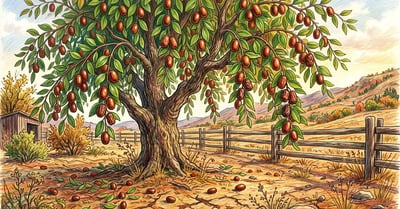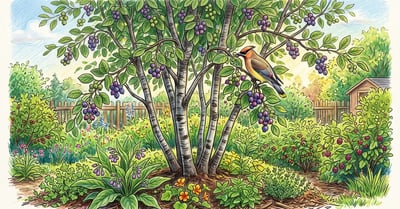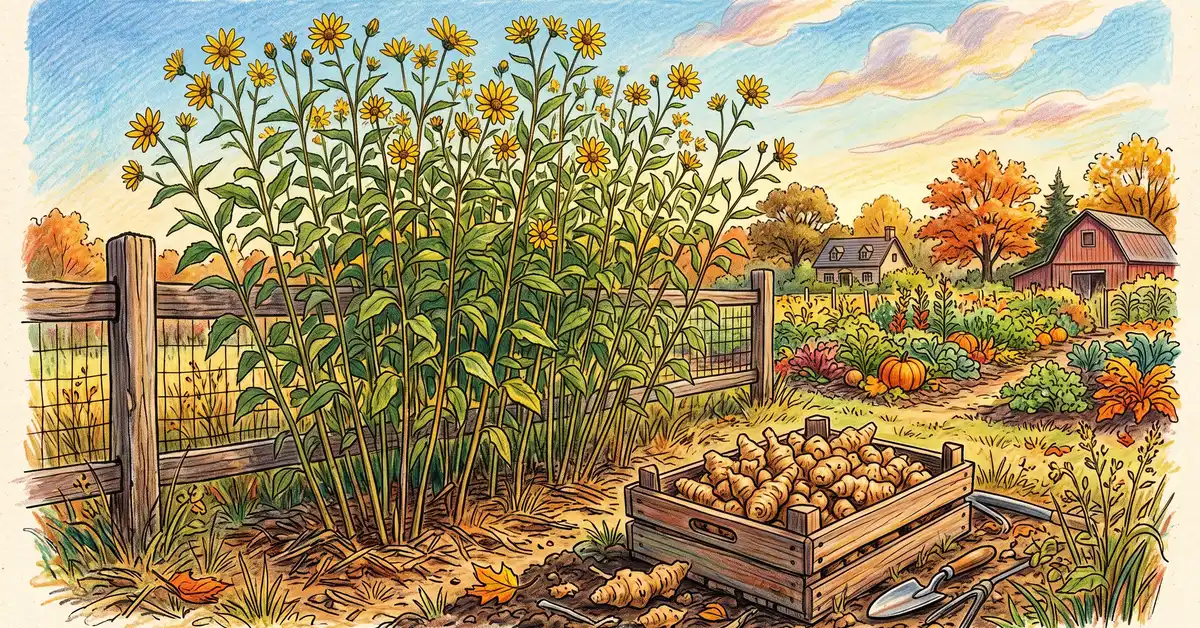

If you've decided to plant a food forest, the next problem is the plant list itself: which trees, shrubs, herbs, and vines actually fit your climate, your space, and the seven canonical layers? This guide is the working list — over 100 named species organized by the seven food forest layers and four USDA climate bands, with hardiness zones, mature size, and primary function for each. It's built from Robert Hart's foundational Forest Gardening framework, Toensmeier and Jacke's two-volume Edible Forest Gardens, Martin Crawford's research, and the Plants For A Future temperate food forest database. sea buckthorn in the shrub layer growing gooseberries and currants planning the harvest year sunchoke growing guide
You don't need every species — you need the right 15 to 30 for your climate. Use this as the menu; pick what overlaps your USDA hardiness zone, anchor a few canopy and sub-canopy trees first, layer in shrubs and ground cover next, and watch the system stack itself over four to seven years.
Key Takeaway
Pick 5 to 8 anchor species per layer matched to your USDA zone — that's enough to start a working food forest under a quarter acre (1,000 m²). Prioritize at least one nitrogen-fixer per layer (sea buckthorn, Goumi, Siberian pea shrub, white clover), one early-bloom pollinator anchor (serviceberry, redbud, mulberry), and one dynamic accumulator (comfrey, yarrow, dandelion). The system fills in around those choices over 3 to 7 years.
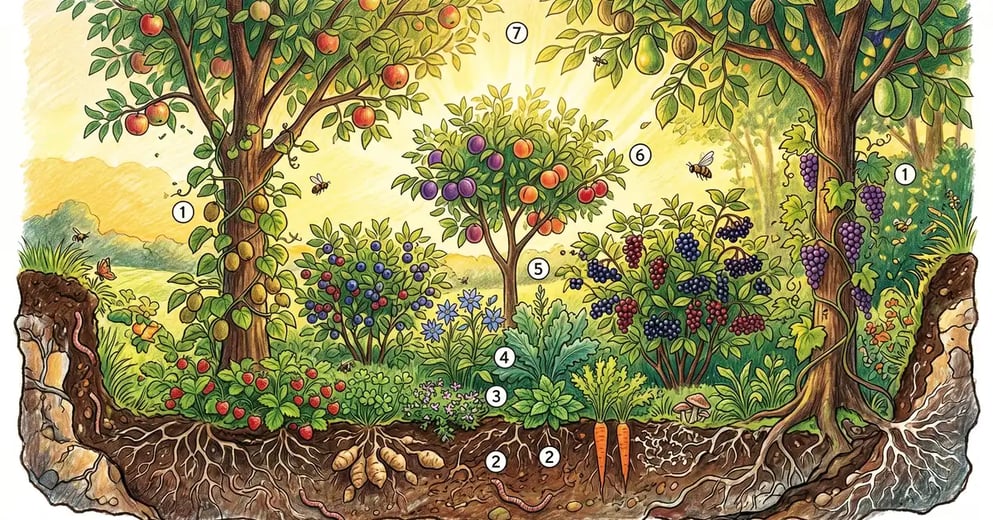
The 7 Layers, in 30 Seconds
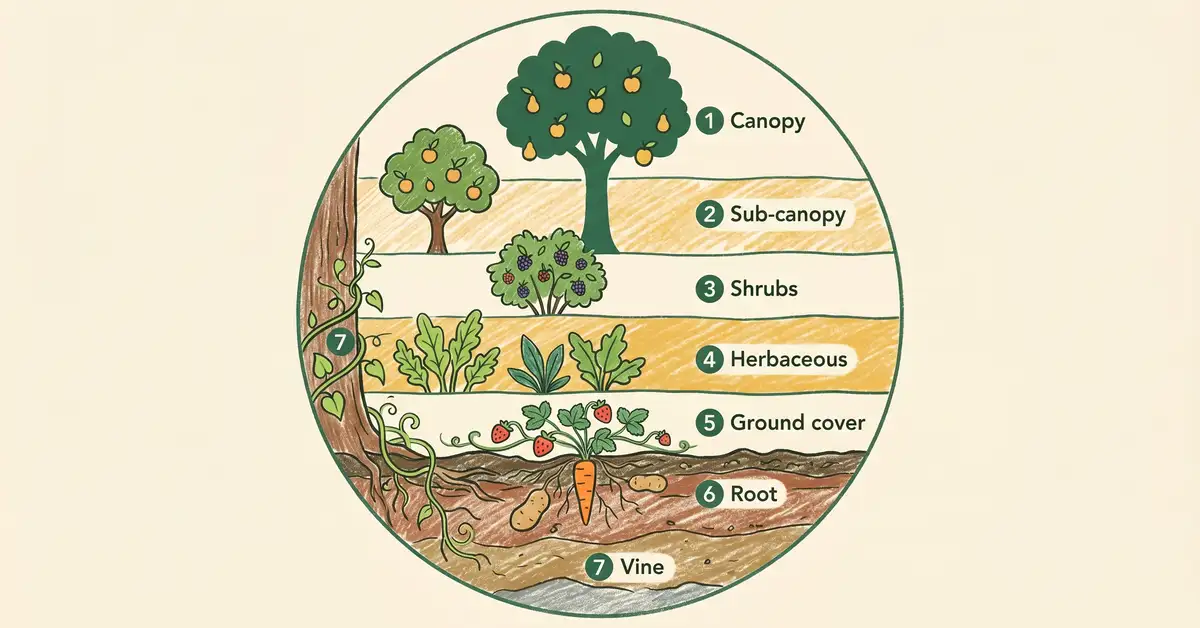
The 7-layer model originated with Robert Hart's Forest Gardening in 1996 and was systematized by Dave Jacke and Eric Toensmeier in Edible Forest Gardens Volume 1. Each layer fills an ecological niche and a light micro-environment that mimics natural forest succession.
| Layer | Height | Light | Function |
| 1. Canopy | 30–60+ ft (9–18+ m) | Full sun | Large nut/fruit; windbreak; long-term yield |
| 2. Sub-canopy | 10–30 ft (3–9 m) | Full to part sun | Dwarf fruit; medium yield; faster to production |
| 3. Shrubs | 3–15 ft (1–4.5 m) | Part sun to part shade | Berries; nitrogen fixation; wildlife habitat |
| 4. Herbaceous | 1–5 ft (0.3–1.5 m) | Part sun to shade | Perennial vegetables; medicinal herbs |
| 5. Ground cover | <1 ft (0.3 m) | Part shade to shade | Living mulch; nitrogen fixation; erosion control |
| 6. Root / tuber | Underground | n/a | Carbohydrate storage crops |
| 7. Vine / vertical | On structure | Full to part sun | Maximize vertical production |
Source:. For the deep dive on each layer, see our 7 layers of a food forest guide.
Layer 1: Canopy Trees (30–60+ ft / 9–18+ m)
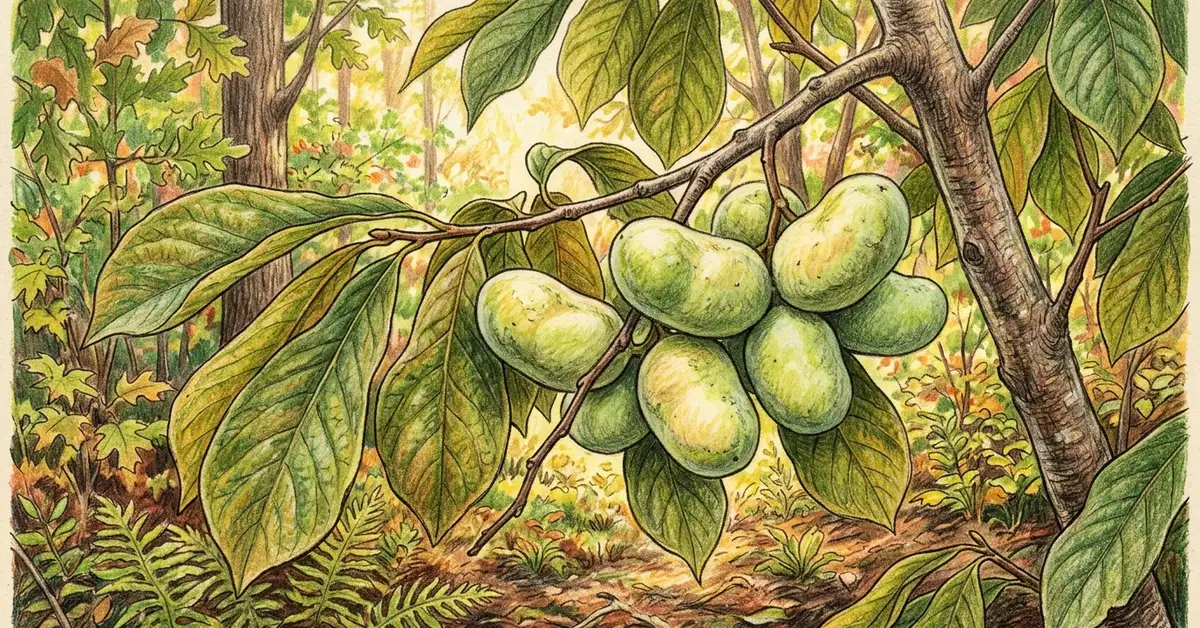
The canopy is the long game. These trees define the architecture of the food forest for decades, take 5 to 15 years to mature, and produce the heaviest single-tree yields in the system. Plant your canopy first — everything else either tolerates or wants the dappled shade they create.
| Species | Latin name | Zone | Mature ht. | Function |
| Black walnut | Juglans nigra | 3–9 | 50–70 ft (15–21 m) | Nut; allelopathic (juglone) |
| English walnut | Juglans regia | 5–8 | 40–60 ft (12–18 m) | Nut; less allelopathic than black |
| Pecan | Carya illinoinensis | 5–9 | 60–80 ft (18–24 m) | Nut (premium) |
| Chinese chestnut | Castanea mollissima | 4–8 | 40–50 ft (12–15 m) | Nut (blight-resistant) |
| Mulberry (red, native) | Morus rubra | 4–9 | 40–60 ft (12–18 m) | Fruit; early-pollen bee forage |
| American persimmon | Diospyros virginiana | 4–9 | 35–60 ft (10.5–18 m) | Fruit; wildlife |
| Asian persimmon | Diospyros kaki | 6–9 | 20–30 ft (6–9 m) | Fruit (non-astringent) |
| Pawpaw | Asimina triloba | 5–9 | 15–30 ft (4.5–9 m) | Fruit; native understory |
| Apple (standard heirloom) | Malus domestica | 3–8 | 35–50 ft (10.5–15 m) | Fruit |
| Pear (standard) | Pyrus communis | 3–7 | 40–50 ft (12–15 m) | Fruit |
| Black locust | Robinia pseudoacacia | 3–8 | 40–60 ft (12–18 m) | Nitrogen fixer (~30–50 lbs N/acre/yr); fuelwood |
| Linden (basswood) | Tilia americana | 2–8 | 60–80 ft (18–24 m) | Pollinator anchor; edible flowers |
| Avocado | Persea americana | 8–11 | 25–35 ft (7.5–10.5 m) | Fruit (fat-rich) |
| Mango | Mangifera indica | 9–11 | 30–60 ft (9–18 m) | Fruit (tropical) |
| Macadamia | Macadamia integrifolia | 9–11 | 40–60 ft (12–18 m) | Nut (premium); long-lived |
| Carob | Ceratonia siliqua | 8–10 | 30–50 ft (9–15 m) | Pod; nitrogen fixer; drought-tolerant |
| Olive | Olea europaea | 7–10 | 20–30 ft (6–9 m) | Fruit; oil; long-lived |
| Coconut | Cocos nucifera | 10–11 | 50–80 ft (15–24 m) | Multi-use tropical staple |
Source:.
Two notes worth flagging. Black walnut is allelopathic — its roots release juglone, which is toxic to many companion plants. Plan walnut guilds with juglone-tolerant species only (currants, comfrey, mayapple, ramps). And black locust is a phenomenal nitrogen-fixer and the only canopy-scale N-fixer in most temperate zones, but it's invasive in some western US regions — check your state's invasive species list before planting.
Layer 2: Sub-Canopy Trees (10–30 ft / 3–9 m)
Faster to production than canopy trees, and the layer where most of your dessert fruit and dwarf fruit will live. Plant sub-canopy 5 to 15 ft (1.5 to 4.5 m) outward from canopy trunks, in the dappled-light zone.
| Species | Latin name | Zone | Mature ht. | Function |
| Apple (semi-dwarf, M7) | Malus domestica | 3–8 | 12–20 ft (3.6–6 m) | Fruit |
| Apple (dwarf, M9/M26) | Malus domestica | 3–8 | 8–15 ft (2.4–4.5 m) | Fruit; early production |
| Pear (dwarf) | Pyrus communis | 4–7 | 10–15 ft (3–4.5 m) | Fruit |
| Peach (low-chill) | Prunus persica | 4–9 | 15–25 ft (4.5–7.5 m) | Fruit |
| Sour cherry | Prunus cerasus | 4–8 | 15–25 ft (4.5–7.5 m) | Fruit (preserves) |
| Sweet cherry | Prunus avium | 5–8 | 20–35 ft (6–10.5 m) | Fruit (premium) |
| Plum (Japanese, hybrid) | Prunus salicina | 5–9 | 15–25 ft (4.5–7.5 m) | Fruit |
| Crabapple | Malus spp. | 3–8 | 15–30 ft (4.5–9 m) | Fruit; pollinator anchor |
| Hazelnut (American) | Corylus americana | 4–9 | 8–15 ft (2.4–4.5 m) | Nut; native |
| Hazelnut (European) | Corylus avellana | 4–9 | 12–20 ft (3.6–6 m) | Nut (filbert) |
| Serviceberry / Saskatoon | Amelanchier alnifolia | 2–9 | 15–25 ft (4.5–7.5 m) | Fruit; native; early pollinator |
| Quince | Cydonia oblonga | 4–8 | 15–25 ft (4.5–7.5 m) | Fruit (preserves) |
| Medlar | Mespilus germanica | 5–9 | 15–25 ft (4.5–7.5 m) | Fruit (bletted) |
| Fig | Ficus carica | 6–10 | 15–30 ft (4.5–9 m) | Fruit (two crops/year zones 8+) |
| Jujube | Ziziphus jujuba | 5–10 | 15–30 ft (4.5–9 m) | Fruit (dried/fresh); drought-tolerant |
| Loquat | Eriobotrya japonica | 7–10 | 15–25 ft (4.5–7.5 m) | Fruit (early spring harvest) |
| Pomegranate | Punica granatum | 7–11 | 12–20 ft (3.6–6 m) | Fruit; ornamental; medicinal |
| Eastern redbud | Cercis canadensis | 4–9 | 20–30 ft (6–9 m) | Pollinator (early); minor N-fixer (legume) |
| Sea buckthorn | Hippophae rhamnoides | 3–7 | 15–25 ft (4.5–7.5 m) | Nitrogen fixer (~40 lbs N/acre/yr); fruit (vit C) |
| Goumi | Elaeagnus multiflora | 4–8 | 6–10 ft (1.8–3 m) | Nitrogen fixer; fruit (tart, medicinal) |
| Avocado (dwarf) | Persea americana | 9–11 | 15–25 ft (4.5–7.5 m) | Fruit (premium) |
| Mango (dwarf) | Mangifera indica | 9–11 | 20–40 ft (6–12 m) | Fruit |
| Citrus (dwarf, self-fertile) | Citrus spp. | 8–11 | 10–20 ft (3–6 m) | Fruit (multi-cultivar) |
| Guava | Psidium guajava | 9–11 | 15–30 ft (4.5–9 m) | Fruit; hardy tropical |
Source:.
Layer 3: Shrubs (3–15 ft / 1–4.5 m)
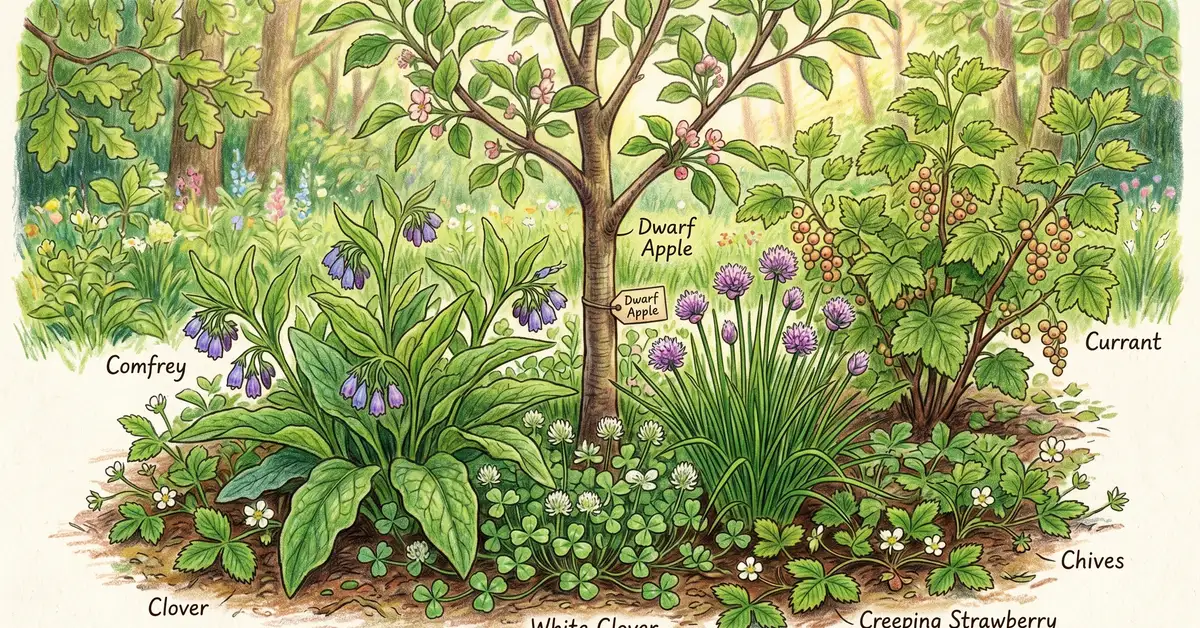
This is where the food forest produces the most pounds per square foot. Berries, currants, hazelnuts, sea buckthorn, elderberry — the shrub layer is also where most of your nitrogen fixers and pollinator habitat sit.
| Species | Latin name | Zone | Mature ht. | Function |
| Highbush blueberry | Vaccinium corymbosum | 3–7 | 6–8 ft (1.8–2.4 m) | Fruit; needs acid soil (pH 4.5–5.5) |
| Southern highbush blueberry | V. corymbosum hybrids | 6–10 | 4–6 ft (1.2–1.8 m) | Fruit; low-chill |
| Black currant | Ribes nigrum | 3–7 | 3–5 ft (0.9–1.5 m) | Fruit (vit C) |
| Red currant | Ribes rubrum | 2–8 | 4–6 ft (1.2–1.8 m) | Fruit; semi-shade |
| Gooseberry | Ribes uva-crispa | 2–8 | 4–6 ft (1.2–1.8 m) | Fruit (jam, cooking) |
| Elderberry (American) | Sambucus nigra ssp. canadensis | 3–8 | 5–12 ft (1.5–3.6 m) | Fruit (medicinal); pollinator |
| Raspberry (red, black, hybrid) | Rubus spp. | 3–8 | 3–8 ft (0.9–2.4 m) | Fruit; semi-shade tolerant |
| Blackberry (thornless) | Rubus fruticosus hybrids | 4–9 | 4–10 ft (1.2–3 m) | Fruit; pioneer |
| Black chokeberry (Aronia) | Aronia melanocarpa | 4–9 | 6–10 ft (1.8–3 m) | Fruit (antioxidant); native; pollinator |
| Honeyberry / Haskap | Lonicera caerulea | 2–8 | 4–8 ft (1.2–2.4 m) | Fruit (early); minimal pest pressure |
| Nanking cherry | Prunus tomentosa | 4–8 | 6–8 ft (1.8–2.4 m) | Fruit (tart); early bloom |
| Buffaloberry | Shepherdia canadensis | 2–7 | 4–12 ft (1.2–3.6 m) | Nitrogen fixer (~20 lbs N/acre/yr); native |
| Siberian pea shrub | Caragana arborescens | 2–8 | 12–15 ft (3.6–4.5 m) | Nitrogen fixer (~30–50 lbs N/acre/yr); fodder |
| False indigo | Amorpha fruticosa | 4–8 | 6–10 ft (1.8–3 m) | Nitrogen fixer; pollen/nectar; drought-tolerant |
| Lilac (edible flowers) | Syringa vulgaris | 3–8 | 8–15 ft (2.4–4.5 m) | Edible flowers; early pollinator |
| Pomegranate (shrub form) | Punica granatum | 7–11 | 6–12 ft (1.8–3.6 m) | Fruit; ornamental |
| Bay laurel | Laurus nobilis | 8–10 | 6–15 ft (1.8–4.5 m) | Culinary leaves; aromatic |
| Mesquite | Prosopis spp. | 8–11 | 15–25 ft (4.5–7.5 m) | Nitrogen fixer; pods (forage); arid-zone |
Source:.
Layer 4: Herbaceous (1–5 ft / 0.3–1.5 m)
Perennial vegetables, medicinal herbs, dynamic accumulators, and the densest collection of pollinator-supporting flowers. This layer also doubles as your living mulch under tree drip-lines.
| Species | Latin name | Zone | Function |
| Asparagus | Asparagus officinalis | 3–9 | Perennial vegetable (20+ year stand) |
| Rhubarb | Rheum rhabarbarum | 3–8 | Perennial vegetable; long-lived |
| Sorrel | Rumex acetosa | 3–8 | Perennial green; lemony |
| Good King Henry | Blitum bonus-henricus | 3–9 | Perennial spinach substitute |
| Sea kale | Crambe maritima | 5–9 | Perennial brassica; coastal-adapted |
| Perennial kale (Daubenton, Tree Collards) | Brassica oleracea var. | 6–9 | Perennial greens (5–7 yr stand) |
| Walking onion | Allium × proliferum | 3–9 | Perennial allium; self-propagating |
| Lovage | Levisticum officinale | 3–9 | Perennial celery substitute; medicinal |
| Comfrey | Symphytum × uplandicum | 3–9 | Dynamic accumulator (K, P); chop-and-drop mulch |
| Stinging nettle | Urtica dioica | 3–10 | Medicinal; high-protein green; dynamic accumulator |
| Bee balm / Monarda | Monarda spp. | 3–9 | Pollinator anchor; medicinal tea |
| Anise hyssop | Agastache foeniculum | 4–8 | Pollinator anchor; tea |
| Oregano | Origanum vulgare | 5–10 | Culinary; medicinal; pollinator |
| Mint (apple, peppermint, etc.) | Mentha spp. | 3–10 | Culinary; medicinal; contain in pots |
| Lemon balm | Melissa officinalis | 3–9 | Culinary; medicinal; bee anchor |
| Fennel | Foeniculum vulgare | 4–9 | Culinary; pollinator anchor |
| Yarrow | Achillea millefolium | 3–9 | Dynamic accumulator; pollinator; medicinal |
| Chicory | Cichorium intybus | 3–10 | Dynamic accumulator (deep tap-root); medicinal |
| Echinacea / coneflower | Echinacea purpurea | 3–9 | Medicinal; pollinator |
| Calendula | Calendula officinalis | 2–11 | Medicinal; pollinator; self-seeding |
| French sorrel | Rumex scutatus | 5–9 | Perennial green |
| Salad burnet | Sanguisorba minor | 4–8 | Perennial green (cucumber flavor) |
Source:; Toensmeier, Perennial Vegetables (2007).
Layer 5: Ground Cover (<1 ft / 0.3 m)
Living mulch, weed suppression, nitrogen fixation at scale (white and red clover), and the layer most beginners under-plant. A dense ground-cover layer is the single best protection against weed pressure during your food forest's first 5 years.
| Species | Latin name | Zone | Function |
| White clover | Trifolium repens | 2–9 | Nitrogen fixer (~40–80 lbs N/acre/yr); pollinator forage |
| Red clover | Trifolium pratense | 2–9 | Nitrogen fixer; dynamic accumulator; pollinator |
| Strawberry (alpine, June-bearing) | Fragaria spp. | 3–10 | Fruit; living mulch |
| Wild ginger (native) | Asarum canadense | 3–8 | Native ground cover; deep-shade tolerant |
| Sweet woodruff | Galium odoratum | 4–8 | Aromatic ground cover; shade-tolerant |
| Creeping thyme | Thymus serpyllum | 4–9 | Culinary; pollinator; fragrant ground cover |
| Roman chamomile | Chamaemelum nobile | 4–9 | Medicinal; pollinator; fragrant |
| Lingonberry | Vaccinium vitis-idaea | 2–8 | Fruit; acid-soil specialist |
| Cranberry | Vaccinium macrocarpon | 2–7 | Fruit; wet-soil specialist |
| Partridgeberry | Mitchella repens | 3–8 | Native woodland ground cover; minor fruit |
| Wintergreen | Gaultheria procumbens | 3–8 | Native; aromatic; minor edible berry |
| Ajuga / bugleweed | Ajuga reptans | 3–9 | Aggressive ground cover; pollinator |
Source: PFAF temperate food forest plants.
Layer 6: Root / Tuber
The underground layer is often skipped, but it's where you produce your storable carbohydrates. Most root crops in a food forest are perennial or self-propagating tubers — plant once, harvest for years.
| Species | Latin name | Zone | Function |
| Jerusalem artichoke (sunchoke) | Helianthus tuberosus | 3–9 | Perennial tuber; aggressive (contain it) |
| Groundnut (American) | Apios americana | 3–9 | Native nitrogen-fixing vine + tuber |
| Chinese yam | Dioscorea polystachya | 5–10 | Tuber + bulbil; vine habit |
| Oca | Oxalis tuberosa | 7–10 | Andean tuber; lemon-flavored |
| Mashua | Tropaeolum tuberosum | 7–9 | Andean tuber + edible vine |
| Skirret | Sium sisarum | 4–8 | Perennial root vegetable |
| Salsify | Tragopogon porrifolius | 3–9 | Biennial root (oyster flavor) |
| Scorzonera | Scorzonera hispanica | 3–9 | Perennial root; black-skinned |
| Camas (caveat) | Camassia quamash | 3–9 | Native bulb; ⚠️ toxic look-alike (death camas) — careful ID |
| Sweet potato | Ipomoea batatas | 9–11 perennial; annual elsewhere | Tuber + edible greens |
Source: PFAF; Toensmeier, Perennial Vegetables.
Layer 7: Vines (Vertical / Climbing)
Vines maximize vertical production. Trained up canopy and sub-canopy trees (carefully — never let a heavy vine smother a young tree), or up dedicated trellises, the vine layer adds another 20 to 40% production capacity to a food forest without consuming additional ground area.
| Species | Latin name | Zone | Function |
| Hardy kiwi | Actinidia arguta | 3–8 | Fruit (cold-hardy kiwi) |
| Fuzzy kiwi | Actinidia deliciosa | 7–9 | Fruit (commercial-type kiwi) |
| Kiwi berry / arctic kiwi | Actinidia kolomikta | 3–7 | Fruit; ornamental variegated foliage |
| Grape (American) | Vitis labrusca | 4–9 | Fruit; wine; juice |
| Grape (European) | Vitis vinifera | 6–10 | Fruit; wine |
| Maypop / native passionfruit | Passiflora incarnata | 5–10 | Fruit; native; medicinal flowers |
| Tropical passionfruit | Passiflora edulis | 9–11 | Fruit (tropical) |
| Hops | Humulus lupulus | 3–9 | Brewing; medicinal; vigorous |
| Schisandra | Schisandra chinensis | 4–7 | Fruit (medicinal); shade-tolerant |
| Akebia (5-leaf) | Akebia quinata | 5–9 | Fruit (unusual); ornamental |
| Magnolia vine (Schisandra) | Schisandra chinensis | 4–7 | Adaptogenic medicinal berries |
| Chayote | Sechium edule | 7–11 perennial | Squash-family fruit; perennial in zones 7+ |
| Runner bean (perennial in zone 7+) | Phaseolus coccineus | 7–11 perennial | Bean + nitrogen fixation; pollinator |
| American groundnut | Apios americana | 3–9 | Native vine + tuber; nitrogen fixer |
Source:.
Pick Your Climate Anchors
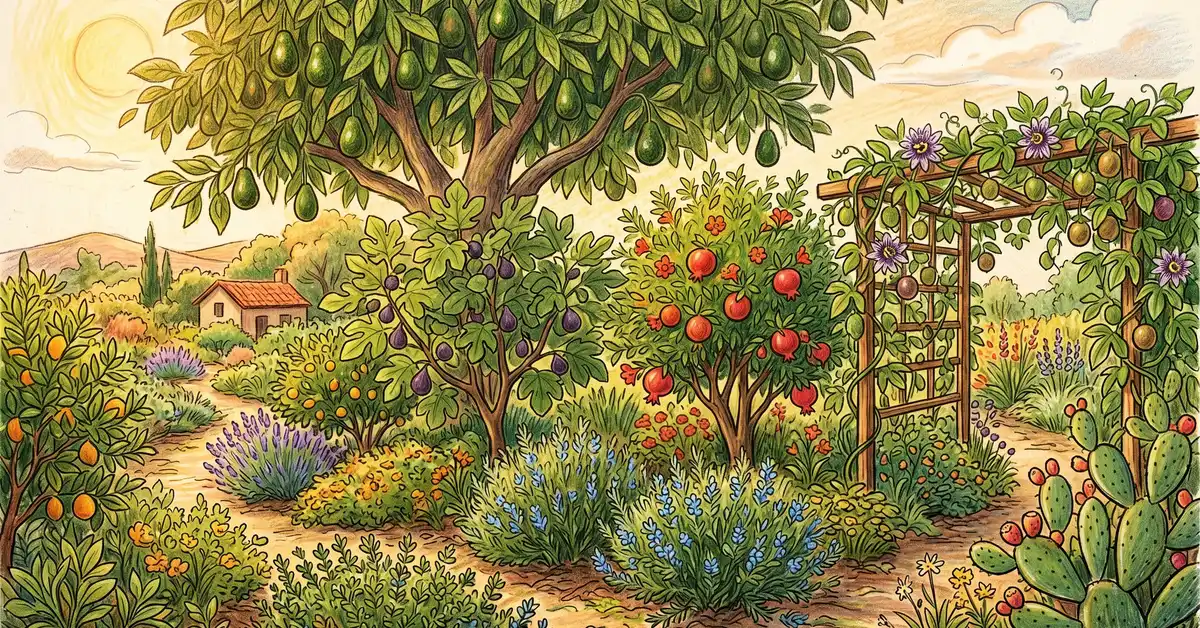
Don't try to plant from the master list. Pick five to eight anchor species per layer, matched to your USDA zone. Below is a starter template.
| Climate | Zones | Anchor canopy | Anchor sub-canopy | Anchor shrubs |
| Cold temperate | 3–5 | Black walnut, mulberry, serviceberry, cold-hardy apple | Dwarf apple, sour cherry, Saskatoon, hazelnut | Highbush blueberry, black currant, elderberry, sea buckthorn (N), Siberian pea shrub (N) |
| Cool temperate | 5–7 | English walnut, Asian persimmon, pawpaw, mulberry, linden (pollinator) | Semi-dwarf apple, peach, plum, hazelnut, medlar, Goumi (N) | Blueberry, currant, raspberry, Aronia, honeyberry, false indigo (N) |
| Warm temperate | 7–9 | Pecan, Asian persimmon, fig, jujube | Low-chill peach, fig, loquat, pomegranate | Southern blueberry, blackberry, pomegranate (shrub), mesquite (N), bay laurel |
| Subtropical | 9–11 | Avocado, mango, macadamia, coconut (z10+), citrus | Dwarf avocado, dwarf mango, fig, guava, citrus (dwarf) | Pomegranate, guava, bay laurel, mesquite (N) |
Source:. (N) = nitrogen fixer.
Why This Works: The Permaculture Bridge
Industrial monoculture grows one plant in one layer and uses fertilizer, pesticide, and irrigation to keep it alive. A food forest grows 30 to 100 species across seven layers, and each species fixes one of the problems the others create. Black locust fixes nitrogen the apples consume. Comfrey mines potassium the strawberries need. Serviceberry feeds the bees that pollinate the cherry. Clover suppresses the weeds that would compete with the elderberry roots. The forest stops being a list of plants and becomes a system that maintains itself — which is the entire point of designing with nature instead of against it.
Get the Weekly Dig
One practical permaculture guide a week, written for gardeners who do this on weekends: food forest and guild designs that produce. Free, no spam, unsubscribe any time.
Join the newsletterBuild Around Guilds, Not Lists
A food forest isn't a randomised plant list — it's a series of guilds, each anchored on one canopy or sub-canopy tree with 5 to 7 supporting species. Three classic guilds:
Apple guild (zones 3–8)
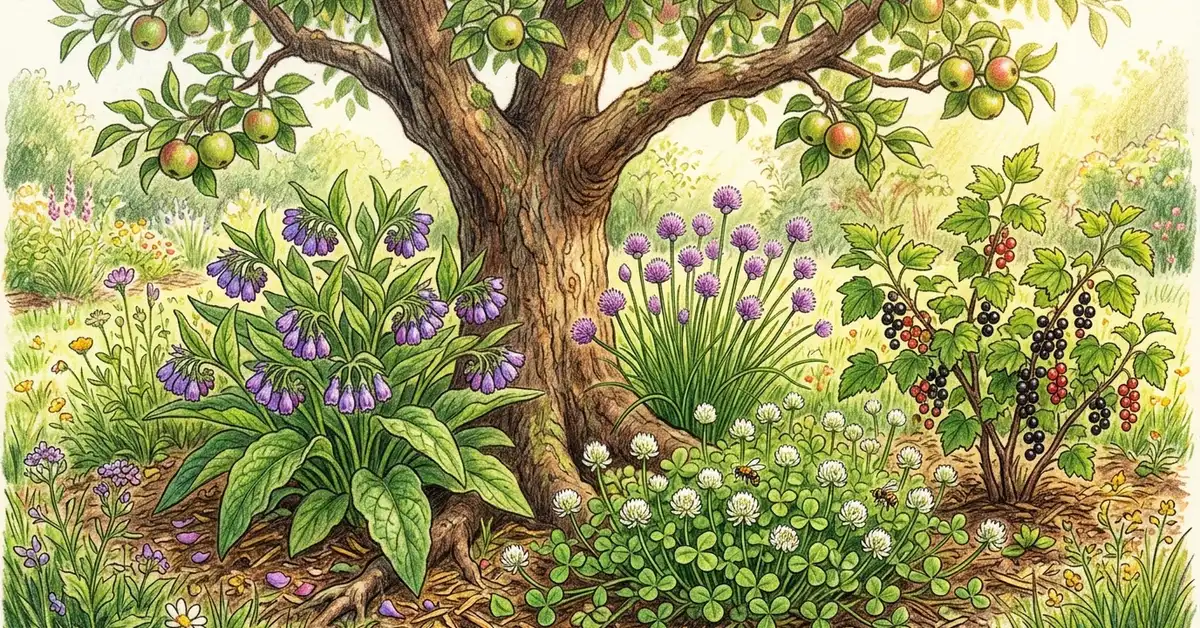
Apple (canopy) + comfrey (dynamic accumulator + chop-and-drop mulch) + chives (pest deterrent) + white clover (nitrogen fixer + ground cover) + currant (under-tree shrub) + nasturtium (pest trap) + daffodil (rodent deterrent at trunk).
Walnut guild (juglone-tolerant, zones 4–8)
Black walnut (canopy) + Allegheny serviceberry (juglone-tolerant sub-canopy) + currant (juglone-tolerant shrub) + comfrey + ramps (Allium tricoccum, native shade-loving allium) + mayapple (native woodland) + ferns. Critical: never plant nightshades, blueberries, or apples within 50 ft (15 m) of black walnut roots.
Mulberry guild (zones 4–9)
Mulberry (canopy, fast pioneer) + sea buckthorn (nitrogen fixer + secondary fruit) + comfrey (chop-and-drop) + clover (ground-cover N-fix) + raspberry (under-tree shrub) + chives + spring bulbs.
Avocado guild (zones 9–11)
Avocado (canopy) + pigeon pea (nitrogen-fixing shrub) + lemon balm (pollinator + culinary) + sweet potato (ground cover + tuber) + papaya (sub-canopy fruit) + Mexican tarragon (pollinator herb) + passionfruit (vine).
Source: Jacke & Toensmeier — Edible Forest Gardens Vol. 1; Crawford, Creating a Forest Garden.
For a deeper walk-through of how to design and plant your first guild, see our how to start a food forest step-by-step guide and the food forest design mapping guide.
Frequently Asked Questions
What is a food forest?
A food forest is a multi-layered, edible perennial planting that mimics natural forest succession. The canonical structure has seven vertical layers: canopy trees, sub-canopy, shrubs, herbaceous plants, ground covers, root/tuber crops, and vines. Once mature (typically 5 to 7 years), a well-designed food forest produces fruit, nuts, herbs, vegetables, and medicinals while requiring far less labor than annual gardening.
How many plants do you need to start a food forest?
A working backyard food forest under a quarter acre (1,000 m²) typically uses 30 to 60 plants spread across all 7 layers. That's usually 2 to 3 canopy trees, 4 to 6 sub-canopy trees, 8 to 12 shrubs, 10 to 20 herbaceous plants, ground cover seed for the entire area, 5 to 8 root crops, and 2 to 4 vines. Quality matters more than quantity — pick well-matched species for your zone first, fill in the gaps over years 2 and 3.
What plants should you avoid in a food forest?
Three categories. First, plants that don't match your USDA zone — never force a zone 9 species in zone 5; it's a slow death. Second, allelopathic plants placed near sensitive companions — black walnut releases juglone toxic to apples, blueberries, nightshades, and many vegetables (plant a 50-foot / 15-meter buffer or use juglone-tolerant guild members only). Third, regionally invasive species — autumn olive, Russian olive, and Siberian pea shrub are excellent nitrogen fixers but invasive in parts of the western US; check your state's invasive species list and substitute Goumi or sea buckthorn where applicable.
What's the best food forest plant for beginners?
Mulberry, in temperate zones. It grows fast (10 to 15 ft / 3 to 4.5 m in 3 years), produces fruit early, tolerates a wide range of soils, attracts pollinators, and feeds birds (which keeps them off your other fruit). Pawpaw is the strong second choice for native eastern US plantings — slower but uniquely tropical-flavored fruit in temperate zones with virtually no pests. In subtropical zones, fig is the equivalent: fast, productive, low-maintenance.
How long until a food forest produces food?
Year 1: ground covers and perennial herbs (clover blooming, oregano harvesting, comfrey chopped). Year 2: berries (raspberry, currant, blueberry first crops). Year 3: dwarf fruit trees begin producing (early apple, pawpaw, fig). Year 5 to 7: full sub-canopy production and beginning canopy yields (walnut, persimmon, pecan). Year 10+: peak canopy yields. The system compounds — 100 lbs of fruit in year 3 becomes 800 lbs in year 8 with no additional labor.
Resources
- PFAF — Edible Plants for Temperate Food Forests (rated 3–5 for edibility)
- ECHO Community — Plants For A Future Database overview
- FAO — Plants For A Future profile (over 8,000 species)
- Chelsea Green — Edible Forest Gardens Volume I (Jacke & Toensmeier)
- ECHO Community — Edible Forest Gardens Volume 2
- Edible Forest Gardens Vol. 1 — Vision and Theory (PDF)
- Dustin Bajer — Cold Hardy Food Forest Plant List (285+ species)
- Bite Sized Gardening — Stephen Barstow's Favourite Food Forest Plants
- Plants For A Future — Wikipedia overview
- Perennial Solutions — Edible Forest Gardens reference
- One Green World — Edible Forest Gardens Vol. 2
Use this list as your menu, not your shopping list. Pick the 5 to 8 anchors per layer that match your USDA zone, plant the canopy first, then layer downwards over the next 3 to 5 years. The forest does most of the work after year 3 — you just keep adding species into the gaps.
If you're at the start of your journey, our food forest guide pillar covers the full design and establishment workflow. To match plants to a specific small site, see backyard food forest under a quarter acre. And once you've planted, our soil health guide walks through how to build the living soil that feeds every layer above.