
What Actually Happens in Year 3 of a Syntropic System?
By the third year, a well-designed syntropic agroforestry system crosses a threshold. Ernst Gotsch's method divides a system's life into three phases, colonisation, accumulation, and abundance, and year 3 is where colonisation hands off to accumulation. The fast pioneers that dominated years 1 and 2 are subordinated, the canopy begins to close, and the first structurally significant perennial yields arrive. If you are earlier in the sequence, start with syntropic agriculture year 1.
If you have been managing a syntropic plot, you feel this shift as a change in labor. The intensive planting is done; now the work is pruning, and the pruning is heavier. If you are new to the framework, our complete introduction to syntropic agriculture sets up the concepts this piece builds on.
This is not a passive milestone. Year 3 is the payoff of deliberate design decisions made at planting, and the point where mistimed pruning or delayed thinning can stall a system for years.
Key Takeaway
Year 3 is the transition from a pioneer-driven soil-building machine to a young, self-fertilising forest. The canopy closes, bananas and papaya carry the yield, and pruning shifts from maintaining individual plants to steering the succession of the whole system.
The Engine: Stratification and Succession
Syntropic agriculture reads living systems as syntropic, tending toward greater organisation and energy concentration, the opposite of entropy, when management amplifies rather than suppresses ecological processes. Agenda Gotsch, the official record of Gotsch's work, frames it as successional agroforestry that keeps the soil permanently occupied and photosynthesis maximised through dense planting and recurring pruning.
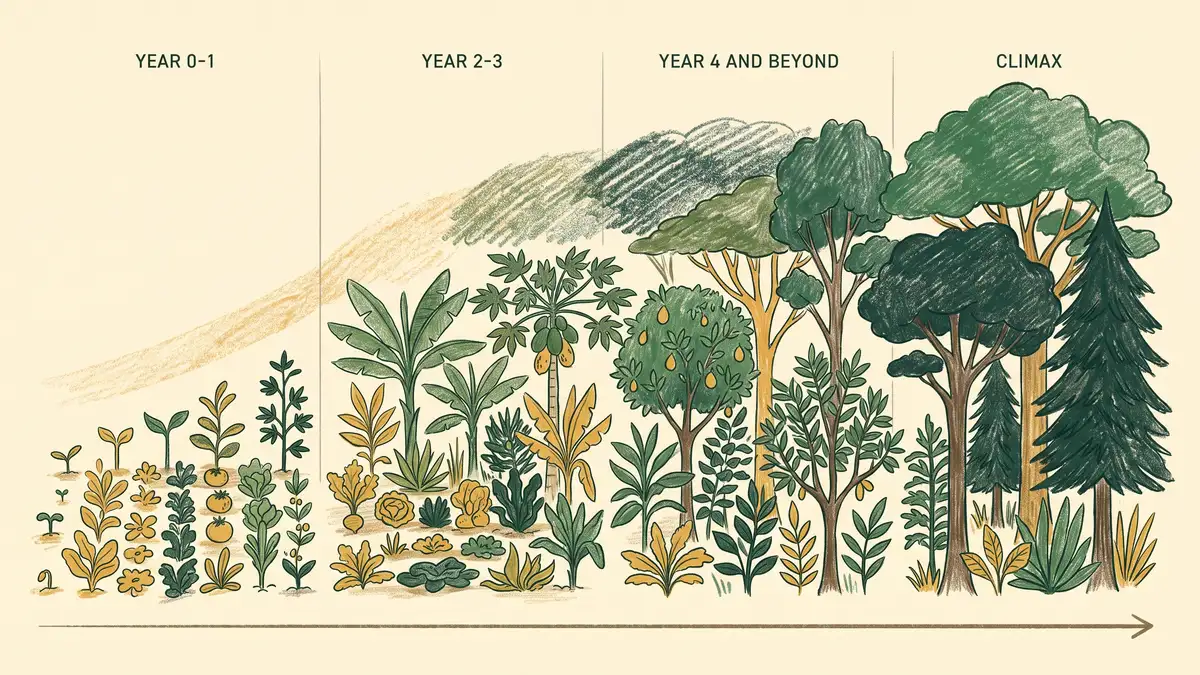
Two axes organise everything. The first is stratification: species are placed by their mature height into emergent, high, medium, and low strata so every light niche is filled. As Syntopia Agroforst describes it, successional cycles of placenta, secondary, and climax species nest within four layers. The second axis is succession: plants are sorted into placenta (short-lived pioneers, six months to three years), secondary (three to fifteen years), and climax (fifteen-plus years), planted together but destined to dominate in sequence.
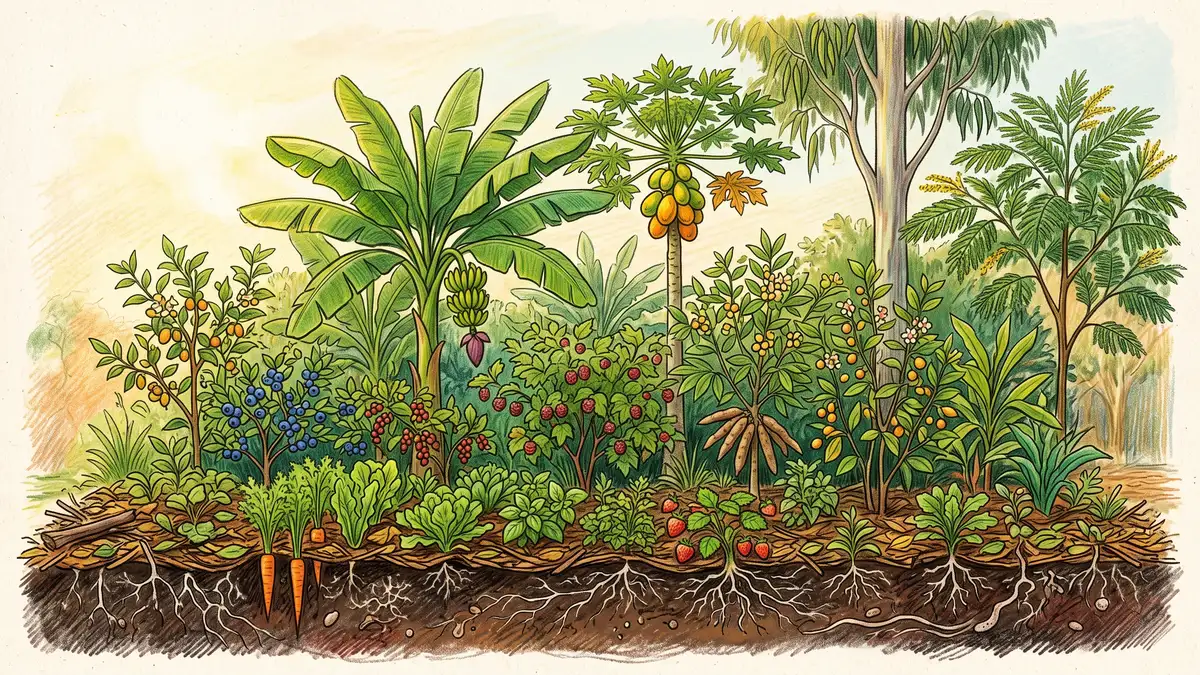
Why This Works: Syntropy, Not Inputs
Conventional farming fights entropy with external inputs, fertilizer, sprays, irrigation, replacing what the system leaks. Syntropic design instead stacks species and disturbance so the system accumulates order on its own: every layer captures light, every pruning feeds the soil, and complexity compounds. You are not feeding the plants, you are building the process that feeds them.
The Year 3 Threshold: Canopy Closes, Yields Arrive
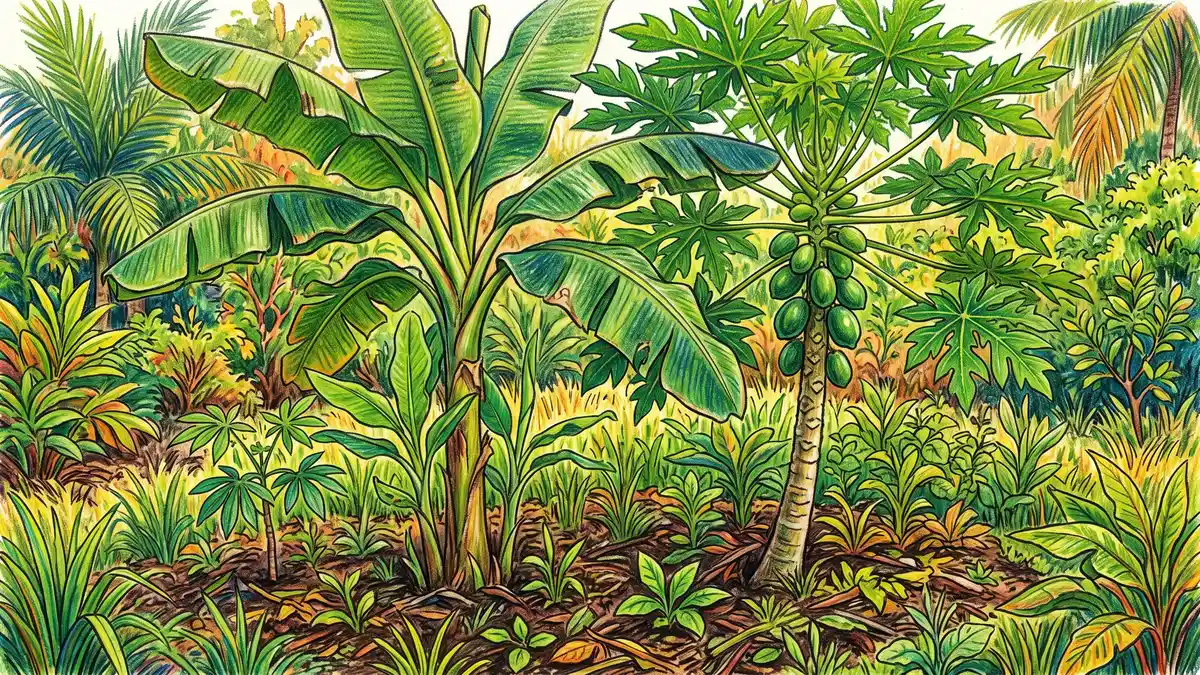
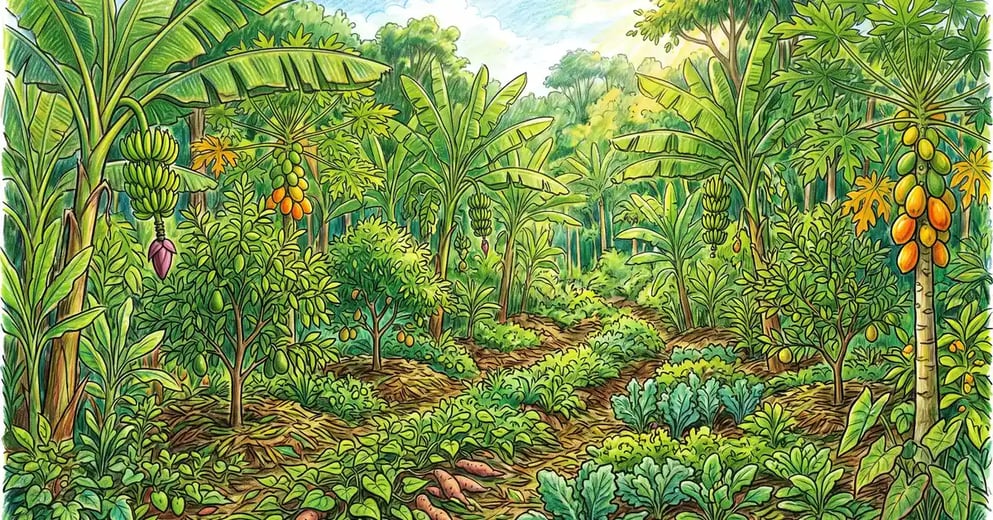
The visible signature of year 3 is canopy closure. Bananas (Musa spp.) and papaya (Carica papaya), planted in the original consortia, take twelve to eighteen months to reach productive size, so by years 2 to 3 they are carrying real yield while shading the soil for understory crops like cocoa (Theobroma cacao). Direct sun reaches the ground only through gaps, weed pressure collapses, and the plot stops looking like a crop field and starts looking like a forest garden.
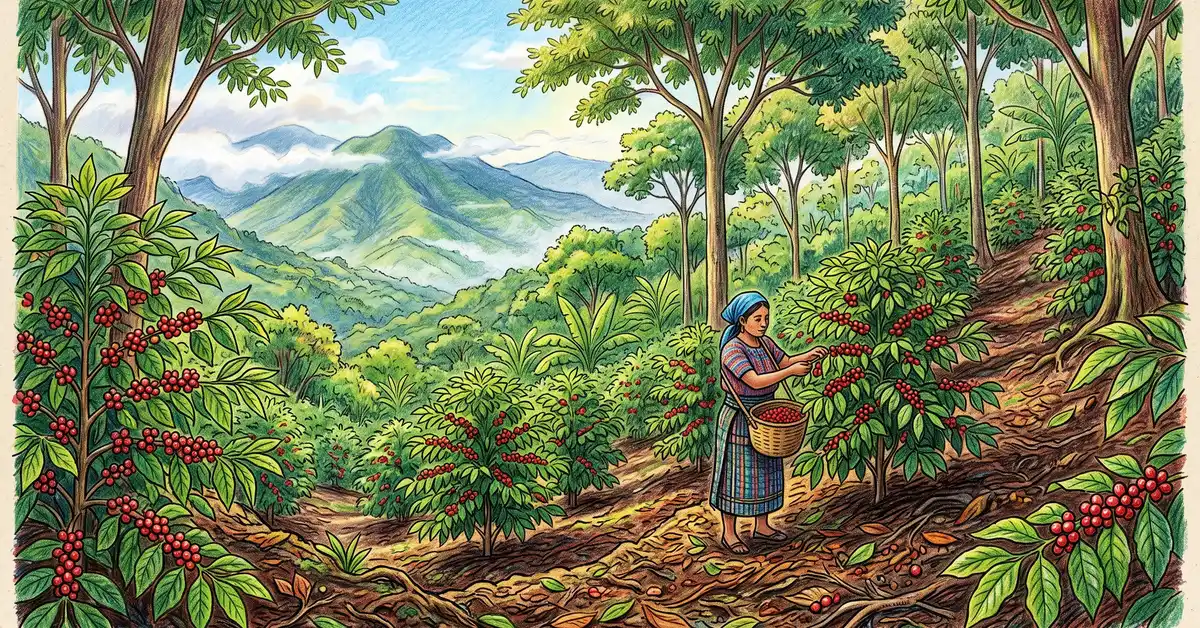
That transformation is only possible because of the early over-planting. Syntropic systems start at 1,200 to 3,000 individuals per hectare across 20 to 50 species, four to ten times the density of conventional cocoa cabruca, which the USDA documents at roughly 93 shade trees and 693 cacao plants per hectare. That deliberate excess is what pruning then sculpts into structure.
| Phase | Years | Dominant Species | What's Happening |
| Colonisation | 0-3 | Placenta pioneers, annuals | Rapid biomass, soil building |
| Accumulation | 3-15 | Secondary + young climax | Canopy closes, perennial yields |
| Abundance | 15+ | Climax trees | Self-regulating, full stratification |
Sources: Syntopia Agroforst, Mountaintime Farm, Principles of Syntropic Agroforestry.
Income shifts too. Annual crops carried years 1 and 2; now short-cycle perennials, bananas, papaya, early fruit, become the major yield channel, while cocoa may begin flowering but is not yet at full production. Our breakdown of placenta plants and fast biomass builders covers which pioneers do this heavy lifting.
Pruning Is the Driver, Not a Chore
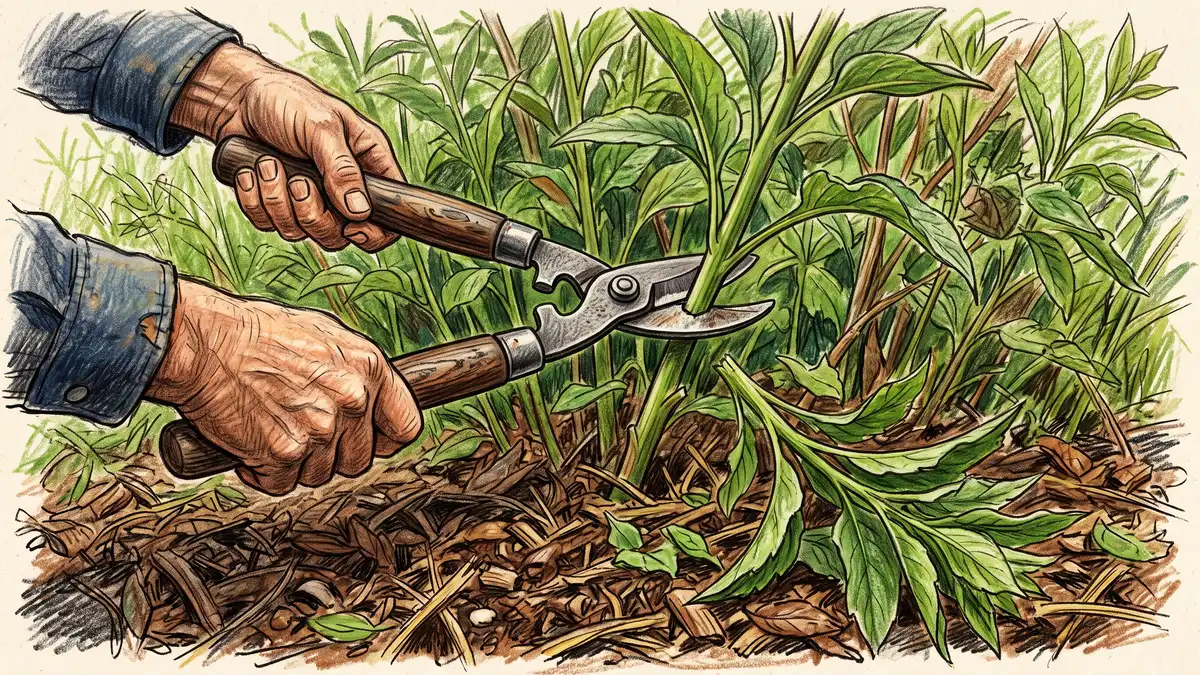
Gotsch's most quoted claim is that the most important tool in regenerative farming is not compost or cover crops but pruning shears. In syntropic systems, pruning is managed disturbance that mimics natural gap dynamics, and it is the primary engine of succession. Our guide to pruning in syntropic agriculture goes deep on the technique.
The physiology matters. Cutting 50 to 70% of a pioneer's biomass during vigorous vegetative growth strips apical buds and shifts the balance of auxins, gibberellins, and cytokinins, redirecting energy from reproduction into a flush of new leaves and roots. Each cut is a pulse: regrowth above, root turnover below, and a wave of microbial activity as the dropped biomass decomposes in place.
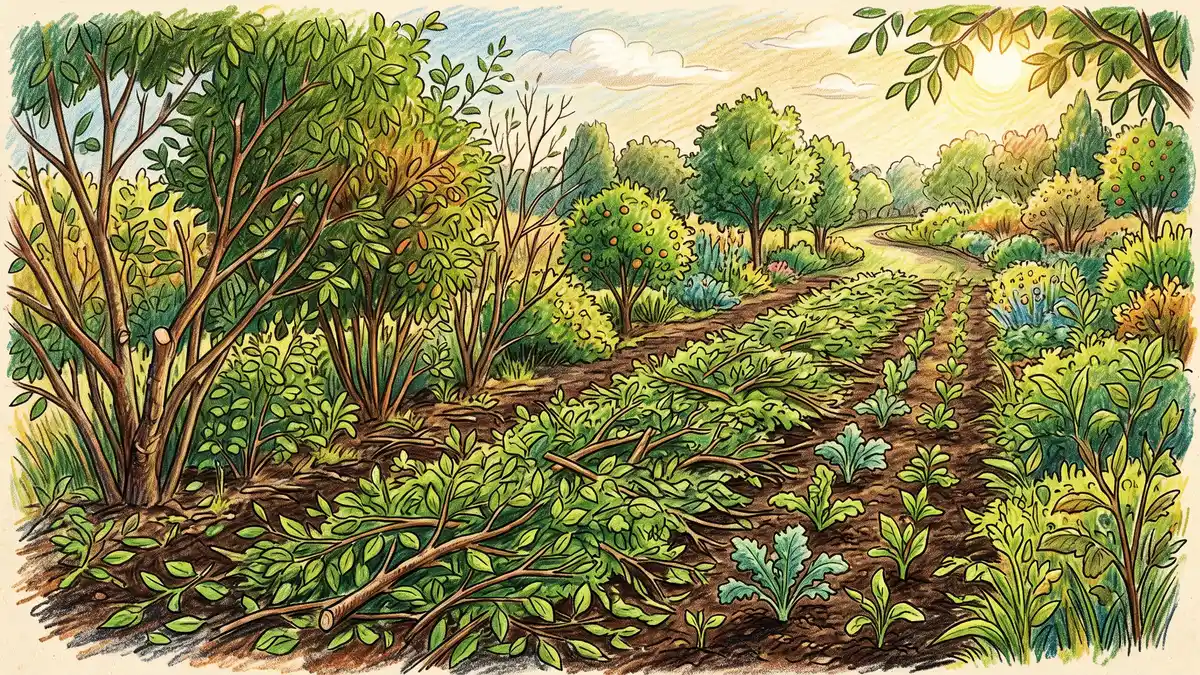
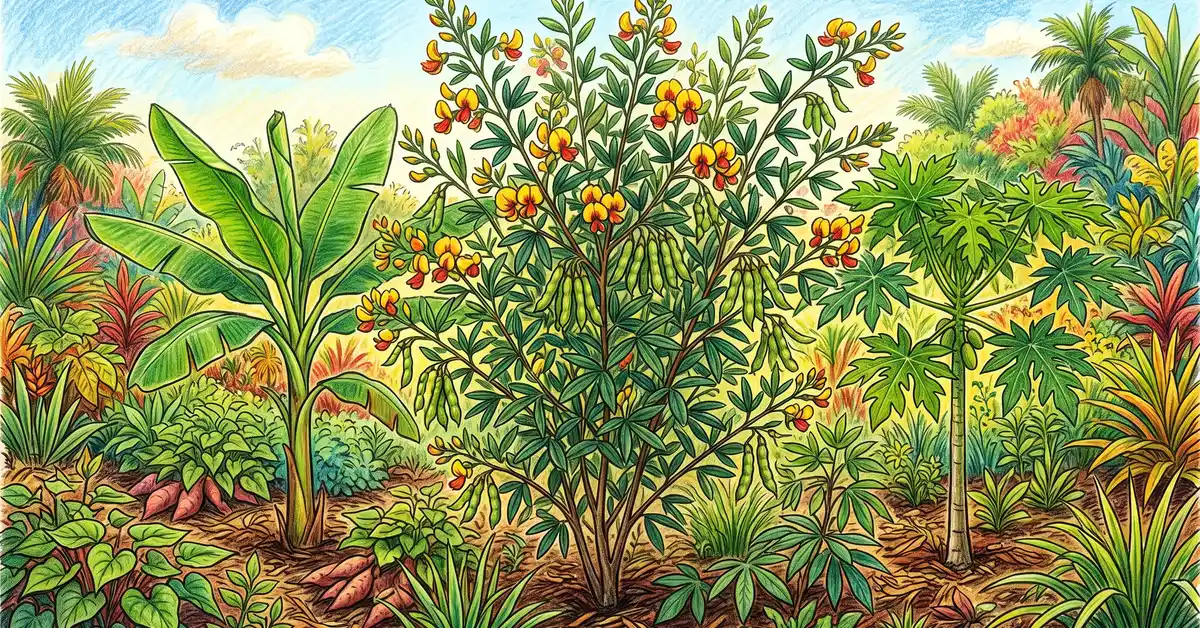
By year 3 the pruning regime differentiates by stratum. Pioneers like Inga edulis, pigeon pea (Cajanus cajan), and banana keep taking heavy cuts, 50 to 70%, two to four times a year. Secondary species like cocoa and citrus get gentler treatment, 20 to 40% once or twice a year, shaped for light and fruit rather than biomass. Climax trees are barely touched. A core rule: prune adjacent strata together so light resets across all layers at once, avoiding sudden shocks to shade-adapted crops. This is the same accelerated-succession logic behind succession planting the syntropic way.
The Year 3 Mistake: Shading Out Your Cash Crop
The most costly error at this stage is letting fast pioneers over-shade the medium stratum. Once the canopy closes, an un-pruned Inga or banana stand will starve young cocoa of light and stall it for seasons. Year 3 requires strategic crown management, opening light corridors, not the light, frequent trimming of year 1.
What the Soil and Numbers Show
The evidence base is real but still maturing. Peer-reviewed work confirms the direction: a 2026 study found early-stage successional agroforestry markedly improves soil organic matter, nutrient availability, and water-holding capacity versus monoculture, and González-Socorro and colleagues report that successional agroforestry enhances biomass carbon storage in cocoa systems. On carbon, Nair's foundational meta-analysis put tropical agroforestry sequestration at roughly 1.1 to 3.0 metric tons of carbon per hectare per year (about 0.45 to 1.2 tons per acre), with the highest rates in high-biomass, low-disturbance systems, exactly the syntropic profile.
Gotsch's own Fazenda Olhos d'Agua in Bahia is the long-running demonstration. Over roughly 40 years he restored more than 500 acres (200 hectares) of eroded pasture, and, as our deep dive on the science of syntropic farming details, soil organic matter climbed from about 1.5% to 5 to 7%, and cocoa yields reached 1.5 to 2.0 tons per hectare (1,300 to 1,800 pounds per acre) against a regional average of 0.4 to 0.8. Believe.Earth documents the most striking outcome: the system revived springs that had disappeared. A 2025 review by Jacobi and colleagues now formally frames syntropic farming systems as reconciling productivity, soil health, and climate benefits.
Key Takeaway
Be honest about the evidence: rigorous, long-term, syntropic-specific datasets are still emerging, and the headline Fazenda figures come from one exceptional site. But the mechanism, dense stratification plus disturbance driving biomass and carbon accumulation, is well supported by agroforestry science. Year 3 is the inflection point where that mechanism crosses from incremental to compounding, and where food-forest thinking becomes a working reality.
Frequently Asked Questions
What happens in year 3 of syntropic agriculture?
Year 3 is the transition from the colonisation phase to the accumulation phase in Ernst Gotsch's framework. The fast pioneer species that dominated the first two years are pruned back and subordinated, the canopy begins to close across the system, and short-cycle perennials like banana and papaya start producing meaningful yields. Weed pressure drops as shade and mulch build, the soil visibly darkens with accumulated organic matter, and the grower's labor shifts from intensive planting and light trimming toward heavier, more strategic pruning that steers the developing forest.
How long does a syntropic agroforestry system take to mature?
Syntropic systems are designed to evolve over roughly 10 to 20 years through three phases. Colonisation runs years 0 to 3, dominated by pioneers building soil. Accumulation spans roughly years 3 to 15, when secondary and young climax species define structure and perennial yields stabilize. Abundance begins around year 15, when climax trees dominate, stratification is complete, and the system becomes largely self-regulating with minimal input. Year 3 matters because it is the hinge between the first and second phases, when the system stops being a pioneer polyculture and starts behaving like a young forest.
Why is pruning so important in syntropic agriculture?
Pruning is the primary tool for accelerating succession. Cutting 50 to 70% of a pioneer's biomass during vigorous growth redirects the plant's energy from reproduction into new vegetative growth, triggering hormonal flushes of leaves and roots. The cut material is dropped in place as mulch, feeding soil organisms and building organic matter, while the opened canopy resets light for lower strata. In effect, each well-timed prune injects a pulse of energy and biomass into the system, which is why practitioners say the pruning shears do more than any bag of fertilizer.
What is chop-and-drop and why does it work?
Chop-and-drop means cutting branches or whole crowns of fast-growing species and leaving the material exactly where it falls, rather than removing or composting it elsewhere. The lignin-rich biomass decomposes in place around the root zones that need it most, feeding fungi and bacteria, building stable soil carbon, holding moisture, and suppressing weeds. Over repeated cycles it forms a deep, continuous mulch layer that mimics a forest floor. By year 3 the pioneers are large enough that each chop-and-drop event returns substantial biomass, which is what lets a mature syntropic plot self-fertilize without external inputs.
Do syntropic systems really outproduce conventional agroforestry?
The documented results are strong but come mostly from Ernst Gotsch's Fazenda Olhos d'Agua, where syntropic cocoa reportedly yields 1.5 to 2.0 tons per hectare against a regional Bahia average of 0.4 to 0.8, alongside soil organic matter rising from about 1.5% to 5 to 7%. Peer-reviewed studies confirm that successional agroforestry improves soil health and carbon storage compared with monoculture, so the direction is well supported. That said, long-term, replicated data specifically on syntropic systems is still emerging, so treat single-site figures as promising rather than universal, and expect performance to depend heavily on design and management skill.
Get the Weekly Dig
One practical permaculture guide a week, written for gardeners who do this on weekends: food forest and guild designs that produce. Free, no spam, unsubscribe any time.
Join the Weekly DigResources
- Agenda Gotsch: Ernst Gotsch's Syntropic Farming Official Site
- Syntopia Agroforst: Syntropic Agriculture (strata and succession)
- Mountaintime Farm: The Principles of Syntropic Agroforestry
- FiBL: Felipe Pasini and Dayana Andrade on Syntropic Agriculture
- Believe.Earth: Ernst Gotsch and the Restoration of Fazenda Olhos d'Agua
- USDA ARS: Cacao Cabruca Agroforestry System
- Early-Stage Successional Agroforestry Improves Soil Health (2026)
- Gonzalez-Socorro et al. (2026): Successional Agroforestry and Carbon Storage in Cocoa
- Jacobi et al. (2025): Syntropic Farming Systems for Reconciling Productivity and Soil Health
- Nair (2009): Soil Carbon Sequestration in Tropical Agroforestry Systems
- Monroe (2016): Soil Carbon Stocks Under Cacao Agroforestry Systems