
Who Is Ernst Götsch and Why Does Syntropic Farming Matter?
Ernst Götsch is the Swiss-born plant breeder who, since 1982, has restored about 1,200 acres (480 hectares) of degraded Atlantic Forest pasture in Bahia, Brazil, and built a farming system that produces cocoa, fruit, and timber while sequestering carbon at near-rainforest rates. If you have ever wondered whether a productive farm can also rebuild soil, return spring water to a dry valley, and shelter 200+ species on the same acre, Götsch’s work at Fazenda Olhos d’Água is the longest-running real-world answer. The method has real sceptics, and we set out the fair criticisms and rebuttals in a separate piece. If you are weighing syntropic farming against the other main forest-building school before you commit a plot to either, start with two ways to build a forest.
The reason his name keeps appearing in agroforestry, regenerative agriculture, and permaculture conversations is that he didn’t just plant trees. He formalised a method — syntropic farming — that treats ecological succession as the primary design tool, replaces all external inputs with on-site biomass, and plants 4 to 10 times the density of conventional agroforestry. Forty years of results have made the method credible enough that EMBRAPA (Brazil’s federal agricultural research agency) now studies it, and practitioners in Portugal, Spain, France, Mexico, and Belize have built farms on his principles.
This guide gives you Götsch’s biography in context, the four operational principles that distinguish syntropic farming from permaculture and conventional agroforestry, the documented outcomes from Fazenda Olhos d’Água, and the international sites where the method has been adapted to temperate climates.
What you’ll learn in this guide:
- The biographical arc that took Götsch from Swiss plant breeding to Brazilian agroforestry
- The four operational principles of syntropic farming — stratification, succession, density, and managed disturbance
- The documented numbers from Fazenda Olhos d’Água and what still needs independent verification
- How syntropic farming differs from permaculture in design driver, inputs, and timeline
- Where the method has been adapted outside Brazil and what works in temperate climates
Key Takeaway
Syntropic farming is not a faster permaculture or a denser agroforestry. It is a succession-driven, closed-loop, high-density system in which the farm is designed to mature toward a climax ecosystem over 10 to 20 years, with every input cycled in place. Götsch’s contribution is the protocol, not the principles — the principles come from forest ecology.
From Switzerland to Bahia: Ernst Götsch’s Path to Syntropic Farming
| Fact | Detail |
| Name and spellings | Ernst Götsch. Written Gotsch or Goetsch where the umlaut is dropped, and often misspelled Ernest Gotsch |
| Born | 14 January 1948, Raperswilen, Switzerland |
| Trained in | Genetic enhancement research at FAP Zürich-Reckenholz, the Swiss federal agricultural research station now part of Agroscope |
| First trials | Switzerland and Germany from 1974, then fieldwork in Namibia and Costa Rica |
| Moved to Brazil | 1982, to develop a cacao plantation in southern Bahia with a Swiss landowner |
| Farm | Fazenda Olhos d’Água, Piraí do Norte, southern Bahia, Brazil |
| Farm size | About 1,190 acres (480 hectares) as the initial area, per his own Agenda Gotsch project. Published figures differ: SWI swissinfo gave the farm as 120 hectares in 2023 |
| Known for | Syntropic farming, also called syntropic agroforestry or successional agroforestry. In Portuguese, agricultura sintrópica or agrofloresta |
| His own book | Break-Through in Agriculture (1995) |
| Film about the work | Life in Syntropy (2015), by Dayana Andrade and Felipe Pasini |
| Still active | Yes. He was 75 and working on how to mechanise large mixed cultures when SWI swissinfo profiled him in 2023, and he was billed to speak in person in Goshen, New York, on 21 March 2026 |
Sources: Agenda Gotsch, SWI swissinfo.ch, Cornell Cooperative Extension Orange County.
Götsch was born in 1948 in Raperswilen, a small Swiss village near the German border. He worked in genetic enhancement research at FAP Zürich-Reckenholz, the Swiss federal agricultural research station that is now part of Agroscope, and he went in intending to manipulate nature for human benefit. He left having concluded the opposite: that nature is the more intelligent party and the useful skill is learning to work with it. From 1974 he ran his own trials in Switzerland and Germany, and later worked in Namibia and Costa Rica. His early career inside conventional Swiss agriculture is what makes the rest of the story unusual: he had institutional credibility before he stepped outside the institution.
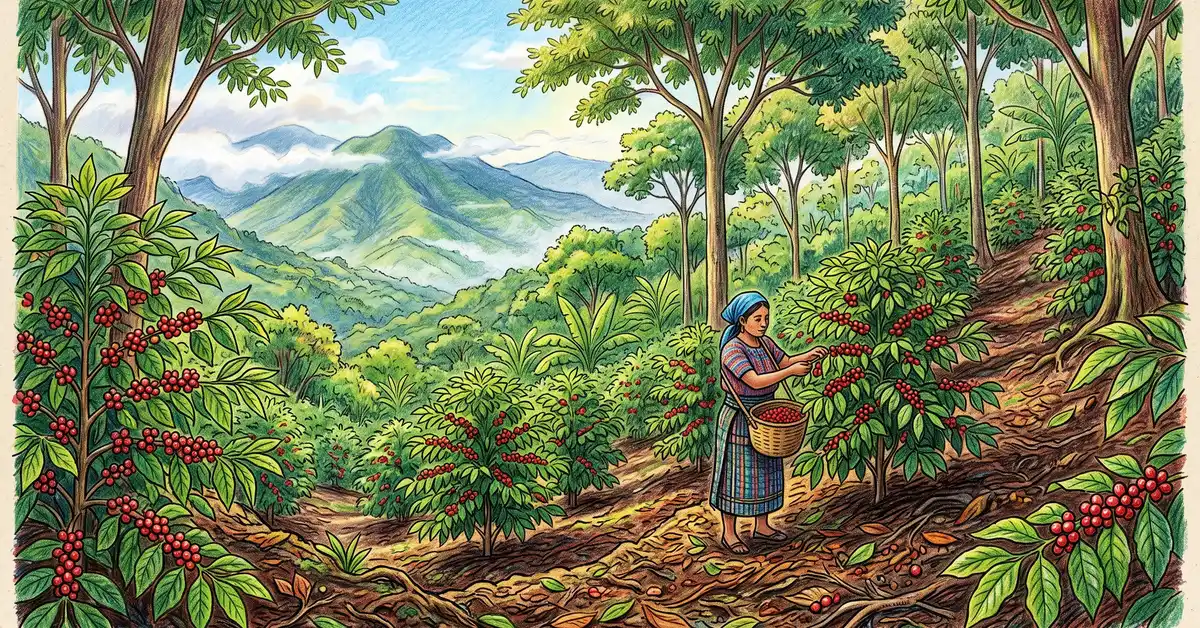
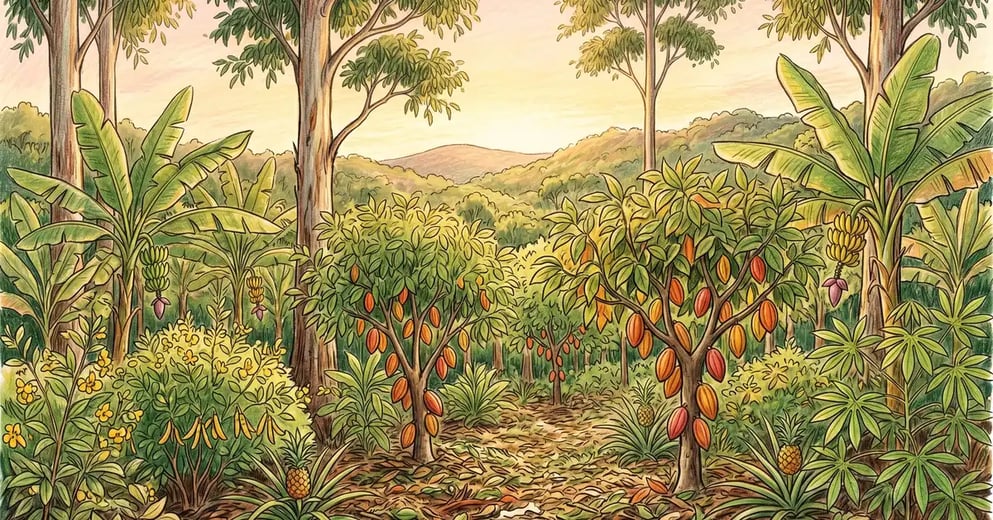
In 1982 he went to Piraí do Norte, in the southern cocoa belt of Bahia, to develop a cacao plantation with a Swiss landowner on roughly 1,190 acres (480 hectares) of degraded pasture. The land had been stripped of forest decades earlier, the springs had stopped running, and most of the topsoil had washed into the rivers. Conventional agronomy at that point would have prescribed lime, fertiliser, mechanical cultivation, and a single commodity crop. Götsch did the opposite. He planted hundreds of species per hectare, mimicking the structural and successional patterns of the surrounding Atlantic Forest, and refused to bring in external compost or mulch — everything the system needed had to be grown and cycled on site.
By the mid-1990s the farm was producing cocoa at yields well above the regional average, the springs had returned, and visiting researchers from EMBRAPA, UFV (Universidade Federal de Viçosa), and UFBA were beginning to take measurements. Götsch published Break-Through in Agriculture in 1995 and his methods spread through informal practitioner networks before Organic Consumers and the 2015 documentary Life in Syntropy, by Dayana Andrade and Felipe Pasini, brought the work to an international audience.
What Makes Syntropic Farming Different? The Four Operational Principles
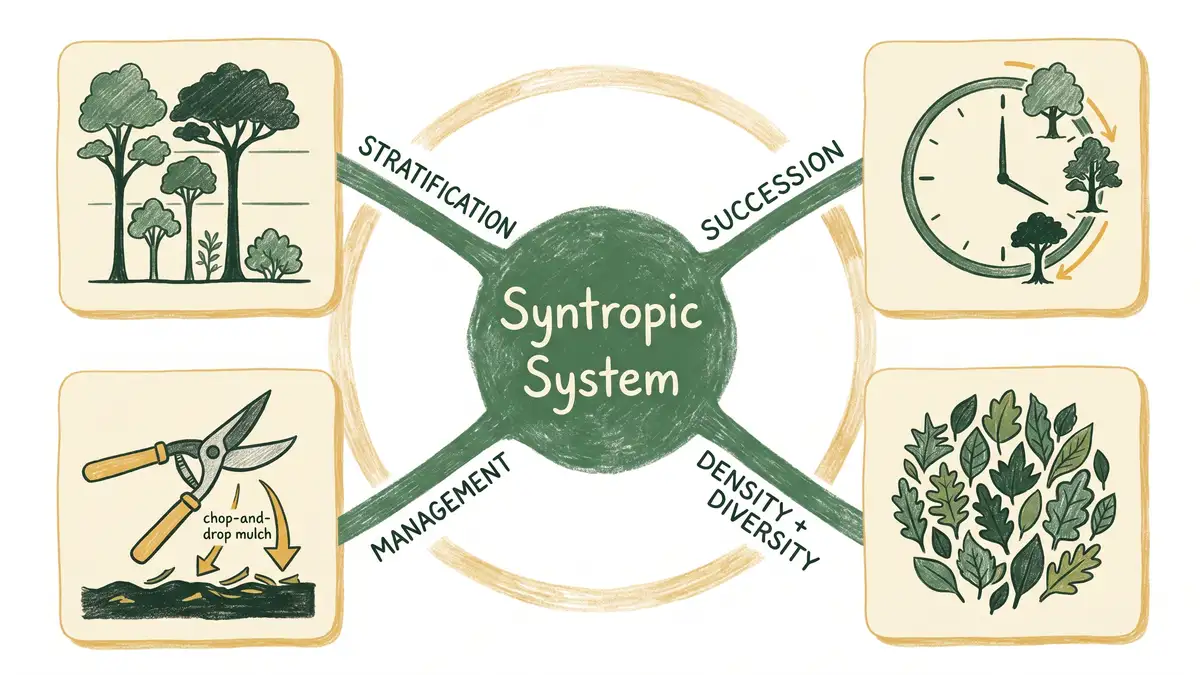
Syntropic farming rests on four principles that work together. Strip out any one of them and the system reverts to either conventional agroforestry or unstructured polyculture. According to ATTRA-NCAT, the National Sustainable Agriculture Information Service, what distinguishes the method is that all four operate simultaneously from year one.
Stratification — vertical layering
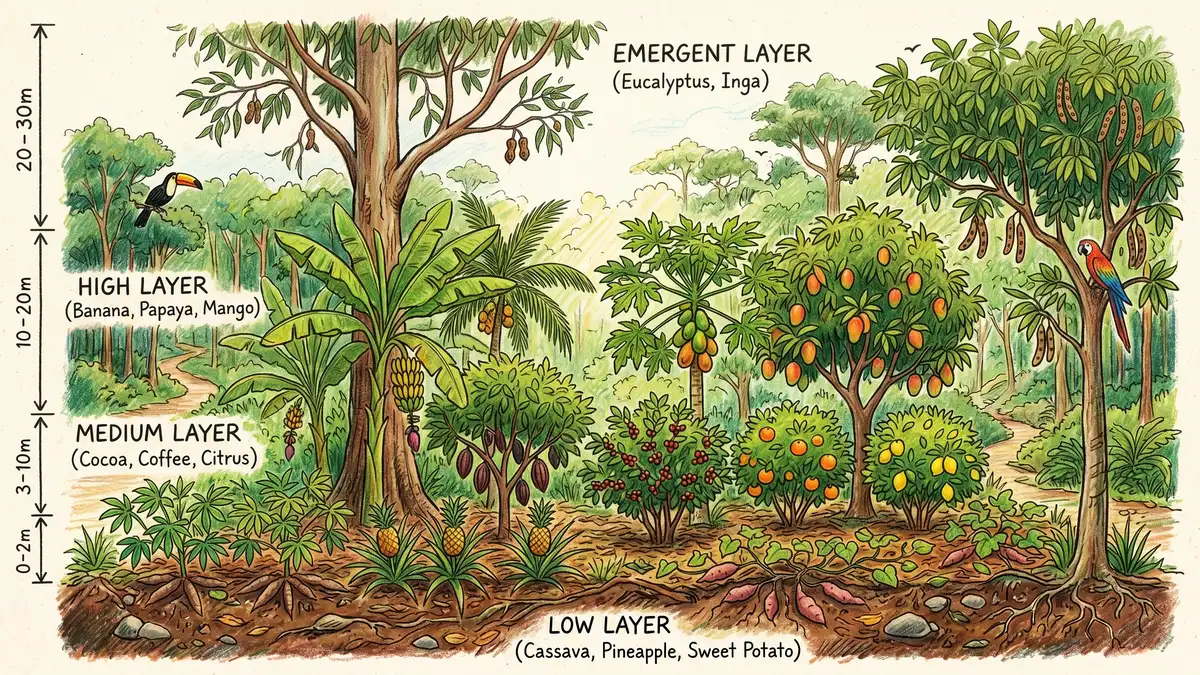
Plants are organised into 4 to 6 explicit canopy layers: emergent (80–130 ft / 25–40 m), high canopy (50–80 ft / 15–25 m), medium (25–50 ft / 8–15 m), low (6–25 ft / 2–8 m), ground (0–6 ft / 0–2 m), and the soil/fungal layer. Every layer must be filled simultaneously so that no light is wasted.
Succession — staged consortia
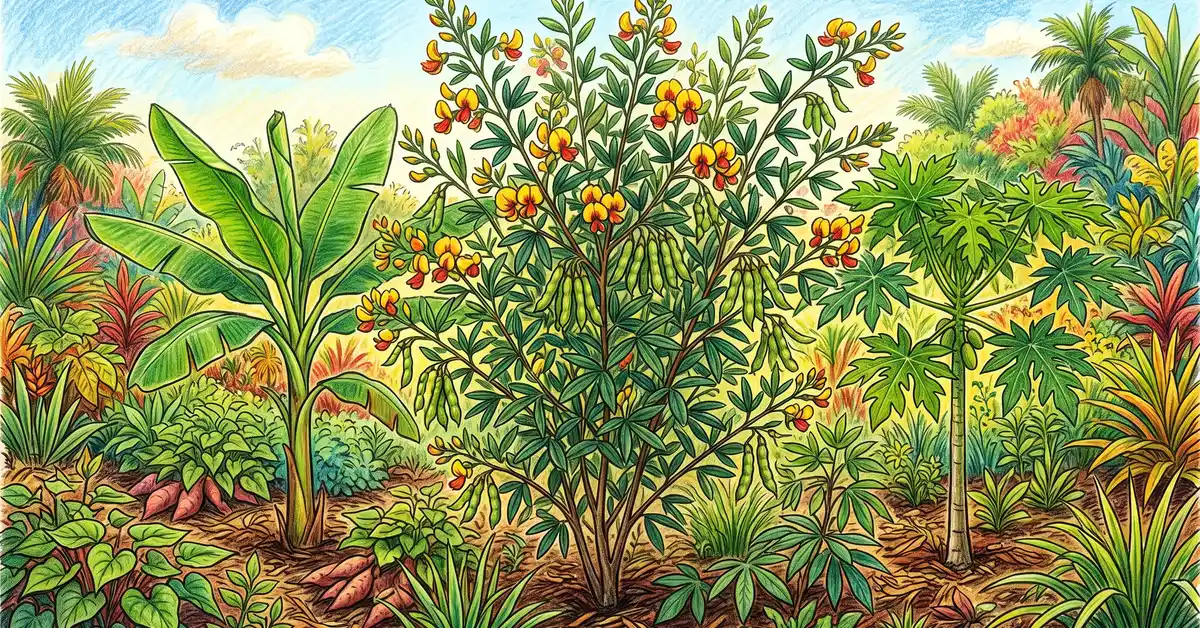
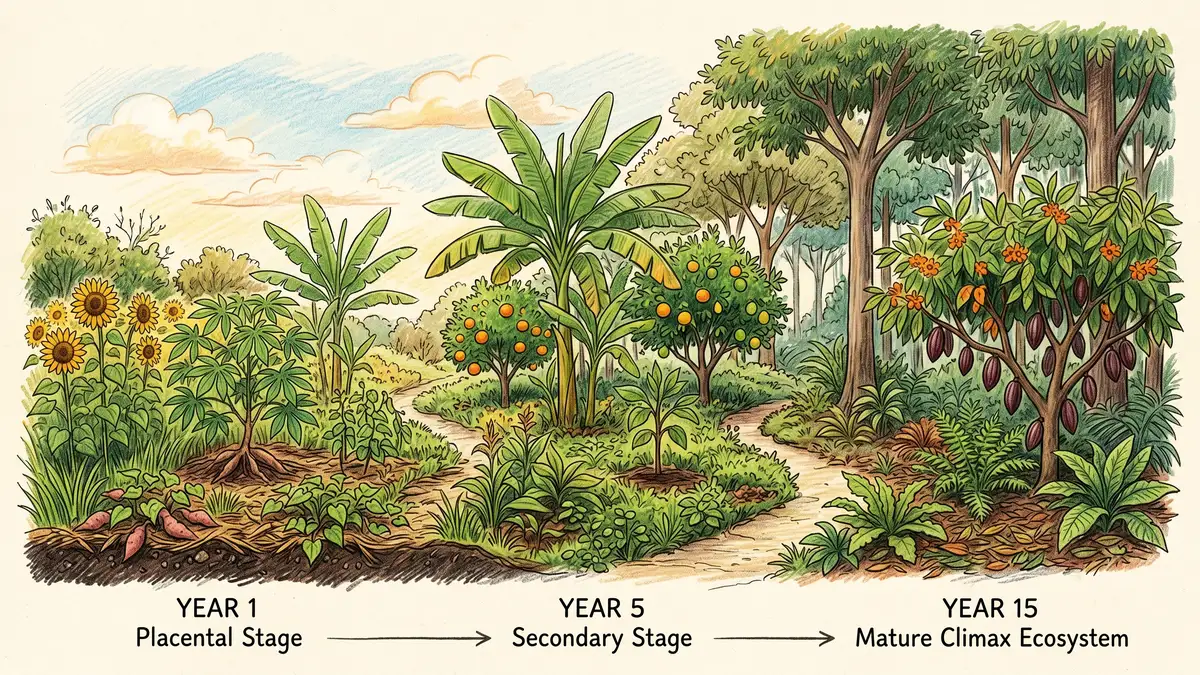
The system advances through deliberate stages: pioneer (Years 1–3, fast nitrogen-fixers and annuals), secondary (Years 3–10, perennial crops and shade trees), and climax (Years 10–20+, stable productivity, low labour). Each stage is a planned consortium that prepares the soil and microclimate for the next.
High density and high diversity
Plantings run at 1,200–3,000 individuals per hectare in Year 1 (vs. 300–600 for conventional cocoa-cabruca), thinning to 600–1,000 by maturity. Species counts reach 20–50 per hectare versus 3–5 in conventional shade systems. Density closes the canopy fast and shuts out weed pressure without herbicide.
Managed disturbance — chop-and-drop
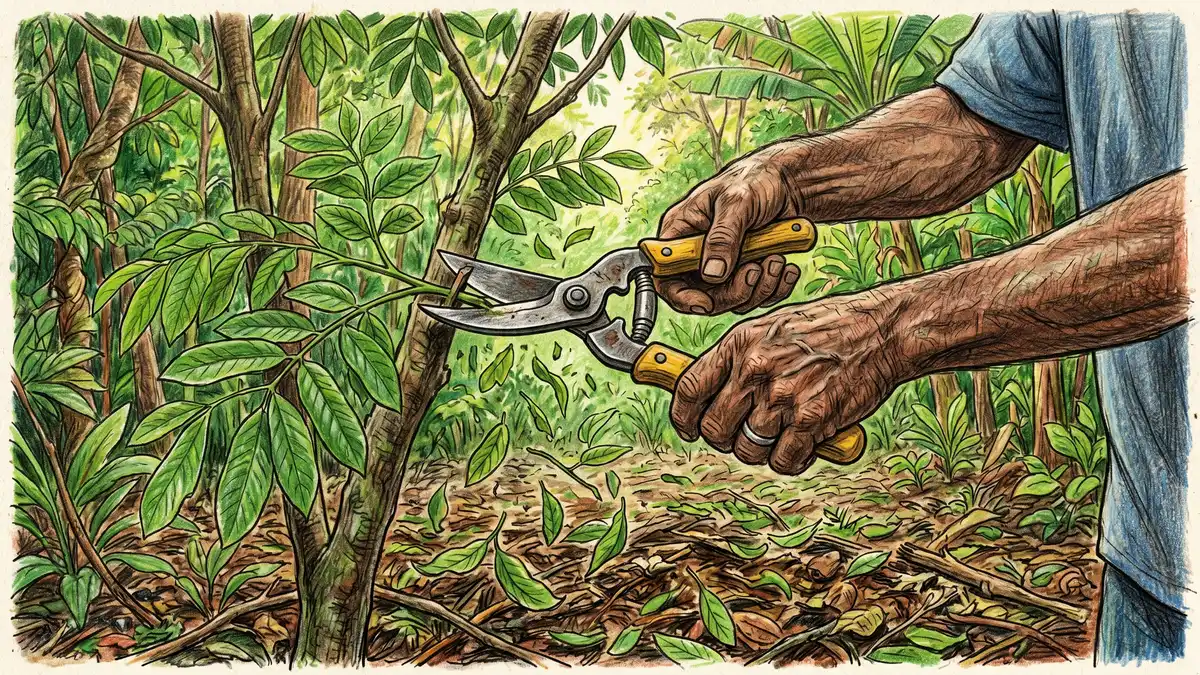
No external compost, mulch, or fertiliser enters the system. Selective pruning every 6–12 months in the secondary stage and annually in the climax stage cuts fast-growing species and drops the biomass in place. This mimics natural forest gap dynamics and feeds the soil food web continuously. Chop-and-drop mulching is the operational core of the closure principle.
The Numbers from Fazenda Olhos d’Água
The most cited outcomes from Götsch’s farm are documented in EMBRAPA field visits, university theses, and the Prince Albert II of Monaco Foundation project record on the broader Olhos d’Água water-source restoration programme. Several of the carbon and yield figures still need peer-reviewed confirmation in English-language journals; the dossier below flags those caveats.
| Metric | Reported Value | Comparison / Baseline |
| Cocoa yield (syntropic) | 1.5–2.0 t/ha (1,300–1,800 lb/acre) | 0.4–0.8 t/ha regional Bahia average |
| Soil organic matter (Year 10+) | 5–7% | 1.5% degraded pasture baseline |
| Carbon sequestration (mature) | 20–30 t C/ha/year | Comparable to primary forest regrowth |
| Spring water restoration | Year-round flow returned | After 12 years of dry-season cessation |
| Microclimate cooling | 1–3°F (1–3°C) lower | vs. adjacent monoculture pasture |
| Species richness | 200–300 species | Trees + understory; site biodiversity survey |
Sources: ATTRA-NCAT on soil and farm restoration, the Prince Albert II of Monaco Foundation project record for the water-source work, and the farm profile at Organic Consumers. The carbon and yield rows come from EMBRAPA field reports and Portuguese-language theses, not from peer-reviewed English-language journals; see the FAQ below.
Why This Works: Succession-as-Design
Conventional agroforestry treats the farm as a stable system you maintain. Permaculture, in the Mollison and Holmgren tradition, designs around zones, sectors, and client needs — succession is acknowledged but not the primary design tool. Götsch’s key insight is that you can compress and direct ecological succession the way a plant breeder directs genetic selection. Every species in a syntropic plot is chosen for the role it plays in moving the system from disturbed soil toward climax forest. The farm is a trajectory, not a snapshot.
Syntropic Farming vs Permaculture: A Practitioner’s Comparison
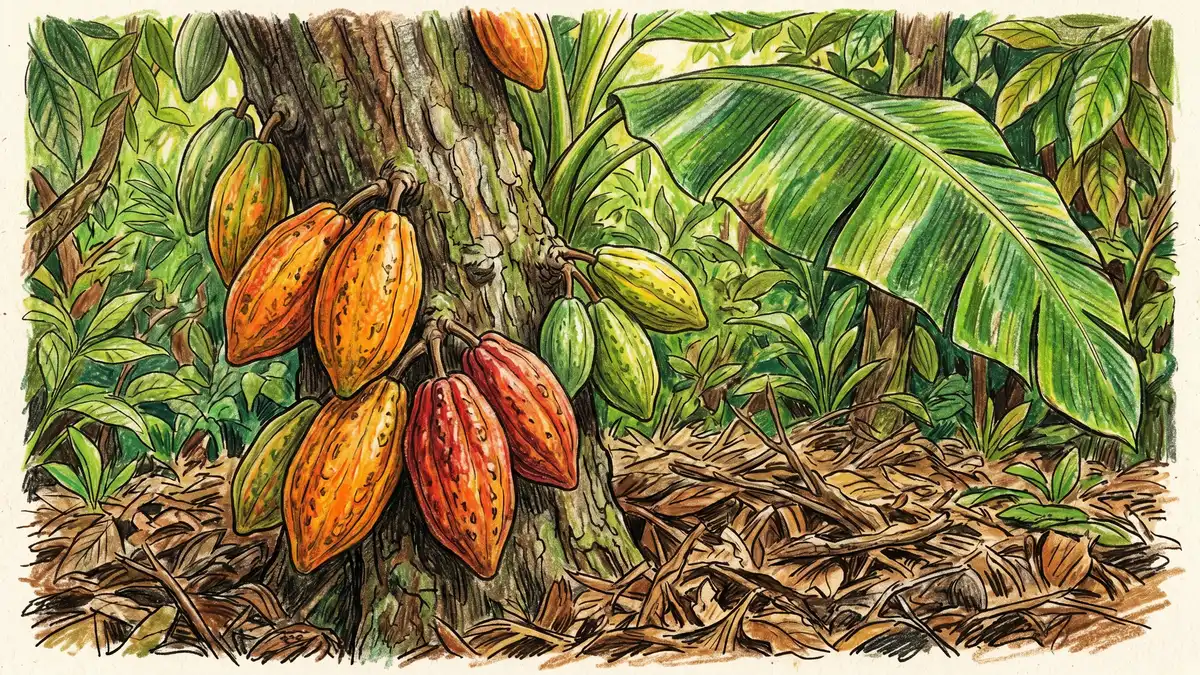
Practitioners moving from a permaculture background usually notice the operational differences before the philosophical ones. The first is that a syntropic plot looks chaotic in Year 1 and 2 — the density, the deliberate use of pioneer species you’ll later cut, and the absence of mulch from off-site — all of this can feel undisciplined to someone trained on Mollison’s zone diagrams or Holmgren’s twelve principles. The discipline is just on a different time axis.
The comparison below is drawn from Syntropia (Australia) and Lancaster Farmland Trust, both of which work with practitioners running both systems.
| Dimension | Syntropic Farming | Permaculture |
| Primary design driver | Succession + climax trajectory | Zones, sectors, client needs |
| Planting density | 1,200–3,000/ha initial | Variable; typically 1–2x conventional |
| External inputs | Zero (closed-loop chop-and-drop) | Often imports compost, mulch, manure |
| Pruning cycle | Systematic, every 6–12 months | Lighter, often reactive |
| Timeline | Explicit 10–20 year design arc | Implicit; emerges over time |
| Soil disturbance | Minimal post-establishment | Light; varies with method |
Sources: Syntropia (Australia) and Lancaster Farmland Trust, both of which work with practitioners running the two systems side by side.
The practical implication for someone designing a plot today is that the two systems answer different questions. Permaculture asks how should this whole property be arranged so it serves the people and animals who use it? Syntropic farming asks how should this single plot be sequenced so it builds toward a productive climax forest? A full design can use both — permaculture for the property scale, syntropic for the production beds. For a deeper side-by-side, see our syntropic agriculture vs permaculture comparison.
International Adoption: Syntropic Farms Beyond Brazil
The first generation of non-Brazilian syntropic farms is now 5 to 15 years old. Las Cañadas in Veracruz, Mexico is the largest documented site outside Brazil — more than 200 hectares of syntropic cocoa, coffee, and fruit, run by the Instituto de Visión Larga Plazo and used as a training centre for Latin American practitioners. Quinta dos Sete Nomes in Cova da Beira, Portugal demonstrates that the method works in a temperate Iberian climate with chestnut, berry, and perennial consortia.
Other documented sites include La Junquera (Andalucía, Spain) with citrus and stone-fruit consortia, several smallholder trials across the Cévennes in southern France, and IFOAM-affiliated cacao projects in the Toledo District of Belize. The Instituto Terra network in Brazil tracks much of this expansion alongside its own Atlantic Forest work, and the Yale Forum on Religion and Ecology has documented the conceptual transfer.
How far the method has actually travelled is partly measurable. An academic thesis covering 1993 to 2018 counted more than 4,000 farmers, around 3,500 families and almost 2,000 other people who had taken up the method; Götsch’s own estimate, given to SWI swissinfo in 2023, is above 10,000 farmers. And the temperate question now has an institutional answer: Cornell Cooperative Extension, billing his March 2026 talk in New York, records that he has applied the system in temperate ecosystems across the Mediterranean, western Europe and even northern Europe, though his best-known sites remain tropical and subtropical.
Common Misconception to Avoid
A syntropic farm is not a natural forest. It is intensively managed: continuously pruned, strategically thinned, and actively redesigned as the system advances through succession. If you walk away from a syntropic plot expecting it to maintain itself like a wild ecosystem, the pioneer species will dominate and the climax trajectory will stall. The closure principle — no external inputs — only works because the management is constant.
Key Takeaway
Götsch’s contribution is a method that is climate-agnostic but locally implemented. The principles transfer to temperate sites, but the species consortia, pruning calendar, and time-to-climax all need local adaptation. Plan on 15–25 years to climax in temperate zones versus 10–15 in the tropics, and budget for more pruning passes in the first five years.
Get the Weekly Dig
One practical permaculture guide a week, written for gardeners who do this on weekends: food forest and guild designs that produce. Free, no spam, unsubscribe any time.
Join the Weekly DigWhere to Read Götsch’s Own Work: The Books, the Free Guide, and the Film
Searches for Götsch’s writing keep landing on the wrong object, because the best-known book with his name on the cover is not by him. Four different things get conflated, so here they are separated.
| Title | Who wrote it | What it actually is |
| Break-Through in Agriculture (1995) | Ernst Götsch | His own short account of the first Bahia results, and the text most later citations trace back to. Hard to find in English |
| Syntropic Agriculture According to Ernst Götsch | José Fernando dos Santos Rebello and Daniela Ghiringhello Sakamoto | Not written by Götsch. A practitioner handbook about his method, now in an English edition (ISBN 978-989-3571-90-3). This is the book most people mean when they search his name and the word book |
| Syntropic Farming: A Form of Regenerative Agroforestry | Compiled by practitioners, reviewed by Götsch but, by the guide’s own disclaimer, not edited by him | The free field guide written for smallholders in rural Haiti, using hand tools only. The most practical free PDF in circulation and the one to start with |
| Life in Syntropy (2015) | Dayana Andrade and Felipe Pasini | The short film shot at Olhos d’Água and other sites, made for an international audience and free to watch |
Sources: the English edition listing, Life in Syntropy (full film), and the disclaimer page of the Syntropic Farming guide itself.
If you want Götsch unmediated, the honest answer is that there is not much of it in English. He has published very little under his own name, teaches mostly in person and largely in Portuguese, and his official outlet is Agenda Gotsch, his media and training arm. That gap is why the practitioner handbooks and the film carry most of the method’s reach outside Brazil, and why so much of the English-language material is second-hand.
Frequently Asked Questions
Is Ernst Götsch still alive, and is he still teaching?
Yes. Götsch was born on 14 January 1948, which makes him 78 in 2026. SWI swissinfo profiled him at 75 in 2023, still chewing on the problem of how to mechanise large mixed cultures, and Cornell Cooperative Extension billed him to give an in-person talk on syntropic agroforestry in Goshen, New York, on 21 March 2026. He works through courses, lectures and consulting for public, private and third-sector projects rather than running a formal institute, and enquiries go through Agenda Gotsch.
Where is Ernst Götsch’s farm located?
Fazenda Olhos d’Água sits in the municipality of Piraí do Norte, in the southern cocoa belt of Bahia state, north-eastern Brazil. The site originally totalled around 1,200 acres (500 hectares) of degraded Atlantic Forest pasture when Götsch acquired it in 1982. The farm is part of the broader Olhos d’Água water-source restoration project, which also protects roughly 50 springs across the surrounding watershed. Visits are by invitation through Agenda Gotsch, Götsch’s training and media arm. For our overview of how syntropic systems are built from the ground up, see our complete introduction to syntropic agriculture.
What is the difference between syntropic farming and agroforestry?
Conventional agroforestry pairs one or two commodity crops with a shade tree (cocoa-cabruca, for example) at densities of 300–600 plants per hectare and treats the system as static after establishment. Syntropic farming uses 4 to 10 times that density, plants 20–50 species per hectare in 4 to 6 explicit canopy layers, and is designed to advance through pioneer, secondary, and climax stages over 10 to 20 years. The closure principle — no external compost, mulch, or fertiliser — is also distinct: every nutrient must be cycled in place via chop-and-drop pruning.
Can syntropic farming work in a temperate climate?
Yes, with two adjustments. Temperate sites in Portugal, Spain, France, and the United States have demonstrated viability with chestnut, hazelnut, berry, and stone-fruit consortia. The first adjustment is the species mix, which has to draw on locally adapted pioneer, secondary, and climax species rather than tropical analogues. The second is the timeline: temperate systems typically take 15 to 25 years to reach a productive climax, compared to 10 to 15 in the tropics, because growth rates are slower. The four operational principles — stratification, succession, density, and chop-and-drop — do not change.
How is the carbon sequestration claim of 20–30 t C/ha/year measured?
The figure is reported from Fazenda Olhos d’Água in mature plots (Year 10+) and is comparable to primary Atlantic Forest regrowth rates measured by EMBRAPA. As of 2026 it has not been independently confirmed in a peer-reviewed English-language meta-analysis — most of the underlying data sits in EMBRAPA field reports and Portuguese-language MSc and PhD theses at universities like UFV and UFBA. Carbon flux towers and radiometric soil-carbon validation are the standard verification tools, and several university-based monitoring projects on syntropic sites in Brazil and Mexico are ongoing.
How do I start practising syntropic principles in my own garden?
Start with one bed, not the whole property. Choose a 4×8 ft (1.2×2.4 m) area with full sun, plant a pioneer consortium dense enough to close the canopy in one season (radish, mustard, fava bean, sunflower), and add at least one secondary-stage perennial fruit or nut species. If that ground is compacted pasture or old lawn, open it once without turning it over, which is exactly the job a broadfork sized to your bed width does: the tines lift and fracture the profile so roots and water can get down, while the soil layers stay in the order the biology built them. After that first pass you should not need to dig the bed again. Practise the pruning discipline from the start: every six months, cut the fastest-growing pioneer species at the base and drop the biomass on the soil. The core skill is reading the ecological signals — once a layer is being shaded out by the next, it is ready to be cut and replaced. For the food-forest layer logic that pairs naturally with syntropic stratification, our guide to the seven layers of a food forest is a useful adjacent read, and our primer on natural succession walks through the staged consortia.
Resources
- Organic Consumers — Olhos d’Água Farm: profile of Götsch’s farm and 1995 Break-Through in Agriculture
- Prince Albert II of Monaco Foundation — Olhos d’Agua water-source recovery project
- ATTRA-NCAT — How Syntropic Agriculture Restores Soil and Farms
- Yale Forum on Religion and Ecology — Syntropic Farming & Agroforestry
- Lancaster Farmland Trust — A Beginner’s Guide to Syntropic Farming
- Bosque de Niebla — Syntropic Farming: A Form of Regenerative Agroforestry (PDF)
- Syntropia (Australia) — What Is the Difference Between Syntropic Farming and Permaculture?
- Instituto Terra — Where It All Began: the forest that grew out of a dream
- Agenda Gotsch: Götsch’s official project and training site, with his own articles
- SWI swissinfo.ch: Swiss agronomist turns monoculture into organic farming (2023 profile, adoption figures)
- Cornell Cooperative Extension Orange County: Introduction to Syntropic Agroforestry, talk by Ernst Götsch, 21 March 2026
- Life in Syntropy (2015): the full short film by Dayana Andrade and Felipe Pasini