
You plant a young apple tree. You expect it to grow. Two years later it is barely taller than it was the day it went in the ground, the soil around it is hard and bare, and weeds keep showing up where you wish your tree were thickening up. Something is missing. biomass species for zones 8b to 9
What is missing is the placenta.
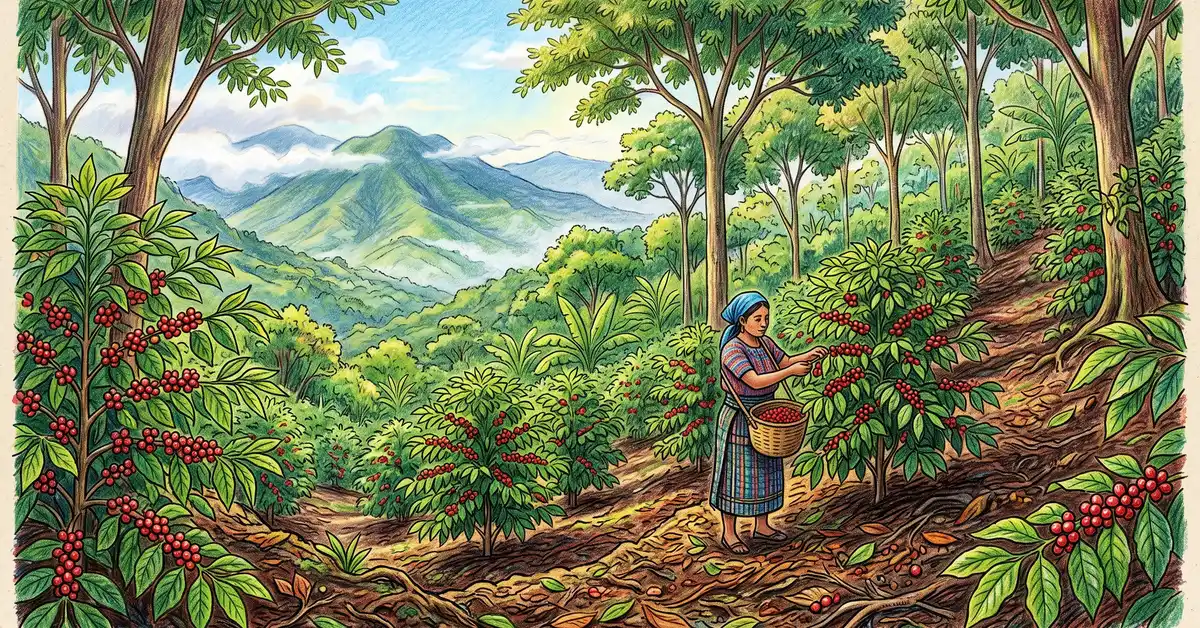
In syntropic agriculture, the regenerative agroforestry method developed by Swiss farmer Ernst Götsch in Brazil, the trees and crops you actually want to harvest are never planted alone. They are planted inside a thick consortium of fast-growing companion species called placenta plants, named after the biological placenta because they nourish and protect the young trees that will replace them later. Get the placenta right and a young food forest builds soil, retains water, and reaches productivity in 4 to 5 years instead of 15 to 20.
This guide explains what placenta plants are, the role they play in Götsch's stratification and succession system, which species work in the original Brazilian context, the temperate substitutes that work in US climates, how to prune them, and the most common mistakes practitioners make. Every number here is sourced from Agenda Gotsch's own teaching materials, Embrapa research, and published cost-benefit analyses of syntropic farms.
The short answer
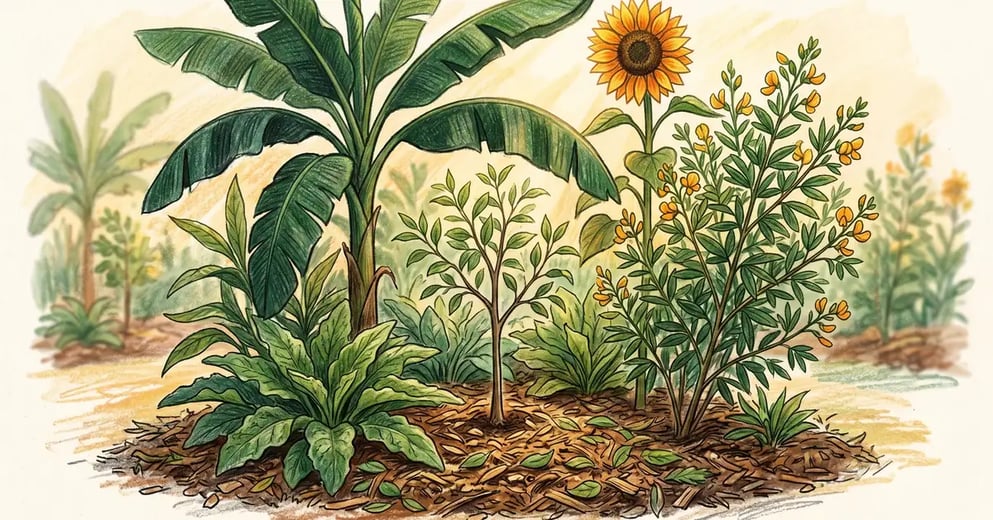
Placenta plants are fast-growing biomass producers (pigeon pea, banana, sun hemp, mucuna in tropical Brazil; comfrey, sunflower, jerusalem artichoke, alder, willow, hazel in temperate US climates) that you plant densely around young trees in a syntropic system. They feed the soil, shade out weeds, and create the microclimate young trees need. You chop them down to the ground every 6 to 12 months and let the biomass become mulch. Then you replace them with the next successional layer.
What placenta plants actually do
In a syntropic system, every plant has a function in time and a function in space. The function in time is its successional role: pioneer, secondary, climax. The function in space is its vertical strata: low, medium, high, emergent.
Placenta plants live at the intersection of "early successional" and "every strata." They are the first wave of life that colonizes a disturbed area, and they are deliberately spread across the canopy layers so the entire vertical structure of the future forest is occupied from day one. Their job, according to Agenda Gotsch's life cycle teaching, is to do four things at once:
First, produce biomass. Lots of it. Dense placenta consortia in tropical syntropic systems generate 30 to 80 tonnes of fresh organic matter per hectare per year. That biomass becomes mulch through chop-and-drop pruning, feeding the soil microbiome and lifting organic matter by 1 to 3% over 5 to 10 years.
Second, capture sunlight that would otherwise hit bare soil. The syntropic rule is that the soil should almost never see direct sun. Placenta plants make that rule possible during the early years before the target trees grow large enough to do the shading themselves.
Third, manage water. Their root systems create channels for infiltration, their canopies slow rainfall impact, and their dead biomass holds moisture like a sponge.
Fourth, regulate the microclimate. Placentas buffer extreme temperatures, raise local humidity in dry seasons, and break drying winds that would otherwise stress young fruit tree seedlings.
Why this works (the syntropic insight)
Conventional orchards plant a young tree, mulch around it, and then weed religiously to keep "competition" out. Syntropic agriculture flips the assumption: the bare patch is the problem, not the so-called competition. Other plants growing tightly around your fruit tree are not stealing resources, they are creating the soil ecosystem that will let the tree thrive in three years. The placenta layer is how you imitate the way an actual forest builds itself. Nothing in a forest grows alone, and trees that grow alone in monoculture orchards need irrigation, fertilizer, and herbicide to compensate for the missing community.
Where placentas sit in the syntropic strata system
Götsch's classification, formalized in the Agenda Gotsch natural succession framework, uses four vertical strata for any given climate:
| Strata | Light requirement | Mature height | Tropical example placentas | Temperate example placentas |
| Emergent | Full sun, dominant canopy | Over 80 ft (24 m) | Inga edulis, fast eucalyptus species | Black alder, hybrid poplar, willow |
| High | Full sun, secondary canopy | 30 to 80 ft (9 to 24 m) | Gliricidia, papaya, leucaena | Birch, hazel, mulberry, robinia |
| Medium | Partial sun | 10 to 30 ft (3 to 9 m) | Banana, pigeon pea | Elderberry, autumn olive, siberian pea shrub |
| Low | Shade tolerant | Under 10 ft (3 m) | Cassava, mucuna, sun hemp, sweet potato | Comfrey, sunflower, jerusalem artichoke, daikon, fava bean |
Sources:.
The original Brazilian placenta plants
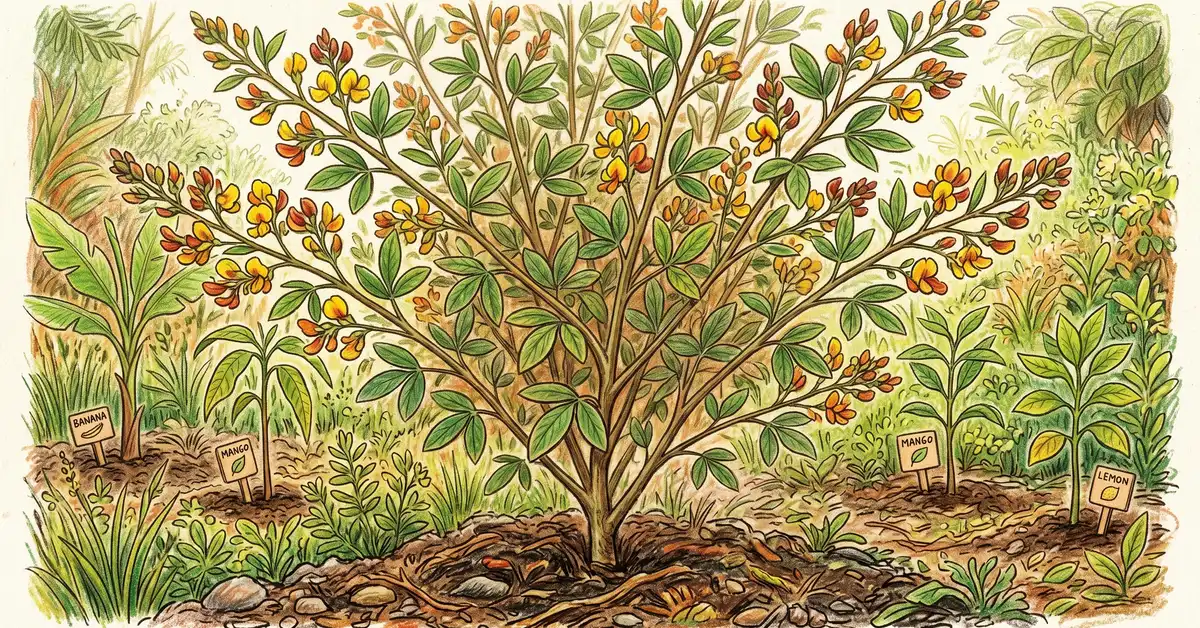
Götsch's original work happened in southern Bahia, in the humid tropical Atlantic Forest biome. The placenta species he selected reflect that context: nitrogen-fixing legumes, fast biomass producers, and short-cycle food crops that pay back the planting effort.
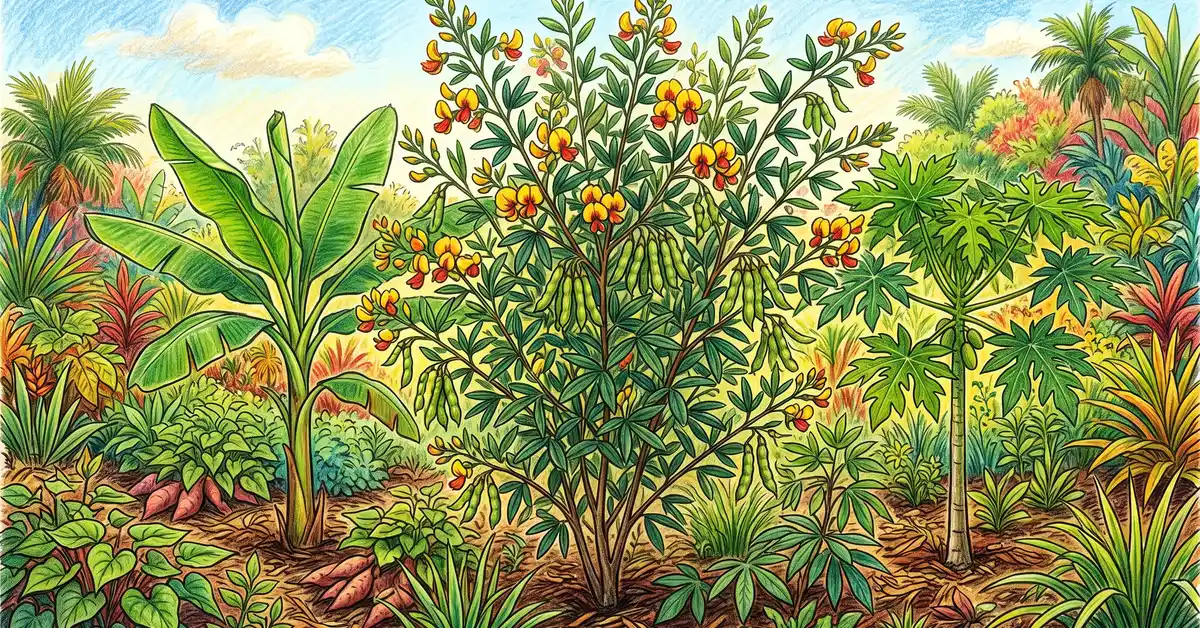
Pigeon pea (Cajanus cajan). The single most-used placenta in tropical syntropic systems. A nitrogen-fixing shrub that reaches 6 to 10 ft (1.8 to 3 m) in one season, tolerates poor soils, and produces edible peas. Chop-and-drop pruning at flowering returns 5 to 8 lb (2.3 to 3.6 kg) of green biomass per plant. Plant density runs 1 plant every 2 to 3 ft (60 to 90 cm) in row.
Banana (Musa spp.). Acts as a placenta in the medium strata. Produces dense, water-rich biomass that decomposes quickly into mulch. Each chopped pseudo-stem returns 30 to 50 lb (14 to 23 kg) of biomass. Götsch frequently warns that bananas are heavy feeders and should not dominate placenta layers in nutrient-poor soils, where they signal a missing fertility source.
Sun hemp (Crotalaria juncea) and mucuna (Mucuna pruriens). Annual nitrogen-fixing legumes used as low-strata placentas. Grow to 6 to 8 ft (1.8 to 2.4 m) in 90 days. Excellent fast cover for new beds before perennials establish.
Gliricidia sepium. A high-strata nitrogen fixer that coppices well, meaning you can cut it back almost to the ground and it regrows. Used as a living trellis and biomass producer.
Cassava (Manihot esculenta). Low-strata placenta that doubles as a food crop. Tolerates poor soil, drought, and full sun.
Eucalyptus species (Götsch's controversial choice). Götsch defends eucalyptus as an emergent placenta on degraded sites in Brazil because of its extraordinary biomass production and pruning tolerance. This is one of the most contested elements of his methodology and one of the harder choices to translate to other contexts.
Temperate climate substitutes for US gardens
Pigeon pea will not survive a winter in USDA zone 6. Banana will not survive a winter anywhere in the continental US outside of southern Florida or the Gulf Coast. Translating Götsch's system to a US climate means substituting functional analogues that survive your winters and play the same role.
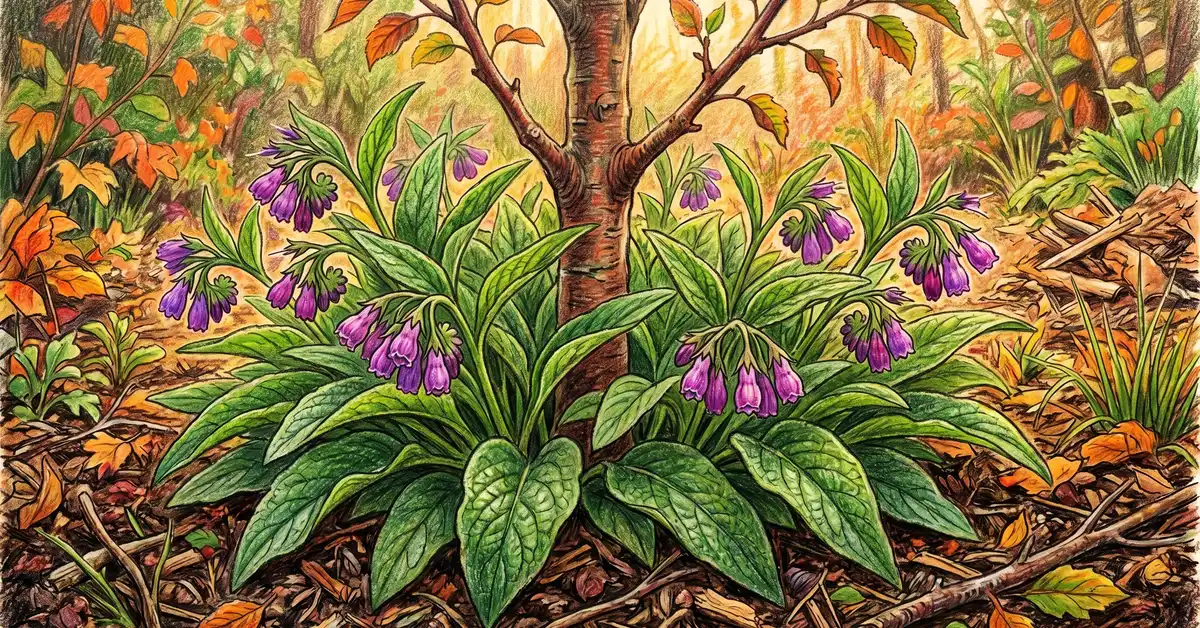
Comfrey (Symphytum officinale or Bocking 14). The temperate equivalent of mucuna for low-strata biomass. A single mature comfrey clump produces 15 to 25 lb (6.8 to 11.3 kg) of leaves per year across 3 to 4 chop-and-drop cycles. Mineral-rich, tap-rooted, hardy to zone 4. The Bocking 14 cultivar is sterile and will not spread by seed, which matters because comfrey can become invasive otherwise.
Sunflower (Helianthus annuus). Annual low-to-medium placenta. Fast biomass, attracts pollinators, edible seeds. Drop at flowering for 8 to 12 lb (3.6 to 5.4 kg) of stalk and leaf biomass per plant. Plant at 12 inch (30 cm) spacing.
Jerusalem artichoke (Helianthus tuberosus). Perennial placenta that doubles as a food crop. Reaches 6 to 10 ft (1.8 to 3 m) every year. Tubers harvested in fall, stalks chop-dropped after frost. Caution: like comfrey, it can spread aggressively. Plant inside root barriers if you do not want a permanent jerusalem artichoke bed.
Daikon radish and fava bean. Annual low-strata placentas for winter cover. Daikon roots break compaction down to 18 inches (45 cm); favas fix nitrogen at 60 to 120 lb per acre (67 to 134 kg per hectare).
Alder (Alnus glutinosa or Alnus rubra). The temperate emergent placenta. Nitrogen fixing via Frankia bacteria, grows 3 to 5 ft (0.9 to 1.5 m) per year, coppices well. The standard substitute for eucalyptus in the Pacific Northwest and Northeast.
Willow (Salix spp.). Fast biomass for wet sites, coppices aggressively. Hybrid willow trials in the northeastern US show biomass yields of 4 to 6 tons per acre per year (9 to 13 tonnes per hectare).
Hazel (Corylus avellana). Medium-to-high strata coppice, edible nuts. Grows back rapidly after chop-and-drop.
Robinia (black locust). Aggressive nitrogen-fixing emergent placenta. Will become a long-term presence unless you control it carefully, because it suckers and can be invasive in many US regions. Check your state's invasive species list before planting.
How to plant a placenta layer, step by step
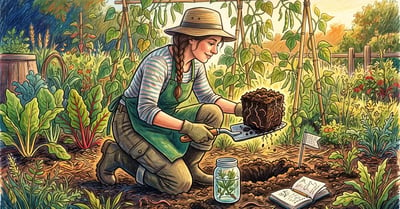
Sheet mulch the area
Lay cardboard, then 4 to 6 inches (10 to 15 cm) of wood chips or straw over the entire bed. The placenta layer goes into this mulched bed, not bare soil. Sheet mulch suppresses weed competition during the first 60 to 90 days while the placenta establishes.
Plant your target trees first
The fruit trees, nut trees, or timber trees you actually want long term go in first, spaced according to their mature size. For a backyard food forest, that usually means dwarf or semi-dwarf fruit trees every 8 to 12 ft (2.4 to 3.7 m).
Plant the placenta consortium densely between them
Götsch's planting density is high: typically 1 placenta plant every 1 to 2 ft (30 to 60 cm) in row, and 12 to 18 inches (30 to 45 cm) between rows. For a 4 ft x 8 ft (1.2 m x 2.4 m) bed, that means 30 to 60 placenta plants. Mix species across all four strata so every vertical layer is occupied.
Water deeply for the first 30 days
Until the placenta establishes, water the whole consortium together as one system. After 30 days, the dense canopy will hold moisture and you can scale watering back substantially.
First chop-and-drop at 4 to 6 months
When the placenta starts to flower or visibly compete with the target trees for light, cut it back hard. Leave all the chopped material on the soil surface as mulch. Do not remove biomass. Use loppers or a machete for sun hemp, sunflowers, and pigeon pea; pruning saw for hazel and alder.
Replace short-lived placentas with secondary species in year 2
Annual placentas (sun hemp, sunflowers, daikon, mucuna) die after their first cycle. Replace them with year-2 placentas: secondary perennials that fill the same niche but live longer. This is the transition from "placenta phase" to "secondary phase" in Götsch's succession diagram.
Phase out placentas entirely by year 5 to 7
By year 5 to 7, your target trees have a closed canopy and the placenta layer has done its job. Allow remaining placentas to die back naturally or coppice them down for one final mulch deposit. The system transitions into the abundance and saturation phases.
The biomass numbers that justify the work
Syntropic systems are labor-intensive in the first 3 years. The justification is the biomass and soil-building return.
A SIT cost-benefit framework analysis of syntropic farming documented mature tropical systems producing 30 to 80 tonnes of fresh biomass per hectare per year, with soil organic matter rising from baseline values of 1 to 2% to 3 to 5% within 5 to 10 years. That carbon goes into the soil instead of the atmosphere.
For a US backyard food forest of 1/4 acre (1,000 sq m), scaling down proportionally gives roughly 750 to 2,000 lb (340 to 900 kg) of fresh placenta biomass per year. That is enough mulch to cover the entire bed area 2 to 3 inches deep, free, from your own land.
The Regeneration Field Institute's syntropic blog documents commercial banana-cacao syntropic systems in Costa Rica reaching financial break-even by year 3 to 4 from cacao and banana sales, with the placenta layer feeding both crops without external inputs.
Six common placenta-design mistakes
1. Treating placentas as competition and removing them
The biggest beginner error. A new practitioner plants the target trees, then nervously yanks out the placenta layer because it "looks weedy." The target trees then sit in bare soil for the next three years and grow at half the rate they would have if the placenta had stayed. The fix: trust the design. The placenta layer is supposed to look thick and chaotic.
2. Skipping low-strata placentas
Practitioners obsessed with the dramatic medium and high strata often forget the low layer. Porvenir Design's syntropic tips highlight this as the second most common error: without comfrey, sunflowers, daikon, or sweet potato at ground level, you still have weed pressure and exposed soil between the taller plants.
3. Using nutrient-demanding placentas in poor soils
Banana looks like a magical placenta until you plant it in degraded clay or sandy soil and it sits there, stunted. Bananas need nutrients. On poor soils, lead with nitrogen-fixing placentas (pigeon pea, sun hemp, alder, robinia, fava) for 1 to 2 years to build fertility before introducing the nutrient-demanding species.
4. Underestimating pruning intensity
Placentas need to be cut hard and cut on schedule. Götsch's pruning teaching emphasizes that incomplete or late pruning is the single biggest reason syntropic systems fail. A pigeon pea cut at 2 ft high every 18 months is not playing its role. Cut to 6 inches (15 cm) above ground every 6 to 12 months.
5. Planting placentas that become invasive long term
Robinia, jerusalem artichoke, autumn olive, and some willows will outlive their welcome in temperate gardens. Always check your state's invasive species list and prefer sterile cultivars (like Bocking 14 comfrey) for known spreaders.
6. Forgetting placenta 2 (the second wave)
Practitioners often plant a single round of annual placentas, then leave the bed alone after the first chop-and-drop. The result is bare soil in year 2. The fix: have a year-2 placenta consortium ready (perennial sunflowers, hazel, comfrey, alder coppice) to plant immediately after the annuals die.
A note on Götsch's eucalyptus
Ernst Götsch defends eucalyptus as a syntropic placenta because of its extraordinary biomass production in Brazil. Outside of Götsch's specific Bahian context, eucalyptus has serious downsides: high water use, allelopathy that suppresses other plants, and fire risk. Do not transplant the eucalyptus choice directly into a US garden. Use alder, robinia, or hybrid poplar instead as your nitrogen-fixing emergent placenta.
Chop-and-drop frequency and tools
The pruning schedule depends on growth rate and target tree needs. As a starting framework:
| Placenta type | Chop frequency | Cut height | Tool |
| Annual herbaceous (sunflower, sun hemp, mucuna) | Once at flowering | Ground level | Machete, loppers |
| Perennial herbaceous (comfrey, jerusalem artichoke) | Every 8 to 12 weeks during growing season | 2 to 4 inches (5 to 10 cm) above crown | Loppers or sickle |
| Pigeon pea, gliricidia, leucaena | Every 6 to 12 months | 6 to 12 inches (15 to 30 cm) above ground | Pruning saw, loppers |
| Coppice trees (alder, willow, hazel, robinia) | Every 12 to 36 months | 4 to 8 inches (10 to 20 cm) above ground | Pruning saw, hand chainsaw |
| Banana | After harvesting each bunch (typically 12 to 18 months) | Ground level on the spent pseudostem only | Machete |
Sources:.
Get the Weekly Dig
One practical permaculture guide a week, written for gardeners who do this on weekends: food forest and guild designs that produce. Free, no spam, unsubscribe any time.
Join the Weekly DigFrequently asked questions
What are placenta plants in syntropic agriculture?
Placenta plants are fast-growing, biomass-producing pioneer species planted densely around target trees in a syntropic agroforestry system. They feed and protect the long-term trees during early establishment, then are progressively replaced as the system matures. The term comes from the biological placenta, which nourishes a developing embryo.
Who developed the placenta plant concept?
Swiss-born farmer Ernst Götsch developed the concept while regenerating degraded land in southern Bahia, Brazil, starting in the early 1980s. The formal framework is documented through Agenda Gotsch, his teaching organization, and elaborated by syntropic practitioners worldwide.
What are the best placenta plants for a US backyard food forest?
For most US climates: comfrey (Bocking 14 for non-spread), sunflower, jerusalem artichoke, daikon, fava bean, alder, hazel, willow, mulberry, autumn olive, and elderberry. Cover all four strata (low, medium, high, emergent) and mix nitrogen-fixers with biomass producers.
How many placenta plants do I need per square foot?
Götsch's standard density is roughly 1 placenta plant every 1 to 2 ft (30 to 60 cm) in row. For a 4 ft x 8 ft (1.2 m x 2.4 m) bed, that is 30 to 60 placenta plants spread across all four strata.
How long do placenta plants stay in the system?
Annual placentas (sunflowers, sun hemp, mucuna, fava) last one growing season. Short-cycle perennials (comfrey, jerusalem artichoke, pigeon pea) last 2 to 4 years. Long-cycle placentas (alder, hazel, robinia) can persist 7 to 15 years but are progressively chopped and let go as the target trees establish dominance.
Can placenta plants compete with my fruit trees?
Only if you skip the pruning. The whole point of regular chop-and-drop is to keep placenta plants from out-competing target trees for light and water. Pigeon pea cut to 6 inches (15 cm) every 6 to 12 months is a feeder, not a competitor. Pigeon pea left to grow 10 ft (3 m) tall over the same period will shade out a young apple tree.
How much biomass does a placenta layer produce?
Mature tropical syntropic systems generate 30 to 80 tonnes of fresh biomass per hectare per year. A 1/4 acre (1,000 sq m) US backyard food forest scaled down proportionally produces 750 to 2,000 lb (340 to 900 kg) of fresh biomass per year, enough to mulch the entire bed area 2 to 3 inches (5 to 8 cm) deep.
Do I need a permaculture design certificate to plant a placenta layer?
No. Götsch himself has never required formal credentials. Free resources from Agenda Gotsch, Mountain Time Farm, and the Regeneration Field Institute cover the placenta concept and species selection in enough depth for a backyard practitioner to start.
Resources
- Agenda Gotsch: Life cycle, stratification and succession (Götsch's official framework explanation)
- Agenda Gotsch: Natural succession in syntropic farming
- Mountain Time Farm: The Principles of Syntropic Agroforestry (clear stratification primer)
- Porvenir Design: 12 Syntropic Farming Tips and Tricks
- SIT cost-benefit framework analysis of syntropic farming (PDF)
- Regeneration Field Institute: Syntropic agriculture blog
- Rancho Mastatal: What is syntropic farming?
- ECHO Community: Syntropic farming practitioner forum