
What Is Syntropic Agriculture? A Definition That Actually Makes Sense
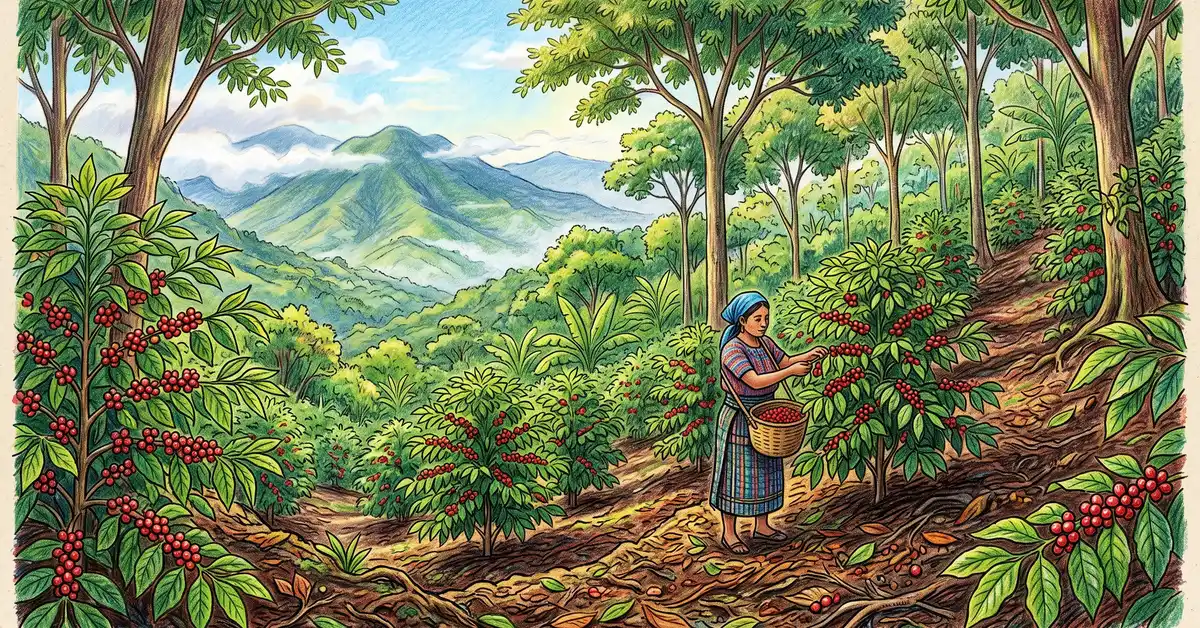
Syntropic agriculture is a regenerative farming system that uses planned plant succession and dense polycultures to rebuild degraded soil, restore water cycles, and produce food at every layer of a managed ecosystem. Developed by Swiss-Brazilian farmer Ernst Götsch in Bahia, Brazil starting in 1982, it has restored over 1,200 acres (500 hectares) of exhausted cattle pasture into one of the most biodiverse productive landscapes in Brazil's Atlantic Forest — and along the way, brought back 14 dried-up springs that conventional restoration could not. year 3 transition making a living from permaculture syntropic agriculture criticisms permaculture versus biodynamics keyline design and restoration agriculture designing a resilient farm in a cold climate mycorrhizal networks in syntropic systems syntropic agriculture and soil carbon syntropic growing in the city syntropic agriculture in humid subtropical zones analog forestry what coppicing is and how it works grazing livestock among trees growing crops under a standing canopy what to expect in year one shade grown coffee
If you have spent any time with permaculture principles or food forest design, syntropic farming will feel familiar — and unfamiliar. Familiar because it stacks plants vertically, mimics forest ecosystems, and relies on biology over chemistry. Unfamiliar because it is far denser, far more actively managed, and built around something most permaculture systems treat as background scenery: time. Where a permaculture food forest aims for a stable design, a syntropic system is designed to change on purpose, year by year, through choreographed pruning and planned species succession.
This guide is the introduction we wish we had read three years ago — the practical, evidence-backed walk-through of what syntropic agriculture actually is, how it differs from related systems, what it produces, and how American gardeners and farmers can begin applying its principles in temperate, subtropical, and arid US climates.
What you will learn in this guide:
- Where syntropic agriculture came from and how it actually works
- The five core principles: stratification, succession, density, diversity, and active management
- How syntropic differs from permaculture, agroforestry, food forests, and Fukuoka-style natural farming
- What the peer-reviewed research says about yields, soil carbon, and economics
- Realistic timelines from first harvest to mature forest
- How to apply syntropic principles in temperate North America — from a 1/10-acre backyard to a 50-acre farm
The Core Idea
Syntropic agriculture treats a farm not as a static design but as a directed ecosystem moving through succession. The farmer is part conductor, part forester — planting all succession phases at once, then pruning and chopping over decades to keep the system in a continuous state of regeneration.
Where It Came From: Ernst Götsch and Fazenda Olhos d'Água
Ernst Götsch was a researcher at Switzerland's Zurich-Reckenholz agricultural institute when he started asking an inconvenient question: was breeding crops to be more pest-resistant really the best path, or could we get better results by improving the ecological conditions around the plants? He left mainstream research, moved to Costa Rica during the Central American conflicts of the late 1970s, and in 1982 accepted an invitation to take on a piece of land in Bahia, Brazil that nobody else wanted: 480 hectares (about 1,186 acres) of clear-cut, cattle-degraded ground locally called Fugidos da Terra Seca — "Escaped from the Dry Land." Götsch renamed it Fazenda Olhos d'Água ("Tears in the Eyes Farm") and got to work.
Forty years later, that property is a 1,235-acre (500 ha) productive forest, exporting organic cacao at roughly four times the price of conventional cocoa, with documented increases in biodiversity, soil organic matter, and — most strikingly — water. Brazilian environmental agency IBAMA was reportedly stunned by aerial photographs of the farm in the early 1990s: from the air, the property looked like dense Atlantic Forest, yet underneath that canopy was a working agricultural operation. Götsch's method took 15 years to acquire its current name. Today it is variously called syntropic agriculture, syntropic farming, or successional agroforestry, and it is taught from Cornell Small Farms to NCAT/ATTRA to the Yale Forum on Religion and Ecology.
Syntropy vs. Entropy: The Idea Underneath the Method
Most working farmers do not need a physics lecture to plant a tree, and Götsch's frameworks can sound mystical until you slow them down. Here is the practical version: entropy is the tendency of systems to break down and disperse energy — it is what happens to a tilled field left bare in the rain. Syntropy, by contrast, is the tendency of living systems to accumulate complexity, build order, and create new energy. A maturing forest is syntropic. So is a healthy soil food web. So, in Götsch's framing, is a well-designed agroforestry consortium.
The term traces back to twentieth-century thinkers — Albert Szent-Györgyi (the Nobel-winning biochemist who isolated vitamin C), the Italian mathematician Luigi Fantappiè, and biologist Erwin Schrödinger — all of whom argued that living systems do not just resist entropy, they actively reverse it. Götsch's contribution was applying this to land management: instead of fighting an entropic system with diesel and inputs, design the farm so that the ecology itself produces fertility, regulates pests, holds water, and increases productivity over time. As one researcher working on large-scale syntropic grain trials put it, "design and maintenance replace fertilisers and even irrigation."
Why This Works: Net Energy, Not Net Inputs
Conventional agriculture is a one-way energy account — fuel, fertiliser, and pesticides go in, food and depleted soil come out. A syntropic system flips that ledger: the front-loaded labour and knowledge build a system that, after a few years, generates more biomass, water, and biology than it consumes. This is what permaculture's obtain a yield and produce no waste principles look like when pushed to their logical conclusion.
The Five Core Principles of Syntropic Agriculture
Strip away the philosophy and a syntropic system rests on five practical pillars. Every design choice can be traced back to one of them.
1. Stratification: Plants Stacked by Light Need
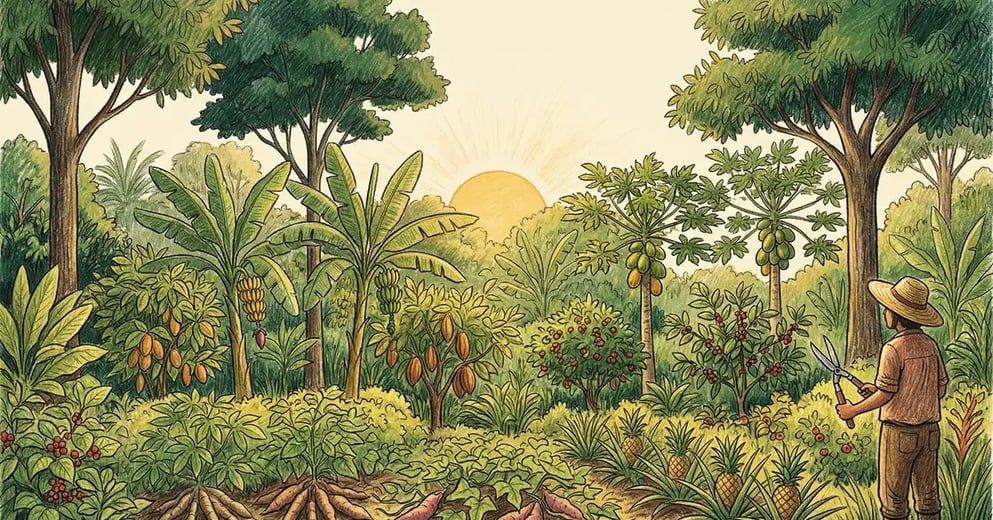
Like a natural forest, a syntropic plot is organised into vertical layers — usually four — with each plant placed according to its light requirements. The emergent stratum holds the tallest, full-sun species (timber trees, pecan, walnut, eucalyptus in tropical zones). The high stratum holds productive trees that want full to partial sun (apple, pear, stone fruit; cocoa and coffee in the tropics). The medium stratum is for shrubs and small trees in partial shade (elderberry, hazelnut, pawpaw, banana). The low stratum is shade-tolerant ground cover and herbs (comfrey, mint, ginger, leafy greens). This is the same vertical logic our 7 layers of a food forest guide describes — syntropic systems just push the density and the management much harder.
2. Succession: All Phases at Once
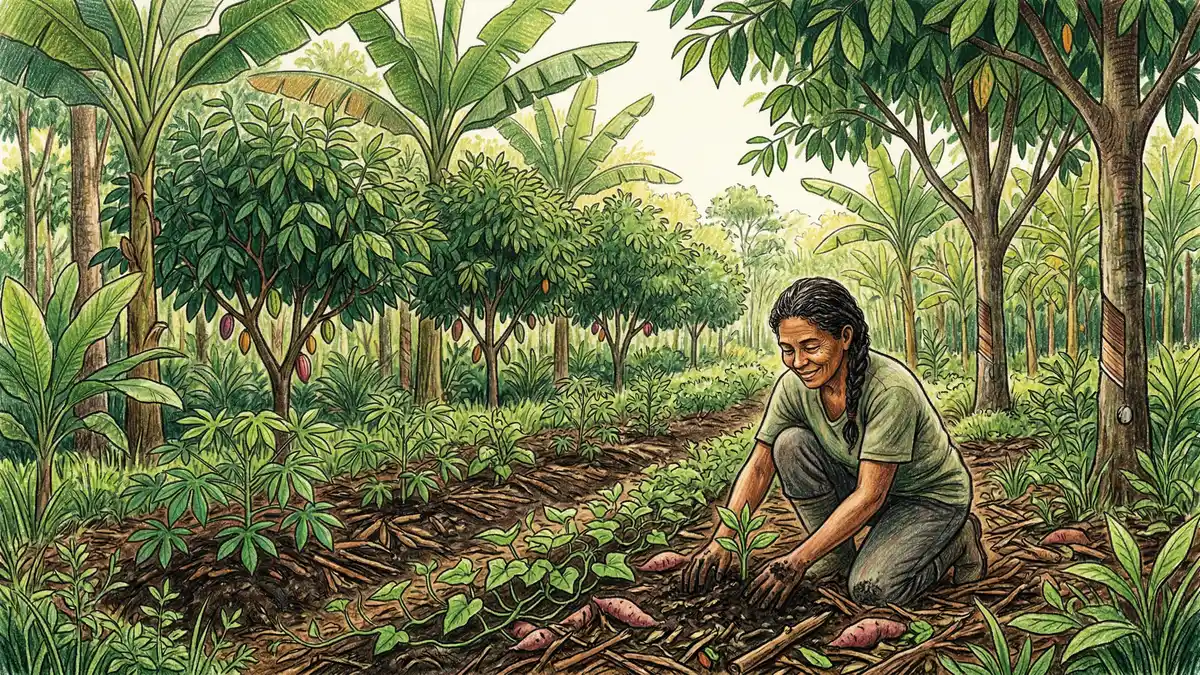
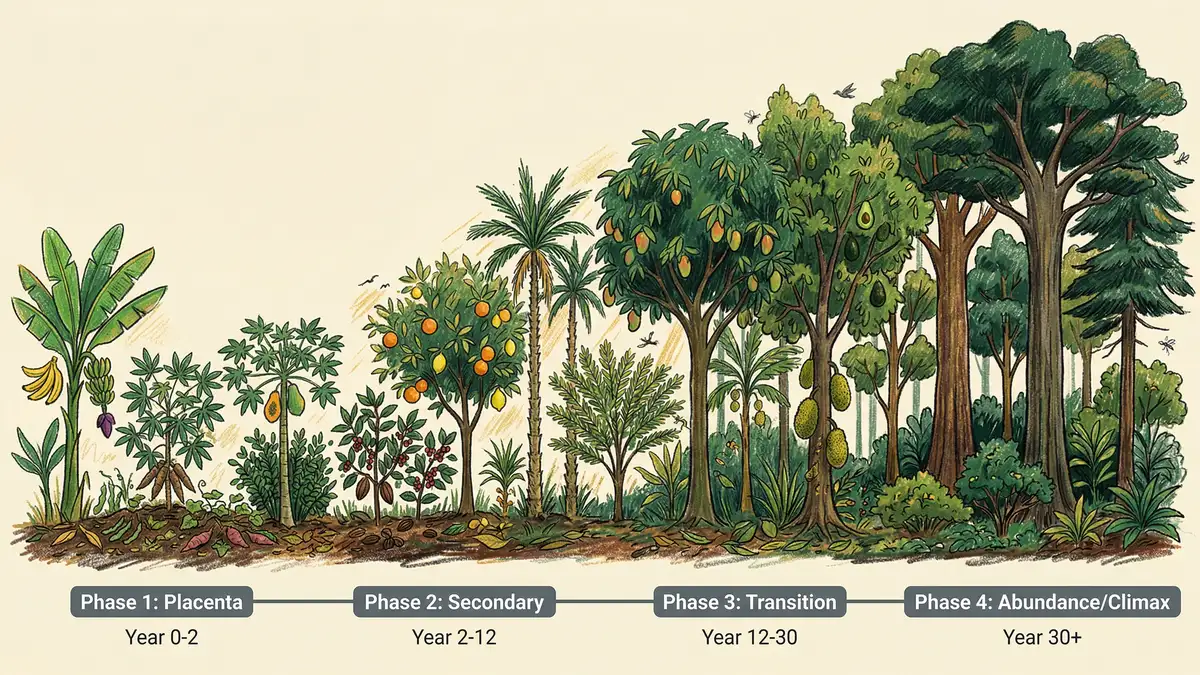
This is the principle most newcomers miss. In a syntropic system, you do not plant pioneer species and wait for them to mature before adding fruit trees. You plant all succession phases simultaneously in the same row. Cassava, beans, banana, cocoa, and a hardwood seedling go in on the same day, in the same strip of soil. Each species grows at its own rate and in its own niche, and the farmer manages the transition through pruning. Götsch divides succession into placenta (years 0-3), secondary (years 3-15), and climax/abundance (15+ years), each dominated by progressively longer-lived species. Mountain Time Farm's principles overview is a useful US-based introduction to how the phases are designed in practice.
3. Density: 20-40 Plants per Square Meter
Syntropic establishment density is shocking the first time you see it: 20 to 40 plants per square meter (roughly 80,000 to 160,000 plants per acre), organised in narrow strips a few feet wide. That density is then progressively thinned through active pruning and selective removal. The reason is ecological — natural pioneer colonisation is dense, and trees self-thin over time as taller individuals overtop smaller ones. By front-loading the density, the system reaches closed canopy fast, suppresses weeds without herbicide, and lets the farmer choose which plants to sacrifice for biomass and which to keep for production.
4. Diversity: Multi-Functional Consortia
A syntropic consortium typically holds 5 to 20 species per planting strip, each chosen for a specific role: nitrogen fixation, biomass production, dynamic accumulation, pest deterrence, food, fiber, or timber. This is not random — it is the same logic behind companion planting, scaled up and stretched across decades. Function diversity matters as much as species diversity: every consortium needs at least one nitrogen-fixer, one heavy biomass producer, and one long-cycle anchor species.
5. Disturbance: The Choreography of Pruning
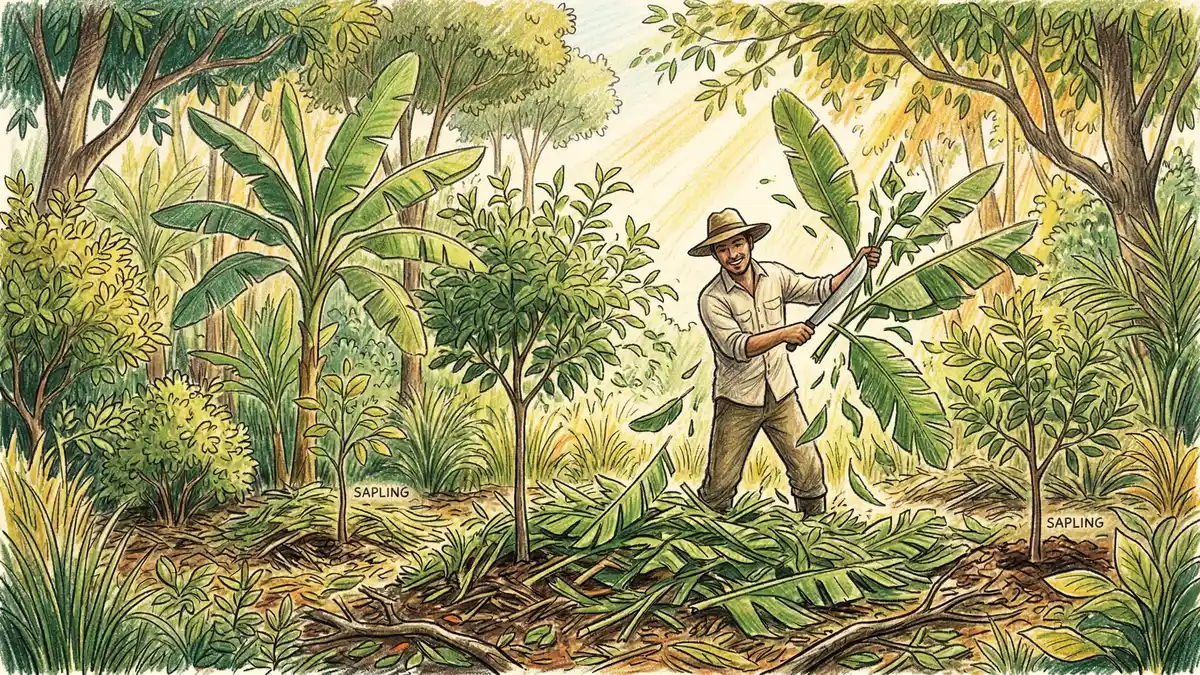
The most labor-intensive piece, and the one that separates syntropic from a low-input food forest. Pruning in a syntropic system is not optional and not occasional — it happens 4 to 6 times per year per strip, on a schedule keyed to plant growth pulses. Cutting a tree's branches signals its roots to die back, releasing growth-promoting compounds that benefit neighbours. Cut biomass is dropped on the soil surface (chop-and-drop), feeding the soil food web and shading out weeds. The system is held in a perpetual state of mid-succession regeneration rather than allowed to coast toward static climax.
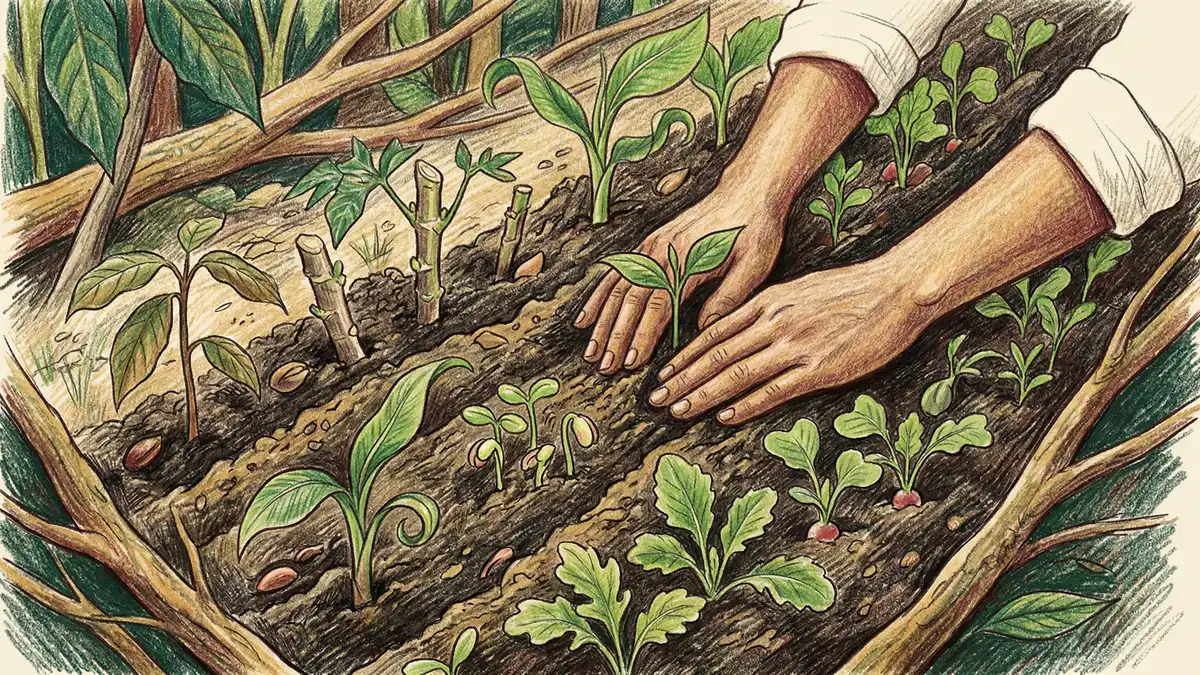
You can see why this is not a beginner's weekend project. A syntropic farm is closer to a long-running orchestra than a vegetable patch. The good news is that the principles scale all the way down — a 4-foot-wide bed in a Pennsylvania backyard can be designed syntropically, with placenta-phase radishes and beans going in next to a hazelnut sapling and a future-pawpaw seedling on the same morning. The reverse is also true: large-scale syntropic grain trials at the CEPEAS research center in Bahia have produced wheat at roughly 2 tonnes per hectare (about 1,800 lb/acre) on highly degraded soil with no synthetic fertiliser. Same five principles, different scale.
The Four Succession Phases (and What to Plant in Each)
The succession framework is where syntropic theory becomes a planting list. Here is how Götsch and his students typically break it down for design purposes:
| Phase | Years | Role | Example Species (Temperate US) |
| Placenta I | 0-1.5 | Rapid soil cover, biomass, nitrogen fixation | Buckwheat buckwheat soil-building cover crop, sunflower, bush beans, daikon, mustard, sorghum |
| Placenta II | 1.5-3 | Heavier pioneer cover, transition to perennials | Comfrey, sunchoke, willow coppice, black locust seedlings |
| Secondary | 3-15 | Productive fruit and shrub layer, canopy formation | Elderberry, hazelnut, peach, pawpaw, serviceberry, mulberry |
| Climax / Abundance | 15+ | Long-lived structure, timber, deep nutrient cycling | Black walnut, oak, chestnut, persimmon, hickory, pecan |
Sources:
The non-obvious part: every species on this table goes into the ground at roughly the same time, often in the same 3-foot-wide strip. The walnut you plant on day one will not be the dominant tree for 25 years, but its presence shapes the row from the beginning. The buckwheat and beans you plant on either side of it will be cut and dropped half a dozen times before the walnut throws its first nut.
How Syntropic Differs from Permaculture, Agroforestry, and Food Forests
This is the question we get most often, so it deserves a clear answer rather than a hedge. All four systems share the goals of ecological health and integrated production, but they differ on how prescriptive they are and how they handle time.
| System | Founder(s) | Core Logic | Density | Time Dimension |
| Permaculture | Mollison & Holmgren (1970s) | Design framework based on 12 principles | Variable | Largely static after design |
| Food Forest | Hart, Holzer, Crawford | Layered perennial garden mimicking woodland | Moderate | Slow natural progression |
| Agroforestry | Many (academic origin) | Trees + crops or livestock combined on same land | Low to moderate | Often static rotation |
| Syntropic Agriculture | Ernst Götsch (1980s) | Active succession management with chop-and-drop | Very high (20-40/m²) | Central — designed evolution |
Sources:
The cleanest way to think about it: permaculture is a worldview and a design language; syntropic agriculture is a specific production methodology. You can absolutely use syntropic methods inside a permaculture project — many practitioners do — but syntropic farming is far more prescriptive about how the planting is laid out, when things get pruned, and which species belong in which phase. As Australian practitioner site Syntropia puts it: "Permaculture is how to live; syntropic agriculture is a specific and precise methodology of production — how to obtain a yield."
Worth noting too: syntropic agriculture is often confused with Masanobu Fukuoka's natural farming, but they are nearly opposite in approach. Fukuoka emphasised minimal intervention — no tilling, no weeding, no pruning. Götsch emphasises maximum informed intervention — cut, drop, prune, manage. Both work; both are ecological; they ask different things from the farmer.
What the Research Actually Shows
For all the YouTube mystique around Götsch, the peer-reviewed evidence base is genuinely promising — and honest about what is still unproven. Here are the headline numbers we found in the literature.
Soil organic carbon and nitrogen. In a temperate alley cropping system in Brandenburg, Germany established in 2019, researchers measured significantly elevated soil organic carbon and total nitrogen under tree rows compared to crop rows in both topsoil and subsoil after just four years. Conventional alley cropping systems typically take a decade to show that kind of SOC accumulation; the syntropic-style intensive mulching appears to compress the timeline. The study also found compositionally distinct bacterial and fungal communities under the trees, with shifts toward beneficial microorganisms and a reduction in pathogenic populations.
Cocoa yields. A cost-benefit analysis of syntropic farming published through SIT Digital Collections cites data from Andres et al. (2016) showing cocoa yields 12 to 46 percent higher in agroforestry systems compared to monocultures, with the cumulative yield of all harvested products from the syntropic plot dramatically exceeding monoculture output. Götsch's own farm exports organic cacao at roughly four times the price of conventional product.
Grain on degraded soil. Large-scale wheat trials at the Centre for Research in Syntropic Farming (CEPEAS) achieved roughly 2 tonnes per hectare (1,785 lb/acre) with no synthetic fertiliser on 2-billion-year-old, severely depleted Bahian soils. That is below Brazil's national wheat average of 2.8 tonnes per hectare, but it was achieved on land that should not have grown wheat at all — and the system simultaneously built soil, captured carbon, and established hardwood lines for future income.
Biomass production. Case studies report 15 to 20 tons of dry matter per hectare per year (about 6.7 to 8.9 tons per acre) generated by chop-and-drop in mature syntropic systems. That biomass becomes mulch, feeds soil biology, and replaces what conventional systems import as fertiliser.
Honest limits. Temperate-climate research is still thin. The few peer-reviewed studies (Brandenburg, Portugal, exploratory work in semi-arid New Mexico) are encouraging but preliminary. Cold-climate practitioners are, to a real extent, still experimenting rather than implementing well-validated protocols. We will say more about this in the limitations section.
Where the Evidence Is Strongest
Tropical and subtropical systems with 5+ years of management have the strongest documented results — soil carbon, water restoration, biodiversity, and yields all check out. Temperate-climate evidence is newer but trending positive, especially for soil microbiology under tree rows. Long-term economic data outside Brazil remains scarce.
How to Start a Syntropic System: Five Practical Steps
Whether you have a 1/10-acre backyard in Pennsylvania or 50 acres in Oregon, the starting sequence is the same. The scale changes; the logic does not.
Read your site for one season
Walk it. Note sun angles, prevailing wind, slopes, drainage, frost pockets, and existing vegetation. Take soil samples if you can. Understand what natural ecosystem historically grew on that ground — that is your reference point. Mountain Time Farm's "how to get started" guide is a useful checklist for this stage. Cost: a notebook. Time: about 4-6 hours over a season.
Choose proven local species first
For the temperate eastern US, that means starting with pawpaw, persimmon, serviceberry, hazelnut, elderberry, mulberry, apple, pear, walnut, and oak — not tropical substitutes. Build a consortium with at least one species from each of the four succession phases and each of the four strata. Aim for 8-15 species per planting strip on your first row.
Lay out narrow rows and plant dense
Mark planting strips 3-5 feet wide with grass alleys between them. Inside the strip, plant much denser than feels comfortable — every 4-12 inches for placenta species, every 2-4 feet for shrubs, every 12-20 feet for trees. Plant all succession phases on the same day. Water in well, then mulch heavily — 3-6 inches (8-15 cm) of woody material around the seedlings.
Build a pruning calendar and stick to it
This is where most beginners fall off. Schedule chop-and-drop sessions four to six times per year, keyed to growth flushes. Cut placenta species back hard, drop the biomass on the strip, and use the cuts to open light for the next layer up. Pruning is the system's metabolism — skipping it is like skipping watering in a vegetable garden.
Observe, document, adapt
Keep photographs and a simple yield log. Watch which species thrive and which stall. Replace failures with proven performers. After three seasons, you will know more about syntropic farming on your specific piece of land than any imported curriculum can teach you. This is where syntropic and permaculture rejoin: observe and interact.
Common Mistake to Avoid
Treating syntropic farming as "set and forget" food forest planting. The whole system depends on the active pruning calendar. If you plant 20 species into a dense strip and then leave them alone, you will get a tangled, light-starved mess inside two years — not a regenerating ecosystem. Either commit to the management or scale your plot down to what you can realistically maintain.
Climate Adaptation: Does It Work in the United States?
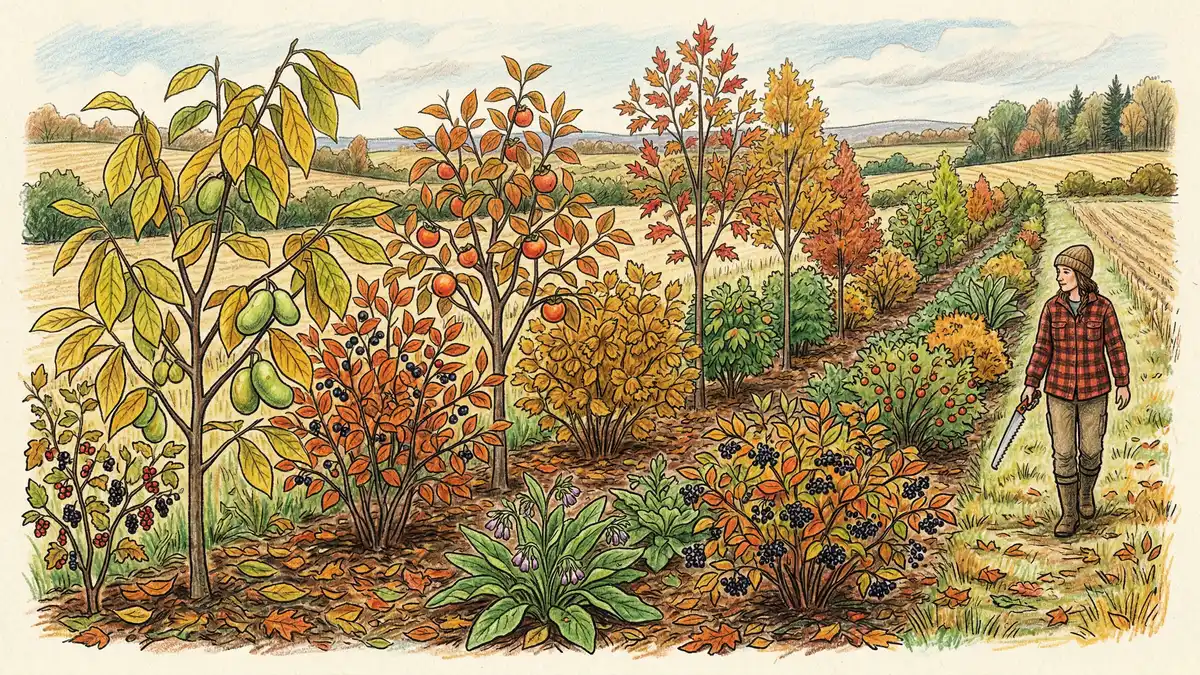
Short answer: yes, with modifications. Syntropic farming originated in tropical Brazil, and the textbook species lists are tropical. But the principles are climate-agnostic, and practitioners across North America are now adapting them with promising early results. The key adaptations for cooler latitudes, drawn from Propagate Ag's cold-climate syntropic guide, look like this:
Wider tree spacing. At higher latitudes the sun is lower, light competition is fiercer, and tree growth is slower. Where a Bahian system might place fruit trees 6-12 feet apart, a Vermont or Oregon system needs 20+ feet between rows so each tree gets enough direct sun.
Herbaceous biomass over woody biomass. Cold-climate trees grow slowly and produce less prunable biomass per year. Compensate with grass and herbaceous perennial clippings — they decompose faster, can be cut with common farm equipment, and provide better continuous soil cover under fruit trees. Winter rye is a particularly powerful biomass crop.
Cold-hardy species substitution. Use pawpaw, persimmon, serviceberry, seaberry, elderberry, Asian pear, mulberry, hazelnut, walnut, oak, and chestnut. Do not try to substitute apples for tropical canopy trees one-for-one — the ecology does not translate.
Below-ground biology bias. In cold climates, much of the system's productivity will live in the root zone and soil food web rather than above-ground biomass turnover. Build deep, well-structured living soil early — it will carry the system through slower above-ground growth.
For semi-arid regions (Arizona, New Mexico, west Texas), the species palette shifts toward mesquite, honey locust, desert willow, prickly pear, and pomegranate, with much heavier mulch and water-conserving design. Götsch's principles still apply; the plant list looks completely different. Hawaii, Florida, and southern California can run something close to the Bahian model directly.
Why This Works: Function Stacking Across Layers
Whether you are in Maine or Maui, the reason syntropic principles travel is that they are based on function, not species. You always need a nitrogen fixer, a biomass producer, a canopy former, and a long-cycle anchor. Once you can name those four roles in your local flora, you can build a syntropic consortium anywhere — which is the same logic underlying the permaculture each function supported by many elements principle.
The Honest Limitations
Syntropic agriculture is not a silver bullet, and writing about it without naming the trade-offs would be selling something. Four real constraints to know going in:
Labour intensity is the biggest one. The system is radically more hands-on than any conventional or organic operation we know of. Pruning four to six times a year, monitoring succession phases, managing dense polycultures — for a commercial farm in a high-wage US region, the labour math can be brutal. Most successful US syntropic projects to date are owner-operated homesteads, demonstration farms, or operations that integrate paid education and tours into the business model.
The learning curve is real. There is no input recipe to follow. Each region, soil type, and microclimate requires custom design. Expect to spend 1-3 years getting comfortable with species behavior on your specific site.
The time horizons are long. Even with graduated yields starting in months, full system maturity and maximum profitability are 15-30+ years out. This favors landowners over tenants and patient operators over financially stretched ones.
Temperate research is still thin. The 40-year track record is in tropical Brazil. Outside the tropics, you are an early adopter, and that comes with the usual risks of running ahead of the literature.
Frequently Asked Questions
Is syntropic agriculture scientifically proven?
It has 40 years of observable results in tropical Brazil with documented soil regeneration, water cycle restoration, and yields. Peer-reviewed research increasingly supports the central claims — soil carbon accumulation, biodiversity, biomass production, and even cocoa yield premiums. Robust longitudinal studies in temperate climates remain limited, however, and the field needs more controlled, multi-site research before syntropic systems can be considered as well-validated as conventional agriculture. The evidence base is real and growing, especially since 2018, but it is honest to call temperate-climate syntropic farming "well-supported in principle and still being tested in practice."
How long until I see yields from a syntropic system?
Faster than people expect. Quick-cycle pioneers like radishes, leafy greens, and beans produce within 30-60 days of planting. Banana and cassava (in tropical zones) start in 6-12 months. In temperate zones, your first significant fruit yields from peach, mulberry, and elderberry typically arrive in years 2-4. Apple, pear, hazelnut and pawpaw productivity ramps up in years 5-10. Hardwood timber returns are 25-50 years out. The whole point of the staggered phases is that something is producing income at every stage, so you are never waiting decades for a first harvest.
How is syntropic farming different from permaculture?
Permaculture is a design framework — a set of ethics and 12 principles you can apply to any land-use challenge. Syntropic farming is a specific production methodology with fairly prescriptive rules about plant arrangement, density, succession phases, and pruning calendars. You can absolutely use syntropic techniques inside a permaculture project, and many practitioners do. But where permaculture asks "how do I design ethically?", syntropic asks "how do I arrange these plants in space and time to obtain the highest possible yield while building soil?"
Can a backyard gardener actually do this, or is it only for farms?
Yes, absolutely. The principles scale all the way down. A 4-foot by 20-foot strip in your Pennsylvania, Ohio, or Oregon backyard can be designed syntropically — placenta beans and radishes next to a hazelnut and a future pawpaw, with comfrey at the base and a walnut seedling at one end. Start with a single strip you can realistically maintain. The 4-6 prunings per year on a small plot are achievable for a gardener with an hour a week. Most US homesteaders we know who use syntropic methods started exactly this way.
Can I use syntropic farming on rented land?
It is harder. Syntropic systems hit their stride in years 5-15 and reach peak value in years 15-30 — that is a long time to invest in land you do not own. If your lease is short, focus on the elements you can capture quickly: dense polyculture vegetable strips, intensive chop-and-drop mulching, and fast-cycle perennials like comfrey, sunchoke, and elderberry. Save the hardwood plantings for land you control. Some tenant farmers have negotiated long-term leases (10+ years) specifically to make agroforestry pencil out — worth asking.
How is syntropic agriculture different from Fukuoka's natural farming?
They share an ecological worldview but ask opposite things from the farmer. Fukuoka's natural farming is built on minimal intervention — no tilling, no weeding, no pruning, no fertiliser. The farmer's job is to set conditions and step back. Syntropic farming is built on maximum informed intervention — heavy pruning, chop-and-drop on a tight schedule, dense planting, active succession management. Both can produce remarkable results; they suit different temperaments, climates, and labour situations. Fukuoka's method is closer to no-till; Götsch's is closer to intensive forestry.
Where can I learn more or take a course?
Free options first: the Forests4Farming Academy offers free online modules, and Cornell Small Farms, NCAT/ATTRA, and Yale's Forum on Religion and Ecology all publish accessible introductory material. For paid training, look at Propagate Ag (cold-climate focus), Agenda Götsch's official courses, and regional permaculture programs that include syntropic modules. Lancaster Farmland Trust runs periodic workshops for the northeastern US. For US homesteaders, the most useful first step is usually visiting an existing demonstration site — there are now several across the eastern seaboard.
Get the Weekly Dig
One practical permaculture guide a week, written for gardeners who do this on weekends: food forest and guild designs that produce. Free, no spam, unsubscribe any time.
Join the Weekly DigResources
- Agenda Götsch — Life in Syntropy — Ernst Götsch's official site with lectures, documentaries, and project archives.
- Believe.earth — Ernst Götsch: The Creator of the Real Green Revolution — Long-form profile of Götsch and Fazenda Olhos d'Água.
- Yale Forum on Religion and Ecology — Syntropic Farming & Agroforestry — Academic introduction to syntropic principles.
- NCAT/ATTRA — How Syntropic Agriculture Restores Soil and Farms — US-focused practical overview from the National Center for Appropriate Technology.
- Cornell Small Farms — Introduction to Syntropic Agroforestry — Workshop and curriculum from Cornell's small farms program.
- Propagate Ag — Cold Climate Syntropic Agriculture — The most useful US-focused guide to temperate adaptation.
- PMC/NIH — Trees Shape the Soil Microbiome of a Temperate Agrosilvopastoral System — Peer-reviewed Brandenburg trial documenting soil carbon and microbiome changes.
- SIT Digital Collections — A Cost-Benefit Framework Analysis of Syntropic Farming (PDF) — Peer-reviewed economic analysis with cocoa yield data.
- Lancaster Farmland Trust — A Beginner's Guide to Syntropic Farming — Northeast-US practitioner overview.
- Forests4Farming Academy — Free online syntropic agroforestry courses for beginners.
the 12 permaculture principles
fast-growing food forest workhorse
mulberry as a food forest workhorse
fast-growing mulberry food forest
syntropic restoration of degraded land adapting it to a summer-dry climate