
 how pruning feeds soil fungi pruning timing where frost is a factor cutting trees back to a permanent framework pigeon pea plant
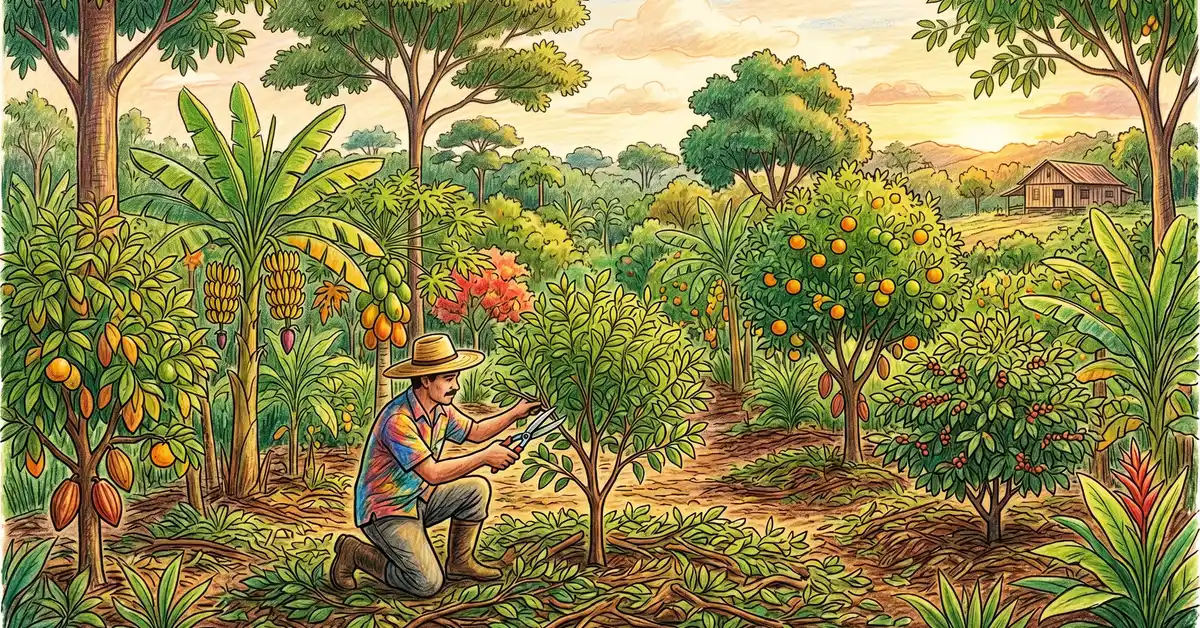
If you ask Ernst Gotsch what the most important tool in regenerative farming is, he does not say "compost" or "cover crops" or "mulch." He says "pruning shears." In the syntropic system he developed over four decades at Fazenda Olhos d'Agua in Brazil, pruning is not a chore that protects plants. It is the active intervention that drives soil building, biomass production, water cycling, and yield. Cut the right tree at the right time, drop the branches on the ground, and you have just done more for your farm than a full season of fertilizer.
That sounds extreme. It is also the explicit teaching of Agenda Gotsch's "Pruning Instead of Fertilizers and Irrigation": pruning is described as the fuel of transformations and the key to accelerating natural succession. This guide unpacks the logic, the rules, the species-by-species playbook, and what gardeners outside the tropics can actually use from it.
Key takeaway
Syntropic pruning is succession management. Cutting back pioneer species releases growth hormones, drops biomass to feed the soil, and opens light for the next stratum. Done right, a syntropic plot self-fertilizes, retains water, and reaches productive yields faster than any input-dependent system.
Why pruning is the primary management tool
Conventional pruning is defensive. You cut back to control shape, remove disease, or reduce competition. Syntropic pruning is offensive. You cut back to provoke growth, drop fertility, and steer the system toward a target successional stage. As ForestNation summarizes Gotsch's method, the key is intensive pruning to return biomass to the soil, which feeds the entire system without external inputs.
The biological mechanism is hormonal. When you cut a woody stem, the plant's apical dominance breaks: auxin produced by the terminal bud no longer suppresses the lateral buds below it. Cytokinin and gibberellin redistribute. Lateral branches activate. Roots send out new feeder hairs to support the burst of leaf growth. A pruned plant is not a damaged plant. It is a plant in accelerated regrowth mode, with photosynthesis ramping up to rebuild lost biomass within weeks.
Multiply that across hundreds of trees in a polyculture and the system runs on a continuous pulse of growth. Each pruning event drops new mulch on the soil, releases light to the understory, and keeps every species in its productive prime. Compare this to no-dig gardening, which protects soil by avoiding disturbance, and you see that syntropic pruning is the agroforestry equivalent of the same idea applied through the canopy rather than the soil surface.
The three successional stages
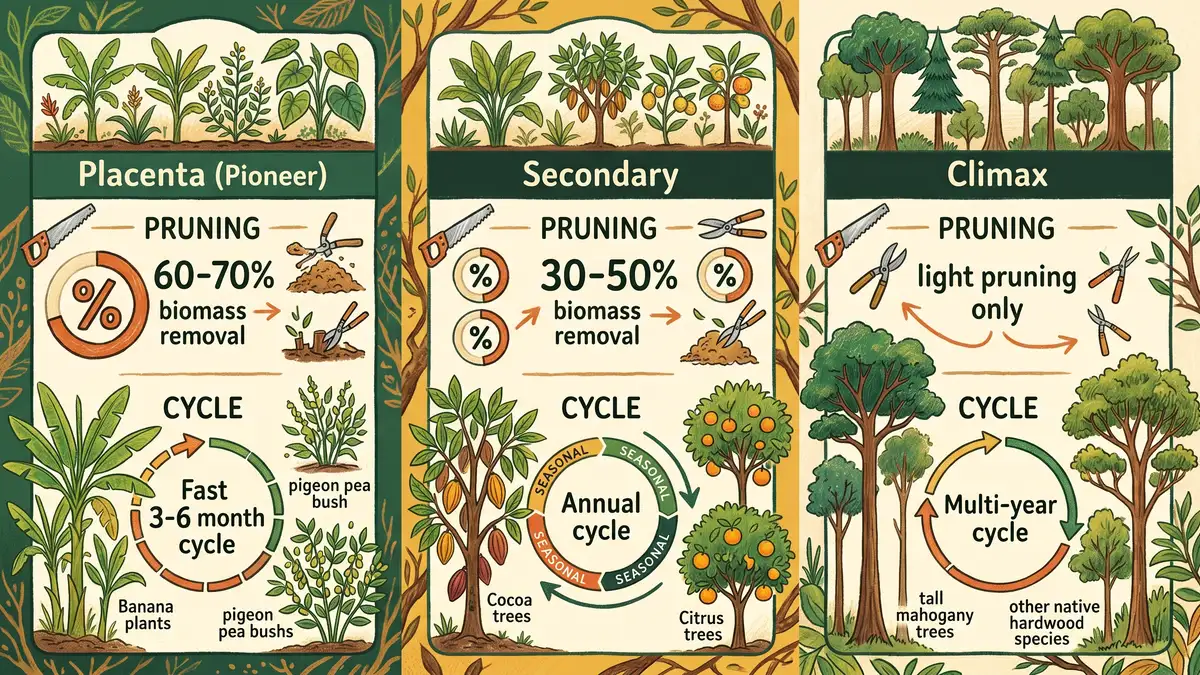
Gotsch organizes every species in his system into one of three successional categories. The category determines how often and how hard you prune. As Agenda Gotsch explains in the life cycle and stratification framework, these stages mirror what natural forests do over decades, compressed into an actively managed system that reaches comparable structure in years.
Placenta (pioneer) stage
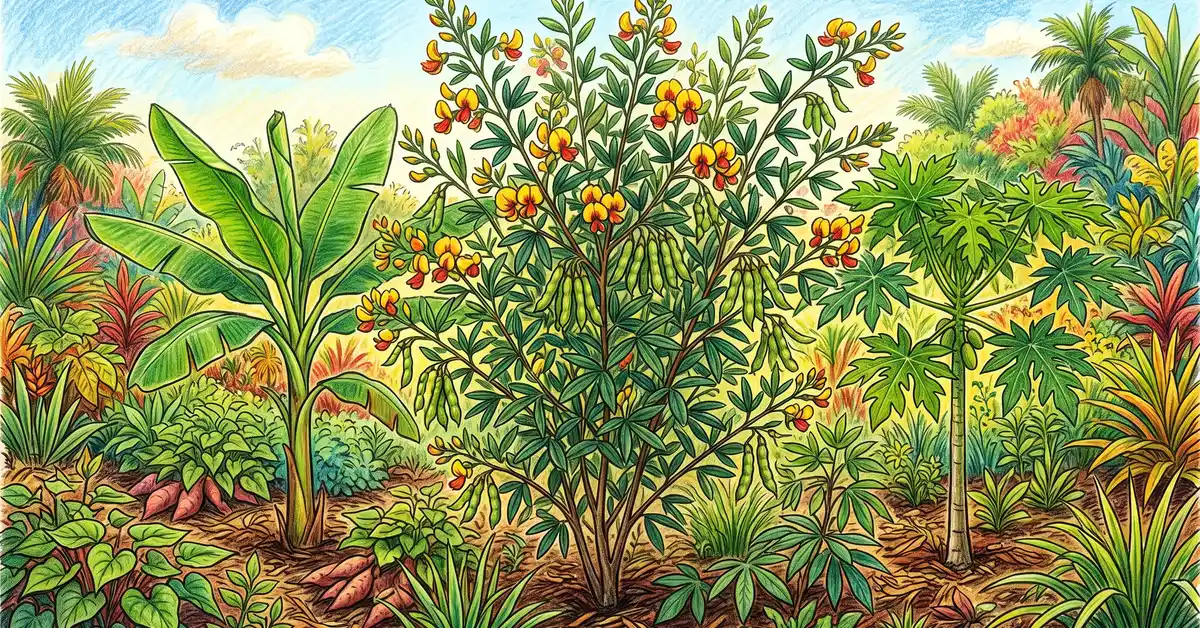
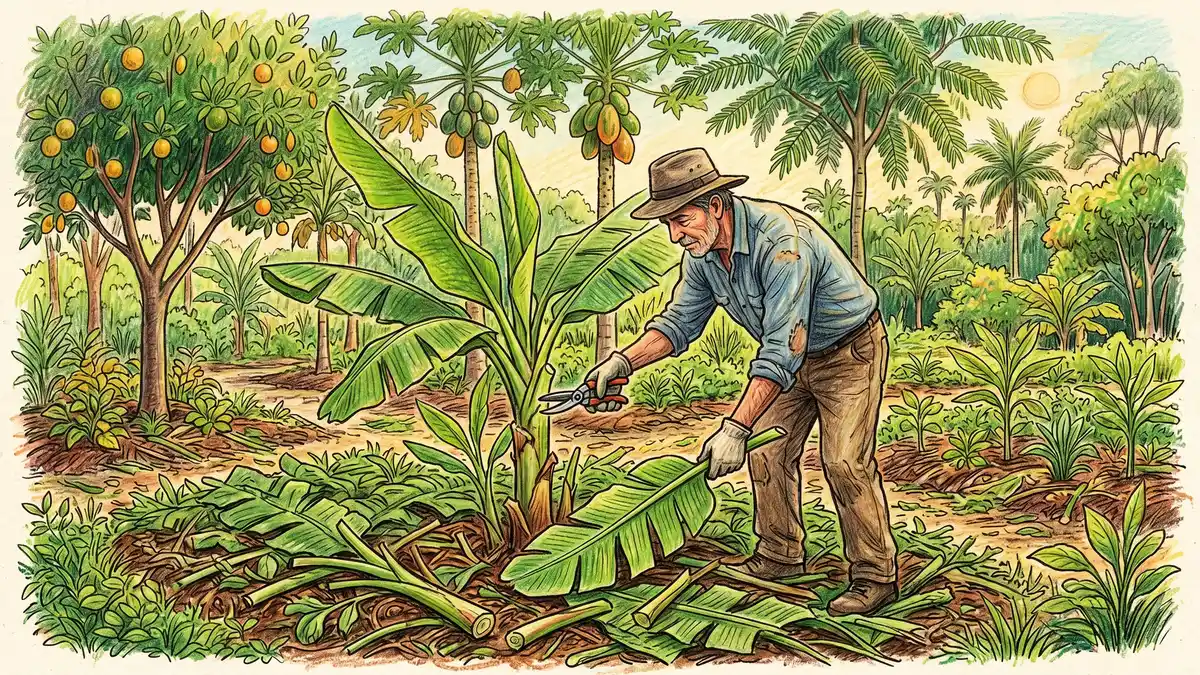
Fast-growing, short-lived species that build the initial biomass and protect the soil. Examples: banana, papaya, pigeon pea, ice cream bean (Inga edulis), gandu, gliricidia, eucalyptus. Lifespan 5 to 15 years. Pruned aggressively (50 to 70% biomass removal per cycle) two to four times per year. These are your soil builders.
Secondary stage
Medium-growth, longer-lived productive species that produce your main commercial crop. Examples: cocoa, citrus, coffee, avocado, acai, jaboticaba. Lifespan 20 to 50 years. Pruned moderately (20 to 40% removal) once or twice per year, targeting light penetration and fruit production rather than biomass.
Climax stage
Slow-growing, long-lived hardwoods that become the eventual canopy. Examples: mahogany, ipe, jatoba, native rainforest species. Lifespan 50 to 200+ years. Lightly pruned only when needed to manage shading, often just once every few years. These are your long-term investment and the system's eventual structure.
Why this works (the permaculture lens)
Natural forests pass through these same three stages over 80 to 200 years. Syntropic pruning collapses that timeline by manually creating the disturbance pioneer species need to keep growing, and then progressively retiring them as secondary and climax species mature. You are not fighting succession. You are accelerating it, and harvesting at each stage along the way.
The "prune for life" rule
The slogan you will hear from Gotsch's students is "podar para a vida", which translates as "prune for life". Syntopia Agroforst's syntropic guide describes pruning as a central method that fulfills multiple purposes simultaneously: stimulating growth, redirecting plant energy from reproduction back into vegetative expansion, and producing on-site mulch. The rule is to prune when the plant is in vigorous vegetative growth, not when it is stressed, not when it is fruiting, not when it is dormant.
Two timing principles drive every cut:
Cut during vegetative growth
Pruning before flower buds set redirects the plant's energy into new leaves and branches rather than seeds. For tropical pioneers like banana and pigeon pea, this means cutting every 3 to 6 months. For temperate equivalents (alder, willow, comfrey), it means cutting in late spring or mid-summer before flowering peaks.
Synchronize the system
Prune adjacent strata together so light reaches every layer at the same moment. If you prune the canopy only, the understory rushes upward and competes. If you prune both simultaneously, each species rebounds in its own zone without conflict. The "chop day" on syntropic farms is an event: 6 to 10 workers move through a plot in a coordinated wave.
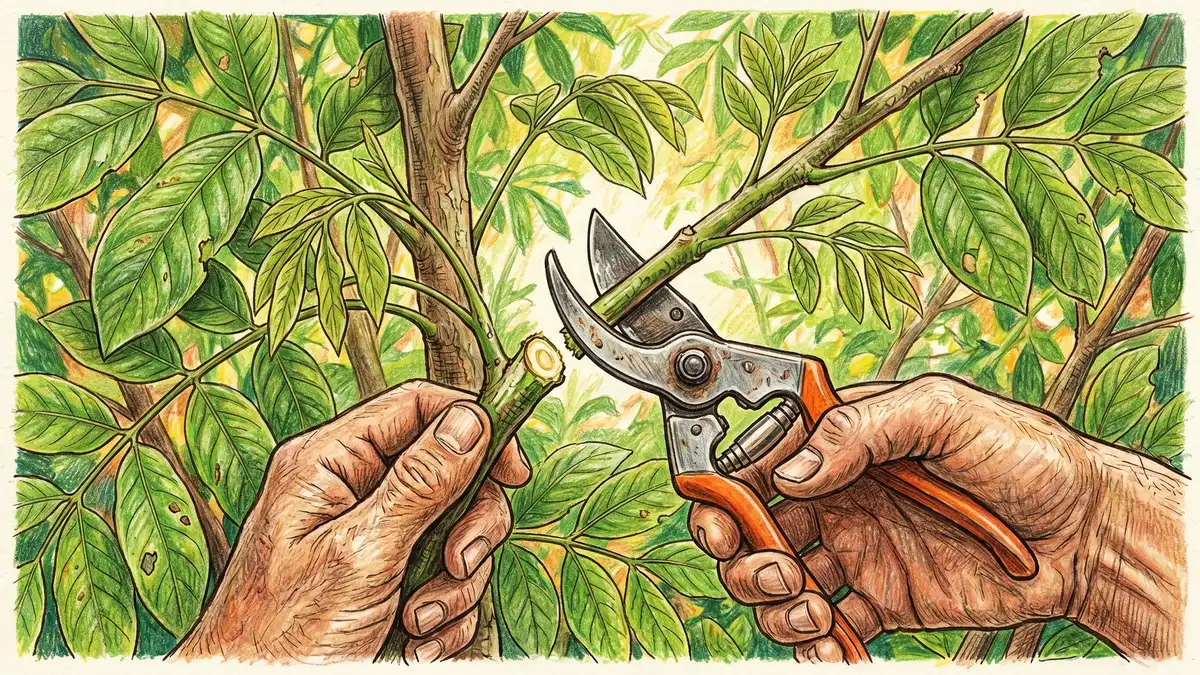
Beginner mistake: light pruning. New syntropic practitioners often cut 10 to 15% of the canopy and feel they have done a lot of work. They have not. The hormonal response that drives the system requires significant biomass removal. Pioneer species in particular need 50 to 70% removal per cycle to trigger the full growth flush, and the cut material has to go on the ground as mulch, not be hauled away. Mongabay's profile of Gotsch's method documents practitioners who describe the volume of cut material as initially overwhelming and only later understood as the system's primary nutrient input.
Biomass: the chop and drop layer
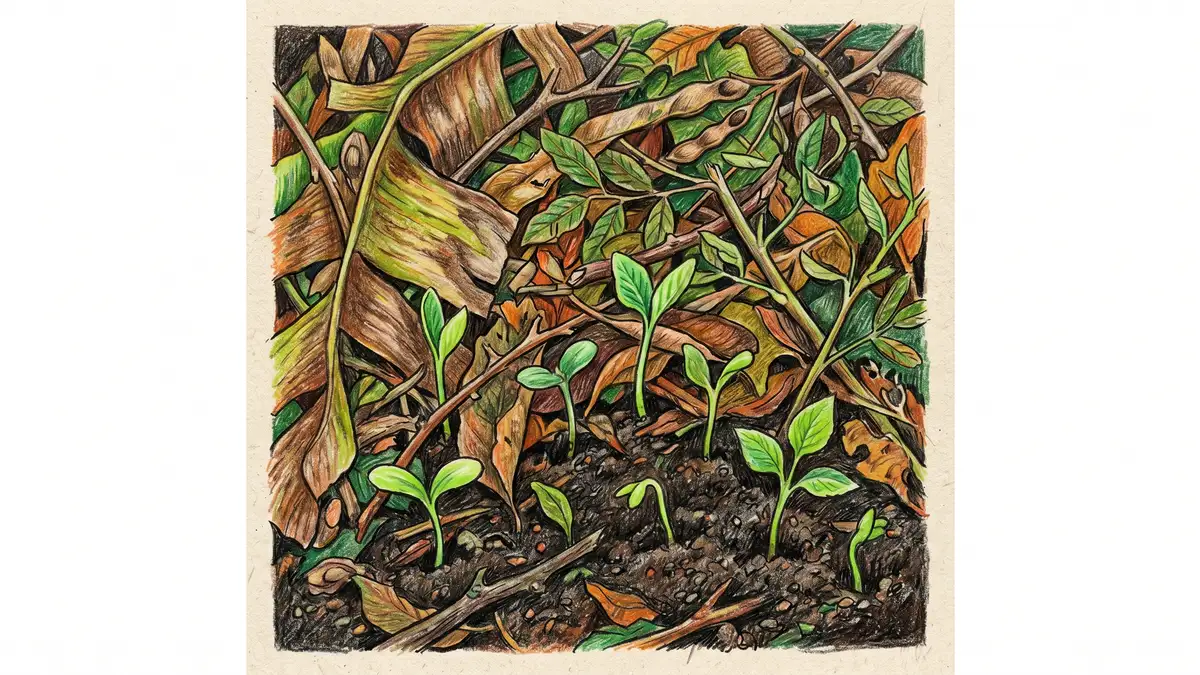
In a mature syntropic plot, the pruned biomass accumulates on the ground at rates that conventional farmers struggle to believe. Active systems generate 30 to 80 tons of fresh biomass per hectare per year. That biomass returns to the soil as mulch within months, lifting soil organic matter by 1 to 3% over five to ten years and rebuilding microbial communities that conventional agriculture has typically depleted. The connection to broader regenerative methods is direct: this is the same principle behind chop and drop mulching, just scaled to entire farms.
| System type | Biomass returned to soil | External inputs needed | Soil organic matter trend |
| Conventional monoculture | Crop residues only (1–3 t/ha/yr) | Synthetic NPK, herbicides | Declining |
| Cover-cropped organic | 5–15 t/ha/yr cover + residue | Compost, mineral amendments | Stable to slow increase |
| Mature syntropic plot | 30–80 t/ha/yr pruned biomass | None once established | Rising 1–3% per decade |
Source: SIT Graduate Institute cost-benefit analysis of syntropic farming and Believe.earth profile of Ernst Gotsch's restoration outcomes at Fazenda Olhos d'Agua.
Stratification: pruning to manage light
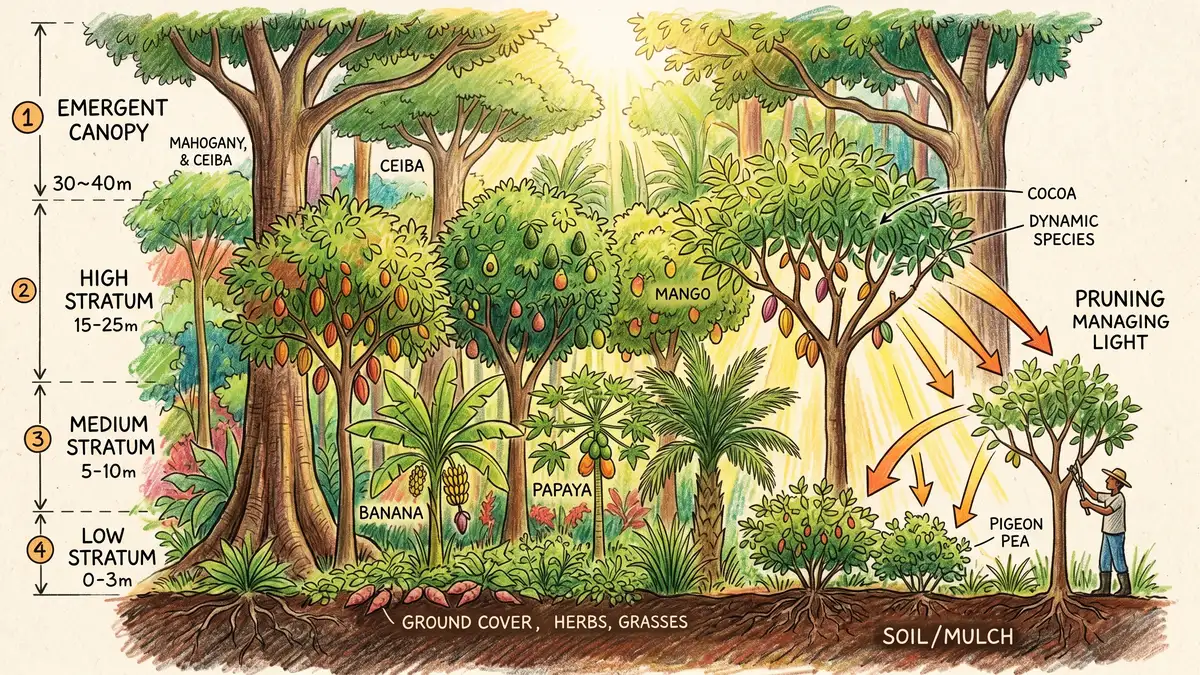
Every plant in a syntropic system occupies a vertical stratum based on its light demand and adult height. The four canonical strata are emergent (tallest, full sun), high (large fruit trees), medium (smaller trees and tall shrubs), and low (ground cover and shade-tolerant understory). Mountain Time Farm's principles of syntropic agroforestry describe stratification as the fundamental organizing principle: every plant has a designed place both in space (vertical) and in time (successional stage).
Pruning is how you keep the strata in balance. Without pruning, the fastest growers shade everything underneath them and the system collapses to a few species. With pruning, you remove just enough canopy to let light reach the next layer down, and that layer responds with its own growth pulse. Done at the right cadence, every plant from the emergent layer to the ground cover stays in active production.
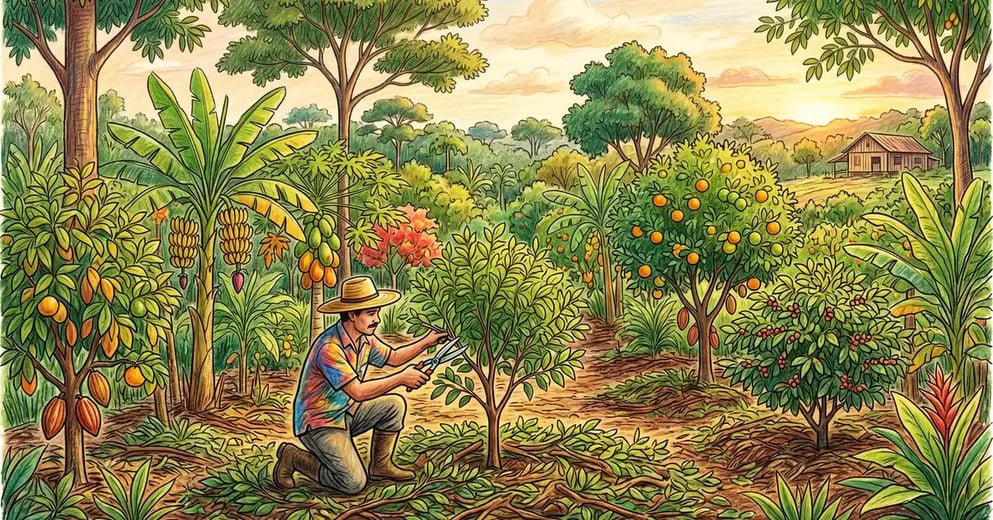
The species pairings matter. A typical Brazilian syntropic cocoa plot will have banana and pigeon pea in the placenta layer, cocoa and citrus in the secondary layer, and mahogany or native hardwoods slowly developing in the climax layer. The placenta species pump biomass into the soil for the first 10 to 15 years while the secondary species establish, and by the time the placenta plants are senescing, the secondary layer is in full production and the climax species are reaching toward the canopy. The pruning regime decreases in intensity over time as the system matures.
What this means for temperate growers
Most syntropic content focuses on tropical and subtropical systems because Gotsch worked in Bahia, Brazil. Temperate practitioners cannot grow banana or cocoa, but the underlying principles transfer cleanly. Forests4Farming's work in temperate agroforestry documents adaptations using alder, willow, hazel, and elder as the placenta layer, with apple, pear, plum, and walnut in the secondary layer, and oak or sweet chestnut as climax species.
Pick fast-growing nitrogen-fixing pioneers
Alder, sea buckthorn, gorse (with caution), or autumn olive in temperate climates. These play the banana role: heavy seasonal pruning, dropped on site as mulch, nitrogen fixed into the soil. Look for our deeper guide on nitrogen-fixing plants for species selection.
Use willow and hazel as "mother trees"
Coppiced willow regrows 6 to 8 feet (about 2 to 2.5 m) of biomass per year and can be cut to ground level every two to three years. Hazel is similar. Both produce useful wood (basketry, garden stakes, biochar feedstock) and prolific biomass for mulch.
Time cuts to your climate, not Brazil's
In temperate zones the high vegetative period runs from late spring (mid-May) through mid-summer. Prune pioneers then, and again in early autumn for fast-regrowing species like willow. Avoid pruning in late autumn when the plant is shutting down for winter.
Drop biomass exactly where it grew
The biggest temperate adaptation is not species, it is the habit of leaving cut material on the ground. Most temperate gardeners haul prunings to a compost pile or burn them. Stop. Lay them flat on the soil under the trees they came from. Soil organic matter climbs without the labor of compost turning.
Where syntropic claims need caveats
Most of the data behind syntropic agriculture comes from on-farm documentation, not from peer-reviewed agricultural research. The biomass figures, soil restoration timelines, and yield claims are credible based on observation but have not been replicated at scale by independent academic studies. As a SIT Graduate Institute analysis notes, the cost-benefit case is strong qualitatively but quantitative validation remains limited. Treat the framework as a tested practitioner method, not as established science.
Cost and time to start
Setting up a syntropic plot is more time-intensive than a conventional one but uses fewer inputs over its lifespan. A small home plot (1,000 sq ft / 93 m²) needs 30 to 60 seedlings across all strata, costing $200 to $500 in plants and a weekend of design and planting. Pruning labor through the first three years averages 4 to 8 hours per month, dropping to 2 to 4 hours per month from year five onward as the system matures. There are no fertilizer, irrigation, or herbicide costs from year two onward in a well-designed system. Global Earth Repair Foundation documents Gotsch's economic case: the labor saved on inputs and irrigation more than offsets the labor spent on pruning, while soil and water assets compound.
Start one syntropic row this season
You do not need 1,200 acres to apply the method. Plant one row with three layers: a fast pioneer (alder or willow), a productive secondary (apple, pear), and one slow climax (oak or chestnut). Prune the pioneer twice a year and drop everything on site. By year three you will have a working syntropic micro-plot and a deep, dark layer of soil under it.
Learn more about syntropic agricultureFrequently asked questions
What is syntropic pruning?
Syntropic pruning is the practice of cutting back pioneer and secondary trees in an agroforestry system to drive growth, release biomass to the soil, and manage light penetration to lower strata. It is the primary management tool in syntropic agriculture as developed by Ernst Gotsch, and it replaces conventional fertilization and irrigation as the system's main fertility input.
Why is pruning so important in syntropic agriculture?
Pruning triggers hormonal responses (auxin redistribution, gibberellin and cytokinin release) that drive new growth, and the cut biomass returns to the soil as mulch. Both effects compound: each pruning event produces more biomass, which feeds the soil, which produces healthier plants, which produce more biomass. The system runs on this loop instead of external inputs.
How often should you prune in a syntropic system?
Pioneer species (banana, pigeon pea, alder, willow) get pruned two to four times a year with 50 to 70 percent biomass removal. Secondary species (cocoa, citrus, apple, pear) get pruned once or twice a year with 20 to 40 percent removal. Climax species (mahogany, oak, walnut) are pruned only as needed, typically every few years.
What happens to the pruned material?
It stays on the ground exactly where it was cut. This is the chop-and-drop method. The biomass decomposes in place, feeds soil organisms, retains moisture, and suppresses weeds. Hauling cut material away breaks the closed nutrient loop the system depends on.
Can you do syntropic agriculture in a temperate climate?
Yes, with species substitutions. Alder, willow, hazel, and sea buckthorn replace tropical pioneers. Apple, pear, plum, and hazelnut replace tropical secondary species. Oak, sweet chestnut, and walnut replace tropical climax species. The principles (heavy pioneer pruning, chop and drop, stratification, succession management) transfer directly.
Who invented syntropic agriculture?
Swiss-Brazilian agronomist Ernst Gotsch developed the method over 40+ years at his farm Fazenda Olhos d'Agua in Bahia, Brazil, where he restored 1,200 acres (about 486 hectares) of degraded land. The method draws on conventional ecology and on Gotsch's own field observations rather than on a single academic discipline.
Is syntropic pruning the same as coppicing?
Coppicing is a related but narrower technique: cutting a tree to ground level so it regrows from the stump. Syntropic pruning includes coppicing as one tool but is broader: it shapes, thins, and re-times every species in the system according to its successional stage. Coppicing is one possible cut on one type of tree. Syntropic pruning is a system-wide management regime.
How long until a syntropic plot becomes self-sustaining?
Most documented plots reach a productive, low-input state by year four or five. Pioneer species are at full biomass output, secondary species are fruiting, and the soil has built enough organic matter to retain water through dry periods without irrigation. Climax species are still decades from maturity but no longer need active support. For where this cycle starts, see when to make the first cut in the opening season.
Resources
- Agenda Gotsch: Pruning Instead of Fertilizers and Irrigation
- Agenda Gotsch: Life Cycle, Stratification and Succession
- Mongabay: In Syntropic Agriculture, Farmers Stop Fighting Nature
- SIT Graduate Institute: Cost-Benefit Analysis of Syntropic Farming (PDF)
- Mountain Time Farm: The Principles of Syntropic Agroforestry
- Syntopia Agroforst: Syntropic Agriculture Guide
- Believe.earth: Ernst Gotsch, Creator of the Real Green Revolution
- Forests4Farming: Syntropic Agroforestry and Regenerative Farming
- Global Earth Repair Foundation: Ernst Gotsch
- ForestNation: Syntropic Agriculture Overview