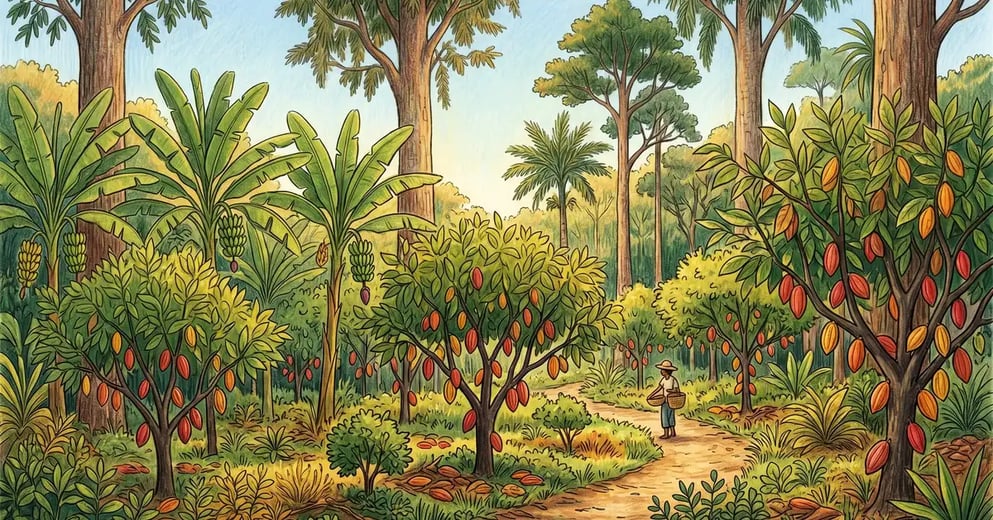

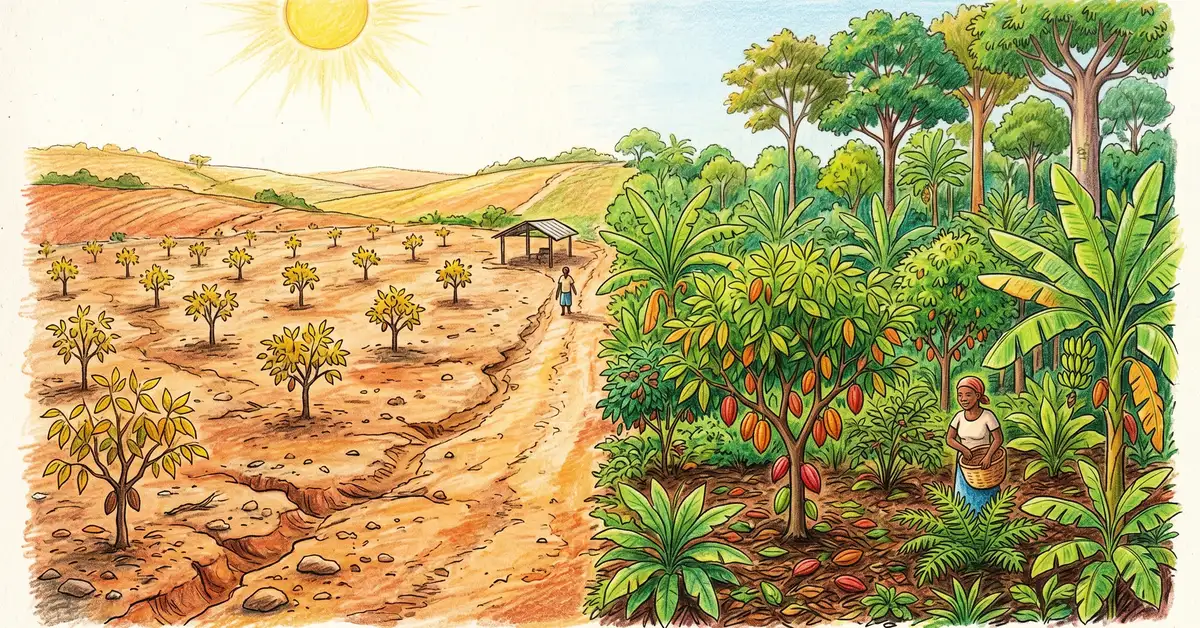
In 1982 a Swiss farmer named Ernst Gotsch bought 480 hectares of exhausted cattle pasture in Bahia, Brazil. The springs had dried up. The soil was bare. Forty years later the same land has 14 perennial springs flowing year-round, dense canopy forest, and a productive cocoa, banana, and hardwood agroforest that supports a working farm and a teaching school. The method that produced this result is called syntropic agriculture, and cocoa is one of the trees that makes it work. what a shade canopy does for coffee
Where cocoa actually wants to grow
Theobroma cacao is an Amazon understory tree. In the wild it grows in the dappled light under taller forest trees, in soil rich with organic matter, with constant moisture and warm temperatures. The plant evolved for shade. When commercial cocoa moved to full-sun monoculture in the 20th century it produced more pods in the short term but burned out the soil and exposed the trees to diseases their wild ancestors rarely faced. CIFOR research and World Agroforestry both document that shade-grown cocoa trees commonly live 40 to 60 years, while full-sun cocoa burns out in 15 to 25 years.
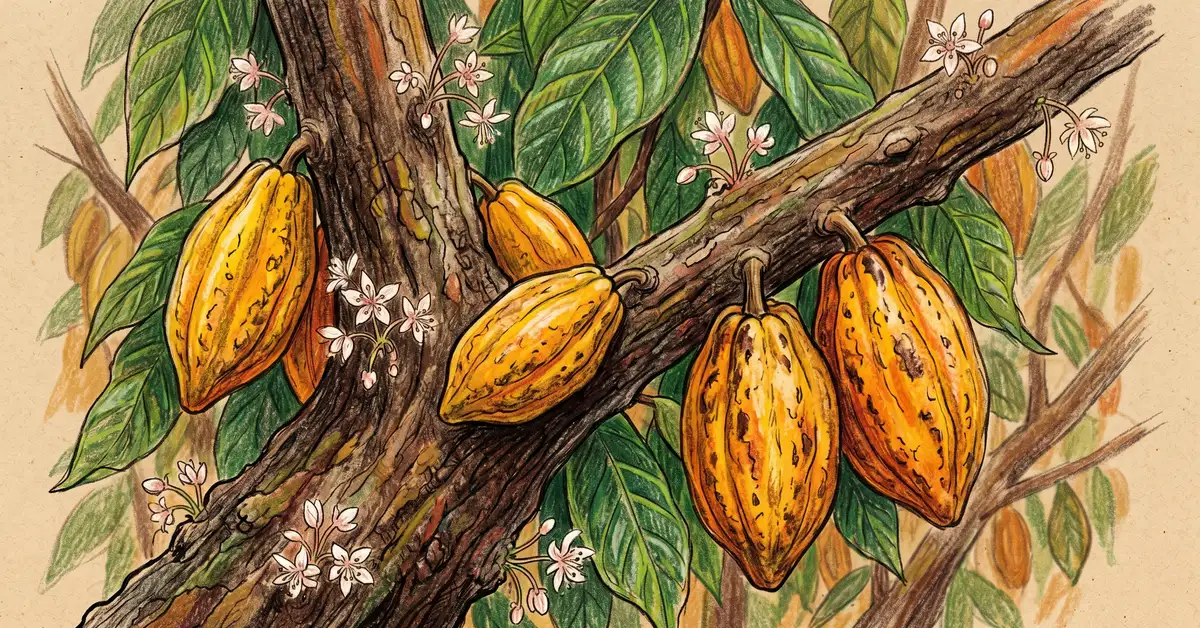
The crash of Brazilian cocoa in Bahia is the historical lesson the world keeps re-learning. In 1989 the witch's broom fungus (Moniliophthora perniciosa) reached Bahia. Within a decade Brazilian cocoa production fell from about 400,000 tons to 130,000 tons. The trees most stressed by sun, monoculture, and degraded soil collapsed first. The disease taught what the forest had quietly been saying for decades: cocoa is a shade plant.
Cocoa botany basics that drive the design:
Native range. Amazon basin understory, 30 to 50 percent canopy shade preferred.
Climate. 50 to 100 in annual rainfall, USDA hardiness zones 11 to 13, no frost tolerance.
Size. 13 to 26 ft at maturity. Evergreen. Flowers and pods attach directly to the trunk and main branches (cauliflory).
Soil. Deep, well-drained, rich in organic matter, pH 6.0 to 7.5.
Lifespan. 40 to 60 years in agroforestry, 15 to 25 years in monoculture.
What syntropic agriculture is (and is not)
Why this works (the permaculture principle)
Ernst Gotsch designed syntropic agriculture by spending decades observing how a tropical forest assembles itself. Bare land does not jump to climax forest. It moves through stages: weeds, grasses, soft-wood pioneers, hardwoods, then the climax canopy. Each stage prepares the soil for the next. Gotsch's insight was that a farmer can compress this succession into 5 to 15 years by planting all stages at once and managing them through pruning. The result is a productive food system that builds soil, restores water cycles, and produces commercial crops at the same time. The same logic underpins our broader syntropic agriculture introduction.
Syntropic agriculture is not just shade-grown cocoa. It is a process-based method with five identifying features:
1. Stratification by light. Every plant has a place in a vertical layer based on its light requirement. The four canonical strata are emergent (canopy 30 ft+), high (15 to 30 ft), medium (6 to 15 ft), and low (under 6 ft).
2. Succession through time. Pioneers like bananas and fast biomass trees plant first, climax species like cocoa and hardwoods overlap with them, and the system shifts through time as pioneers are harvested or pruned and climax species mature.
3. Density. Syntropic systems are densely planted, often 3 to 5 times the plant density of conventional agroforestry, because density and competition drive the process.
4. Frequent pruning. Heavy pruning (chop and drop) is the central management practice. Without pruning the canopy closes, light reaches the lower strata, and the system stalls. Trees are pruned at the moment they would naturally die back, mimicking natural disturbance.
5. Biomass over inputs. Pruned material becomes mulch and feeds the soil. The system aims to produce all its own fertility on-site rather than importing fertilizer.
The syntropic cocoa stratification model
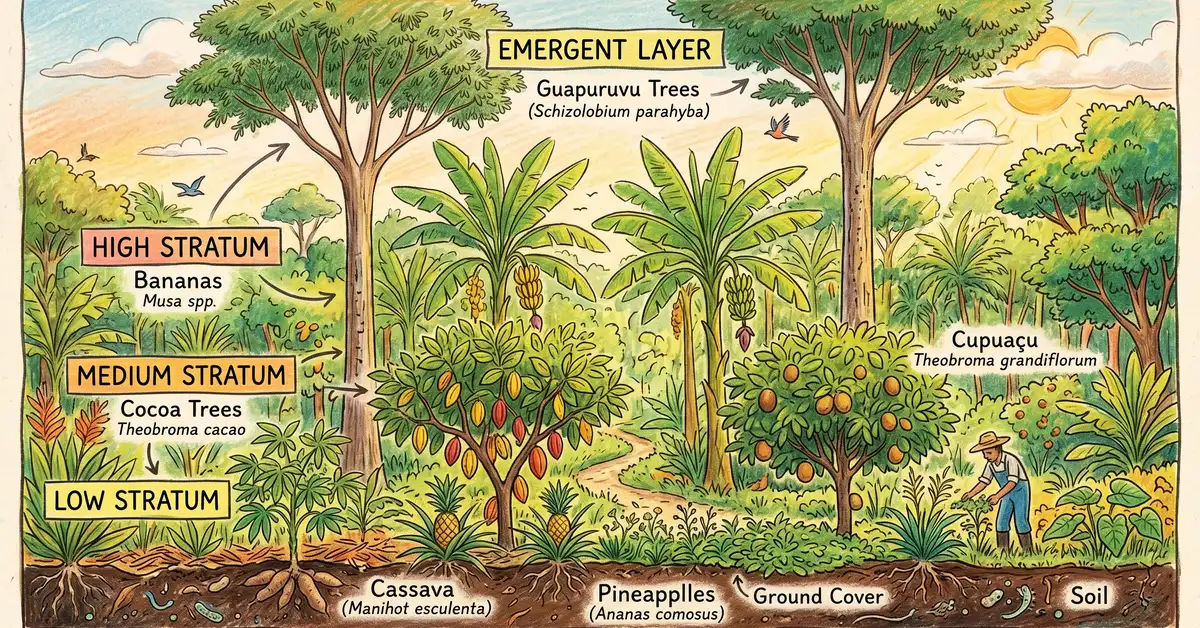
| Stratum | Height | Light need | Key species | Role |
| Emergent | 30 ft+ | Full sun | Schizolobium parahyba (guapuruvu), mahogany, jatoba, ipe | Long-term timber, canopy structure, deep root water cycling |
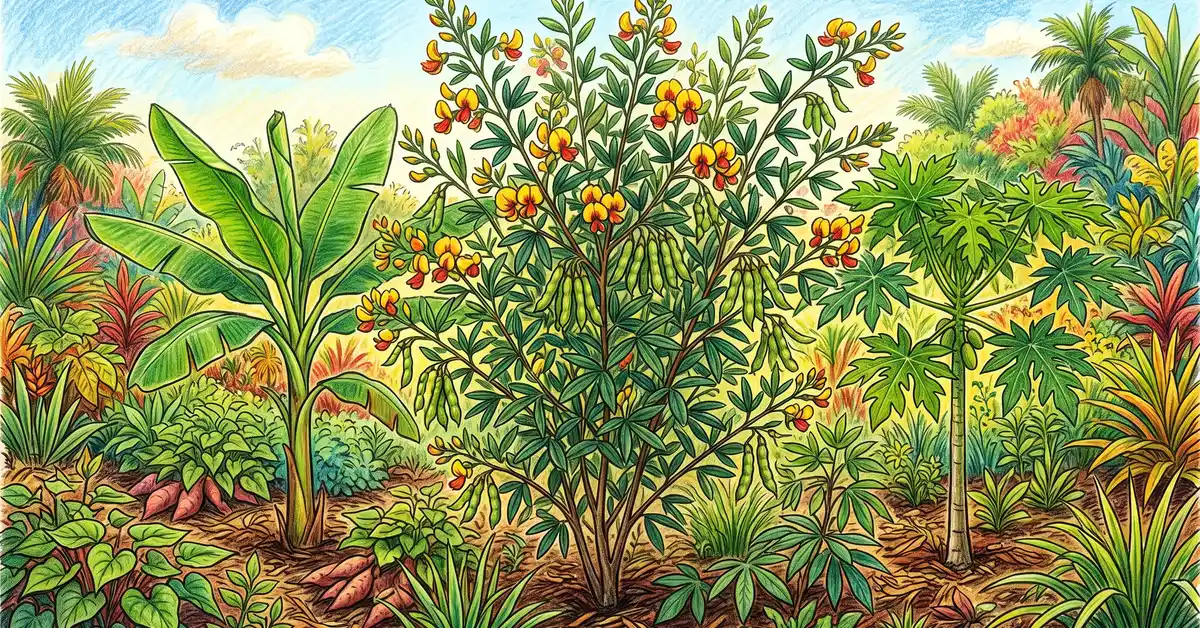
| High | 15-30 ft | Sun to high light | Banana Musa spp., papaya, gliricidia, pigeon pea, inga (ice cream bean) | Fast biomass, nitrogen fixation, fruit, pioneer shade |
| Medium | 6-15 ft | 30-50 percent shade | Cocoa Theobroma cacao, cupuacu T. grandiflorum, citrus, coffee | Cash crops, climax canopy understory |
| Low | Under 6 ft | Light to deep shade | Cassava, pineapple, ginger, turmeric, herbs, vegetables in early years | Soil cover, early income, ground biomass |
Source: Ernst Gotsch publications and apprentice schools,.
Pruning: the practice that makes syntropic work
Pruning is to syntropic agriculture what cultivation is to row crops. It is the central recurring intervention that drives the system. The principle is to prune at the moment of maximum photosynthetic activity, ideally in the wet season when the plant is putting out new leaves. Heavy pruning releases light to the lower strata, drops biomass on the soil, and stimulates the remaining plants to grow more vigorously.
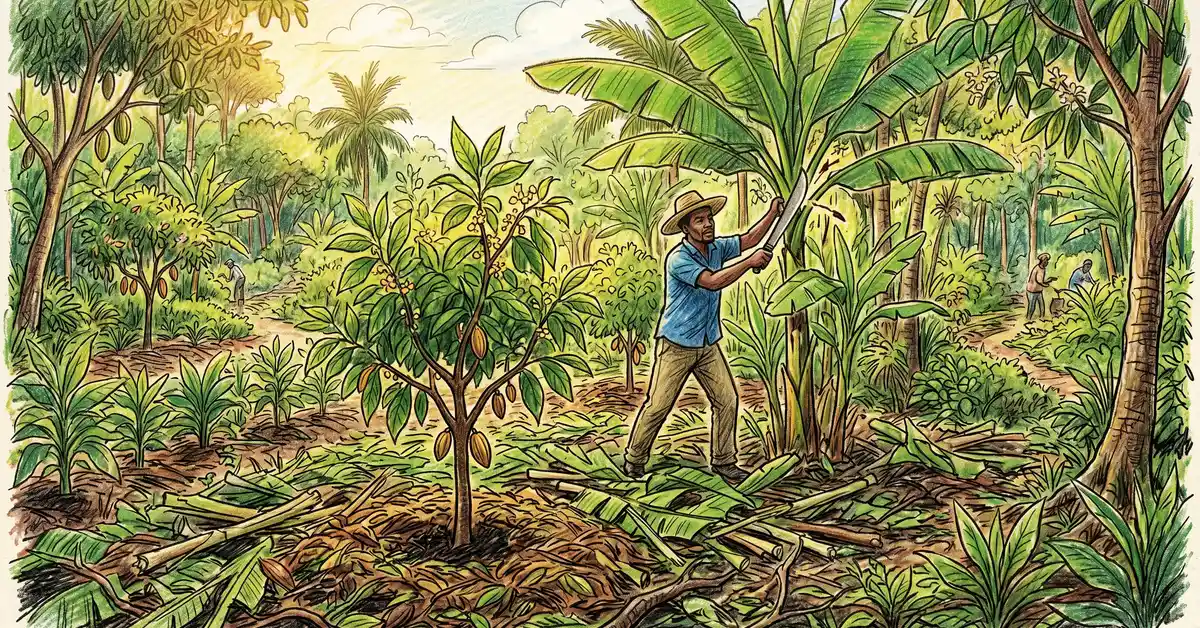
Typical pruning cadence in a syntropic cocoa system:
Bananas. Major pruning at fruit harvest (whole pseudostem cut), plus selective leaf removal 2 to 4 times per year. The pseudostem is 90 percent water and decomposes into rich biomass within weeks.
Guapuruvu and other emergent biomass trees. Pollarded (top cut) every 2 to 4 years to drop massive biomass and release light. The species can regrow 3 m per year, so the cycle continues indefinitely.
Inga and gliricidia. Cut back hard 2 to 3 times per year for biomass and nitrogen-rich leaf litter.
Cocoa. Lightly pruned for shape and disease management. Cocoa is a climax species and is not pruned heavily.
Without consistent pruning, the system stalls. With it, the same hectare can produce cocoa, banana, hardwood, and ground crops continuously for decades.
Yields and economics
The case study that started it all: Fazenda Olhos d'Agua
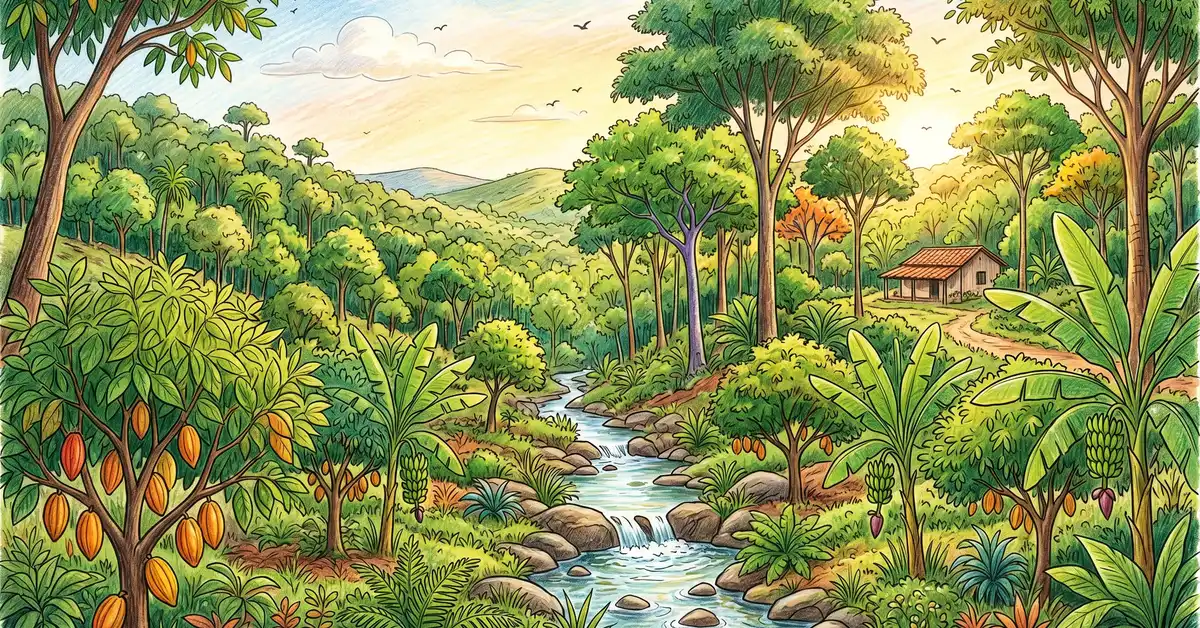
Ernst Gotsch bought Fazenda Olhos d'Agua in 1982. The name translates to "Farm of Spring Eyes," ironic given that all 14 historical springs had dried up by purchase. The 480-hectare property in Piraí do Norte, Bahia, was degraded Atlantic Forest converted to cattle pasture. Over the following 40 years Gotsch and his team planted millions of trees across the property using syntropic methods, with cocoa as the medium-stratum cash crop. By 2020 all 14 springs flowed year-round again, the property was estimated to receive 10 times more rainfall infiltration than equivalent degraded land in the region, and microclimate temperatures had dropped substantially relative to neighboring properties.
Disease resistance and the witch's broom story
Witch's broom (Moniliophthora perniciosa) and frosty pod rot (Moniliophthora roreri) are the two diseases that decided the geography of world cocoa production. Both spread fastest in stressed monoculture cocoa. Both spread slowest in healthy diverse agroforestry. Embrapa Brasil documents that shaded cocoa under proper agroforestry management suffers significantly less infection from both diseases than full-sun monoculture, in part because the trees are less stressed and in part because the diverse plant community supports natural disease antagonists.
Carbon and water
Beyond food and timber, syntropic cocoa systems deliver measurable ecosystem services. Peer-reviewed studies in Cameroon, Ghana, and Brazil show 50 to 100 tons of CO2 sequestered per hectare over 20 to 30 years in well-managed cocoa agroforestry. FAO reports that cocoa agroforestry rehabilitated from monoculture can re-establish hydrological function within 5 to 15 years, with measurable increases in dry-season streamflow and water infiltration.
Who is doing this around the world
Brazil. Gotsch's Fazenda Olhos d'Agua and the Mata Atlantica restoration movement. Apprentices Henrique Souza, Andre Trigueirinho, and others teach syntropic methods globally.
Belize. Maya Mountain Cacao and Toledo Cacao Growers Association apply agroforestry principles to shade-grown cocoa for specialty markets.
Ecuador. Smallholder cooperatives in coastal provinces apply agroforestry to fine flavor cacao varieties (Nacional, Arriba) using local fruit and timber trees.
Cameroon and Ghana. CIFOR and ICRAF research programs document cocoa agroforestry as the highest-carbon, highest-resilience production system in West Africa.
Mexico. La Lomita and other Chiapas cooperatives use agroforestry cocoa with fair trade and organic certification premiums.
Get the Weekly Dig
One practical permaculture guide a week, written for gardeners who do this on weekends: food forest and guild designs that produce. Free, no spam, unsubscribe any time.
Join the newsletterFrequently asked questions
What is syntropic cocoa farming?
Syntropic cocoa farming is a process-based agroforestry method developed by Swiss-Brazilian farmer Ernst Gotsch that grows Theobroma cacao inside a multi-layer plant succession designed to mimic natural Atlantic Forest dynamics. Cocoa sits in the medium stratum, shaded by bananas, biomass trees, and eventually a hardwood canopy. The system relies on heavy pruning to release light and recycle biomass.
Where are cocoa beans grown in the world?
West Africa produces roughly 70 percent of global cocoa, with Ivory Coast at about 44 percent and Ghana at about 20 percent. Latin America (Ecuador, Brazil, Peru, Colombia) and Asia (Indonesia, Papua New Guinea) account for the rest. Almost all production occurs within 20 degrees latitude of the equator because cocoa requires consistent warmth and rainfall.
Are cocoa beans a fruit?
Cocoa beans are the seeds inside the fruit of Theobroma cacao, an evergreen tree native to the Amazon basin. The fruit is called a pod, attaches directly to the trunk and main branches (cauliflory), and contains 20 to 40 seeds embedded in sweet white pulp. The seeds become cocoa after fermentation and drying.
How many cocoa trees per acre?
Monoculture cocoa plantations commonly stock 400 to 700 trees per acre (1,000 to 1,700 per hectare). Syntropic cocoa systems use lower cocoa density (200 to 400 per acre) but add hundreds of additional plants per acre across the other strata (bananas, biomass trees, ground crops, hardwoods) for total densities of 1,500 to 3,000 plants per acre.
How profitable is shaded cocoa vs monoculture?
On cocoa yield alone, full-sun monoculture wins early but burns out in 15 to 25 years. Syntropic and shaded cocoa systems produce 800 to 1,500 kg/ha cocoa over 40 to 60 years plus banana, fruit, timber, and ecosystem services. Total system economic value over the full lifespan is substantially higher in agroforestry, and the agroforestry farm retains its land value rather than degrading to abandonment.
What is the difference between syntropic agriculture and permaculture?
Permaculture is a broad ethical and design framework developed by Bill Mollison and David Holmgren that applies to whole-property design, including water, energy, and social systems. Syntropic agriculture is a specific process-based agroforestry method developed by Ernst Gotsch focused on plant community design, succession, and pruning. The two are compatible; syntropic systems often live inside larger permaculture designs.
What is the witch's broom disease that destroyed Brazilian cocoa?
Witch's broom is a fungal infection (Moniliophthora perniciosa) that causes abnormal branch proliferation and pod loss in cocoa. It reached Bahia, Brazil in 1989 and within a decade collapsed Brazilian production from about 400,000 tons to 130,000 tons. Monoculture cocoa under stress was particularly vulnerable. Shaded agroforestry cocoa shows significantly less infection.
Who is Ernst Gotsch?
Ernst Gotsch is a Swiss-born farmer who moved to Brazil in 1982 and bought 480 hectares of degraded Atlantic Forest land in Bahia. Over 40 years he developed syntropic agriculture by observing forest succession and designing plant communities that compress it. His Fazenda Olhos d'Agua now hosts a teaching school and has restored 14 perennial springs that had dried up on the property before he arrived.
Resources
- World Agroforestry Centre (ICRAF)
- Center for International Forestry Research (CIFOR)
- Embrapa Brasil
- CATIE Centro Agronomico Tropical
- Food and Agriculture Organization of the United Nations (FAO)
- International Cocoa Organization
- Penn State Cocoa Research
- Agenda Gotsch (Ernst Gotsch teaching platform)