
Leave a garden bed alone and two things seem to happen at once. Left truly bare, it erodes, dries, and falls apart. But given a little life, it does the opposite: weeds move in, then shrubs, then trees, and the patch slowly builds itself into something richer and more complex than it started. That second tendency, life pulling order out of raw materials, has a name that most gardeners have never heard: syntropy.
Syntropy is often described as the opposite of entropy, the famous physical law that says everything trends toward disorder. It is a genuinely useful idea for understanding why your garden wants to grow, and it is the concept behind one of the most exciting movements in regenerative growing. This guide explains what syntropy actually means, whether it really contradicts physics (it does not), and how you can garden with it. It expands on our introduction to syntropic agriculture.
What you'll learn:
- What entropy and syntropy actually mean, in plain language
- Why building order in your garden does not break the second law of physics
- Where the idea came from and who developed it
- How to work with syntropy in a real backyard
Key Takeaway
Entropy is the universe's tendency toward disorder and dispersed energy. Syntropy is the local, opposite pattern: living systems concentrate energy and build complexity, using sunlight to grow structure, biomass, and soil. It is not magic or a loophole in physics. A garden is simply an open system that imports high-quality energy and exports waste heat, building order in one place while the universe's total disorder still rises.
Doesn't Building Order Break the Laws of Physics?
No, and this is the part worth getting right. The second law of thermodynamics says that in an isolated system, entropy tends to increase, which is why physicists call it "time's arrow." Things left to themselves spread out, cool down, and fall apart. So how can a forest grow more ordered over decades?
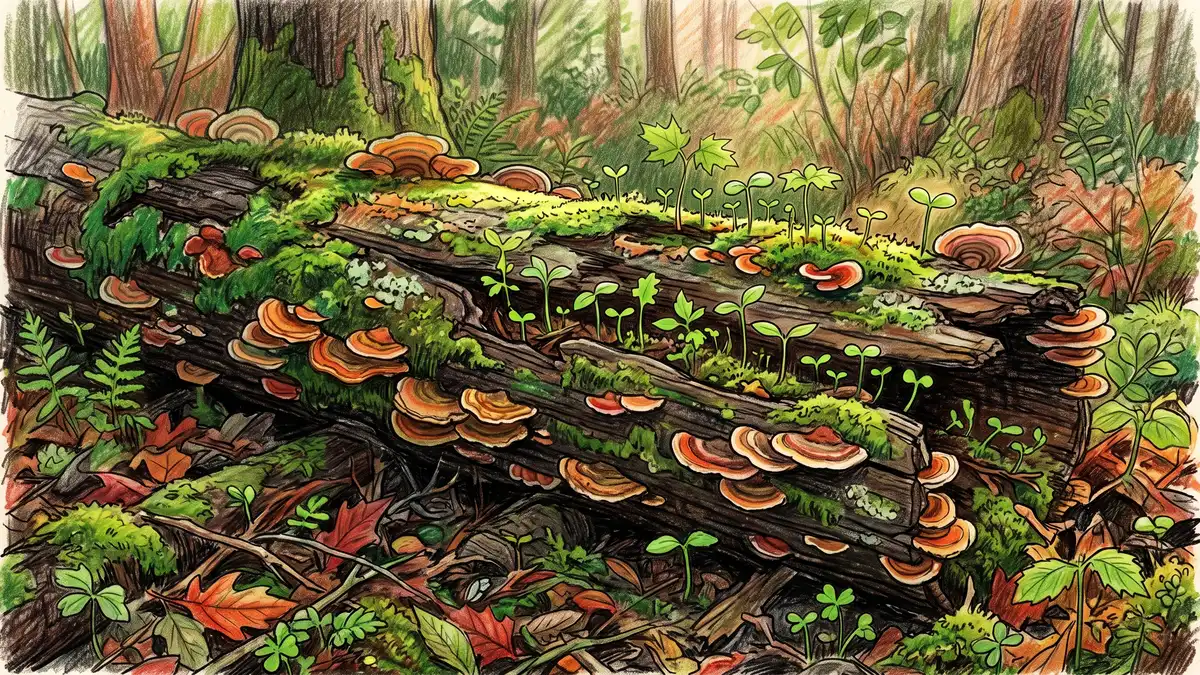
The answer is that a garden is not an isolated system; it is an open one. It constantly takes in low-entropy energy from the sun and exports high-entropy waste heat back out. The physicist Ilya Prigogine won the 1977 Nobel Prize for showing that open systems far from equilibrium can organize themselves into what he called dissipative structures, patterns that hold their order precisely because energy keeps flowing through them. A plant, a garden, a whole ecosystem builds local order while the total entropy of the universe still rises. Even your compost pile fits: it breaks complex matter into simpler molecules, releasing entropy, yet the result feeds new structure in the soil.
Where Did the Idea of Syntropy Come From?
It emerged from physicists trying to describe why life defies the drift toward disorder. In 1941, the Italian mathematician Luigi Fantappie coined the word sintropia, presenting a "unified theory of the physical and biological world" that paired entropy with its mirror image. Three years later, Erwin Schrodinger's landmark book What Is Life? argued that organisms survive by feeding on what he called "negative entropy", drawing order from their surroundings.
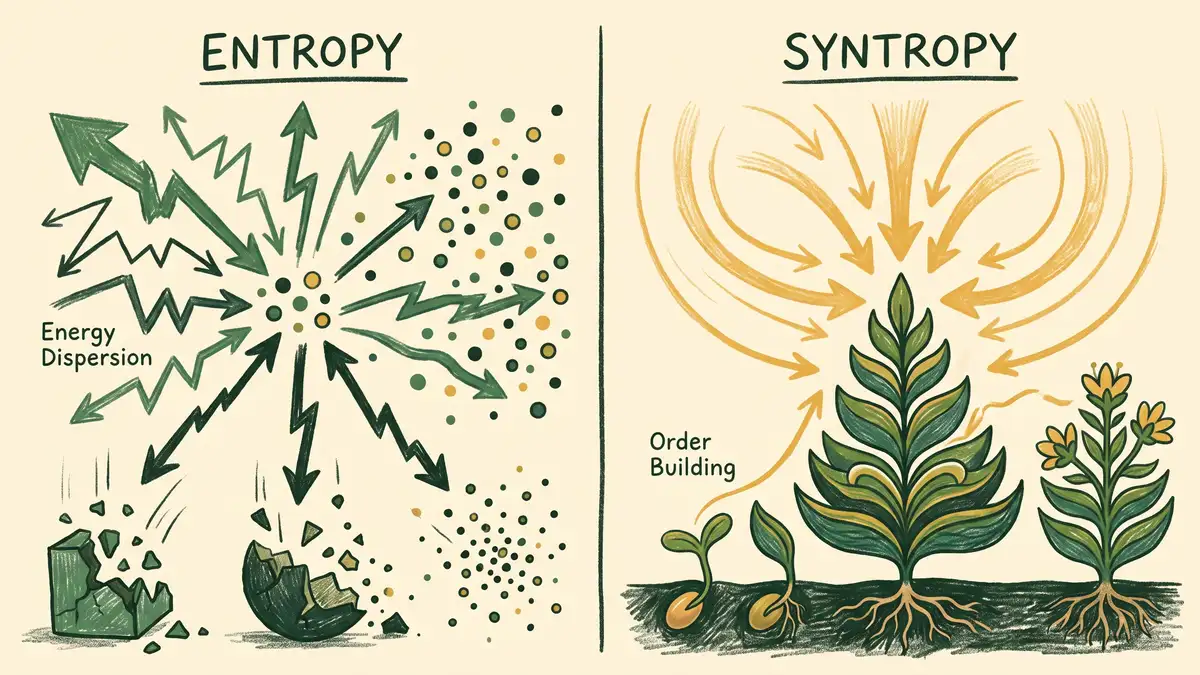
The Nobel biochemist Albert Szent-Györgyi later used "syntropy" for life's drive toward complexity, and Buckminster Fuller coined the related "synergetics." Not all of these framings were equally rigorous, and some have been misused, but the useful thread running through them is real: living matter, powered by an energy flow, moves against the local grain of entropy.
| Thinker | Year | Contribution |
| Luigi Fantappie | 1941 | Coined "syntropy" as the counterpart to entropy |
| Erwin Schrodinger | 1944 | Life feeds on "negative entropy" (negentropy) |
| Ilya Prigogine | 1977 | Dissipative structures: order from energy flow |
| Ernst Gotsch | 1980s+ | Applied syntropy to farming in Brazil |
Sources: Frontiers Magazine on Fantappie, Prigogine Nobel Lecture
Why This Works: Succession Is Syntropy You Can Watch
Ecological succession, the way bare ground moves through weeds and pioneers to a mature forest, is syntropy made visible over time. At each stage the system captures more sunlight, stores more carbon and water, holds more biodiversity, and builds deeper soil. Your garden is a small dissipative structure doing the same thing: pulling in solar energy and turning it into living order. When you plant in layers and let natural succession do the heavy lifting, you are steering that process instead of fighting it.
How Do You Garden With Syntropy?
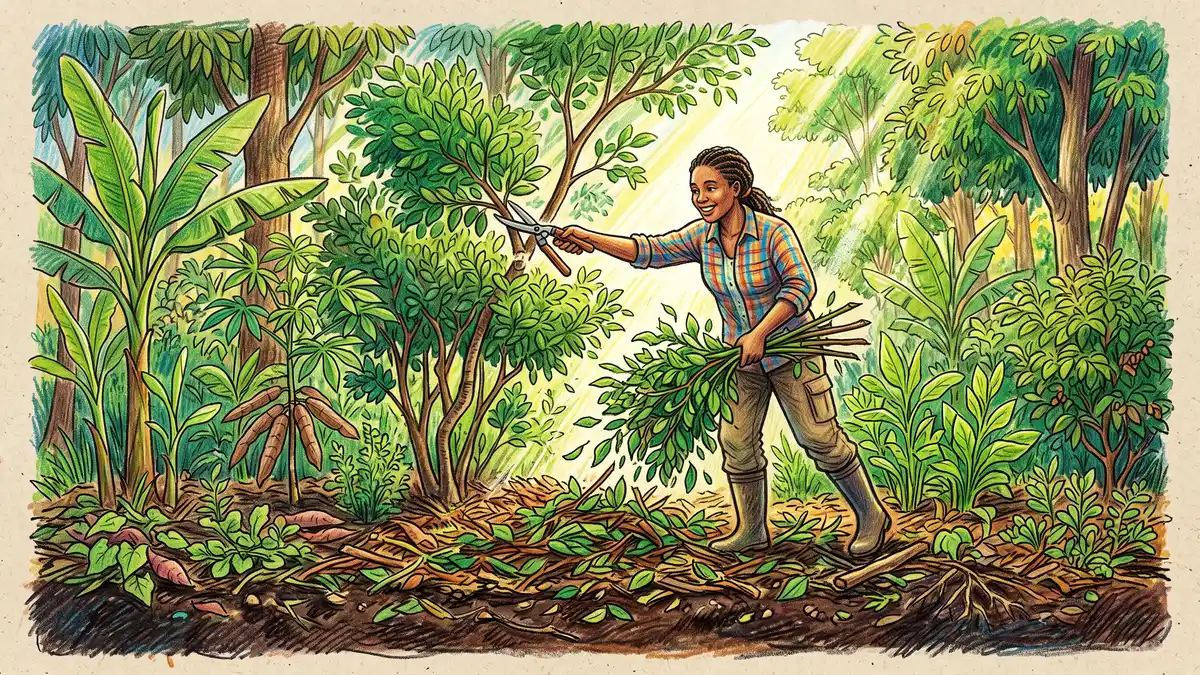
You accelerate the natural build-up of life, the way Ernst Gotsch does. The Swiss-born farmer moved to a degraded, deforested patch of southern Bahia, Brazil, in the 1980s and turned it into thriving forest by treating syntropy as a farming method. His farm reportedly revived springs that had dried up and rebuilt fertile soil. You can borrow the same moves at backyard scale.
Stack plants in layers
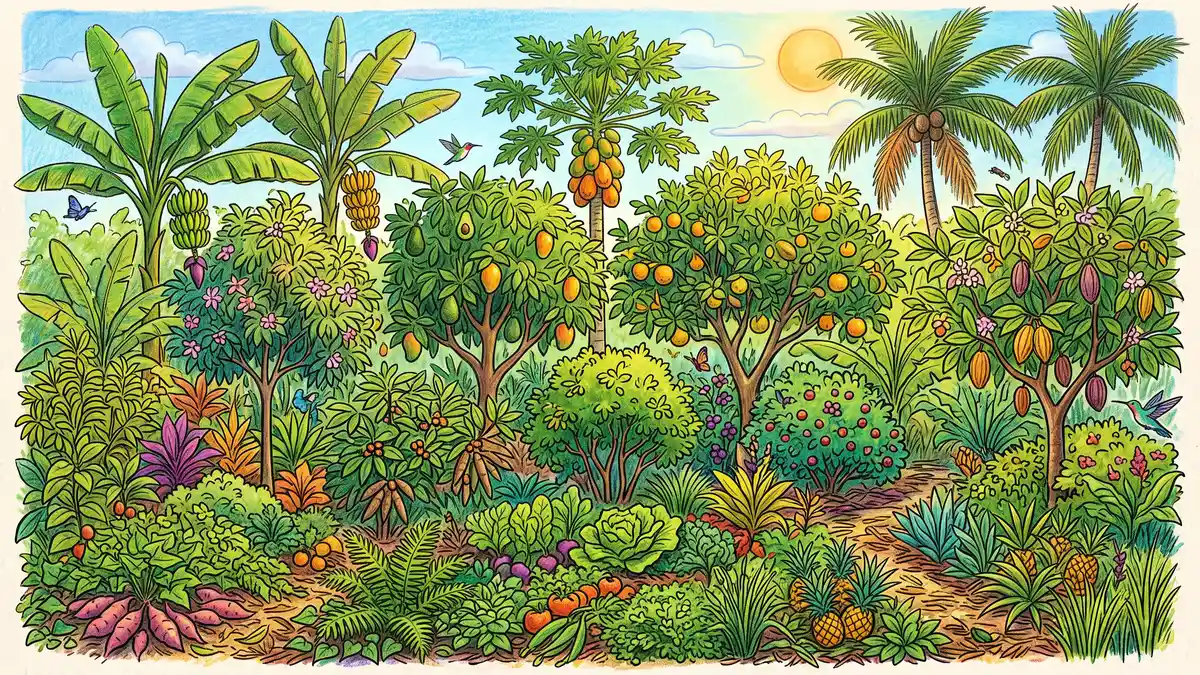
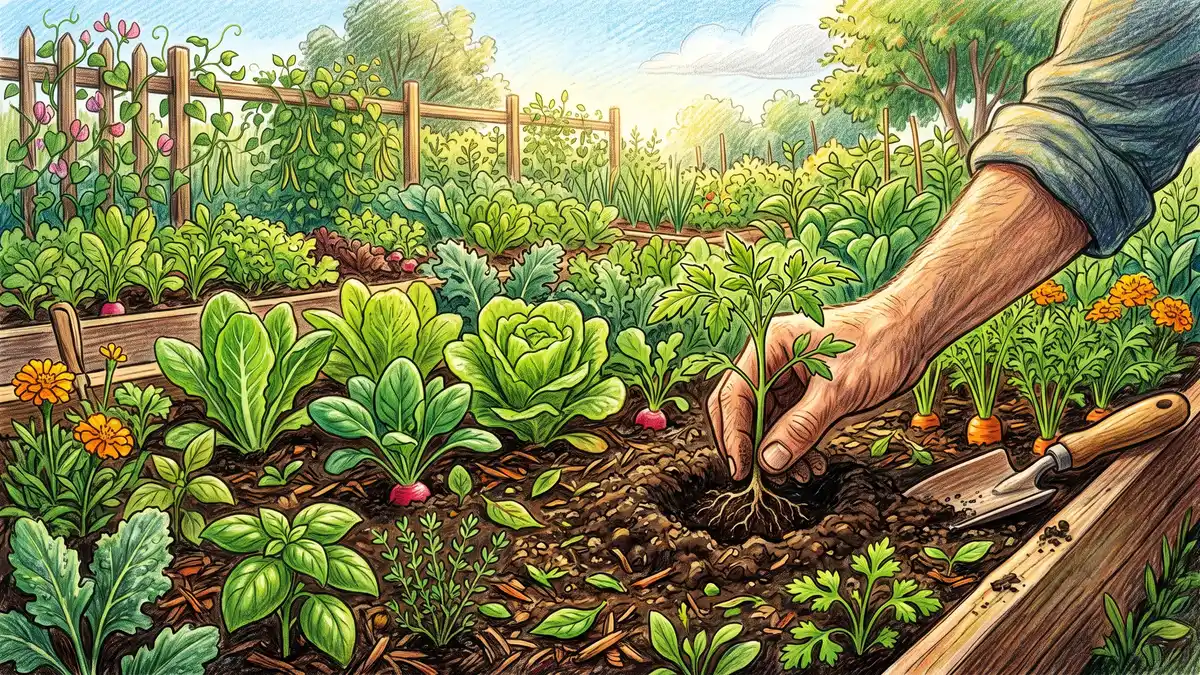
Plant densely and in vertical layers, from ground covers to shrubs to trees, so more leaves catch more sunlight. Maximizing photosynthesis is the engine that drives the whole syntropic build-up.
Prune hard and chop-and-drop
Gotsch works with a machete, cutting plants back to trigger vigorous regrowth and dropping the trimmings as mulch. That biomass feeds soil fungi and bacteria, cycling nutrients back into the system.
Keep the soil covered and growing
Bare soil bleeds energy and structure. Continuous plant cover and living roots keep photosynthesis running and organic matter accumulating, which is the practical heart of chop-and-drop systems.
A Note on the Hype
Syntropy is a helpful lens, not a mystical force. Some popular sources treat it as an extra power that lets life override physics, which is not accurate and can tip into pseudoscience. The honest version is more interesting: life builds order because it sits in a river of solar energy and knows how to use it. You do not need to believe in magic to grow a food forest, only in sunlight, water, and good design rooted in real permaculture practice.
Key Takeaway
Gardening with syntropy means helping life accumulate faster than it breaks down. Stack diverse plants, capture as much sunlight as you can, prune to generate biomass, and keep soil covered and alive. Do that and your garden becomes a self-reinforcing system that grows richer each year, turning the sun's energy into food, habitat, and deep, living soil.
Frequently Asked Questions
What is syntropy in simple terms?
Syntropy is the tendency of living systems to build order, complexity, and stored energy over time, the local opposite of entropy's drift toward disorder. In a garden, you see it as succession: bare ground gradually becomes weeds, then shrubs, then forest, accumulating more biomass, biodiversity, and soil with each stage. The term was coined by mathematician Luigi Fantappie in 1941, and physicist Erwin Schrodinger described the same idea as life feeding on "negative entropy." Syntropy is not a mysterious force; it is simply what happens when a system captures a steady flow of energy, like sunlight, and uses it to organize matter into living structure.
Is syntropy the opposite of entropy?
Yes, in a local and practical sense. Entropy describes energy spreading out and systems becoming more disordered, the overall direction the universe moves. Syntropy describes the opposite local pattern: energy being concentrated and matter organized into complex, living forms. The two are not in conflict, because they operate at different scales. A plant builds order within itself (syntropy) while releasing waste heat that increases the entropy of its surroundings. The universe's total entropy still rises, exactly as physics requires. So syntropy is best understood as the opposite trend within open, energy-fed systems, not a rival law that cancels entropy out.
Does syntropy break the second law of thermodynamics?
No. The second law applies strictly to isolated systems, which exchange neither energy nor matter with anything outside them. Gardens, organisms, and ecosystems are open systems: they constantly import low-entropy energy from the sun and export high-entropy heat. Physicist Ilya Prigogine earned a Nobel Prize for showing that such open systems can spontaneously build ordered "dissipative structures" as long as energy keeps flowing through them. Life takes full advantage of this. It builds local order while the entropy of the wider universe continues to increase, so no physical law is violated. The apparent paradox dissolves once you remember the garden is plugged into the sun.
What is syntropic agriculture?
Syntropic agriculture is a regenerative growing method, pioneered by Ernst Gotsch in Brazil, that deliberately applies the principle of syntropy to farming. Instead of fighting nature, it accelerates natural succession by planting densely in stacked layers, pruning heavily to stimulate growth and generate biomass, and dropping that biomass as mulch to feed the soil. The goal is a self-improving system where fertility, water retention, and biodiversity increase over time rather than being depleted. Gotsch famously regenerated degraded, deforested land in Bahia into productive forest, reviving dried-up springs in the process. It shares much with permaculture and food forests but places special emphasis on succession and biomass management.
How do I use syntropy in my own garden?
Start by maximizing photosynthesis and minimizing bare soil. Plant a diversity of species densely and in layers, from ground covers up through shrubs and trees, so the whole space captures sunlight. Prune vigorously and use the trimmings as chop-and-drop mulch to keep feeding soil life. Keep something growing year-round with cover crops or perennials so living roots and leaf cover never stop building organic matter. Think in terms of succession, planting fast pioneers alongside slower long-term species, and let the system mature over years. Each of these moves helps life accumulate faster than it decays, which is syntropy working in your favor.
Get the Weekly Dig
One practical permaculture guide a week, written for gardeners who do this on weekends: permaculture design for real backyards. Free, no spam, unsubscribe any time.
Join the Weekly DigResources
- Second Law of Thermodynamics — Overview
- Erwin Schrodinger — What Is Life? (1944, full text)
- Ilya Prigogine — Nobel Lecture on Dissipative Structures
- Frontiers Magazine — Luigi Fantappie and the Physics of Life
- Luigi Fantappie — Biography and Work
- Believe.Earth — Ernst Gotsch and Syntropic Farming
- Agenda Gotsch — Syntropic Agriculture Resources
- ScienceDirect — Research on Syntropic Agroforestry Systems