
Bacteria vs Fungi: Why Your Soil's Balance Matters
Here is a fact that reframes how you think about dirt: a single teaspoon of healthy garden soil can hold hundreds of millions to a billion bacteria, plus fine threads of fungi weaving through it, more living organisms than there are people on Earth, according to the USDA NRCS Soil Biology Primer.
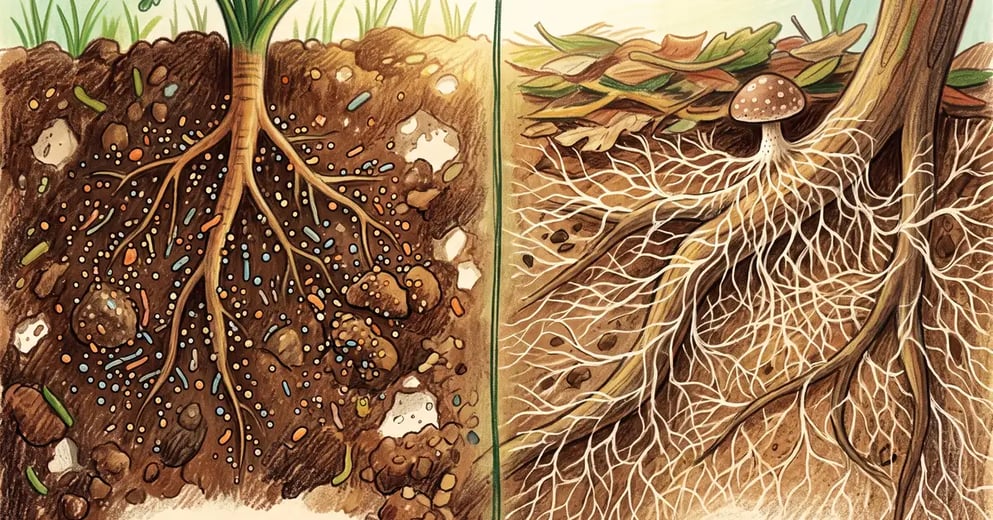
Those two groups, bacteria and fungi, are the workhorses of your soil, and the balance between them quietly decides which plants thrive. Fast-growing vegetables love bacteria-rich soil. Fruit trees and berries prefer soil dominated by fungi. Understanding this balance, measured as the fungal-to-bacterial (F:B) ratio, lets you stop guessing and start matching your soil to what you are trying to grow. This guide breaks down what each group does, which plants want which, and how to shift the balance in your own beds.
Key Takeaway
Soil is not one-size-fits-all. Annual vegetables do best in balanced, bacteria-friendly soil, while perennials, berries, and trees want fungal-dominated soil. You can steer the balance with two simple levers: what you mulch with, and how much you disturb the ground.
What Do Soil Bacteria Do?
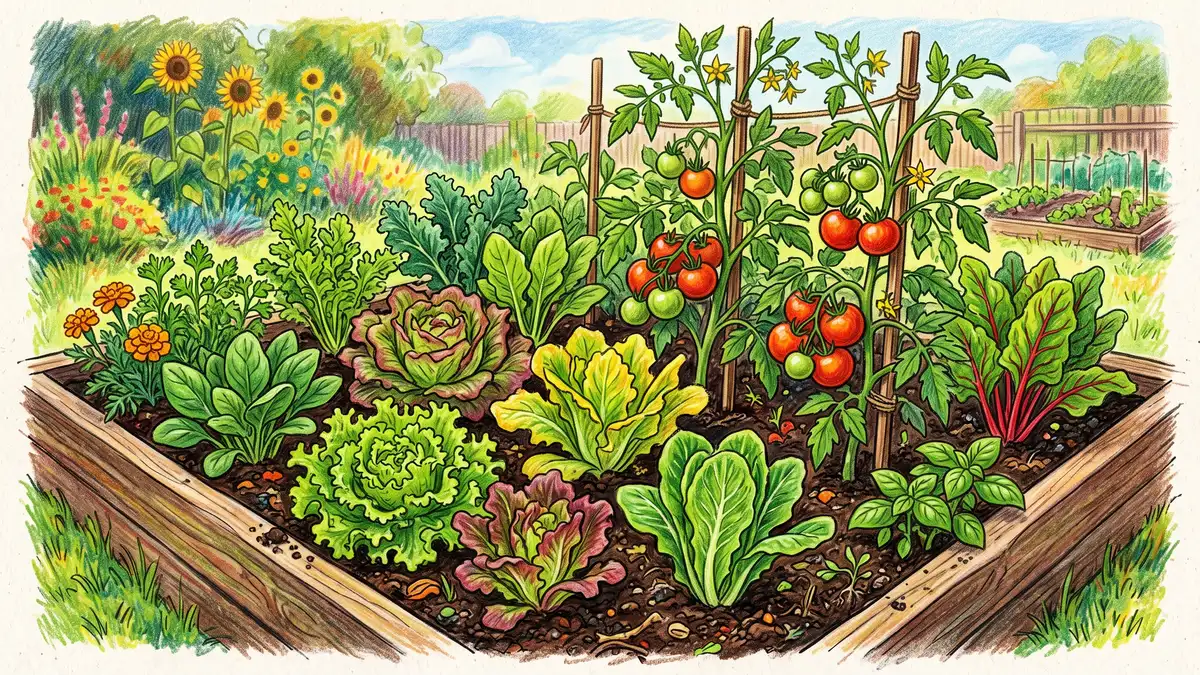
Bacteria are the sprinters of the soil. They are the most numerous organisms in the root zone, and although they make up only 2 to 5 percent of soil organic matter by mass, they drive roughly 90 percent of the energy flow through the soil's microbial community, per the NRCS Soil Biology Primer. Their job is fast nutrient cycling: they break down fresh, green material and convert nitrogen into the ammonium and nitrate forms plants can grab quickly.
Bacterial-dominated soil is the soil of disturbance and early growth. Freshly tilled ground, weedy patches, and annual vegetable beds all lean bacterial. That earthy smell when you turn a compost pile or dig a bed comes largely from actinobacteria, filamentous bacteria that help build humus, as Oregon State University Extension notes. Bacteria also glue fine soil particles into crumbs, improving structure, and they generally favor neutral to slightly alkaline soil.
What Do Soil Fungi Do?
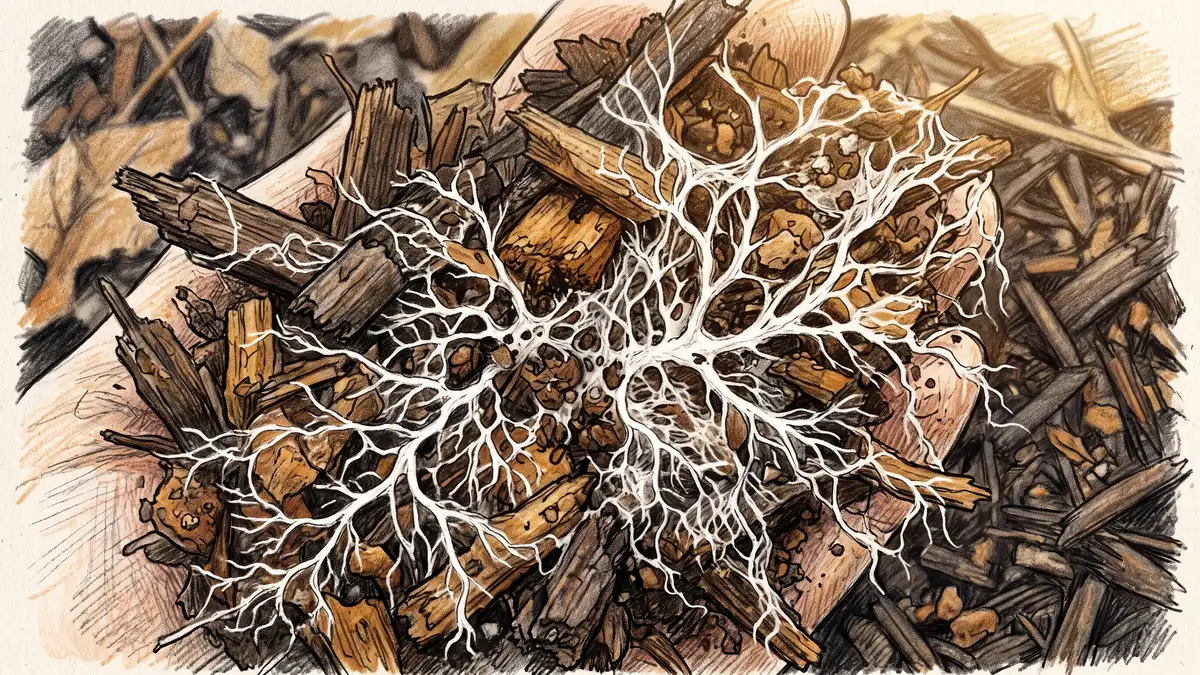
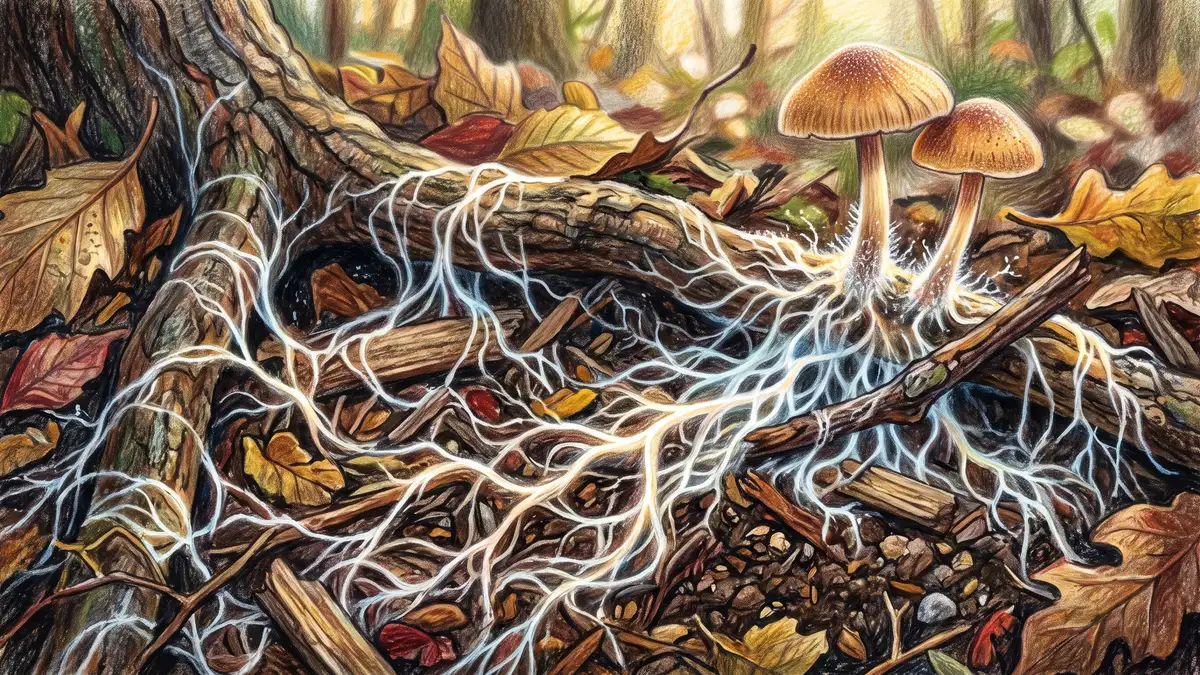
Fungi are the long-haul specialists. Their thread-like hyphae stretch through the soil to decompose tough, woody material like lignin that bacteria struggle with. Most importantly, mycorrhizal fungi form partnerships with plant roots, extending their reach for water and nutrients in exchange for sugars. Colorado State University Extension describes these organisms working in harmony to release nutrients and improve uptake efficiency, a network we cover in depth in our guide to mycorrhizal fungi.
Fungi also build long-term soil health. Mycorrhizal fungi produce glomalin, a sticky glycoprotein that USDA Agricultural Research Service scientists found accounts for roughly 27 percent of soil carbon. Glomalin is itself 30 to 40 percent carbon, binds soil into stable aggregates, and can persist for 7 to 42 years, making fungal soils better at storing carbon and holding structure. Fungi dominate later successional systems, tolerate lower (more acidic) pH, and thrive under perennials.
| Trait | Bacteria | Fungi |
| Speed | Fast nutrient cycling | Slow, long-lasting |
| Food they prefer | Green, nitrogen-rich material | Woody, high-carbon material |
| pH preference | Neutral to alkaline | Slightly acidic |
| Best for | Annual vegetables, grasses | Trees, shrubs, berries |
| Bonus | Quick, plant-ready nitrogen | Carbon storage, water reach |
Sources:
Which Plants Want Bacterial or Fungal Soil?
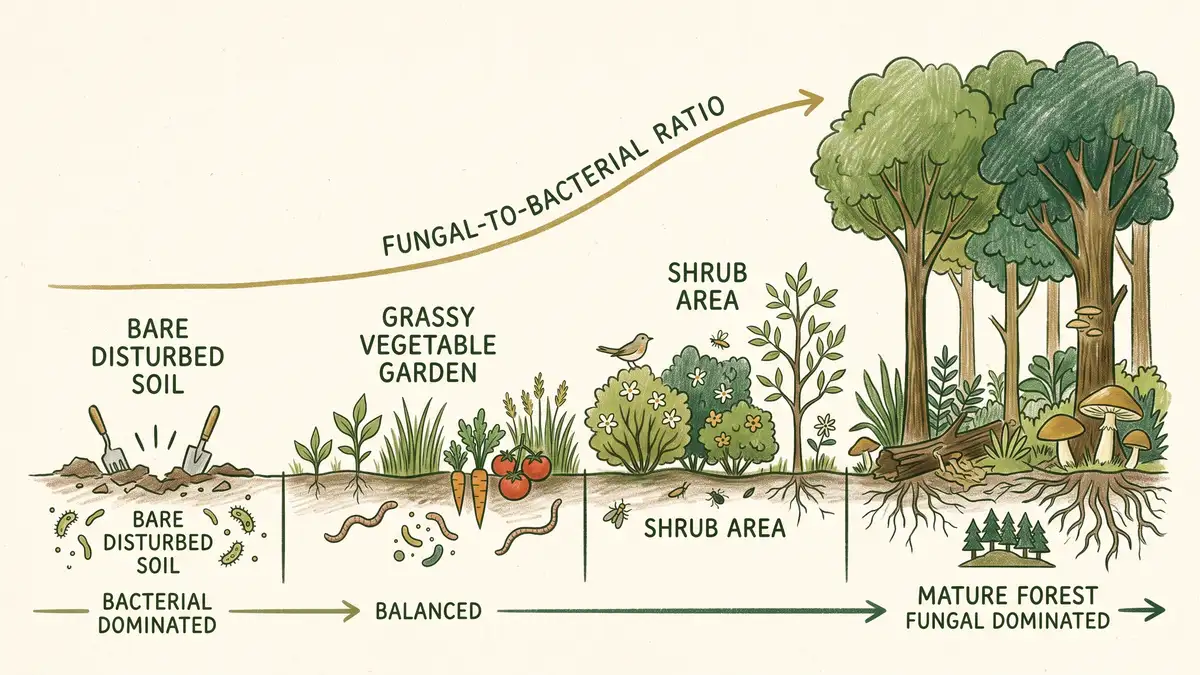
The link between soil life and plants follows ecological succession, the natural progression from bare ground to mature forest. The NRCS Soil Biology Primer explains that grasslands and farm soils "usually have bacterial-dominated food webs," while forests are strongly fungal. As the land matures and plant litter becomes woodier, fungi take over and the F:B ratio climbs.
| System | Typical F:B Ratio | Plants That Fit |
| Disturbed / weedy ground | Below 1 (bacterial) | Weeds, pioneer annuals |
| Vegetable garden / grassland | Around 1:1 | Vegetables, lawns, corn |
| Shrubs and berries | 2:1 to 5:1 | Blueberries, currants, roses |
| Deciduous forest | 5:1 to 10:1 | Fruit and nut trees |
| Conifer / old-growth forest | 100:1 to 1000:1 | Pines, mature woodland |
Sources:
The practical read: your tomato and lettuce beds want roughly balanced soil, so a bit of finished compost and steady moisture is plenty. Your blueberries, fruit trees, and perennial borders want fungal soil, which means feeding them the way a forest floor feeds itself. This is the same living network we map in our soil food web guide.
Why This Works: Succession
Every soil is somewhere on a journey from bare ground to forest, and its biology reflects that stage. When you pile wood chips under a fruit tree, you are fast-forwarding that patch of ground toward a forest-floor state, which is exactly the fungal-rich environment your perennials evolved with. Match the successional stage to the plant, and the plant more or less takes care of itself.
How to Shift Your Soil Toward Fungi (or Bacteria)
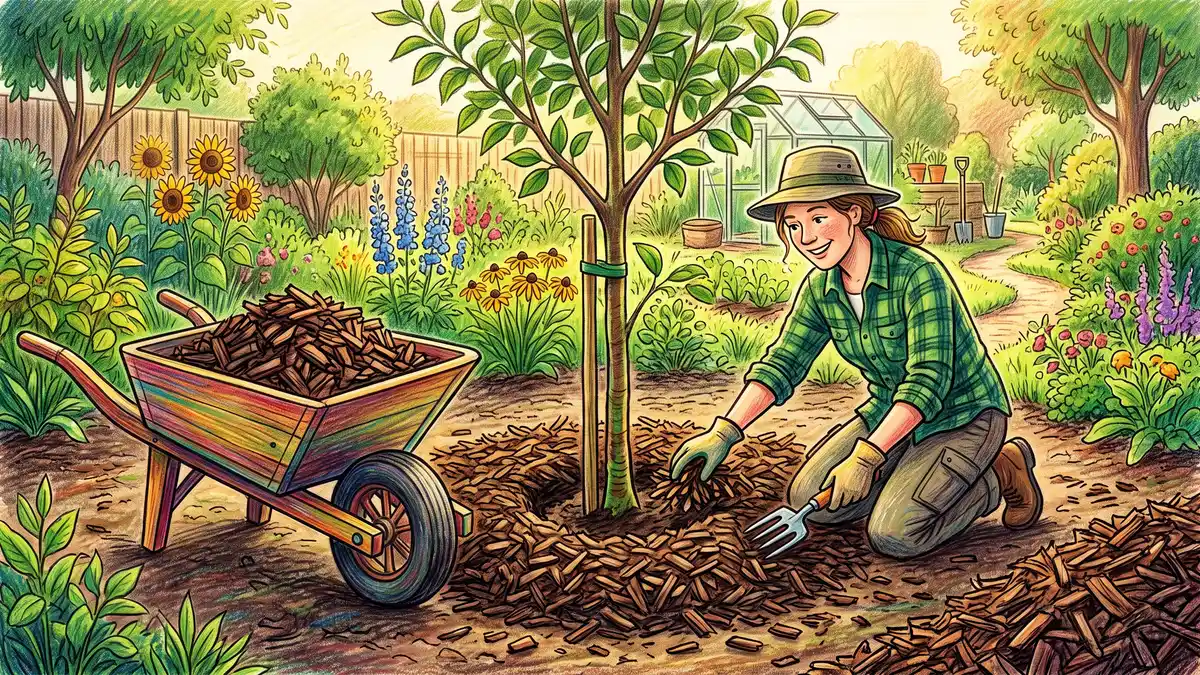
The good news for weekend gardeners: you do not need a microscope to move the needle. A peer-reviewed grassland study found that heavy synthetic nitrogen fertilizer lowers the F:B ratio by favoring bacteria, while organic inputs and reduced mineral nitrogen raise it. In other words, how you feed and work the soil steers its biology. Here is how to shift it in either direction.
To go fungal: mulch with wood
Cover perennial beds, berries, and tree roots with wood chips, bark, or leaf mold. Woody, high-carbon material is fungal food.
To go fungal: stop digging
Tillage shreds fungal networks. Switch to no-dig methods and lay amendments on top so hyphae can rebuild undisturbed.
To go fungal: ease off synthetic nitrogen
Cut back on quick synthetic feeds. Use slow, fungal-friendly compost so the balance can tip toward fungi.
To go bacterial: add greens and turn
For annual veggie beds, mix in nitrogen-rich greens and finished compost and work the top few inches to favor fast bacteria.
What Sets Fungi Back
Frequent tilling, heavy synthetic nitrogen, and fungicides all knock back fungal networks and mycorrhizae, which can take years to rebuild. If you want fungal soil under perennials, protect it: mulch, minimize disturbance, and see our comparison of no-till vs tilling before you reach for the tiller.
None of this requires lab testing. Build your soil biology the way nature does, through mulch, organic matter, and patience, and both bacteria and fungi will do their jobs. For the foundation, start with our soil health guide and how soil microbes outperform fertilizer.
Frequently Asked Questions
What is the difference between bacterial and fungal soil?
Bacterial soil is dominated by fast-acting bacteria that cycle nutrients quickly and thrive in disturbed, recently worked, or annual-cropped ground. Fungal soil is dominated by fungi whose thread-like networks decompose woody material, partner with roots, and store carbon, and it develops in undisturbed, perennial, and forested systems. The balance is measured as the fungal-to-bacterial (F:B) ratio: below 1 means bacterial, around 1:1 is balanced, and higher ratios mean increasingly fungal. Neither is better in the abstract. The right balance depends entirely on what you are growing.
Are vegetables bacterial or fungal?
Most annual vegetables and grasses do best in roughly balanced to bacterial-dominated soil, with an F:B ratio near 1:1. Bacteria supply the fast, plant-ready nitrogen that quick-growing crops like lettuce, corn, and squash demand. That is why a well-composted, occasionally worked vegetable bed suits them so well. Some gardeners following Dr. Elaine Ingham's Soil Food Web work push brassicas and tomatoes toward slightly more fungal soil, but for most home growers, balanced soil rich in compost is the reliable target for the veggie patch.
How do I make my soil more fungal?
Feed the fungi and leave them alone. Mulch beds with woody, high-carbon materials like wood chips, bark, and leaf mold, which are exactly what fungi decompose. Stop tilling, since digging tears apart the fine hyphal networks fungi build, and switch to no-dig methods. Ease off quick synthetic nitrogen fertilizers, which favor bacteria, and use slow, fungal-rich compost instead. Keep the soil covered and give it time. Fungal networks rebuild over months and years, not days, so consistency matters more than any single amendment.
Does tilling hurt soil fungi?
Yes. Tillage physically shreds the thread-like fungal hyphae and mycorrhizal networks that take a long time to grow, so heavily tilled soils tend to be bacterial-dominated. That is fine for annual vegetable beds, where a bacterial lean actually suits fast crops, but it works against you under perennials, berries, and trees that depend on fungal partners. If you are building fungal soil, minimize disturbance, mulch instead of digging things in, and let the network knit itself back together.
How much of soil carbon comes from fungi?
A surprising amount. USDA Agricultural Research Service scientists found that glomalin, a glycoprotein produced by mycorrhizal fungi, accounts for roughly 27 percent of the carbon in soil. Glomalin is itself 30 to 40 percent carbon, glues soil particles into stable aggregates, and can persist for anywhere from 7 to 42 years. That means fungal-rich soils are not just good for growing perennials, they are also better at holding structure and storing carbon over the long term, a real bonus for both your garden and the climate.
Get the Weekly Dig
One practical permaculture guide a week, written for gardeners who do this on weekends: building living soil without buying it in bags. Free, no spam, unsubscribe any time.
Join the Weekly DigResources
- USDA NRCS — Soil Biology Primer
- Oregon State University Extension — Understanding Soil Health and Biota
- Colorado State University Extension — Introduction to Soils
- University of Minnesota Extension — Soil Health, the Key to Healthy Plants
- Michigan State University Extension — Soils for Gardeners
- USDA Agricultural Research Service — Glomalin: Hiding Place for a Third of the World's Stored Soil Carbon
- Cornell Cooperative Extension Tompkins County — The Soil Microbiome
- Peer-reviewed study — Fungal-to-bacterial ratios under contrasting nitrogen inputs