
You're standing in front of a rototiller at the hardware store wondering if you really need to spend $400 to break up your garden every spring. You don't. Most US backyard gardens get better, faster results from never tilling at all. Here is when tilling helps, when it hurts, and how to switch to no-till without losing a season of harvest. measuring whether your soil is improving
This guide compares both methods side by side for a typical 100 to 500 sq ft (9 to 46 sq m) US backyard garden, gives you the no-till transition steps that work on grass or compacted lawn, and tells you the one situation where breaking the ground really is the right call.
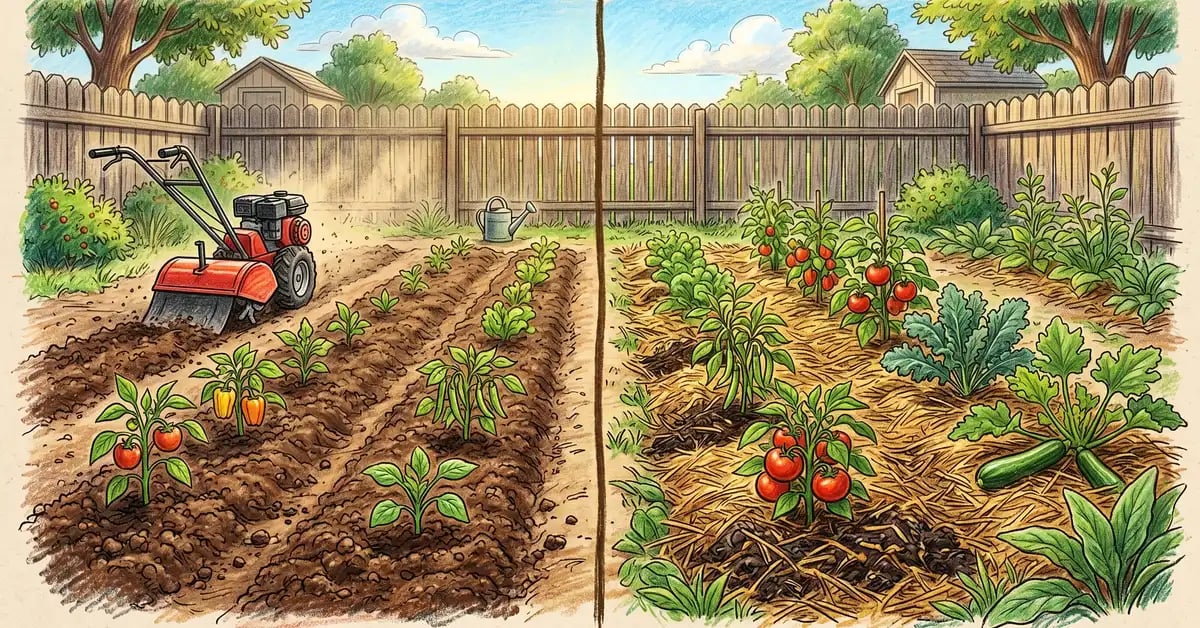
What tilling actually does (the part the catalog skips)
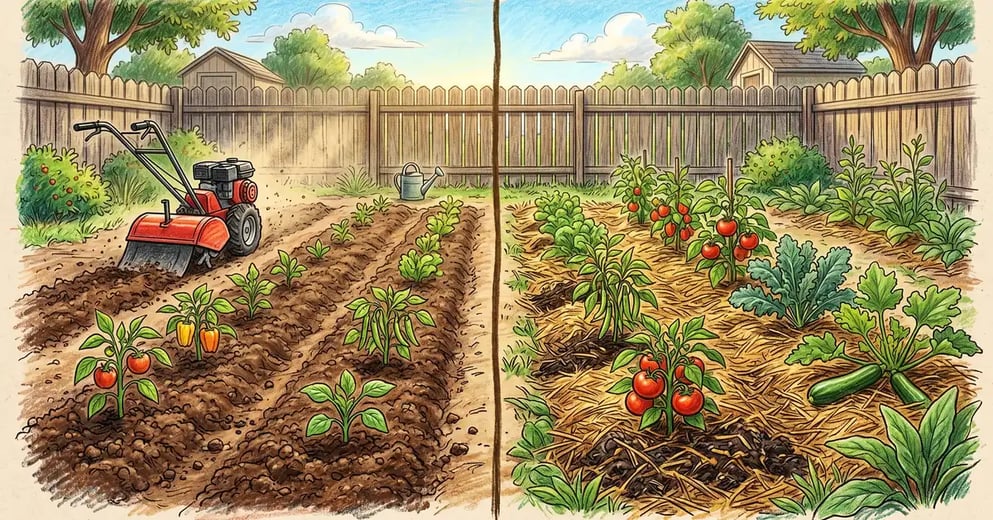
Tilling means physically inverting and breaking up the top 6 to 12 in (15 to 30 cm) of soil. The classic methods are rototilling (a powered tool with rotating tines), double digging (hand digging two spade depths), and disc tilling (used on small farms). All three produce the same effect: they shred the soil structure, expose buried biology to air, and bury surface residues.
The immediate result looks great. The soil is fluffy. Seeds plant easily. Weeds are gone. The hidden costs show up over weeks and months:
- Soil organic matter oxidizes. When you mix buried carbon with oxygen, soil microbes burn through it like kindling. USDA NRCS soil health data documents 3 to 5 percent of soil organic matter lost per year on annually tilled fields, vs 0.5 to 1.0 percentage point gained per year under no-till.
- Aggregate structure breaks. Soil aggregates (the crumbs that give healthy soil its sponge-like texture) take 5 to 10 years to build and 30 minutes to destroy with a rototiller.
- Earthworm populations crash. Rodale Institute trials show 50 to 70 percent reduction in earthworm density within one growing season of conventional tilling, vs steady increases under continuous no-till mulching.
- Mycorrhizal networks sever. The fungal hyphae that connect plant roots and trade nutrients underground get physically cut. They rebuild in 1 to 2 years but only if you stop tilling.
- Weed seeds get a wake-up call. A single tilling pass brings 50 to 200 buried weed seeds per square foot up to the light. Penn State Extension trials document a 3 to 5 fold increase in summer weed emergence after spring tilling.
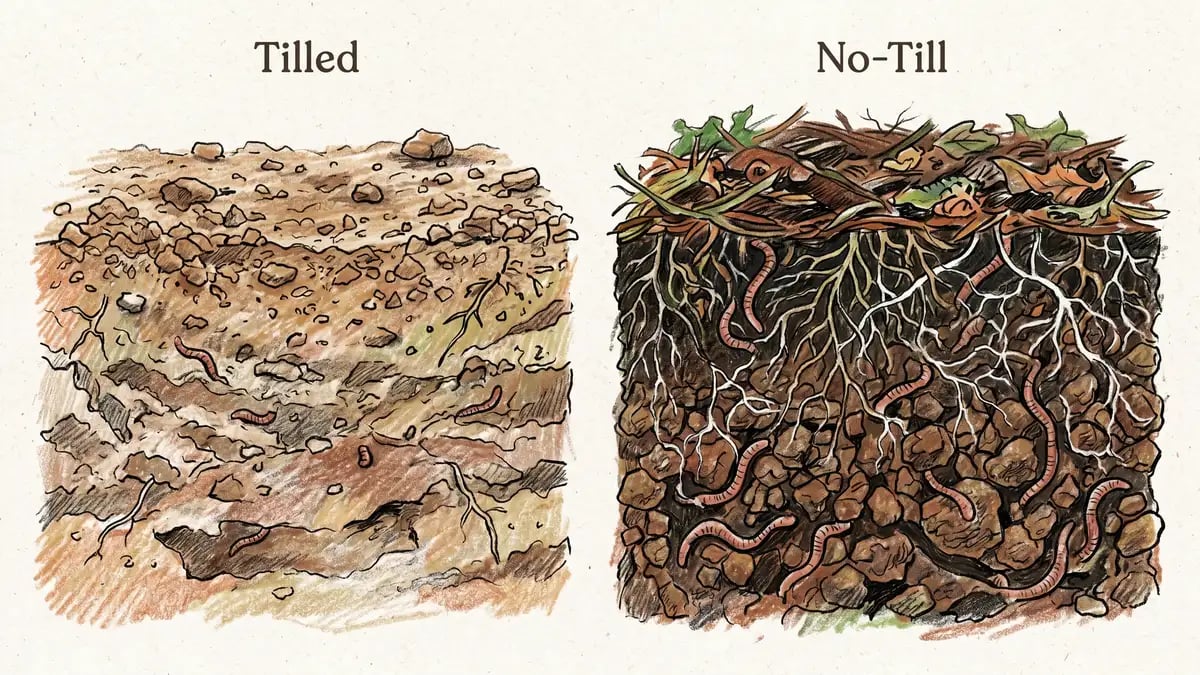
Why no-till works (the part that surprises people)
An undisturbed forest floor has never been tilled, yet it builds the deepest, richest soil on earth. The mechanism is mechanical no-disturbance combined with continuous surface biomass input. Roots from previous crops decay in place, creating channels for water and air. Mulch on top moderates temperature and feeds soil biology slowly. Earthworms and mycorrhizae build vertical channels that outperform any rototiller. The biology does the cultivating, and it does it 12 in (30 cm) deep without breaking the structure above it. This is what permaculture practitioner Charles Dowding has demonstrated at his Homeacres trial site over 15+ years.
Side-by-side comparison for a US backyard
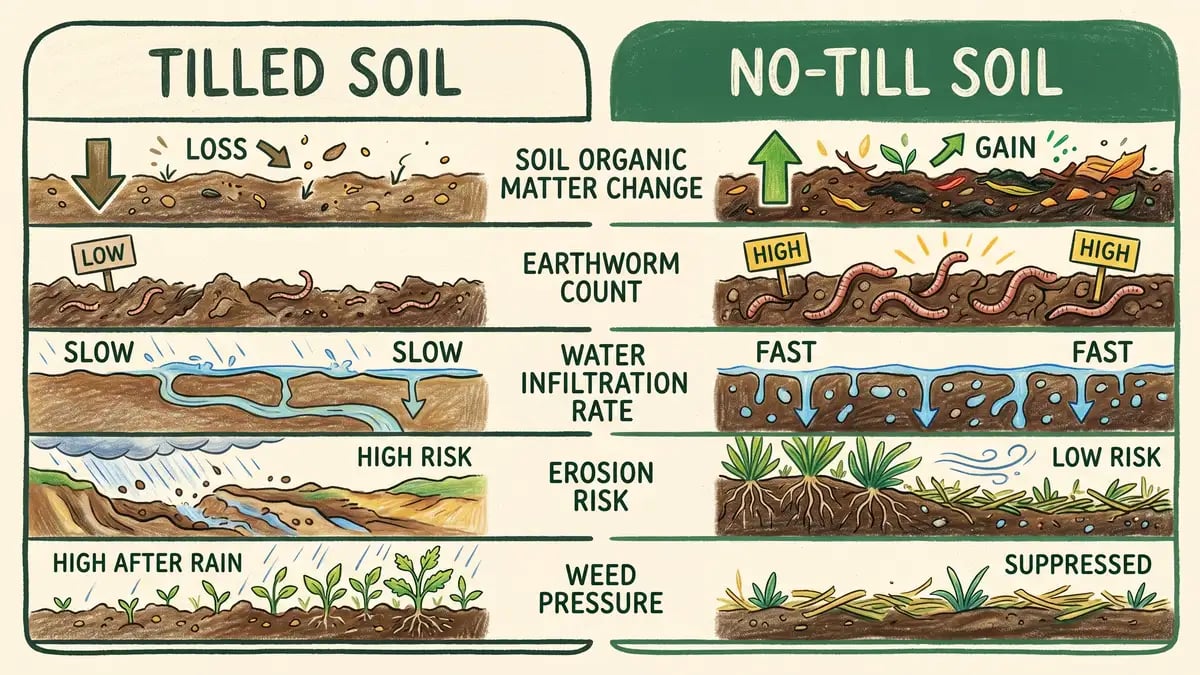
| Metric | Conventional tilling | No-till |
| Soil organic matter change | Down 3-5% per year | Up 0.5-1.0% per year |
| Earthworm density (year 1) | Down 50-70% | Up 2-3x |
| Water infiltration rate | 0.5-1.0 in/hour | 1.5-3.0 in/hour |
| Annual soil erosion | 5-10 tons/acre/year | Under 1 ton/acre/year |
| Year 1 weed pressure | High after rain | Suppressed by mulch |
| Year 1 yield (vegetables) | Equal to no-till | Equal to tilled |
| Year 3+ yield (vegetables) | Stable or declining | Stable to increasing |
| Annual labour (100 sq ft) | 30 min tilling + ongoing weeding | 4-6 hr year 1 setup, 1 hr/yr after |
| Up-front equipment cost | $300-600 rototiller | $150-250 broadfork (optional) |
Source: USDA NRCS Soil Health, Rodale Institute Farming Systems Trial, Penn State Extension home garden trials, Charles Dowding Homeacres data.
When tilling actually makes sense
No-till is the default for established beds, but tilling has three justifiable uses for a US backyard. Be honest about which one applies before you commit.
- Breaking new ground from established lawn or compacted clay. If you are converting a section of cool-season grass lawn into a vegetable garden, a one-time pass with a rototiller or broadfork breaks the sod and saves 6 months of sheet mulching. After that one pass, switch to no-till forever. Cornell Cooperative Extension's soil preparation guidelines confirm this exception.
- Severely compacted subsoil. If your soil test shows penetration resistance over 300 psi at 6 in depth (often the case on suburban building lots where the topsoil was scraped and the subsoil compacted by construction equipment), a single deep broadforking or one rototilling pass at 12 in helps roots colonise. Then mulch and never till again.
- Initial fill of a raised bed. Loosening the native soil at the bottom of a new raised bed before filling with compost gives roots a transition zone between bed and ground. This is one-and-done, not annual.
Warning: tilling once a year is the worst middle ground. The pattern of tilling every spring "just to freshen things up" combines all the costs of tilling with none of the benefits. Either commit to a one-time soil-loosening event followed by no-till, or accept the ongoing organic matter loss. Annual tilling is the worst option for US backyard gardens per Penn State Extension home garden trials.
How to switch a tilled garden to no-till in one weekend
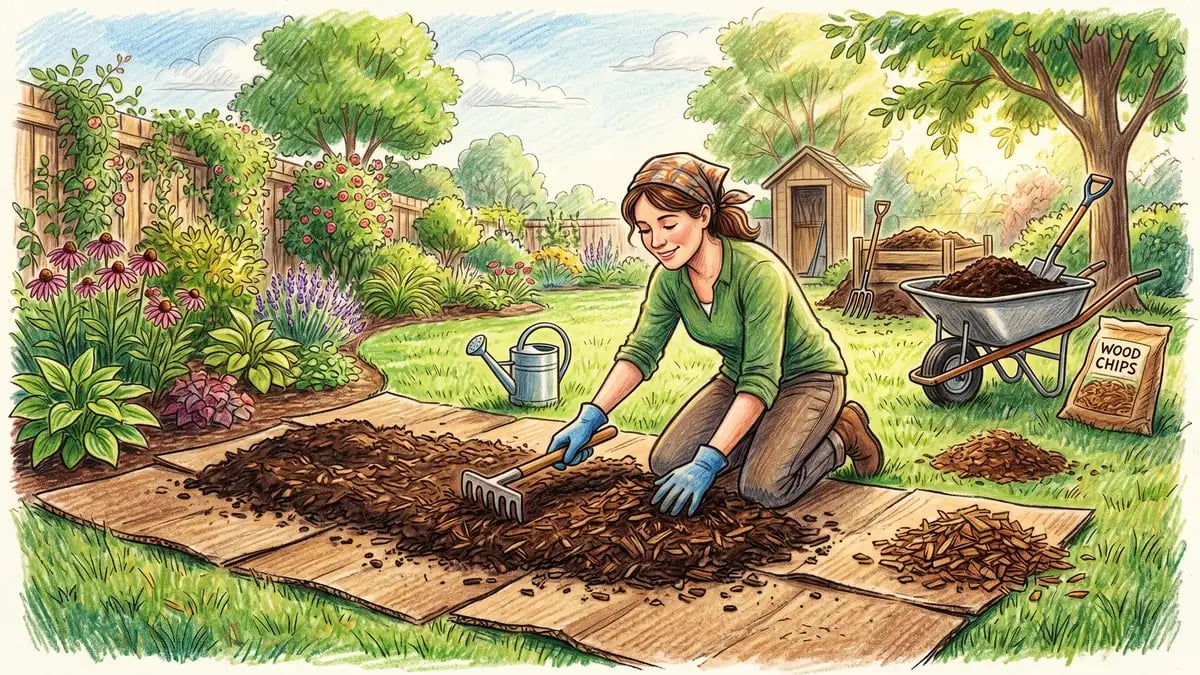
The transition method below works on existing tilled beds (easier) and on lawn (harder, longer). Plan 4 to 6 hours for the initial setup on a 100 sq ft (9 sq m) area. Total cost: $40 to $120 depending on local compost prices.
Stop tilling immediately
Even if last year's bed looks compacted, do not till to "start fresh." Resist the muscle memory. The biology underneath will repair the structure faster than you can.
Cut existing vegetation at ground level
Lawn, weeds, last year's spent vegetables: cut at the soil line and leave the cuttings in place as the first mulch layer. Hori-hori knife or hedge shears work. Do not rake up the cuttings.
Lay cardboard over grass or weed pressure
If converting from lawn, lay one to two layers of plain brown cardboard (remove tape, plastic, and printed labels) overlapping by 6 in (15 cm). On existing tilled beds, skip the cardboard. Wet thoroughly with a hose to start decomposition.
Add 4 to 6 in of compost on top
This is where you plant. A 100 sq ft bed needs about 1.5 to 2.5 cubic yards (1.1 to 1.9 cubic meters) of compost. Buy bulk from a local landscape supplier ($35-50 per cubic yard) rather than bagged ($6-10 per cubic foot) to save 60 percent.
Plant directly into the compost layer
Tomato, pepper, squash, lettuce, brassica transplants go straight into the compost. Direct-sown small seeds (carrot, lettuce) prefer a thin layer of fine compost or seed-starting mix on top. Water in.
Top up with mulch as the season goes
Keep 3 to 6 in (7.5 to 15 cm) of organic mulch (straw, chopped leaves, comfrey clippings) on the surface throughout the year. The mulch is the no-till engine. Bare soil between mulch refreshes is when weeds and oxidation come back.
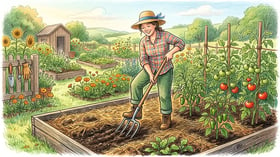
If you have severely compacted clay subsoil after construction or a previously paved area, a broadfork (a U-shaped tool with 4 to 6 long tines) lets you aerate to 10 in (25 cm) depth without inverting layers. the broadfork comparison by garden size Push it in, lean back to lift, move 6 in (15 cm), repeat. A 100 sq ft area takes about 20 minutes. Most US backyards never need this after the initial setup.
The broadfork stays useful for occasional spot-aeration in heavy traffic zones (paths between beds, where you stand to harvest). It does not replace the no-till discipline. It is a precision instrument, not a rototiller substitute.
Common mistakes that kill a no-till transition
- Thin mulch. A 1 in (2.5 cm) mulch layer lets weed seeds germinate and oxidation continue. 3 to 6 in (7.5 to 15 cm) is the working range. Many failed no-till conversions are actually thin-mulch conversions.
- Tilling once "to fix" a problem then claiming no-till. Every tilling pass resets the soil clock. If you have to till for a real reason (initial setup), commit; do not do it twice.
- Bare soil between mulch refreshes. Mulch decomposes. If you let beds go bare for 4 to 6 weeks in summer, weeds germinate and the surface dries out. Top up before the bed shows soil.
- Skipping cardboard on grass. Trying to no-till directly on cool-season grass without cardboard buries you in regrowth. The cardboard is the one-time exception worth doing right.
- Comparing year 1 yield to expectation. No-till matches conventional tilling on yield in year 1 in most US studies but can lag in heavy clay or cold northern climates. By year 3, no-till routinely matches or exceeds conventional. If year 1 underperforms, do not till; just top up mulch and wait.
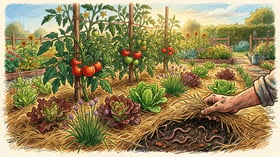
The mature no-till bed at year 3 looks visibly different from the tilled bed next door. The mulch is partly decomposed at the surface and dark crumbly soil at the interface. Pull back the corner of the mulch and you'll see earthworms working in the top inch. Roots from your tomatoes go 18 to 24 in (45 to 60 cm) deep through old root channels you never had to dig.
This is what soil that has not been tilled looks like. It is also the result every gardener wants from a $400 rototiller they bought once.
Get the Weekly Dig
One practical permaculture guide a week, written for gardeners who do this on weekends: building living soil without buying it in bags. Free, no spam, unsubscribe any time.
Join the Weekly DigHow no-till fits the larger soil-building picture
No-till is one of four soil-building practices that compound. Used alone it works. Combined with chop-and-drop mulching, cover cropping, and continuous ground cover, the effect is much stronger.
If you want the full system: pair no-till with our chop and drop guide for free mulch from your own garden, our soil health pillar for the underlying biology, and composting basics for the kitchen scraps no-till does not absorb. For the bigger picture, what is permaculture is the cross-pillar overview.
Need the gear for this?
Which broadfork holds up in clay, which one suits a small bed, and what to skip.
See the broadfork picksFrequently asked questions
What is tilling soil?
Tilling soil means mechanically breaking up and inverting the top 6 to 12 in (15 to 30 cm) of soil. The classic methods are rototilling with a powered machine, double digging by hand, or disc tilling. All three shred soil structure, expose buried biology to air, and bury surface residues. The immediate effect looks like fluffy planting-ready soil; the longer-term effect is organic matter loss and biological disruption.
Why is tilling bad for soil?
Tilling oxidises soil organic matter at 3 to 5 percent per year, destroys soil aggregates that take years to build, severs mycorrhizal fungal networks, reduces earthworm populations by 50 to 70 percent in a single season, and increases erosion 5 to 10 fold versus no-till. Per USDA NRCS soil health research, repeated annual tilling is the single fastest way to degrade garden soil.
Is tilling good for soil?
Only in three specific situations: breaking new ground from established lawn, fixing severely compacted clay subsoil from construction, or loosening the base of a new raised bed before filling. Each is a one-time event followed by no-till forever. Annual tilling is not good for soil under any conditions per current US extension research.
What is no-till gardening?
No-till gardening means never inverting or breaking up the soil. You leave the soil structure intact, keep the surface continuously covered with mulch or living plants, and let earthworms and fungi do the cultivating below. Plant directly into compost added on top of existing soil. Popularised by Ruth Stout in the 1950s, Masanobu Fukuoka in the 1970s, and Charles Dowding in the present day.
How does no-till reduce soil erosion?
No-till leaves the soil surface covered with mulch and continuous root structure rather than exposing bare crumbly soil to wind and rain. USDA NRCS data shows soil erosion under continuous no-till at under 1 ton per acre per year versus 5 to 10 tons per acre per year under conventional annual tilling, a 5 to 10 fold reduction. The mulch absorbs raindrop impact and slows water flow across the surface.
What to do instead of tilling?
For an established bed: cut existing vegetation at the soil line, leave it as mulch, top up with 1 to 2 in of compost in spring, plant directly. For new ground from lawn: lay one to two layers of plain cardboard over the grass, top with 4 to 6 in of compost, plant directly. For compacted soil: use a broadfork to aerate without inverting, then mulch heavily. Never till annually.
How long does it take to convert a tilled garden to no-till?
Year 1 establishes the new system: yields match what you had under tilling. Year 2 the biology rebuilds: earthworm populations, mycorrhizal networks, and aggregate structure start to recover. Year 3 the no-till bed outperforms the previous tilled state on yield, water retention, and weed suppression. Full mature soil takes 5 to 7 years but you see meaningful gains within the first growing season.
Do I need a broadfork for no-till?
No, not usually. Most US backyard gardens never need a broadfork once mulched. The exceptions are heavy compacted clay subsoil (often after suburban construction) and high-traffic zones like paths. A broadfork costs $150-250 and lasts decades. It's a useful one-time investment for compacted properties and unnecessary for most backyards.
Resources
- USDA NRCS: Soil Organic Carbon Soil Health Guide
- Rodale Institute Farming Systems Trial: 40+ years of no-till vs tilled data
- Penn State Extension: No-Till Vegetable Gardening
- Charles Dowding: 15+ years of side-by-side no-dig results
- Cornell Cooperative Extension: Soil Preparation Guidelines
- USDA Agricultural Research Service: No-Till Builds Soil Organic Matter
- Permies: Ruth Stout Deep Mulch Method (historical reference)