Hot vs Cold Composting: Which One Is Right for Your Homestead?
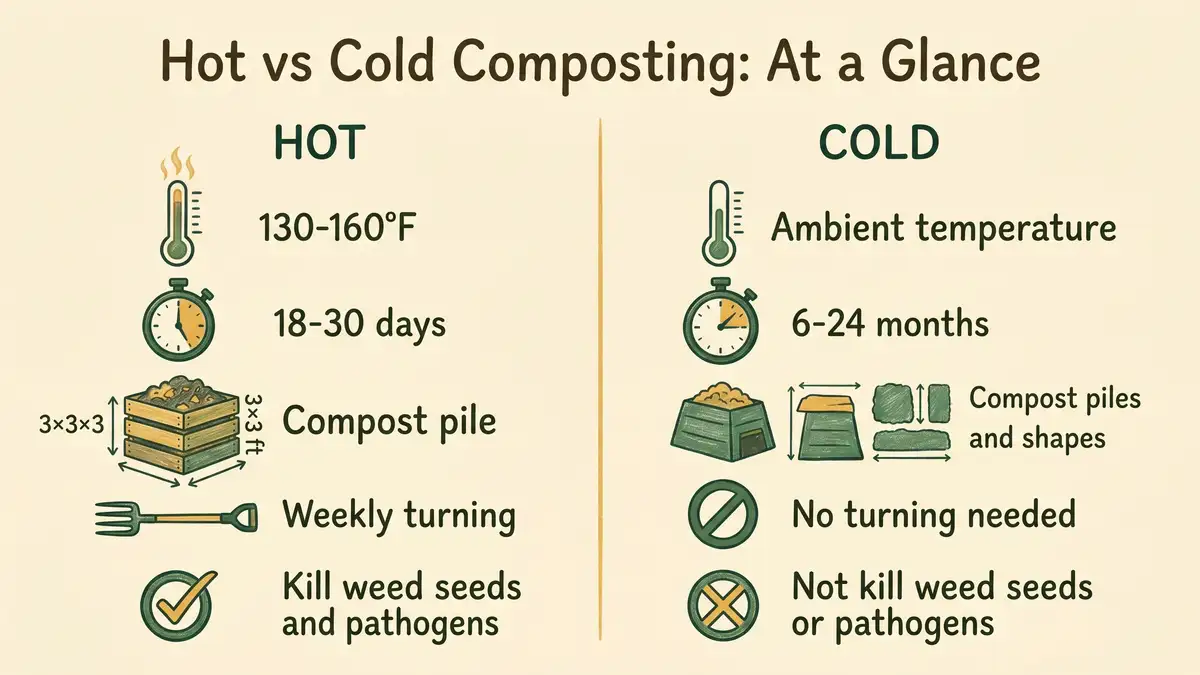
Both methods produce finished compost. The difference is how much time you put in vs how long you wait. Hot composting hits 130–160°F (55–70°C) at the core, finishes in 18–30 days, kills weed seeds and pathogens, and demands a 3×3×3 ft (1×1×1 m) minimum pile plus regular turning. Cold composting sits at ambient temperature, finishes in 6–24 months, won't reliably kill weed seeds, and works at any size with almost zero effort. in-ground composting composting lawn clippings without the smell particle size and how fast a pile works what a composting toilet actually does
For a homesteader running a productive operation, the right choice depends on three honest answers: how fast do you need finished compost, how much time can you spend turning a pile, and do you have weed seeds or diseased plant material that need to be neutralized? Cornell Waste Management Institute's Science of Composting (PDF) is the gold-standard reference for the underlying biology; the practical comparison below translates that into homestead decisions.
Key Takeaway
If you have weed seeds, manure, or diseased plant material to neutralize — or you need finished compost in under a month — go hot. If you have a steady stream of yard waste and the patience to wait a year or more, cold is genuinely less work and produces compost that's just as biologically rich. Most homesteads end up running both: a hot pile for problem inputs and a cold heap for the rest.
Hot Composting: How It Actually Works
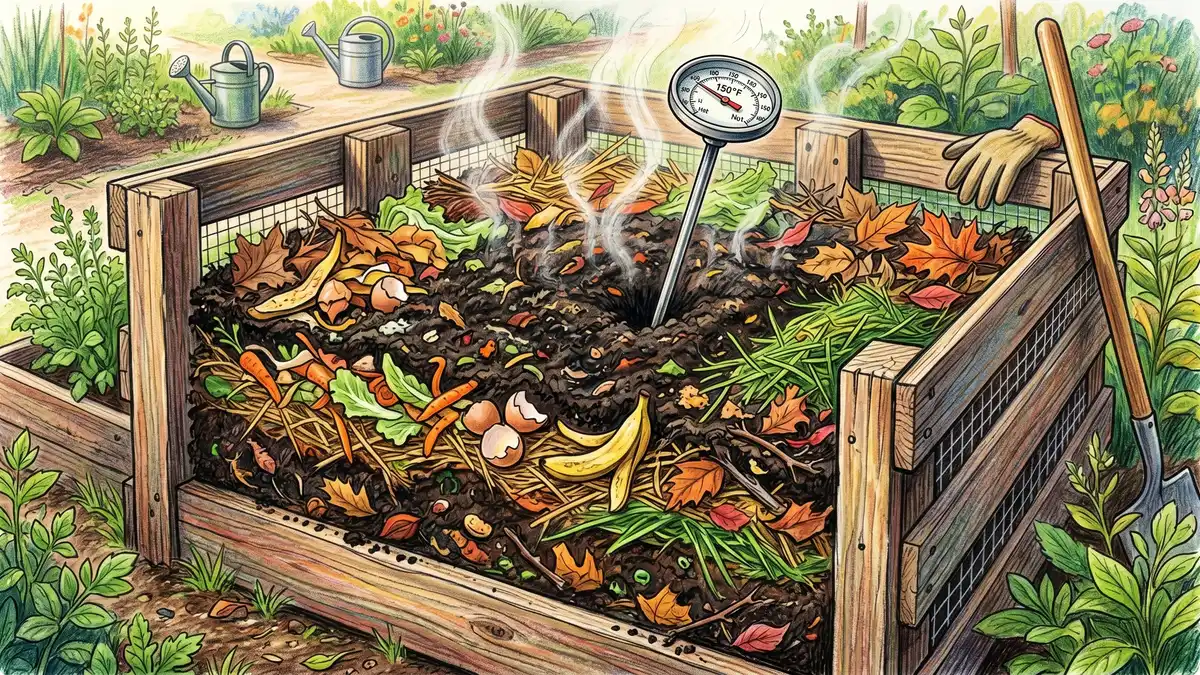
Hot composting deliberately drives a thermophilic bacterial community by giving them a 3×3×3 ft (1×1×1 m) pile of well-balanced material. At that scale and with the right C:N ratio, internal temperatures rise above 130°F (55°C) within 24–48 hours of building. According to University of Minnesota Extension, the four conditions that have to be right are: volume (the 3×3×3 ft minimum), C:N ratio (target 25:1 to 30:1), moisture (45–60%, like a wrung-out sponge), and aeration (turn every 2–7 days).
The Berkeley method — popularised by the University of California, Berkeley — pushes this further: build a 1 m³ pile, turn every 2 days starting on day 4, and aim for finished compost in 18 days. Permies forum's working-practitioner thread documents real-world results from this approach, which most homesteaders find more workable when scaled to a turn-every-3-to-7-days rhythm rather than the strict 2-day cadence.
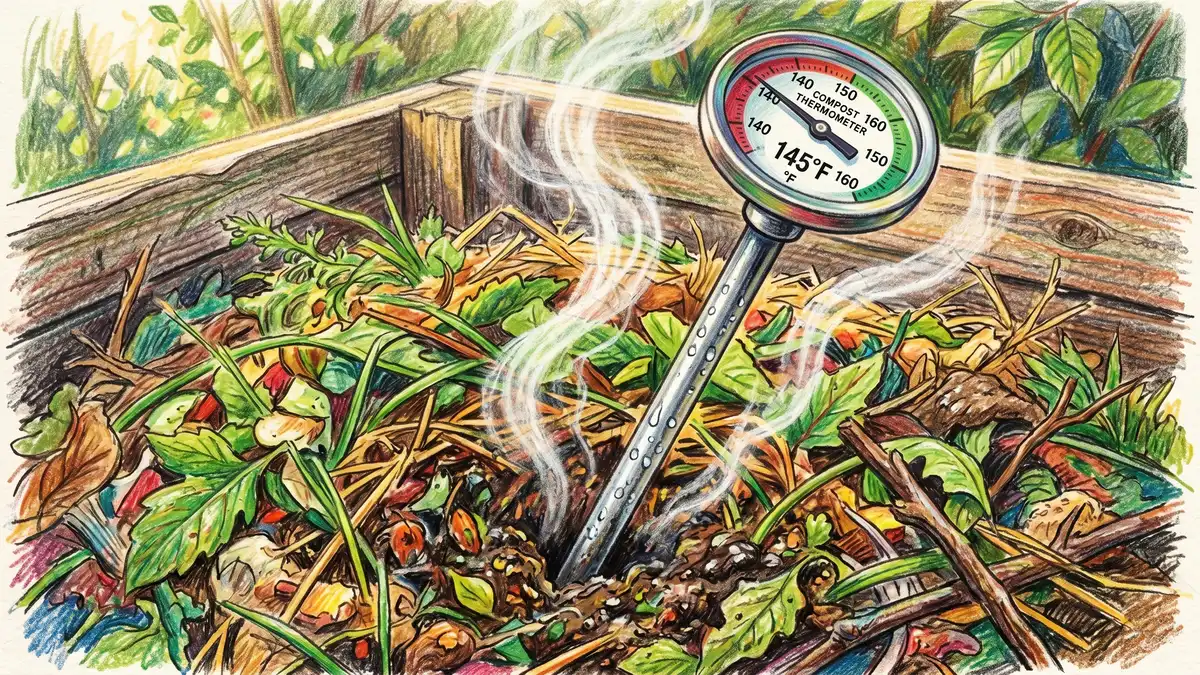
The single most useful tool for hot composting is a long-stem compost thermometer (the kind with a 20–24 inch / 50–60 cm probe). Push it into the centre of the pile every 2–3 days and you'll know exactly what's happening. If the pile reaches 140°F (60°C) and holds for 3 days, weed seeds die; data compiled by Grow It Build It from extension trials shows the kill threshold curve in detail. If the pile drops below 110°F (43°C) before turning, your moisture is off, your C:N is off, or the pile is too small. eOrganic's peer-reviewed extension publication on weed-seed and pathogen kill confirms that 131°F (55°C) for 3 consecutive days is the USDA NRCS standard for thermophilic sanitization.
Cold Composting: How the Slow Method Actually Works
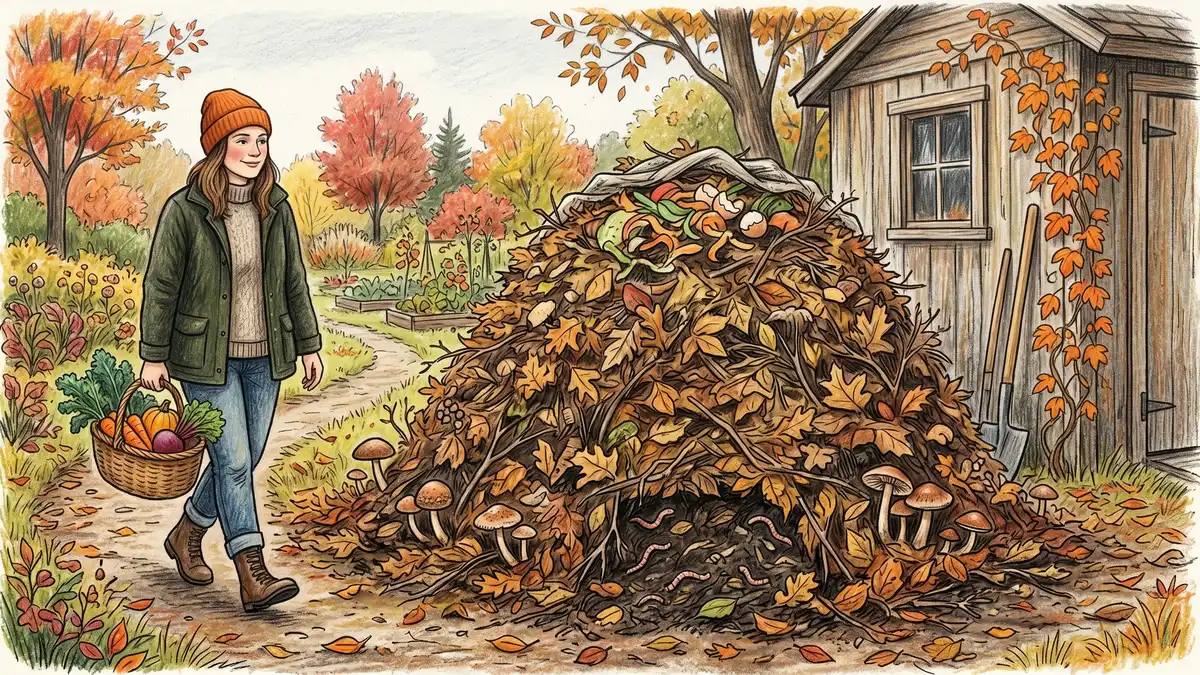
Cold composting is what happens when you stop trying to manage anything: you pile organic matter, you wait, it decomposes. Mesophilic bacteria, fungi, and macroorganisms (worms, beetles, isopods) do the work at ambient soil temperature. Fine Gardening's comparison piece is honest about the trade-off: cold compost takes 6–24 months but produces a finished product just as biologically active and arguably more diverse than hot.
The big asterisks: cold piles do not reach temperatures that kill weed seeds or plant pathogens. Anything you put in comes out — including dock seeds, bindweed root fragments, and tomato hornworm pupae. You also lose more nitrogen to slow volatilization over the long timescale, though the compounds that build organic matter (humic acids, microbial necromass) are arguably better preserved by the lower temperature.
For most homesteads, cold composting is the default for yard waste, fall leaves, kitchen scraps without weed-seed risk, and chop-and-drop material. Penn State Extension's compost guide recommends layering as you add (alternating 4 in / 10 cm of greens with 4 in of browns) but otherwise leaving it alone.
The Comparison Matrix
| Factor | Hot composting | Cold composting |
| Time to finished | 18–30 days | 6–24 months |
| Effort per week | 1–2 hours (turning + monitoring) | ~10 minutes (just adding material) |
| Pile size | 3×3×3 ft (1×1×1 m) minimum | Any size |
| C:N ratio | Strict 25:1–30:1 target | Loose, 20:1–50:1+ acceptable |
| Weed seed kill | Yes (140°F / 60°C for 3+ days) | No |
| Pathogen kill | Yes (131°F / 55°C for 3+ days) | No |
| Nitrogen retention | Higher (faster cycling) | Lower (slow volatilization) |
| Microbial diversity | Lower (heat-favoured species) | Higher (broader community) |
| Cold-climate winter | Stalls below freezing | Stalls but resumes in spring |
| Best for | Manure, weed seeds, diseased material, fast turnaround | Yard waste, leaves, low-effort steady stream |
Sources:.
Why This Works: Two Microbial Communities, Same Goal
Hot composting selects for thermophilic bacteria that thrive at 130–160°F (55–70°C). Cold composting runs on mesophilic bacteria and fungi at ambient temperatures, plus a much wider macrofauna community — earthworms, springtails, isopods, beetles. Both end at the same place: stable humus, available nutrients, microbial diversity in the finished product. The path is just radically different in time and labor.
The 5-Step Decision Framework
If you're choosing between methods or deciding which feedstock to send where, run through these five questions:
Do you have weed seeds, manure, or diseased material?
If yes → hot pile. The 140°F / 60°C threshold for 3+ days is the only reliable way to kill seeds and pathogens in a backyard system. Cold piles will spread them through your beds.
Do you need finished compost in under 8 weeks?
If yes → hot pile (or buy bagged compost). Cold composting cannot deliver in this timeframe even in ideal climates.
Can you commit 1–2 hours per week to turning?
If yes → hot pile is realistic. If no → cold pile is the only sustainable option. Don't start a hot pile you can't maintain — half-tended hot piles produce worse compost than well-tended cold ones.
Do you have at least 1 cubic yard (~0.75 m³) of fresh material at once?
If no → cold pile. Hot composting requires building the entire 3×3×3 ft pile in roughly one go to reach critical mass. Trickle-feeding ruins the temperature curve.
Do you live somewhere with cold winters?
Cold piles freeze and stall in zones 3–5 from November through March. Hot piles can keep going if they're large enough and well-insulated. University of Illinois winter composting guide (PDF) covers cold-climate adjustments.
Hybrid Methods: Tumbler, Trench, and Bokashi
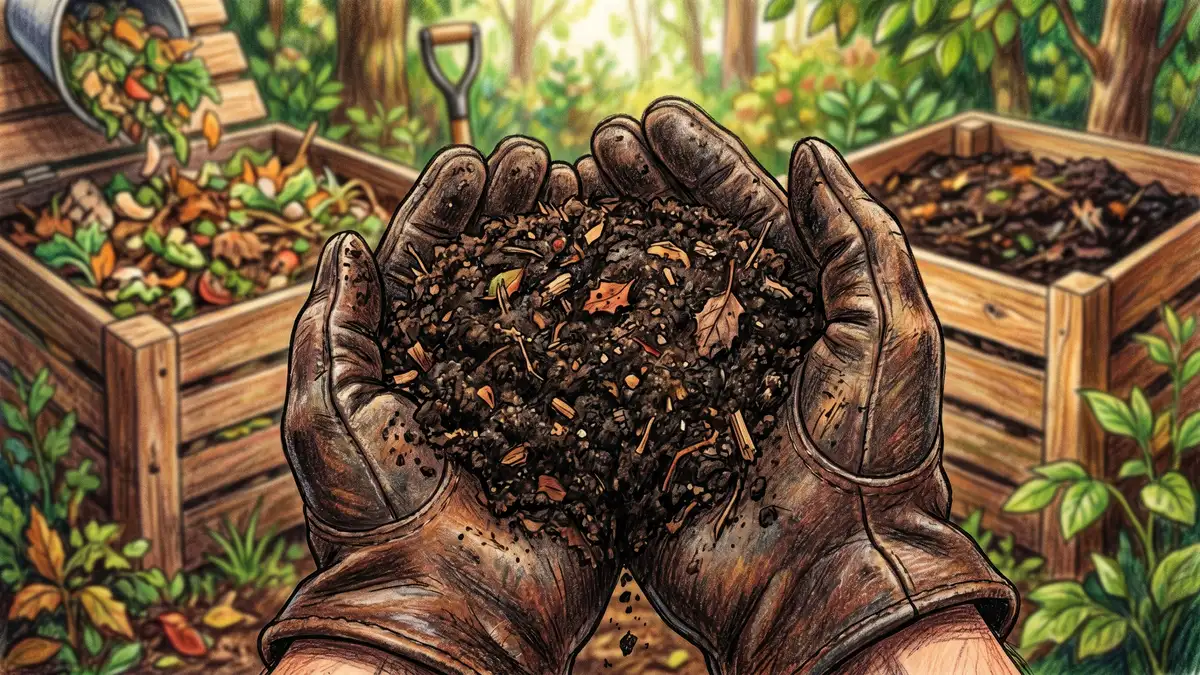
The two methods aren't the only options. Tumbler composters are intermediate — they reach mid-range temperatures (90–130°F / 32–55°C), turn easily, and finish in 6–10 weeks. They don't reliably kill weed seeds but they're faster than cold and lower-effort than hot.
Trench composting is cold composting, in-ground. Dig a 12 in (30 cm) trench, fill with kitchen scraps, cover with soil. The material breaks down in place over 6–12 months and feeds the bed directly. University of Minnesota Extension covers it as one of the standard low-input variations — it's the easiest way to keep composting through a frozen winter.
Bokashi is a third route entirely — it's anaerobic fermentation rather than aerobic decomposition. Kitchen scraps go into a sealed bucket with bran inoculated with effective microorganisms; the result is pickled (not finished) compost in 2–4 weeks that then needs to be buried in soil to fully break down. It's not a full replacement for hot or cold, but a useful pre-processing step for kitchen waste in winter or in apartments. Our broader composting for beginners guide covers the full spectrum, and our bokashi-specific deep dive covers the fermentation method end-to-end.
Common Mistake to Avoid: Trying Hot Compost in a Pile That's Too Small
The most common reason a "hot" pile never gets hot is that it's under 3×3×3 ft (1×1×1 m). At smaller volumes there isn't enough thermal mass to retain heat against ambient losses, no matter how perfect your C:N ratio. If you can't build a full-size pile, run cold instead — a small "hot" pile that never reaches 130°F is just a cold pile with extra steps and worse moisture management. Urban Worm Company's C:N calculator is useful for sizing inputs once you have the volume.
Need the gear for this?
Bins and tumblers picked by yard size, with the honest trade-offs for each.
See the compost bin picksHot and cold composting are two ends of the same spectrum, and most homesteads benefit from running both. The mechanics of either method connect directly to our composting for beginners guide and how to start a compost bin. If you're troubleshooting a stalled pile, our compost troubleshooting guide covers every common failure mode. The carbon-to-nitrogen logic underlying both methods is in brown vs green compost materials, and the timing question gets a deep dive in how long does compost take. The finished compost feeds the broader soil and composting hub, and the macronutrients you'll be applying connect to NPK explained.
Frequently Asked Questions
What is hot composting?
Hot composting is a managed thermophilic process where pile temperatures reach 130–160°F (55–70°C) at the core. It requires a minimum 3×3×3 ft (1×1×1 m) pile, a C:N ratio of 25:1–30:1, moisture around 45–60%, and turning every 2–7 days. The reward is finished compost in 18–30 days, plus reliable kill of weed seeds and plant pathogens once the pile holds 140°F (60°C) for 3 or more days.
What is cold composting?
Cold composting is the passive method — pile organic material and wait. Mesophilic bacteria, fungi, and macrofauna (worms, beetles, isopods) decompose it at ambient temperature over 6–24 months. There's no minimum pile size, no strict C:N target, no turning requirement, and effectively no labor beyond adding material. The catch: it doesn't reach temperatures that kill weed seeds or pathogens.
How do you make compost in 7 days?
You can't, reliably. The fastest documented method is the Berkeley 18-day method: build a 1 m³ pile with C:N at 30:1, turn every 2 days starting day 4, and finish around day 18. Some commercial in-vessel composters with active aeration get faster, but home backyard composting at 18–21 days is the realistic floor. Anything claiming 7 days is either a partial product (not stable, still hot) or marketing.
Does hot composting really kill weed seeds?
Yes, when the temperature threshold is met. Per eOrganic's peer-reviewed extension publication, holding 140°F (60°C) for 3 consecutive days kills nearly all common annual weed seeds. The USDA NRCS standard for sanitization (Conservation Practice Standard 317) is 131°F (55°C) for 3 days. The catch is making sure the entire pile reaches that temperature — the outer 6 inches is always cooler, which is why turning matters: each turn brings outside material to the center.
Can I compost in winter?
Yes, but expect cold piles to stall when ambient temperatures drop below freezing. U Illinois Extension's winter composting guide recommends building piles tall (4 ft / 1.2 m or more), insulating with straw bales on the windward side, and accepting that activity restarts in spring rather than continues through January. Hot piles fare better because their thermal mass resists freezing, but only if they're at full size. Trench composting, bokashi, or worm composting indoors are the practical alternatives for active winter cycling.
Get the Weekly Dig
One practical permaculture guide a week, written for gardeners who do this on weekends: composting that actually finishes and soil that feeds itself. Free, no spam, unsubscribe any time.
Join the Weekly DigResources
- Cornell Waste Management Institute — Science of Composting (PDF)
- USDA NRCS — Composting Facility Conservation Practice Standard 317 (PDF)
- eOrganic — Composting to Reduce Weed Seeds and Plant Pathogens
- Penn State Extension — Compost: How to Make It and How Much to Use
- UMN Extension — Composting in Home Gardens
- UMass Extension — Waste Management and Composting
- USDA SARE — Composting Resources
- University of Illinois Extension — Winter Composting (PDF)
- Grow It Build It — How Hot Composting Kills Weed Seeds (data summary)
- Urban Worm Company — Compost C:N Ratio Calculator