
What NPK Actually Means on a Fertilizer Bag
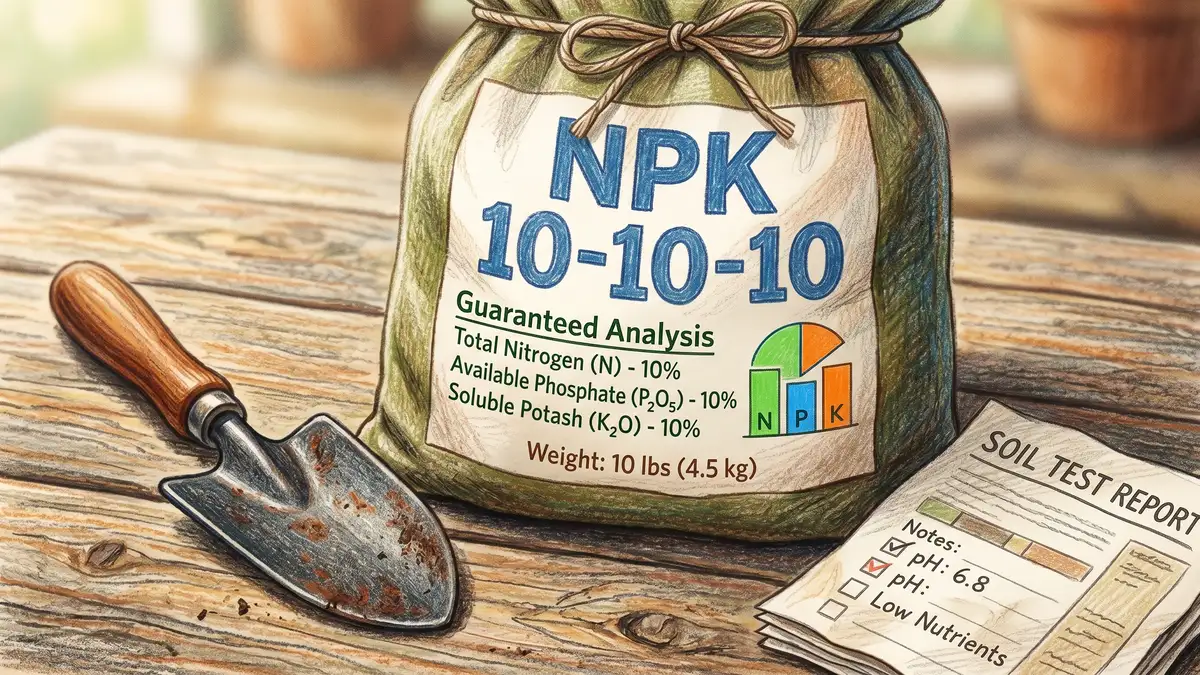
The three numbers on every fertilizer bag — 10-10-10, 5-10-10, 28-0-3 — are the percentages by weight of nitrogen (N), phosphate (P₂O₅), and potash (K₂O), in that order. A 50 lb bag of 10-10-10 contains 5 lbs of nitrogen, 5 lbs of phosphate, and 5 lbs of potash; the rest is filler. Clemson Cooperative Extension's fertilizer-label primer walks through the format in detail.
One catch most home growers miss: P and K are reported as oxides, not as the elements themselves. Per University of Minnesota Extension and USDA's RNGR fertilizer-units explainer (PDF), the actual elemental phosphorus is roughly 44% of the P₂O₅ figure, and elemental potassium is roughly 83% of K₂O. So a "10" P₂O₅ value actually delivers 4.4% elemental P, and a "10" K₂O value delivers 8.3% elemental K. This matters when you're matching a soil-test recommendation (usually given as elemental P and K) to a fertilizer bag.
Key Takeaway
NPK is the shorthand for plant nutrition, but it's not the whole story. Nitrogen drives leaf and stem growth, phosphorus drives roots and flowers, potassium drives water management and fruit quality. Read the label, run a soil test before you buy fertilizer, and match the ratio to what the crop actually needs at its current growth stage.
What Each Macronutrient Actually Does
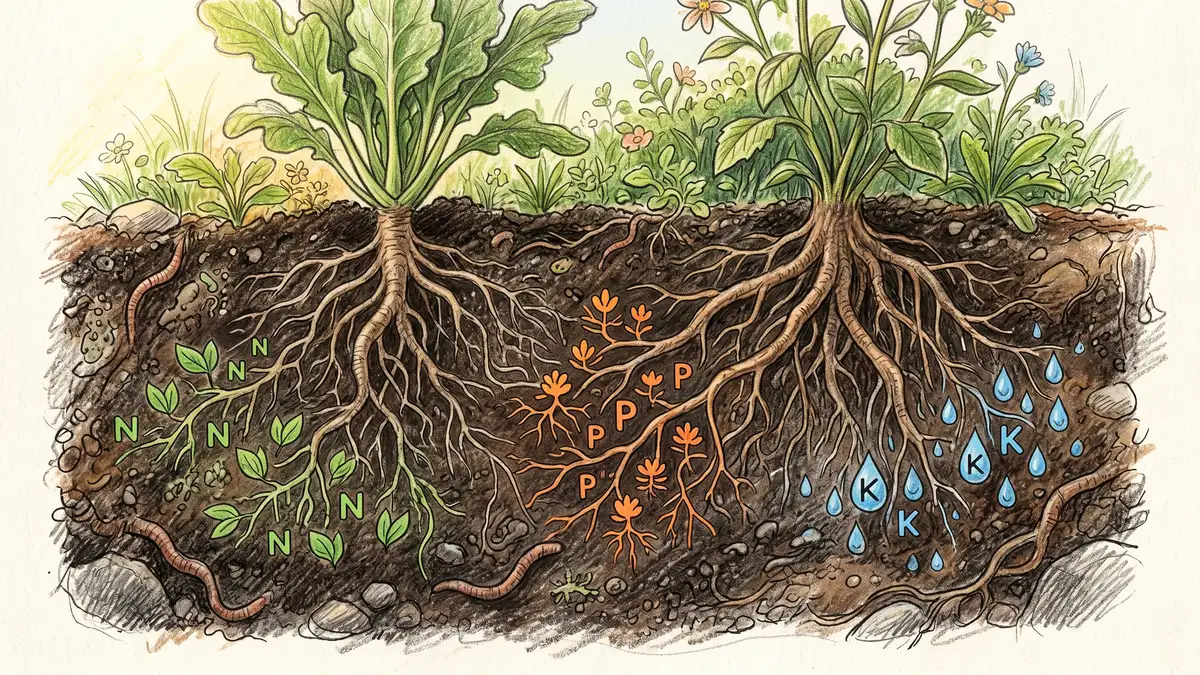
Nitrogen (N). The atom at the centre of every chlorophyll molecule and the backbone of every amino acid. Plants pull nitrogen out of the soil as nitrate (NO₃⁻) or ammonium (NH₄⁺), and shortages show up as yellowing of older leaves while new growth stays green. UGA Extension's deficiency guide covers the visual symptoms by macronutrient. Nitrogen leaches faster than the other two — sandy soils and high rainfall regions need more frequent, smaller applications.
Phosphorus (P). Critical for root establishment, flower initiation, and the ATP energy transfers that run plant metabolism. Most soil phosphorus is locked up by minerals — only ~1% is plant-available at any moment, which is why phosphorus deficiency shows up despite "adequate" total soil P. Mycorrhizal fungi (which colonise plant roots in undisturbed, organically managed soils) release organic acids that dissolve mineral-bound phosphorus and dramatically improve uptake. Deficiency shows as purplish or reddish discolouration on leaves and stems.
Potassium (K). Regulates osmotic pressure, water uptake, and stomatal closure under drought stress; also boosts fruit quality, sugar content, and disease resistance. Plants take up K as a free K⁺ ion, which moves quickly through soil water. Deficiency starts as browning and scorching on the margins of older leaves, often accompanied by reduced winter hardiness.
Why This Works: Soil Biology Does the Hard Part
NPK availability isn't just chemistry — it's biology. Mycorrhizal fungi extend root surface area effectively by 10–100×, dissolving mineral-bound P and shuttling it back to the plant. Soil bacteria mineralise organic nitrogen at temperatures above ~50°F (10°C). When you build organic matter and avoid disturbance, you build the microbial workforce that converts unavailable nutrient stocks into available flow. Colorado State Extension's plant-nutrition primer covers this systems view.
NPK Ratios by Crop: A Practical Quick Reference
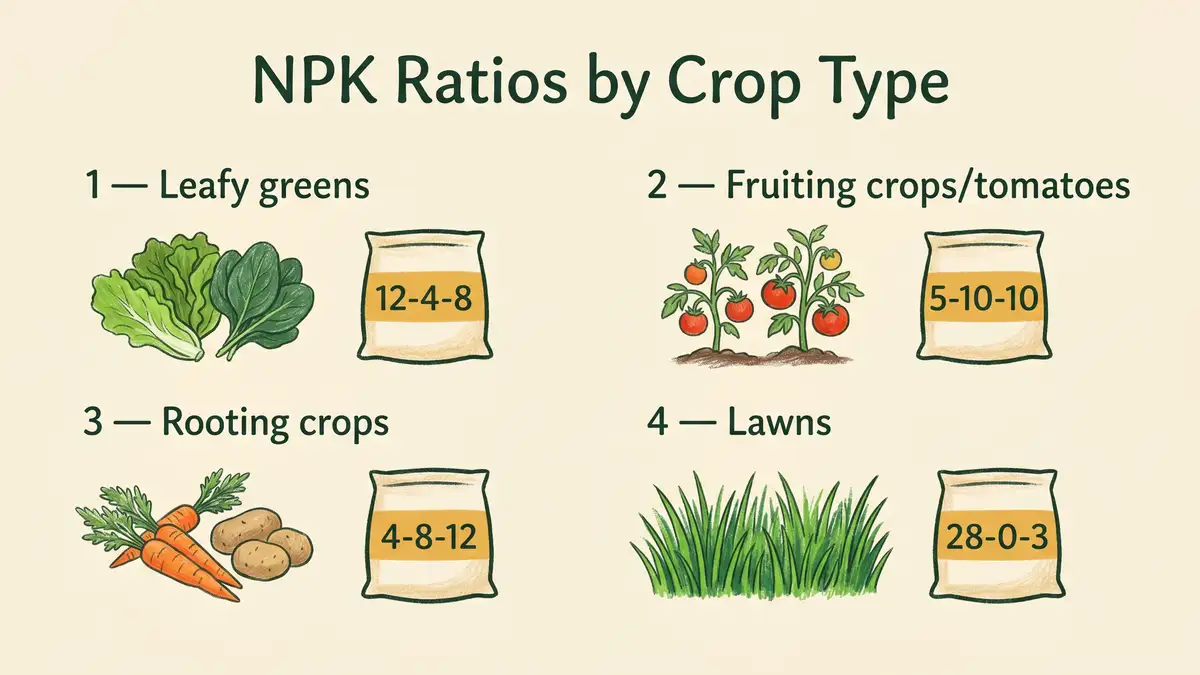
Most commercial "general-purpose" fertilizer (10-10-10) is a compromise that's good enough for nothing in particular. The ratios below are extension-service recommendations matched to what each crop is actually trying to do during its main growth phase.
| Crop type | Target NPK ratio | Why |
| Leafy greens (lettuce, spinach, kale) | ~12-4-8 or 14-7-7 | You're harvesting leaves — N drives leaf size and quality |
| Fruiting crops at establishment (tomatoes, peppers) | ~5-10-10 or 8-32-16 starter | P supports root and flower bud formation |
| Fruiting crops at fruiting | ~4-6-8 or 2-7-7 | Lower N; excess N delays maturity and reduces fruit quality |
| Root crops (carrots, beets, parsnips) | ~5-10-10 or 4-8-12 | Excess N grows tops; K and P size the root |
| Lawns / turfgrass | ~28-0-3 or 24-0-6 | Continuous mowing creates enormous N demand |
| Roses (during bloom) | ~5-10-5 or 6-10-4 | Balanced N with extra P for flower production |
Sources:.
How to Read a Fertilizer Label and Calculate the Right Application Rate
Most extension recommendations specify nitrogen rates in pounds of N per 1,000 sq ft (lbs N / 1,000 ft² ≈ 4.5 g/m² × N percentage). Translate that into bag weight with one division:
Bag weight needed = target N rate (lb / 1,000 ft²) ÷ N percentage on label
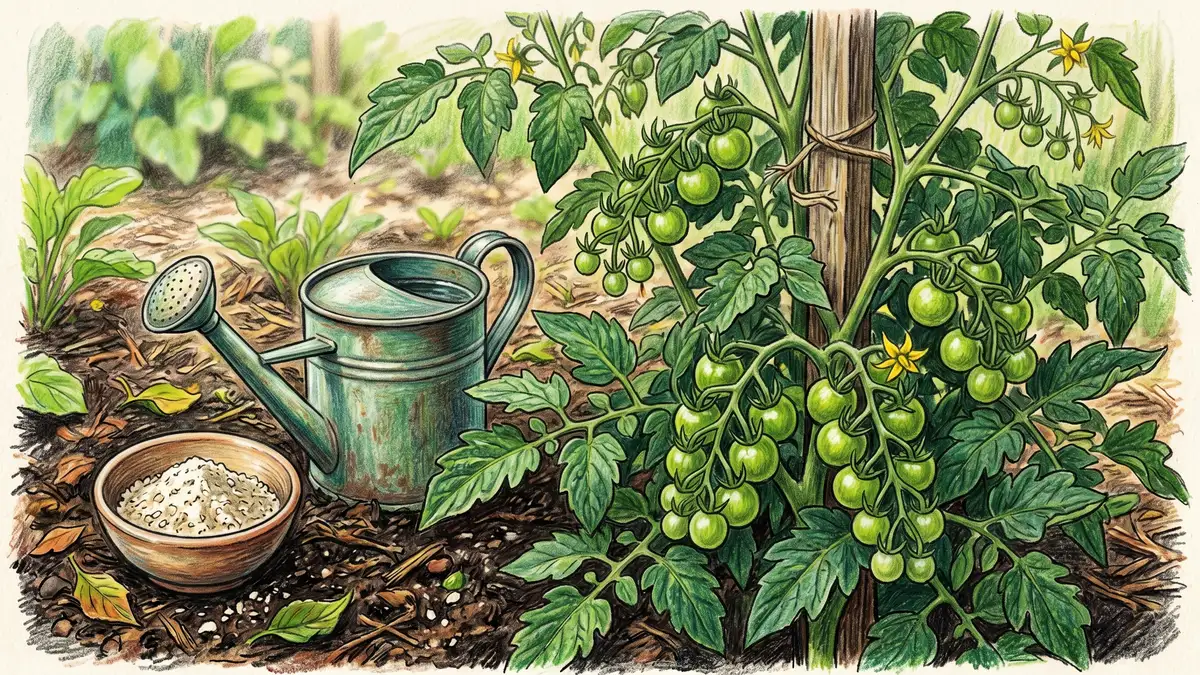
Worked example: a tomato bed needs 1 lb of N per 1,000 sq ft for the establishment phase. With a 5-10-10 fertilizer, you'd need 1 ÷ 0.05 = 20 lbs of fertilizer per 1,000 sq ft. That same target with 10-10-10 would be 10 lbs per 1,000 sq ft — half the bag weight for the same N delivered.
One trap to avoid: when a soil test returns a phosphorus deficiency in elemental P (most cooperative extension reports use ppm of available P), don't divide directly by the P₂O₅ percentage on a fertilizer bag. Multiply the bag's P₂O₅ value by 0.44 to get elemental P first. The same trap applies to potassium with the K₂O × 0.83 conversion.
Organic vs Synthetic Sources: Different Speeds, Different Trade-offs
Synthetic fertilizers (urea, ammonium nitrate, triple superphosphate, potassium chloride) dissolve in water within hours and feed plants within days. They're precise, cheap, and easy to over-apply — and they contribute zero organic matter or biological activity to the soil. Long-term reliance on synthetics without organic-matter inputs gradually erodes soil structure and microbiology.
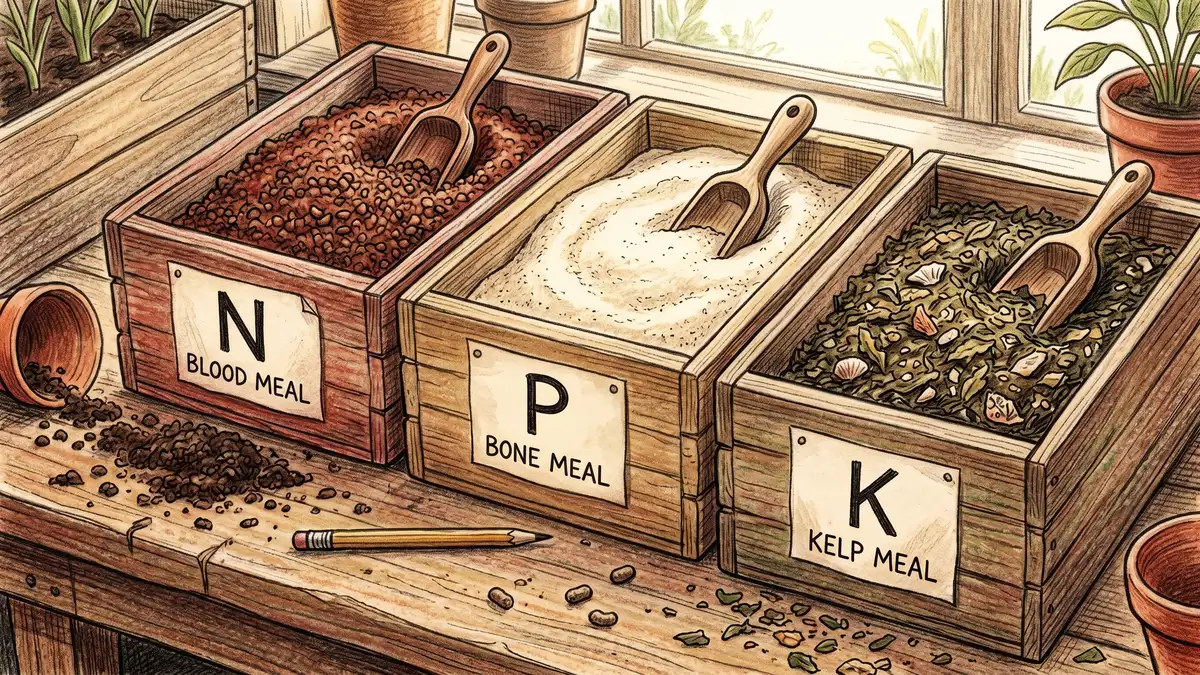
Organic NPK sources release nutrients on a curve as soil microbes break them down. The trade-off: slower response, lower risk of leaching, plus organic-matter contribution that builds soil over years. The standard short list:
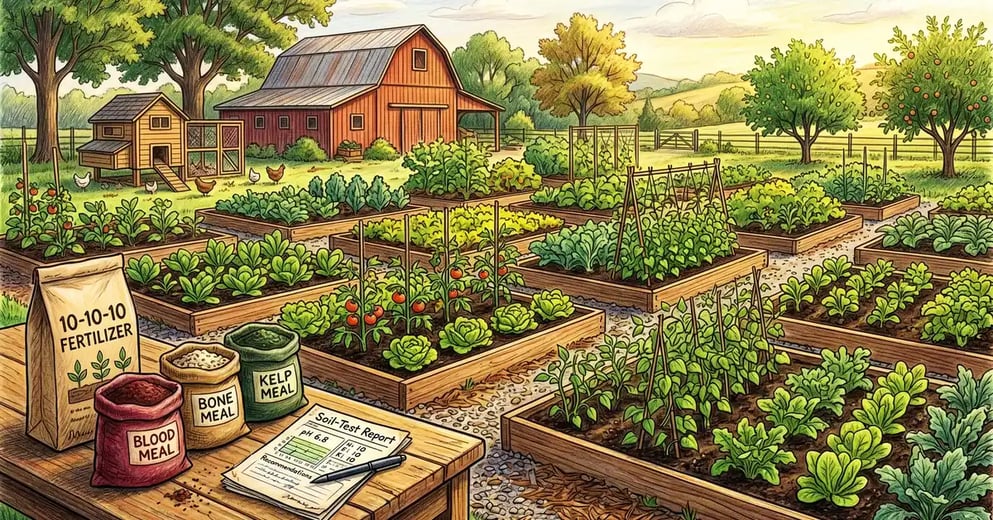
- Blood meal — roughly 12-2-1 (high N). Releases over 4–6 weeks. The fast-organic nitrogen source.
- Bone meal — roughly 3-15-0 (high P). Slow phosphorus release over a season; pair with rooting stage of fruiting crops.
- Kelp meal — roughly 1-0-2 plus a wide spectrum of micronutrients. Slower potassium release; primary value beyond NPK.
- Composted chicken manure — roughly 3-2-2. Balanced and steady; needs at least 6 months of composting before garden use.
- Worm castings — roughly 1-0-0 by NPK numbers, but the real value is the microbial inoculation, not the macronutrient delivery.
Soil Testing: The Step Most Gardeners Skip
Buying fertilizer without a soil test is like ordering blood-test results from a vitamin company. Penn State Extension offers full soil-fertility testing for around $15–25 per sample. The report tells you pH, organic matter, and current available NPK levels — which directly drives your amendment plan for the year. Standard sampling protocol calls for 2 composite samples per 1,000 m² (¼ acre) of homogeneous land, two cups per sample, mixed and submitted together.
Sample correctly
Use a clean trowel or soil probe. Take 8–12 small cores from across the bed at 4–6 in (10–15 cm) depth, mix in a clean bucket, and bag a single 1–2 cup composite. Avoid sampling within 30 days of fertilizer or lime application.
Submit to your state's cooperative extension
Find the local office; mail in the sample with a description of what you're growing. Most reports come back within 7–14 days with extension-tailored recommendations.
Read pH first
Most vegetables want soil pH between 6.0 and 6.8. Below 5.5, aluminium becomes toxic and phosphorus locks up. Above 7.5, P locks up via calcium-phosphate precipitation. Correct pH before chasing NPK numbers.
Apply only what's deficient
Don't apply N-P-K when only K is short. Don't apply phosphorus to a soil already at high P (this wastes money, locks up iron, and risks runoff). The soil-test report tells you what's missing.
Re-test every 2–3 years
Track whether your amendments are accumulating, holding steady, or depleting. The second and third tests are where the system intelligence shows up.
Common Mistake to Avoid: Treating Every Plant Like It Wants 10-10-10
Generic balanced fertilizer is the most over-used product in home gardening. It's adequate for nothing in particular. Leafy greens want high N. Fruiting crops want low N once they flower. Root crops want low N at all stages. Lawns want very high N. Applying 10-10-10 to everything wastes phosphorus on lawns and starves leafy greens of nitrogen. Match the ratio to the crop and the growth stage.
NPK is just the macronutrient layer of a much bigger soil-fertility picture. Once you've matched your fertilizer to your crops, the next move is building the organic matter and biology underneath — covered in our soil and composting hub and the soil health guide. The slow-release organic amendments mentioned above are explored in detail in our organic fertilizer guide, and the practical composted-manure option is covered alongside the broader process in composting for beginners. Cover crops are the third leg of feeding soil without buying fertilizer — see the cover crops guide. The system-level frame for "feed the soil, not the plant" sits inside our 12 permaculture principles.
Frequently Asked Questions
What does NPK stand for?
NPK stands for nitrogen, phosphorus, and potassium — the three macronutrients plants need in the largest quantities. The three numbers on a fertilizer bag are the percentages by weight of each: a 10-10-10 product is 10% nitrogen, 10% phosphate (P₂O₅, not elemental P), and 10% potash (K₂O, not elemental K). The remaining 70% is filler or carrier material.
What's a good NPK ratio for plants?
It depends on the crop and growth stage. Leafy greens want high N (around 12-4-8). Fruiting crops want a balanced or P-heavy ratio at establishment (5-10-10) and lower N during fruiting (4-6-8). Root crops want low N (5-10-10 or 4-8-12). Lawns want very high N (28-0-3). Generic 10-10-10 is a compromise — adequate but rarely optimal.
What's the best NPK ratio for tomatoes?
Two-stage feeding works best. At transplant and during the first 4–6 weeks, use a balanced or P-emphasis ratio like 5-10-10 or a starter formula like 8-32-16 to support root and flower-bud development. Once the first fruit clusters set, switch to a lower-N, K-emphasis ratio like 4-6-8 or 2-7-7 to favour fruit maturation over continued vegetative growth. Heavy nitrogen during fruiting produces lush foliage and few tomatoes.
Is 10-10-10 fertilizer good for everything?
It's good for nothing in particular. It's a defensible compromise when you don't know the crop and don't have a soil test, but specialised ratios outperform it for almost every specific use case. For most homestead vegetable production, separate fertilizers for greens, fruiting crops, and root crops will give better results than 10-10-10 across the board.
How do I read a fertilizer label correctly?
The three numbers on the front are N, P₂O₅, and K₂O percentages by weight, in that order. Multiply the bag weight by each percentage to get pounds of each nutrient (a 50 lb bag of 10-10-10 = 5 + 5 + 5 lbs). When matching to a soil-test report, convert P₂O₅ × 0.44 = elemental P and K₂O × 0.83 = elemental K. Clemson Extension's reading-a-fertilizer-label fact sheet covers the secondary nutrients (Mg, Ca, S, micronutrients) listed below the NPK guarantee on most products.
Get the Weekly Dig
One practical permaculture guide a week, written for gardeners who do this on weekends: building living soil without buying it in bags. Free, no spam, unsubscribe any time.
Join the Weekly DigResources
- University of Minnesota Extension — Interpreting Soil Tests for Fruit and Vegetable Crops
- Penn State Extension — Soil Testing
- Clemson Cooperative Extension — Reading a Fertilizer Label
- Colorado State Extension — Plant Nutrition
- UGA Extension — Nutrient Deficiencies
- Illinois Extension — The Agronomics of N, P, & K
- Kansas State — Soil Test Interpretations and Fertilizer Recommendations (PDF)
- USDA RNGR — Understanding Common Fertilizer and Plant Nutrition Units (PDF)
- CASTCO — Guidance: Soil NPK and pH Testing
- Science in Hydroponics — Why NPK Labels Express P and K as Oxides