What Is an Urban Food Forest, and Can It Really Work in a City?
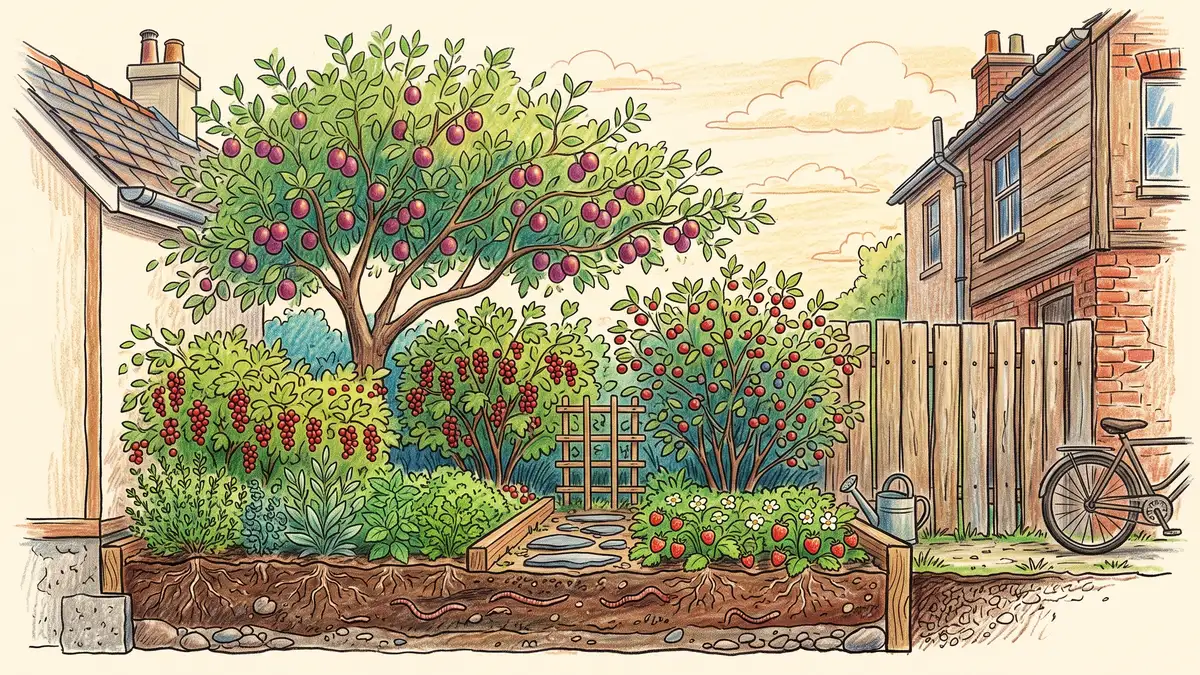
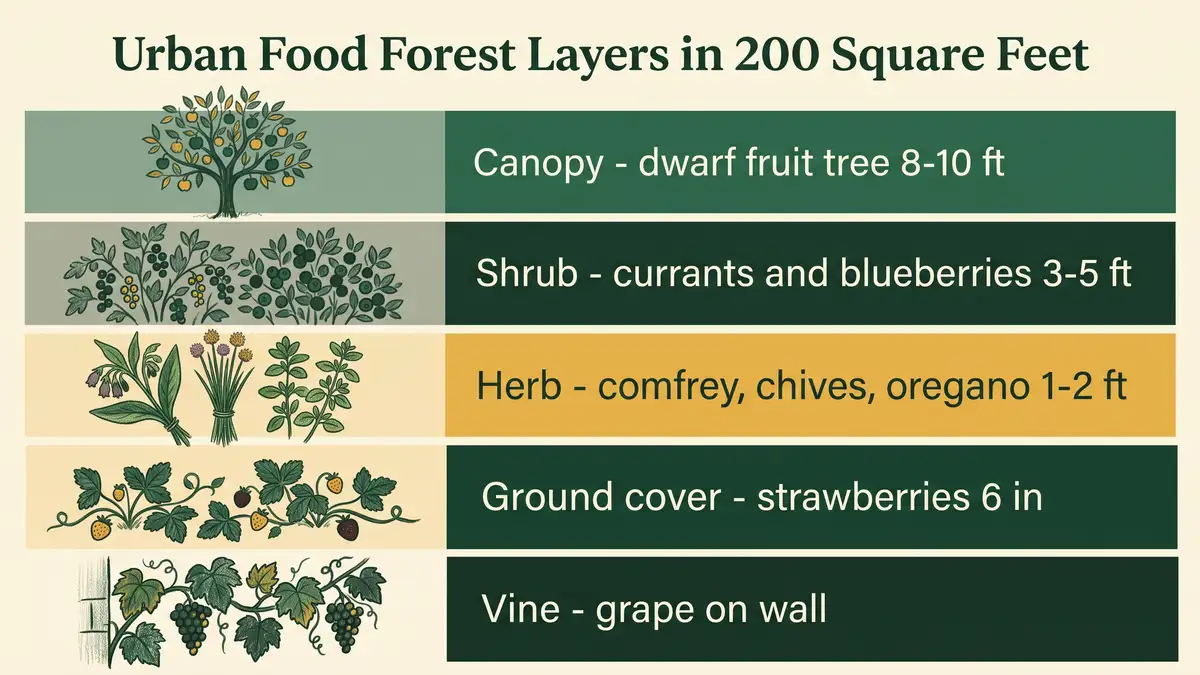
Yes, and the proof is already growing on public land. An urban food forest is a multi-layer planting of fruit trees, berry shrubs, climbing vines and perennial herbs arranged so the layers stack instead of compete. Same idea as a woodland, with the non-edible species swapped for ones you can eat.
The scale question stops most city gardeners before they start. It shouldn't. Asheville, North Carolina built the first public food forest in the United States on just 1.5 acres at the Dr. George Washington Carver Edible Park, carrying the full seven-layer structure. Atlanta's Urban Food Forest at Browns Mill runs to 7.1 acres, the largest in the country, with more than 1,000 residents, students and partners volunteering on site.
Syracuse went the other direction. The Syracuse Urban Food Forest Project, launched in 2019 by Syracuse University and SUNY ESF, spreads its plantings across a seven-mile corridor along the Onondaga Creekwalk, hopping between parks, school grounds and vacant lots. That distributed model is the one that matters if you are working with 200 square feet behind a row house. A food forest does not have to be one place.
What we will cover:
- The real minimum footprint, using published rootstock spacing
- What city orchards actually harvest, crop by crop
- How to check your soil is safe before a single plant goes in
- A first-season build you can finish across three weekends
Key Takeaway
You are not shrinking a farm. You are choosing which layers to keep. A rooftop with three layers and a wall-trained vine is a working food forest. Forcing all seven into 150 square feet is how urban plantings shade themselves out by year four.
How Much Space Does an Urban Food Forest Actually Need?
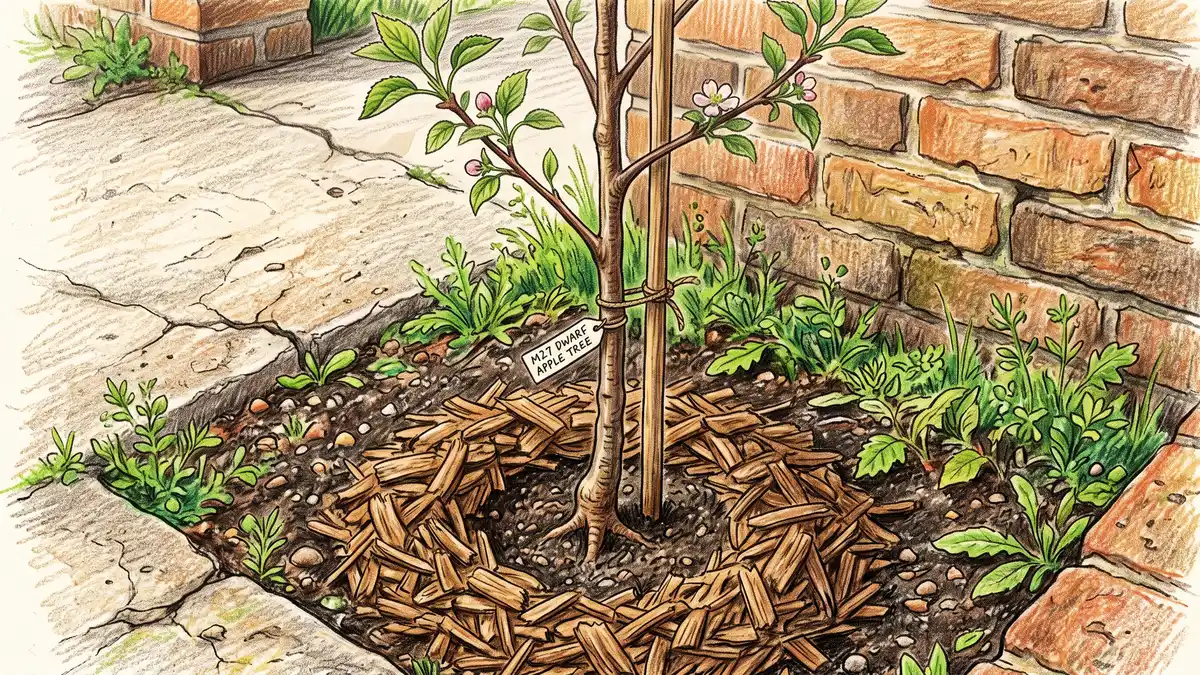
Less than almost anyone tells you, if you pick the rootstock first and the variety second. Oregon State University Extension puts the range plainly: a home orchard runs from 15 feet of wall for two espaliered dwarf apples up to half an acre for full-size mixed plantings. The same apple variety can occupy 6 feet or 40, depending entirely on what it was grafted onto.
On dwarfing rootstock an apple needs 5 to 10 feet of spread and bears in 3 to 5 years. Semi-dwarf wants 15 to 25 feet and 5 to 7 years. Vigorous means 30 to 40 feet and up to a decade. In a city lot, the dwarf tree is not a compromise. It is the correct tool.
| Tree Type | Spread | Height | Years to Bear | Yield per Tree |
| Vigorous apple (seedling) | 30-40 ft. | 25-60 ft. | 7-10 | 300-400 lb. |
| Semi-dwarf apple (MM-106, M-7) | 15-25 ft. | 15-25 ft. | 5-7 | 180-300 lb. |
| Dwarf apple (M-9, M-26, Bud 9) | 5-10 ft. | 6-15 ft. | 3-5 | 50-150 lb. |
| More dwarfing apple | 4-6 ft. | 5-7 ft. | 3-5 | 25-50 lb. |
| Fig | 12-20 ft. | - | 5-6 | varies by site |
| Peach / nectarine | 12-15 ft. | - | 4-5 | varies by site |
Source: Oregon State University Extension, Growing Tree Fruits and Nuts at Home (EC 819)
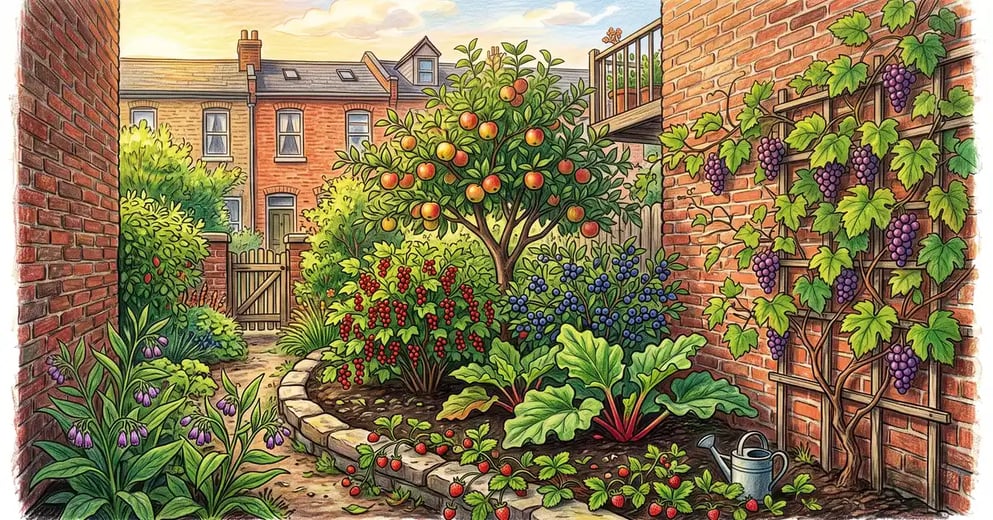
Work backwards from that table and a 500-square-foot yard is generous, not tight. Two dwarf apples 8 feet apart along a fence, a fig in the warmest corner, currants and gooseberries beneath, herbs and strawberries at ground level, a grape running up the wall. Five layers in a space most people write off. We walk that footprint through in our guide to a small food forest in 500 square feet.
Why This Works: Stacking Functions
Every element in a permaculture design is asked to do more than one job. A south-facing brick wall is not just a boundary. It is a heat sink holding warmth overnight, a trellis for your vine layer, and a windbreak for the shrubs in front. In the countryside you would build those functions. In a city they already exist, which is why urban sites often beat rural ones for tender fruit like figs.
What Can You Realistically Harvest From a City Planting?
More than the sceptics expect, less than the brochures promise. The Philadelphia Orchard Project surveys its partner sites every year. In 2023, reporting partners harvested 11,733 pounds of fruit and nuts, more than double the 4,620 pounds recorded in 2022, with half of it given away free or picked directly by neighbors. The crop-by-crop breakdown tells you which species carry a city planting and which are decorative.
| Crop | 2023 Yield | Notes for Small Spaces |
| Asian pear | 1,664 lb. | Trains well on a wall; heavy cropper |
| Pawpaw | 1,639 lb. | Shade tolerant; needs two for pollination |
| Fig | 1,207 lb. | Container-friendly; loves reflected wall heat |
| Sweet cherry | 614 lb. | Needs the most room of this group |
| Apple | 471 lb. | Pest pressure is the limiting factor, not space |
| Peach and nectarine | 356 lb. | Fast to bear, short-lived trees |
Source: Philadelphia Orchard Project, 2023 Orchard Partner Survey Summary
One number deserves its own line. In its fourth year of production, a single learning orchard pulled 124 pounds off seven fig varieties. That is a realistic backyard figure, and it arrived four years after planting, not fifteen. Our breakdown of when a food forest starts producing covers the rest of the layers.
Key Takeaway
Plan for the fourth season, not the first. Dwarf trees bear in 3 to 5 years, figs in 5 to 6. Strawberries, herbs and brambles carry the first two seasons while the woody layers build structure, which is why the ground layer goes in on day one rather than last.
Is Your City Soil Safe to Plant In?
Assume it isn't until a lab tells you otherwise. This is the step that gets skipped, and it is the one with real consequences. A 2022 review in Frontiers in Ecology and Evolution compiled soil lead results from 1,646 New York City garden samples and found a median of 355 mg/kg, with readings up to 9,000 mg/kg. Forty-eight percent of sites exceeded the 400 mg/kg federal guideline then in force.
That threshold has since tightened. In January 2024 the EPA lowered its residential soil lead screening level from 400 ppm to 200 ppm, and to 100 ppm where lead service lines or lead paint are also present. Against the newer number, far more urban gardens land in the caution zone.
The response is not to give up. It is to change what you grow where. The same review notes that fruiting crops, tomatoes, cucumbers and eggplants, take up substantially less lead than leafy greens and root crops. Raised beds of clean imported soil, mulch to hold dust down, compost, and lime to raise pH all measurably lower risk, as does siting beds at least 50 meters (about 165 feet) back from heavy traffic. Our guide to testing your soil properly covers which test to order.
Common Mistake to Avoid
Treating a raised bed as a permanent fix. Roots and frost eventually breach the barrier between clean fill and contaminated subsoil, and deep-rooted perennials get there fastest. If you are capping known contamination, check the boundary every few years and keep root crops out of that bed entirely. Michigan State University Extension flags testing cost as the main reason urban growers skip this step, which makes conservative design the cheaper insurance.
How Do You Build One This Season?
Three weekends, roughly $250 to $400 depending on how much soil you buy in. Sequence matters more than budget.
Test the soil, then map the sun
Send a sample to your state extension lab before you buy anything. While you wait, photograph the space every two hours across one clear day. Fruit wants 6 or more hours of direct sun; note where you get it and where a light-colored wall extends the window.
Place the canopy first, in the worst position
Your one or two dwarf trees go where they shade least, usually the north edge. Everything else arranges around them, because they are the only element you cannot move in three years.
Fill the shrub and ground layers immediately
Currants, gooseberries and raspberries 3 to 4 feet apart around the trees. Strawberries, chives, oregano and thyme across every remaining square foot. Bare ground in a city lot becomes weed pressure and dust; covered ground becomes yield.
Mulch 3 inches deep, then water weekly for year one
Keep mulch pulled back a few inches from trunks. New trees need consistent moisture through their first two summers, and a slow weekly soak beats a daily splash. After year two, most plantings need extra water only in drought.
Why This Works: The Edge Effect
Ecologists have long observed that the boundary between two systems is more productive than either alone, because species from both sides overlap there. A city lot is almost entirely edge: wall meets bed, path meets planting, sun meets shade. That is why compressed urban designs outperform their square footage, and why the vine layer matters more here than in an open field.
The wider benefits are worth knowing. US Forest Service research finds a single medium tree can intercept up to 2,380 gallons of rainfall a year before it hits pavement, and Forest Service modelling in Baltimore found heavily forested parks running as much as 7.1 °C (12.8 °F) cooler in the evening than the inner city. Your four trees will not do that alone. Ten thousand gardens might.
Frequently Asked Questions
How do I start a food forest in a small city yard?
Test the soil, map your sun hours, then plant from the top down: canopy, shrubs, herbs, ground cover, vines. Choose dwarf rootstock for anything woody so mature size fits the space, and fill the ground layer in the first season so bare soil never sits exposed. Expect meaningful tree yields in years three to five. Our step-by-step guide for beginners covers species selection in detail.
How long does it take to grow a food forest?
Ground and herb layers produce in the first season. Brambles and currants arrive in year two. Per Oregon State Extension, dwarf apples bear in 3 to 5 years, peaches in 4 to 5, figs in 5 to 6. Structural maturity, where the layers genuinely interact, is more like a 7 to 10 year horizon.
What is the difference between a food forest and a forest garden?
Nothing meaningful. Forest garden is the older British term, used by Robert Hart and later Martin Crawford; food forest is what stuck in North America. Both describe a mainly perennial polyculture with at least three identifiable vertical layers of food-bearing plants. That layer count is the useful test: if you only have trees, you have an orchard.
Can I build a food forest on a balcony or rooftop?
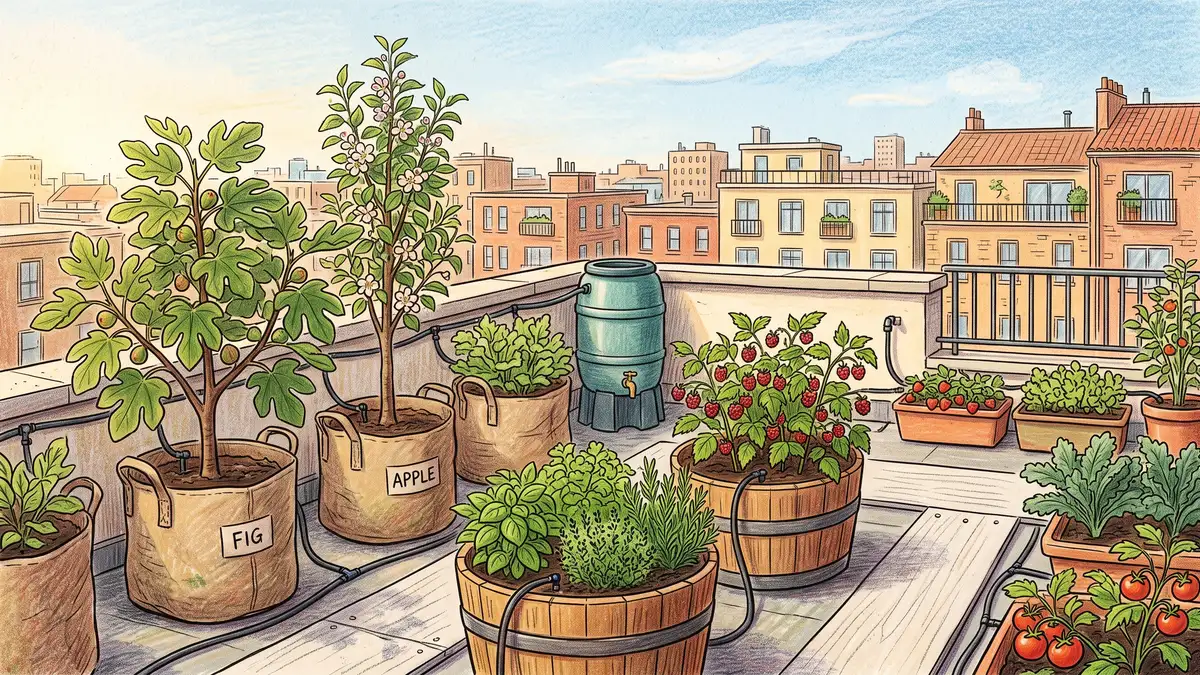
Yes, with two constraints. Weight is the first and it is not negotiable: deep containers of saturated soil are heavy, so confirm the structural load limit with the building owner or an engineer before installing anything substantial. Wind is the second, since rooftops dry out fast and rock young trees loose. Use genetic dwarf trees in large containers, group planters to shelter each other, and expect to water far more often than at ground level.
Do urban food forests attract pests?
They attract wildlife, which is mostly the point, and occasionally that goes badly. Philadelphia Orchard Project staff lost nearly an entire watermelon crop to what they assumed was a family of groundhogs. Diversity is the practical defense: a mixed planting rarely fails all at once the way a monoculture does. Add tree guards and netting for the specific crops you are least willing to lose, and build soil food web health, since vigorous plants shrug off minor pest pressure.
Get the Weekly Dig
One practical permaculture guide a week, written for gardeners who do this on weekends: food forest and guild designs that produce. Free, no spam, unsubscribe any time.
Join the Weekly DigThe pattern worth carrying away: a food forest is not a size, it is a structure, and structure scales down further than most people believe. For the full architecture before you plant, start with our food forest guide and the breakdown of the seven layers.
Resources
- Oregon State University Extension — Growing Tree Fruits and Nuts at Home (EC 819)
- Paltseva et al. (2022), Frontiers in Ecology and Evolution — Legacy Lead in Urban Garden Soils
- US EPA — Updated Screening Levels for Lead in Residential Soil (2024)
- Philadelphia Orchard Project — 2023 Orchard Partner Survey Summary
- USDA Forest Service — Control Stormwater Runoff with Trees (Fact Sheet #4, PDF)
- Paramita et al. (2021), USDA Forest Service — Modeling Lives Saved from Extreme Heat by Urban Tree Cover (PDF)
- City of Asheville — Dr. George Washington Carver Edible Park
- The Conservation Fund — Urban Food Forest at Browns Mill, Atlanta