
You don't need an acre to grow a food forest. Robert Hart's original Shropshire forest garden — the model for every modern temperate food forest — was 0.12 acres, roughly 500 square meters. Scaled to a typical American suburban yard, that's about 500 sq ft (46 sq m): the back portion of a quarter-acre lot, minus the lawn you don't really use. With one dwarf fruit tree, two or three sub-canopy trees, six to eight berry shrubs, a band of perennial herbs and ground cover, and a vine on the back fence, you'll be eating fresh fruit, herbs, and greens by Year 3 and producing real volume by Year 5. sea buckthorn for small spaces food forests on city lots and rooftops
This is the practical playbook for the 500 sq ft build: layout geometry, climate-specific species lists, the year-by-year planting sequence, real cost numbers, and the four mistakes that wreck most small food forests. Every step is based on documented case studies and university extension guidance.
Key Takeaway
Pick a 500 sq ft (46 sq m) area with at least 6 hours of daily sun. Lay it out as one keyhole bed with a central path. Year 1: sheet-mulch the whole footprint, plant one dwarf fruit tree plus two nitrogen-fixing shrubs and ground cover. Year 2: add the sub-canopy and remaining berry shrubs. Year 3: fill in the herbaceous layer and a single climbing vine. By Year 5 the system is mature, requires under 5 hours a week, and produces fresh harvests from May through October.
Why 500 Square Feet Is the Practical Floor
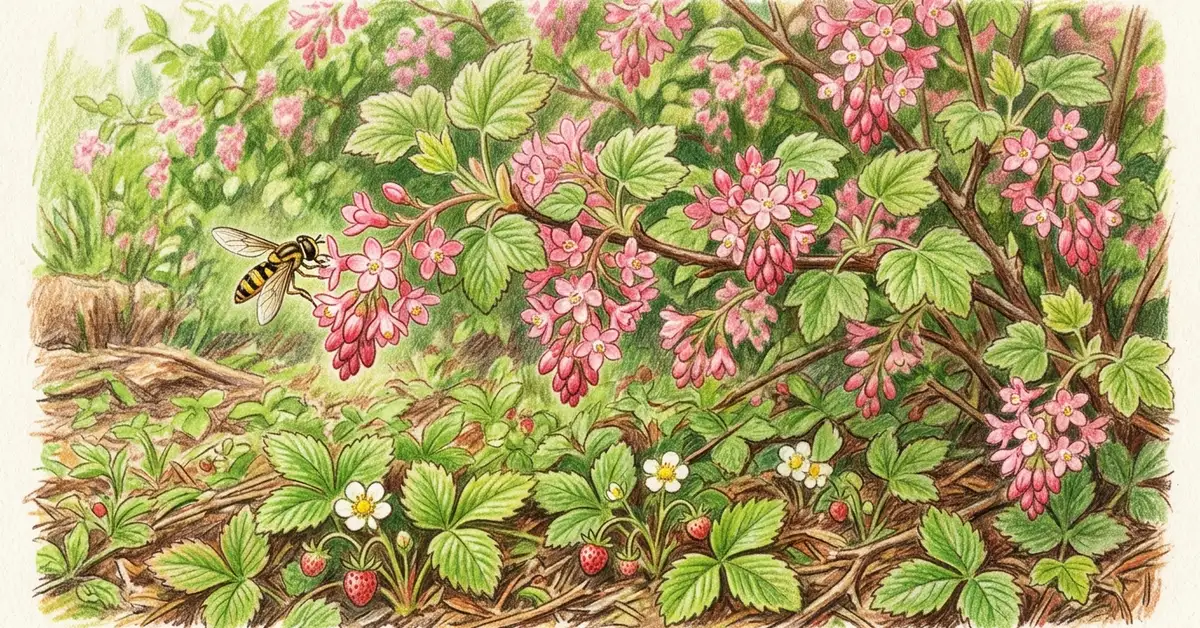
A food forest works because seven vertical layers occupy the same ground at different heights and root depths — the canopy, sub-canopy, shrubs, herbaceous, ground cover, root, and vine layers we cover in our 7 layers of a food forest guide. Below about 400 sq ft (37 sq m), you don't have enough horizontal room to fit even one canopy tree at its mature drip-line plus supporting shrubs and herbs without crowding everything into shade. Above 500 sq ft, every additional 100 sq ft (9 sq m) buys you another shrub or herbaceous patch, but the system stops scaling exponentially.
Hart's original Shropshire forest garden, established starting in the 1960s on the site of an old orchard, occupied just 0.12 acres — about 500 sq m, or 5,400 sq ft. That's a working maximum, not a minimum. Within that footprint Hart fit standard-sized fruit trees, sub-canopy trees, shrubs, herbs, and vines — and his 0.12-acre model has been replicated and shrunk across thousands of suburban lots since. The Permaculture Association's archive of Hart's work documents the original layout and the species list he established. Our 500 sq ft target is the same model, scaled to roughly one-tenth, with dwarf trees substituted for full-size canopy.
The key constraint is sun. A food forest needs at least 6 hours of direct sun per day at ground level for the canopy tree to fruit reliably. South-facing yards work best in the northern hemisphere; east- or west-facing exposures work but reduce yield 20-30%. North-facing yards in zones 4-6 generally aren't viable for full canopy fruit trees — though shrub-and-herb-only "low food forests" still work.
Site Assessment: 30 Minutes Before You Plant Anything
Four checks before you order trees. None of them require professional gear.
| Check | How | What you're looking for |
| Sun map | Photograph the area at 9 AM, noon, and 3 PM on a sunny day | 6+ hours direct sun in the central planting zone for the canopy tree |
| Soil texture | Jar test (1/3 soil, top with water, shake, wait 24 hrs) | Loamy = ideal; heavy clay or pure sand needs amendment |
| Drainage | Dig a 12-inch (30 cm) hole, fill with water, time the drain | <2 hours = good; >4 hours = raised bed required |
| pH | $10 strip kit from any garden center | 6.0–7.0 for most fruit; 4.5–5.5 if you want blueberries (acidify a sub-area) |
Source:.
Once you have the site map, identify your microclimates. South-facing fences become heat traps that extend the growing season for figs or pomegranates by 2-4 weeks. North corners stay cool — perfect for currants, gooseberries, and shade-tolerant herbs. Mark these zones on your sketch before you place a single plant.
The Keyhole Layout: One Path, Maximum Edge
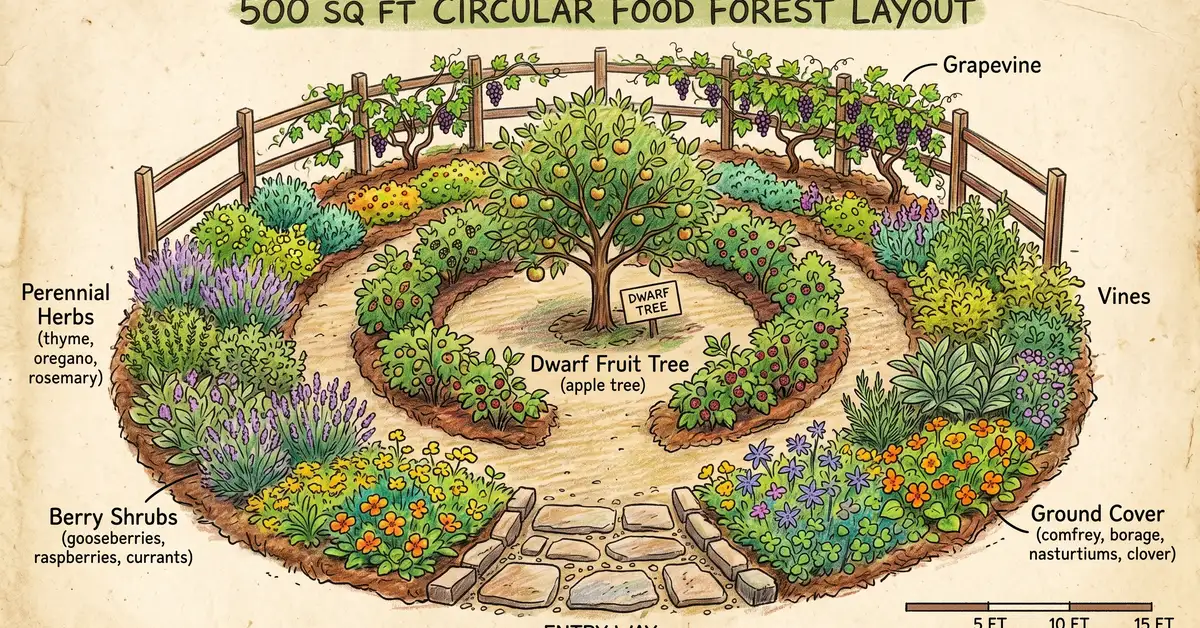
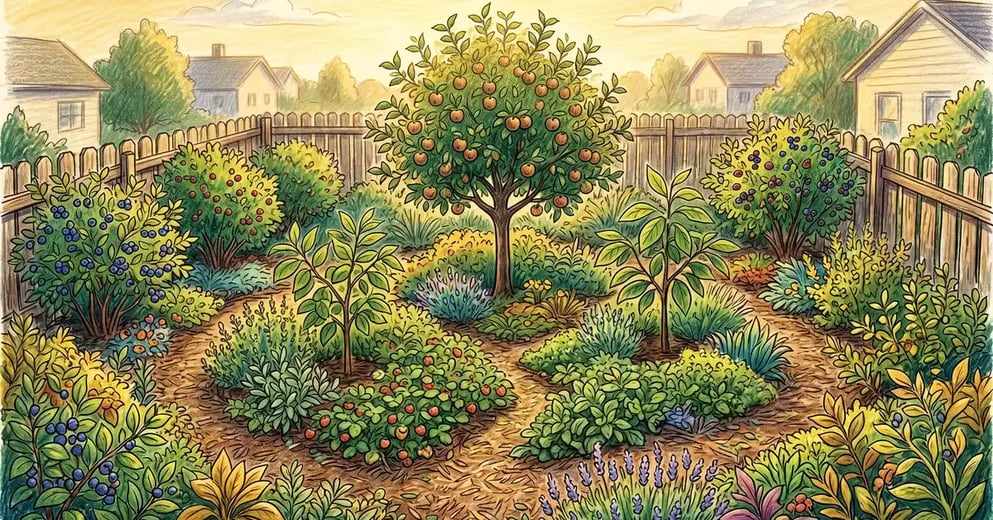
Five hundred square feet works best as a single circular keyhole bed roughly 25 feet (7.6 m) in diameter, with a 24-inch (60 cm) mulched path entering from one edge and curving toward the center. The geometry maximizes growing edge while keeping every square foot reachable from the path — no compaction, no awkward stretches.
The placement template:
- Center: one dwarf fruit tree (apple, pear, peach, plum on M9 / Quince A / dwarf rootstock — mature size 8 to 12 ft / 2.4 to 3.6 m)
- Ring 1 (3-6 ft / 0.9-1.8 m from trunk): 4 to 6 berry shrubs spaced around the dwarf tree
- Ring 2 (6-10 ft / 1.8-3 m from trunk): 2 to 3 sub-canopy trees (pawpaw, dwarf cherry, fig in zones 7+)
- Ring 3 (outer band): herbaceous perennials + ground cover
- Back fence or trellis: 1 vine (hardy kiwi, grape, or maypop)
Path width matters. 24 inches (60 cm) minimum for wheelbarrow access — narrower and you'll be hand-carrying every load of mulch and compost forever. Account for paths and access at 15-20% of total area; that leaves about 400 sq ft (37 sq m) for actual planting.
If a circular keyhole doesn't fit your yard geometry, four rectangular quadrants with mulched paths between them works the same way. The shape doesn't matter — vertical layering and access do.
Climate-Specific Species List for 500 sq ft
Match these to your USDA zone. Each list assumes one canopy tree at center, two sub-canopy near the edges, and the rest filling the rings.
| Zone | Canopy (1) | Sub-canopy (2) | Shrubs (4–6) | Herbs / GC | Vine (1) |
| Cold (3–5) | Dwarf apple (M9, hardy cultivar) | Saskatoon, sour cherry | Highbush blueberry, black currant, gooseberry, sea buckthorn (N-fixer), Aronia | Asparagus, comfrey, chives, white clover, alpine strawberry | Hardy kiwi (Actinidia kolomikta) |
| Cool (5–7) | Dwarf apple or pear | Pawpaw, hazelnut, dwarf plum | Blueberry, red currant, gooseberry, raspberry, Goumi (N-fixer), elderberry | Asparagus, rhubarb, sorrel, oregano, comfrey, chives, strawberry, white clover | Hardy kiwi or grape |
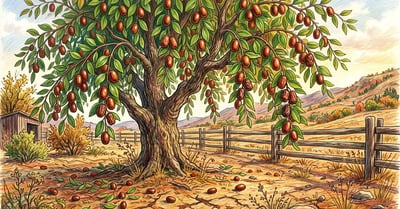
| Warm (7–9) | Dwarf peach or fig | Pawpaw, jujube, pomegranate | Southern blueberry, blackberry, fig (shrub form), pomegranate, mulberry (shrub-pruned) | Asparagus, oregano, thyme, chives, lemon balm, strawberry | Grape, maypop (Passiflora incarnata) |
| Subtropical (9–11) | Dwarf citrus or avocado | Loquat, dwarf mango, fig | Pomegranate, guava, dwarf banana, pigeon pea (N-fixer) | Sweet potato, oregano, mint, lemon balm, chives, sweet alyssum | Passion fruit, chayote |
Source:.
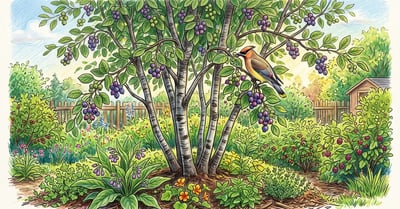
One non-negotiable rule: include at least one nitrogen fixer (sea buckthorn, Goumi, pigeon pea, or Siberian pea shrub depending on zone). That's the single biggest difference between a food forest that needs annual fertilizer and one that doesn't. The target ratio across all layers is roughly 30% nitrogen-fixing plants, 70% non-fixing — see our nitrogen-fixing plants guide for the supporting science.
The Year-by-Year Build Sequence
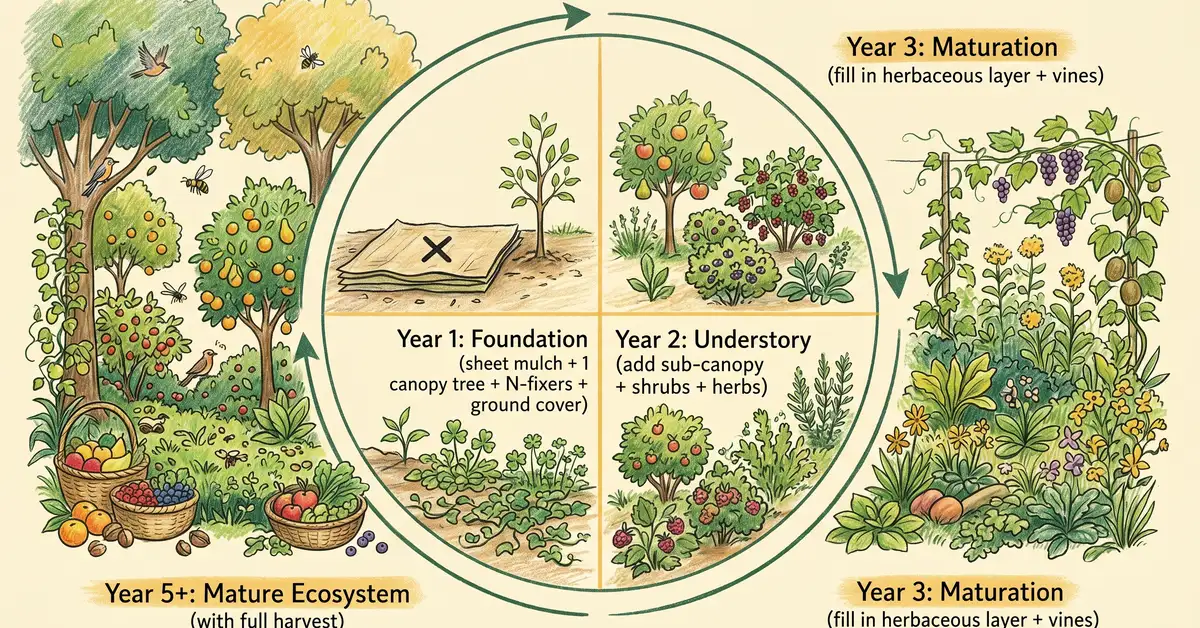
Year 1: Sheet mulch + canopy tree + N-fixers + ground cover
Late winter to early spring: lay overlapping cardboard over the entire 500 sq ft, top with 4 inches (10 cm) of wood chips, and let it kill the lawn for 6 to 8 weeks. Late spring to early summer: plant the dwarf canopy tree (cost: $40 to $80 bare-root) at center, two nitrogen-fixing shrubs (sea buckthorn, Goumi, or Siberian pea shrub at $20-40 each), and white clover or strawberry ground cover by seed across the whole footprint. Total Year 1 cost: $250 to $500. Time: 30 to 50 hours across 8 to 10 weekends.
Year 2: Sub-canopy + remaining shrubs + first perennial herbs
Plant 2 to 3 sub-canopy trees (pawpaw, hazelnut, dwarf plum, fig — $30 to $60 each bare-root) and 4 to 6 berry shrubs (blueberry, currant, gooseberry, raspberry, elderberry — $15 to $30 each). Add asparagus crowns, rhubarb, comfrey starts. Refresh mulch by 2 inches (5 cm). Cost: $150 to $300. Time: 4 to 6 hours per week growing season.
Year 3: Herbaceous fill + climbing vine
Fill in the outer ring with perennial herbs — oregano, thyme, sage, chives, lemon balm, mint (in a buried pot, contained). Plant one vine (hardy kiwi requires a male and female pair; grape and maypop are self-pollinating) on a back fence or trellis. First small harvests of berries, herbs, asparagus. Cost: $80 to $150. Time: 3 to 4 hours per week.
Year 4–5: First major harvests + system maturation
The dwarf canopy tree begins fruiting. Sub-canopy berries and dwarf cherries hit full production. Asparagus reaches harvest threshold. Mycorrhizal networks are established (see our soil food web guide). Maintenance: 2 to 3 hours per week growing season. No fertilizer required — the nitrogen fixers and the soil food web cover it.
Year 7+: Mature ecosystem, steady state
Full canopy production. Mature shrub yields (blueberry 6 to 10 lb / 2.7 to 4.5 kg per bush, raspberry 3 to 5 lb / 1.4 to 2.3 kg per cane row, etc.). Self-seeding herbs reduce replanting work. Mulch refresh every 2 to 3 years. Maintenance under 5 hours per week. Annual cost: $50 to $100 in mulch and replacement plants.
Source:.
Sheet Mulch: The Single Highest-Leverage Year-1 Move
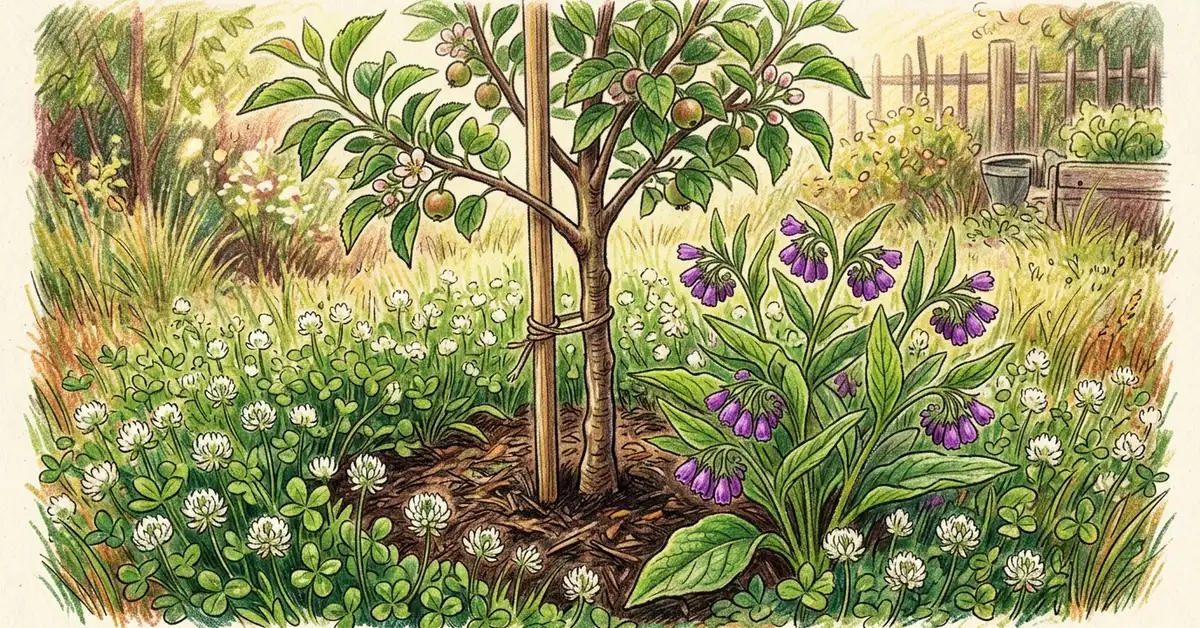
Don't skip sheet mulching. It's the difference between a food forest that struggles with weed pressure for three years and one that's basically weed-free from the start. The mechanism is simple: cardboard smothers the existing lawn or weeds, wood chips on top suppress new germination, and worms drag both layers down into the soil over 6 to 8 weeks — building organic matter from day one.
The recipe for 500 sq ft:
- 15 to 20 large flattened cardboard boxes (free from any appliance store)
- 4 cubic yards (3 m³) of wood chips ($60 to $150 delivered, often free from local arborists)
- 1/2 to 1 cubic yard (0.4 to 0.8 m³) of compost ($30 to $80)
- 2 hours to lay it all out, plus a hose
Lay cardboard with overlapping seams (6 inches / 15 cm minimum overlap), wet it thoroughly, then add 3 to 4 inches (7.6 to 10 cm) of wood chips. Plant directly through the cardboard for trees and shrubs — cut a slit just big enough for the root ball. The cardboard breaks down within 6 months and the planted root system establishes in worm-rich soil. Our no-dig gardening guide covers the full method.
Real Cost Breakdown for a 500 sq ft Build
| Item | Year 1 | Year 2 | Year 3 | Year 4+ ongoing |
| Sheet mulch (cardboard + chips + compost) | $80–150 | $30–60 refresh | $30–60 | $30–80 every 2–3 yrs |
| Canopy tree (1 dwarf, bare-root) | $40–80 | — | — | — |
| Sub-canopy trees (2–3) | — | $60–180 | — | — |
| Shrubs (6 berries + N-fixers) | $60–150 (N-fixers) | $80–180 (berries) | — | $15–30 replacement |
| Perennials and ground cover | $30–60 (clover seed + N-fix herbs) | $40–80 (asparagus + rhubarb) | $60–100 (full herb fill) | $0–20 |
| Vine (1) | — | — | $25–60 | — |
| Total | $250–500 | $210–500 | $115–220 | $50–100/yr |
Source: documented small-food-forest builds compiled in the Permies suburban food forest journey thread.
Three-year total: roughly $575 to $1,220 for a mature 500 sq ft food forest. Compare to the $200 to $400 a typical suburban household spends on annual vegetables and store-bought berries every year — the food forest pays for itself in fruit and herb yield somewhere in Year 4 to 6, and produces freely from there.
Why This Works: The Permaculture Bridge
The idea behind a small food forest isn't to grow a forest. It's to build an ecosystem that maintains itself. The seven-layer structure isn't aesthetics — each layer occupies a different niche the others leave open. Canopy tree captures sunlight and shades out summer weeds. Berry shrubs use the dappled mid-light. Herbs use the ground-level moisture and surface heat. Ground cover suppresses bare soil. Nitrogen fixers feed the canopy tree's nutrient demand without you adding fertilizer. The mycorrhizal fungi we covered in our soil food web piece run the underground equivalent. Stack all seven and the work shrinks every year — by Year 5 you're harvesting more food than a tilled vegetable garden of the same size produces, with a quarter of the labor. The forest stops being something you maintain and becomes something you tend.
The 4 Mistakes That Wreck Small Food Forests
Avoid these — they cost you years of recovery
1) Planting a standard-size fruit tree. A standard apple matures at 25 to 30 ft (7.6 to 9 m) and shades out everything else in 500 sq ft. Use M9 / M26 dwarf or semi-dwarf rootstock only. 2) Skipping nitrogen fixers. Without 30% N-fixers (clover, sea buckthorn, Goumi, Siberian pea shrub), the canopy tree will need synthetic nitrogen forever. 3) Underestimating mature canopy spread. A "dwarf" tree at planting is a 4-foot stick; at Year 5 it's 8 to 12 ft (2.4 to 3.6 m) wide. Plant accordingly. 4) Forgetting paths. Every shortcut you take on path width (under 24 in / 60 cm) you pay for in compaction and harvest awkwardness for the next 20 years.
Get the Weekly Dig
One practical permaculture guide a week, written for gardeners who do this on weekends: food forest and guild designs that produce. Free, no spam, unsubscribe any time.
Join the newsletterFrequently Asked Questions
What is the smallest practical food forest size?
Around 400 to 500 sq ft (37 to 46 sq m) is the practical floor for a true seven-layer food forest. Below that, you can't fit even one canopy tree at its mature drip-line plus supporting shrubs and herbs without overcrowding. Smaller spaces (under 200 sq ft) work well as a "low food forest" — shrubs, herbs, and ground covers without a canopy tree — or as container-based perennial plantings.
How long does it take a small food forest to produce food?
Fast crops in Year 1: clover, herbs, ground cover, possibly first asparagus shoots. Year 2: small berry harvests from established shrubs (raspberries especially). Year 3: meaningful berry harvests, first canopy fruit possible on dwarf trees. Year 5: full sub-canopy and shrub production, dwarf canopy tree at near-full yield. Year 7+: mature ecosystem with peak production and minimal labor.
How much sun does a small food forest need?
A minimum of 6 hours of direct sunlight per day at ground level for the canopy tree to fruit reliably, ideally 8+ hours. South-facing yards work best in the northern hemisphere. East- or west-facing exposures reduce yield 20 to 30% but still work. North-facing zones below USDA 6 generally won't support a canopy fruit tree — though a shrub-and-herb-only "low food forest" still works well there.
Can I plant a food forest in my front yard?
Often yes, but check your HOA covenants and local zoning first. Many HOAs restrict edible plantings or require setbacks for trees. Front-yard food forests work best when designed with neat edges (mulched paths, defined keyhole shape) and visually attractive species (flowering currants, espaliered fruit trees, ornamental herbs). Check our food forest design mapping guide for layout strategies that satisfy both yield and curb appeal.
How much does a 500 sq ft food forest cost to build?
$250 to $500 in Year 1 for sheet mulch materials, the canopy tree, two nitrogen-fixing shrubs, and ground cover. Year 2 adds another $210 to $500 for the sub-canopy trees and remaining berry shrubs. Year 3 fills in herbs and a vine for $115 to $220. Three-year total: roughly $575 to $1,220 for a mature ecosystem. After Year 4, ongoing costs drop to $50 to $100 per year for occasional mulch and replacement plants.
What's the difference between a food forest and a regular garden?
A regular garden is annual — you till, plant, weed, water, and harvest in one season, then start over. A food forest is perennial and layered — you plant once, build soil for 3 to 5 years, and harvest progressively more each year for decades after with a fraction of the labor. The food forest also produces year-round biological functions (pollination, pest suppression, soil building) that an annual garden does not. Our food forest pillar guide covers the full conceptual difference.
Resources
- Permaculture Association — Forest Gardening with Robert Hart
- Permacultured — A Food Forest Garden with Robert Hart
- Orchard People — Three Steps to Turning Your Backyard into a Food Forest
- Permaculture Apprentice — Creating a Food Forest Step-by-Step Guide
- The Foodscaper — The Anatomy of a Backyard Food Forest
- Zaytuna Farm — Geoff Lawton Food Forest Course
- PFAF — Robert Hart's Forest Garden species reference
- Eco Books — Robert Hart's Forest Gardening reference
- Films for Action — Establishing a Food Forest the Permaculture Way (Geoff Lawton)
- Permies — Suburban Permaculture Food Forest journey thread
Five hundred square feet is a weekend project that pays out for thirty years. Sketch your circle, get the cardboard, order one dwarf tree and two nitrogen-fixing shrubs, and the rest builds itself across the next three growing seasons.
Once you've planted, our 100+ species food forest plant list gives you the menu for filling in over time. If you want to scale up after Year 5, our 1/4 acre suburban food forest guide handles the next size tier. And if you're brand new to the underlying design philosophy, start at the food forest pillar guide and circle back here when you're ready to put a shovel in the ground.