
Why Would You Plant a Jujube Tree?
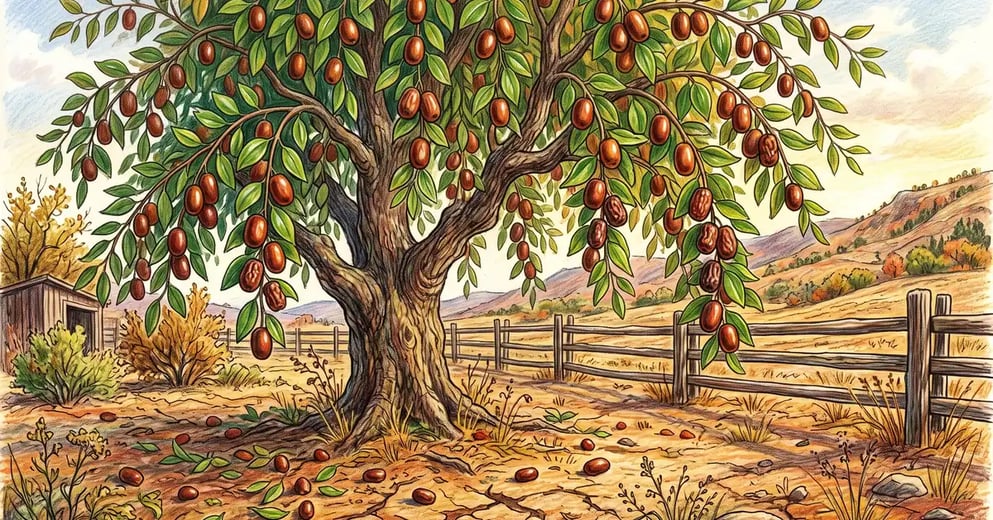
Because it fruits reliably in places where peaches and apples struggle, and it asks for almost nothing in return. Jujube (Ziziphus jujuba, the Chinese date) tolerates drought, salinity, and soil pH anywhere from 4.5 to 8.4. It leafs out late enough to duck most spring frosts. Texas A&M AgriLife describes it as drought tolerant with few pest and disease problems, needing relatively little care to crop well.
The catch, and there is one, is that most Americans have never eaten a jujube and would not recognise one at a market. You are planting a tree whose fruit you will mostly be eating yourself.
Fall and winter is bare-root planting season for fruit trees, which makes this the right time of year to decide whether one belongs on your place.
Below: the cultivars worth your money, what pollination actually requires, the spacing question extension has not answered, how to know when the fruit is ready, and the drawbacks nobody puts in the nursery catalogue.
Key Takeaway
Jujube is a hot-summer tree, not just a hardy one. Low chill requirement plus a high heat requirement to break dormancy means it leafs out late and needs a long hot season to ripen. If your summers are cool and short, cold hardiness alone will not give you fruit.
Which Cultivar Should You Plant?
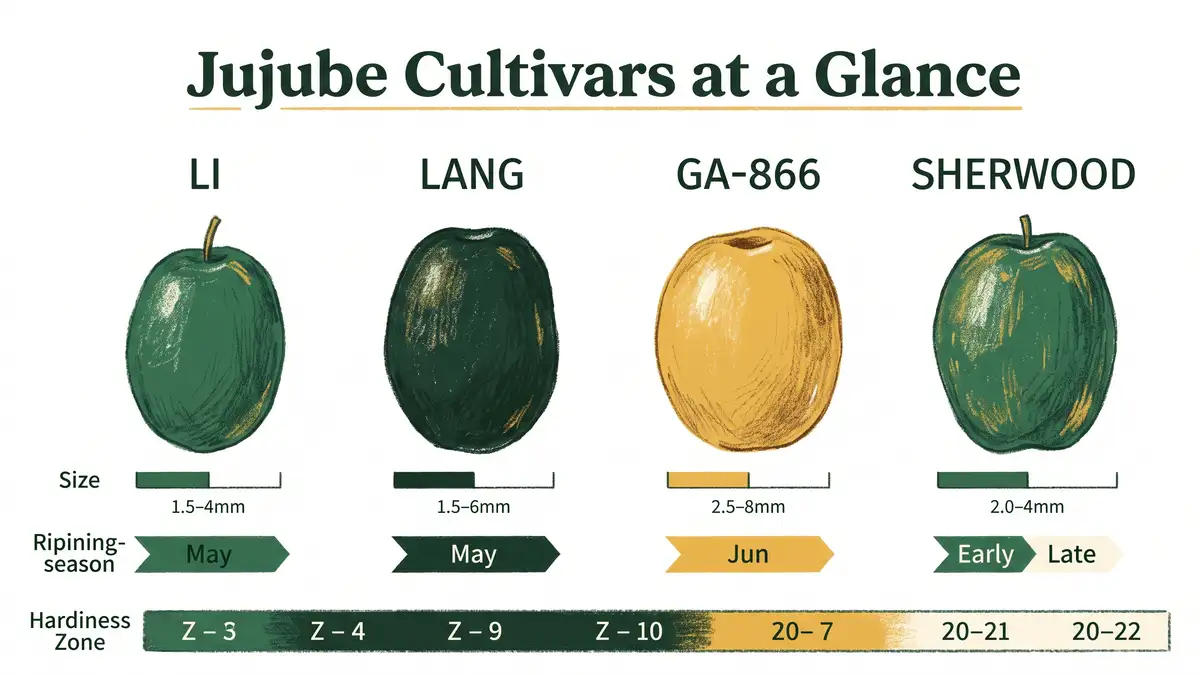
Start with Li if you want one tree that works. UF IFAS describes 'Li' as producing large fruit up to about 85 g, good quality fresh or dried, and New Mexico State University has tested it as self-fertile. That combination is what a first jujube needs to be.
| Cultivar | Fruit | Best for |
| Li | Large, up to 85 g | Fresh and dried, self-fertile, the default pick |
| Lang | Large, pear-shaped | Drying, eat only when fully red-brown |
| Honey Jar | Small, over 30 Brix | Fresh eating, short tree |
| Sugar Cane | Small, round, over 32 Brix | Fresh eating, recent US import |
| GA-866 | Up to about 45 Brix | Sweetest known, but 8 to 10 years to crop well |
| Sherwood | Thornless habit | Anywhere children or livestock pass |
Sources: UF IFAS HS1477, Jujube as a Florida Fruit Crop, New Mexico State University, Jujube: Chinese Date in New Mexico.
On pollination, the honest position is that self-fertile does not mean self-sufficient. NMSU found 'Li', 'Alcalde #1' and 'Shanxi Li' self-fertile, and also found that cross-pollination increased both fruit set and fruit size. Plant one tree and you will get fruit. Plant two cultivars and you will get more, and bigger.
Not the Same Plant
Ziziphus jujuba, the Chinese jujube, is what this article is about. Ziziphus mauritiana, the Indian jujube or chinee apple, is a different species that UF IFAS documents as having invasive potential in Florida. Check the botanical name on the label, not the common name, before you buy.
How Do You Plant and Space Them?
Here is a gap worth knowing about: no US extension publication in this evidence set gives a spacing figure for jujube. Not Texas A&M, not UF IFAS, not NMSU, not Arizona. They describe tree size and pruning; they do not publish a planting distance table.
What they do give you is size. UF IFAS notes jujube can reach 25 to 40 feet in Florida if left alone. NMSU's pruning guide suggests holding trees at around 9 to 10 feet once the canopy reaches the height you want, particularly where harvest access matters. So the spacing decision follows from how hard you intend to prune, and anyone quoting you a precise figure is extrapolating from general fruit tree practice, as you will have to.
Pick the hottest, sunniest spot you have
This is the decision that determines whether you get fruit. The tree needs long hot summers to ripen a crop, and its late leaf-out means a south-facing site does not put it at frost risk the way it would a peach. Poor soil is genuinely fine: pH 4.5 to 8.4, and it tolerates salinity.
Plant two cultivars if you have room
Self-fertile cultivars will crop alone, but NMSU measured better set and larger fruit with cross-pollination. A 'Li' and a 'Honey Jar' gives you a large fresh-and-dried fruit plus a small very sweet one, on trees of different sizes.
Water through establishment, then step back
UF IFAS is clear that jujube is drought tolerant once established but fruits more heavily with regular water. Treat irrigation as a yield lever rather than a survival requirement, which is the opposite of how most fruit trees behave.
Prune for height and light, early
NMSU's training guidance is to remove excess primary shoots from fruiting spurs while they are small, and thin crowded branches to keep light in the canopy. Doing this decisively when shoots are soft is far easier than cutting hard wood later; jujube wood is dense.
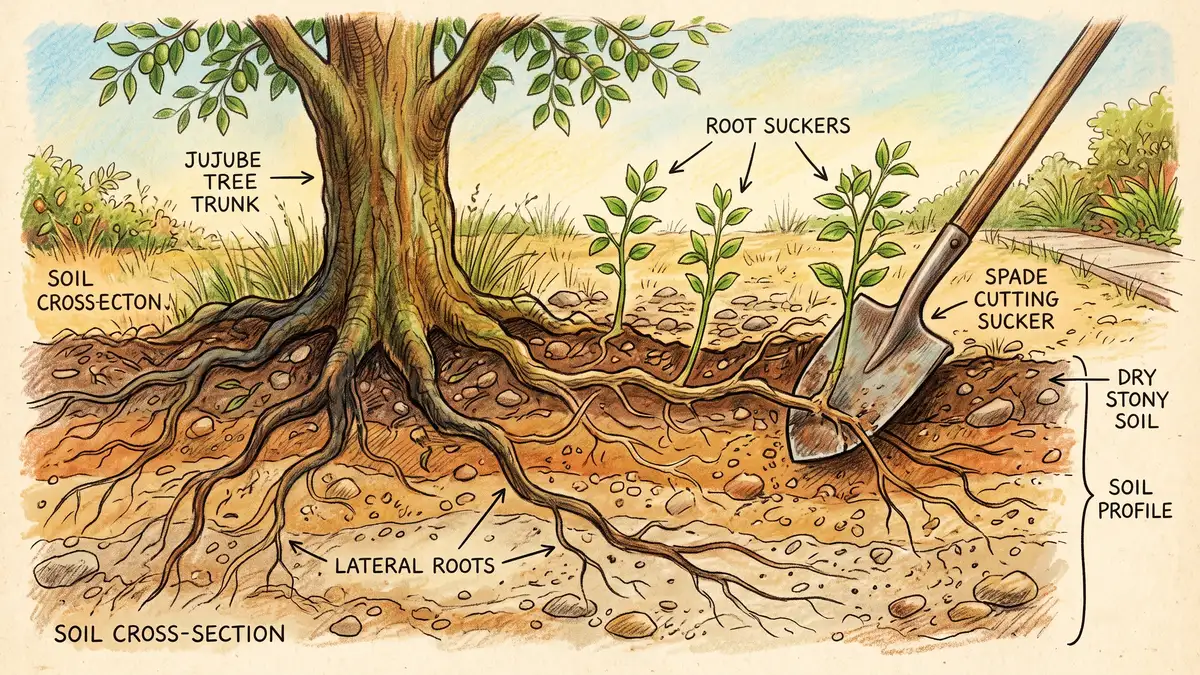
Deal with suckers on a schedule, not when you notice them
Cut them at or below ground level while they are thin. Jujube grows well on its own roots, so suckers from a seedling rootstock may fruit differently from the grafted cultivar above. Walk the tree once a month in the growing season and the job stays trivial.
When Is the Fruit Ready, and What Do You Do With It?
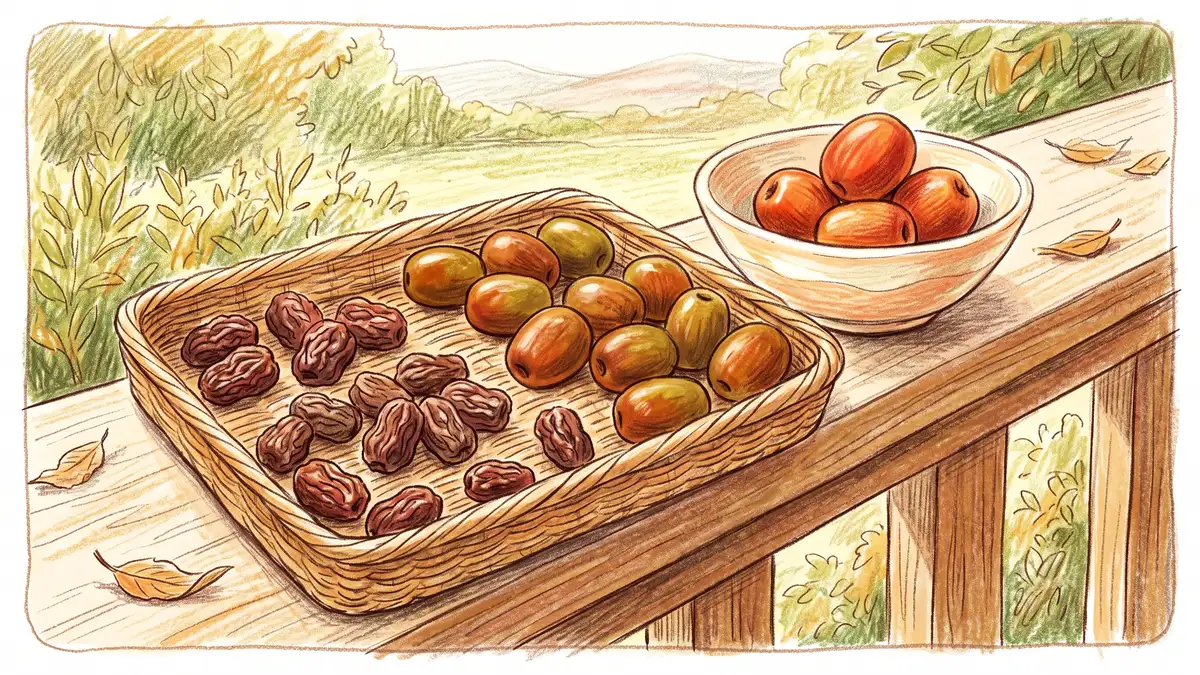
Colour is the maturity index, and picking green does not work. UC Davis postharvest research is unambiguous: fruit picked green will not ripen satisfactorily off the tree. The progression runs green, then whitish-green, then reddish-brown, then dark brown.
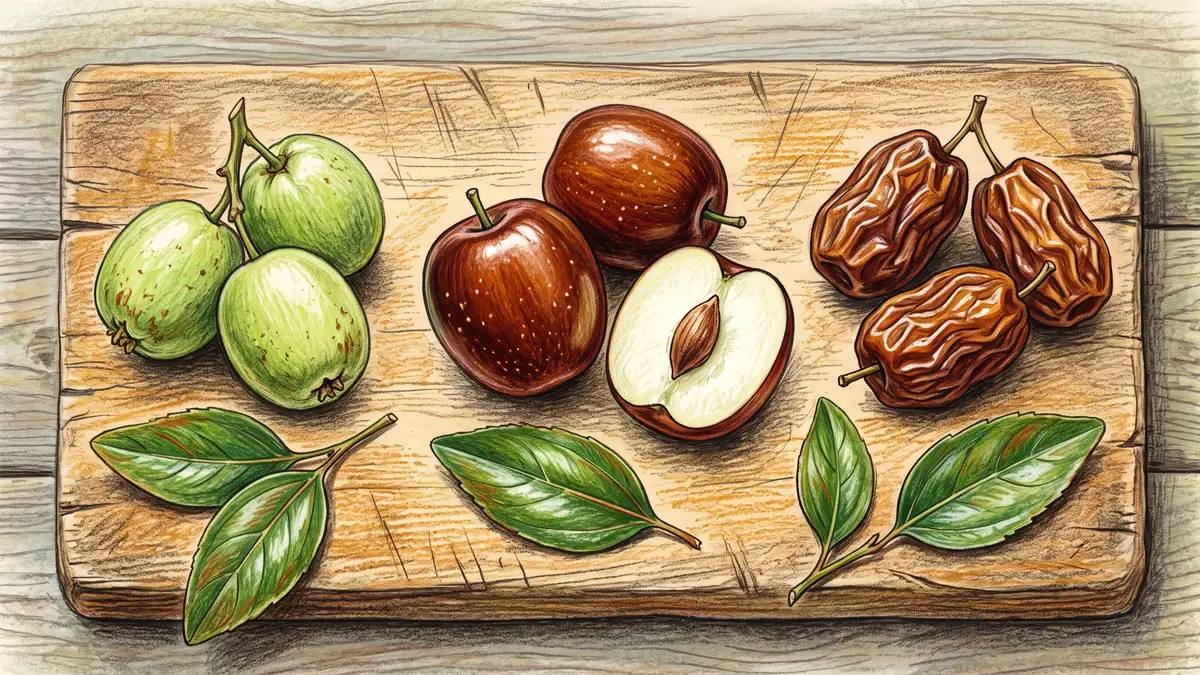
You get two entirely different fruits from one tree depending on when you pick. At the whitish-green to partly reddish-brown stage the fruit is crisp like a firm apple, around 70 to 75 percent moisture, and eaten fresh. Leave it to dry on the tree and it goes dark, wrinkled and date-like, down to 20 to 25 percent moisture and correspondingly sweeter.
Storage follows from that. UC Davis gives fresh jujubes two to three months at 38 to 50 °F (3 to 10 °C), and dried jujubes up to a year at 38 to 68 °F (3 to 20 °C). For a homestead that is unusually good: a fruit tree whose crop keeps for a year without canning, freezing or a root cellar.
Why This Works: Match the Species to the Site
Permaculture design tends to start by reading the site rather than the catalogue, and jujube is a good illustration of what that gets you. On hot, alkaline, low-water ground, the return on a peach is a spray schedule and a disappointing crop; the return on a jujube is fruit with almost no inputs. Choosing a species that already fits the conditions is cheaper than correcting conditions to suit a species, which is the same logic behind selecting food forest species by climate zone and the site-first approach in our food forest guide.
What Are the Real Drawbacks?
Suckering, thorns, and a fruit nobody knows. UF IFAS notes that 'Tigertooth' suckers frequently and that jujubes grow well on their own roots, meaning unmanaged suckers form clonal thickets. That is useful if you want a living fence and a problem if you want a tidy orchard. Extension does not publish figures for how far suckers travel, so plan on inspection rather than a rule.
Most cultivars carry paired spines at the nodes, which matters where children, livestock or a mower pass. 'Sherwood' is the thornless option worth knowing about.
Then there is GA-866, which reaches around 45 Brix and is one of the sweetest fruits you can grow, and does not bear well until roughly 8 to 10 years after planting. That is a long wait on a homestead, and it is the sort of detail nursery listings tend to leave out.
Key Takeaway
Two things are genuinely unresolved in the published literature, and you should know it. There are no US extension per-tree yield figures in pounds, only a 3 to 5 year timeline to first fruit, and no USDA-verified vitamin C numbers for jujube in the sources consulted. The high-vitamin-C claim you will see repeated everywhere is drawn from other literature, not from a national nutrient database entry anyone has checked.
Frequently Asked Questions
What hardiness zone do jujube trees grow in?
Texas A&M AgriLife gives zones 6 to 9 as the growing range, and UF IFAS reports cultivars performing in zones 5 through 10 while doing best in 6 to 9. On minimum temperature, UF IFAS states established trees are cold tolerant to -20 °F, and University of Arizona Cooperative Extension reports tolerance down to -28 °F. Both sources stress the same caveat: cold hardiness is not the limiting factor. The tree needs long, hot summers to ripen a crop, so a cool short summer will produce a healthy tree and little fruit.
Do you need two jujube trees to get fruit?
No, but two will give you more. New Mexico State University has tested 'Li', 'Alcalde #1' and 'Shanxi Li' as self-fertile, meaning a single tree will set fruit on its own. The same research found that cross-pollination increased both fruit set and fruit size, and UF IFAS describes some cultivars such as 'Winter Delight' as only partially self-fertile. If you have space for two, plant two different cultivars. If you have space for one, choose a confirmed self-fertile cultivar like 'Li'.
How long until a jujube tree fruits?
UF IFAS gives three to five years from planting for jujube to begin yielding, which is comparable to other fruit trees and faster than nuts. The exception is 'GA-866', which UF IFAS reports does not bear well until around eight to ten years after planting despite producing some of the sweetest fruit available. Note that no US extension publication in this evidence set gives per-tree yields in pounds at any age, so anyone quoting you a poundage figure is estimating rather than citing.
How do you know when jujubes are ripe?
Go by colour, and do not pick green. UC Davis postharvest research states that jujubes picked green will not ripen satisfactorily off the tree. Fruit run green, then whitish-green, then reddish-brown, then dark brown. Pick at whitish-green to partly reddish-brown for a crisp apple-like fresh fruit at 70 to 75 percent moisture. Leave fruit on the tree until dark and wrinkled for the date-like stage at 20 to 25 percent moisture, which is sweeter and stores for far longer.
Are jujube trees invasive?
Chinese jujube, Ziziphus jujuba, is not listed as invasive in the US sources reviewed here, though it does sucker from the roots and can form clonal thickets if suckers go unmanaged. The species to watch for is the different one: Ziziphus mauritiana, Indian jujube or chinee apple, which UF IFAS documents as having invasive potential in Florida. Check the Latin name on the plant tag. If you are planning a mixed planting, our guide to starting a food forest covers how to site a suckering species deliberately.
Get the Weekly Dig
One practical permaculture guide a week, written for gardeners who do this on weekends: food forest and guild designs that produce. Free, no spam, unsubscribe any time.
Join the Weekly DigResources
- UF IFAS HS1477, Jujube as a Florida Fruit Crop
- UF IFAS Gardening Solutions, Jujube
- Texas A&M AgriLife Extension, Jujubes
- New Mexico State University, Jujube: Chinese Date in New Mexico (H330)
- New Mexico State University, Jujube Training and Pruning Basics (H337)
- University of Arizona Cooperative Extension, Chinese Jujube
- UC Davis Postharvest Technology Center, Jujube produce facts
- UF IFAS, Indian jujube (Ziziphus mauritiana) weed science profile
- Horticulture Research, historical and current research progress on jujube