
What Is the Difference Between Garden Soil and Potting Soil?
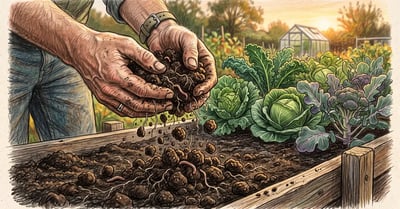
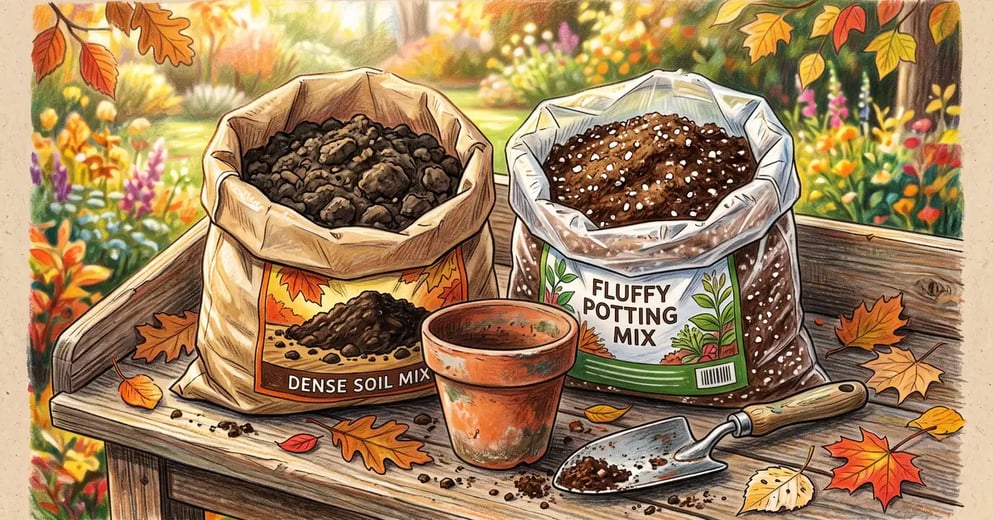
Garden soil has actual dirt in it. Potting soil usually does not. That single fact explains almost every mistake made in the growing-media aisle.
Bagged garden soil is mineral soil, sand, silt and clay, generally blended with some compost. Bagged potting mix is a soilless recipe built from peat moss or coco coir, composted bark, and lightweight aggregates like perlite and vermiculite. They look similar through plastic. They behave nothing alike once water hits them.
Put garden soil in a pot and you get a saturated, airless layer at the bottom that roots cannot use. Put potting mix in a raised bed and it settles, dries out hard, and runs out of nutrients halfway through the season. Both products are fine. Both fail badly in the wrong place. If you are working out what your ground needs more broadly, start with our soil health guide.
What this guide covers:
- What is actually inside each bag, and what the label is not obliged to tell you
- The physics that makes garden soil drown a container plant
- Why gravel in the bottom of a pot makes it worse, not better
- Which bag to buy for pots, raised beds, in-ground rows and lawn patching
Key Takeaway
Pick by where the growing happens, not by what sounds better. Anything in a container gets potting mix. Anything in the ground gets garden soil or compost. Raised beds sit in between and want mostly topsoil with compost mixed in.
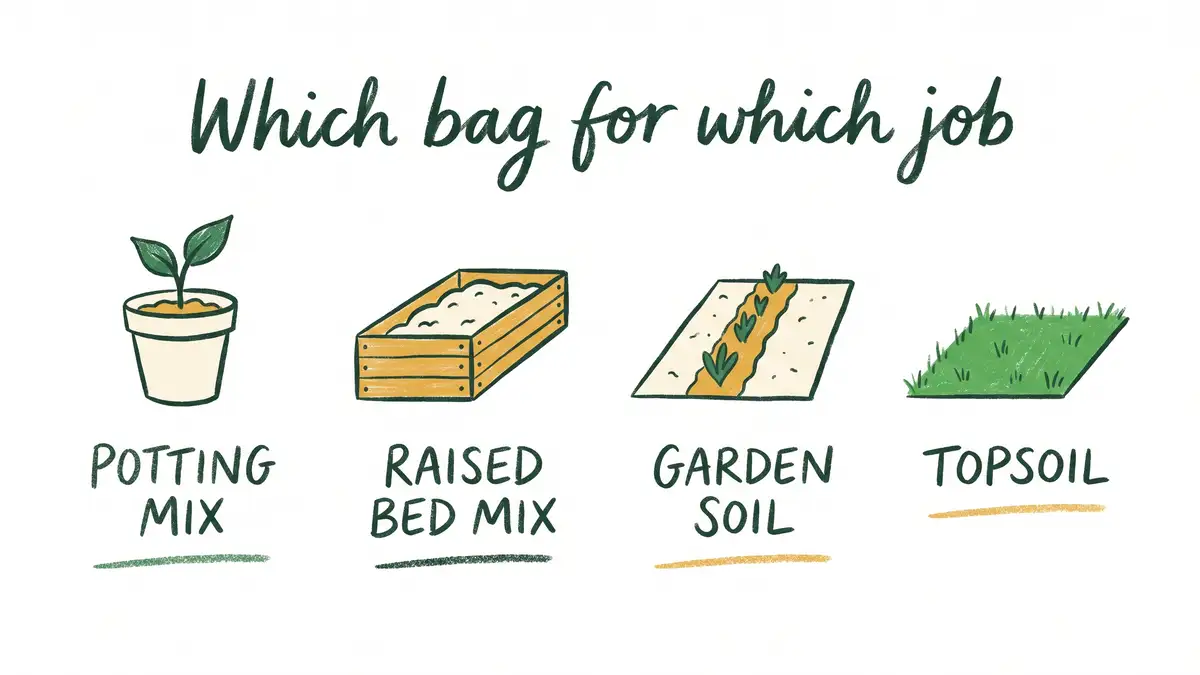
What Is Actually in Each Bag?
Four product categories, and the names are not standardised. UMass Extension's guide to bagged mixes is the clearest US extension source on what to expect from each.
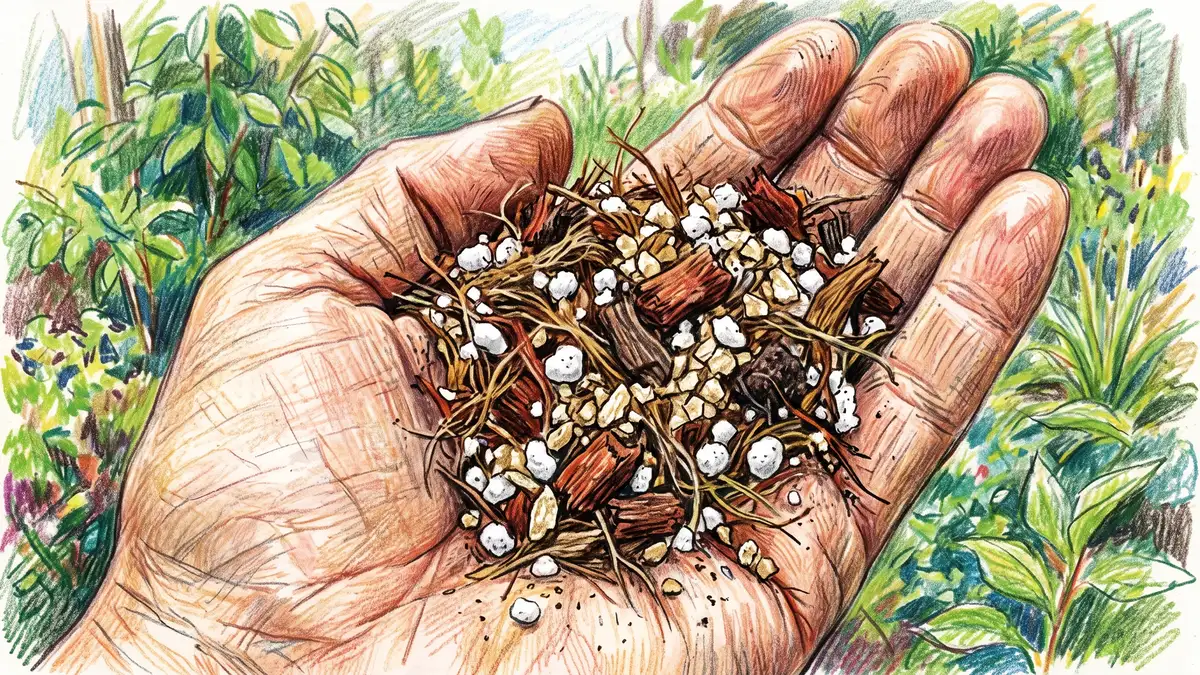
Potting mix is the most engineered of the four. Peat commonly makes up 30 to 80 percent of the volume, with bark for structure, perlite for air and often vermiculite for water holding. Most include a wetting agent, because dry peat repels water, and a small starter fertilizer charge. It is milled to be light, uniform and free of weed seeds and pathogens.
| Bag says | What is in it | Where it belongs |
| Potting mix / potting soil | Soilless: peat or coir, bark, perlite, vermiculite | Containers, baskets, seed starting |
| Garden soil / in-ground soil | Mineral soil plus compost or organic matter | Amending in-ground beds and rows |
| Raised bed mix | Varies widely, often a scaled-up potting mix | Topping up beds, read the label |
| Topsoil | Screened mineral soil, quality highly variable | Lawn patching, bulk fill, bed blends |
Sources: UMass Extension, Bagged Potting Mixes and Garden Soils, Michigan State Extension on topsoil
Topsoil is the wildcard. Michigan State Extension's blunt piece makes the point that no quality guarantee attaches to the word. It may be stripped subsoil, screened construction spoil, or excellent. You cannot tell from the bag.
Labelling is thinner than most shoppers assume. The voluntary Mulch and Soil Council product standards and certification programme is the main industry backstop, and a certified logo on the bag tells you the contents were verified against the label. Absent that, the ingredient list is largely marketing.
Common Mistake to Avoid
Buying by weight. UMass Extension advises rejecting a bag of potting mix that feels very heavy, because it is either water-soaked or padded out with sand. A good potting mix should feel almost implausibly light for its volume, at roughly 10 to 16 pounds per cubic foot against about 83 pounds for mineral soil.
Why Does Garden Soil Fail in a Pot?
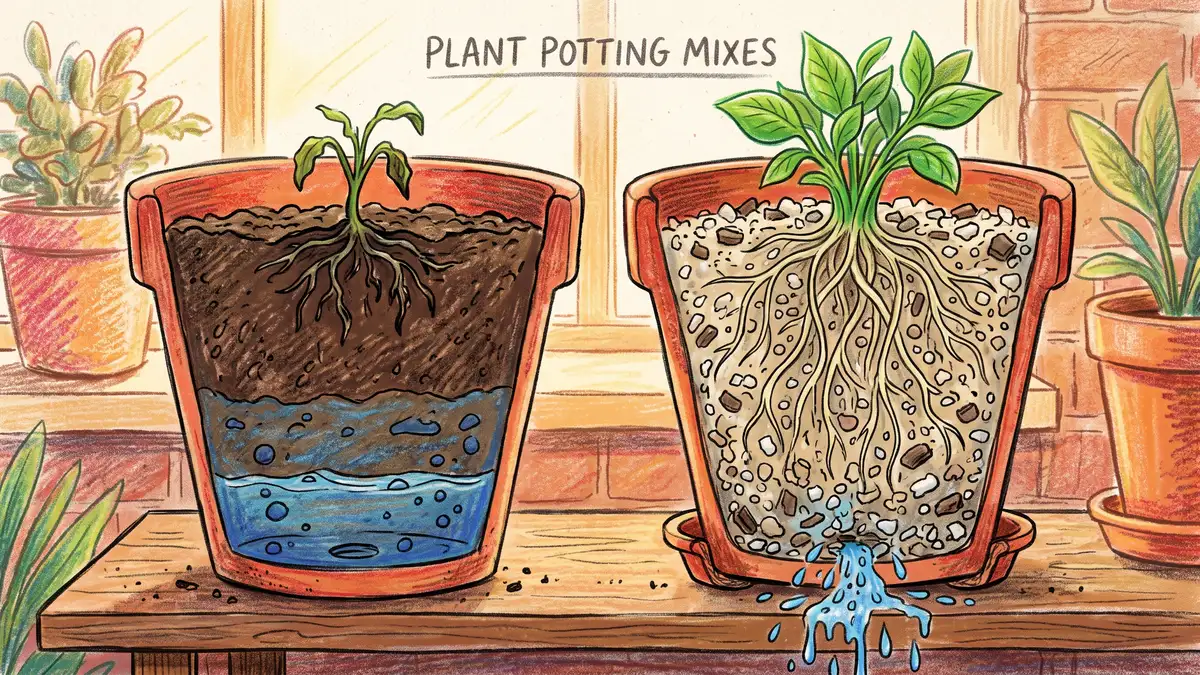
Because of a perched water table, and it happens no matter how many drainage holes you drill. This is the single most useful piece of soil physics a container gardener can learn.
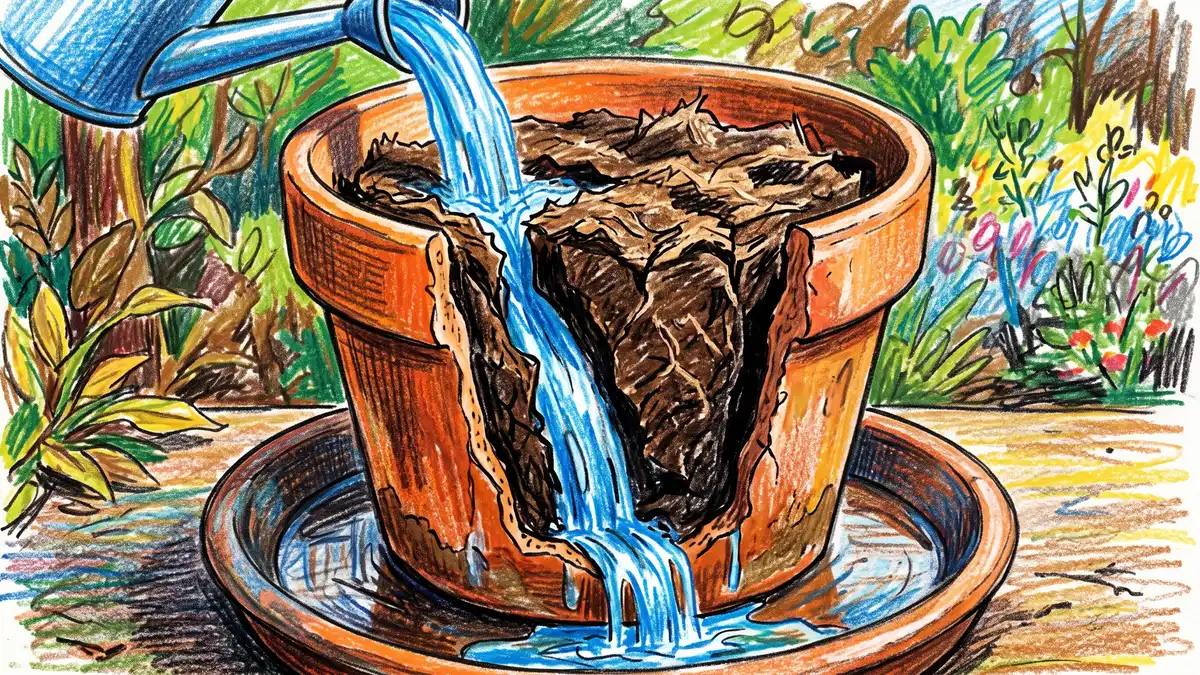
Water moving down through a medium stops at the bottom of the pot. It will not fall out of the drainage hole until the medium immediately above it is fully saturated, because the attraction between water and particle surfaces is stronger than gravity until that point. The result is a permanently saturated band at the base of every container, regardless of the medium.
How thick that band is depends on particle size. Finer particles hold water more strongly, so the saturated zone is deeper. Garden soil, with its silt and clay, produces a thick airless layer. Potting mix, engineered coarse and porous, produces a thin one.
The numbers show the gap plainly. A soilless mix carries 75 to 95 percent total porosity, with 10 to 30 percent still filled with air after it has drained. South Dakota State Extension puts ideal field soil porosity at about 50 percent, at a bulk density near 1.33 g/cm³. Potting mix runs around 0.2 g/cm³. That is roughly a six-fold difference in mass and an inverted difference in air.
Why This Works: Roots Breathe
Root systems respire. They need oxygen at the root surface the same way leaves need carbon dioxide, and standing water excludes it within hours. This is why a drowned plant and a drought-stressed plant look identical from above, and it is the same principle behind raised beds on wet ground and behind not walking on your beds after rain. Air in the soil is not empty space. It is a resource.
Does Gravel in the Bottom of a Pot Help?
No. It moves the problem closer to the roots. This is one of the most durable pieces of bad gardening advice in circulation, and the physics has been settled for decades.
The Master Gardeners of Northern Virginia quote Washington State University's Dr Linda Chalker-Scott directly: gravitational water will not move from a finely textured medium into a coarser one until the finer medium is saturated. Adding a gravel layer does not drain the pot. It raises the floor, so the saturated band now sits higher up, in the part of the pot where the roots actually are.
The research on layered media is specific about the threshold. Water perches at an interface when the particles below are at least 2.1 times larger than the particles above. Garden gravel over potting mix clears that threshold comfortably, which is exactly why it perches.
What helps: a uniform medium all the way down, adequate drainage holes, and a pot deep enough that the saturated band is a small share of the volume. Our guide to mixing your own container soil has the recipes if you would rather blend than buy.
Ask where the roots will sit
In a pot, a basket or a seed tray, buy potting mix. In open ground, buy garden soil or compost. That one question settles most purchases.
Lift the bag before you read it
A good potting mix feels far lighter than it looks. A heavy bag is wet, sandy, or not really a potting mix.
Read the ingredients, not the front
Peat, coir, bark, perlite and vermiculite mean soilless. Any mention of soil, sand or loam means it belongs in the ground.
For volume, buy bulk not bags
Past about ten cubic feet, bulk delivery costs a fraction of bagged. Beds are a bulk job; pots are a bag job.
Get Our Free Companion Planting Chart
Join 10,000+ gardeners getting weekly tips on what to plant together, soil health, and permaculture techniques.
Send Me the Chart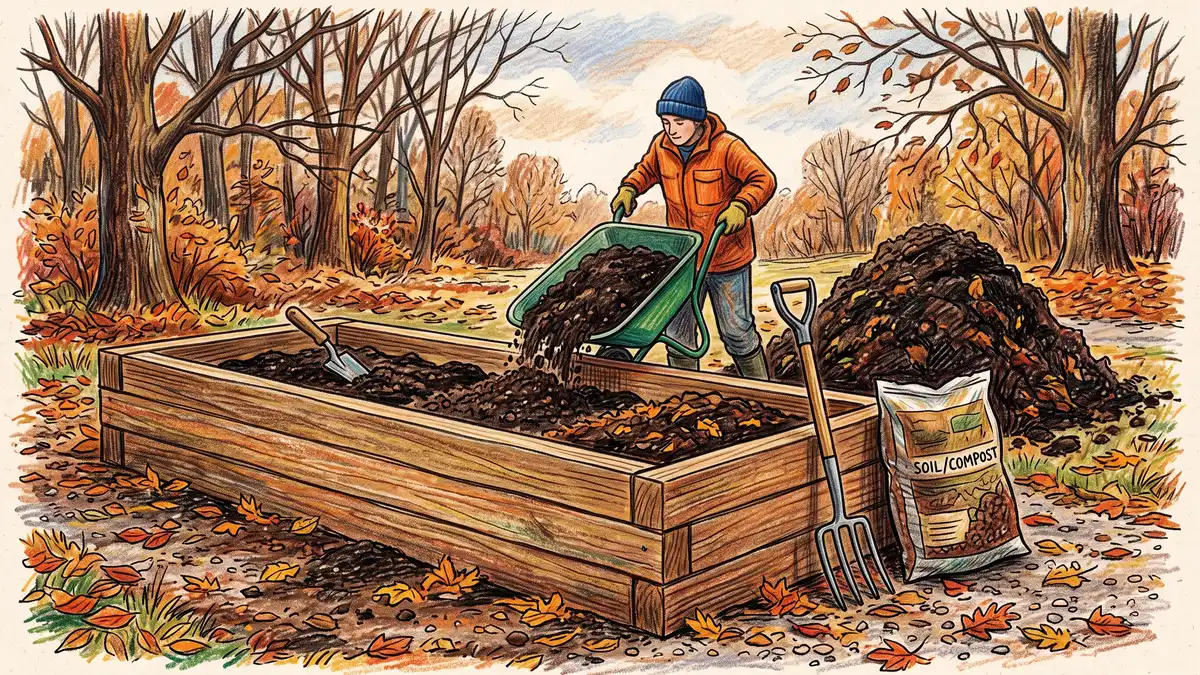
What Should Go In a Raised Bed?
Mostly topsoil, with compost as the minority partner. Not potting mix, and not pure compost either. US extension services are remarkably consistent on this once you line them up.
| Source | Recommended fill | Mineral soil share |
| Iowa State Extension | 70% topsoil, 30% compost | 70% |
| Iowa State, alternative | Equal parts topsoil, organic matter, coarse sand | 33% |
| Clemson Extension | Topsoil with compost at 10-20% of volume | 80-90% |
| Cornell Cooperative Extension | 2 parts soil, 1 part organic matter, 1 part sand or perlite | 50% |
Sources: Iowa State Extension raised bed soil mix, Clemson HGIC Raised Beds, Cornell Cooperative Extension raised bed gardening
Three things go wrong when a bed is filled with potting mix instead. It settles hard as the organic fraction decomposes, so the bed needs topping up every year. It goes hydrophobic when it dries, and water then channels down the gaps rather than wetting the medium. And the fertilizer runs out fast: UMass notes a starter charge is typically exhausted after two or three waterings, with slow-release prills lasting weeks rather than a season.
Clemson also warns against the opposite error, too much compost, which causes its own nutrient imbalances and instability. If you are filling a new bed this autumn, our breakdown of raised bed soil mixes compared works through the options and costs. For balcony growers filling pots rather than beds, container food forests shows what the same principles look like at pot scale.
Key Takeaway
The reason extension services keep specifying mineral soil as the majority of a raised bed is stability. Compost and peat both disappear. Sand, silt and clay do not. The mineral fraction is the skeleton and the organic fraction is the fuel, and a bed built only from fuel collapses.
Frequently Asked Questions
Can you use garden soil in pots?
Not on its own, no. Garden soil has roughly half the pore space of a potting mix and around six times the bulk density, so in a container it compacts, holds a thick saturated layer at the base and starves roots of oxygen. It also brings weed seeds, insects and pathogens that bagged potting mix does not. If garden soil is all you have, cut it heavily with perlite and compost, use the deepest pot available, and expect to water carefully. Buying a bag of potting mix is easier and usually cheaper than losing the plants.
Can you use potting soil in the ground?
You can, and it will not harm anything, but it is a poor use of money. Potting mix is engineered for the constrained physics of a container, and in open ground you are paying a premium for aeration the soil already has. It also decomposes and disappears faster than compost. Spend the same money on compost worked into the existing soil and you get more organic matter for your dollar plus a lasting improvement in structure.
What is the difference between potting mix and potting soil?
In practice the terms are used interchangeably on US shelves, and neither is legally defined. The distinction professionals draw is that a true potting mix contains no mineral soil at all, while some products labelled potting soil include a small soil fraction. Check the ingredient list rather than the front of the bag. If it names peat, coir, bark, perlite or vermiculite and nothing else, you have a soilless mix, which is what you want for containers.
Is bagged topsoil any good?
It varies enormously, and the label will not tell you. Michigan State Extension is direct about this: topsoil carries no quality guarantee and can be anything from good screened loam to stripped subsoil. Buy it for bulk fill, lawn patching or as the mineral base in a raised bed blend, and never as a standalone growing medium. If you want to know what you are actually getting, our guide to soil texture classes explains how to test a sample yourself.
Do I need to fertilize bagged potting mix?
Yes, and sooner than you would expect. The starter charge in a typical bag is exhausted after two or three waterings, and controlled-release prills release over weeks rather than months, faster in warm weather. Plan to begin liquid feeding roughly a month after potting up, or mix in a controlled-release fertilizer at planting. Store unopened bags dry, because a mix that gets wet and then dries in the bag can pre-release its fertilizer and burn roots later.
How much soil do I need for a 4 by 8 raised bed?
Multiply length by width by depth in feet. A 4 by 8 bed filled 10 inches deep needs about 27 cubic feet, which is a full cubic yard or roughly thirty-four 0.8 cubic foot bags. Bulk delivery is dramatically cheaper than bags at that volume. Following the Iowa State ratio, that is about 19 cubic feet of topsoil to 8 cubic feet of compost. Order a little extra, since everything settles in the first season.
Ready to Grow Smarter?
Get our free 20-page beginner's guide to backyard food forests. Two printable worksheets, a year-by-month food-forest calendar, and a curated reading path.
Read the Free GuideResources
- UMass Extension: Bagged Potting Mixes and Garden Soils for Home Gardeners
- Michigan State Extension: The Shocking Truth About Topsoil
- UF/IFAS Extension: Homemade Potting Mix
- Iowa State Extension: Soil Mix for a Raised Bed
- Clemson HGIC: Raised Beds
- Cornell Cooperative Extension: Raised Bed Gardening
- SDSU Extension: Bulk Density as an Indicator of Soil Health
- University of Minnesota Extension: Starting Your Garden and Containers Off Right
- Master Gardeners of Northern Virginia: The Gravel Drainage Myth
- Mulch and Soil Council: Uniform Product Standards