
The forecast says 36F. You go to bed. In the morning the beans are black and the lawn is silver. how much a hoop house really protects how to overwinter pepper plants which vegetables survive frost
That is not a bad forecast. It is a forecast measured at 5 feet, describing a different air mass from the one sitting on your lettuce. Understanding why is most of what separates gardeners who lose crops in October from gardeners who do not, and it is a physics problem before it is a shopping problem.
Here is what each protection method is worth in actual degrees, which of them have published numbers behind them, and which are widely repeated folklore.
What Is Frost, and Why Does It Vary Across One Garden?
Start with the distinction that decides whether anything you do will work.
A radiation frost forms on clear, calm nights. The ground and the plants radiate their heat to a cloudless sky, cool faster than the air around them, and ice forms on their surfaces. Michigan State Extension describes the conditions: a dry, cold air mass, minimal cloud, minimal wind.
An advection freeze is a cold air mass moving in, usually with wind, often lasting days. UC ANR's frost protection principles are direct about the consequence: wind machines, heaters and overhead irrigation are designed for radiation frosts and become inefficient or useless in a strong advection freeze, because warming incoming cold air exceeds what is practical even on a commercial farm.
Almost everything in the next section works against radiation frost. In a hard advection freeze with the whole air column in the teens and moving, covered tender plants still die. That is not a failure of technique.
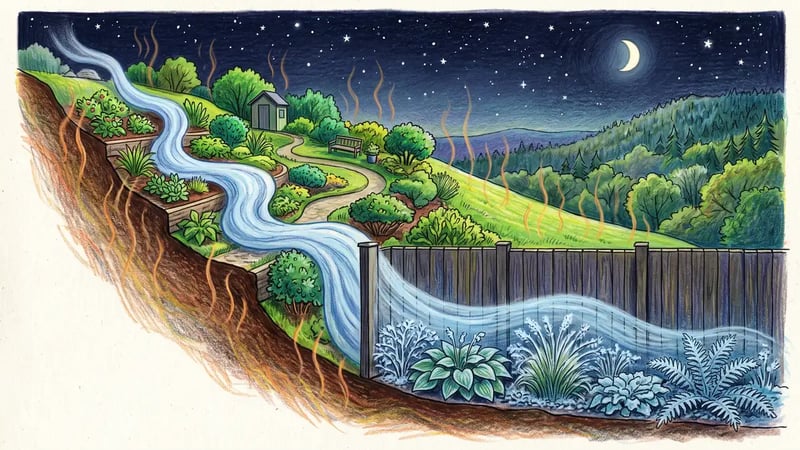
Now the garden-scale variation. Cold air is denser than warm air and behaves like water: it flows downhill and pools. NC State Extension makes the point that surprises most people: on a calm night the warmest spot in a yard is often near the top of a slope, and a solid fence or hedge placed downhill from your beds traps draining cold air and creates a frost pocket where you built a windbreak. A low spot commonly runs 2 to 5F colder than ground only a few feet higher.
Then the vertical gradient. Forecast temperatures come from sensors about 5 feet up in ventilated shelters. Under radiation frost conditions the lowest few feet of air is markedly colder, and buds can sit as much as 4F below ambient air when there is no movement to mix it. That is why a forecast of 36F still frosts your strawberries.
Key Takeaway
Treat a still, clear forecast of 36F as a frost warning at ground level. Wind and cloud are the two things that break radiation frost, so a breezy or overcast night at 34F is often safer than a dead-calm one at 37F. Buy a cheap min-max thermometer and leave it at plant height for a season; it will tell you more about your garden than any regional forecast.
How Many Degrees Is Each Method Actually Worth?

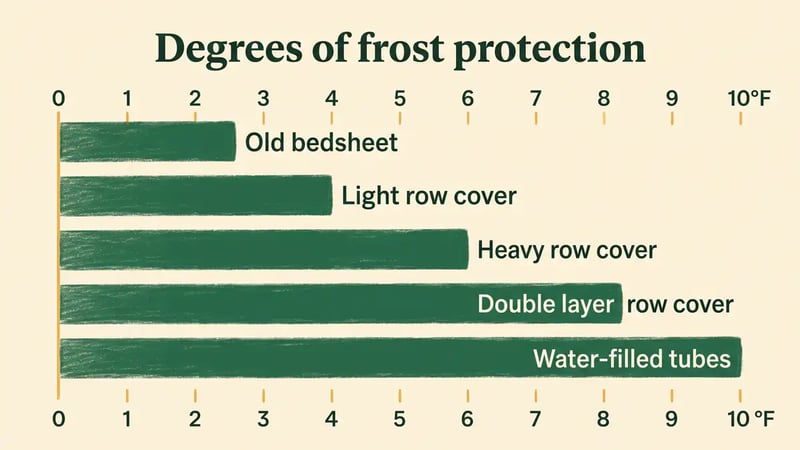
Row cover is the one method with clean published numbers, because commercial growers buy it by specification. University of Maryland Extension gives three grades:
Lightweight at 0.45 oz per square yard transmits 90 to 95% of light and gives about 2F. Medium at 0.5 to 1.0 oz transmits 70 to 85% and gives 4 to 6F. Heavyweight at 1.5 to 2.2 oz transmits only 30 to 50% but gives up to 8F.
Note the trade-off the numbers make visible: protection and light transmission move in opposite directions. Heavyweight cover is for overnight emergencies and overwintering, not for leaving on a crop that needs to grow. Utah State Extension reports the same range and adds a limit worth knowing: most agricultural woven fabrics and polyethylene protect reliably only down to about 28F, with a few heavy materials holding to 20F.
| Method | Degrees of protection | Evidence |
| Lightweight row cover (0.45 oz) | About 2F | Published, Maryland Extension |
| Medium row cover (0.5-1.0 oz) | 4 to 6F | Published, Maryland Extension |
| Heavyweight row cover (1.5-2.2 oz) | Up to 8F | Published, Maryland Extension |
| Double layer over hoops | More than single, not quantified | Extension guidance |
| Plastic sheet on hoops | Several degrees, foliage must not touch | Extension guidance |
| Old bedsheets and blankets | A few degrees, never measured | Experiential |
| Cloche or milk jug | Not quantified | Experiential |
| Water-filled tubes | Manufacturer claims only | Not independently measured |
| Overhead sprinkling | Effective but high risk at home scale | Commercial orchard practice |
| Household box fan | No evidence at garden scale | Folklore |
Sources: University of Maryland Extension, Row Covers, Utah State Extension, Row Covers, Colorado State CMG GardenNotes 722.
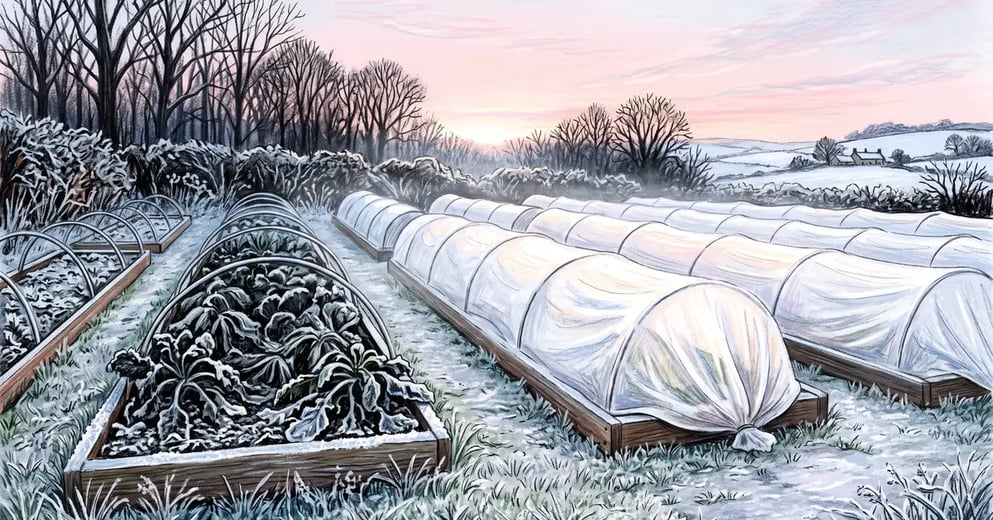
Two points that get skipped. First, anything that touches foliage conducts heat straight out of the leaf, which is why plastic laid directly on plants produces a perfect print of frost damage where it made contact, while spunbonded fabric resting on the same leaves does not. Plastic goes over hoops or it does not go on. Second, the protection comes from trapping heat radiating out of the soil, so a cover must reach the ground on all sides. A cover thrown over a plant and tied at the stem, greenhouse-style, does close to nothing.
On the two methods people ask about most. Overhead sprinkling genuinely works, and it works through latent heat: water freezing on the plant releases heat and holds the tissue at about 32F. It is also the method most likely to destroy your garden if you get it wrong, because you must run it continuously until the ice melts in the morning, and the ice load itself breaks branches. It belongs to orchards with the water supply and the pumps to sustain it.
Running a fan is a misapplied idea. Commercial wind machines work by pulling warmer air down from an inversion layer 30 or more feet up. A box fan in a vegetable bed has no inversion to reach and simply moves the same cold air around, which on a still night can strip away what little boundary layer the plants had.
Why This Works: Thermal Mass and the Edge Effect
Every one of the effective methods is a version of the same principle: put something between the plant and the open sky, and give the site something that stores daytime heat and releases it at night. A south-facing masonry wall, a water barrel, a paved path, even bare damp soil rather than dry mulch, all buffer the low. Permaculture calls this stacking thermal mass into the design, and it is why the microclimate against a brick house is routinely a full zone warmer than the middle of the same yard. Choosing where to plant is the cheapest frost protection there is, and it is free every year afterwards. It is the same logic behind a sunken greenhouse, at a scale you can build in an afternoon.
At What Temperature Does Each Crop Get Damaged?
Extension services sort vegetables into three groups, and the bands are tight enough to be useful.
| Group | Damaged at | Crops |
| Tender | 31 to 32F | Tomato, pepper, eggplant, bean, basil, squash, cucumber, melon, corn, sweet potato |
| Semi-hardy | Survive repeated light frost at 30 to 32F | Beet, cauliflower, celery, potato, leaf lettuce, radish, chard, green onion, parsnip |
| Hardy | Tolerate 28F and lower | Broccoli, cabbage, carrot, kale, spinach, garden pea, collards |
Source: NC State Extension, Frost and Freeze Protection for Vegetables.
The practical rule that falls out of it: cover semi-hardy crops when the forecast drops below 30F and hardy crops below 25F, and cover tender crops any time the forecast is under 36F on a still clear night.
Fruit trees are a different problem, because the damage threshold moves as the buds develop. This is where the numbers get genuinely dramatic. Michigan State's critical spring temperature tables give the temperature that kills 10% and 90% of buds at each stage. For apples, 10% kill sits at 15F at silver tip and 28F at first bloom. The 90% kill figure moves from 2F at silver tip to 25F at bloom.
| Apple bud stage | 10% of buds killed at | 90% of buds killed at |
| Silver tip | 15F | 2F |
| Green tip | 18F | 10F |
| Tight cluster | 27F | 21F |
| Pink | 28F | 24F |
| First bloom | 28F | 25F |
| Full bloom | 28F | 25F |
Source: Michigan State Extension, Critical Spring Temperatures for Tree Fruit Bud Development Stages, after Washington State University Extension bulletins.
Read that table again. The same tree that shrugs off 5F in March can lose most of its crop at 27F in May. A late frost is not worse than a winter freeze because it is colder. It is worse because the tree has spent its hardiness.
The Warm Spell Is the Real Danger
Cold acclimation is reversible. A week of unseasonable warmth in late winter pushes buds forward and strips hardiness that took months to build, so the frost that follows does damage a colder night in January would not have. This is why pruning timing matters and why siting matters more: a tree on a north-facing slope breaks dormancy later and dodges more late frosts than the same tree in a warm sheltered corner.
How Do You Cover Plants Properly?
Five steps, in the order that matters. Most of the value is in the first three, and all of them are free.
Water the soil in the afternoon
Moist soil holds and conducts more heat than dry soil and releases it overnight. Extension sources describe the effect qualitatively rather than in degrees, so treat it as a real but modest gain. Water the ground, not the foliage, and do it while there is still sun on the bed.
Pull back dry mulch from around stems
This one is counterintuitive. A thick dry mulch insulates the soil from the sun during the day, so less heat goes in and less comes back out at night. On a frost night you want soil exposed to the sky and radiating. Rake mulch aside in the afternoon and pull it back the next day.
Cover before sunset, not at bedtime
The point is to trap heat, and by 10pm most of it has already gone. Get covers on while the ground is still warm to the hand.
Take it to the ground and weight the edges
Bricks, boards, soil, anything. A gap at the base vents the warm air you are trying to keep and undoes most of the benefit. Use hoops for anything that would otherwise crush the crop or, with plastic, touch it.
Uncover in the morning, earlier than feels necessary
Plastic and heavy covers cook plants fast once the sun is on them, and a clear tunnel can pass 100F on a 50F day. Vent or remove as soon as the frost has lifted. Lightweight fabric can stay on for days.
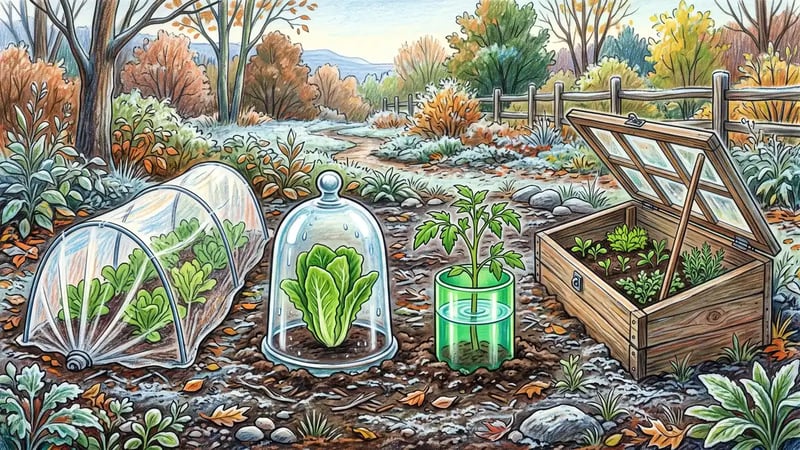
For anything you want to protect repeatedly rather than once, a structure beats a sheet. A cold frame gives you a controllable microclimate for the whole shoulder season, and a low tunnel over hoops does the same thing at bed scale for a fraction of the effort of covering by hand every night.
Key Takeaway
The three biggest mistakes are all free to fix. Covering too late, leaving a gap at the ground, and letting plastic touch foliage. Any one of them costs you most of the degrees the material was supposed to buy.
How Should You Read Frost Dates and Forecasts?
Two things gardeners routinely conflate. USDA hardiness zones describe average annual minimum winter temperature and tell you whether a perennial survives your winter. Frost dates describe when freezing is likely in spring and fall and tell you when to plant annuals. They are different datasets answering different questions, and a zone number tells you nothing about your last frost.
Frost dates are also probabilities, not deadlines. NOAA's climate normals report the dates past which the chance of a freeze drops below 40, 30, 20 and 10 percent. The commonly quoted "average last frost date" is the 50% date, which means half of years have a damaging freeze after it. Planting tomatoes on that date is a coin flip. The NOAA Climate Normals tool lets you pull the 10% date for your nearest station, which is the number to use for anything you cannot replace.
Then adjust for your own ground. If you have a frost pocket, your effective last frost is later than the station's by whatever your own thermometer says, and one season of records at plant height is worth more than any published map. Our guide to planning around the first frost date covers the fall side of the same calculation.
Why This Works: Observe Before You Intervene
The first principle in every permaculture curriculum is a season of observation before design, and frost is the clearest case for why. Mapping where frost lands first, where snow lingers longest, and which corner blooms two weeks early tells you where the tender crops go and where the late-flowering fruit belongs. That mapping is free and permanent, while row cover is bought again every few years. Permaculture design tends to front-load the thinking precisely so the maintenance drops afterwards.
Frequently Asked Questions
At what temperature should you cover plants for frost?
It depends on the crop and on the sky. Cover tender plants such as tomatoes, peppers, beans and basil whenever the forecast is below about 36F on a clear still night, because plant-height temperature can sit several degrees under the reported figure. Semi-hardy crops such as lettuce, beets and chard need covering below 30F, and hardy crops such as kale, cabbage and carrots below 25F. On a windy or overcast night the same forecast temperature is much less dangerous, because both conditions interrupt radiational cooling.
Will cardboard boxes protect plants from frost?
They work, for one night, on a small plant. A cardboard box is opaque and rigid, so it blocks the plant's view of the open sky and does not touch the foliage, which are the two things that matter. Set it before sunset, weight the edges to the soil, and remove it in the morning, because the plant gets no light underneath. Nobody has published a degrees-of-protection figure for cardboard, so treat it as a decent improvisation rather than a measured method, and use row cover if frost is a regular event.
Can you cover plants with plastic to protect from frost?
Only over a frame. Plastic is a poor insulator and an excellent conductor, so anywhere it rests on a leaf it pulls heat directly out and produces a frost burn in that exact shape. Supported on hoops with a clear air gap it holds several degrees, and it is far better than fabric at shedding rain and wind. It also overheats catastrophically in morning sun, so it has to come off or be vented early. Spunbonded row cover has neither problem, which is why growers use it despite plastic being cheaper.
Does watering plants before a frost help?
Watering the soil helps, modestly. Moist soil stores more heat during the day and conducts it upward at night, so a damp bed is warmer at the surface than a dry one. Extension guidance describes the benefit qualitatively and rarely puts a number on it, so it is worth doing but not worth relying on alone. Watering the foliage is a different thing and is not the same as commercial overhead sprinkling, which only protects because it runs continuously all night and releases latent heat as it freezes.
Why does frost form when the forecast says 36F?
Because the forecast describes air about 5 feet above ground in a ventilated shelter, and on a clear calm night the air at leaf height is colder. The ground and plants radiate heat to the open sky faster than the air does, and the coldest air, being densest, settles in the lowest few feet. Plant surfaces can sit around 4F below the reported air temperature under those conditions, and a low corner of the garden can run 2 to 5F colder again than higher ground a short distance away.
Does mulch protect plants from frost?
Over winter, yes, for roots and crowns, which is why fall mulching is standard practice. On a single frost night, a thick dry mulch works against you: it insulates the soil from the day's sun so less heat is stored, and it blocks the heat that would otherwise radiate up around the plant after dark. If a hard frost is forecast on a bed you have already mulched, rake the mulch clear of the plants for the afternoon and replace it the next day.
Get the Weekly Dig
One practical permaculture guide a week, written for gardeners who do this on weekends: permaculture design for real backyards. Free, no spam, unsubscribe any time.
Join the Weekly DigResources
- University of Maryland Extension: Row Covers, Weights and Frost Protection
- Utah State Extension: Row Covers
- Colorado State Extension CMG GardenNotes 722: Frost Protection and Extending the Growing Season
- NC State Extension: Frost and Freeze Protection for Vegetables
- Michigan State Extension: What Are Radiation Freezes?
- Michigan State Extension: The Difference Between a Frost and a Freeze
- Michigan State Extension: Critical Spring Temperatures for Tree Fruit Bud Stages
- Penn State Extension: Orchard Frost, Critical Temperatures for Various Fruits
- UC ANR: Principles of Frost Protection
- NOAA NCEI: US Climate Normals Quick Access, Freeze Date Probabilities