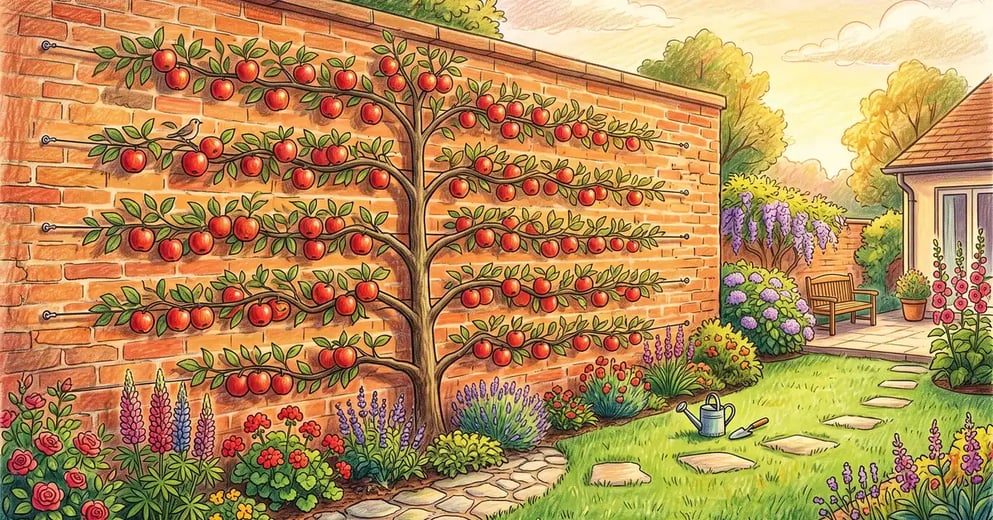

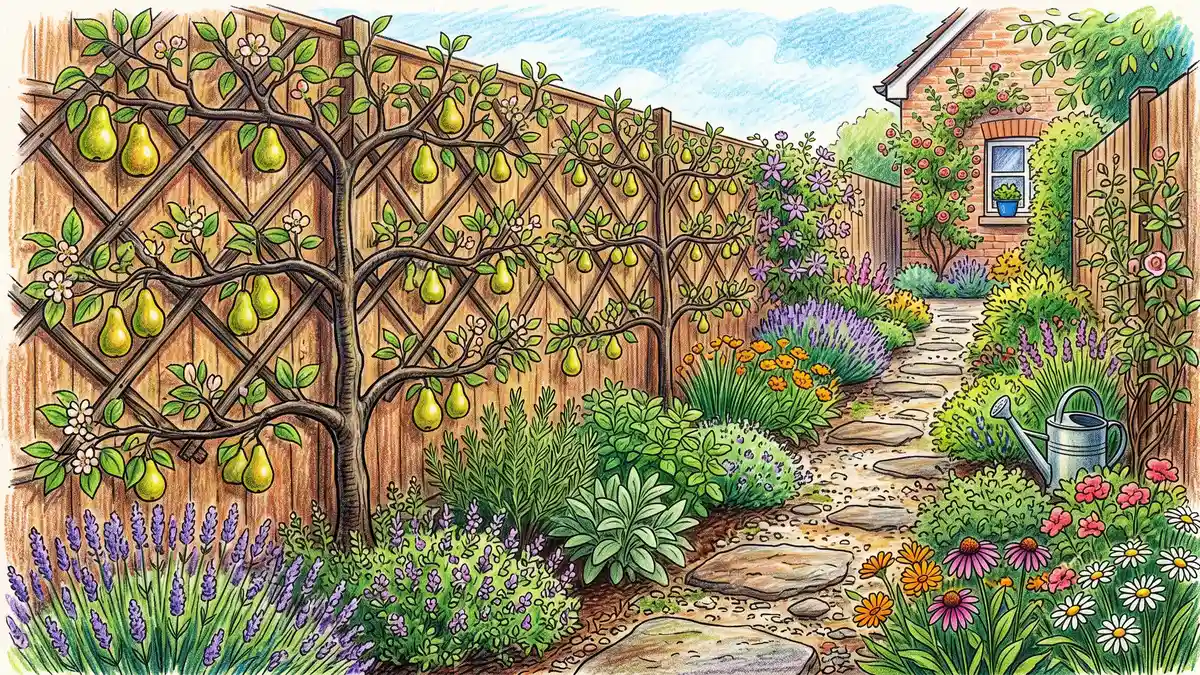
You want fruit trees, but your yard is a 6-ft (1.8 m) fence line and a sunny wall. Espalier solves exactly that problem: a fruit tree trained flat in two dimensions, hugging a wall or wires, taking up less than 2 ft (60 cm) of depth while producing real harvests. It's how French and Roman gardeners grew fruit inside courtyard walls centuries ago, and it works just as well along a suburban fence in Ohio. pruning windows by species
What Is an Espalier Fruit Tree (and Why Bother)?
An espalier is a tree pruned and tied so all its branches grow in a single flat plane against a support. University of Wisconsin Horticulture's espalier guide notes that almost any flat surface works — wood fences, chain-link, brick walls, building sides — as long as you can mount a support structure. The payoffs Wisconsin lists are the ones weekend gardeners actually care about: espaliered trees bear earlier, bear longer, color their fruit more deeply, and every apple is reachable without a ladder.
There's also a productivity story. Trellis-trained orchard systems have posted high early yields in commercial research going back decades — the Tatura Trellis work published in HortScience (van den Ende, 1987) documented that flat, supported training delivered high and early cropping across major deciduous fruits. Your backyard version is the same physics: more light on every leaf, less wood to maintain.
Here's what you'll learn:
- Which trees take to espalier — and the variety trap that ruins the project before it starts
- The exact wire heights and spacing extension services recommend
- A year-by-year training plan with the two pruning seasons that matter
- How a wall-trained tree creates its own warm microclimate
Key Takeaway
Espalier is a beginner-friendly project with a patience requirement: a dwarf apple or pear, three wires, and 15 minutes of tying a month beats hours of ladder pruning later. Expect structure-building for 2-3 years, then decades of easy harvests.
Which Fruit Trees Espalier Best?
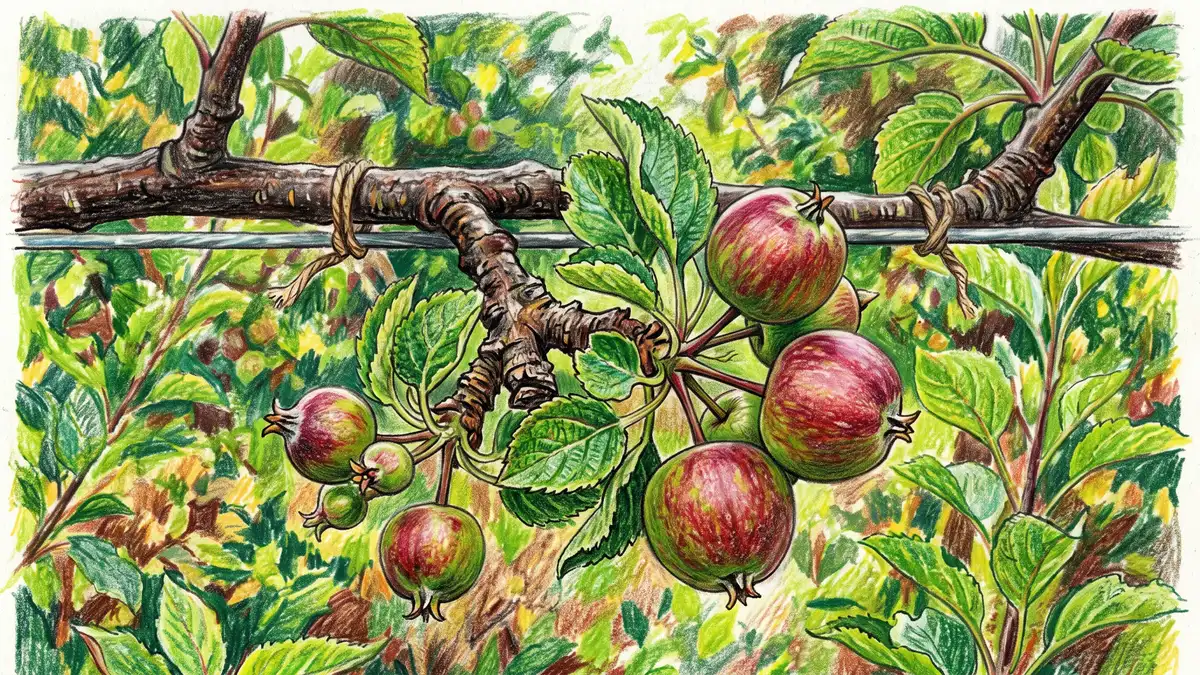
Apples and pears, specifically spur-bearing varieties. Wisconsin Horticulture is direct about this: trees that fruit on long-lived spurs — the short, stubby shoots along older branches — are the easiest to espalier, and apple and pear are the traditional subjects. Espalier pruning constantly removes branch tips, so a tip-bearing apple variety loses its fruit buds every time you cut.
Ask Extension's espalier guidance names names: spur-bearing choices like Golden Delicious, Liberty, Northern Spy, and Honeygold are recommended, and disease-resistant spur types make the low-spray home orchard realistic. Stone fruits (peach, cherry) can be fan-trained but fruit on younger wood and demand more skill — not the first project.
Rootstock matters as much as variety: choose a dwarf (M9-class) or semi-dwarf rootstock so the tree's vigor matches the size of your wires. A full-size seedling rootstock will spend its life trying to become a 25-ft (7.6 m) tree, and you'll spend yours fighting it.
Why This Works: The Edge Effect
A wall espalier is a deliberate microclimate. Permaculture calls boundaries between systems "edges," and a south-facing masonry wall is a classic productive edge: it absorbs heat all day and radiates it back at night. UC Marin's Master Gardeners note that in cool or foggy climates, a heat-retaining wall can carry warmth-loving trees that would struggle in the open yard. You're not just saving space — you're farming a warmer zone that already existed.
How Do You Build the Support?
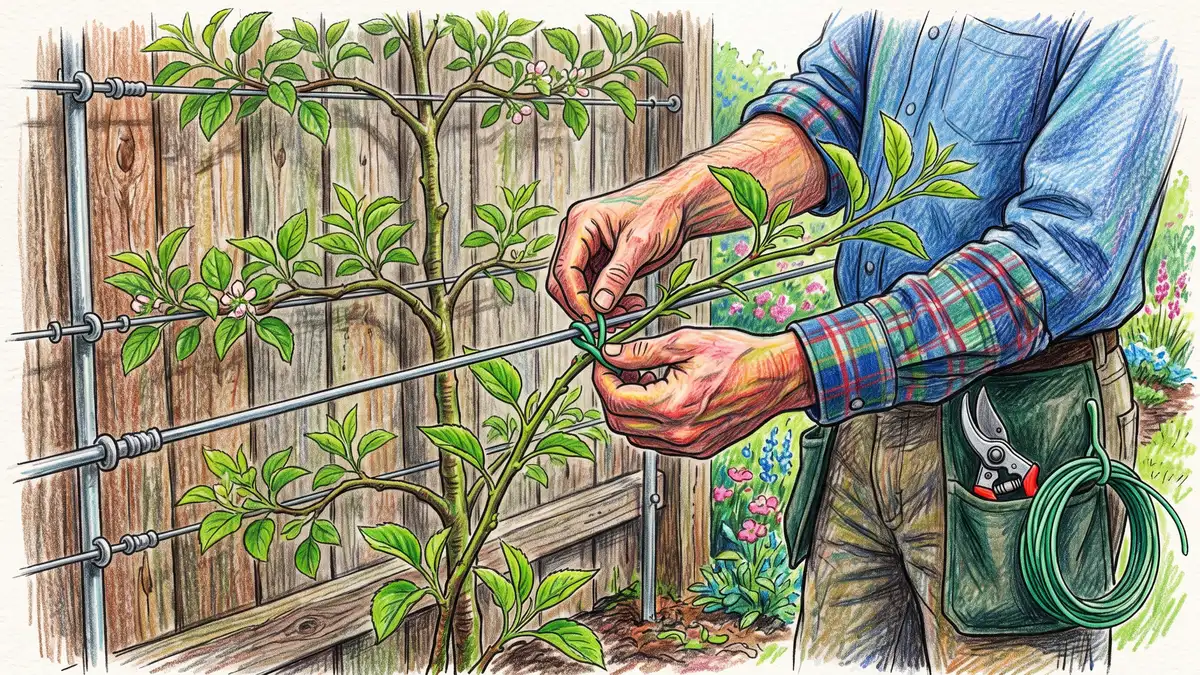
The hardware is an afternoon's work and about $40-60 in materials for a single tree. The specs below combine UC Marin Master Gardeners' how-to, the Ohio State Extension trellis factsheet, and the RHS espalier training guide.
| Element | Specification | Source |
| Bottom wire height | 15-24 in. (38-60 cm) above soil | UC Marin 15-18 in.; Ohio State 18-24 in.; RHS 16 in. |
| Wire spacing | 12-24 in. (30-60 cm) between tiers | Ohio State 18-24 in. vertical spacing |
| Gap from wall | 6-8 in. (15-20 cm) for airflow | UC Marin; Wisconsin says at least 8 in. |
| Wire gauge | 12-14 gauge galvanized, tensioned with turnbuckles | UC Marin |
| Tree spacing | 6-8 ft (1.8-2.4 m) between trunks, dwarf rootstock | UC Marin; UMD dwarf spacing |
| Cleared soil zone | 3 ft (90 cm) diameter, grass- and weed-free | UC Marin |
Sources: UC Marin Master Gardeners, Ohio State Extension, RHS, University of Maryland Extension
How Do You Train an Espalier, Year by Year?
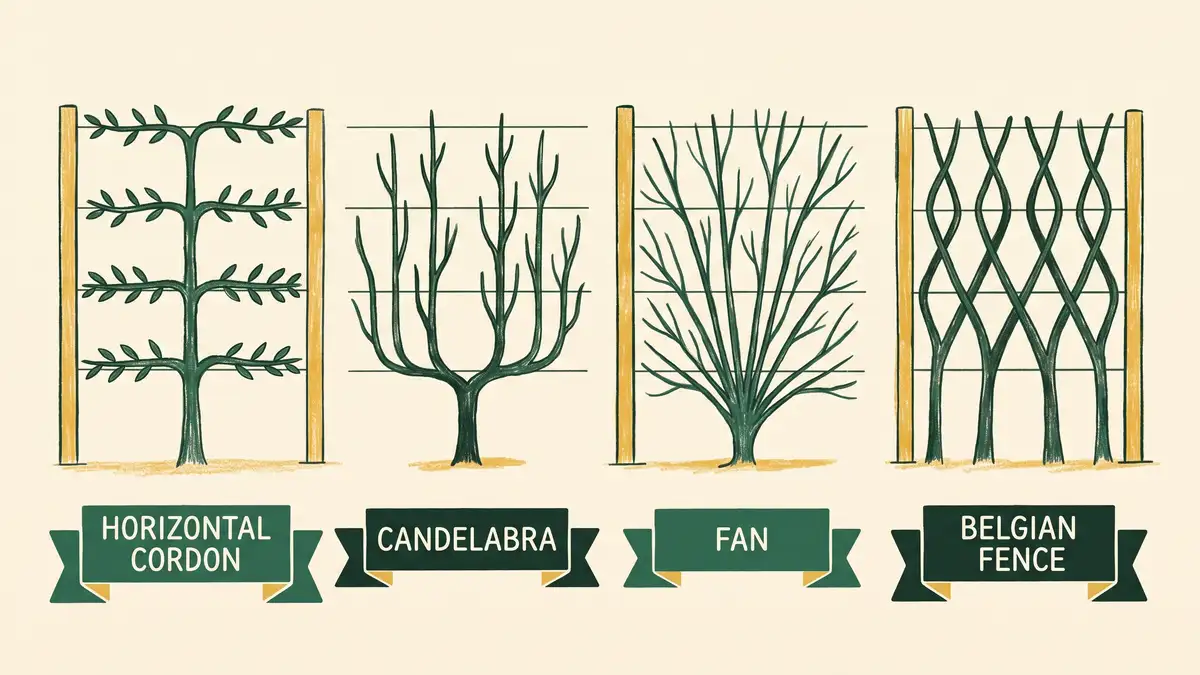
The classic three-tier horizontal cordon is the beginner pattern. Total cost including a bare-root dwarf tree: usually under $100. Time commitment after setup: a few short sessions a year.
Year 1, planting: cut the whip
Plant a one-year bare-root whip in front of the bottom wire and cut it back to about 30 in. (75 cm) — University of Maryland's standard heading cut — just above the first wire. This forces the buds below the cut to break into shoots.
Year 1, summer: pick three shoots
Keep one vertical leader and two side shoots. Tie the side shoots at roughly 45 degrees while they're young and flexible, then lower them to horizontal along the first wire at the end of the season. Everything else gets removed.
Each winter: build the next tier
Following the RHS method, cut the central stem just above the next wire to stimulate a new set of side shoots. Repeat once per tier — a three-tier espalier takes three winters to frame.
Each summer: prune for fruit, not wood
When the lower third of new shoots turns woody — late July for pears, mid-to-late August for apples per the RHS — cut side shoots from the horizontal arms back to about three leaves. This converts leafy growth into fruiting spurs and keeps the tree flat.
Ongoing: tie, check, loosen
Wisconsin recommends a quick monthly pass in the growing season: remove shoots growing perpendicular to the plane, and loosen ties before they girdle thickening branches. Fifteen minutes, tops.
What Are the Common Espalier Mistakes?
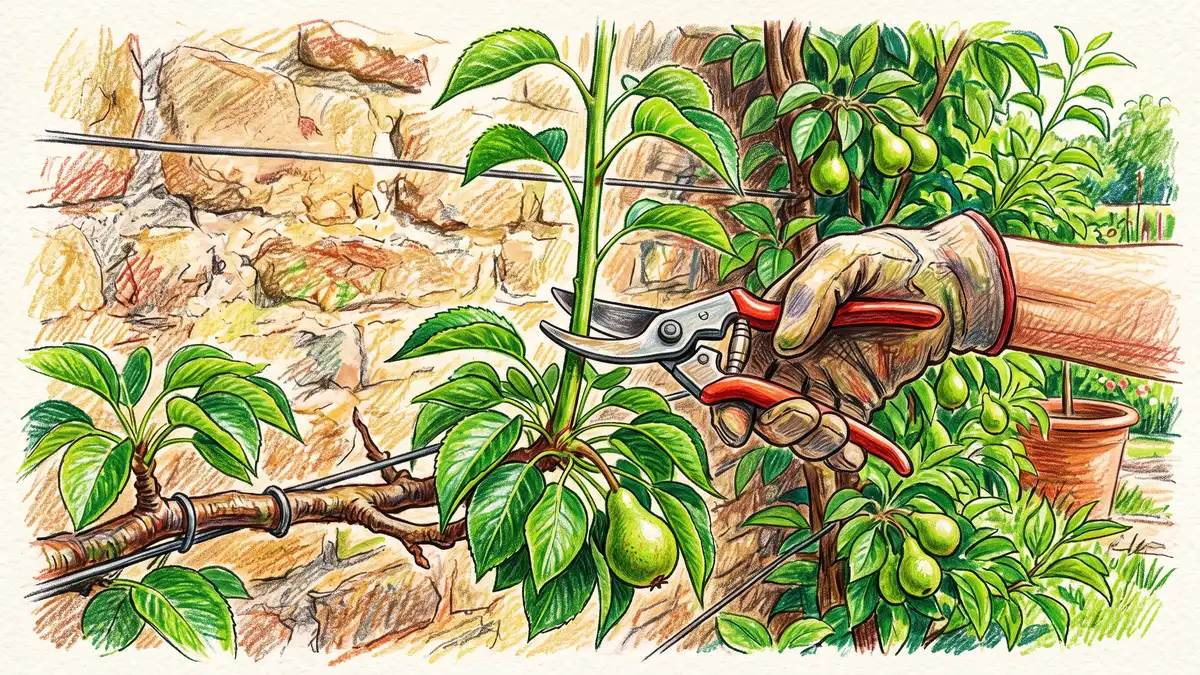
The variety trap is the big one. A tip-bearing apple looks identical at the nursery, but espalier pruning removes its fruit buds year after year — you get a beautiful green sculpture that never crops. Confirm "spur-bearing" on the label or ask the nursery directly.
Second: over-pruning in winter. Maryland Extension warns that excessive pruning triggers excessive shoot growth and delays fruiting — the tree responds to hard cuts by making wood, not fruit. Spread structural corrections over several winters and let summer pruning do the calming work.
Third: flush mounting. Skip the 6-8 in. (15-20 cm) wall gap and you lose airflow, cook the branches against hot masonry, and can't reach behind to tie or harvest.
Common Mistake to Avoid
Don't plant an espalier and skip the cleared soil zone. UC Marin calls for a 3 ft (90 cm) weed-free circle around each tree — a dwarf rootstock has a small root system, and lawn grass will outcompete it for water in year one, exactly when the tree is building its framework.
Where does an espalier fit in a bigger design? It's the space-saving edge of a food forest — the same layered logic compressed onto a wall. Underplant it the way you'd build an apple tree guild: comfrey, chives, and low herbs in that cleared circle once the tree establishes, following the fruit tree companion planting playbook. In a small yard, one espaliered wall plus a couple of dwarf trees is a complete backyard food forest starter.
Key Takeaway
Espalier rewards small, regular attention over heroic effort: one winter cut per tier, one summer session to convert shoots into spurs, monthly ties. The tree does the rest for decades.
Frequently Asked Questions
How do you espalier fruit trees?
Plant a one-year dwarf whip in front of a wire support, cut it to about 30 in. (75 cm) just above the bottom wire, and train the resulting shoots: one vertical leader, two side arms tied down to the wire. Each winter, cut the leader above the next wire to create a new tier; each summer, prune side shoots on the arms back to about three leaves to build fruiting spurs. Structure comes from winter cuts, fruit from summer cuts — that division does most of the work.
What are the best fruit trees for espalier?
Spur-bearing apples and pears on dwarf or semi-dwarf rootstocks. Extension recommendations include Golden Delicious, Liberty, Northern Spy, and Honeygold; disease-resistant spur types keep spraying minimal. Avoid tip-bearing apple varieties, which lose their fruit buds to espalier pruning, and treat stone fruits as an advanced project — they fan-train but fruit on young wood. Whatever you pick, plan for pollination with a compatible partner variety nearby.
How far apart do you plant espalier fruit trees?
Plant dwarf trees 6-8 ft (1.8-2.4 m) apart along the support, per UC Marin Master Gardeners and Maryland Extension's dwarf-tree spacing. Keep the support itself 6-8 in. (15-20 cm) off the wall for airflow, and give each tree a 3 ft (90 cm) weed-free circle. A 20 ft (6 m) fence run comfortably holds three espaliered trees — which is also a tidy pollination group.
How long does an espalier take to produce fruit?
Plan on meaningful crops in year 3 or 4 for dwarf apples and pears — the first two to three years go into building tiers, and extension guidance warns that heavy structural pruning delays fruiting. The consolation: Wisconsin Horticulture notes espaliered trees bear earlier than conventionally grown ones and keep bearing for decades, with commercial trellis research (Tatura, HortScience 1987) confirming that flat training brings trees into production early.
When do you prune an espalier?
Twice a year, for different reasons. Late winter (February-March per Maryland Extension) is for structure: creating tiers and correcting the framework while the tree is dormant. Summer — late July for pears, mid-to-late August for apples per the RHS — is for fruit: shortening new side shoots to about three leaves so the tree converts energy into fruiting spurs instead of vertical wood. Add a quick monthly tidy of perpendicular shoots during the growing season.
Get the Weekly Dig
One practical permaculture guide a week, written for gardeners who do this on weekends: food forest and guild designs that produce. Free, no spam, unsubscribe any time.
Join the Weekly DigResources
- University of Wisconsin Horticulture — Espalier (fundamentals and species choice)
- UC Marin Master Gardeners — How to Espalier (structure specs and steps)
- UC Marin Master Gardeners — Training Fruit to Fit: A Guide to Espaliers
- Royal Horticultural Society — Apples and Pears: Espalier Pruning and Training
- University of Maryland Extension — Growing Apple and Pear Trees in a Home Garden
- Ohio State Extension — Trellis Espalier System for Supported Apple Trees
- Ask Extension — Espaliering Apple Trees (spur-bearing variety recommendations)
- van den Ende (1987) — Training and Management of Fruit Trees on Tatura Trellis, HortScience