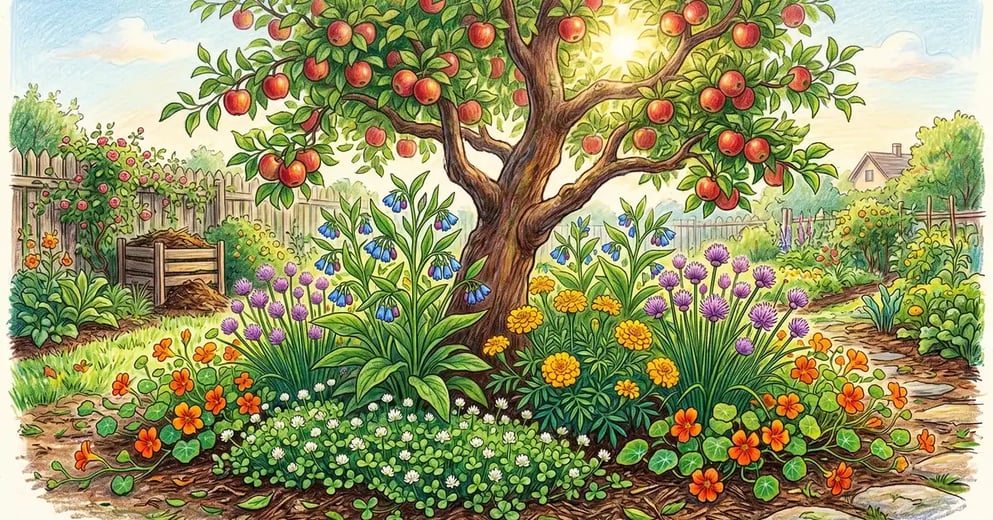

Plant white clover as a living mulch from the trunk ring out to the drip line, chives or garlic 12 to 18 in (30 to 45 cm) from the trunk, comfrey and yarrow at the drip line, and borage or calendula just beyond it. Keep the first 6 to 12 in (15 to 30 cm) around the bark bare, with nothing planted and no mulch piled against it. Those five plants cover nitrogen, pest deterrence, mulch and pollinators, and for most backyard apples that is the whole answer.
The rest of this guide is the longer version: the 7 functional roles a guild fills, how far out each ring sits on your rootstock, the year-by-year order to plant in, the mistakes that kill young guilds, and what to keep out. The bare circle around a new tree is not neutral ground. Left alone grass fills it, competes hard for water and nitrogen, and shelters the voles that girdle bark under winter snow. Numbers come from Oregon State, Penn State, Cornell, Montana State and the US Apple Association. Working a small plot? The same guild logic applies to apples trained as espaliers.
Key Takeaway
An apple tree guild is a community of plants that fill 7 functional roles around the tree: nitrogen fixer, nutrient accumulator, pest repeller, pollinator attractor, insectary plant, suppressor groundcover, and mulch maker. The best beginner combination is white clover groundcover, comfrey at the drip line, chives or garlic near the trunk, and a clump of yarrow plus borage 4 to 6 ft (1.2 to 1.8 m) out. Avoid planting brassicas, grass turf, or anything attractive to rodents. Place most plants at or just inside the drip line, not pressed against the trunk.
What is an apple tree guild
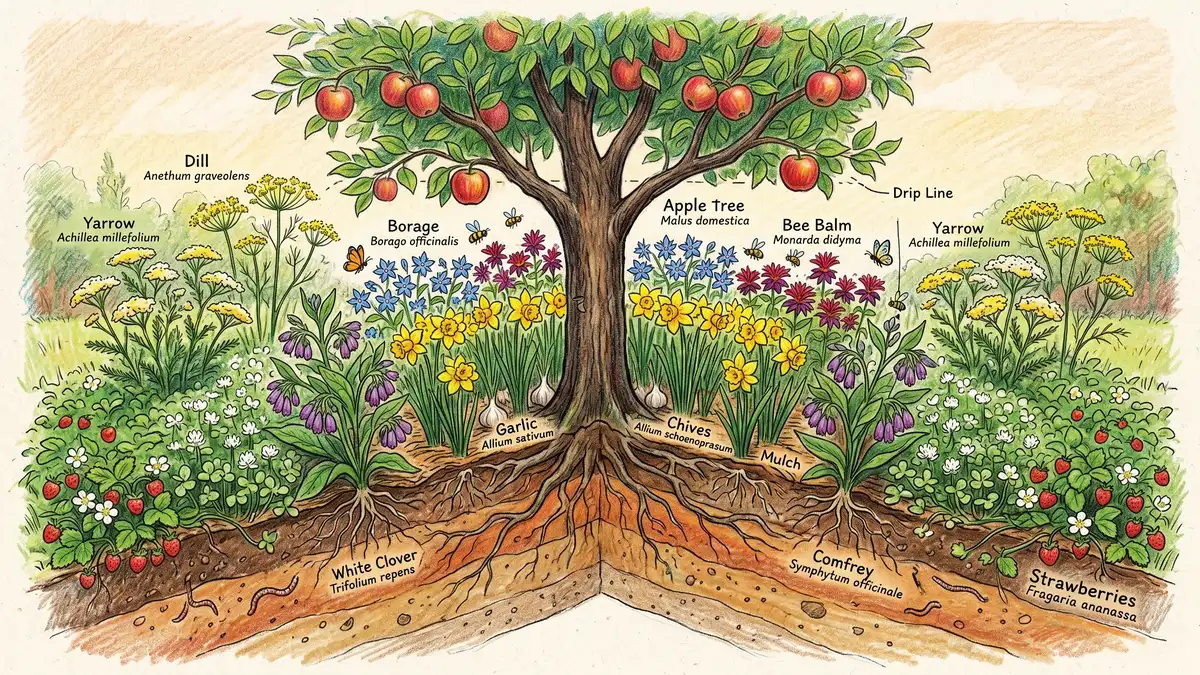
An apple tree guild is a polyculture of mutually beneficial plants grouped around a fruiting tree. It is the smallest working unit of a food forest: a food forest guild built around one productive tree. The concept traces to Robert Hart's Forest Gardening and its seven vertical layers, was formalized by Bill Mollison, and was developed further by Dave Jacke and Eric Toensmeier in Edible Forest Gardens. For the full architecture see the seven layers of a food forest. Each plant in the guild performs at least one function that the tree benefits from: fixing nitrogen, attracting pollinators, mining deep minerals, deterring pests, or suppressing weeds.
The pattern matters because apple trees are heavy feeders that benefit from continuous nitrogen and active soil biology. A bare circle of woodchip mulch is fine. A guild does more for the tree and rewards you with bee forage, cut flowers, herbs, and edible greens from the same footprint. For broader context see our 12 permaculture principles guide.
The 7 functional roles of an apple guild
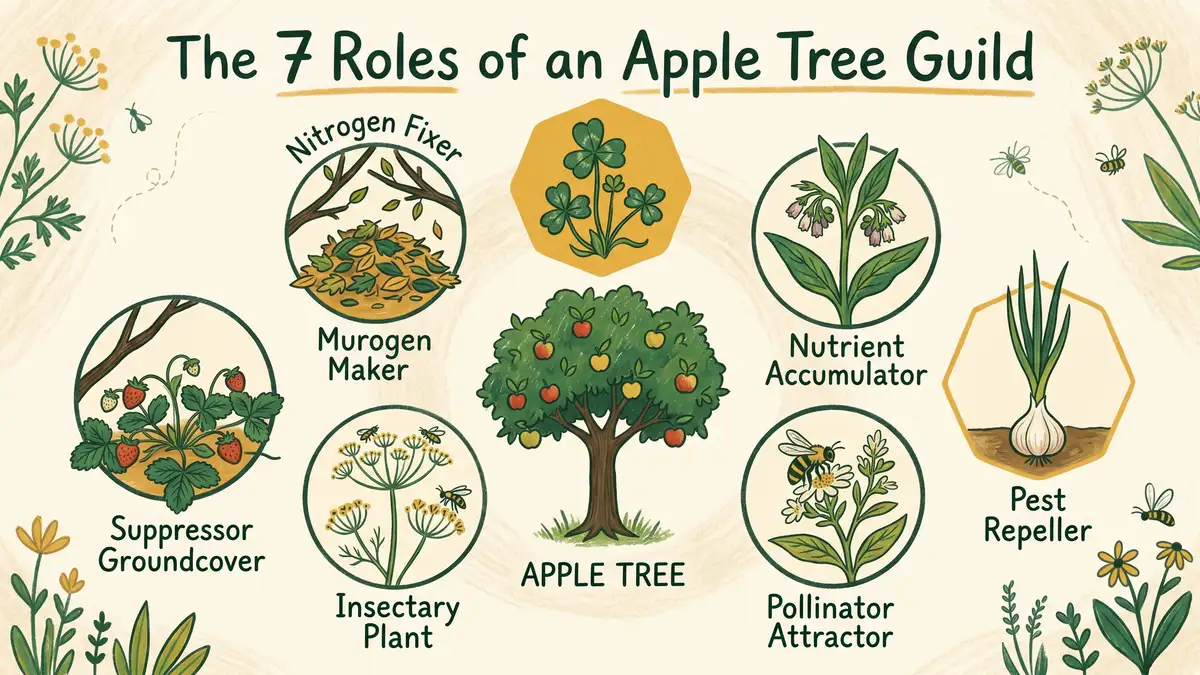
Each role can be filled by one or several plants. You do not need every plant on this list. You need at least one plant in each role.
| Role | What it does | Best plants for apple guilds |
| Nitrogen fixer | Hosts rhizobia bacteria that pull atmospheric N into the soil | White clover, red clover, lupine, bush bean, goumi |
| Nutrient accumulator | Deep taproots mine subsoil minerals, leaves become mulch | Comfrey, dandelion, yarrow, dock, chicory |
| Pest repeller | Aromatic foliage confuses or repels apple pests | Chives, garlic, onion, tansy, nasturtium, mint (contained) |
| Pollinator attractor | Flowers in or near apple bloom feed bees and hoverflies | Borage, bee balm, calendula, phacelia, sweet alyssum |
| Insectary plant | Umbel flowers shelter parasitic wasps and lacewings | Dill, fennel, yarrow, queen anne's lace, cilantro |
| Suppressor groundcover | Dense cover crowds out grass that competes for water | Strawberry, white clover, creeping thyme, sweet woodruff |
| Mulch maker | Produces fast biomass for chop-and-drop around the tree | Comfrey, sorrel, daylily, large-leaf cardoon |
Sources: Functional categories adapted from Bill Mollison Permaculture: A Designers' Manual and from Fedco Seeds 10 Orchard Companions recommendations.
Where to place each plant
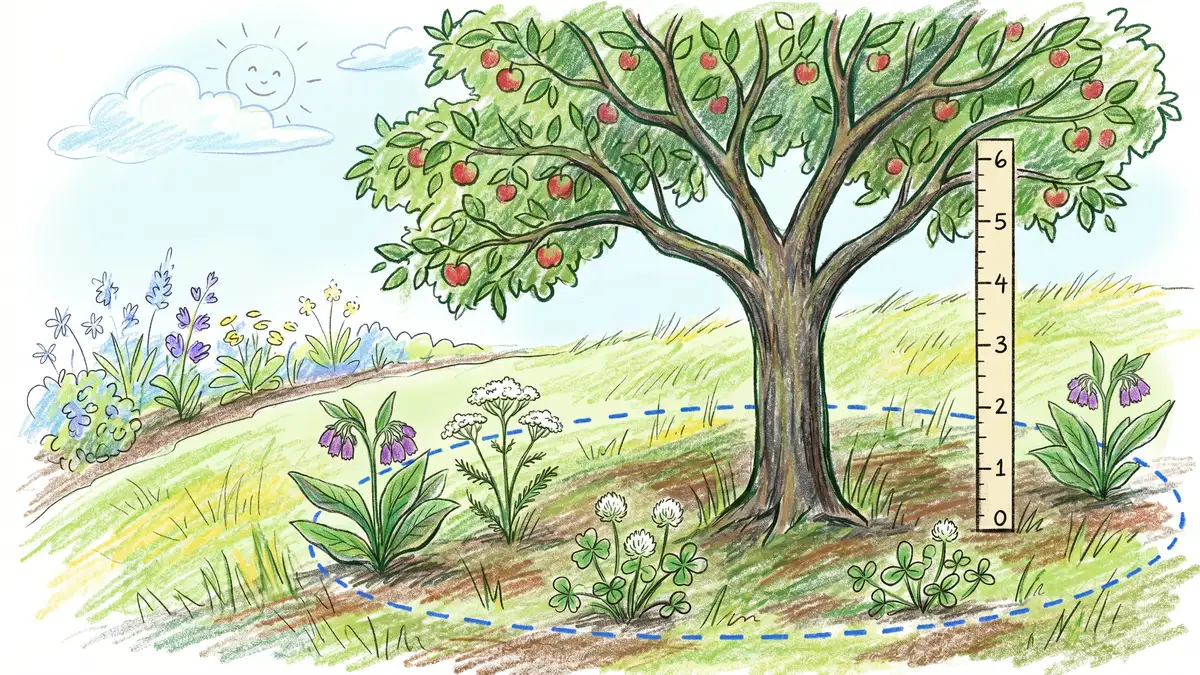
The drip line is the imaginary circle on the ground directly below the outermost branches. Most apple feeder roots are concentrated just inside that line, so this is where guild plants do their work without sitting on the trunk. For a young dwarf apple this is roughly 3 to 4 ft (0.9 to 1.2 m) from the trunk; for a mature standard tree it can be 12 to 15 ft (3.7 to 4.6 m) out.
Why This Works (the permaculture lens)
A bare mulched circle around an apple tree is a vacuum that grass and weeds rush to fill. A diverse guild fills the same vacuum with plants that pay rent: clover hands the tree nitrogen, comfrey mines potassium from 6 ft (1.8 m) down and drops it on the surface as mulch, alliums confuse pests by scent, and borage brings bees in for the apple bloom. The same square footage that fed one tree now feeds a tree, bees, you, and the soil. This is what Bill Mollison meant by "each element performs many functions."
The trunk zone (0 to 18 inches / 0 to 45 cm)
Keep the immediate 6 to 12 in (15 to 30 cm) ring around the trunk free of plants, mulch, and tall grass. This air gap prevents bark rot and removes vole habitat. Beyond that gap and out to 18 in (45 cm), plant pungent alliums: chives, garlic, garlic chives, or shallots. Their sulfur compounds confuse the apple maggot fly and discourage voles from chewing the trunk in winter.
The middle ring (18 in to drip line)
This is where your nitrogen fixer and groundcover work. Sow white clover (Trifolium repens) as a living mulch. Add a strawberry patch on the sunny south side. Tuck a daffodil bulb cluster on the north side to mark spring and repel deer and voles.
The drip line ring
Place 1 to 3 comfrey plants (Symphytum × uplandicum, the sterile Bocking 14 cultivar) at the drip line. Chop the leaves 3 to 4 times per season and drop them at the trunk as mulch. Add a clump of yarrow (Achillea millefolium) for insectary umbels. Plant borage (Borago officinalis) at the drip line for late-spring bee forage.
The outer ring (beyond drip line)
This is bonus space. Plant dill for beneficial insects, plus fennel, calendula, phacelia and bee balm. Add a small fruit shrub like serviceberry, goumi, or seaberry to extend the bloom window.
How far out the guild reaches, by rootstock
"At the drip line" is a different distance on every tree, and the rootstock decides it. A guild sized for a standard apple will swamp a mini-dwarf; a guild sized for a dwarf leaves two thirds of a standard tree's root zone in grass. Find your rootstock first, then place the rings.
| Rootstock class | Mature height | Drip line from trunk | Typical yield | Guild scale |
| Mini-dwarf (Bud.9) | 5 to 6 ft (1.5 to 1.8 m) | 2 to 3 ft (0.6 to 0.9 m) | Under 1 bushel | 1 comfrey, 3 chives, clover. Container scale |
| Dwarf (M.9) | 6 to 10 ft (1.8 to 3.0 m) | 3 to 4 ft (0.9 to 1.2 m) | 1 to 2 bushels (45 to 100 lb / 20 to 45 kg) | 1 comfrey, 6 chives, 1 yarrow, clover |
| Semi-dwarf (M.7a, MM.106, MM.111) | 12 to 18 ft (3.7 to 5.5 m) | 6 to 8 ft (1.8 to 2.4 m) | 5 to 10 bushels (225 to 450 lb / 100 to 205 kg) | 3 comfrey, 10 chives, 2 yarrow, 1 goumi, clover |
| Standard (seedling) | 20 to 25 ft (6.1 to 7.6 m) | 12 to 15 ft (3.7 to 4.6 m) | 10 to 20 bushels (450 to 900 lb / 205 to 410 kg) | 3 comfrey, full clover understory, 2 N-fixing shrubs |
Semi-dwarf is the practical sweet spot for a backyard guild: big enough to carry a real understory, small enough to prune and pick from the ground.
One more number decides the inner boundary. Arborists size a tree protection radius at 1 ft for every 1 in of trunk diameter (0.3 m per 2.5 cm), and apple feeder roots run densest near the drip line while extending two to four times beyond the canopy spread. So a semi-dwarf with a 4 in (10 cm) trunk wants that inner 4 ft (1.2 m) circle free of competing herbaceous plants for the first two to three growing seasons. Plant the outer rings first and fill inward as the tree establishes.
| Zone | Distance from trunk | What goes here | Why |
| Trunk-clear | 0 to 6 in (0 to 15 cm) | Bare soil. No plants, no mulch | Moisture against bark causes crown rot (Phytophthora) |
| Inner | 6 in to 3 ft (15 cm to 0.9 m) | Low groundcover, daffodil ring at 18 to 24 in (45 to 60 cm), chives | Keeps the feeder zone uncrowded, daffodil alkaloids deter voles |
| Middle | 3 to 8 ft (0.9 to 2.4 m) | Comfrey, yarrow, borage, dill, fennel | Deep taproots mine below the apple's shallow feeders |
| Outer, at the drip line | 8 to 15 ft (2.4 to 4.6 m) | Goumi, mountain mint, anise hyssop, calendula | Nitrogen fixer gets full sun at the canopy edge |
| Beyond the drip line | 15 ft (4.6 m) and out | Sea buckthorn, extra pollinator beds, berry shrubs | Extends the food forest outward without crowding the apple |
Sources: rootstock size and yield classes from NC State Extension's production guide for smaller orchard plantings; mulch and crown-rot spacing from Michigan State Extension, Backyard Fruit Trees.
Nitrogen fixers that work under apples
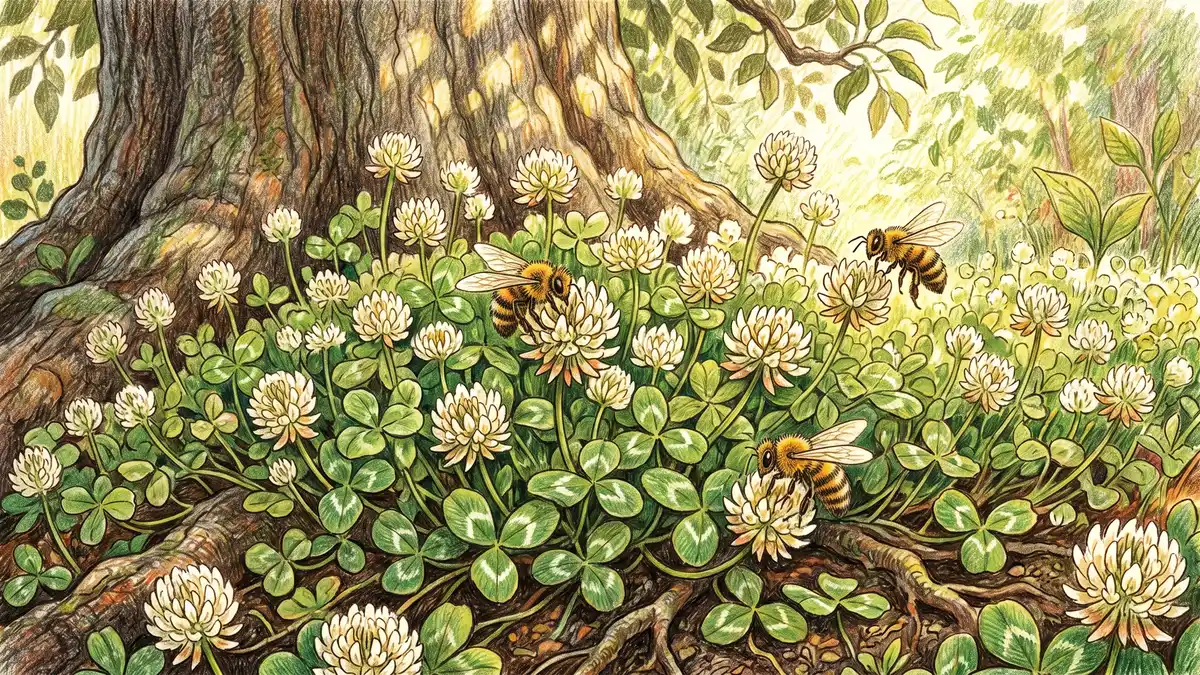
Apple trees need 0.5 to 1 lb (225 to 450 g) of actual nitrogen per year for a mature standard tree. The Orchard Project's nutrient guide documents that white clover living mulch can supply 50 to 100 lb (23 to 45 kg) of N per acre per year through symbiotic fixation, equivalent to providing a substantial share of a backyard orchard's nitrogen needs.
Practical options for the home orchard:
- White clover (Trifolium repens): best all-purpose living mulch, shade-tolerant, mowable
- Red clover (Trifolium pratense): taller, more drought-tolerant, blooms longer for bees
- Lupine (Lupinus perennis): perennial nitrogen fixer for the outer ring, beautiful spring bloom
- Bush bean: annual fixer, plant in early summer, harvest beans, leave roots in soil
- Goumi (Elaeagnus multiflora): large nitrogen-fixing shrub for outer ring, edible berries
Comfrey: the workhorse of the apple guild
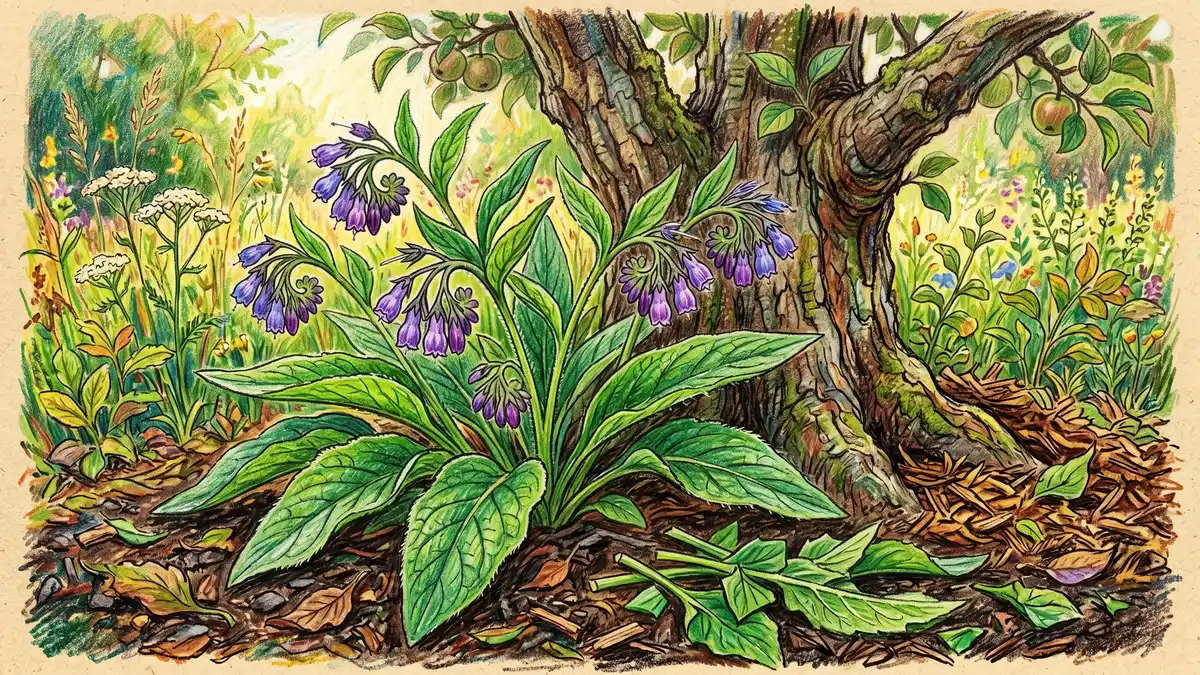
Comfrey deserves its own section because it does four jobs at once: nutrient accumulator, mulch maker, pollinator forage, and physical barrier. Russian comfrey (Symphytum × uplandicum) sends a taproot 6 to 10 ft (1.8 to 3.0 m) deep, mining potassium, calcium, and phosphorus that surface plants cannot reach.
Plant the sterile Bocking 14 cultivar specifically, because it does not self-seed and will not invade the rest of the yard. Place 1 plant per dwarf apple and 2 to 3 plants per standard apple at the drip line. Cut the leaves 3 to 4 times per growing season and drop them at the trunk: this is the chop-and-drop technique, covered in our chop and drop mulching guide.
Pest-repelling alliums
Apple growers in cooler climates fight 4 main pests: codling moth (Cydia pomonella), apple maggot (Rhagoletis pomonella), aphids, and voles in winter. The allium family (chives, garlic, garlic chives, walking onion) addresses several of these at once.
Oregon State Extension's fruit tree IPM page documents that codling moth controls work best as a multi-pronged strategy: pheromone traps, sanitation, and habitat that supports natural predators. Aromatic alliums around the trunk add another disruption layer to that strategy, and they make winter trunk-chewing rodents less interested.
Practical plan: ring 6 to 10 chive plants in a wide circle 12 to 18 in (30 to 45 cm) from the trunk. Let them flower in late spring (small purple globes attract early bees). Cut them back after flowering, and they will rebloom.
Codling moth, scab and voles: what the guild actually handles
Three problems do most of the damage to backyard apples, and the guild helps with each one to a different degree. Being honest about which is which saves you from expecting the planting to do work it cannot.
Codling moth. The larvae bore into developing fruit. Left unmanaged it can destroy up to 95% of a crop, and a single female lays up to 100 eggs. Adults fly at apple bloom and again 6 to 8 weeks later. The guild contributes real habitat here: dill, fennel and yarrow umbels shelter the parasitic wasps that target the larvae. It is not a standalone control. Combine it with pheromone traps and fallen-fruit sanitation, per Penn State Extension's home orchard tables.
Apple scab. A fungal disease that needs 6 to 23 hours of leaf wetness at 42 to 75 F (6 to 24 C) to infect, per Cornell IPM. The guild does almost nothing for scab directly, and a dense understory can make it slightly worse by holding humidity. What helps: pruning for airflow, raking out fallen leaves where the overwintering inoculum sits, and in humid climates choosing a resistant cultivar (Liberty, Enterprise, GoldRush, Pristine, Williams' Pride, CrimsonCrisp).
Voles. Meadow and pine voles girdle young trunks under winter snow and often kill the tree outright. This is where the guild earns its keep. Penn State's vole IPM calls for a vegetation-free zone at the trunk, which is the same bare ring the guild already requires, plus a ring of 12 to 15 daffodil bulbs at 18 to 24 in (45 to 60 cm): the alkaloids in the bulbs are one of the few things voles will not chew. Back it up with a hardware-cloth trunk guard, quarter-inch (6 mm) mesh, 24 in (60 cm) tall, buried 2 in (5 cm) into the soil, for the first five winters.
Pollinator support during apple bloom
Apple trees are mostly self-incompatible, so they need bees moving pollen from one variety to another. The US Apple Association's pollinator best practices PDF emphasizes that managed honeybees plus wild native bees (mason bees, bumblebees) together produce the best fruit set, and that flower diversity in and around the orchard supports the wild bee populations doing much of the work.
A peer-reviewed review in Managing Floral Resources in Apple Orchards for Pest Control (PMC) synthesizes 66 studies showing that flowering understory plants support natural enemies of apple pests and increase pollination services. Plant for sequential bloom:
| Bloom window | Best guild flowers |
| Early spring (before apple bloom) | Daffodils, crocus, chives, dandelion |
| Apple bloom (April-May) | Borage, calendula, phacelia, sweet alyssum |
| Early summer | Yarrow, dill, fennel, bee balm |
| Late summer | Goldenrod, anise hyssop, calendula re-bloom |
Sources: Bloom sequence adapted from Fruition Seeds' companion plants for the orchard and US Apple pollinator data.
The 6-step apple guild plan
Mark the drip line
Stand at the trunk and look up at the outermost branches. The shadow on the ground at noon traces the drip line. Mark it with stakes or a hose to plan around.
Clear the bark zone
Keep a 6 to 12 in (15 to 30 cm) bare ring around the trunk. No mulch piled against the trunk, no plants closer than 6 in (15 cm). This prevents rot and vole damage.
Seed the living mulch
Broadcast white clover seed across the area between the bark zone and the drip line. Rake in lightly and water.
Plant the trunk-zone alliums
Ring 6 to 10 chive divisions in a circle 12 to 18 in (30 to 45 cm) from the trunk. Plant 3 to 5 garlic cloves in fall on the same ring.
Set the drip-line workhorses
Plant 1 to 3 Bocking 14 comfrey crowns at the drip line. Add 1 yarrow clump and 2 to 3 borage seedlings on the same circle.
Fill the outer ring
Beyond the drip line, sow dill, fennel, calendula, phacelia. Add a nitrogen-fixing shrub like goumi or serviceberry on the north side for added pollinator forage.
Time: about 3 to 4 hours over a weekend for a single mature tree. Cost: under $50 in seeds, divisions, and starter plants if you source comfrey from a local permaculture group.
Year by year: the order to plant a guild
Year zero is the step most people skip, and skipping it is why so much broadcast clover never comes up. If the guild is going into what is currently lawn, the soil under that lawn is compacted from years of mowing, and seed sown onto compacted turf sits on the surface and dies. Loosen the profile without inverting it and without slicing the tree's feeder roots: a broadfork opens the soil 10 to 14 in (25 to 35 cm) down and leaves the layers where they are, which a tiller does not. Work the outer rings only, and on an established tree stay outside the drip line. Our guide to broadfork sizing by bed width and soil type covers which tine length handles heavy clay against loam.
| When | What goes in | The job |
| Year 0, autumn | Soil prep, daffodil bulbs | Test pH (target 6.0 to 6.8), loosen compacted ground, amend with compost, plant the daffodil ring 18 to 24 in (45 to 60 cm) from where the trunk will stand |
| Year 1, spring | Apple tree, mulch, white clover | Plant the tree, mulch 3 to 4 in (8 to 10 cm) deep and kept 6 in (15 cm) off the bark, broadcast clover for groundcover |
| Year 1, late spring | Comfrey, yarrow, chives, borage | Set the accumulators in the middle ring. Borage reseeds itself from year 2 on |
| Year 1 or 2 | Goumi or sea buckthorn | Nitrogen-fixing shrub at the outer edge, north side, so it never shades the apple |
| Year 2 to 3 | Pollinator perennials | Mountain mint, anise hyssop, native asters at the outer ring as the canopy gap allows. Comfrey is croppable 4 to 6 times a season by now |
| Year 4 to 6 | Nothing new. Cut back | The tree comes into bearing. Reduce nitrogen-fixer biomass hard: surplus nitrogen pushes soft growth, delays fruiting and costs you storage quality |
| Year 7 and on | Maintenance only | Full guild maturity. Chop-and-drop mulch and light pruning are the whole input list |
What NOT to plant under apple trees
Avoid These Plants and Conditions
Lawn turf grass right up to the trunk. Grass competes hard for water and nitrogen, and harbors voles. Brassicas (cabbage, broccoli, kale). Heavy nitrogen feeders that compete with the apple. Black walnut anywhere within 50 ft (15 m). Juglone suppresses apple growth and other Rosaceae. Mulch piled against the trunk. Mulch volcanoes cause bark rot and invite vole damage; keep mulch pulled back 6 in (15 cm) from the trunk. Aggressive mints unconstrained. Mint works as a pest deterrent but needs a buried pot or root barrier or it will take over. Anything attractive to deer right at apple height. Hostas and daylilies will pull deer through the orchard, which can lead to bark damage on young trees.
Five mistakes that kill a young apple guild
The plant list is the easy part. These five are what actually goes wrong, and four of them happen in the first two years.
1. Planting everything in year 1. A newly planted apple cannot hold its own against a mature comfrey, a yarrow clump and a goumi all establishing at once. The tree loses. Plant the tree, get it through one full season, then phase companions in over two to three years.
2. Comfrey too close to the trunk. Those big leaves lie down in autumn and trap moisture against the bark, which is how crown rot starts. Keep every herbaceous plant at least 24 in (60 cm) out.
3. Choosing an invasive nitrogen fixer. Autumn olive (Elaeagnus umbellata) is invasive across most of the eastern US per USDA's invasive species profile, and Siberian peashrub is restricted in Minnesota and several other states. Goumi and sea buckthorn are the safer picks, but check your own state list before either goes in the ground.
4. Trusting daffodils alone against voles. A daffodil ring works until a hard winter and a big vole population, and then it does not. The hardware-cloth guard is cheap insurance for a tree you waited five years to fruit.
5. Leaving the nitrogen fixers running once the tree bears. Clover and goumi keep delivering nitrogen whether or not the tree still needs it. From year 4 on, surplus nitrogen means soft wood, more scab and aphids, and apples that will not store. Mow the clover harder and cut the fixing shrubs back.
Apple guild for small spaces and containers
If you have a dwarf apple in a half-barrel or a small backyard, a scaled-down guild still works. The Cottage Vegetable's mini fruit tree guild guide demonstrates a compact version that fits a 3 ft (0.9 m) radius:
- 1 chive plant on the south side of the trunk
- 1 strawberry plant on the east side
- 1 small comfrey (or yarrow if comfrey is too aggressive for the space)
- White clover seed throughout
- 2 to 3 daffodil bulbs on the north side
This mini-guild covers nitrogen fixation, pest repulsion, pollinator forage, and a small edible groundcover from one container or one tiny circle around the trunk.
A guild around one tree is the unit. Stacking several of them is a food forest, and the step up is mostly a question of spacing and sequence: see how to start a food forest step by step, and, once you are sketching it out, the food forest design mapping guide. The same pattern with a different canopy tree is covered in the cherry tree guild.
Frequently Asked Questions
What is the best companion plant for apple trees?
If you only plant one thing, plant white clover (Trifolium repens) as a living mulch from the bark zone to the drip line. It fixes nitrogen, suppresses grass, feeds pollinators when it flowers, and survives mowing. After clover, comfrey at the drip line is the highest-leverage second pick.
What should you not plant near apple trees?
Avoid black walnut (juglone toxicity within 50 ft / 15 m), grass turf right up to the trunk (competes for water and shelters voles), heavy nitrogen-feeding brassicas in the same root zone, mulch piled against the trunk, and aggressive mints without a root barrier.
Can you plant flowers under apple trees?
Yes. Flowers are central to a good apple guild. Borage, calendula, phacelia, sweet alyssum, and bee balm during apple bloom support pollinators. Daffodils and crocus in early spring repel deer and voles. Yarrow and dill umbels later in season attract beneficial predator insects.
What is the apple tree guild in permaculture?
An apple tree guild is a designed community of plants placed around the tree to perform 7 functions: nitrogen fixation, nutrient accumulation, pest repulsion, pollinator attraction, insectary support, weed suppression, and mulch production. The concept was developed by Bill Mollison and elaborated by Dave Jacke and Eric Toensmeier in Edible Forest Gardens.
How far from the trunk should I plant companions?
Keep a 6 to 12 in (15 to 30 cm) bare ring around the trunk. Plant alliums (chives, garlic) 12 to 18 in (30 to 45 cm) from the trunk. Plant nitrogen fixers and groundcover from there out to the drip line. Plant comfrey and large herbs at the drip line. Place the outer ring of pollinator flowers and fruiting shrubs beyond the drip line.
Does clover really help apple trees?
Yes. White clover hosts Rhizobium bacteria that pull atmospheric nitrogen into nodules on its roots. When clover roots die back, that nitrogen becomes available to nearby plants including the apple. A clover living mulch can supply 50 to 100 lb (23 to 45 kg) of N per acre per year, a substantial share of an apple's annual nitrogen budget.
Can apple trees be planted near other fruit trees?
Yes, with adequate spacing. Apples, pears, plums, and cherries can be planted in the same backyard orchard if each tree has its drip line clear of neighbors. Avoid planting apple next to black walnut (juglone) or under the heavy shade of larger nut trees. Two apple varieties planted within 50 ft (15 m) of each other improve cross-pollination and fruit set.
How long until an apple tree guild is fully productive?
Year 1 the tree and the groundcover establish and produce nothing. Years 2 to 3 the accumulators come online: comfrey can be cut 4 to 6 times a season by year 2, and the clover is fixing nitrogen at scale. Years 4 to 6 the apple starts bearing meaningfully, 5 to 10 bushels on a semi-dwarf, and this is the point to cut the nitrogen fixers back. From year 7 the system is largely self-sufficient for fertility, with chop-and-drop mulch and light pruning the only regular inputs.
Can you add a guild around an apple tree that is already established?
Yes, and on an existing tree it is usually the higher-value move, because the tree is already carrying fruit. Work from the surface: plant daffodil rings in autumn, set comfrey crowns at the drip line in spring, broadcast white clover straight into the existing turf after mowing it short, and put a goumi or sea buckthorn at the perimeter. Do not dig, till, or broadfork inside 6 ft (1.8 m) of the trunk on a mature tree; you will cut feeder roots the tree cannot spare. Surface-plant and mulch well instead.
Get the Weekly Dig
One practical permaculture guide a week, written for gardeners who do this on weekends: food forest and guild designs that produce. Free, no spam, unsubscribe any time.
Join the Weekly DigResources
- Fruit Tree Integrated Pest Management (Oregon State Extension)
- Managing Floral Resources in Apple Orchards for Pest Control (PMC review of 66 studies)
- Pollinator Best Management Practices for Apples (US Apple Association PDF)
- Managing Codling Moth in the Home Orchard (Montana State Western Agricultural Research Center)
- 10 Companion Plants for the Orchard (Fedco Seeds)
- Companion Plants for the Orchard (Fruition Seeds)
- Fruit Trees Need Their Nutrient Fix (The Orchard Project)
- Home Orchard Disease and Insect Tables (Penn State Extension)
- Integrated Management of Voles in Orchards (Penn State Extension)
- Apple Scab Fact Sheet (Cornell CALS IPM)
- Smart Gardening: Backyard Fruit Trees (Michigan State Extension PDF)
- Production Guide for Smaller Orchard Plantings (NC State Extension)
- Codling Moth Fact Sheet (UNH Extension)
- Black Walnut Toxicity (Pacific Northwest Plant Disease Handbook)
- Autumn Olive Invasive Species Profile (USDA NISIC)
- Companion Plants for Apple Trees Expert Guide (Raintree Nursery)
- Mini Fruit Tree Guild for Small Gardens (The Cottage Vegetable)
- Nitrogen-fixing plants for fruit trees (The Orchard Project)