
You planted an apple tree (or a peach, or a cherry, or a young dwarf citrus) and now there's a 6-foot circle of bare mulch or boring lawn around it. That blank space is the most productive ground in your yard — if you fill it correctly. A fruit tree guild is the permaculture answer: 5–8 carefully chosen companion plants arranged around your tree that fix nitrogen, mine deep nutrients, attract pollinators, repel pests, suppress weeds, and produce mulch you never have to buy. Done well, the guild does most of the orchard work for you. Done badly, the companions compete with the tree and you end up with stunted growth. Southwest US food forest strategies what to plant under a cherry tree wall-trained espalier trees
This article walks through the canonical guild structure (the seven functional roles every guild needs to fill), then gives you specific plant lists for apple, citrus, and stone-fruit trees with spacing, costs, and the mistakes to avoid. Total time to install a guild around one tree: 2–4 hours. Total cost: $50–$300 in plant material. Payoff: lower water bills, less fertiliser, and 30–80% reductions in pest pressure within three years.
The short answer
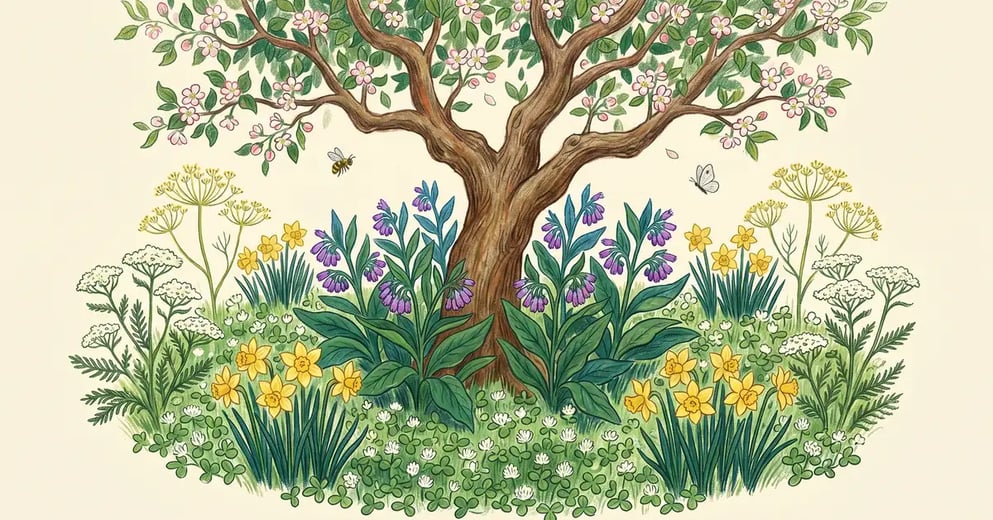
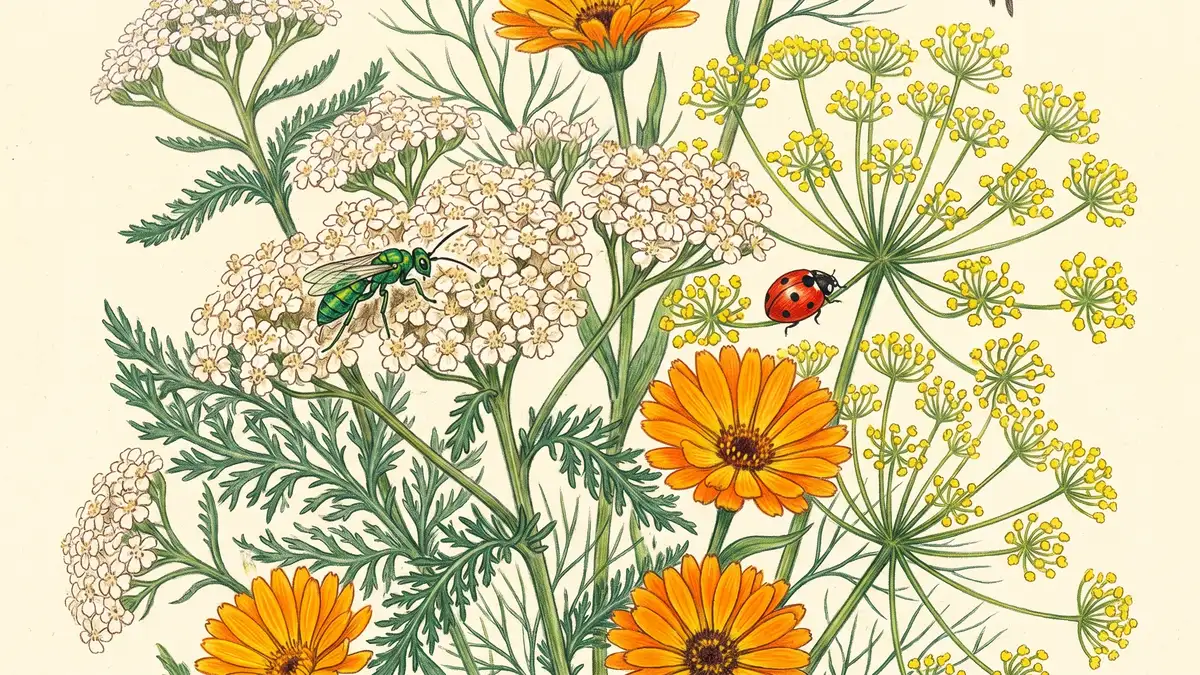
A fruit tree guild surrounds your tree with 5–8 companion plants filling 7 functions: nitrogen fixer, dynamic accumulator, mulch producer, pollinator attractant, pest repeller, ground cover, and the tree itself. The classic apple guild is comfrey, daffodils, chives, yarrow, dill, white clover, and a marigold or two. Keep a 12–18 inch (30–46 cm) clear zone right at the trunk. Plant in spring or fall. Don't pile mulch against the trunk — it kills the tree.
What Is a Fruit Tree Guild?
A guild is a permaculture term for a community of plants designed around a central productive species — in this case, your fruit tree. The term comes from Bill Mollison, who defined it as "a harmonious assembly of species clustered around a central element" each working in some way to support the central plant. In practice, a fruit tree guild replaces the monoculture lawn or bare mulch under your tree with a stratified plant community that mimics what natural forests do: cycle nutrients, attract beneficial insects, suppress weeds, and build soil — without you having to buy or apply most of those inputs.
The 1000 Islands Master Gardeners describe guilds as "biodiverse interdependent polycultures of plants, insects, microorganisms and animals" connected by an underground mycelial network. That sounds romantic, but the practical effect is concrete: by Year 3, a well-designed guild eliminates most fertiliser inputs, reduces watering by 20–75%, and drops pest pressure by 30–80% compared to the same tree planted in lawn.
This isn't theoretical. The framework Toby Hemenway and Dave Jacke documented in Edible Forest Gardens is now mainstream — it's taught at orchard education programmes, recommended by UC Cooperative Extension's young fruit tree care guide, and validated by university extension research from Cornell, Penn State, and Oregon State. If you've already met our guide on companion planting in the vegetable garden, this is the perennial, woody, multi-decade version of the same idea.
The 7 Functional Roles Every Guild Needs
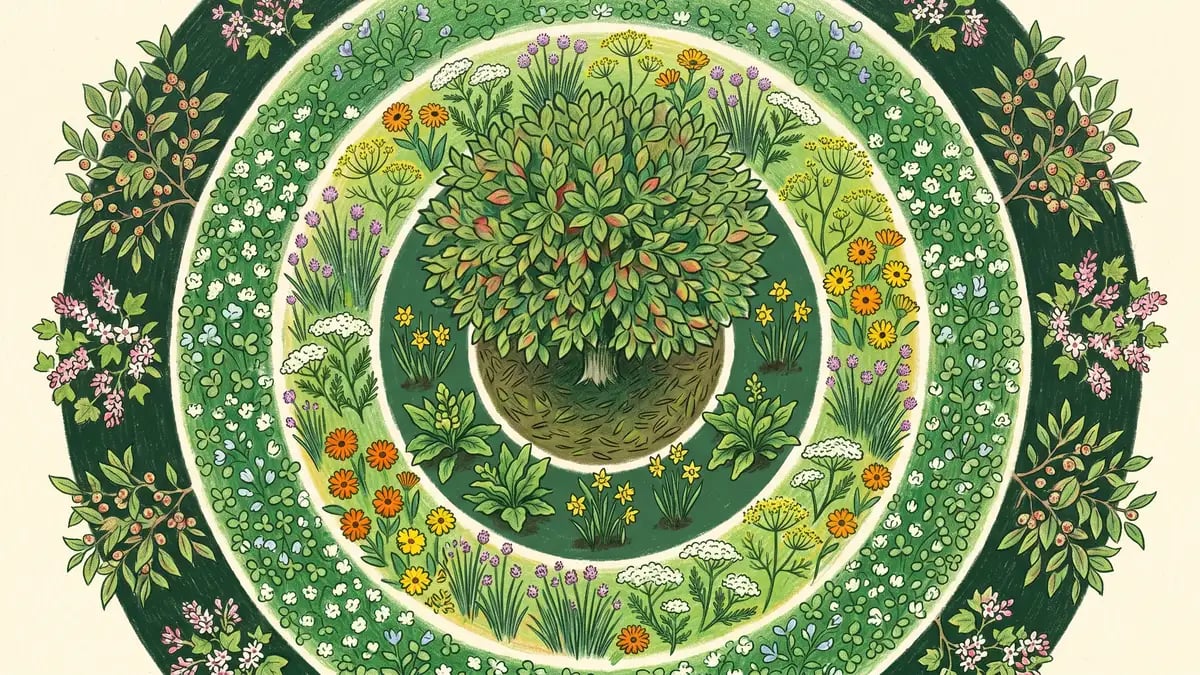
Every guild plant earns its place by performing one or more of seven jobs. You don't need a separate plant for each — comfrey alone hits four of them. But every job needs at least one plant assigned to it. Use this as a checklist when designing your guild.
| Function | What it does | Best species |
| 1. The fruit tree | The productive centre — apple, pear, peach, plum, cherry, citrus | Choose dwarf or semi-dwarf rootstock for backyards |
| 2. Nitrogen fixer | Pulls nitrogen from the air into the soil through root nodules | White clover, crimson clover, goumi, lupins, peas/beans |
| 3. Dynamic accumulator | Mines deep minerals (especially potassium) and brings them up | Comfrey 'Bocking 14', yarrow, dandelion, chicory |
| 4. Mulch producer | Grows fast biomass you chop and drop on the soil 2–5× per year | Comfrey, sorrel, chop-and-drop perennials |
| 5. Pollinator attractant | Brings bees and beneficial insects when the tree blooms | Daffodils, borage, calendula, bee balm, alyssum |
| 6. Pest repeller / confuser | Disrupts pest scent or attracts the predators of pests | Chives, garlic chives, yarrow, dill, fennel, marigold |
| 7. Ground cover / weed suppressor | Crowds out grass and weeds; protects soil moisture | White clover, thyme, strawberries, nasturtium |
Source: Toby Hemenway — Using Natural Plant Communities to Guide Guild Design
Why this works (the permaculture insight)
A fruit tree planted in lawn is in a fight. Grass roots compete for water and nitrogen, lawn-mowing damages the trunk, and there's no diversity to host beneficial insects. A guild flips that — every plant in the circle is on the tree's side. Comfrey mines potassium from 8 feet down and dumps it on the surface. Clover feeds nitrogen into the root zone. Yarrow brings parasitic wasps that eat the codling moth larvae. Daffodils repel voles. The tree stops being an isolated monoculture and starts being the keystone of a tiny food web. After 2–3 years, the guild is largely self-managing — that's the difference between gardening and ecosystem design.
The Classic Apple Tree Guild (and Why It's the Template)
Apple is the most-documented guild because dwarf and semi-dwarf apple trees are forgiving, the tree's pest pressures (codling moth, aphids, scale) all have well-known biological controls, and the spacing requirements work out neatly for backyard plots. Use this as your starting template — the same logic adapts to pear, plum, and cherry with small substitutions.
Inside the drip line of a 15-foot-wide semi-dwarf apple tree, plant the following:
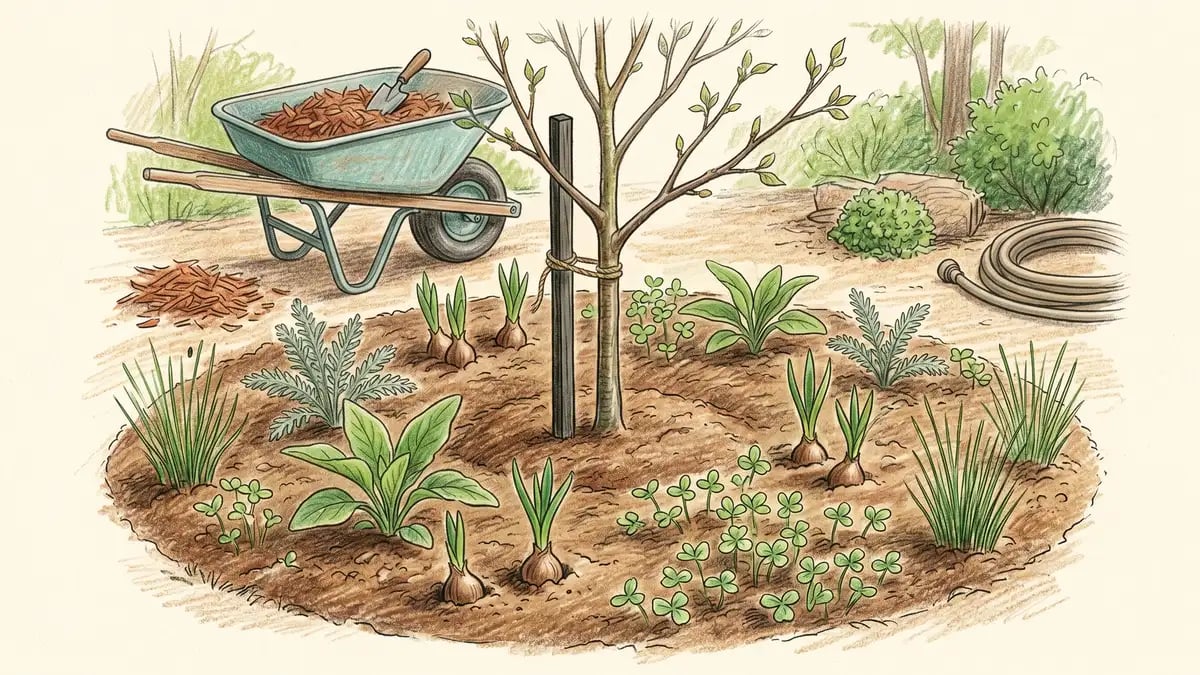
Trunk clear zone — 12–18 inches (30–46 cm) of bare mulch
Wood chips piled 2–3 inches deep, but never touching the bark. This is the single most important rule in fruit tree care: a "mulch volcano" piled against the trunk causes stem girdling, fungal disease, and rodent damage. Keep the bark dry and exposed.
Inner ring — daffodils and chives (18 in to 3 ft / 46 cm to 0.9 m)
Plant 8–12 daffodil bulbs in a circle 6 inches (15 cm) outward from the trunk. Their bulbs are unpalatable to voles, deer, and rabbits, and they bloom 2–4 weeks before the apple — pre-positioning early-season pollinators. Add 4–6 clusters of chives or garlic chives for codling moth confusion via allium volatiles.
Middle ring — comfrey, yarrow, dill (3 ft to drip line)
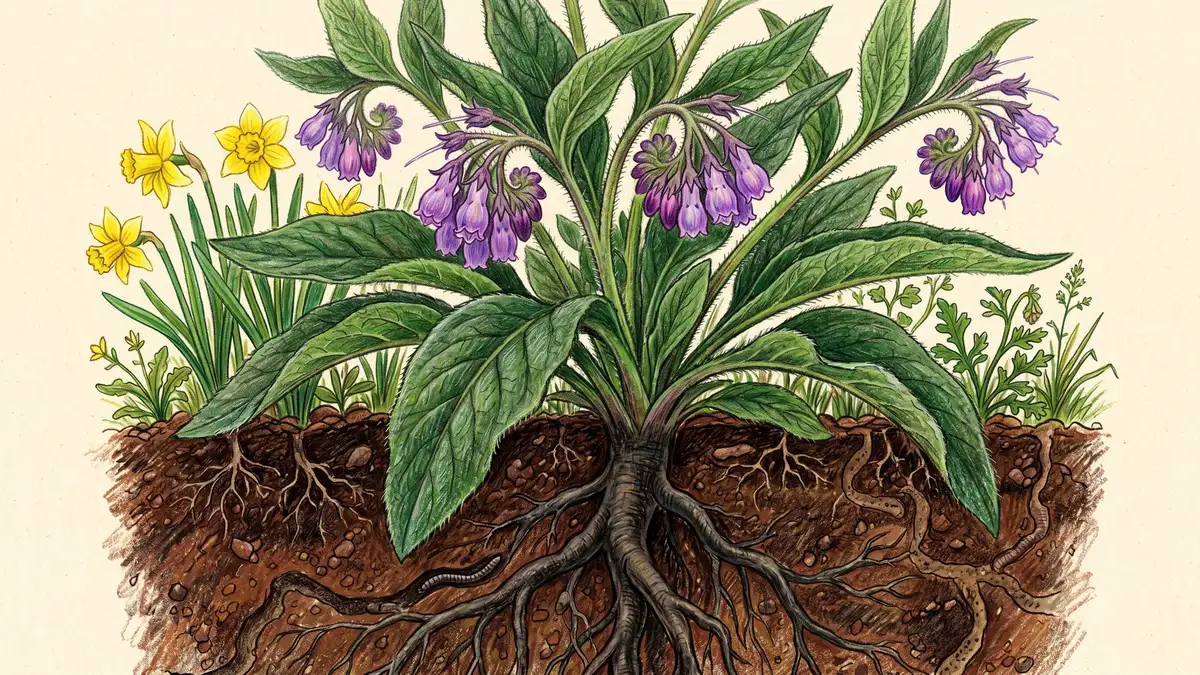
2–3 comfrey plants ('Bocking 14' is sterile and won't take over) spaced 3 ft (0.9 m) apart. A yarrow patch and self-seeding dill nearby. The Polyculture Project's comfrey research documents that one comfrey plant produces 4–6 kg of biomass per year — enough mulch to feed the entire guild.
Ground cover — white clover everywhere else
Broadcast seed 1 oz per 100 sq ft once the tree is established. White clover fixes 100–150 pounds of nitrogen per acre per year in good conditions. Mow it 2–3× per season — those clippings drop nitrogen back to the soil.
Drip line edge — calendula, bee balm, optional goumi
Calendula (annual but self-seeds) and bee balm bring in pollinators and parasitic wasps. If you have room, a goumi (Elaeagnus multiflora) bush at the drip line is an additional nitrogen fixer that also produces edible berries. Don't plant goumi inside the drip line — its roots will compete with the apple.
Total cost for one tree's worth of plants: 8 daffodil bulbs ($8), 3 comfrey crowns ($25), yarrow start ($6), dill seed ($3), chives start ($5), white clover seed ($8), calendula seed ($3), optional goumi ($25). Around $60–$80 for the full guild, less if you split comfrey crowns from a friend's plant. For neighbours growing related crops, our deep dives on, and the soil food web all extend the same principles.
Adapting the Guild for Citrus, Peach, and Cherry
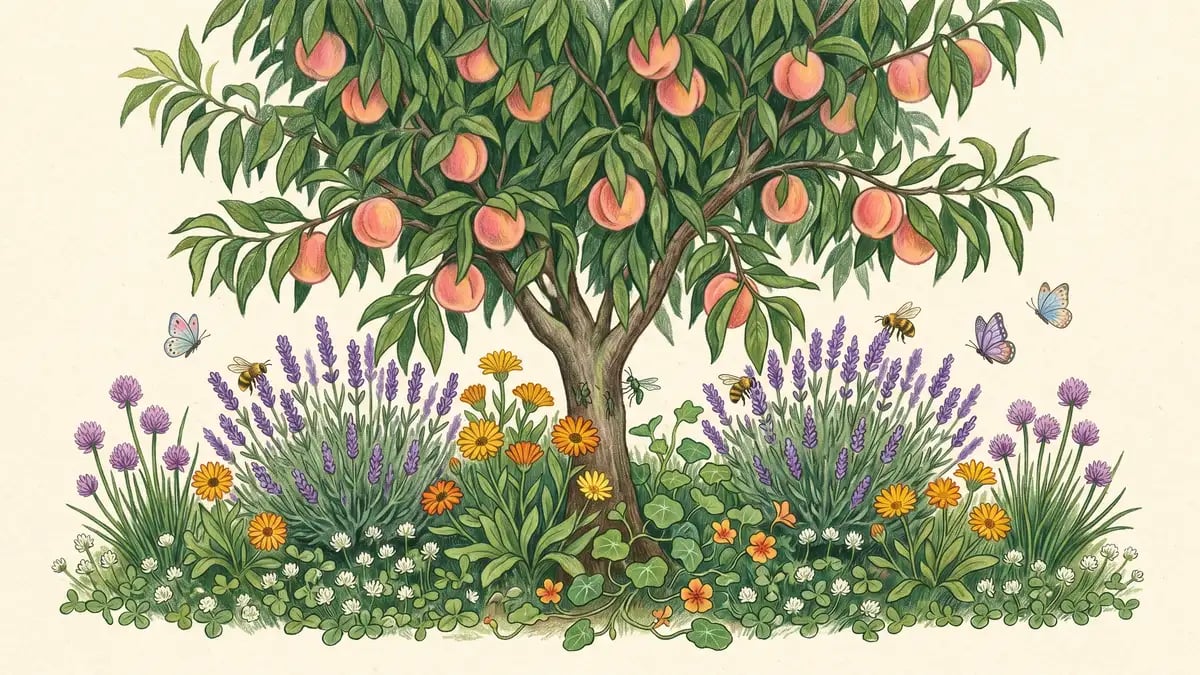
The apple template is the baseline. Each fruit family needs a few specific swaps based on its growth habit, root depth, and pest profile.
| Tree | Keep from apple guild | Swap or add | Avoid |
| Pear | Daffodils, chives, comfrey, yarrow, white clover | Add tansy nearby (not in guild — fire-blight context) | Anything that traps moisture against the trunk |
| Peach (Prunus) | White clover (sparingly), borage, calendula, chives | Lavender at drip line; thyme as low ground cover | Comfrey too close; deep root competition stresses shallow Prunus roots |
| Plum (Prunus) | Most apple guild plants | Extra airflow — wider spacing for brown rot prevention | Dense mulch against the trunk; thick canopy ground covers |
| Cherry (Prunus) | Yarrow, dill, alyssum (cherry fruit fly parasitoids) | Sweet alyssum as a hoverfly magnet | Excessive mulch — encourages cherry leaf spot |
| Citrus (warm climates only) | Borage, calendula, French marigold | Lavender, rosemary, lemon balm at drip line | Anything under the canopy — citrus self-mulches with leaves |
Sources:.
Stone fruit — handle with care. Peach, plum, and cherry are Prunus species with shallow root systems that are extremely sensitive to disturbance and competition. UC Cooperative Extension specifically recommends keeping three feet around the trunk free of grass or vegetation for young stone fruit. Don't pile comfrey close to the trunk, and don't dig in this zone once the tree is established. White clover only — and only if you have reliable rainfall or irrigation.
Citrus — different physiology entirely. Citrus trees grow to the ground in a dense canopy and self-mulch with their own dropped leaves. Don't underplant directly beneath the canopy. Instead, plant your nitrogen fixers, herbs, and pollinator attractants at the drip line and just outside it. Lavender, rosemary, sage, thyme, and borage all match citrus's Mediterranean preferences. French marigolds at the drip line suppress root-knot nematodes — citrus's most common soil pest.
Plants and pairings to avoid
Black walnut within 30–50 ft (9–15 m). Walnut roots release juglone, which kills apples, blueberries, tomatoes, and most stone fruit. Mulch volcanoes — never pile mulch against the trunk; keep a 12–18 inch (30–46 cm) bare ring. Aggressive nitrogen-fixing trees inside the drip line — mimosa, locust, and autumn olive will outcompete a young fruit tree if planted too close; keep them outside the canopy and prune hard. Comfrey too close to peach or cherry trunks — its 8-foot taproot will compete with shallow Prunus roots for the first 2 years. Fennel anywhere in the inner guild — allelopathic; suppresses neighbours.
How to Install a Guild Around an Existing Fruit Tree
You don't have to start from a bare patch. A guild can be retrofitted around a mature tree without disturbing its root system. The trick is to work in zones, plant in fall or early spring, and accept that Year 1 looks sparse — the guild matures over 2–3 seasons.
Step 1 — Mow and mulch. Mow the lawn or weeds inside the drip line as short as possible. Cover with cardboard (one layer, overlapping seams 6 inches), then top with 4–6 inches of wood chips. Leave a 12-inch bare ring at the trunk. This is the same sheet mulching technique we use for new garden beds, applied to the area inside the drip line.
Step 2 — Plant the perennials in fall. Comfrey crowns, daffodil bulbs, chives, and yarrow all establish best when planted in October–November (Northern Hemisphere). Cut Xs through the cardboard, plant the crowns or bulbs in the soil below, and pull the mulch back around the base. By spring, your perennials are rooted and ready to grow.
Step 3 — Seed the ground cover in early spring. Once soil temperatures are above 50°F (10°C), broadcast white clover seed directly over the mulch. Rake gently to settle the seed and water it in. Clover germinates in 7–14 days and fills in over the first season.
Step 4 — Add the annuals after last frost. Calendula, dill, nasturtium, and bee balm starts go in once the soil is warm. They self-seed for subsequent years. Year 1 is establishment; Year 2 is when you start chopping comfrey for mulch and seeing parasitic wasps move in. Year 3 is when irrigation needs drop noticeably.
Get the Weekly Dig
One practical permaculture guide a week, written for gardeners who do this on weekends: food forest and guild designs that produce. Free, no spam, unsubscribe any time.
Join the Weekly DigFrequently Asked Questions
What is a fruit tree guild?
A fruit tree guild is a permaculture design pattern where a central fruit tree is surrounded by 5–8 companion plants chosen to fill specific ecological roles: nitrogen fixation, dynamic nutrient accumulation, pest deterrence, pollinator attraction, mulch production, and ground cover. The classic apple guild includes comfrey, daffodils, chives, yarrow, dill, white clover, and one or two flowering annuals. Properly designed guilds reduce the tree's water and fertiliser needs by 20–75% within three years and lower pest pressure by 30–80% compared to a tree planted in isolation.
What should you not plant near fruit trees?
Avoid black walnut anywhere within 30–50 ft (9–15 m) — its juglone toxin kills apples and most stone fruit. Don't plant aggressive nitrogen-fixing trees (mimosa, locust, autumn olive) inside the drip line because they'll outcompete the fruit tree for water and light. Keep fennel, brassicas, and dense vegetable plantings out of the inner guild zone. For stone fruit specifically (peach, plum, cherry), avoid deep-rooted competitors like comfrey within the first 3 ft of the trunk because their shallow roots are stressed by competition.
What not to plant near apple trees?
Avoid potatoes and tomatoes near apple trees — they share early blight and other disease pressures. Don't plant black walnut, hickory, or pecan within 50 ft. Skip aggressive grasses (Bermuda grass, quackgrass) inside the drip line; they outcompete the tree for water. And keep mulch a full 12–18 inches away from the trunk — a "mulch volcano" against the bark causes girdling and disease.
What not to plant near citrus trees?
Don't underplant directly beneath citrus canopies — citrus shades out competitors and self-mulches with dropped leaves and fruit. Avoid heavy nitrogen-demanding vegetables like brassicas and corn in the root zone (citrus is already a heavy nitrogen feeder). Keep grass and turf away from the trunk. Position companion plants — lavender, rosemary, borage, French marigold — at and just beyond the drip line, never directly under the canopy.
Can you plant different fruit trees next to each other?
Yes, with caveats. Apples, pears, plums, and cherries can be grouped if you allow proper spacing for mature canopy size (usually 12–20 ft apart for semi-dwarf, 8–12 ft for dwarf). Don't group stone fruit too tightly — they share brown rot and other disease pressures, and dense canopies trap humidity. Avoid mixing citrus with temperate fruit trees because their water and pruning needs are very different. For pollination, planting two compatible varieties of the same species (two different apples, two different cherries) within 50 ft (15 m) increases fruit set significantly.
What fruit trees should not be planted together?
Don't plant black walnut anywhere near apples, peaches, plums, or cherries — juglone will kill them. Avoid grouping all your stone fruit (peach + plum + cherry) tightly together because brown rot, leaf curl, and other Prunus diseases spread fast in dense plantings. Keep citrus separate from temperate fruit trees because of climate and pest mismatch. And don't plant nitrogen-fixing trees (locust, mimosa) right next to fruit trees — they'll outcompete the fruit tree unless you actively prune them down.
How long does it take a fruit tree guild to establish?
Year 1 is establishment — comfrey roots, clover germinates, daffodils settle. The guild looks sparse and you may need to weed and water normally. Year 2 you'll start harvesting comfrey for chop-and-drop mulch and noticing more pollinators and beneficial insects. Year 3 is when irrigation needs drop measurably and you stop adding fertiliser entirely. By Year 4–5 the guild is essentially self-managing — chop comfrey 2–3× per season, mow clover paths, and harvest fruit.
Resources
- 1000 Islands Master Gardeners — Designing Fruit & Nut Tree Guilds
- Toby Hemenway — Using Natural Plant Communities to Guide Guild Design
- Dave Jacke — Edible Forest Gardens (overview)
- Tenth Acre Farm — How to Build a Permaculture Fruit Tree Guild
- OrchardPeople — Nitrogen Fixing Trees for Your Orchard
- The Polyculture Project — Comfrey Biomass and Nutrient Data
- UC Cooperative Extension — Planting and Care of Young Fruit Trees (PDF)
- Cornell — 2025 Pest Management Guidelines for Tree Fruit (PDF)
- UMN Extension — Brown Rot of Stone Fruit
- Gardenia.net — Best Peach Companion Plants
- Permaculture Apprentice — How to Plant Your Fruit Tree Guilds
- Grow Organic — What Not to Plant Near a Black Walnut Tree
- Plants For A Future — Symphytum officinale (Comfrey)