
Why Do Gardeners Plant Marigolds With Vegetables?
Walk through any productive vegetable garden in May and you'll spot them: bright orange and yellow marigolds (Tagetes spp.) tucked between tomato cages, lining raised bed edges, and clustered near pepper plants. The advice to "plant marigolds for pest control" has been passed down through generations of gardeners. But how much of that advice holds up under scientific scrutiny? what the evidence says about whiteflies plants that repel aphids keeping rabbits out of the garden companion planting with wildflowers what the marigold research actually shows
The answer is more nuanced than most gardening guides suggest. French marigolds (Tagetes patula) produce alpha-terthienyl, one of the most toxic naturally occurring compounds ever identified against plant-parasitic nematodes, with field trials documenting up to 99% suppression of root-knot nematodes when grown as cover crops. Meanwhile, research from Newcastle University published in PLOS ONE confirmed that marigolds emit limonene, a volatile compound that measurably repels whiteflies from tomatoes. Yet the popular belief that marigolds universally repel all garden pests? That's largely unsupported by peer-reviewed evidence.
What you'll learn in this guide:
- Which marigold species actually work for pest control and which don't
- The science behind nematode suppression, whitefly repellence, and beneficial insect attraction
- How to choose between French, African, and Signet marigolds for your garden
- Proper spacing and placement for maximum effectiveness
- What the research says about marigolds with tomatoes, peppers, cucumbers, and other vegetables
Key Takeaway
Marigolds earn their place in the vegetable garden through three distinct mechanisms: root-zone nematode suppression via alpha-terthienyl, airborne whitefly repellence via limonene, and beneficial insect attraction through nectar and pollen. Each mechanism works differently and requires different planting strategies to be effective.
Which Marigolds Are Best for Pest Control?
Not all marigolds are created equal when it comes to companion planting. The genus Tagetes includes roughly 50 species, but three dominate home gardens and each brings different strengths to the table.
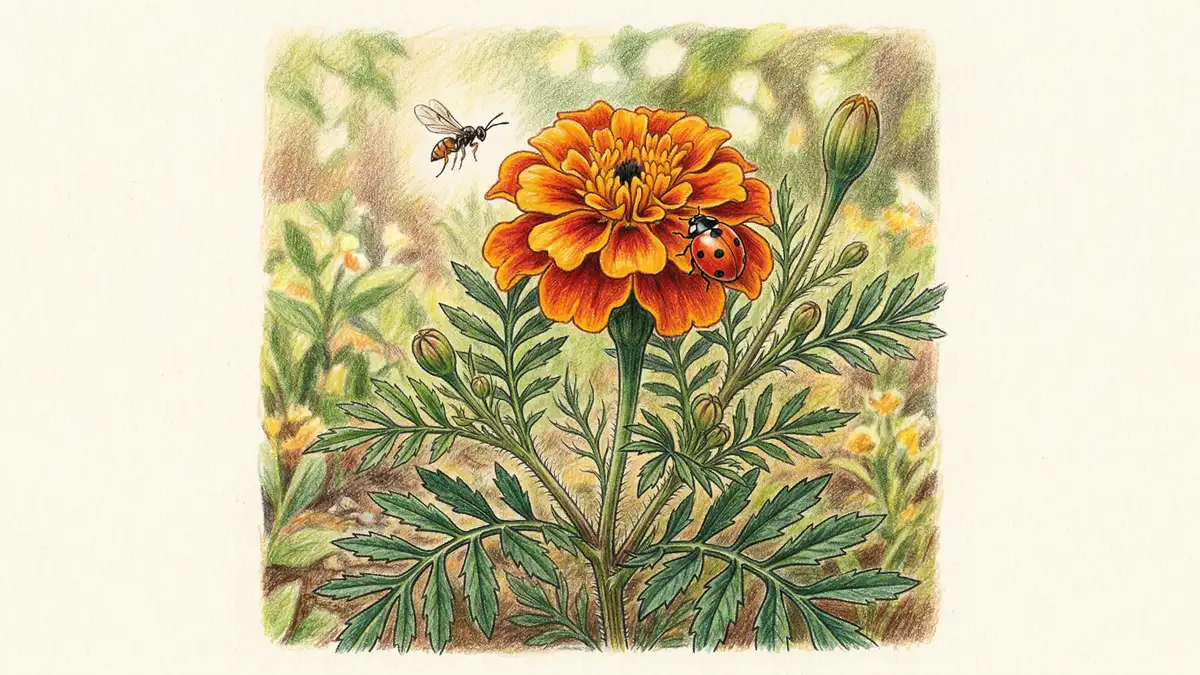
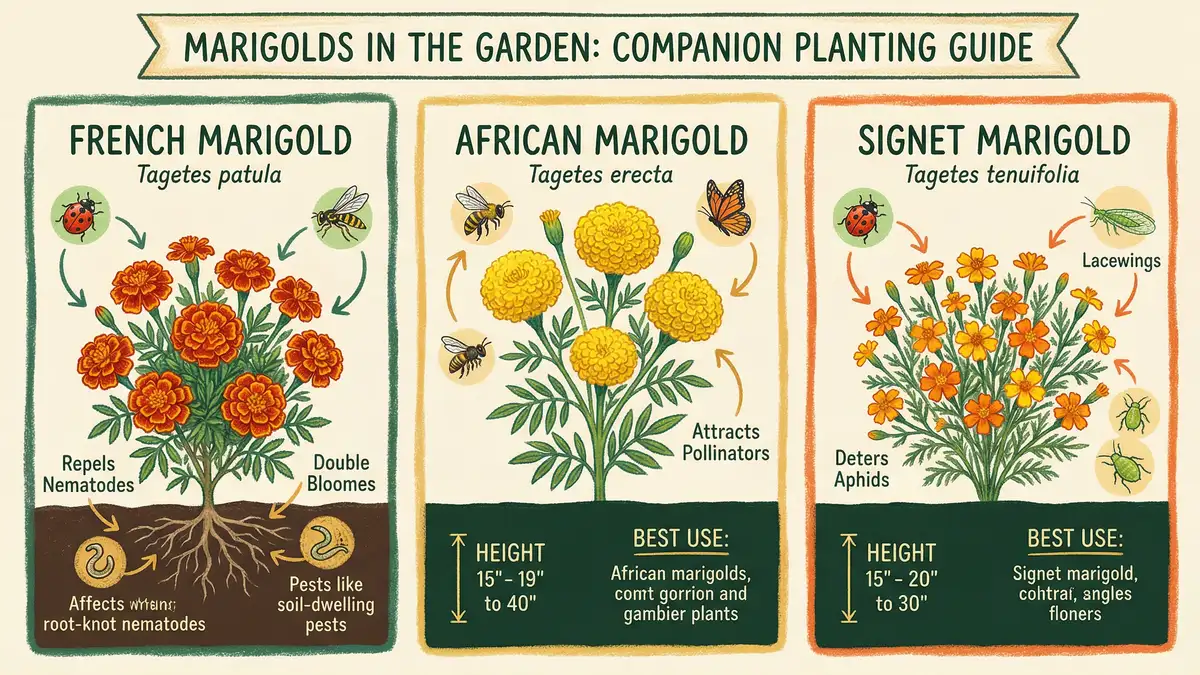
French marigolds (Tagetes patula) are the workhorse of companion planting. These compact plants reach 6-12 inches (15-30 cm) tall and produce the broadest spectrum of nematicidal compounds. According to the University of Florida IFAS Extension, French marigold cultivars demonstrate the widest range of nematode-suppressive activity among all Tagetes species, effectively targeting both root-knot (Meloidogyne spp.) and root-lesion (Pratylenchus spp.) nematodes. They also produce the limonene responsible for whitefly repellence.
African marigolds (Tagetes erecta) grow much taller at 1-3 feet (30-90 cm) and produce large pompom-style blooms. They're effective against nematodes too, with the cultivar 'Flor de Muerto' showing considerable nematicidal activity, though Clemson University Extension notes they generally have narrower species specificity than French varieties. Their larger size means wider spacing of 12-24 inches (30-60 cm) between plants.
Signet marigolds (Tagetes tenuifolia) are the smallest species with fine-textured foliage and abundant small flowers. They're excellent for attracting minute pirate bugs (Orius spp.), which feed on thrips, aphids, and mites. However, the LSU Agricultural Centre cautions that Signet marigolds lack natural resistance to root-knot nematodes, making them unsuitable for nematode suppression programs.
| Species | Height | Nematode Suppression | Best Use |
| French (T. patula) | 6-12 in. | Broadest spectrum | Interplanting, nematode cover crop, whitefly repellence |
| African (T. erecta) | 12-36 in. | Good, narrower range | Border planting, nematode cover crop |
| Signet (T. tenuifolia) | 6-12 in. | None | Beneficial insect attraction, containers |
Sources:
How Do Marigolds Actually Control Pests?
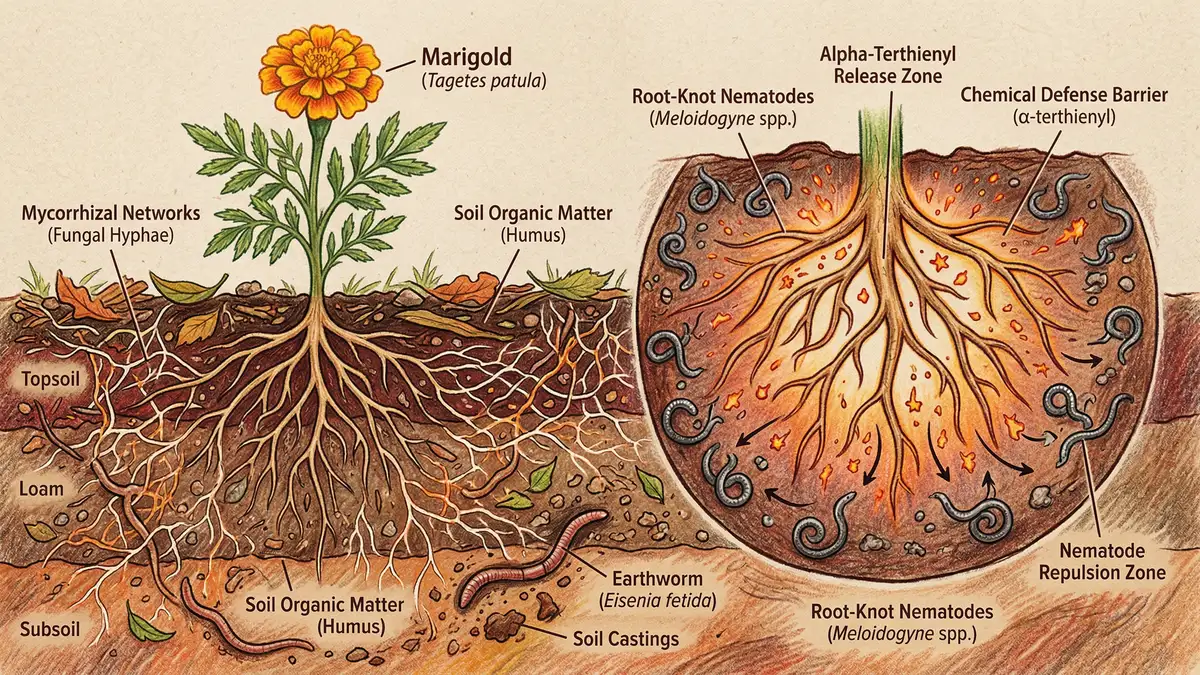
Underground: nematode suppression. Marigold roots exude thiophene compounds, primarily alpha-terthienyl, that are lethal to plant-parasitic nematodes. According to peer-reviewed nematology research, these compounds inhibit nematode egg hatching and damage internal tissues when nematodes penetrate marigold roots. Research from UC Riverside documented 99% reduction in root-lesion nematode damage to tomatoes following African marigold cover crop cultivation. The ATTRA Sustainable Agriculture program reports that the French cultivar 'Single Gold' achieved 99% control in Dutch field trials.
Above ground: limonene emission. French marigold foliage releases limonene, a monoterpene volatile that disrupts whitefly host-finding behavior. The Newcastle University team found that tomatoes grown alongside marigolds showed significantly slower whitefly population development over 48 days. Lead researcher Dr. Colin Tosh noted that limonene is inexpensive, not harmful, and far less risky than pesticides.
Ecosystem level: beneficial insect attraction. Marigold flowers provide nectar and pollen to ladybugs, lacewings, hoverflies, and parasitic wasps. Research cited by Cornell Cooperative Extension found that beneficial insects can migrate up to 260 feet (80 m) from flowering plant refugia into neighboring crop fields, meaning even border plantings can protect substantial garden areas.
Why This Works: Stacking Functions
In permaculture design, every element should serve multiple purposes. A single French marigold plant simultaneously suppresses nematodes through root chemistry, repels whiteflies through airborne limonene, attracts beneficial predatory insects through nectar, and adds organic matter to the soil when turned under at season's end. That's four functions from one plant occupying 8 inches (20 cm) of bed space. This is the guild principle in action: plants working together so the whole system performs better than any single element could alone.
Common Mistake: Expecting Universal Pest Repellence
Research at Rutgers University found that marigolds failed to repel cabbage, carrot, and onion pests. The USDA documents 15 pest species that actively infest marigolds themselves, including aphids, Japanese beetles, and spider mites. Plant marigolds for their proven benefits (nematode suppression, whitefly deterrence, beneficial insect attraction), not as a magical pest-repelling cure-all.
Which Vegetables Pair Best With Marigolds?
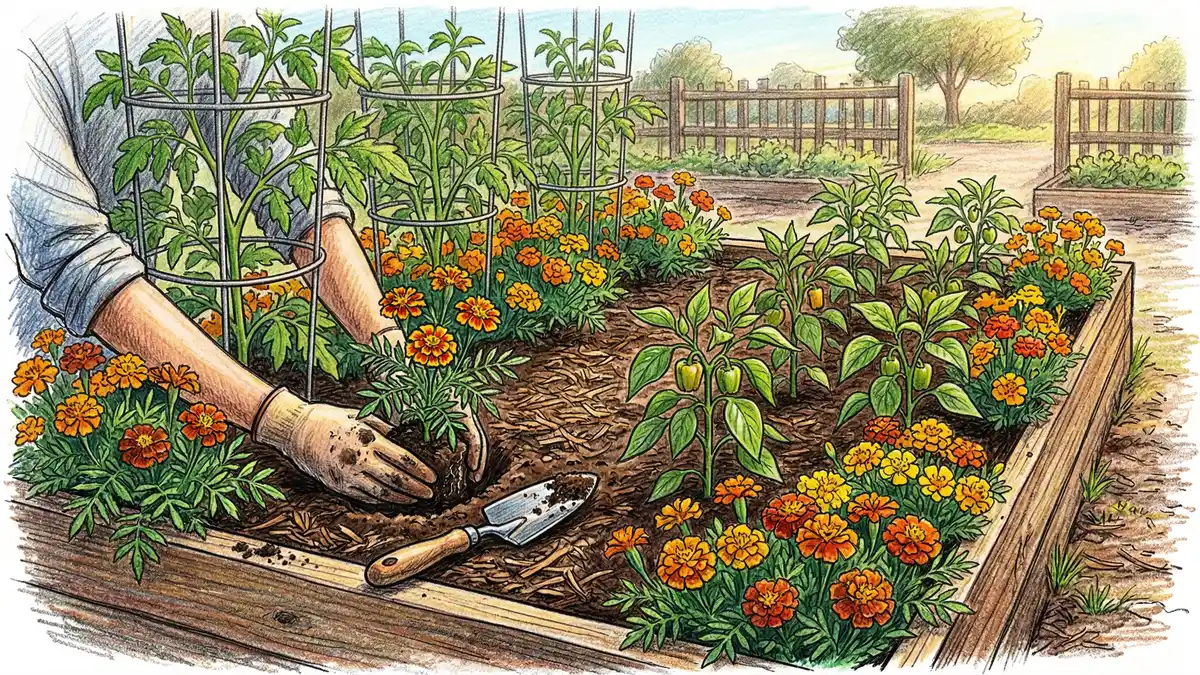
Tomatoes are the classic marigold companion with the strongest research backing. The combination provides nematode suppression through root chemistry, whitefly repellence through limonene, and parasitic wasp attraction that helps control tomato hornworms. Space French marigolds 12-15 inches (30-38 cm) from tomato stems to balance pest protection against resource competition.
Peppers benefit from similar mechanisms. The limonene that repels whiteflies from tomatoes works equally well around pepper plants, and nematode suppression protects pepper root systems that are vulnerable to the same Meloidogyne species.
Cucumbers and squash gain protection primarily through beneficial insect attraction and some above-ground pest deterrence. An Iowa State University study found that marigolds intercropped with zucchini demonstrated superior resistance to cucumber beetle damage. Marigold and nasturtium companions showed equal effectiveness against squash bugs.
Potatoes are an underrated pairing. Research from ATTRA documented that marigold rotation crops (particularly 'Cracker Jack') produced fewer root-lesion nematodes and elevated potato yields compared to rye rotation or continuous potato cropping.

Beans present a more complicated relationship. Traditional sources list beans as poor marigold companions due to allelopathic concerns, but subsequent trials showed positive results against Mexican bean beetles when marigolds were intercropped with beans. The evidence is mixed, so proceed with observation.
Brassicas (cabbage, broccoli, kale) receive only modest protection from marigolds. Iowa State research found that thyme, nasturtium, and onion companions all provided superior resistance to cabbage worm and weevil damage compared to marigolds for these crops.
How to Plant Marigolds for Maximum Pest Control
Choose the Right Cultivars
For nematode suppression, select proven French marigold cultivars: 'Single Gold', 'Tangerine', 'Queen Sophia', 'Nemagold', or 'Nema-Gone'. For beneficial insect attraction, Signet marigold 'Lemon Gem' excels at drawing minute pirate bugs. A seed packet of 100+ seeds costs $2-5.
Start Seeds 6-8 Weeks Before Last Frost
Sow in pre-moistened seed starting mix at 70-75 degrees Fahrenheit (21-24 degrees Celsius). Seeds germinate in 5-8 days. Pinch growing tips when seedlings reach 4 inches (10 cm) to encourage bushier growth and more flowers. Total time investment: about 2 hours for a full garden's worth.
Transplant After All Frost Danger Passes
Wait until soil temperatures reach at least 60 degrees Fahrenheit (15 degrees Celsius). Harden off seedlings over 7-10 days before planting out. This typically aligns with tomato transplanting time in your zone.
Space Strategically
Plant French marigolds 8-12 inches (20-30 cm) apart and 12-15 inches (30-38 cm) from vegetable stems. For nematode cover cropping, plant at dense 8-inch (20 cm) centers in a monoculture for 3-4 months before the target vegetable crop. Border plantings should be within 6 feet (2 m) of crops for maximum whitefly protection.
Maintain Through the Season
Marigolds need full sun (6+ hours), about 1 inch (2.5 cm) of water weekly, and minimal fertilizer. Deadhead spent blooms every week or two to extend flowering from early summer through first frost. At season's end, till plants into the soil or compost them to add organic matter.
Key Takeaway
For nematode control, interplanting isn't enough. You need to grow marigolds as a dedicated cover crop for 3-4 months before planting vegetables in that bed. Interplanting provides above-ground benefits (whitefly deterrence and beneficial insects) but won't suppress nematodes already attacking neighboring vegetable roots.
Why This Works: Observe and Interact
The first permaculture design principle reminds us to observe our gardens before intervening. Before planting marigolds for nematode control, get a soil nematode assay through your local county extension office. If root-knot nematodes aren't present, you'll get more value from interplanting for whitefly protection and beneficial insect attraction than from a cover crop rotation. Match the strategy to your actual garden conditions, not generic advice.
Frequently Asked Questions
Do marigolds repel mosquitoes?
Marigolds contain compounds that mosquitoes find unpleasant, but simply growing marigold plants in your garden won't create a mosquito-free zone. The limonene and other volatile compounds released by living plants disperse quickly in outdoor air. Research confirms marigolds are effective against whiteflies in close proximity to crop plants, but mosquito repellence from growing plants lacks strong scientific documentation. Crushed marigold foliage applied to skin may provide temporary relief, though commercial repellents remain far more effective.
What should you not plant with marigolds?
Beans have traditionally been listed as poor marigold companions due to potential allelopathic effects from thiophene root compounds. However, research results are mixed, with some trials showing marigolds actually helped reduce Mexican bean beetle damage. Brassicas (cabbage, broccoli, kale) gain minimal protection from marigolds compared to better companion options like thyme, nasturtium, or onions. Avoid planting marigolds near crops where they might compete for light with low-growing vegetables.
How far apart should marigolds be from vegetables?
Plant French marigolds 12-15 inches (30-38 cm) from vegetable stems for intercropping. For border plantings, position them within 6 feet (2 m) of target crops for limonene-based whitefly protection. For nematode cover cropping, the marigolds occupy the bed alone at 8-inch (20 cm) centers for 3-4 months before vegetables are planted. African marigolds need wider spacing of 12-24 inches (30-60 cm) between plants due to their larger size.
Where should you plant marigolds in a vegetable garden?
The most effective placement depends on your goal. For whitefly protection, interplant French marigolds directly among tomatoes and peppers. For beneficial insect attraction, plant as borders around bed edges where they can serve as visible landing pads for pollinators and predatory insects. Research from Cornell Extension shows beneficial insects can travel up to 260 feet (80 m) from flowering refugia, so even edge plantings protect a large area.
Which marigolds are best for pest control?
French marigolds (Tagetes patula) are the most versatile choice, offering the broadest nematode suppression spectrum plus limonene-based whitefly repellence. Specific cultivars with documented nematode resistance include 'Single Gold', 'Tangerine', 'Queen Sophia', and 'Nema-Gone'. For beneficial insect attraction specifically, Signet marigold 'Lemon Gem' excels at attracting minute pirate bugs. African marigolds are effective for nematode cover crops but take up more garden space.
Get the Weekly Dig
One practical permaculture guide a week, written for gardeners who do this on weekends: companion pairings that hold up under scrutiny, and the ones that do not. Free, no spam, unsubscribe any time.
Join the Weekly DigResources
- UF IFAS Extension — Marigolds (Tagetes spp.) for Nematode Management
- PLOS ONE — Companion Planting With French Marigolds Protects Tomato Plants From Whiteflies
- PMC — Effects of Tagetes patula on Active and Inactive Stages of Root-Knot Nematodes
- ATTRA — Nematodes: Alternative Controls
- LSU Agricultural Centre — Marigolds Effective Against the Southern Root-Knot Nematode
- UMN Extension — Marigolds
- Cornell Cooperative Extension — Companion Planting and Flower Borders
- Clemson University Extension — How to Grow and Care for Marigolds
pairing marigolds with lavender
sage companion plants