
Garden writers throw the words "intercropping" and "companion planting" around as if they meant the same thing. They do not. Intercropping is an agronomic discipline with 80 years of peer-reviewed yield data. Companion planting is a popular horticultural tradition with mixed scientific support. They overlap, they often share examples, and most American backyard gardeners are practicing some of both. Understanding the difference helps you pick the right strategy for your scale and goals.
Where the two terms come from
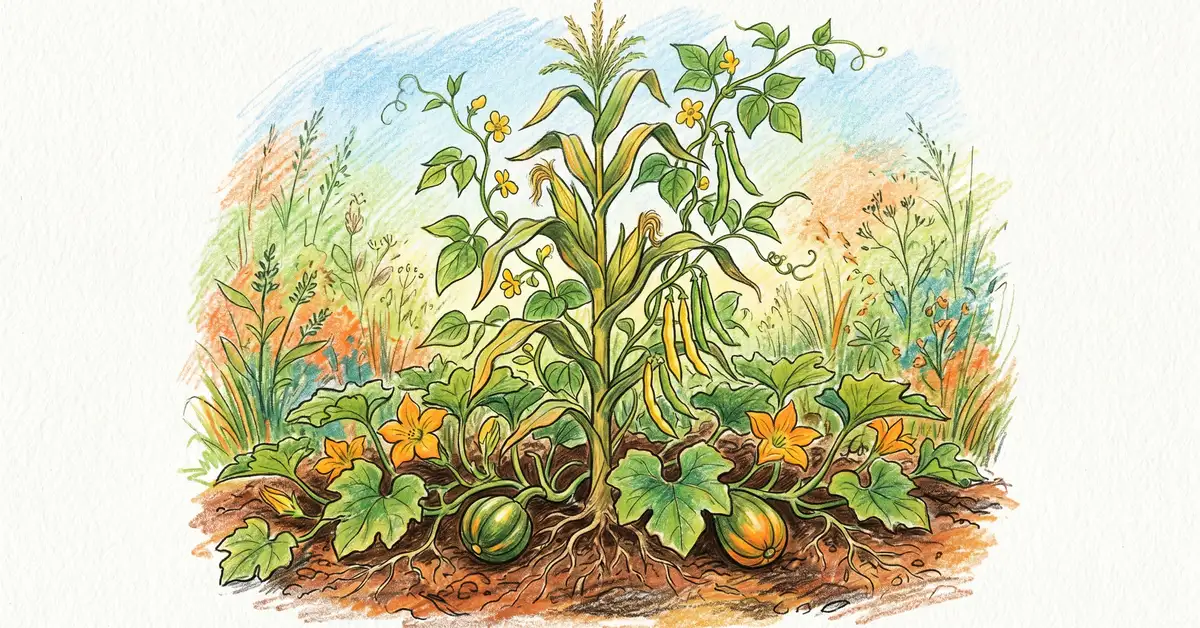
Intercropping is a term from agronomy, the science of crop production at scale. FAO and USDA SARE both define intercropping as growing two or more crops simultaneously on the same area of land, primarily to increase yield or resource efficiency per unit area. The practice predates the term by millennia. Indigenous North American agriculture grew corn, beans, and squash together (the Three Sisters) for 5,000+ years before European contact. Mesoamerican milpa systems combined corn with squash, beans, and amaranth. Sub-Saharan African farms still grow grain-legume intercrops as standard practice.
Companion planting in its modern English-language form began with Helen Philbrick's 1943 book Companion Plants and How to Use Them and reached US mass audience with Louise Riotte's 1975 book Carrots Love Tomatoes. Riotte's book sold over 500,000 copies and shaped a generation of American backyard gardeners. The framework leaned on biodynamic farming, folk traditions, and observation rather than controlled experiments. Some of its pairings (tomato-basil, brassica-aromatic herb, three sisters) hold up to peer-reviewed testing. Others (geraniums repel Japanese beetles, garlic protects roses from black spot) have weak or no scientific support.
What intercropping actually is
Why this works (the permaculture principle)
Permaculture treats every garden as a polyculture by default. Intercropping and companion planting are two languages for the same underlying truth: a diverse plant community produces more total food, suffers less from pests, and uses resources more efficiently than a monoculture. The same logic underpins our broader companion planting framework and our permaculture garden design guide.
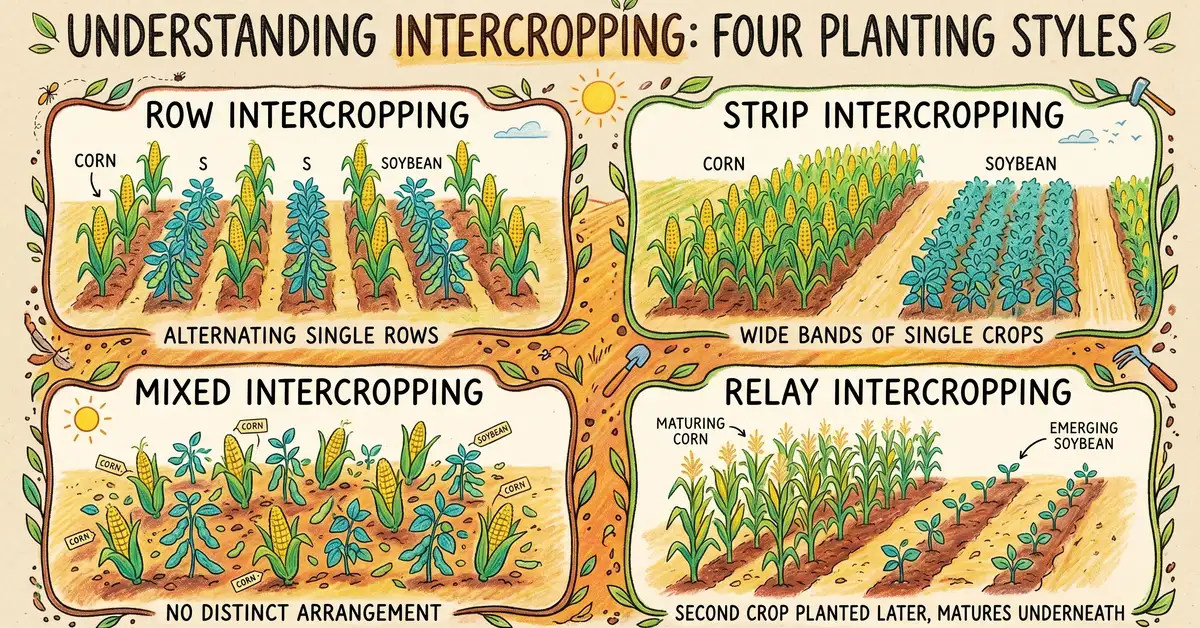
Agronomists classify intercropping into 4 styles:
Row intercropping. Alternating rows of two crops. Classic example: a row of corn, then a row of beans, then a row of corn, repeating. Easy to manage with mechanical equipment.
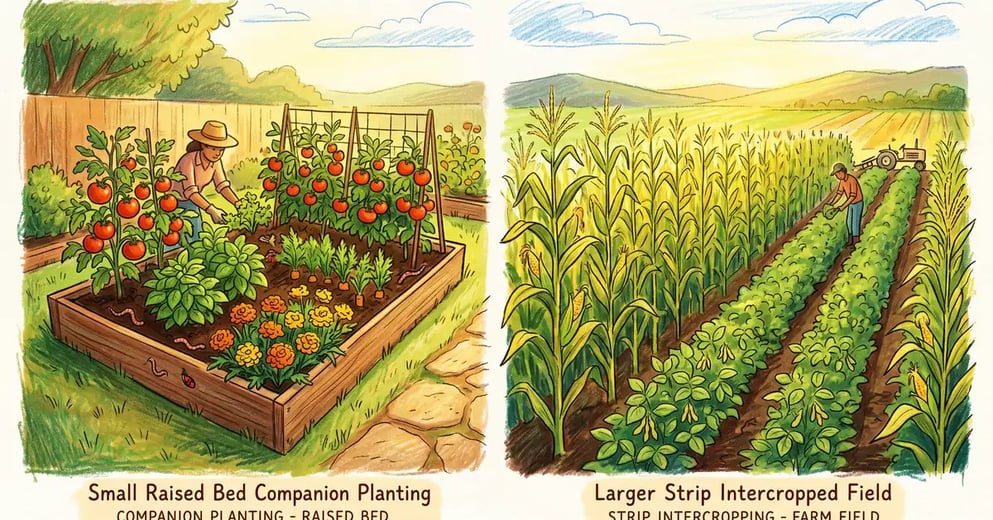
Strip intercropping. Wide bands of single crops in alternation. Each band is wide enough to manage as its own crop (often 4 to 12 rows) but narrow enough for the two crops to benefit each other through edge effects, beneficial insect movement, and disease break.
Mixed intercropping. Plants of two or more crops are mixed without distinct rows. Common in indigenous systems and traditional smallholder agriculture. Productive but harder to mechanize.
Relay intercropping. A second crop is planted into the first before the first is harvested. Wheat undersown with clover is the textbook example: the clover establishes during late wheat growth, then takes over the field after wheat harvest.
The Land Equivalent Ratio
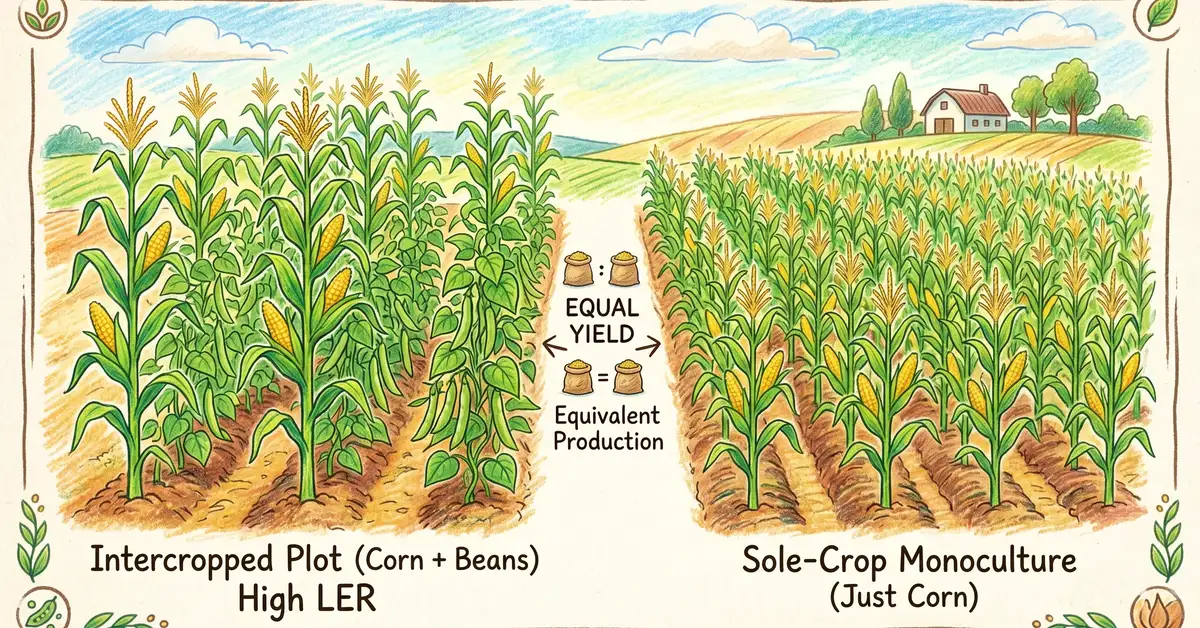
Intercropping's central metric is the Land Equivalent Ratio (LER), the gold-standard measurement of whether a polyculture outperforms its component monocultures. LER above 1.0 means the intercrop produces more total yield than separate monocultures of the same crops on the same combined area. Well-designed intercrops commonly achieve LER 1.2 to 1.5, meaning a 20 to 50 percent yield advantage. Maize-soybean, cassava-cowpea, maize-pigeon pea, and Three Sisters all reach this range in published studies from CGIAR, USDA SARE, and university agronomy programs.
What companion planting actually is
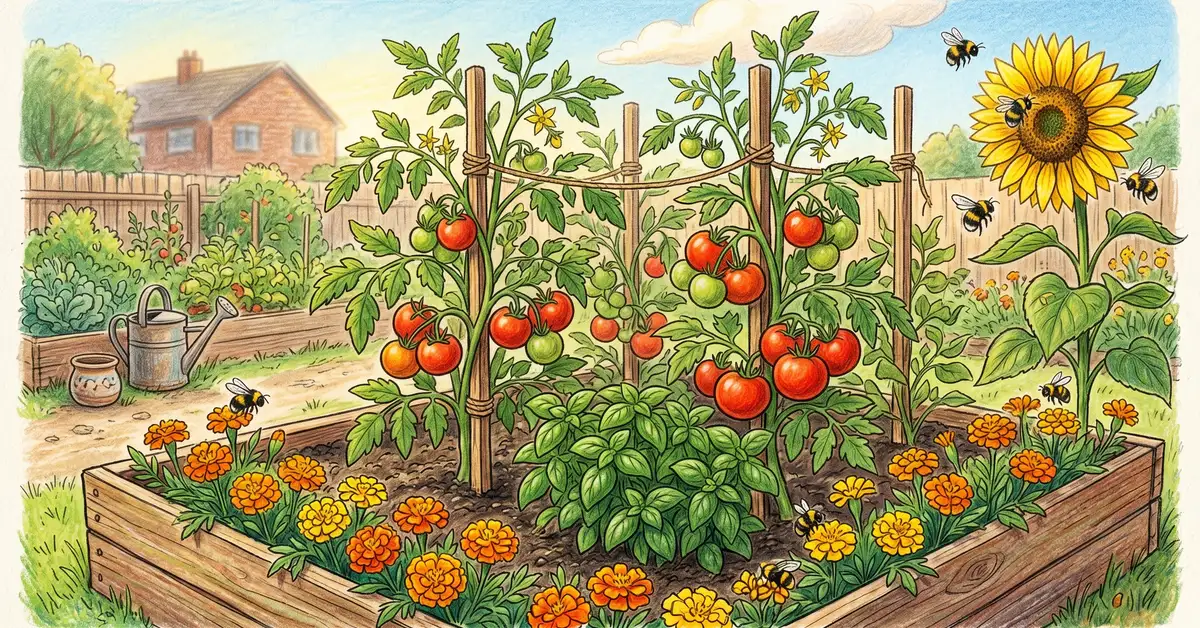
Companion planting works at a different scale and with a different vocabulary. The unit is the pair (or small guild), not the field. The goals are typically pest deterrence, pollinator attraction, beneficial insect harbor, soil benefit, flavor enhancement, and structural support, not maximum yield per acre.
Common companion planting categories:
Pest deterrent pairs. Sage near brassicas to deter cabbage moth. Basil near tomatoes to deter hornworm. Garlic near roses to deter aphids. Some pairings have peer-reviewed support; others are folkloric.
Trap crops. Nasturtium drawing aphids away from cucurbits. Radishes drawing flea beetles away from brassicas. Documented in UC IPM and Cornell IPM literature.
Pollinator attractors. Borage, calendula, sweet alyssum, sunflowers near fruiting crops to increase fruit set through pollinator visitation.
Nitrogen fixers. Beans and peas providing some nitrogen to heavy-feeding neighbors. Strongest in long-term mixed plantings.
Dynamic accumulators. Comfrey near fruit trees mining potassium and trace minerals from subsoil.
Structural support. Corn supporting beans. Sunflowers supporting cucumbers.
Intercropping vs companion planting at a glance
| Factor | Intercropping | Companion planting |
| Origin | Agronomy and indigenous agriculture, thousands of years old | Popularized by Philbrick 1943 and Riotte 1975 in English literature |
| Scale | Field to small farm | Backyard bed and container |
| Primary goal | Yield and resource efficiency per area | Pest deterrence and pollinator support |
| Evidence base | Strong peer-reviewed agronomic data (LER, biomass, yield) | Mixed; some peer-reviewed, much folkloric |
| Key metric | Land Equivalent Ratio (target above 1.0) | Pest pressure reduction, fruit set, qualitative |
| Typical pairings | Grain-legume, grain-tuber, cereal-cover crop | Vegetable-herb, vegetable-flower, vegetable-vegetable |
| Design unit | Row, strip, mix, relay | Pair, guild, small cluster |
| Mechanization | Row and strip styles designed for it; mixed and relay are harder | Not relevant at backyard scale |
| Famous example | Three Sisters (corn-bean-squash), wheat-clover undersow | Tomato-basil, brassica-sage, carrot-onion |
Source:, peer-reviewed agronomy literature on intercropping LER and yield data.
The Three Sisters is both
The Three Sisters (corn, beans, squash) is the most cited example of both intercropping and companion planting in US literature, and there is no contradiction. From an agronomic standpoint it is a row or mixed intercrop with documented LER 1.2 to 1.5 (Iowa State, Penn State, and Native American agriculture programs have measured it). From a companion planting standpoint it is the archetypal mutual-benefit polyculture: corn provides structural support, beans fix nitrogen, squash provides ground cover that suppresses weeds and retains moisture. Read more in our three sisters planting guide.
Modern intercropping in the United States
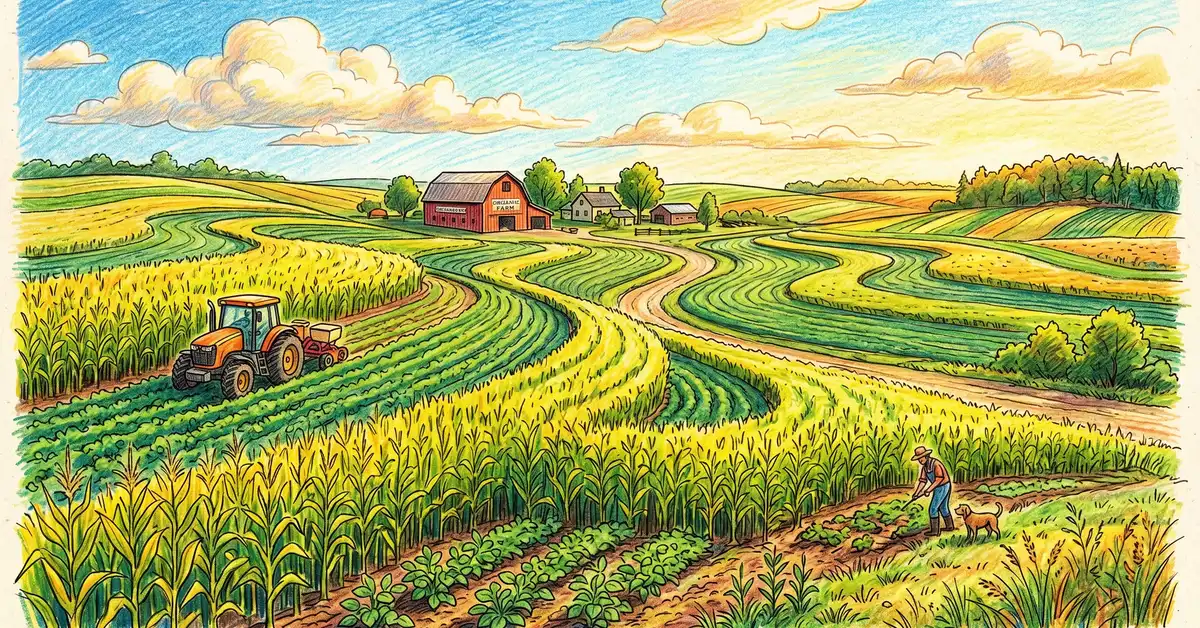
Strip intercropping has been growing in the US Midwest as organic and regenerative farms look for ways to break disease cycles, reduce inputs, and maintain yield. Iowa State University, the Practical Farmers of Iowa, and other regional networks document farms running 4-row to 12-row strips of corn alternating with soybeans or small grains. Documented benefits include 5 to 15 percent yield gains, reduced herbicide and fungicide needs, and improved soil cover. Practical farmers note that strip width matters: too narrow and the equipment cannot operate; too wide and the inter-crop benefits disappear.
Where the science is strongest (and weakest) for companion planting
How to decide which framework to use
The vocabulary you use depends on your scale and goals:
If you are a backyard gardener with raised beds or small in-ground plots. Companion planting is your framework. Think in pairs and small guilds. Focus on the well-supported pairings (sage and brassicas, basil and tomato, three sisters, alliums and carrots). Treat the magazine charts with healthy skepticism.
If you are a market gardener or small farmer with rows. Intercropping is your framework. Use row or strip designs. Measure outcomes with LER. Read SARE and ATTRA literature.
If you are designing a food forest. Both. The guild concept from permaculture combines companion planting logic with the structural diversity of an intercrop. Sepp Holzer's mountain permaculture, Mollison and Holmgren's permaculture, and indigenous polycultures all blend the two.
If you are reading academic agriculture literature. Intercropping is the technical term. Companion planting will rarely appear in peer-reviewed agronomic journals.
If you are reading gardening magazines. Companion planting is the popular term. Intercropping will rarely appear in mainstream gardening writing.
Permaculture, polyculture, and other related terms
A few neighboring terms cause confusion:
Polyculture. The general scientific term for growing multiple species in the same area at the same time. Intercropping is the agronomic form. Companion planting is the horticultural form. Food forests are perennial polycultures.
Monoculture. The opposite of polyculture. One crop per field. Mainstream US grain agriculture is largely monocultural. Read more in our permaculture garden design guide.
Permaculture. A whole-property design discipline that incorporates polyculture, water, soil, and structural design. Polyculture is a tool inside permaculture, not the same thing.
Agroforestry. Intercropping or polyculture that includes trees as a major layer. Alley cropping (rows of crops between rows of trees) is the most common US example.
Crop rotation. Different concept, different time scale. Crop rotation sequences different crops on the same land over multiple years. Intercropping and companion planting grow them at the same time.
Get the Weekly Dig
One practical permaculture guide a week, written for gardeners who do this on weekends: companion pairings that hold up under scrutiny, and the ones that do not. Free, no spam, unsubscribe any time.
Join the newsletterFrequently asked questions
What is the difference between intercropping and companion planting?
Intercropping is the agronomic practice of growing two or more crops in the same area at the same time, primarily to increase yield and resource efficiency, with strong peer-reviewed scientific support. Companion planting is the horticultural and folk practice of pairing specific plants for pest control, pollination, and flavor, with mixed scientific support. They overlap (the Three Sisters is both) but intercropping is field-scale and yield-driven while companion planting is bed-scale and pest-driven.
What is intercropping?
Intercropping is growing two or more crops in the same field simultaneously. The 4 main styles are row intercropping (alternating rows), strip intercropping (alternating wide bands), mixed intercropping (no distinct rows), and relay intercropping (a second crop planted into the first before harvest). Land Equivalent Ratio is the central metric, with values above 1.0 meaning the intercrop outperforms separate monocultures of the same crops on the same combined area.
How does intercropping work?
Intercropping works through three mechanisms: complementarity (crops use different resources at different times), facilitation (one crop helps the other), and reduced competition through niche separation. A grain-legume intercrop, for example, has the grain harvesting different soil nutrients than the legume while the legume fixes atmospheric nitrogen that benefits both. Light, water, and root-zone differences also drive the benefit.
What are 4 examples of intercropping?
(1) Three Sisters: corn, beans, and squash grown together. (2) Wheat undersown with clover for relay intercropping. (3) Strip intercropping of corn and soybean in Midwest organic and regenerative agriculture. (4) Cassava and cowpea in tropical smallholder farms. All of these have published LER data above 1.0.
Is companion planting scientifically proven?
Some companion planting pairings have strong peer-reviewed support, including the Three Sisters, tomato-basil for flavor, brassica-aromatic herb for cabbage moth deterrence, allium-carrot for root fly control, and trap crops like nasturtium for aphids. Many others (geraniums for Japanese beetles, garlic for rose black spot, hyssop for cabbage butterflies) have weak or contradictory data and remain folkloric. Treat popular charts with skepticism.
What is the Land Equivalent Ratio?
Land Equivalent Ratio (LER) is the agronomic metric that compares intercrop yield to the yields of the same crops grown alone. LER above 1.0 means the intercrop produces more total yield than separate monocultures on the same combined area. Well-designed intercrops commonly achieve 1.2 to 1.5, equivalent to a 20 to 50 percent yield advantage.
Is the Three Sisters intercropping or companion planting?
Both. The Three Sisters (corn, beans, squash) is the archetypal example of either framework. From an agronomic standpoint it is a row or mixed intercrop with documented LER 1.2 to 1.5. From a companion planting standpoint it is a mutual-benefit polyculture where corn supports beans, beans fix nitrogen, and squash covers ground.
How does intercropping reduce pests?
Intercropping reduces pest pressure through three mechanisms: visual and olfactory confusion (mixed crops are harder for pest insects to locate than a uniform monoculture), beneficial insect habitat (mixed plantings support more predators and parasitoids), and reduced concentration of any single host species (a pest that specializes in one crop has fewer host plants per unit area). Documented effects vary by crop combination and pest, with 30 to 60 percent reductions in some grain-legume intercrops.
Resources
- Food and Agriculture Organization of the United Nations (FAO)
- USDA SARE Sustainable Agriculture Research and Education
- ATTRA NCAT Sustainable Agriculture
- Practical Farmers of Iowa
- Iowa State University Extension
- Penn State Extension
- University of Maryland Extension
- Michigan State University Extension