
Does Companion Planting Actually Control Whiteflies?
Short answer, and you will not hear it often: the evidence for marigolds, nasturtiums, basil, and mint repelling whiteflies is thin to nonexistent. There is a version of companion planting that helps against whiteflies, but it is not the version on most garden blogs.
That is worth saying up front, because whiteflies are one pest where guessing wrong costs you the crop. They spread viruses. Once Tomato yellow leaf curl virus is in a plant, no spray, no companion, and no beneficial insect will get it out.
So this guide covers what the research supports, what it does not, and the planting strategy that genuinely moves the needle.
Key Takeaway
Stop asking "what repels whiteflies" and start asking "what supports the wasps that eat them". Parasitoid wasps, reflective mulch, and early scouting have real published support. Repellent companion plants do not, at least not as whole plants in a garden bed.
What Exactly Are You Dealing With?
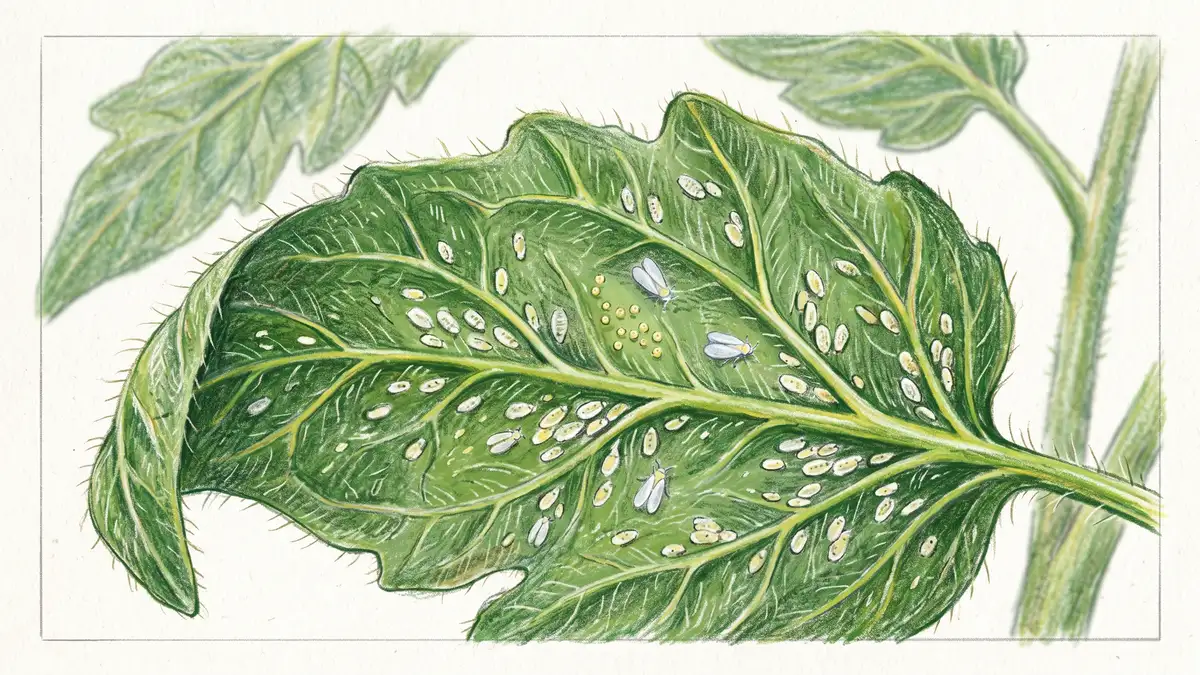
Two species matter in US gardens: the greenhouse whitefly (Trialeurodes vaporariorum) and the sweetpotato or silverleaf whitefly (Bemisia tabaci). Adults are about 1/10 in long, and University of Maryland Extension notes they lay eggs in semi-circular groups of roughly 15 on leaf undersides.
They breed fast. UC IPM reports greenhouse whitefly can go egg to adult in as little as 18 days at 80 to 90°F. A 2023 study by Milenović and colleagues measured Bemisia development at 42.7 days at 63°F (17°C) but only 24.4 days at 73°F (23°C). Heat roughly halves the generation time.
And UF/IFAS reports Bemisia tabaci feeds on over 500 plant species across 74 families, with females living 10 to 24 days and laying 66 to 300 eggs. That host range is why "just remove the affected plant" rarely works.
The Virus Is the Real Damage
Feeding damage and sooty mould are cosmetic annoyances. The serious problem is virus transmission. UF/IFAS notes whiteflies acquire Tomato yellow leaf curl virus as nymphs or adults and retain it for life. Because of this, low whitefly counts are not automatically safe, and a curled, yellowed, stunted tomato is not recoverable. Pull it.
What the Research Actually Says About Companion Plants
Here is where popular gardening advice and published evidence part company.
UF/IFAS published a 2024 review of push-pull technology and companion planting, HS1486. It does not present controlled quantitative experiments showing that marigolds, basil, or similar companions reduce whitefly populations. Neither do the UC IPM or UF/IFAS whitefly guidelines. The specific claim that planting marigolds around your tomatoes will repel whiteflies has not been demonstrated in controlled trials.
There is one genuinely interesting exception, and it is about volatiles, not whole plants. A 2016 study by Du and colleagues in PLOS ONE screened plant volatile compounds against Bemisia tabaci. A blend of D-limonene, citral, and olive oil at 1% concentration produced a 55.5 to 61.5% reduction in adults settling on tomato plants, dropping from 65.7-75.9 adults per plant down to 16.8-21.7. Slow-release dispensers stayed effective for about 29 days.
Read that carefully. It worked as an extracted, concentrated, slow-released compound in a controlled setting. It caused no significant mortality, so it repelled rather than killed. And nobody has shown that a living marigold in your bed emits anything close to that dose. Our article on the science behind marigold pest control covers where marigolds genuinely do work, which is mainly nematodes.
Why This Works: Designing for the Predator, Not Against the Pest
Permaculture tends to solve pest problems by building the system that regulates them rather than by attacking the pest directly. That framing turns out to match the evidence here exactly. There is no reliable published data on repellent companions for whitefly, but there is solid data on parasitoid wasps. So the useful companion planting question is not "what does the whitefly dislike" but "what keeps a parasitoid population alive in my garden between outbreaks". Same practice, better question.
The Companion Planting That Does Work: Feeding the Wasps
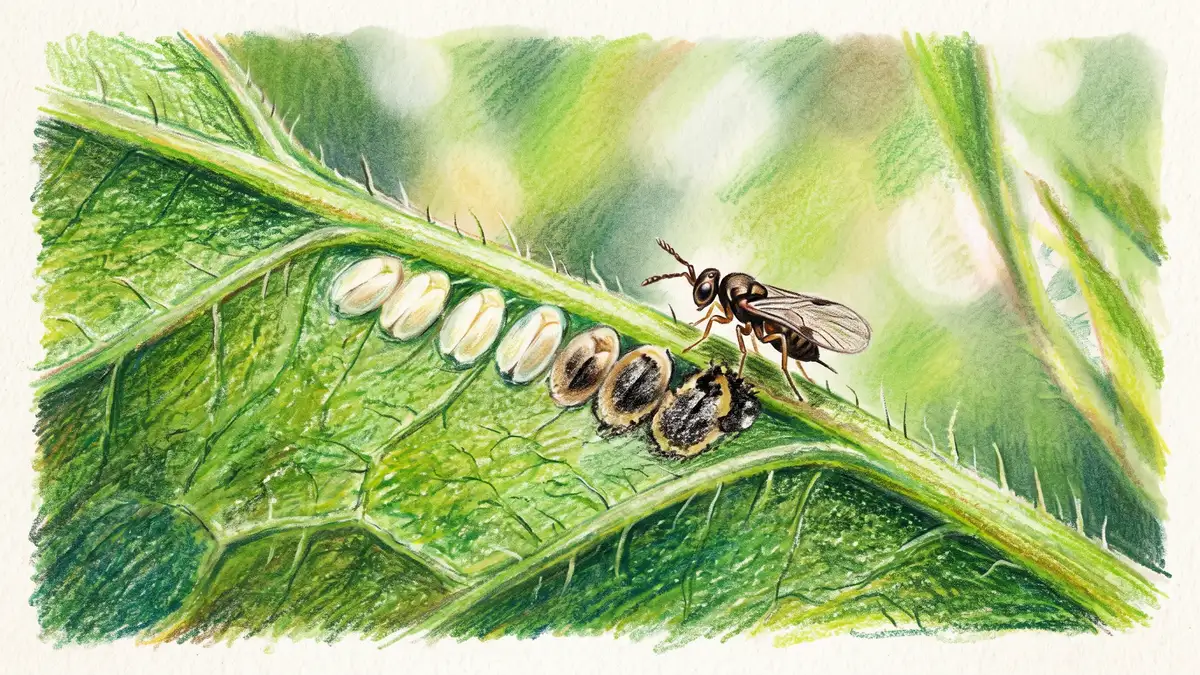
Encarsia formosa is a tiny parasitoid wasp that lays eggs inside whitefly nymphs. UC IPM reports an adult female lives about two weeks, parasitises around 5 whiteflies a day and host-feeds on another 3. Over a lifetime that is roughly 100 whiteflies killed per wasp.
These wasps are not exotic imports you have to buy. UC IPM notes at least 30 Encarsia species occur in California alone, and that in parts of the California Central Coast up to 40% of greenhouse whitefly populations are naturally parasitised or predated. They are probably already in your garden.
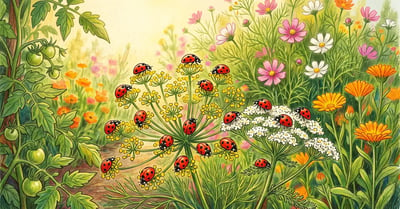
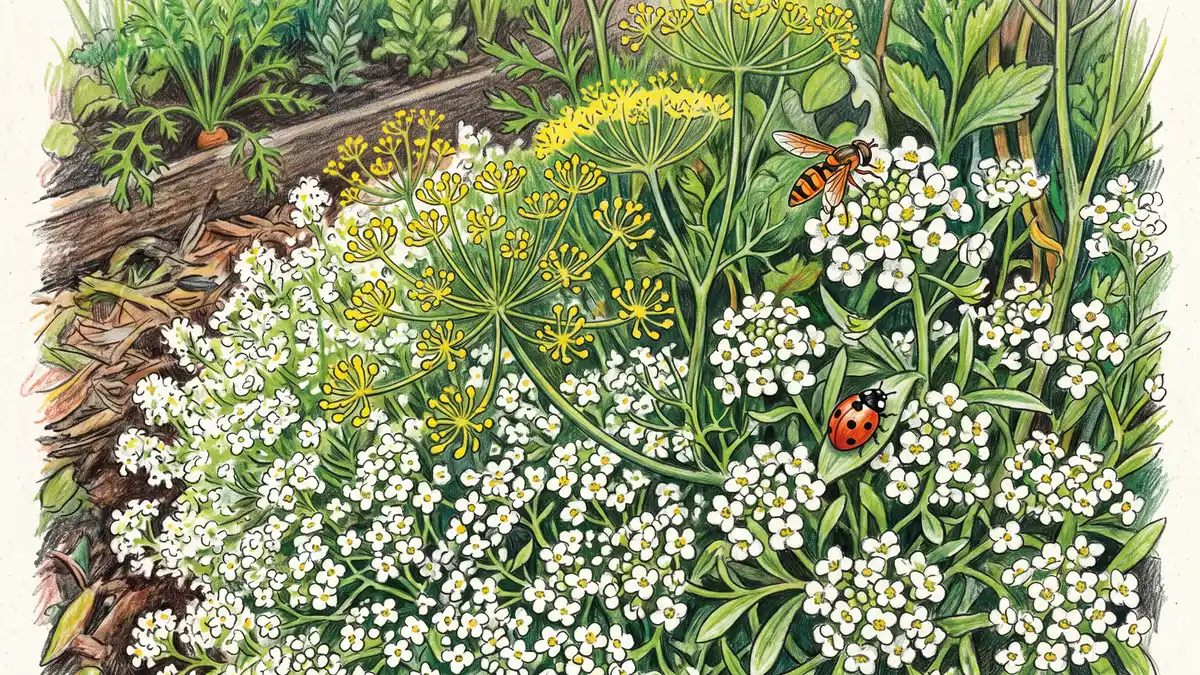
What they need is nectar and pollen between whitefly outbreaks. Tiny wasps have tiny mouthparts, so they feed on small, shallow, open flowers rather than deep tubular ones.
| Plant Family | Grow These | Why It Works |
| Apiaceae | Dill, fennel, cilantro, parsley left to bolt | Flat umbels, shallow nectar, easy access |
| Brassicaceae | Sweet alyssum | Blooms almost continuously, low growing |
| Asteraceae | Yarrow, cosmos, calendula | Open flower discs, long bloom season |
| Lamiaceae | Oregano, thyme, mint left to flower | Small flowers, supports many predators |
| Any | Let a few brassicas and herbs bolt | Free nectar with zero extra work |
Sources: UC IPM, Encarsia formosa, UC IPM Tomato Pest Management Guidelines. Plant families reflect standard IPM insectary practice rather than whitefly-specific trials.
One critical caveat that makes or breaks this: broad-spectrum insecticides kill the wasps far more reliably than they kill the whiteflies. If you spray, you inherit the whitefly problem permanently. Our guide to companion planting for pest control covers building this kind of standing predator population.
The Tactic With the Strongest Data: Reflective Mulch
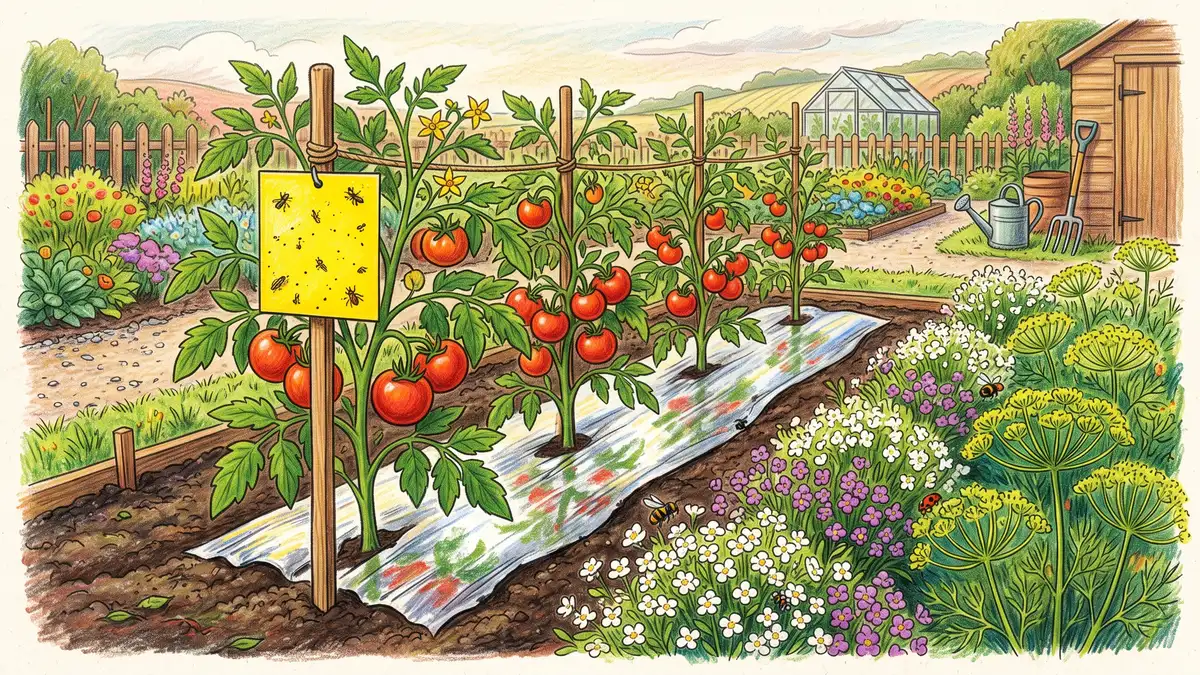
If you only do one thing, do this one. UC IPM reports that reflective silver or aluminium polyethylene mulch, laid before seeding or transplanting, significantly reduces whitefly colonisation and delays damaging populations by four to six weeks.
Whiteflies navigate visually toward the leaf-reflected light signature they expect. Silver mulch scrambles that, and they land somewhere else. In a short season, four to six weeks of delay can be the whole difference between a crop and a failure.
Two limitations to plan around. UC IPM notes the effect fades once foliage covers more than 60% of the mulch surface, so it protects the vulnerable early weeks rather than the whole season. And University of Georgia found that while silver mulch reduces whitefly settling and suppresses TYLCV incidence, no reliable data show it alone reduces virus to acceptable levels. Use it as one layer, not the whole strategy.
Lay Reflective Mulch Before You Plant
Silver plastic mulch goes down first, then you transplant through it. Retrofitting after planting does not work. Budget roughly $20 to $40 for a home bed.
Plant an Insectary Border at the Same Time
Sweet alyssum, dill, and cilantro sown along the bed edge will be flowering by the time whiteflies arrive. Sow them with the crop, not after you see a problem.
Scout Leaf Undersides Weekly
Turn over lower leaves and look. UC IPM's action threshold for tomatoes is about 4 adults per leaf across a random 30-leaf sample. Yellow sticky cards help you spot the first arrivals, though no home-garden trap density is established.
Strip Infested Lower Leaves Early
Whiteflies concentrate on older lower foliage. Removing those leaves at first detection cuts the breeding population without any spray, and it improves airflow.
Spot-Treat Undersides With Soap or Oil
Insecticidal soap and horticultural oil kill only on contact, so UF/IFAS emphasises coverage of the lower leaf surface where the immature stages sit. Treat before populations peak, and never blanket-spray a bed you want wasps in.
What About Trap Crops?
Trap cropping is a genuinely effective technique for some pests. University of Missouri Extension documents that for a garden of about 100 cucurbit plants, just 6 to 8 Blue Hubbard squash plants at the corners, 3 to 8 ft from the cash crop, gave effective protection.
But that trial was against squash bugs and cucumber beetles, not whiteflies. Neither UC IPM nor UF/IFAS describes whitefly trap cropping, and no measured reductions, border widths, or planting ratios exist for whiteflies. Given the pest's 500-plus host range, a "preferred" trap crop is a hard concept to pin down. Treat it as an experiment worth trying, not a recommendation. Our guide to nasturtiums as trap crops covers where the technique is better documented, chiefly aphids.
Break the Cycle: The Underused Cultural Control
The single most effective tactic in commercial production is barely mentioned in home gardening. UF/IFAS recommends a minimum two-month crop-free period, and destroying all vegetable crops within five days of final harvest.
Whiteflies need continuous living hosts. Leave a spent, whitefly-covered tomato plant standing through autumn and you are running a nursery that reseeds next season's problem. University of Minnesota Extension notes whiteflies do not survive winter outdoors in cold states, arriving instead on indoor-started transplants. Inspect any plant you bring in.
Key Takeaway
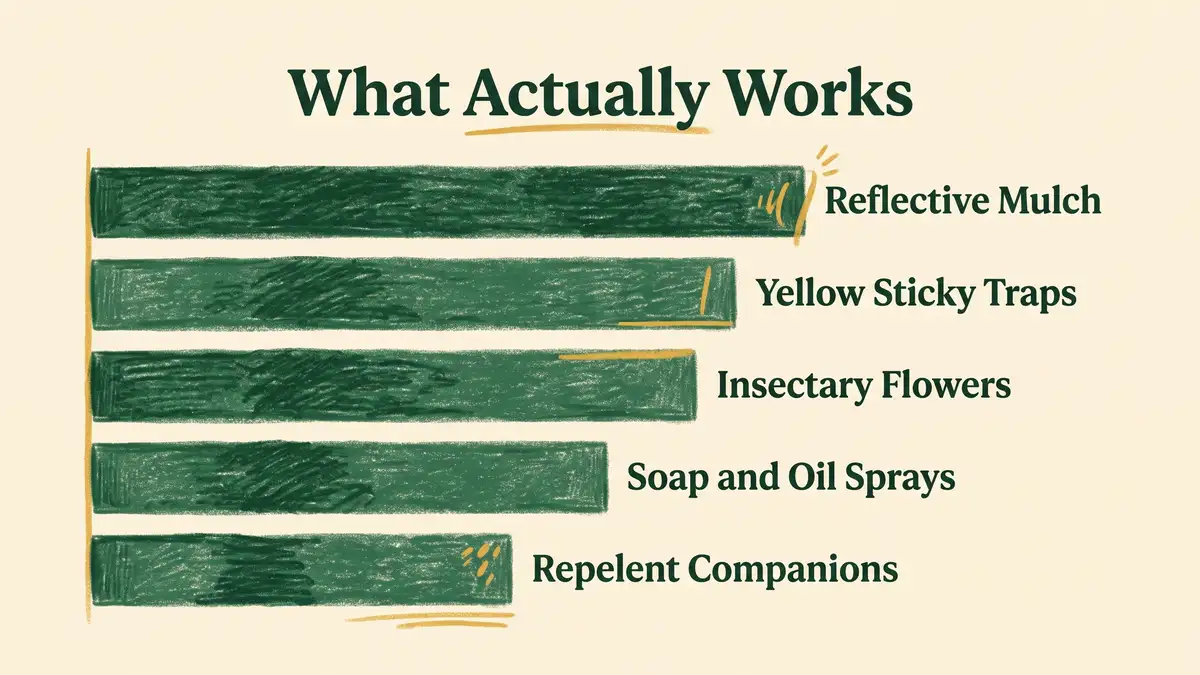
Ranked by evidence: reflective mulch and sanitation first, parasitoid support second, contact sprays third, repellent companion plants last. That last category may still earn its place in your beds for pollinators, beauty, and food, which is reason enough. Just do not rely on it as your whitefly defence. Our companion planting chart shows which pairings have the best support crop by crop.
Frequently Asked Questions
How do I get rid of whiteflies naturally?
Layer several tactics rather than looking for one fix. Lay reflective silver mulch before planting, which UC IPM found delays damaging populations by four to six weeks. Strip infested lower leaves at first detection. Plant sweet alyssum, dill, and cilantro to support the parasitoid wasps that kill whitefly nymphs. Spot-treat leaf undersides with insecticidal soap. And avoid broad-spectrum insecticides entirely, because they wipe out the wasps far more effectively than the whiteflies and leave you worse off.
Will whiteflies kill my plants?
Direct feeding rarely kills a healthy established plant, though heavy infestations cause yellowing, stunting, and sooty mould growing on their honeydew. The genuine threat is virus transmission. UF/IFAS documents that whiteflies transmit Tomato yellow leaf curl virus, cucurbit leaf crumple, squash vein yellowing, and others, and that infected whiteflies stay infectious for life. A virus-infected plant cannot be cured, so remove it rather than treating it. Seedlings and transplants are far more vulnerable than mature plants.
Do marigolds repel whiteflies?
There is no controlled experimental evidence that they do. The UF/IFAS review of push-pull and companion planting does not present quantitative trials showing marigolds reduce whitefly numbers, and neither do the UC IPM guidelines. Research has shown that extracted, concentrated D-limonene blends repel whiteflies in controlled settings, which may be where the folk belief originates, but a living marigold in a bed has never been shown to emit a comparable dose. Grow marigolds for nematode suppression and for the flowers, not as whitefly control.
What attracts whiteflies to my garden?
Warmth, dense soft growth, and continuous host plants. Populations explode in hot weather because development time roughly halves between 63°F and 73°F. Heavy nitrogen fertilisation produces the lush tender foliage they prefer, so easing off high-nitrogen feeds and instead building soil fertility slowly helps considerably. Their host range covers more than 500 species across 74 families, which includes most vegetables plus ornamentals such as hibiscus and lantana. And in cold regions they usually arrive on infested indoor-grown transplants rather than surviving winter outside.
How do I use neem oil for whiteflies?
Treat it as a contact material, which means coverage decides everything. Whitefly eggs and immature stages live on leaf undersides, so a spray hitting only the upper surface accomplishes nothing. Follow label rates precisely, apply in the evening or early morning to avoid leaf burn and to reduce risk to foraging pollinators, and expect to repeat as new adults emerge. Combine it with removing the worst lower leaves first, since that cuts the population you need to spray in the first place.
Get the Weekly Dig
One practical permaculture guide a week, written for gardeners who do this on weekends: companion pairings that hold up under scrutiny, and the ones that do not. Free, no spam, unsubscribe any time.
Join the Weekly DigResources
- UC IPM: Whiteflies, Tomato Pest Management Guidelines
- UC IPM: Whiteflies in Home and Landscape
- UC IPM: Encarsia formosa, Whitefly Parasitoid
- UC IPM: Greenhouse Whitefly Biology and Natural Enemies
- UF/IFAS IN286: Sweetpotato Whitefly, Bemisia tabaci
- UF/IFAS IN695: Management of Whiteflies and Whitefly-Vectored Viruses
- UF/IFAS HS1486: Push-Pull Technology and Companion Planting
- University of Maryland Extension: Whiteflies on Vegetables
- University of Minnesota Extension: Whiteflies
- University of Georgia CAES: Cultural Tactics for TYLCV Management
- University of Missouri Extension: Trap Cropping in IPM
- Du et al. (2016): Screening Plant Volatiles as Whitefly Repellents
- Milenović et al. (2023): Life History Parameters of Bemisia tabaci