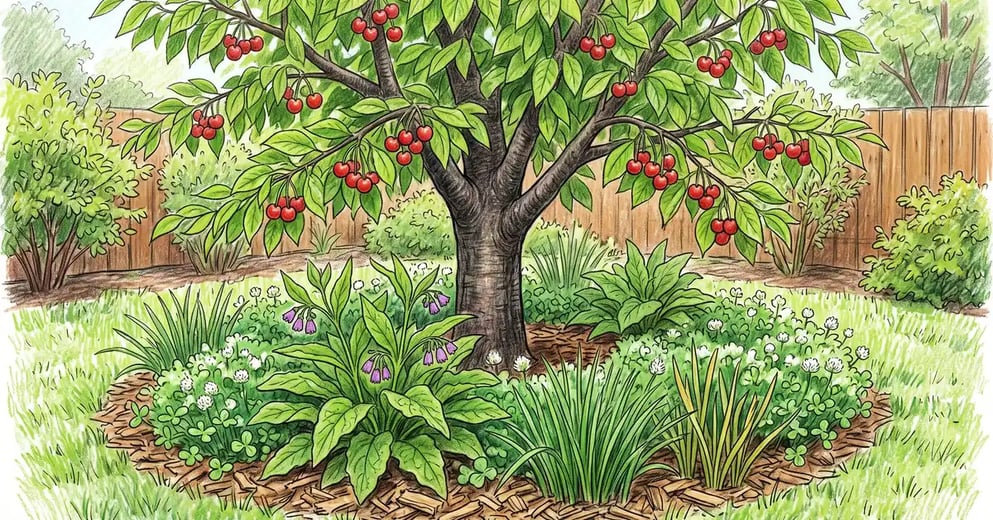

A cherry tree in a lawn is a tree fighting for its life. Grass roots are fine, dense and relentless, and they strip water and nitrogen from exactly the same shallow layer the cherry needs. A guild fixes that, and it does it in a footprint about the size of a small trampoline.
This is the compact version. Not a quarter-acre food forest, but a ring roughly 12 to 15 feet (3.7 to 4.6 m) across, built around one dwarf or semi-dwarf cherry, that feeds itself, feeds beneficial insects, and stops competing with the tree. You can install the whole thing in a weekend for well under $150.
How Big Does a Cherry Guild Need to Be?
Rootstock decides everything. Oregon State University Extension sorts cherry rootstocks into four size classes. Vigorous stocks like Mazzard, Mahaleb and Colt can hit 60 feet (18.3 m) unpruned. Semi-vigorous Gisela 6 and Krymsk 5 run 80 to 90 percent of full size. Semi-dwarfing Gisela 5 lands at 50 to 60 percent, and fully dwarfing Gisela 3 stays below half.
For a backyard, pick Gisela 5 or Gisela 6. Wafler Nursery lists a Gisela 6 cherry at roughly 65 percent of Mazzard size, maturing at 14 to 16 feet (4.3 to 4.9 m) tall. That gives you a guild circle of about 150 to 200 square feet (14 to 19 m²), which is the sweet spot: big enough to matter, small enough to maintain.
Key Takeaway
Choose the rootstock before you choose the plants. A Gisela 5 or 6 cherry stays inside a 12 to 16 foot circle, which is what makes a compact guild possible. A Mazzard-rooted tree will outgrow any guild you design around it.
Why Do Cherry Roots Change the Planting Rules?
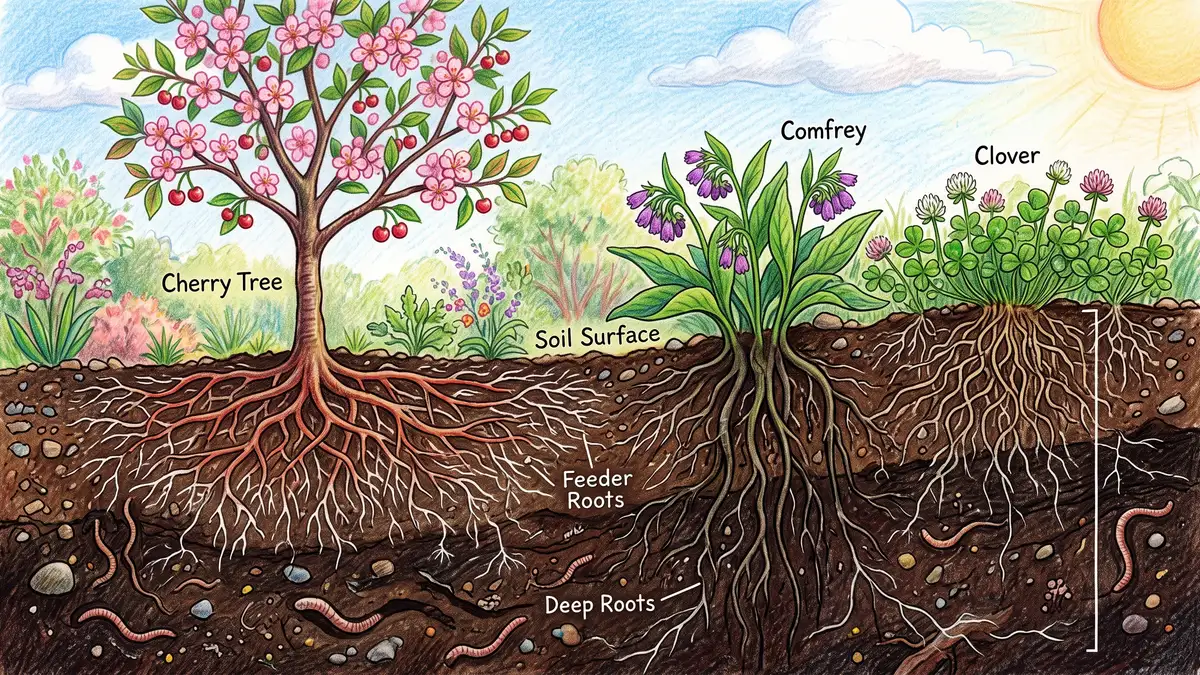
Cherry is shallow-rooted, and that is not a flaw to design around so much as the single most important fact about the site. The classic arboricultural review Root Systems of Trees: Facts and Fallacies found that the majority of tree roots sit in the upper few inches of soil, that absorbing roots extend at or beyond the dripline rather than clustering under the trunk, and that very little root growth happens below about 48 inches (122 cm).
The practical translation: the top 12 to 18 inches (30 to 45 cm) of soil inside the dripline is shared territory, and it is fragile. Do not double-dig it. Do not till it. Plant your understory with the smallest hole that will take the plug, and do the work in the dormant season when the tree has reserves to recover.
How Wide Should the Bare Mulch Ring Be?
This is the one number worth getting right, and there is real research behind it. Utah State University Extension reviewed trials on apples and tart cherries and found that a vegetation-free area of 2 to 3 feet (0.6 to 0.9 m) in radius around the trunk eliminates the competitive effects of grass, and that going wider than that produced no additional benefit.
The same review found grasses are more competitive than broadleaf weeds because their finely divided roots are so efficient at stripping water and nutrients, and that adding extra nitrogen did not overcome the competition. You cannot fertilize your way out of a lawn growing to the trunk. You have to remove it.
Common Mistake to Avoid
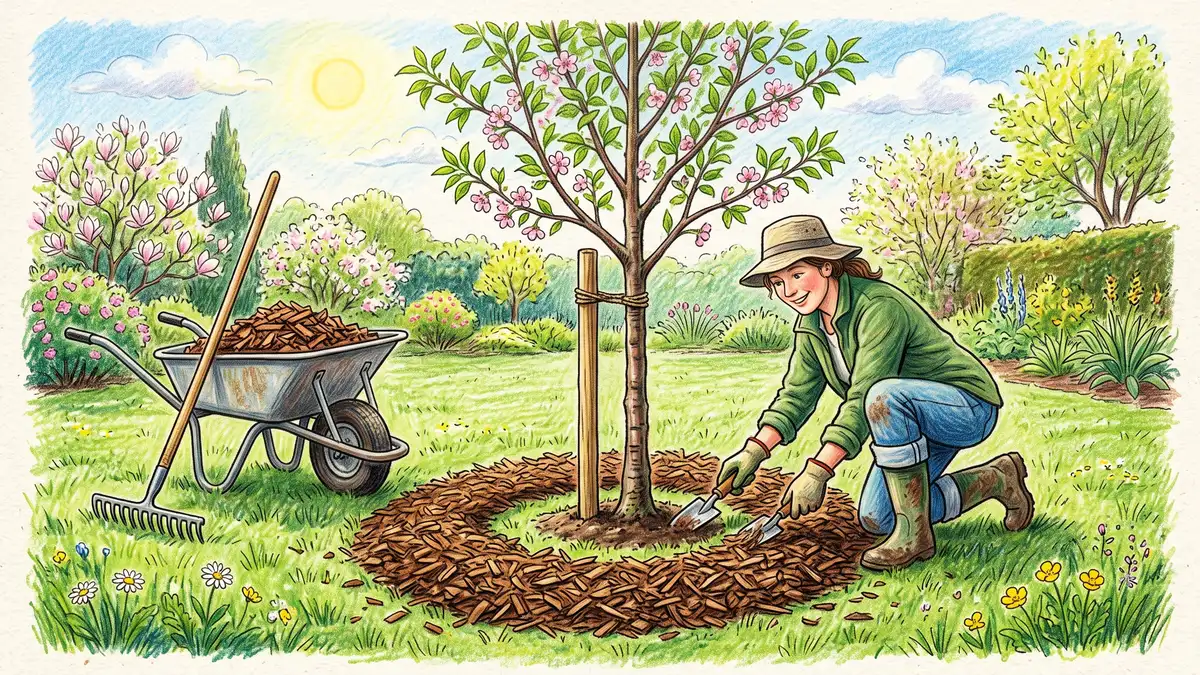
Do not pile mulch against the trunk. Utah State Extension warns that when mulch buries the graft union, the scion can root into the mulch and the dwarfing influence of the rootstock is lost. Keep chips 4 to 6 inches (10 to 15 cm) clear of the trunk flare so the graft union stays visible and dry. A buried graft on a cherry also invites bacterial canker.
What Actually Goes in the Guild?
Work outward in three bands. The inner band is bare mulch. The middle band handles fertility. The outer band handles insects.
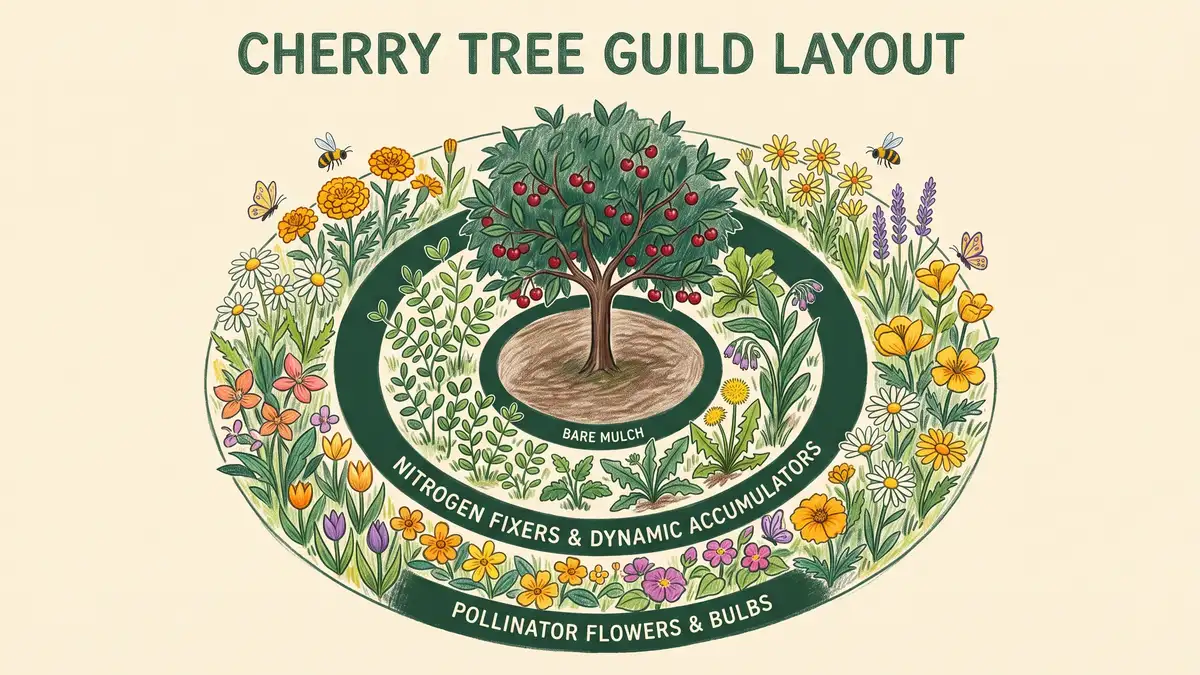
| Band | Distance From Trunk | What Goes There | Job |
| Inner | 0 to 3 ft. (0.9 m) | Wood chip mulch only, clear of trunk | Kill grass competition |
| Middle | 3 to 7 ft. (0.9-2.1 m) | White clover, comfrey, daffodil ring | Nitrogen, mulch, grass suppression |
| Outer | 7 ft. to dripline+ | Yarrow, dill, alyssum, mountain mint, one Siberian pea shrub or goumi | Predatory insects, long-term fertility |
Sources: Utah State University Extension, Journal of Arboriculture
The clover is doing real work, not symbolic work. University of Georgia Extension puts a vigorous white clover stand at 100 to 150 pounds of nitrogen per acre per year (112 to 168 kg/ha). Scale that to a 200 square foot guild and you get roughly half a pound (0.23 kg) of nitrogen a year, delivered slowly, right where the feeder roots are. Sow it shallow, no deeper than a quarter to half an inch (0.6 to 1.3 cm), and do not fertilize while it establishes or the grass wins.
If you want a woody fixer at the edge, sea buckthorn is the heavyweight. A field study cited by Winrock International estimated annual nitrogen fixation from sea buckthorn as high as 179 kg per hectare. It is thorny and vigorous, so site it well outside the dripline. Siberian pea shrub or goumi are gentler choices for a small yard. Our guide to nitrogen-fixing trees for food forests covers the trade-offs.
Why This Works: Stacking Functions
Each band is doing more than one job. The mulch suppresses grass and holds moisture and feeds fungi. The clover fixes nitrogen and covers soil and flowers for bees. The outer ring feeds predators and produces fruit of its own. Permaculture calls this stacking functions, and it is why a guild outperforms the same plants scattered randomly.
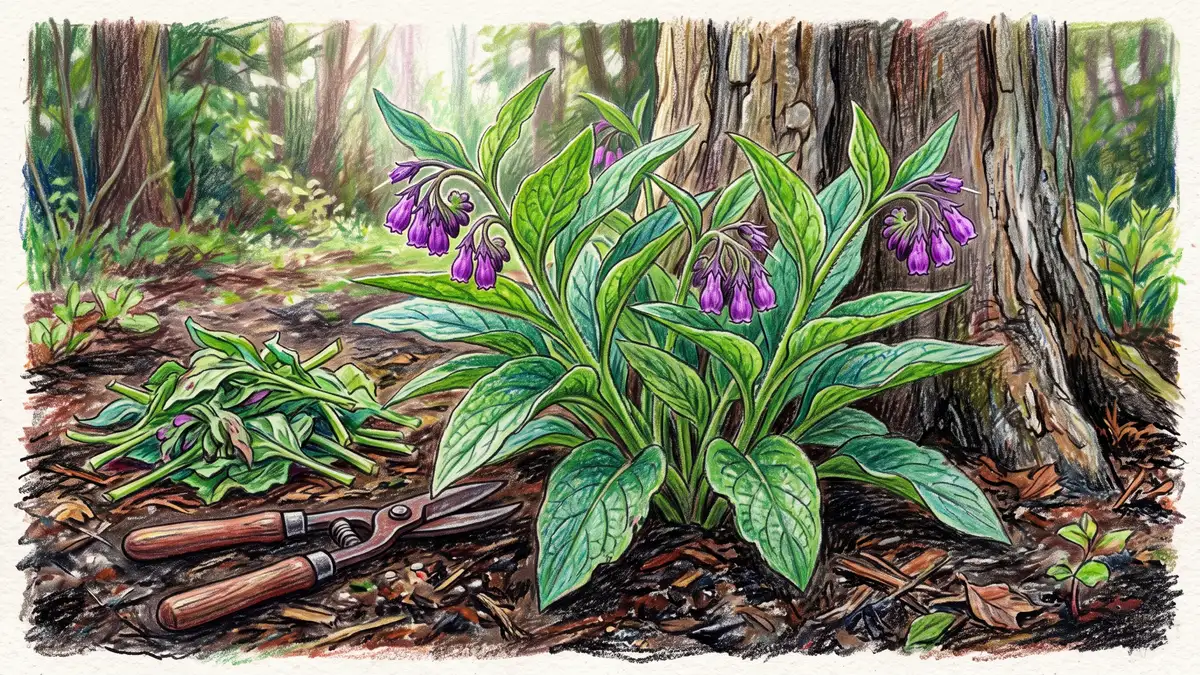
About comfrey. It earns its place, but not for the reason usually given. The "dynamic accumulator" claim, that comfrey mines deep minerals and concentrates them, does not survive scrutiny. Reviewing the tissue analyses, Garden Myths found comfrey's nutrient concentrations sit in the normal range for herbaceous plants, with calcium around 2,000 ppm rather than the 10,000 to 20,000 ppm you would expect from a genuine accumulator.
What comfrey genuinely does is produce an enormous volume of soft, fast-rotting biomass you can cut three or four times a season and drop as mulch. That is worth having. Plant the sterile Bocking 14 cultivar so it does not seed itself across the yard.
How Do You Build It, Step by Step?
Kill the grass, shallowly
Remove sod out to 3 feet (0.9 m) from the trunk with a flat spade, skimming just under the roots. Utah State Extension warns to take care not to damage tree roots. Allow 1 to 2 hours.
Lay 3 to 4 inches of wood chips
Spread chips over the cleared ring, pulled back 4 to 6 inches (10 to 15 cm) from the trunk. Arborist chips are usually free from local tree crews.
Plant the daffodil ring in fall
Set daffodil bulbs about 6 inches (15 cm) apart in a circle just outside the mulch ring. They emerge before the grass, hold the line against turf creep, and rodents leave them alone.
Sow clover and plug in comfrey and herbs
Broadcast white clover across the middle band and rake in lightly. Add two or three comfrey crowns and a handful of yarrow, dill and alyssum plugs at the outer edge. Small holes only.
What Cherry Problems Does the Guild Not Solve?
Be honest about this. A guild improves soil, water retention and beneficial insect populations. It will not stop the three diseases that actually kill backyard cherries, and one guild decision can make them worse.
Brown rot is the big one. The Pacific Northwest Plant Disease Management Handbook puts the emphasis on cultural control: prune out shaded limbs for an open canopy that dries quickly, and remove every mummified fruit from the tree and the ground. Cherry leaf spot works the same way. Washington State University Hortsense notes the fungus overwinters in fallen diseased leaves, so raking and destroying leaf litter is the first line of defense.
That creates a genuine tension with permaculture instinct, which says leave the litter. For cherries, do not. Rake diseased leaves out and compost them hot or bin them, then replace the mulch layer with clean wood chips.
Bacterial canker is the third. WSU Tree Fruit links infection to cold, wet conditions between 59 and 77 °F (15 to 25 °C), to wounds from heading cuts followed by irrigation, and to stress from drought or waterlogging in young trees. Prune only in dry, warm weather, use drip rather than overhead watering, and keep the trunk unwrapped in cardboard.
Key Takeaway
Keep the understory low near the trunk and taller plants at the outer edge. Dense, humid growth against the trunk raises brown rot and canker risk. Airflow beats biodiversity in the inner three feet.
Frequently Asked Questions
What should you plant under a cherry tree?
Low, shallow-rooted plants that will not need digging: white clover as a living mulch, a ring of daffodils to hold back turfgrass, two or three comfrey crowns for cut-and-drop mulch, and low insectary flowers like sweet alyssum and creeping thyme. Keep taller herbs such as yarrow, dill and mountain mint at the outer edge rather than against the trunk, so air keeps moving through the canopy. Avoid anything that requires annual cultivation, which would tear through the cherry's shallow feeder roots.
What should you not plant near a cherry tree?
Avoid turfgrass to the trunk, which is the single most damaging thing you can do. Skip vigorous woody shrubs directly under the canopy, since establishing them means digging into the absorbing root layer. Steer clear of anything that holds moisture against the trunk, and avoid siting other stone fruit close by if bacterial canker is a known problem locally. Vegetables that need regular tilling belong in their own beds, not in the guild.
Is cherry allelopathic like black walnut?
No. Cherry does not produce a broad-spectrum growth inhibitor comparable to walnut's juglone. Prunus species do contain cyanogenic glycosides in leaves and seeds, which is why wilted cherry foliage is toxic to livestock, but current research on root exudates frames them as dose-dependent signalling compounds rather than blanket inhibitors of neighbouring plants. In practice, a wide range of understory plants grow perfectly well beneath cherries.
Do I need two cherry trees for fruit?
It depends on the type. Sour or tart cherries such as Montmorency are self-fertile and will crop alone. Many sweet cherries need a compatible pollinizer nearby, though self-fertile sweet varieties including Stella, Lapins and BlackGold will set fruit on their own, which makes them the obvious pick for a single-tree guild. University of Minnesota Extension covers stone fruit selection for cold climates.
How is a cherry guild different from an apple guild?
The layout logic is the same, but cherries are less forgiving in two ways. Their roots sit shallower, so the no-dig rule matters more, and their disease profile punishes trapped humidity harder, so the inner planting needs to stay lower and more open. Apples also tolerate a wider range of understory competition. See our apple tree guild pattern and the broader guide to fruit tree guilds for the comparison.
Get the Weekly Dig
One practical permaculture guide a week, written for gardeners who do this on weekends: food forest and guild designs that produce. Free, no spam, unsubscribe any time.
Join the Weekly DigOne tree, three bands, a weekend. That is the whole design. If you want to scale the same thinking up to a full multi-layer planting, our food forest guide is the next step, and the soil health guide covers what is happening under the mulch.
Resources
- Oregon State University Extension — PNW 619: Sweet Cherry Rootstocks for the Pacific Northwest
- Utah State University Extension — Managing Vegetation Around Fruit Trees
- Journal of Arboriculture — Root Systems of Trees: Facts and Fallacies
- PNW Plant Disease Handbook — Cherry Brown Rot Blossom Blight and Fruit Rot
- WSU Hortsense — Cherry Leaf Spot
- WSU Tree Fruit — Preventing Bacterial Canker in Sweet Cherries
- University of Georgia Extension — White Clover Establishment and Management Guide
- University of Minnesota Extension — Growing Stone Fruits in the Home Garden
- Winrock International — Hippophaë rhamnoides: A Nitrogen-Fixing Tree Valued for Centuries
- Garden Myths — Comfrey: Is It a Dynamic Accumulator?