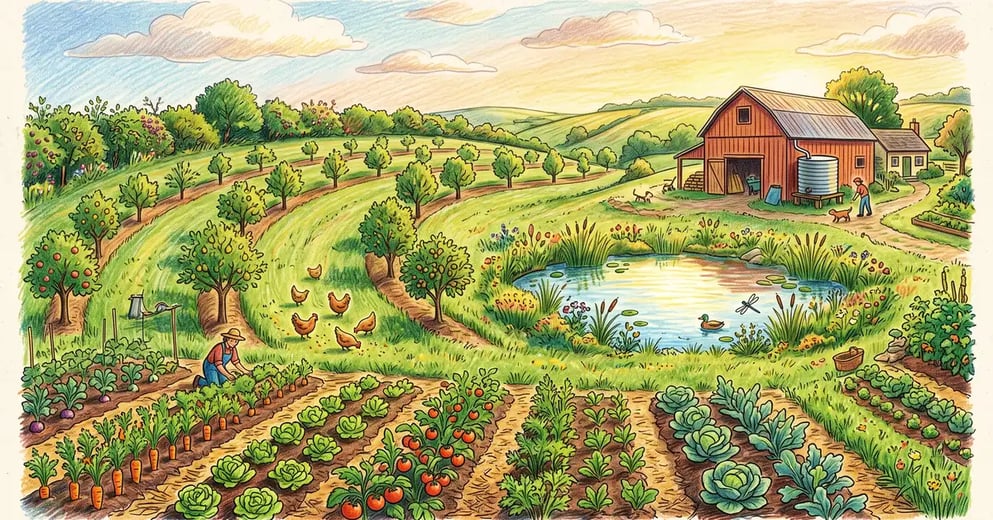

Somewhere between "I want to grow more of my own food" and "I want to quit my job and farm" there is a phrase that gets used constantly and defined almost never: permaculture farm. People picture something specific, contour rows of fruit trees, chickens under the canopy, a pond on the hill, and then discover that nobody agrees on where the garden ends and the farm begins.
This guide answers three things plainly. What actually makes a farm a permaculture farm, what one looks like at different scales, and whether they make money. That last one has an uncomfortable answer, and we are going to give it to you with USDA numbers attached rather than tiptoe around it.
In this guide:
- What separates a permaculture farm from an organic or regenerative one, in practice rather than in branding
- How the zone system actually maps onto acreage, from a quarter acre to a hundred
- The economics, with USDA figures and the criticism people avoid making out loud
- Which enterprises on a permaculture farm earn first, and which take a decade
- The sequencing that stops people planting trees before they have water and access
Key Takeaway
A permaculture farm is a design approach applied to land, not a category of business. There is no certification, no audit and no legal definition, which means the label tells you about the designer's intent and nothing about the outcome. Judge any farm calling itself permaculture on its actual systems and its actual books.
What Makes a Farm a Permaculture Farm?
The honest answer is that it is a design framework, not a production method. USDA Organic is a legal standard with inspectors and a certificate. Permaculture, as set out in Bill Mollison's Permaculture: A Designers' Manual and David Holmgren's Permaculture: Principles and Pathways Beyond Sustainability, is a set of ethics and design principles for arranging elements in a system. Anyone can use the word. Nobody checks.
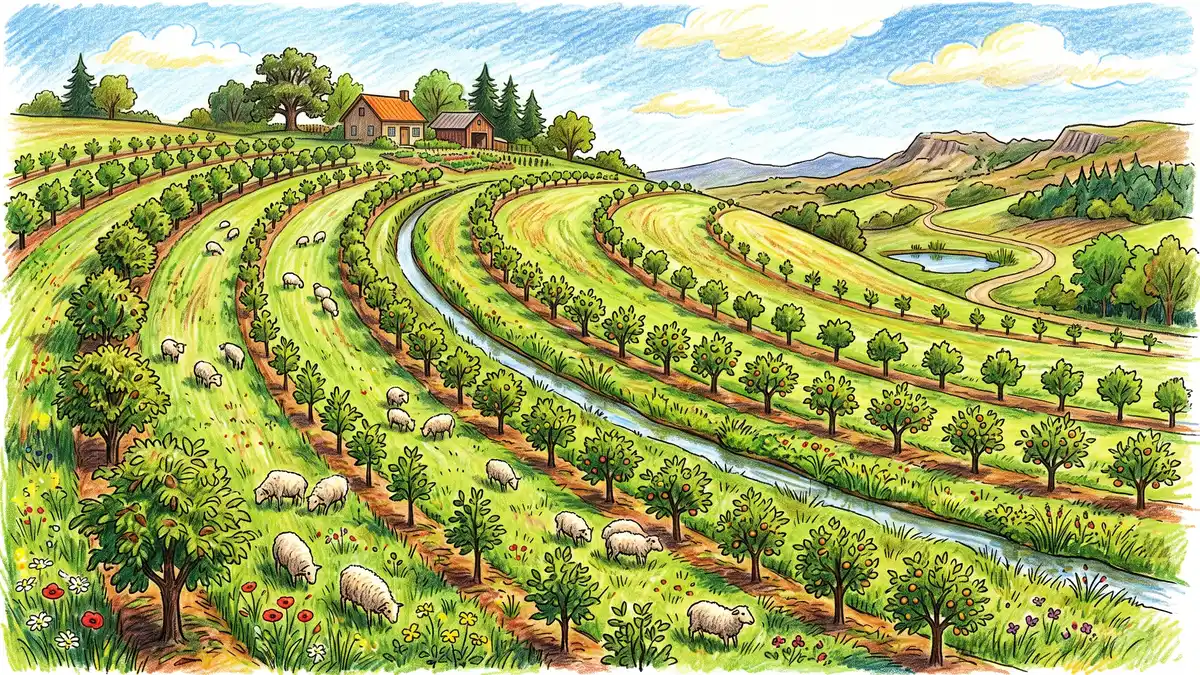
That said, farms designed this way tend to share recognisable features. A high ratio of perennials to annuals. Layout organised by frequency of visit rather than by field boundary, which is the zone system. Water managed by shaping the land before it is managed by pumping. Livestock integrated into cropping rather than housed separately. Fertility cycled on site instead of imported. And polyculture where conventional practice would use a single-species row.
Where it overlaps with neighbouring terms: regenerative agriculture shares the soil goals but is usually applied at broadacre scale and is increasingly certified. Agroforestry is the technical discipline of combining trees with crops or livestock, and permaculture farms use it heavily. Syntropic farming is a distinct system built around succession and heavy pruning. Permaculture is the widest and vaguest of the four, which is both its strength as a planning tool and its weakness as a claim.
How Big Is a Permaculture Farm, and How Is It Laid Out?
There is no minimum acreage, and that is not a dodge. The zone system scales: it describes distance from the point of daily activity, so it works on a quarter acre and on a hundred, only the ring widths change.
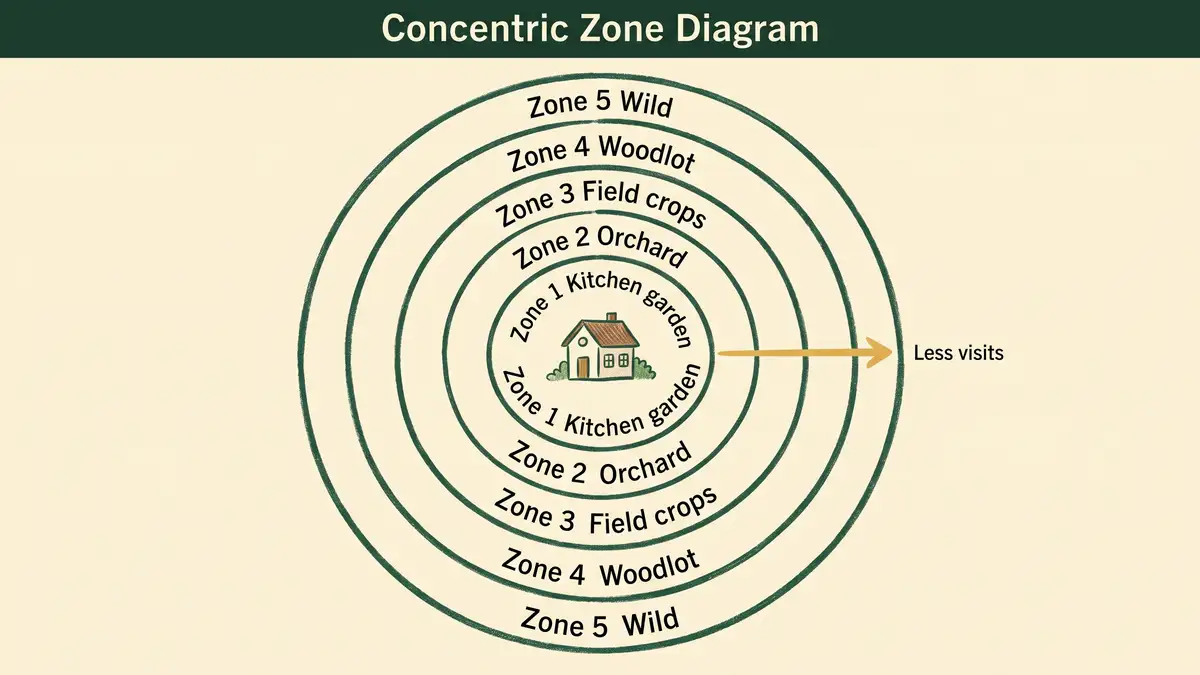
| Zone | Visit Frequency | On a Quarter Acre | On 20 Acres |
| Zone 1 | Daily, often twice | Kitchen beds and herbs by the door | Market garden and propagation area |
| Zone 2 | Most days | Small fruit, compost, a few hens | Orchard, poultry, intensive perennials |
| Zone 3 | Weekly | Rarely exists at this scale | Main crop, nut trees, grazing paddocks |
| Zone 4 | Occasionally | Not applicable | Woodlot, timber, forage, windbreak |
| Zone 5 | Observation only | A wild corner if you can spare it | Unmanaged habitat and reference area |
Sources: Zone framework from Mollison, Permaculture: A Designers' Manual (1988) and Holmgren, Permaculture: Principles and Pathways (2002); scale interpretation per USDA ERS farm size definitions
Documented US operations that get called permaculture farms sit across a wide range. Mark Shepard's New Forest Farm in Wisconsin runs restoration agriculture across roughly a hundred acres of chestnut, hazelnut and apple in contour alley cropping with integrated livestock. Polyface Farm in Virginia, which Joel Salatin runs, is usually described as regenerative rather than permaculture but uses the same stacking logic at a similar scale. At the other end, plenty of productive quarter-acre urban plots apply the identical design framework.
Why This Works: Relative Location
The zone system is really one idea: put things where the work is. Anything you touch daily belongs within a few steps of the door; anything you visit twice a year can be at the boundary. It sounds obvious until you count how many farms put the vegetable garden a five-minute walk away and then wonder why it goes to weeds in July. This is the same reasoning behind designing your first system around movement patterns rather than around a blank map.
Do Permaculture Farms Actually Make Money?
Start with the baseline, because it reframes the whole question. USDA Economic Research Service data shows that around 86 percent of US farms are small family farms with gross cash farm income under $350,000, and that these households depend on off-farm income for most of what they live on. More striking: median farm income for US farm households was forecast at negative $1,498 for 2025, against median off-farm income of $92,123.
Read that again. The median American farm household loses money farming and is supported by a job. That is not a permaculture problem, it is the structure of small-scale US agriculture. Any honest assessment of a permaculture farm's economics has to start there rather than compare it to an imaginary profitable conventional alternative.
Within that reality, where does the money on a permaculture farm actually come from? Published accounts and farm case studies consistently point to the same short list, and it is not commodity production:
Market garden and direct sales, earning in year one
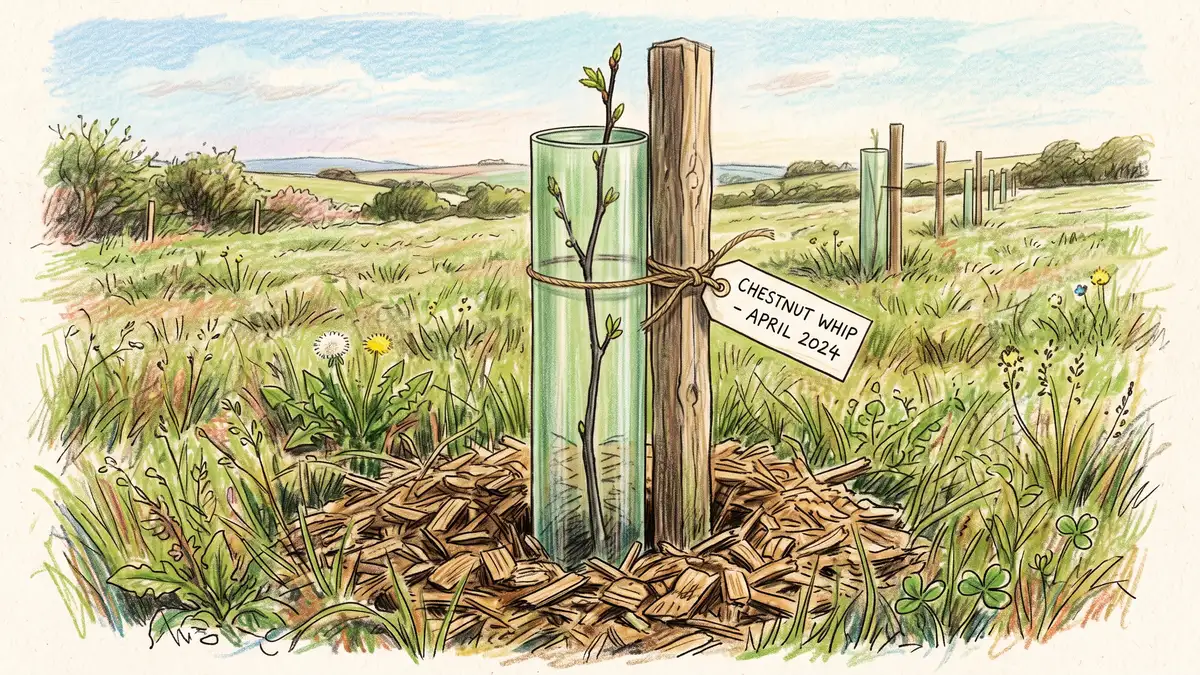
Annual vegetables sold direct at farmers markets or by subscription. Low capital, fast return, high labour. This is what pays the bills while the perennials are still sticks in tubes.
Nursery stock, earning in years two to three
Propagating the plants you are already growing costs almost nothing extra and sells at a good margin to the people visiting your farm.
Eggs and small livestock, earning in year one to two
Quick to establish, continuous cash flow, and they do orchard work while they are at it.
Education, courses and agritourism, earning once you have something to show
The highest-margin enterprise on most permaculture farms, and the one that draws the sharpest criticism.
Tree crops, earning in years seven to fifteen
Chestnuts, nuts and standard fruit are the long play. They are the reason for the whole design, and they contribute nothing to cash flow for most of a decade.
The Criticism Worth Taking Seriously
The most common critique of permaculture farming is that a lot of permaculture farms make their money teaching permaculture farming rather than from what they grow. It is a fair observation, and it has a related academic version: permaculture has a thin quantitative evidence base compared with the agronomic literature on conventional or organic systems, because relatively few permaculture systems have been measured under controlled conditions. Neither point means the design principles are wrong. Both mean you should ask a farm selling a course what proportion of its revenue comes from produce.
How to Start, in the Order That Actually Works
The sequencing rule in permaculture design literature is water, access, structures, then plantings. It is the single most useful thing in this article for anyone with land, and it is almost universally ignored by enthusiastic beginners who plant trees in year one.
The logic is simple: earthworks and roads require machinery, and machinery cannot get to where it needs to be once trees are in the ground. Establish your water harvesting and your access tracks first, put buildings where they need to be, and only then plant. Reversing that order means either moving the trees or living with a layout you would not have chosen. Our guide to swales and berms covers the water stage in detail.
Key Takeaway
If you have land and ambition, start with a market garden and a nursery bed, not with a hundred trees. The annual enterprise funds the perennial one. Farms that plant the orchard first and figure out income later are the ones that end up selling in year four with a beautiful young food forest and no cash.
Why This Works: Obtain a Yield
Holmgren's third principle is "obtain a yield", and it is usually read as a gardening instruction. It is really a financial one. A system that produces nothing for seven years is not a resilient design, it is a bet on your own staying power. Sequencing fast-return enterprises ahead of slow ones is applying a permaculture principle to your bank account, which is exactly what permaculture was meant to be for.
Frequently Asked Questions
What is a permaculture farm?
It is a farm laid out using permaculture design principles: perennials favoured over annuals where practical, layout organised by how often you visit each area rather than by field boundaries, water managed through landform before pumping, livestock integrated into cropping, and fertility cycled on site. What it is not is a certified category. There is no permaculture equivalent of the USDA Organic seal, no inspection and no legal definition, so the term describes design intent rather than any verified practice or outcome.
Are permaculture farms profitable?
Some are, but the honest framing is that most small US farms of any kind are not. USDA ERS forecast median farm income for farm households at negative $1,498 for 2025, with median off-farm income at $92,123, meaning the typical farm household is supported by outside work. Permaculture farms that do turn a profit generally earn it from direct produce sales, nursery stock, eggs and education rather than from tree crops, which take seven to fifteen years to contribute meaningfully.
How many acres do you need for a permaculture farm?
There is no threshold, because the zone system scales with whatever you have. A quarter acre supports zones 1 and 2 in full and a token zone 5. Twenty acres gives you all five with room for grazing and a woodlot. If the question is really "how much land to make a living", that depends far more on your enterprise mix and your market than on acreage. Intensive market gardens produce full-time incomes on one to two acres; nut orchards need considerably more and much more patience.
What is the difference between permaculture and regenerative agriculture?
They overlap heavily and share soil-building goals, but they come from different places. Permaculture is a whole-system design framework covering everything from water to buildings to social structure, developed by Mollison and Holmgren in the 1970s. Regenerative agriculture focuses more narrowly on soil health outcomes, is usually applied at broadacre scale, and increasingly has certification schemes attached. In practice a well-run permaculture farm would satisfy most regenerative criteria, but the reverse is not necessarily true.
Where should I start if I have land?
Water, access, structures, plantings, in that order. Map your water first and put in any earthworks while machinery can still reach the site. Establish your tracks and any buildings next. Only then plant, working outward from zone 1. Alongside that, get a fast-earning enterprise running in year one, usually a market garden, because it funds everything that comes later. Planting an orchard before you have income is the most common way this goes wrong.
Do you need a permaculture design certificate to farm this way?
No. A PDC is a two-week course with no regulatory standing, and plenty of people run excellent permaculture-designed farms without one. What it does provide is a structured pass through the design process and a network of people doing the same thing, which many find worth the money. Treat it as education rather than qualification. Our piece on whether a PDC is worth it goes through what the course actually covers.
Get the Weekly Dig
One practical permaculture guide a week, written for gardeners who do this on weekends: permaculture design for real backyards. Free, no spam, unsubscribe any time.
Join the Weekly DigResources
- USDA Economic Research Service, Farm Household Income Forecast
- USDA ERS, Ag and Food Statistics: Farming and Farm Income
- USDA ERS, Highlights From the Farm Income Forecast
- USDA ERS, Farm Household Income Estimates
- USDA National Agroforestry Center, Alley Cropping: An Agroforestry Practice
- USDA National Agroforestry Center, Alley Cropping
- David Holmgren, Permaculture Principles and Definition
- SARE, Diversifying Cropping Systems: Agroforestry