
What Are Permaculture Zones (and How Are They Different from Hardiness Zones)?
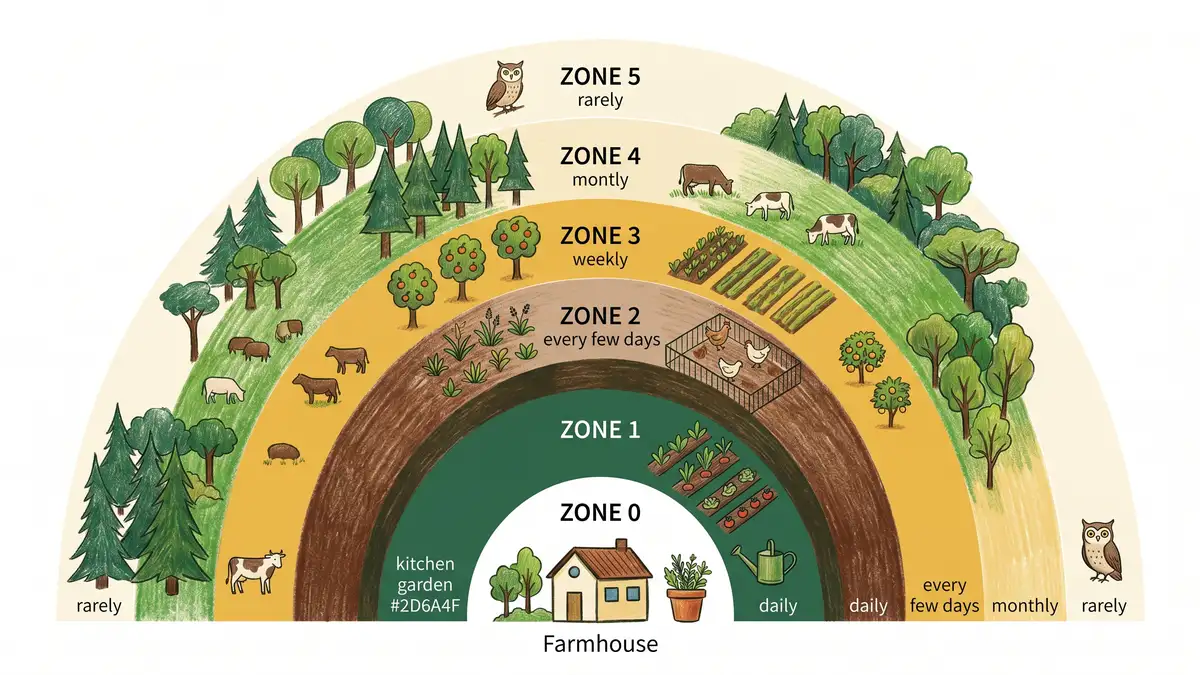
If you searched "what zone am I in" and ended up in two completely different conversations, you're not imagining it. The internet treats "zones" as if there's only one kind, but gardeners are juggling two unrelated systems: the USDA Plant Hardiness Zone Map, which tells you what plants survive your winters, and permaculture zones, which tell you where on your property to put them. how zones scale up to a working farm
The USDA system is a temperature map: 13 zones based on average extreme minimum winter temperatures. The 2023 update showed that about half of the U.S. has shifted a half-zone (~5°F / 2.8°C) warmer in winter compared with 2012. Useful — but it has nothing to do with garden design.
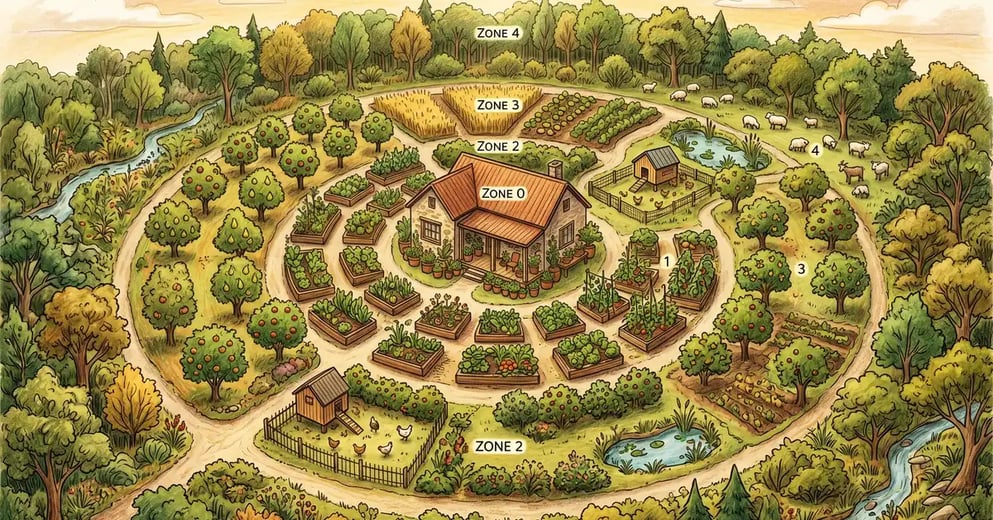
Permaculture zones, developed by Bill Mollison and David Holmgren in 1974–75, are a layout framework. They organise your property into five concentric areas (plus a Zone 0 for the home itself), based on how often you visit each spot and how much maintenance it needs. Daily-attention plants go nearest the door. Wilderness sits at the edge.
What you'll take away from this guide:
- How to tell USDA hardiness zones apart from permaculture zones — for good
- What each of the five zones (plus Zone 0) actually contains, with U.S.-scale examples
- A weekend observation exercise to map zones on your own property
- The three mistakes new designers make on a quarter-acre lot
- How to layer sectors (sun, wind, water) on top of zones
Key Takeaway
USDA Plant Hardiness Zones answer "which plants will live here?" Permaculture zones answer "where on my property should I put them?" The first is climate science. The second is a labour-saving design framework. You need both — and you'll never confuse them again once you see them side by side.
Why Two Different "Zone" Systems Confuse Almost Every New Gardener
The two systems were designed for completely different purposes, and once you see them in a table they stop blurring together.
| System | What it measures | What it tells you | Numbered range |
| USDA Plant Hardiness Zone | Average annual extreme minimum winter temperature | Whether a perennial plant will survive your winter | 1a (coldest) to 13b (tropical) |
| Permaculture Zone | Frequency of human visits and maintenance intensity | Where on your property to place a plant or feature | 0 (the home) to 5 (wilderness) |
Sources:
A blueberry "hardy to USDA Zone 4" survives lows of -30°F (-34°C). That same blueberry could live in permaculture Zone 1 (by your kitchen door) or Zone 3 (along a back fence) — the permaculture number is about access, not survival.
Why This Works: Energy Cycling
Permaculture's core energy principle is to capture, store, and reuse the energy you put into a system — including your own labour. Placing high-attention plants right next to the path you already walk every day means the energy of "going to the kitchen" is paid twice: it makes you dinner and it waters the basil. That's why zones are arranged by visit-frequency, not by plant family or aesthetics.
Walking Through the Five Permaculture Zones (Plus Zone 0)
Zone 0 — The home itself. Where you sleep, cook, and store food. Zone 0 design covers passive solar orientation, thermal mass, water catchment, and how the building "interacts" with the rest of the property. Heating and cooling alone account for a substantial share of household energy use (U.S. DOE), which is why permaculture treats the dwelling as the first design problem, not an afterthought.
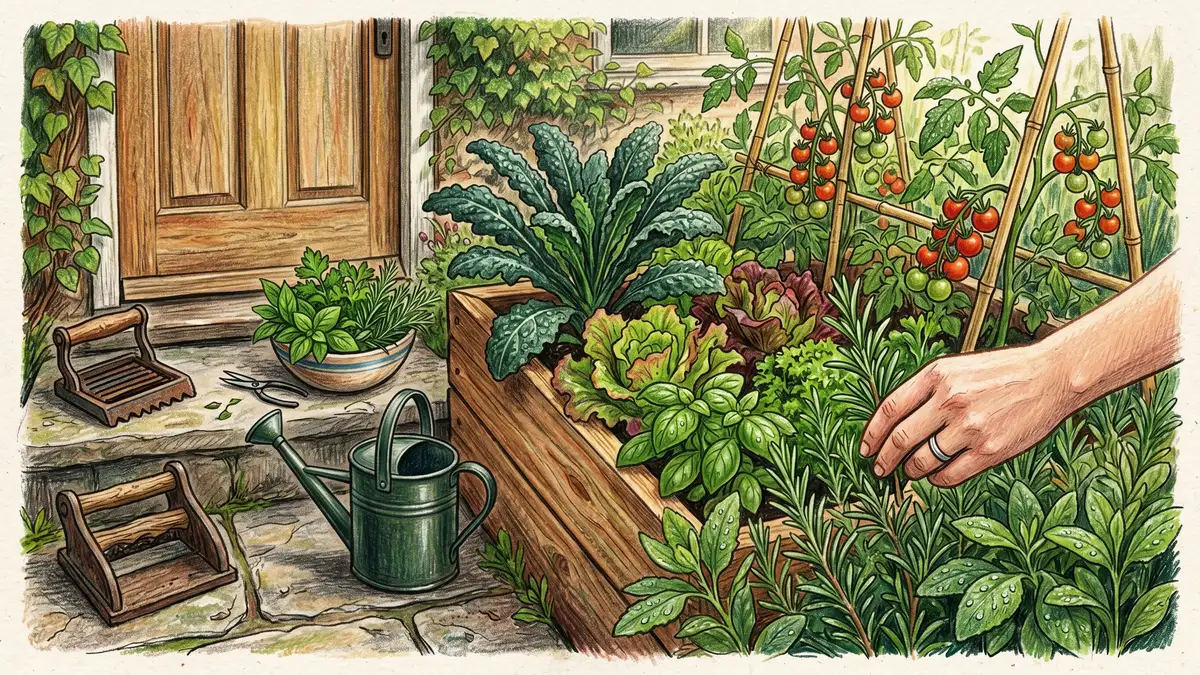
Zone 1 — The kitchen garden (300+ visits/year). Salad greens, culinary herbs, the compost bin, the chicken-coop door. Anything you'd ideally walk to in slippers. NC State Extension suggests about 1,050 sq ft (97.5 m²) of well-prepared beds to feed a family of four through the season — most of that belongs in Zone 1.
Zone 2 — Semi-intensive perennials (~150 visits/year). Fruit trees, a small berry patch, a chicken run, beehives, a polytunnel. Visited every few days — mulched, weeded — but not constantly. This is where companion planting guilds and a young food forest tend to live on residential properties.
Zone 3 — Cropping zone (~50 visits/year). Larger orchard plantings, staple crops, a pumpkin patch, pasture for small livestock. Realistic on properties of about half an acre and up.
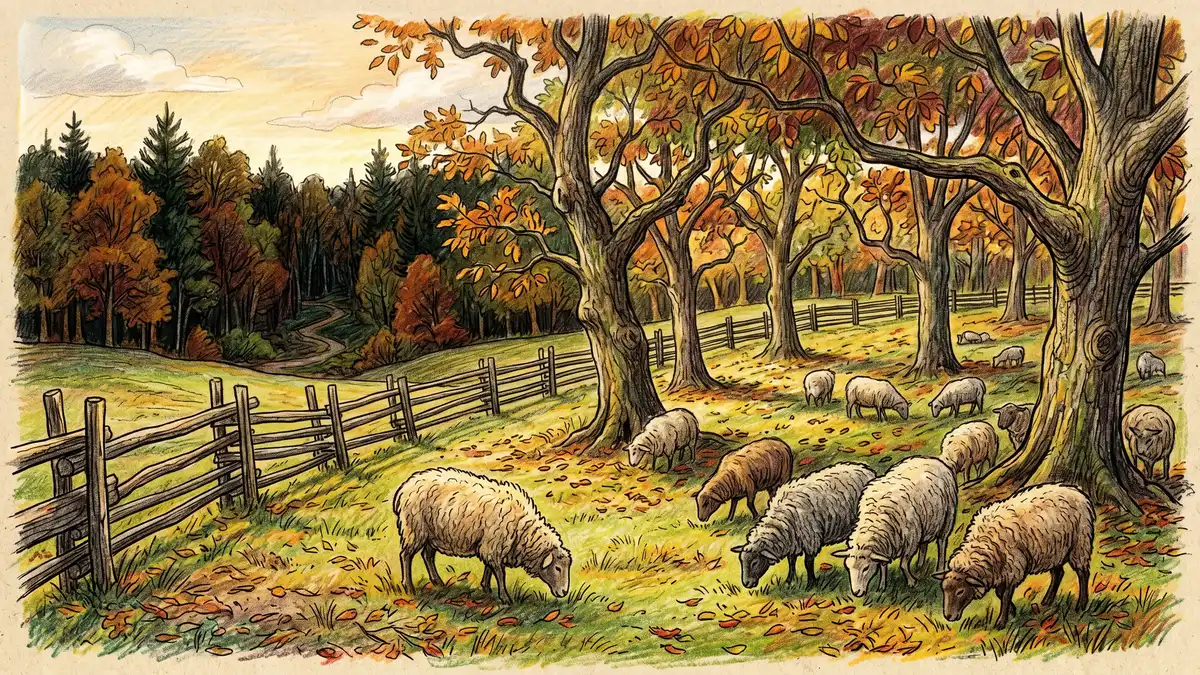
Zone 4 — Semi-managed forest and forage (a few visits/year). Woodlots managed for firewood and timber, wild mushroom or berry harvest, and pasture-and-trees systems like silvopasture (USDA NRCS: trees, forage, and grazing animals deliberately combined on the same acreage).
Zone 5 — Wilderness (rarely visited on purpose). Left mostly alone for wildlife and observation. Even on a quarter-acre lot, a small wild edge — a hedgerow, a corner of native plants — counts as Zone 5 and supports pollinators that benefit every other zone.
Realistic Scale Check
On a typical U.S. quarter-acre suburban lot (about 10,890 sq ft / 1,012 m²), you essentially have Zones 0, 1, and 2 — and that's enough to feed a household, build soil, and create habitat. Trying to carve out a discrete Zone 3, 4, and 5 on a small lot creates fragmented, unusable space rather than a productive design.
How to Map Your Own Property: A Weekend Observation Project
Don't pick up a shovel. Pick up a notebook. Permaculture's first principle is observe and interact, and almost every published practitioner recommends watching a site for at least one full year before making permanent changes. You don't have to wait a year to start, but you can do a useful first pass in a single weekend.
Sketch a base map (30 minutes)
Draw your property on a sheet of grid paper. Mark the house, doors, paths, paved areas, existing trees, fences, and any sun-blocking structures (your neighbour's garage counts). Note compass north.
Trace your daily walking lines
For two days, mark the paths you actually use — front door to driveway, back door to bins, the route to the clothesline. The land within about 30 feet (9 m) of those lines is your real Zone 1, regardless of where you "imagine" it.
Spot-check sun and shade
Take a phone photo of every section of yard at 9am, 1pm, and 5pm. Six or more hours of direct sun = "full sun" for vegetables; three to six = partial shade; under three = full shade. Repeat this in a different season if you can.
Add wind, water, and views
Mark prevailing winds, where rain pools after a storm, and any views you want to keep or screen. These are sectors — external influences that overlay your zones.
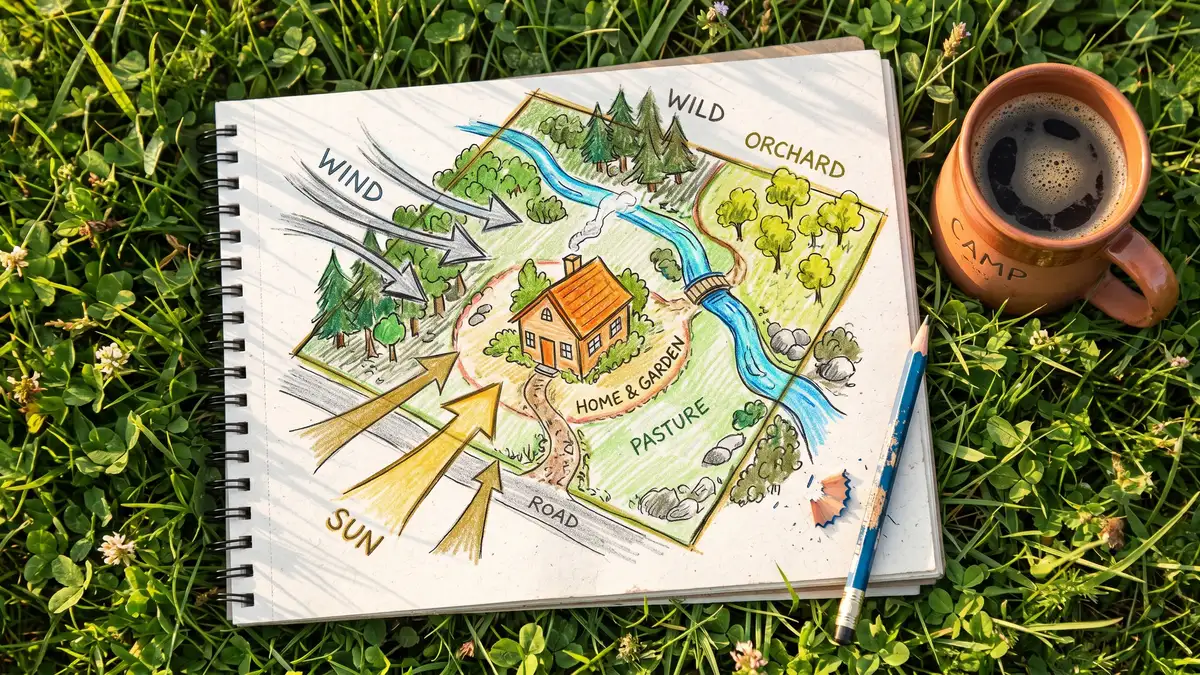
Sectors are the second half of permaculture site analysis. Where zones manage your labour, sectors manage what the environment sends through the site — wind, summer sun, winter shade, fire risk, noise. Penn State Extension notes that the same patch of yard has dramatically different conditions in April (no leaves) and September (full canopy) — which is why a weekend mapping is a starting point, not the finish.
Where Most New Designers Go Wrong
Three Mistakes That Quietly Wreck Most First-Year Designs
1. Skipping the observation year. Building beds before you know how the site behaves through four seasons. 2. Over-zoning a small lot. Trying to fit five zones on a quarter-acre creates marginal, half-managed scraps instead of productive space. 3. Ignoring microclimate. Treating the whole yard as one set of conditions when the south wall is a desert and the north corner is a frost pocket.
Practitioner reports suggest that in the establishment year, a quarter-acre suburban property with intensive Zone 1–2 production demands roughly 10–15 hours of garden work per week in growing season, dropping to 5–10 in the off-season. A balcony or small urban garden settles into around 6 hours per week once established. Designs that demand more time than you have are the most common reason permaculture projects get abandoned.
Two Properties That Show the Range
Melliodora — David Holmgren's 2-acre cool-climate property (Australia). Across about 2 acres (0.8 ha), the design supports 120 fruit and nut trees, intensive vegetable gardens, chickens, geese, and goats — yielding around 2 tonnes of orchard produce annually. Water comes from two dams, a 42,000-litre concrete header tank, and roof-runoff catchment. A textbook Zone 0–4 layout on land that, in U.S. terms, is a generous suburban lot.
The Dervaes Family Urban Homestead — Pasadena, California. Less than a quarter-acre in a city, reportedly producing about 6,000 pounds of food a year through stacked Zone 1–2 design: vertical gardens, container crops, chickens, rabbits, beehives, and dense perennial plantings. The takeaway isn't the headline yield — it's that the same five-zone framework scales from rural acres to a city lot.
Frequently Asked Questions
Are permaculture zones the same as USDA hardiness zones?
No, and conflating them is the most common confusion in beginner permaculture. USDA Plant Hardiness Zones (1a–13b) measure your average extreme winter low temperature and tell you which perennial plants can survive at your location. Permaculture zones (0–5) describe how often you visit different parts of your land and tell you where to place those plants for efficient access. You need both numbers: the USDA zone narrows your plant list, then the permaculture zone decides where each plant goes. For more, see our permaculture foundations guide.
Can I use permaculture zones on a small lot or just a balcony?
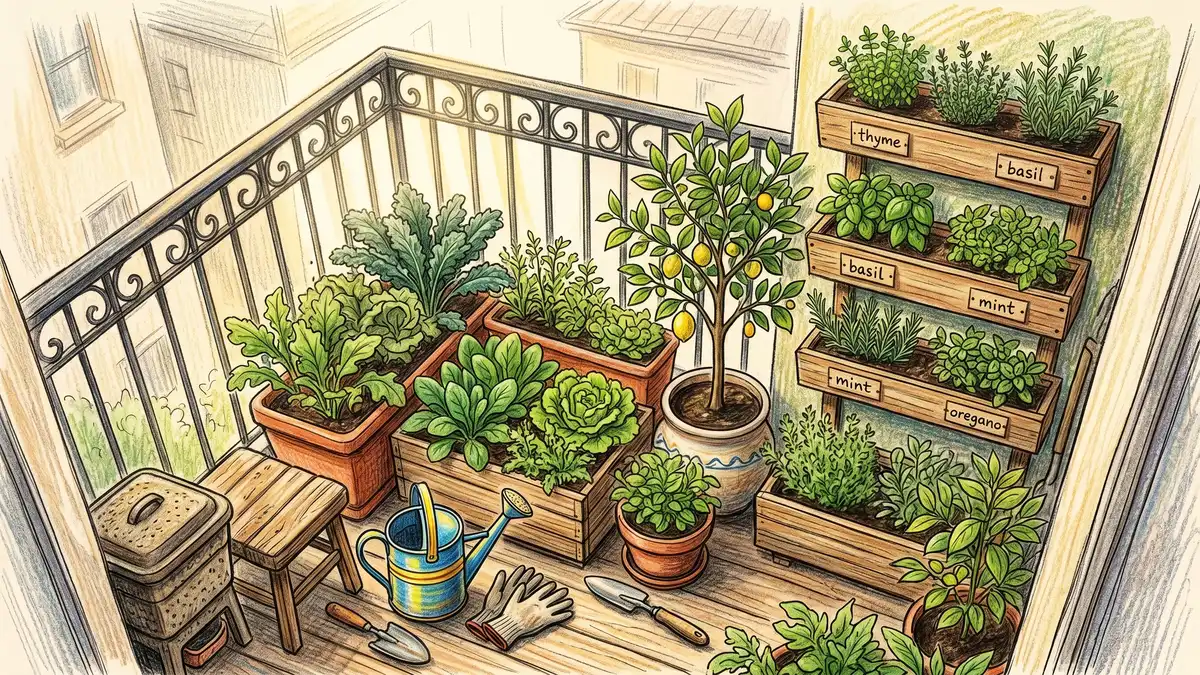
Yes — and this is one of the framework's strengths. On a balcony, Zones 0, 1, and 2 stack into a single space: the apartment is Zone 0, everyday salad greens and herbs in containers are Zone 1, and slower-cycle crops like compact tomatoes or dwarf citrus are Zone 2. You won't have Zones 3, 4, or 5, and that's fine — most urban permaculture is intentionally Zone 0–2 only. The framework still pays off because it forces you to think about visit frequency, sun, and water access before you buy plants.
How long should I observe my property before designing?
The widely cited rule is one full year, so you see how light, water, wind, and frost behave through every season. That's the gold standard. In practice, even a single weekend of mapping puts you ahead of most first-year designs. Treat year one as a soft layout — temporary beds, container plantings, fast-cycling annuals — and reserve permanent infrastructure (paths, irrigation, perennial plantings) for year two. The goal is to design with what your site actually is, not what you imagined it was.
What's the difference between zones and sectors?
Zones organise your design around your labour — how often you visit each area. Sectors organise it around external forces moving through the site: prevailing winds, summer sun angles, winter shade, water flow, fire risk, wildlife corridors. Zones tell you where something belongs; sectors tell you how to position it. For example, your Zone 1 kitchen garden (zone decision) might sit in the lee of an existing hedge that blocks winter wind (sector decision). Most published designs combine both on the same base map.
Do I need to dedicate space to all five zones?
Almost no residential property does. On a typical U.S. quarter-acre lot, you realistically have Zones 0, 1, and 2 — the home, the intensive kitchen garden, and the perennial/orchard area. Zone 3 starts to make sense around half an acre and up; Zones 4 and 5 are usually homestead or rural features. The right move on a small property is to commit fully to Zones 0–2 and leave a small wild-edge corner as a mini Zone 5 for pollinators.
Get the Weekly Dig
One practical permaculture guide a week, written for gardeners who do this on weekends: permaculture design for real backyards. Free, no spam, unsubscribe any time.
Join the Weekly DigResources
- USDA Plant Hardiness Zone Map (2023 update) — the cold-tolerance map permaculture zones are not
- Oregon State University — Introduction to Permaculture: Zones — open-access university chapter on the zone framework
- NC State Extension — Vegetable Gardening Handbook — sizing, raised-bed dimensions, and the family-of-four 1,050 sq ft figure
- Penn State Extension — Getting to Know Your Yard's Microclimates — practical guide to seasonal sun, shade, and microclimate observation
- USDA NRCS — Silvopasture Conservation Practice Standard (381) — formal definition and standards for Zone 4 silvopasture
- U.S. Department of Energy — Passive Solar Home Design — Zone 0 home as part of the system
- Holmgren — Melliodora: A Case Study in Cool Climate Permaculture — the canonical 2-acre case study
- Bill Mollison — Biographical and foundational permaculture history — origin of the zone framework, 1974–75