
What Is Syntropic Agroforestry and Why Combine Trees With Annual Crops?
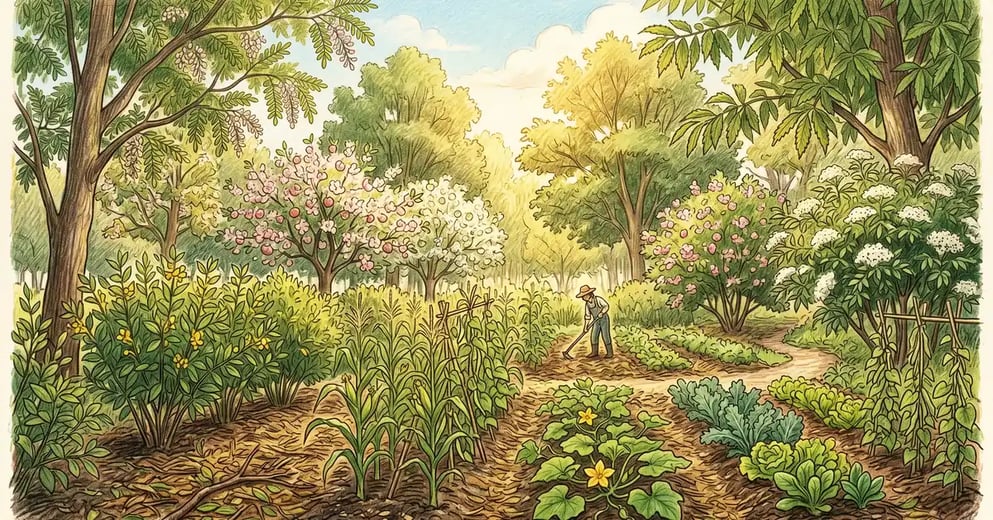
Syntropic agroforestry is a regenerative farming method that integrates fast-growing trees, perennial shrubs, and annual food crops into a single dense planting — managed through heavy pruning and chop-and-drop mulching to mimic natural forest succession. Developed by Swiss-Brazilian farmer Ernst Götsch on degraded land in Bahia, Brazil, the system produces staple food crops (corn, cassava, beans, squash) in the same rows as timber and fruit trees, with the trees actively improving soil and microclimate instead of competing with the annuals. how permaculture farms are laid out silvopasture growing crops between rows of trees shade-grown crops in a managed forest scattered-tree parkland systems
If you have ever grown vegetables under a young hedgerow and watched the corn thrive instead of stunting, you have already seen the effect. Syntropic agroforestry turns that accident into a deliberate design. Götsch's Fazenda da Toca and Fazenda Olhos d'Água sites — together covering more than 400 hectares of restored farmland — demonstrate the principle at commercial scale: yields of cacao, banana, and coffee harvested from soils that were cracked and barren when Götsch arrived in the 1980s.
For the committed permaculture practitioner, the appeal is specific. Unlike alley cropping or traditional agroforestry, syntropic systems treat pruning as a nutrient delivery mechanism, not a chore. Every cut feeds the soil. Every succession stage is planned years in advance. The result is a system that gets more productive — not less — as the trees mature.
What you'll learn in this guide:
- How tree roots and annual crop roots occupy different soil zones, turning competition into complementarity
- The four functional strata (emergent, high, medium, low) and how each contributes to the system
- Specific tree-crop combinations that work in USDA zones 5-9 (with spacing and timing)
- A step-by-step process for converting a quarter-acre or larger plot to a syntropic row
- The three mistakes most temperate-climate practitioners make in their first two years
Key Takeaway
Syntropic agroforestry is not just "trees plus vegetables" — it is a successional design where pioneer trees protect and feed the understory crops, then are progressively replaced by longer-lived species as the system matures. You are planting a 30-year plan on year one, then managing it through pruning rather than tilling.
How Does Tree-Crop Integration Actually Increase Total Yield?
The first question every temperate-climate practitioner asks is the right one: if I plant trees in my vegetable rows, won't the shade cut my yields? In a conventional orchard layout the answer is often yes — but syntropic agroforestry avoids this through three mechanisms documented in the peer-reviewed agroforestry literature.
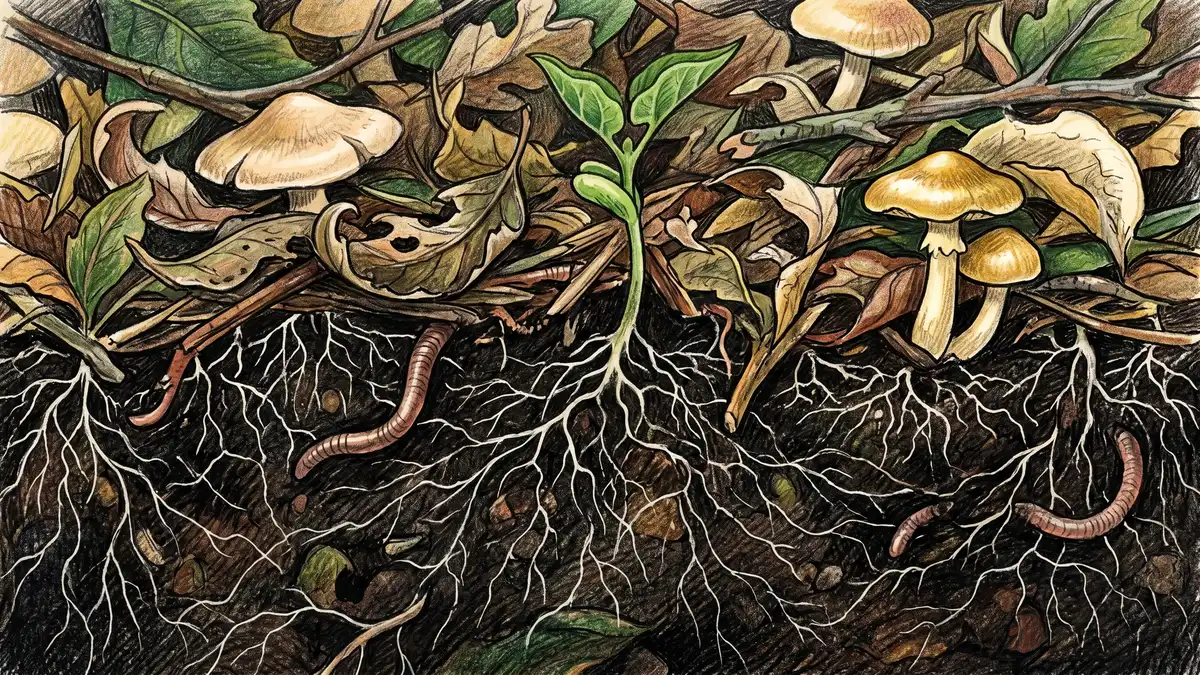
Root niche differentiation. Research synthesised in the FAO's work on agroforestry systems shows that deep-rooted trees pull water and nutrients from soil layers annual crops cannot reach — then redistribute them via leaf fall and root turnover. The total plant community harvests more of the soil profile than monoculture ever could. Meta-analyses of tropical agroforestry published through CIFOR-ICRAF (World Agroforestry) document land equivalent ratios consistently above 1.0 — meaning the combined system outproduces the separate monocultures on the same area.
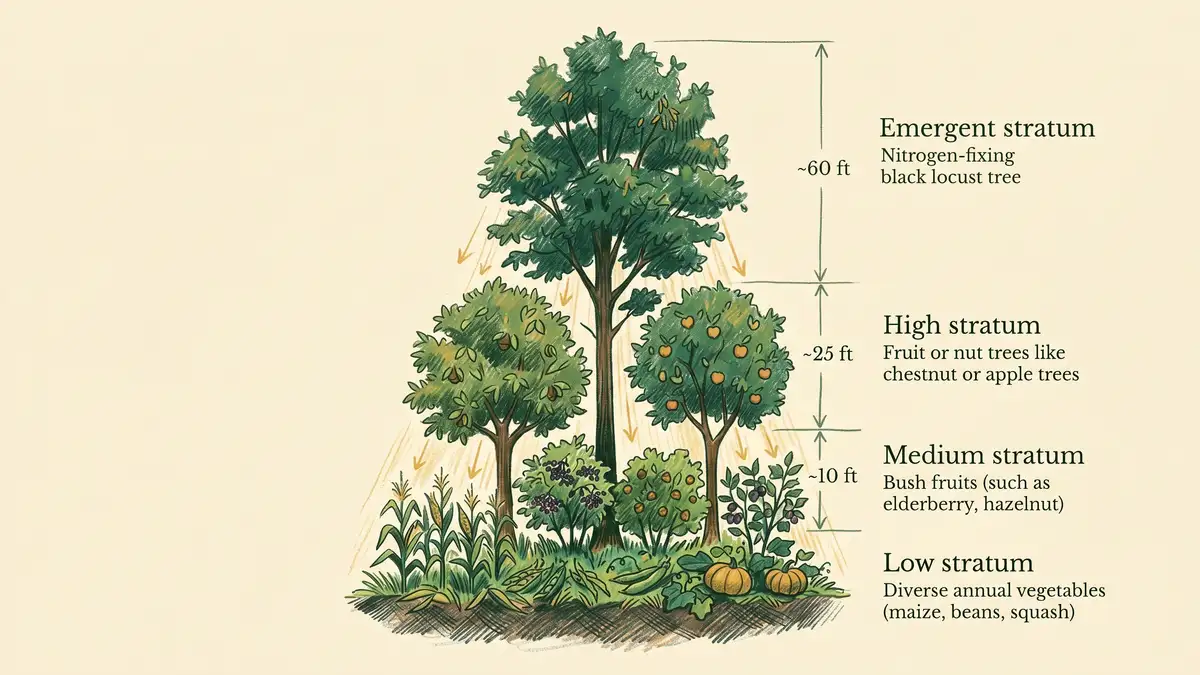
Nitrogen cycling through biomass. Pioneer trees in syntropic systems — species like pigeon pea (Cajanus cajan), black locust (Robinia pseudoacacia), and Siberian pea shrub (Caragana arborescens) in temperate climates — fix atmospheric nitrogen. When these trees are heavily pruned and the biomass dropped on the bed, that nitrogen becomes available to the annual crops growing beneath. USDA's National Agroforestry Center research on alley cropping systems confirms the pattern holds in temperate conditions when species are matched to USDA hardiness zones.
Microclimate moderation. A tree row reduces wind speed by up to 75% for a distance roughly ten times the tree height, according to windbreak studies compiled by the USDA National Agroforestry Center. Lower wind means less evapotranspiration, lower summer soil temperatures, and more moisture available to the annual crop beneath.
Why This Works: Stacking Functions
Bill Mollison's first permaculture design principle — every element should perform multiple functions — is the engineering behind syntropic yield gains. A pigeon pea row fixes nitrogen, provides a pea crop, creates partial shade for lettuce in July, breaks wind, and becomes mulch when chopped. Five functions from one plant. Conventional agriculture asks trees to do one thing (produce fruit). Syntropic design asks them to do five — and the soil rewards it.
What Are the Four Functional Strata in Syntropic Agroforestry?
Götsch's core design tool is the strata system. Every plant you place is assigned to one of four vertical layers based on how much direct light it needs at maturity. This prevents the "everything becomes shade" problem that wrecks poorly designed polycultures.
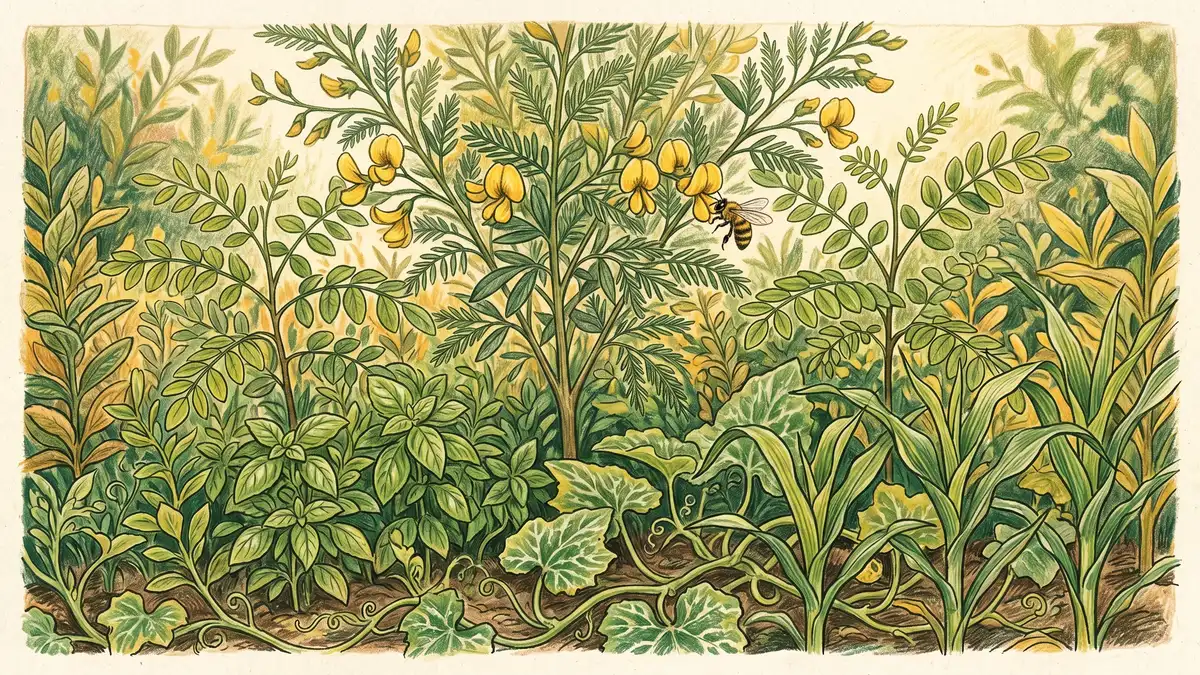
The emergent stratum (100% sun at maturity) is the canopy — species like chestnut, walnut, or pecan in temperate systems. The high stratum (80-100% sun) holds apple, pear, or mulberry. The medium stratum (40-80% sun) suits serviceberry, hazelnut, and currants. The low stratum (0-40% sun) is where your annual vegetables and understory perennials live — lettuce, spinach, strawberries, ramps, garlic mustard.
The critical insight is that a plant's stratum describes the light it needs when it reaches its adult size, not its size today. A three-year-old walnut may currently be shorter than your tomatoes, but you treat it as an emergent and plan the row around its eventual 60-foot canopy. This is why syntropic rows are radical dense at planting — you are populating the future gaps with short-lived species that will be cleared as the permanent canopy closes.
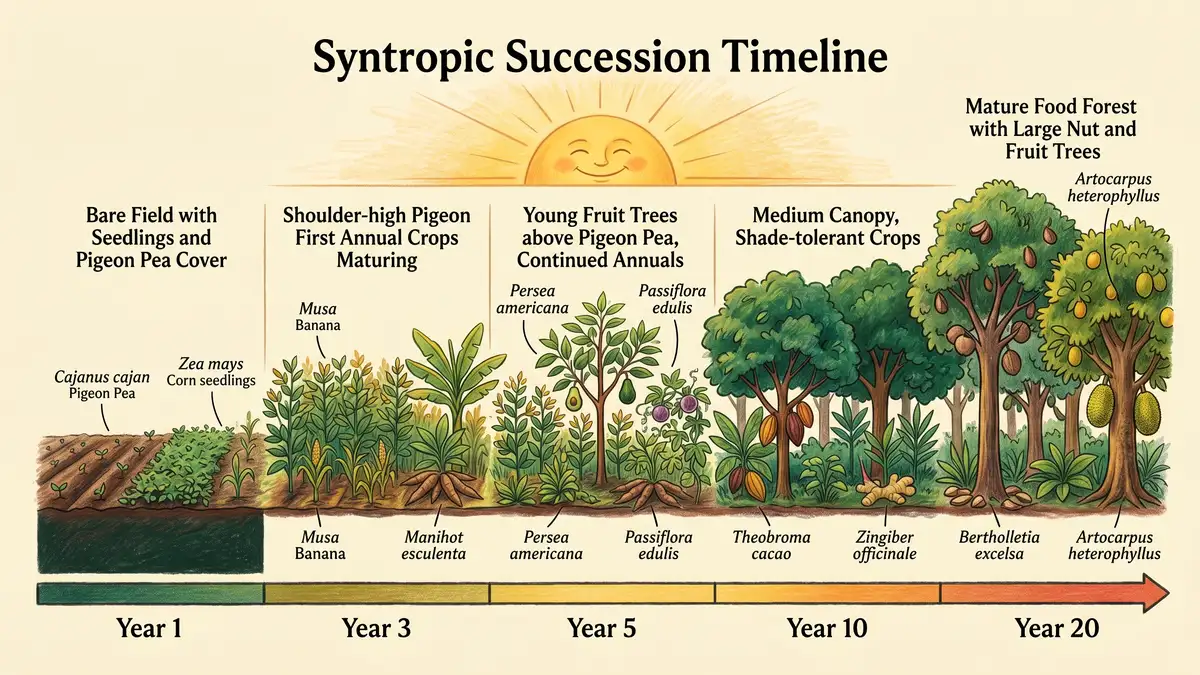
Each stratum is also matched to a successional stage — placenta, secondary, or climax. Pioneer species (placenta I/II) are fast-growing, short-lived, and designed to be cut. Secondaries (bananas in tropical systems, peaches and hazelnuts in temperate) hold the middle years. Climax species (chestnut, oak, walnut) inherit the site. Without this successional layering, your system stalls — which is the subject of natural succession in the garden.
Which Tree-Crop Combinations Work Best in Temperate Climates?
Most widely-shared syntropic examples come from the tropics — cacao under banana, coffee under eucalyptus. For USDA zones 5-9, the species change but the logic is identical: pair a nitrogen-fixing pioneer with a food-producing secondary and an annual understory that tolerates partial shade. The combinations below are grounded in practitioner documentation from Propagate Agroforestry and regenerative farms tracked by the Savanna Institute.
| Pioneer (N-Fixer) | Secondary (Food) | Annual Understory | Climate Zone |
| Black locust (Robinia pseudoacacia) | Paw paw or American persimmon | Squash, garlic, greens | USDA 4-8 |
| Siberian pea shrub (Caragana arborescens) | Sea buckthorn or hazelnut | Cold-hardy lettuce, kale | USDA 2-7 |
| Goumi (Elaeagnus multiflora) | Elderberry, currant, gooseberry | Garlic, onions, herbs | USDA 4-9 |
| Autumn olive (Elaeagnus umbellata)* | Chestnut (emergent) | Squash, corn (first 4 years) | USDA 4-8 |
| Pigeon pea (Cajanus cajan) | Banana or papaya | Okra, peppers, sweet potato | USDA 9-11 |
Sources:. *Autumn olive is invasive in much of the eastern US — check your state's invasive species list before planting; sterile cultivars are preferable.
Notice what is missing: apple trees paired with wheat, walnut over pasture. These classic alley-cropping pairings work, but they skip the pioneer layer that drives the nitrogen and biomass cycling. A true syntropic row includes the short-lived N-fixer, even if you intend to cut it out after four years.
Practitioner Note
For cold-climate adaptation beyond the tropical Brazilian template, study Mark Shepard's restoration agriculture work at New Forest Farm (Wisconsin). His chestnut-hazelnut-currant-asparagus guild on 106 acres is the most documented temperate agroforestry case study — Shepard's book Restoration Agriculture (2013) and his Acorn-supported research provide species lists tested through Wisconsin winters.
How Do You Design a Syntropic Agroforestry System for Your Land?
A practical design follows six steps — roughly two seasons of planning before the first tree goes in. Budget 20-40 hours of design time for a quarter-acre row, and expect the first major pruning cycle to arrive in year three.
Map sun, water, and existing vegetation
Spend a full growing season observing. Mark sun hours at 9am, noon, and 3pm across the seasons. Identify existing fertility indicators (nettles, docks, rapid-growth weeds) and hardpan zones. This is standard permaculture garden design — skipping it guarantees you plant trees in wrong spots.
Lay out rows on contour
Mark rows along the land's contour lines, not the property boundary. On a slope over 5%, rows on contour slow water infiltration and prevent soil loss. Use an A-frame level or a laser level. Row spacing depends on emergent species — 30 to 40 feet apart for chestnut, 18 to 25 feet for persimmon or paw paw.
Plant climax species at their final spacing
Chestnuts go in at 30-foot centres. Walnuts at 40 feet. These are the trees you will not move. Everything else fills the gaps between them. Plant from bare-root stock in early spring while the soil is workable but not waterlogged.
Fill with secondaries and pioneers at 50-80% density
Between the climax trees, plant your secondaries (apple, pear, hazelnut) at 8-12 foot spacing and your pioneers (black locust, pigeon pea, Siberian pea shrub) at 3-6 foot spacing. Yes, this is intentionally crowded. The pioneers will be cut back hard every 1-3 years. The secondaries will be thinned once climax closes.
Seed the understory with annual crops
Between the tree rows (the alleys), plant whatever you would plant in a conventional vegetable bed — corn, beans, squash, greens. In year one, you are essentially running a vegetable farm with immature trees between rows. By year four, shade-tolerance starts to matter and your annual choices shift toward lettuce, kale, and mushrooms.
Prune heavily and drop everything on the bed
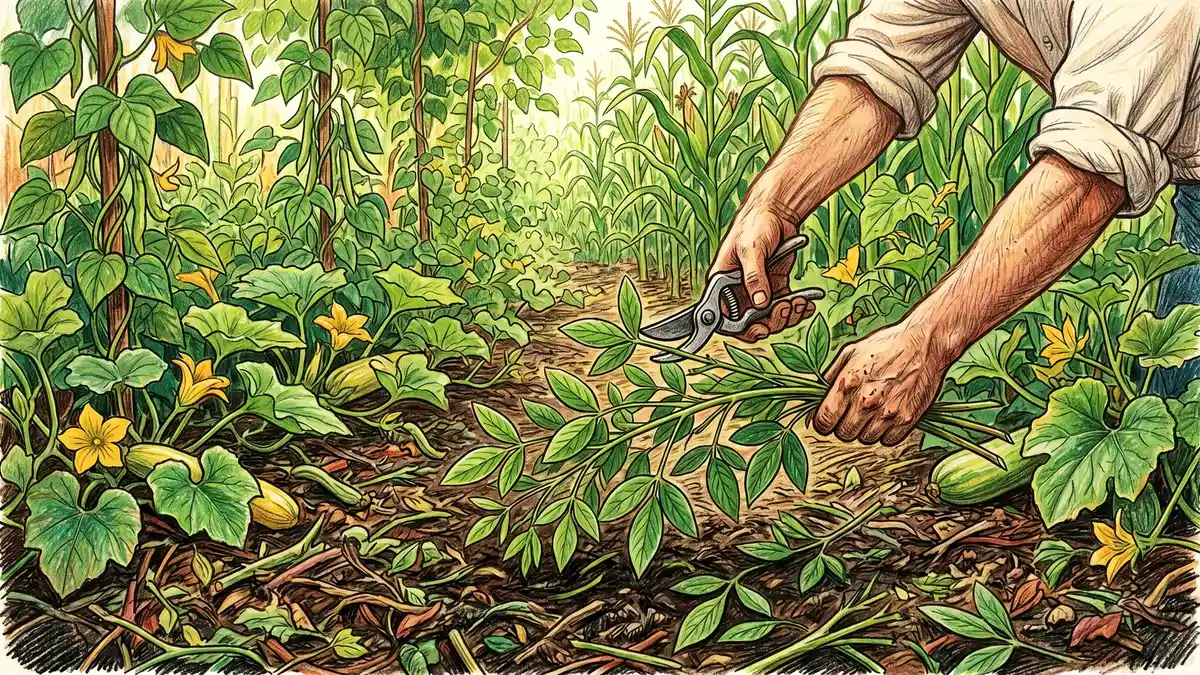
The management phase begins in year two. Cut pioneers back to knee height annually. Prune lower branches of secondaries to shape and to generate biomass. Let the cut material lie — this is the heart of chop and drop mulching, which distinguishes syntropic from conventional agroforestry. The biomass is not waste; it is the fertility program.
What Are the Most Common Mistakes in Temperate Syntropic Agroforestry?
Three failure patterns show up repeatedly in Propagate Agroforestry's practitioner network and in ATTRA / NCAT case studies of US farms attempting the transition. All three are avoidable if you know to look for them.
Mistake one: under-planting the pioneer layer. Temperate-climate practitioners, trained on orchard spacing, plant too few nitrogen-fixers because it "feels crowded." Then the system stalls — there is not enough biomass to drop, the climax trees grow slowly, and the annuals struggle. Pioneers should outnumber secondaries 3-to-1 at planting.
Mistake two: pruning too lightly. Syntropic systems demand what Götsch calls "dynamic management" — cutting pioneer trees back by 70-90% annually. Most first-year practitioners take off 20-30% and wonder why biomass stays thin. The whole system is calibrated to aggressive pruning; timid cuts produce timid results.
Mistake three: racing the succession. Trying to reach "climax stage" on a pristine acre in five years is not possible — soil-building takes the time it takes. In Götsch's own documentation, the shift from pioneer-dominant to secondary-dominant takes 6-10 years on degraded land. Plan for a decade, not a season.
Invasive Species Watch
Several classic syntropic pioneer trees are invasive in parts of the US: Elaeagnus umbellata (autumn olive), Robinia pseudoacacia (black locust — native in Appalachia, invasive elsewhere), and Ailanthus altissima. Check your state's invasive species list (invasive.org) before planting. Use sterile cultivars where available, or substitute native N-fixers like New Jersey tea (Ceanothus americanus), indigo bush (Amorpha fruticosa), or hog peanut (Amphicarpaea bracteata).
For a deeper treatment of how these principles connect back to the underlying science, see our guide to Ernst Götsch and the science of syntropic farming, and the comparison of syntropic agriculture vs permaculture for design-philosophy context.
Frequently Asked Questions
How much land do I need to practice syntropic agroforestry?
Meaningful systems can be established on as little as 1/4 acre (approximately 1,000 m²), though the biomass economics work better at 1 acre or more. Smaller urban and suburban plots can apply the stratification and pruning principles — effectively a compressed version — as part of a backyard food forest under a quarter acre. Commercial operations generally start at 5-10 acres, which allows for row-length efficiency and bulk pruning operations.
How is syntropic agroforestry different from alley cropping?
Alley cropping integrates rows of trees with rows of annual crops — the USDA National Agroforestry Center's definition. Syntropic agroforestry does the same but adds three things: strict successional planning (pioneer, secondary, climax), aggressive pruning with mulch-drop instead of removal, and intentional species stratification to match mature light requirements. Alley cropping asks "trees plus crops"; syntropic asks "how does this plot look in 30 years, and what sequence gets me there?"
Can I do this in USDA zone 5 or colder?
Yes, with adaptations. The Brazilian species list does not transfer, but the principles do. Mark Shepard's New Forest Farm (Wisconsin, zone 4b-5a) runs chestnut, hazelnut, apple, currant, raspberry, and asparagus guilds with success. Cold-climate pioneers include Siberian pea shrub, sea buckthorn, and alder. The pruning cycle lengthens slightly — 2-3 years instead of 1-2 — because growth is slower.
How long until the system pays for itself?
Practitioner data is sparse and varies enormously by species mix and management skill. Annual crop revenue begins in year one and can cover establishment costs on fertile ground. Tree crop revenue starts in years 3-5 (bananas, currants, peaches) and accelerates in years 7-15 as chestnuts, walnuts, and mature fruit trees come online. Propagate Ag's financial models for Midwestern chestnut operations suggest breakeven around year 7-10 — but these are specific to their species mix and market.
Do I need to till before planting?
No. Syntropic practice is firmly no-till — Götsch's entire system rests on protecting soil biology, particularly fungal networks. For row establishment, use sheet mulching (cardboard + deep organic matter) rather than plowing. The initial planting is done by cutting through the mulch with a dibble bar or auger. The no-till approach is covered in detail on the syntropic agriculture pillar.
What equipment do I need beyond basic hand tools?
For a quarter-acre row, pruning shears, a hand saw, loppers, a machete, and a hori-hori knife handle most operations. At 1-5 acres, add a pole pruner, a quality chainsaw (preferably battery), and a chipper for oversized prunings. Above 5 acres, practitioners typically invest in a compact tractor with a flail mower for the alleys and a PTO-driven chipper for biomass processing.
Is syntropic agroforestry profitable compared with conventional farming?
The honest answer is that the datasets are still thin, especially for temperate USA. Brazilian case studies from Götsch-linked farms show higher per-hectare net revenue than monoculture cacao after year 7. In the US, Propagate Agroforestry and the Savanna Institute are building the first systematic financial datasets. Early indications suggest profitability is achievable but requires 5-10 years of patient management — and your skill at pruning and species selection matters more than your acreage.
Get the Weekly Dig
One practical permaculture guide a week, written for gardeners who do this on weekends: food forest and guild designs that produce. Free, no spam, unsubscribe any time.
Join the Weekly DigResources
- Agenda Götsch — Ernst Götsch's official platform, original syntropic research and farm documentation
- Propagate Agroforestry — US-focused species guides and financial modelling tools
- Savanna Institute — Midwestern agroforestry research and practitioner reports
- ATTRA / NCAT — Agroforestry publications for US farmers
- USDA National Agroforestry Center — Practice standards and windbreak research
- CIFOR-ICRAF (World Agroforestry) — Global agroforestry meta-analyses
- Invasive.org — Verify pioneer species against state invasive lists before planting
- Restoration Agriculture (Mark Shepard) — New Forest Farm case study, cold-climate species list