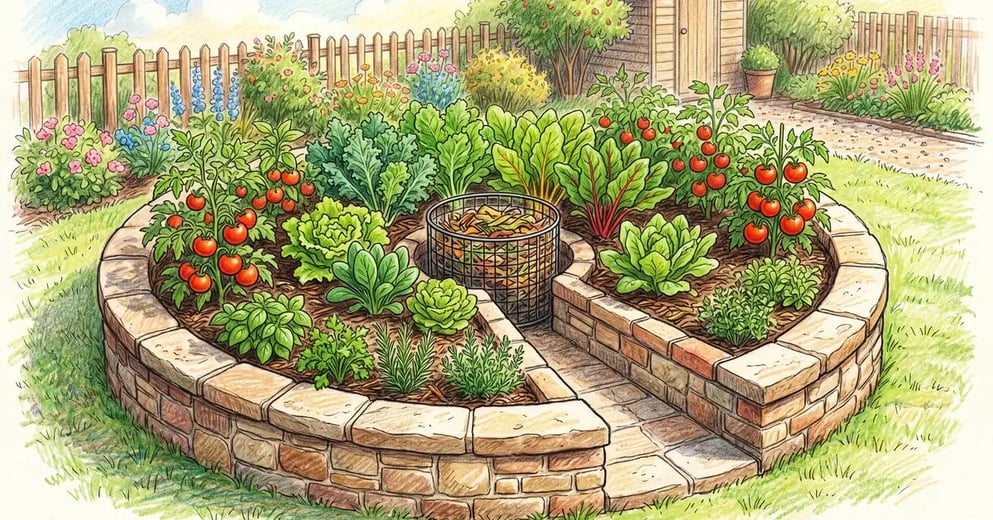

Your raised beds are producing well, but you're hitting the limits of your space — or your back. taller beds that spare your back A keyhole garden gives you a six-foot circle of intensive growing area with a built-in composting system at the centre and a wedge-shaped notch so you never reach more than three feet for any plant. From above, it looks exactly like an old-fashioned keyhole, and that's where the name comes from.
This is one of the most efficient permaculture beds you can build. It cooks compost while it grows food, holds moisture in dry climates, and concentrates nutrients exactly where the roots need them. In Texas, growers report year-round harvests from a single six-foot bed. In Lesotho — where the modern design was born — families feed themselves from one or two of these circles in spaces smaller than a parking spot.
What is a keyhole garden?
A keyhole garden is a circular raised bed, typically about six feet in diameter and 24–36 inches tall (180 cm wide, 60–90 cm tall), with two distinguishing features: a wedge-shaped path cut from the rim into the centre, and a vertical composting basket at the very middle of the bed. The wedge gives you reach-in access to the centre without stepping on the soil. The basket — a one-foot cylinder of hardware cloth or woven sticks — accepts kitchen scraps and grey water, then feeds the surrounding soil through decomposition.
Texas Master Gardeners describe the basic design as "about six feet in diameter and up to three feet high" — small enough that water and nutrients reach every root, large enough to feed a household.
This isn't a clever trend. The modern keyhole bed was developed in Lesotho in the late 1990s by the U.K. charity Send a Cow and the Consortium for Southern Africa Food Security Emergency (C-SAFE), as a response to drought and the AIDS epidemic. It had to grow food reliably in poor soil, with very little water, by gardeners who might be sick or elderly. The C-SAFE design spread through southern Africa, then to drought-prone Texas, where it's now a fixture in extension teaching.
Anatomy and standard dimensions
Once you've seen the parts, the design is hard to forget.
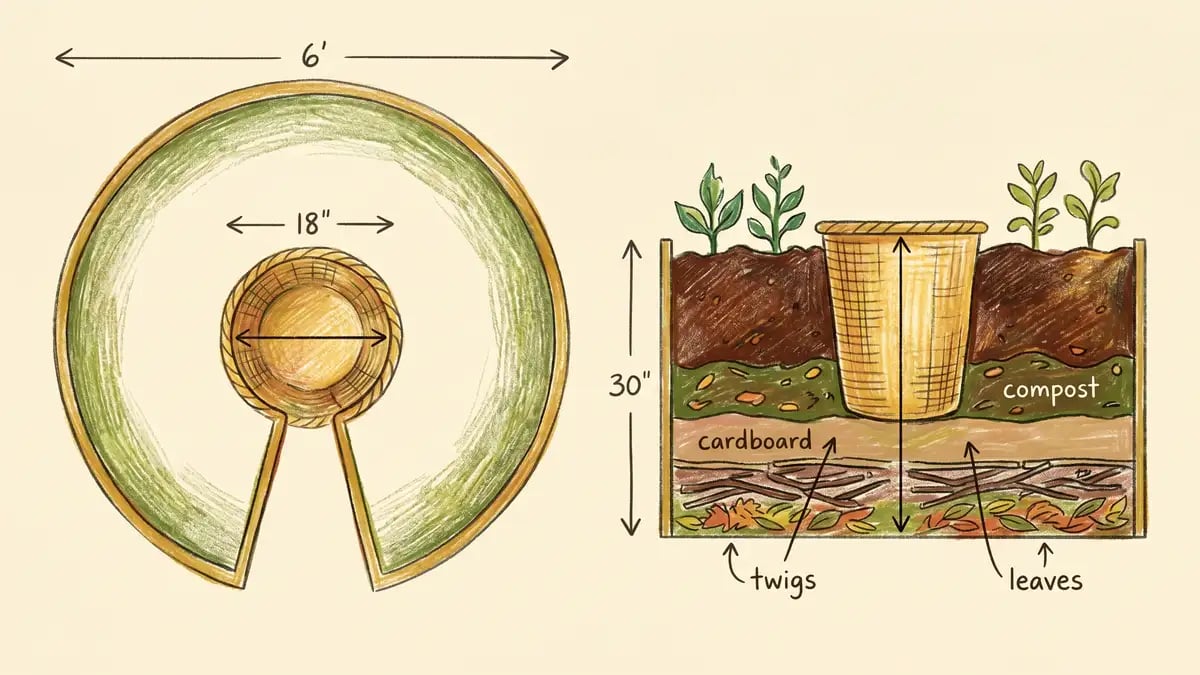
- Outer diameter: 5–6 ft (1.5–1.8 m). Backwoods Home points out that going much wider than six feet means water and nutrients struggle to reach the rim.
- Wall height: 24–36 in (60–90 cm). Lower if you want to sit while harvesting; taller if back pain or wheelchair access matters.
- Composting basket: 12–18 in (30–45 cm) diameter, extending the full height of the bed and another 6–12 in above the soil. Garden Basics describes the standard as "a one-foot diameter cylinder of hardware cloth that will extend about one foot above the final soil level."
- Keyhole notch: a wedge slice removed from one side, just wide enough to step into and reach the basket — typically 18–24 in wide at the rim.
- Layered fill: bottom is woody debris (logs, branches), then cardboard, then compost-rich brown materials (leaves, aged manure), then topsoil, finished with mulch. This is essentially a hugelkultur sandwich inside a stone wall.
The composting basket: where the design earns its keep
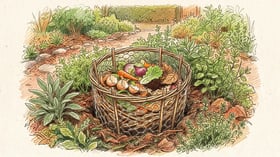
The basket is what makes a keyhole garden a keyhole garden. Drop kitchen scraps in the top — peelings, eggshells, coffee grounds, tea bags, garden trimmings — and the basket becomes a slow, vertical compost pile that sheds nutrients sideways into the surrounding soil every time you water.
You don't need to turn it. You don't need to balance browns and greens (that's already happening in the layered fill). You just keep adding scraps. The London Middlesex Master Gardeners describe the result as a bed that "grows strong, healthy vegetables without fertilizers" because the basket effectively brews compost tea with every rainfall and watering.
Why this works
The keyhole bed is a Zone 1 design — what permaculture calls the area you visit every day, just outside the back door. By stacking three functions (growing, composting, water-holding) inside one structure, it follows the principle of "each element performs many functions." You don't carry food scraps to a distant compost bin and then carry compost back. The whole loop happens within arm's reach. Combine that with a layered hugelkultur fill underneath, and the bed becomes a small, self-feeding ecosystem. For more on how this thinking shapes garden layout, see our guide to permaculture zones.
Takeaway: A keyhole garden is a six-foot circular raised bed with a central composting basket. Build it once and you get a bed that holds water in droughts, feeds itself from kitchen scraps, and grows roughly 60–80 sq ft worth of vegetables in 28 sq ft of footprint.
How to build a keyhole garden in a weekend
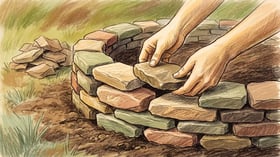
The build is a one-weekend project for two people. Most of the time goes into stacking the wall — everything else is forking material into a pile.
Step 1 — Site and mark
Pick a spot with at least 6 hours of direct sun, close to your kitchen door (this is a Zone 1 bed — the closer the better). Drive a stake into what will be the centre, tie a 3-ft (90 cm) string to it, and walk a circle to mark your six-foot diameter. Mark a wedge from the rim into the centre, about 24 in (60 cm) wide at the outer edge.
Step 2 — Build the basket
Roll a 4-ft (120 cm) length of 1-in (2.5 cm) hardware cloth into a 12–18 in diameter cylinder. Stand it on the centre stake. The top should reach about 6–12 in (15–30 cm) above your final wall height.
Step 3 — Lay the wall
Stack stones, bricks, cinder blocks, or cordwood around the outer mark, leaving the keyhole wedge open. Build to 24–36 in (60–90 cm) tall. Slope the inside of the wall slightly inward toward the basket (a 5–10° pitch) so water gravity-feeds toward the centre.
Step 4 — Layer the fill
Bottom: rotting logs, branches, and woody waste (8–12 in / 20–30 cm deep). Middle: cardboard and dry leaves (4–6 in). Top middle: aged manure and finished compost (8 in / 20 cm). Top: 4–6 in (10–15 cm) of topsoil and finish with mulch. The whole stack should mound slightly toward the basket. This is the same principle behind hugelkultur beds.
Step 5 — Plant and prime
Plant heavy feeders nearest the basket (tomatoes, peppers, leafy greens), medium feeders mid-bed (chard, herbs), and light feeders or trailers at the rim (strawberries, oregano). Prime the basket with a few inches of finished compost, then start adding kitchen scraps daily.
Materials, cost, and time
| Material | Quantity | Approx. cost (US) | Notes |
| Wall material (fieldstone, brick, cinder block, or cordwood) | ~30 cu ft (0.85 m³) | $0–80 | Free if you scavenge stone or use logs from tree work |
| Hardware cloth (1-in mesh, 4-ft strip) | 1 roll | $15–25 | Or use woven hazel/willow for a more traditional look |
| Cardboard (un-printed, no tape) | 10–15 sheets | Free | Saved from grocery boxes |
| Woody debris and leaves | ~20 cu ft (0.57 m³) | Free | Branch trimmings, fall leaves, rotten logs |
| Aged manure and compost | ~10 cu ft (0.28 m³) | $30–60 | Or free from a horse stable or municipal compost |
| Topsoil and mulch | ~6 cu ft (0.17 m³) | $15–30 | Bagged or bulk |
| Total build time | 4–8 hrs | $60–195 | Two people, one weekend |
Source: cost ranges synthesised from published builds at, and backyard-builder reports (2026 US prices).
From Lesotho to Texas: a design that travels well
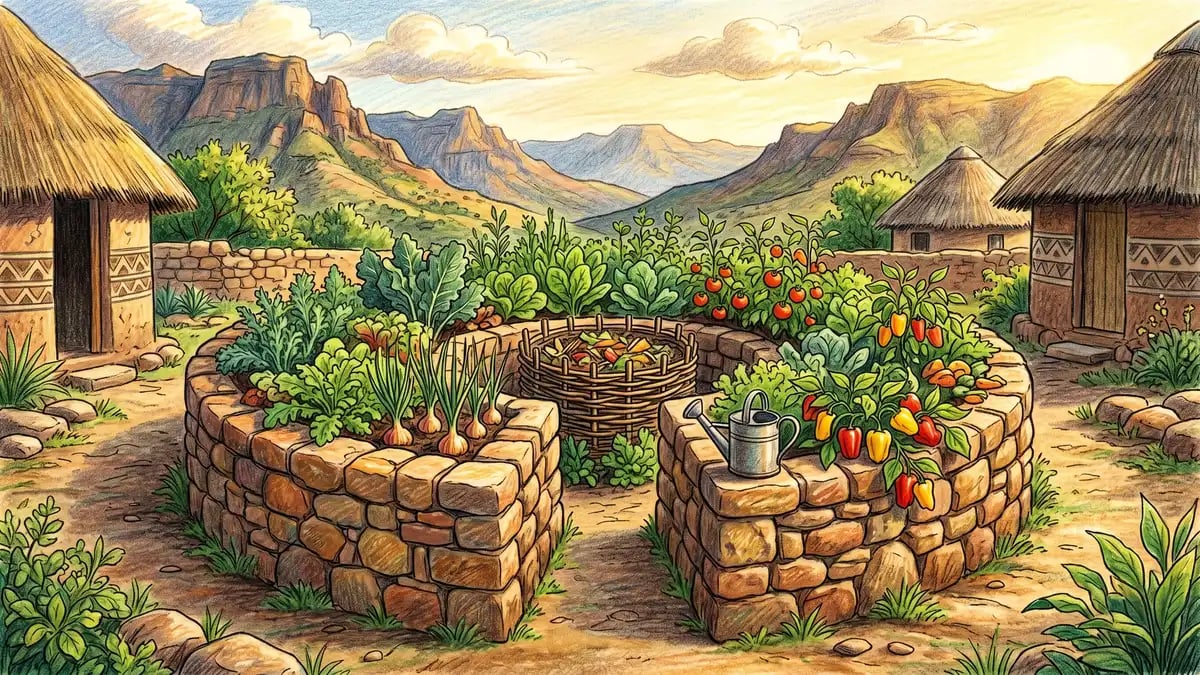
The keyhole bed earns its travel miles because it solves the same three problems almost everywhere: limited space, scarce water, and tired soil. What changes is the wall material and the planting list.
- Sub-Saharan Africa (origin): stone walls, scavenged manure, planted with leafy greens, onions, beans, and tomatoes. Send a Cow's UK programme still teaches this version as the baseline.
- Texas and the US Sun Belt: recycled brick, cinder block, or scavenged stone. Texas Master Gardeners credit the keyhole for staying productive through summer drought and water restrictions. The Spring 2016 Brazos newsletter notes the design is now "common throughout Texas".
- UK and northern Europe: cordwood or gabion baskets, often with a wider wall to insulate against cold spring soil. Planting leans toward chard, kale, herbs, and salad crops.
- Pacific Northwest and humid climates: elevated foundations and slightly drier fill, because the keyhole's water-holding strength can flip into waterlogging where rain is steady.
The pattern itself doesn't care where you live — only the materials change. For a longer look at how the same permaculture ideas adapt across cultures, see Permaculture Around the World.
What to plant in a keyhole bed
Use the basket as the centre of gravity. Heavy feeders go closest because they intercept the most basket-fed compost tea. Light feeders go to the rim where the soil is leaner.
- Inner ring (closest to basket): tomatoes, peppers, broccoli, cabbage, kale, and any leafy crop that benefits from a steady nitrogen drip.
- Middle ring: chard, lettuce, spinach, beets, herbs (parsley, basil, cilantro).
- Outer ring / rim: strawberries, oregano, thyme, nasturtiums, and trailing crops that will spill over the wall.
- Avoid: deep-rooted crops like carrots and parsnips that conflict with the layered fill, and aggressive spreaders like mint that will take over.
Companion planting still applies — keyhole beds are no exception. Pair tomatoes with basil, chard with onions, lettuce with radishes (a good carrot substitute for the inner ring). Our guide to permaculture garden design walks through more of these pairings at scale.
Common problems and fixes
- Soil drops 4–6 in (10–15 cm) by year two. The woody fill compresses as it breaks down. Top up annually with compost and fresh mulch.
- Basket fills up faster than expected. If you have a large household, build a slightly bigger basket (18 in / 45 cm diameter) or use two smaller baskets in a larger circle. Pull finished compost from the bottom in spring.
- Stone wall slumps. Lay a 4-in (10 cm) gravel foundation under the first course of stone, and slope each course slightly inward. This prevents frost-heave failure in cold climates.
- Slugs love the moisture. Mulch with crushed eggshells around the inner ring, and check under leaves at dawn. Permaculture pest management has more low-intervention tactics.
- Freezing in zones 4–5. Insulate by stacking straw bales around the outer wall in November, and fill the basket with browns rather than wet greens through winter.
Get the Weekly Dig
One practical permaculture guide a week, written for gardeners who do this on weekends: permaculture design for real backyards. Free, no spam, unsubscribe any time.
Join the Weekly DigFrequently asked questions
How big should a keyhole garden be?
Six feet (1.8 m) in outer diameter is the standard. Going wider than that means you can't reach the centre easily, and water and nutrients struggle to spread to the rim. Wall height should be 24–36 in (60–90 cm) — taller if you want to garden standing up or use a wheelchair.
Do keyhole gardens really need less water?
Yes — meaningfully. The thick stone or brick wall shades the soil and slows evaporation, the layered woody fill holds moisture like a sponge, and the central basket distributes water sideways through the bed. Texas growers report watering once or twice a week during summer when conventional beds need watering daily.
What goes in the composting basket?
Standard kitchen scraps: vegetable peelings, fruit cores, eggshells, coffee grounds, tea bags, plus garden trimmings. Skip meat, dairy, and oily food (those attract rodents). You can also pour grey water (rinse water from washing produce) directly into the basket. For a fuller list of what counts, see our compost yes/no list.
Can I build a keyhole garden on a hard surface like concrete?
Yes. Lay a thick base of cardboard and woody debris first to prevent root contact with the concrete and to give worms a moist habitat. The bed will work, but the woody fill compresses faster than on bare ground, so plan to top up annually.
How long does a keyhole garden last?
The wall is essentially permanent — well-built stone or brick walls last decades. The fill compresses over the first two to three years and then settles into a long, productive equilibrium. With annual top-ups of compost and mulch, a single bed can produce continuously for 15–25 years before any rebuild.
Where did the keyhole garden design come from?
The modern design was developed in Lesotho in the late 1990s by Send a Cow and the C-SAFE programme as a response to drought and the AIDS epidemic. It needed to grow food reliably in tiny, dry, poor-soil plots tended by people who might be sick. The pattern then spread through southern Africa, into the U.S. (especially Texas), and into the U.K. permaculture movement.
Resources
- Keyhole Gardens — SDSU Extension
- Keyhole Gardens Designed for Texas' Extremes — Brazos Newsletter
- Keyhole Garden Composting — London Middlesex Master Gardeners
- Keyhole Gardens: History and Design — Insteading
- Keyhole Gardens: Drought-Tolerant Design — Anna's Musings
- How to Build Your Own Keyhole Garden — Concern Worldwide US
- Twenty Years and Counting: The Keyhole Garden — Texas Master Gardeners (Bluebonnet)
- African Keyhole Gardens — Garden Basics by Fred Hoffman
- Build a Keyhole Garden — Backwoods Home Magazine