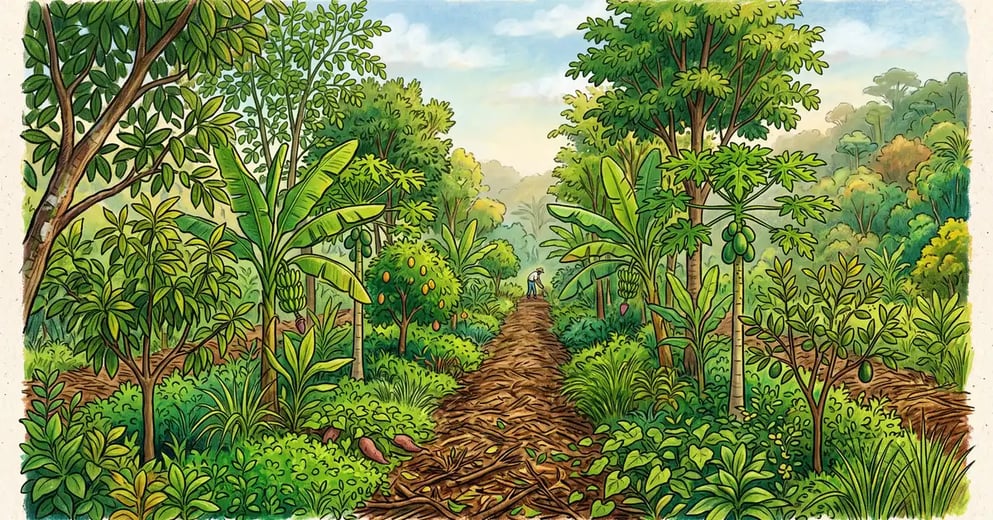

If you have read Götsch and looked at your Gulf Coast property wondering how much of it transfers, the answer is more than anywhere else in the continental United States. Humid subtropical conditions along the Southeast are the closest North American analogue to the Bahian Atlantic Forest where the method was developed.
That is the good news. The complication is a frost window, and it changes the pruning calendar in ways the Brazilian material does not address.
How Close Is the Southeast to Götsch's Conditions?
Close enough that species behaviour and growth rates are broadly comparable through the warm months, and different enough that you cannot copy a Bahian consortium species for species. Rainfall totals and seasonality line up reasonably well. Photoperiod at 30 degrees north differs from 13 degrees south, and more importantly, zones 8b and 9 get freezes that kill the classic support species outright.
It is worth being clear about the evidence base before going further. Most of what circulates about syntropic agriculture is practitioner-reported rather than peer-reviewed. Martinelli and colleagues (2026), synthesising Brazilian agroforestry research, found that Bahia's Atlantic Forest zone drives the largest single share of published studies at 29%, so there is real literature. But specific figures attributed to Fazenda Olhos d'Água mostly come from farm accounts and documentary coverage rather than controlled measurement.
What you'll get out of this guide:
- What the measured data actually shows, separated from practitioner claims
- Which species replace Inga edulis in a climate that freezes
- When to make the severe cut relative to first frost
- What under-pruning does to a system in this climate
Key Takeaway
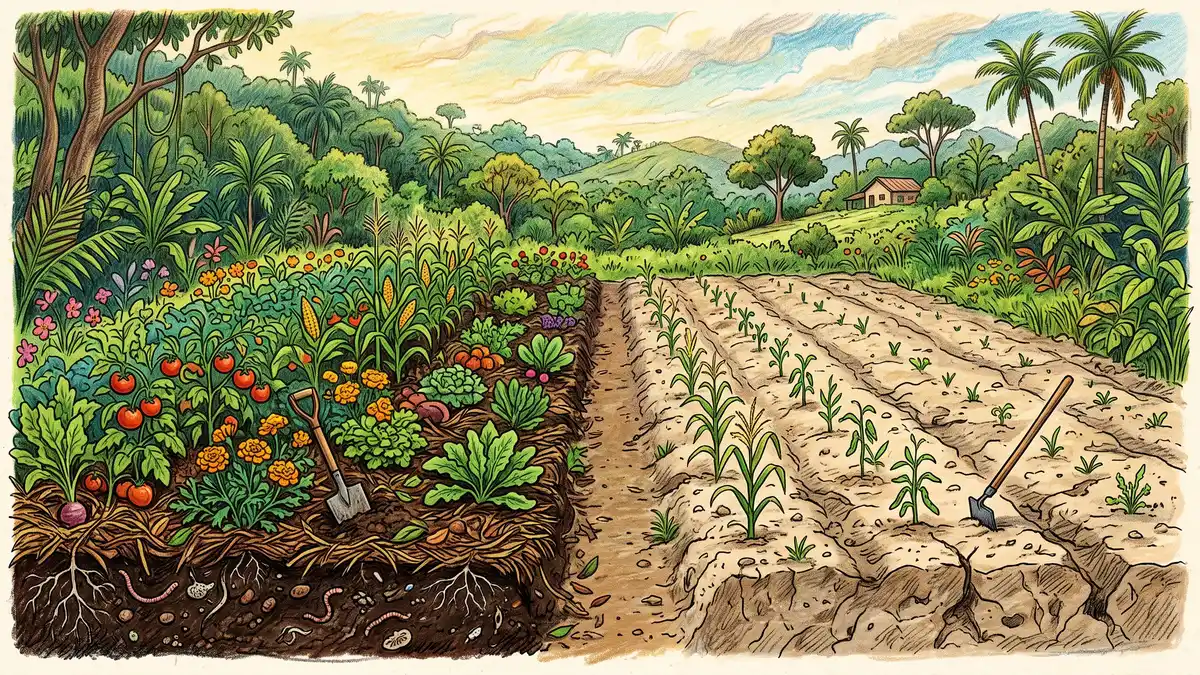
Judge the system on total output, not the headline crop. Rüegg and colleagues (2025) found agroforestry cacao reached only 56% of monoculture cacao yields, while total system yields were higher. That trade is the entire proposition, and if you measure one crop you will conclude the method failed.
What Does the Measured Evidence Support?
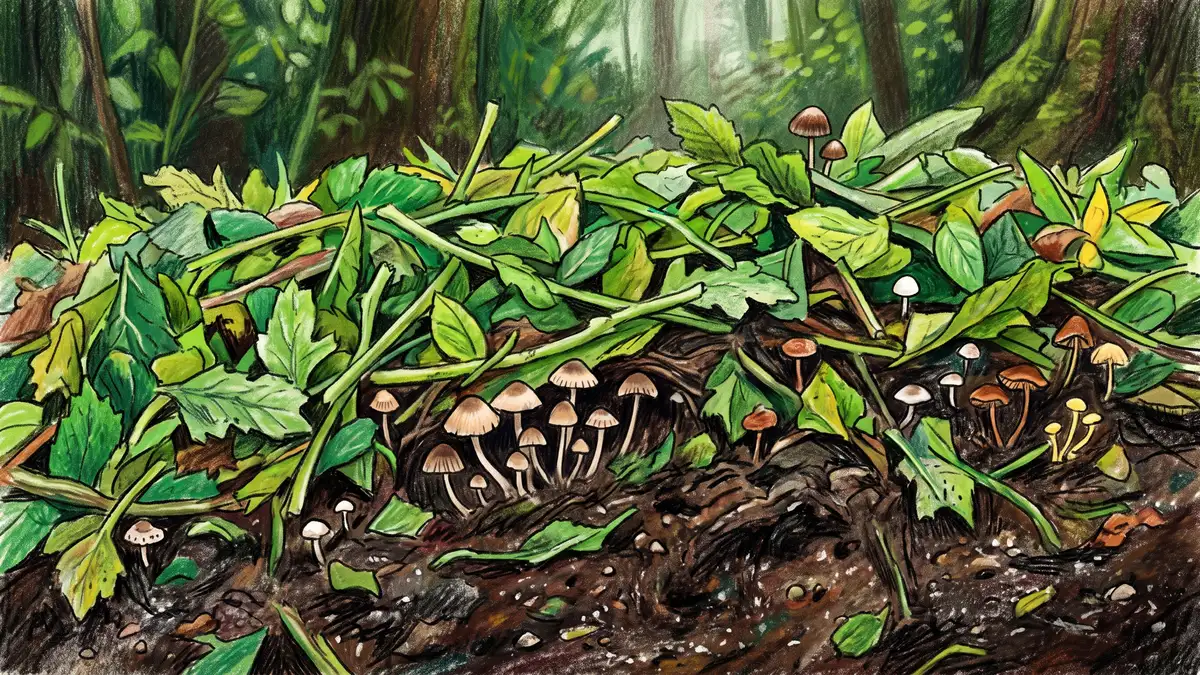
The hydrological claims hold up best. Abebaw's 2025 systematic review found agroforestry systems consistently enhance water infiltration and reduce runoff. On the Gulf Coast, where rainfall arrives in intense convective bursts, that is not a marginal benefit.
Soil carbon is more conditional than the enthusiasm suggests. Amorim and colleagues (2026) examined coffee agroforestry and asked directly whether such systems always improve soil carbon. The answer was no, with altitude and management mediating the outcome.
Climate matters to that calculation too. Villela and colleagues (2026) found carbon losses following agricultural conversion differ by 32% to 47% between subtropical and tropical or arid climates. Subtropical carbon dynamics are their own case, which is precisely why importing Bahian numbers to Alabama is unsound.
On mulch, Li and colleagues (2026) measured soil temperature increases from 0.01 to 2.21 degrees Celsius at 4 inches (10 cm) depth under mulching treatments compared with bare control. Modest, measured, and directionally useful for winter root protection.
| Claim | Evidence Status |
| Improved infiltration, reduced runoff | Systematic review support |
| Higher total system yield | Measured in cacao systems |
| Moderated soil temperature under mulch | Measured, effect modest |
| Always increases soil organic carbon | Not supported, conditional |
| Specific Fazenda Olhos d'Agua figures | Practitioner-reported |
Sources: Abebaw (2025), Rüegg et al. (2025), Li et al. (2026), Amorim et al. (2026).
Which Species Replace Inga in a Climate That Freezes?
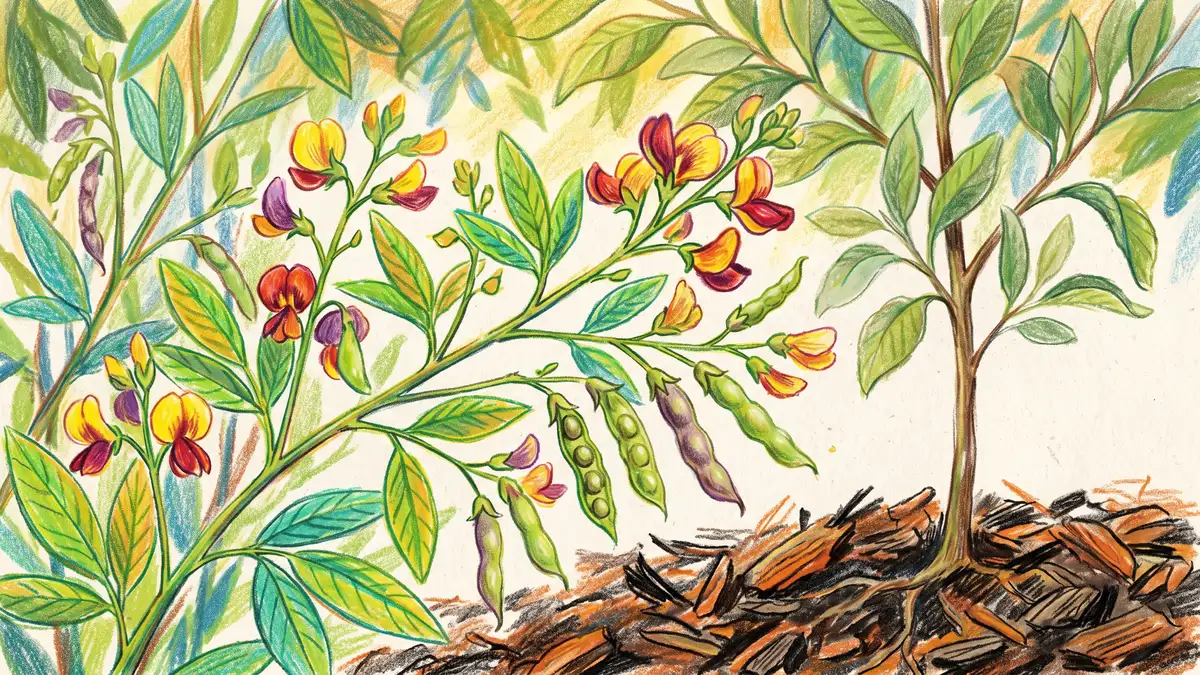
Inga edulis is the reference biomass tree in Brazilian syntropic systems and it will not survive a zone 8b winter. You need a stack of substitutes rather than a single replacement, because no one species matches its combination of nitrogen fixation, coppice vigour and soft leaf litter.
Mulberry (Morus alba, Morus rubra) is the workhorse. Hardy well beyond the region, it coppices hard, regrows fast and drops soft leaf litter that breaks down quickly. Native red mulberry avoids the invasiveness concerns attached to white mulberry in some states, which is worth checking locally before planting.
Pigeon pea (Cajanus cajan) does the nitrogen work. It is frost sensitive and behaves as an annual or short-lived perennial in zones 8b and 9, which turns out to be convenient: it produces heavily, dies back, and resows. Moringa (Moringa oleifera) grows extraordinarily fast through summer and dies to the ground in a freeze, coming back from the root in zone 9. Elderberry (Sambucus canadensis) is native, hardy and productive, and cassava (Manihot esculenta) contributes both biomass and calories.
Check Before You Plant Tithonia
Mexican sunflower (Tithonia diversifolia) is a favourite biomass species in tropical syntropic systems and produces enormous quantities of soft green material. It also spreads aggressively in warm humid conditions and carries invasive status in parts of the Southeast. Check your state's noxious weed and invasive species listings before introducing it, and be honest about whether you can contain something selected specifically for its ability to regrow from anything.
Get Our Free Companion Planting Chart
Join 10,000+ gardeners getting weekly tips on what to plant together, soil health, and permaculture techniques.
Send Me the Chart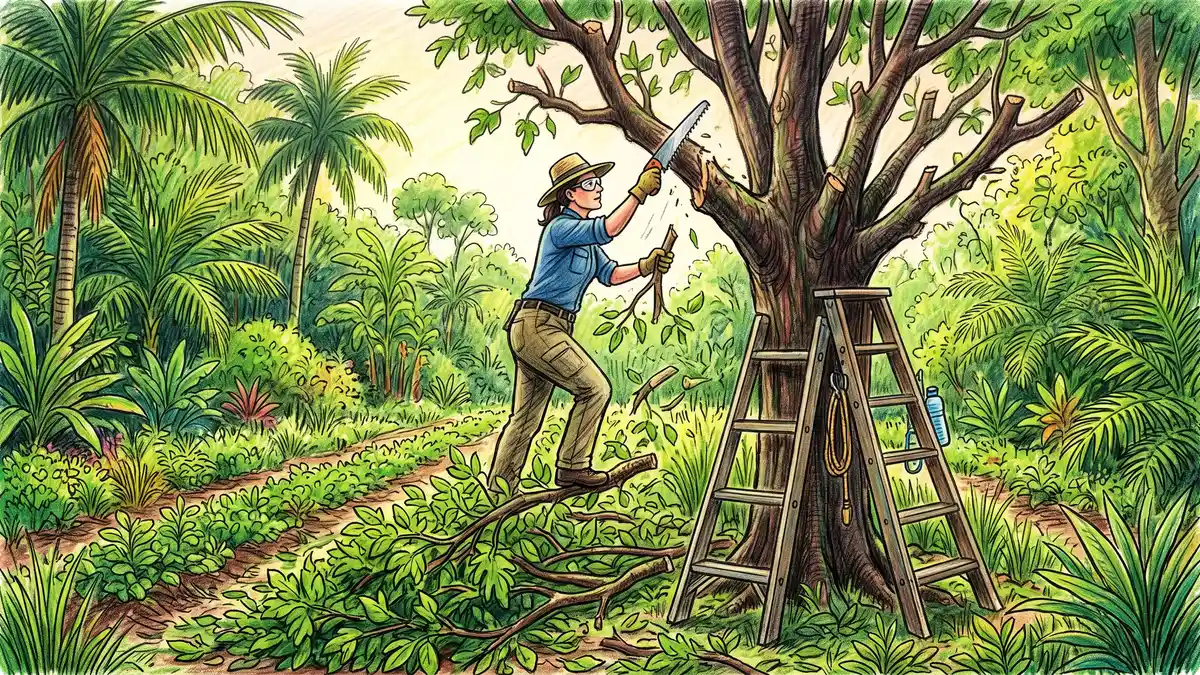
When Do You Make the Severe Cut?
This is where humid subtropical management genuinely departs from the tropical model. In Bahia you can prune hard almost whenever the system calls for it. In zone 8b you cannot, because a severe cut pushes soft regrowth, and soft regrowth going into a freeze is dead regrowth.
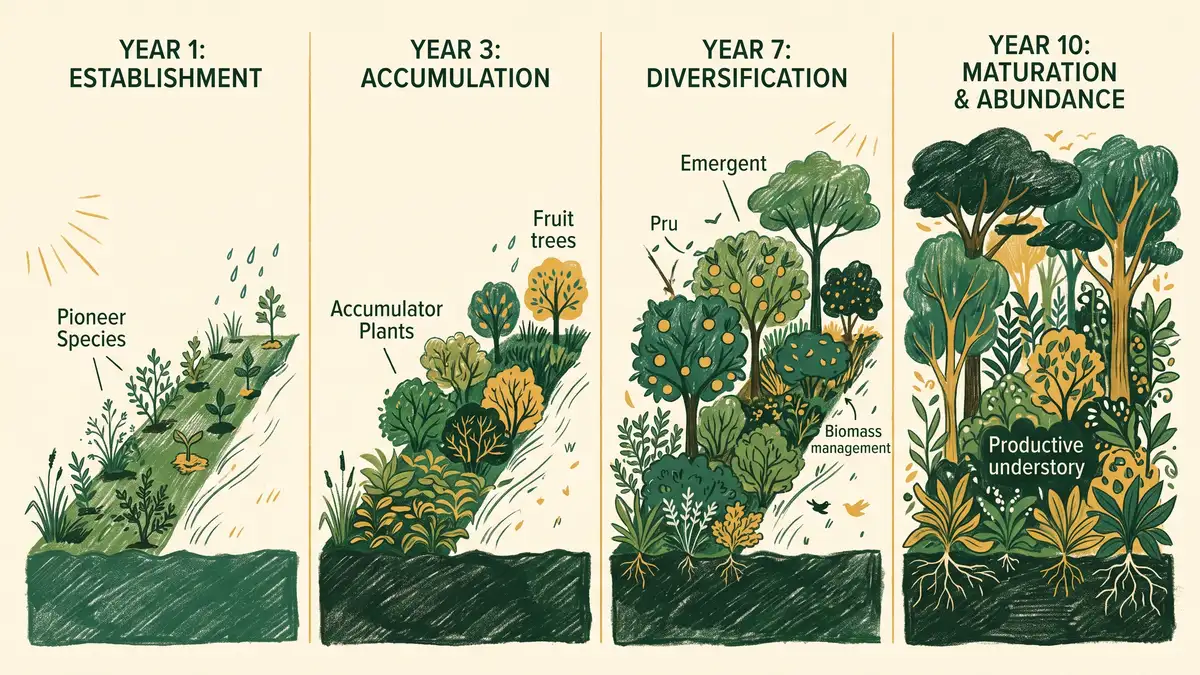
The workable pattern is to concentrate severe pruning in late winter to early spring, once hard frost risk has passed but before the growth surge, giving the system a full season to respond. Through summer, prune lightly and often rather than severely, because growth rates in this climate mean light cuts every few weeks yield more usable biomass than one dramatic intervention. Then stop cutting hard roughly eight weeks before your average first frost.
Decomposition works in your favour and against your record keeping. Green mulch laid down in a Gulf Coast August disappears remarkably fast, which is why systems here need a continuous biomass supply rather than seasonal applications. Our guide to pruning in syntropic agriculture covers cut placement and technique in detail.
Why This Works: Disturbance as a Signal
Götsch's insight was that pruning is not damage control, it is communication. A hard cut signals to the system that a canopy gap has opened, and the response is a flush of growth and root exudation that feeds soil biology. In a climate with no dormancy you are having that conversation nearly year-round, which is why these systems accumulate so fast here and why neglecting the pruning schedule stalls them so completely.
What Happens If You Under-Prune?
The system closes canopy and stops producing. This is the most common failure and it is almost always a labour problem rather than a design problem. Growth rates that make the Southeast attractive for this method also mean the maintenance window is short and unforgiving.
An under-pruned syntropic planting in a humid climate becomes a thicket. Light stops reaching the productive strata, vines colonise the structure you built, and what was designed as a managed succession simply proceeds to a closed young woodland with no yield. Recovering one costs more labour than maintaining it would have.
Be realistic about scale before planting. A quarter acre managed properly beats two acres managed aspirationally, and the honest comparison is against temperate syntropic adaptations, where a dormant season gives you months of slack that you simply do not get here.
Frequently Asked Questions
Is the Southeast really the best US region for syntropic agriculture?
For climatic similarity to where the method was developed, yes. Rainfall, humidity, temperature range and growing season length across the Gulf Coast and lower Southeast are closer to Bahia than anywhere else in the continental United States, and the growth rates that make syntropic succession work are achievable. The qualifications are frost in zones 8b and 9, hurricanes, and the fact that most published agroforestry data from Brazil comes from genuinely tropical sites. Treat the region as favourable rather than equivalent.
How much biomass do these systems actually produce?
Figures circulate widely and most trace to practitioner reports rather than controlled measurement, so treat specific tonnage claims cautiously. What is better established is that agroforestry systems improve infiltration and reduce runoff, and that total system yield can exceed monoculture even when the headline crop underperforms. If you want a number for your own site, measure it: weigh the fresh cuttings from a marked section over a season. That single record is worth more than any published figure from a different climate.
Can I use nitrogen-fixing trees like black locust?
Black locust (Robinia pseudoacacia) fixes nitrogen, coppices vigorously and is hardy across the region, which makes it tempting as an Inga substitute. It also suckers aggressively and is treated as invasive outside its native range in several states. If it is native to your part of the Southeast and you are prepared to manage suckering, it works. Otherwise indigo bush (Amorpha fruticosa) is a better-behaved native nitrogen fixer, though it produces less biomass.
How does this differ from a food forest?
Management intensity and intent. A food forest aims at a relatively stable mature system that needs modest intervention once established. A syntropic system is actively driven through successional stages by heavy, deliberate pruning, and the biomass generated is the point rather than a byproduct. Syntropic systems produce more and demand considerably more labour. Neither is superior, but choosing the wrong one for your available time is how projects fail.
What should I plant in the first year?
Biomass and fast food, densely, alongside the slow trees. Pigeon pea, banana, cassava and mulberry establish quickly and give you material to cut by season two, which is what the fruit trees need. The mistake experienced growers still make is planting the valuable long-term species first and adding support species later. In this climate the support layer is what makes the system work, so it goes in at the same time or before. Our introduction to syntropic agriculture covers the consortia logic behind that sequencing.
Ready to Grow Smarter?
Get our free 20-page beginner's guide to backyard food forests. Two printable worksheets, a year-by-month food-forest calendar, and a curated reading path.
Read the Free GuideResources
- Abebaw (2025) — Systematic review of agroforestry and water management
- Rüegg et al. (2025) — Yields in organic and agroforestry cacao systems
- Amorim et al. (2026) — Soil structure and carbon in coffee agroforestry
- Martinelli et al. (2026) — The landscape of agroforestry in Brazil
- Villela et al. (2026) — Soil carbon debt from land use change in Brazil
- Li et al. (2026) — Effects of mulching practices on soil properties
- Tella et al. (2026) — Two decades of tropical soil analyses
- CABI — Alley cropping as a sustainable agroforestry system